CORONAVIRUS
VS
HANTAVIRUS
Submitted by :-Rani Tiwari
Class:- M pharma 2nd sem
B.U. Jhansi
What is Coronavirus?
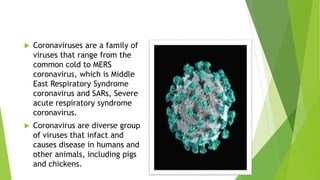
 Coronaviruses are a family of
viruses that range from the
common cold to MERS
coronavirus, which is Middle
East Respiratory Syndrome
coronavirus and SARs, Severe
acute respiratory syndrome
coronavirus.

 Coronavirus are diverse group
of viruses that infact and
causes disease in humans and
other animals, including pigs
and chickens.
Why It is named CoronaVirus?
Coronaviruses are named because of Crown-like appearance of
their virus particles when seen under Electron Microscope
(corona , meaning crown).
Novel Corona Virus
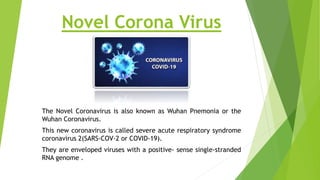
The Novel Coronavirus is also known as Wuhan Pnemonia or the
Wuhan Coronavirus.
This new coronavirus is called severe acute respiratory syndrome
coronavirus 2(SARS-COV-2 or COVID-19).
They are enveloped viruses with a positive- sense single-stranded
RNA genome .
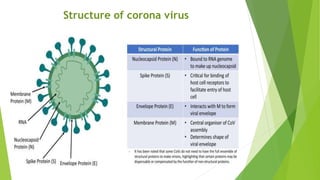
Structure of corona virus
Types of Coronavirus:-
There are seven strains of the Coronavirus documented till date:-
Human Coronavirus 229E (HCoV-229E)
Human Coronavirus OC43(HCoV- OC43)
New Haven Coronavirus (HCoV-NL63)
Severe Acute Respiratory Syndrome-Related (SARS-
CoV)
Human Coronavirus HKU1
Middle East-Respiratory Syndrome Coronavirus
(MERS-CoV)
Novel Coronavirus (2019-nCoV)
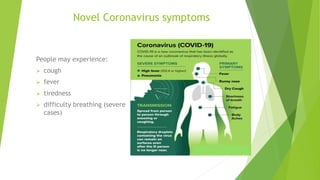
Novel Coronavirus symptoms
People may experience:
 cough
 fever
 tiredness
 difficulty breathing (severe
cases)
Why is the Novel Coronavirus a causes for
concern?
The Novel Coronavirus has a never been observed before, hence,
there is no specific treatment for the disease. Current anti-viral
treatment are also deemed ineffective at combating the illness.
Therefore, present treatment is focused only on alleviating the
symptoms of disease.
Initially, the NCoV was thought to be a zoonotic disease, however,
current findings suggest that this disease spreads from persons to
person. It is suspected to spread through respiratory droplets( an
infected person sneezing or coughing).
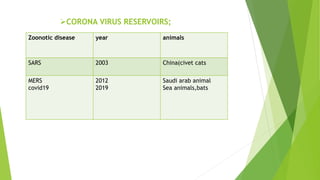
CORONA VIRUS RESERVOIRS;
Zoonotic disease year animals
SARS 2003 China(civet cats
MERS
covid19
2012
2019
Saudi arab animal
Sea animals,bats
“Wuhan pneumonia”
Wuhan, a city in central China, is the capital of Hubei province.
31 December 2019: WHO China Country Office was informed of
cases of pneumonia of unknown etiology detected in Wuhan.
07 January 2020: Chinese authorities identified a novel coronavirus
(2019- nCoV) as the probable causative agent.
◦ Disease now named COVID-19 by WHO
◦ Virus named SARS-CoV-2
(https://www.biorxiv.org/content/10.1101/2020.02.07.937862v1)
As of 23 March 2020: > 330,000 confirmed cases and 14,600
death
◦As of today ~ 80% in three areas: 24% in Mainland China, 44% in
Continental Europe and 10% in US
Human to Human transmission has been confirmed
◦ > 3,000 HCW infections
What about Bats?
• Bats make up roughly 20% of all species of mammals and live
to reach 40 years or more.
• Their ability to fly means they can transmit viruses far and
wide.
• Bats have evolved to tolerate more viruses than other
mammals and carry a significant proportion of zoonoses.
• Bats have suppressed their immune system thus allowing them
to tolerate more viruses without getting sick.
• Innate immunity likely works slightly differently in bats
• More than 500 coronaviruses in China come from bats.
• China is a “hotspot” for bat-borne coronaviruses to emerge.
• Usually there is an intermediary animal which passes the virus
to humans.
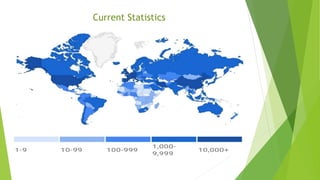
Current Statistics
Current Statistics contd..
Note:- Statistics are up to 12:08pm, 30th march
Location Confirmed
Cases per
1M people
Recovered Deaths
United States 142,537 435.78 4,767 2,510
Italy 97,689 1,546.56 13,030 10,779
China 81,470 59.32 75,770 3,304
Spain 80,100 1,616.54 14,709 6,803
Germany 62,440 760.19 5,024 541
Iran 38,309 472.99 12,391 2,640
United
Kingdom
19,569 301.56 140 1,228
India 1,161 0.92 102 28
India Statistics contd..
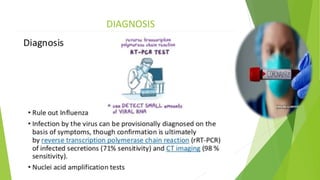
DIAGNOSIS
PREVENTIONS
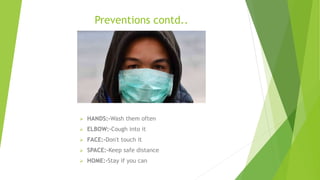
Preventions contd..
 HANDS:-Wash them often
 ELBOW:-Cough into it
 FACE:-Don't touch it
 SPACE:-Keep safe distance
 HOME:-Stay if you can
Preventions contd..
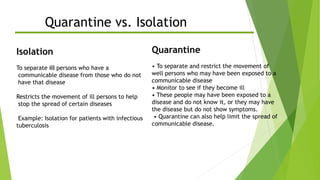
Quarantine vs. Isolation
Isolation
To separate ill persons who have a
communicable disease from those who do not
have that disease
Restricts the movement of ill persons to help
stop the spread of certain diseases
Example: Isolation for patients with infectious
tuberculosis
Quarantine
• To separate and restrict the movement of
well persons who may have been exposed to a
communicable disease
• Monitor to see if they become ill
• These people may have been exposed to a
disease and do not know it, or they may have
the disease but do not show symptoms.
• Quarantine can also help limit the spread of
communicable disease.
What about masks?
Surgical mask:
◦ Meant to protect the environment
from the wearer (designed to keep
the surgeon’s respiratory pathogens
away from a patient)
◦ Does a good job of trapping large
droplets and some aerosols
Respirator (N95 Mask):
◦ Fits tighter to the face and is meant
to help protect the wearer from
inhaling droplets in the environment
News Headlines
HANTAVIRUS
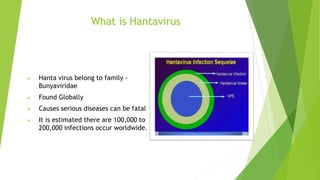
What is Hantavirus
 Hanta virus belong to family -
Bunyaviridae
 Found Globally
 Causes serious diseases can be fatal
 It is estimated there are 100,000 to
200,000 infections occur worldwide.
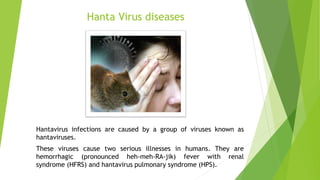
Hanta Virus diseases
Hantavirus infections are caused by a group of viruses known as
hantaviruses.
These viruses cause two serious illnesses in humans. They are
hemorrhagic (pronounced heh-meh-RA-jik) fever with renal
syndrome (HFRS) and hantavirus pulmonary syndrome (HPS).
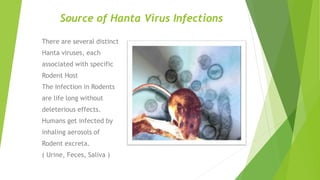
Source of Hanta Virus Infections
There are several distinct
Hanta viruses, each
associated with specific
Rodent Host
The Infection in Rodents
are life long without
deleterious effects.
Humans get infected by
inhaling aerosols of
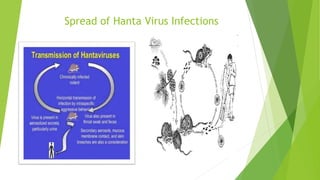
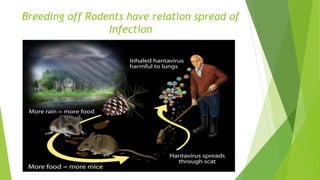
Rodent excreta.
( Urine, Feces, Saliva )
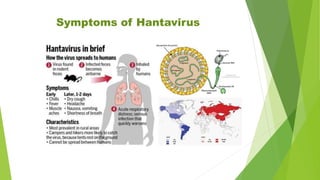
Symptoms of Hantavirus
Spread of Hanta Virus Infections
Breeding off Rodents have relation spread of
Infection
Diseases produced by Hanta
virus Infections
 Hemorrhagic fever with Renal Syndrome( HFR )
 Hanta virus pulmonary Syndrome ( HPS )
Infection with Hanta virus is associated with
Geographic distribution of Rodentsand nature
of the Virus.
Hemorrhagic Fever with Renal
Syndrome
Hemorrhagic fever with renal failure syndrome (HFRS) occurs mainly in Europe
and Asia and is characterized by fever and renal failure associated with
hemorrhagic manifestations. Hemorrhagic fever with renal failure syndrome is
caused by an airborne contact with secretions from rodent hosts infected with
the group of viruses belonging to the genus Hantavirus of the
family Bunyaviridae. In Europe, hemorrhagic fever with renal failure syndrome
is caused by 3 hantaviruses: Puumala virus (PUUV), carried by the bank vole
(Myodes glareolus); Dobrava virus (DOBV), carried by the mouse (Apodemus
flavicollis); and Saaremaa virus (SAAV), carried by the striped field mouse
(Apodemus agrarius). Other viruses in the Bunyaviridae family include Seoul
virus and Tala virus.
In 1993 in the southwestern United States, an outbreak of respiratory illness
occurred during the spring and was caused by a virus belonging to the genus
Hantavirus called Sin Nombre virus. The disease was characterized by rapid
onset of pulmonary edema followed by respiratory failure and cardiogenic shock
and was described as Hantavirus pulmonary syndrome (HPS
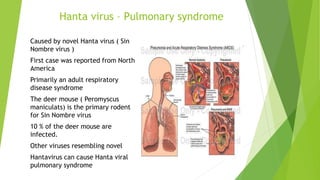
Hanta virus – Pulmonary syndrome
Caused by novel Hanta virus ( Sin
Nombre virus )
First case was reported from North
America
Primarily an adult respiratory
disease syndrome
The deer mouse ( Peromyscus
maniculats) is the primary rodent
for Sin Nombre virus
10 % of the deer mouse are
infected.
Other viruses resembling novel
Hantavirus can cause Hanta viral
pulmonary syndrome
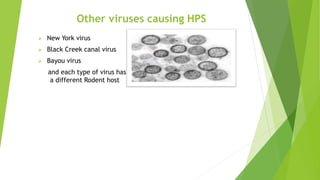
Other viruses causing HPS
 New York virus
 Black Creek canal virus
 Bayou virus
and each type of virus has
a different Rodent host
Management
 Hemorrhagic fever, and renal failure
are manage with supportive
treatment.
 Rodent control
 Protection from exposure to rodent
droppings and contaminated
material.
 Maintanance of adequate of O2.
 Supporting hemodynamic
functioning.
 Antiviral drug Ribavirin is
some benefit
Pathogenesis
Hantavirus preferentially infect
endothelial cells
Virus target the pulmonary
capillary walls (HPS) or the
capillary walls of the kidney (HFRS)
intiating a cascade of events
culminating in a massive,
pulmonary or kidney-specific
inflammatory response-endothelial
damage and edema(TNF alpha and
IL-1beta)
The damage to pulmonary/kidney
microvascular endothelium
increases capillary permeability
and leads to even more
pulmonary/kidney odema
 Detection of antigens by immuno
histochemistry.
 RT – PCR for viral antigen detection
 Specific antibodies by recombinant
proteins
 A four fold rise of IgM antibody titer
between acute and convalescent serum
is diagnostic
Laboratory Diagnosis
Control and Prevention
 Rodent control
 Avoiding control of
Rodents and Rodent
droppings
 Care must be taken to
avoid inhaling aerolized
dried excreta when
cleaning Rodent infected
structures.
Difference between Coronavirus and
Hantavirus
Incubation period
The symptoms of HPS usually appear within 2-4 weeks of exposure
but it can appear as early as 1 week or as late as 6 weeks after
infection
On the other hand, the symptoms of coronavirus appear within 2
to 14 days
Cure
There has not been any specific cure for hantavirus infection but
if the disease is recognised at the early stage, the patient can get
better by receiving medical care in an intensive care unit (ICU).
No specific cure has been found for the disease. However, doctors
are using a combination of drugs and there has been anecdotal
evidence to cure the COVID-19 patients using such combination.
Difference between Coronavirus and
Hantavirus contd..
The Mortality rate and the Transmission risk
The mortality rate of hantavirus pulmonary syndrome is 36 per
cent and the transmission risk of the disease is negligible. In the
case of coronavirus, the mortality rate of the virus is
comparatively very low, around 2 per cent, but the virus is highly
contagious.
Transmission
Coronavirus has a human host, which can transmit the infection
through droplets that may be released when the host sneezes or
coughs.
However, in hantavirus there is no human-to-human transmission.
Corona vs hanta virus

Corona vs hanta virus

  • 1.
    CORONAVIRUS VS HANTAVIRUS Submitted by :-RaniTiwari Class:- M pharma 2nd sem B.U. Jhansi
  • 2.
  • 3.
     Coronaviruses area family of viruses that range from the common cold to MERS coronavirus, which is Middle East Respiratory Syndrome coronavirus and SARs, Severe acute respiratory syndrome coronavirus.  Coronavirus are diverse group of viruses that infact and causes disease in humans and other animals, including pigs and chickens.
  • 4.
    Why It isnamed CoronaVirus? Coronaviruses are named because of Crown-like appearance of their virus particles when seen under Electron Microscope (corona , meaning crown).
  • 5.
    Novel Corona Virus TheNovel Coronavirus is also known as Wuhan Pnemonia or the Wuhan Coronavirus. This new coronavirus is called severe acute respiratory syndrome coronavirus 2(SARS-COV-2 or COVID-19). They are enveloped viruses with a positive- sense single-stranded RNA genome .
  • 6.
  • 7.
    Types of Coronavirus:- Thereare seven strains of the Coronavirus documented till date:- Human Coronavirus 229E (HCoV-229E) Human Coronavirus OC43(HCoV- OC43) New Haven Coronavirus (HCoV-NL63) Severe Acute Respiratory Syndrome-Related (SARS- CoV) Human Coronavirus HKU1 Middle East-Respiratory Syndrome Coronavirus (MERS-CoV) Novel Coronavirus (2019-nCoV)
  • 8.
    Novel Coronavirus symptoms Peoplemay experience:  cough  fever  tiredness  difficulty breathing (severe cases)
  • 9.
    Why is theNovel Coronavirus a causes for concern? The Novel Coronavirus has a never been observed before, hence, there is no specific treatment for the disease. Current anti-viral treatment are also deemed ineffective at combating the illness. Therefore, present treatment is focused only on alleviating the symptoms of disease. Initially, the NCoV was thought to be a zoonotic disease, however, current findings suggest that this disease spreads from persons to person. It is suspected to spread through respiratory droplets( an infected person sneezing or coughing).
  • 10.
    CORONA VIRUS RESERVOIRS; Zoonoticdisease year animals SARS 2003 China(civet cats MERS covid19 2012 2019 Saudi arab animal Sea animals,bats
  • 12.
    “Wuhan pneumonia” Wuhan, acity in central China, is the capital of Hubei province. 31 December 2019: WHO China Country Office was informed of cases of pneumonia of unknown etiology detected in Wuhan. 07 January 2020: Chinese authorities identified a novel coronavirus (2019- nCoV) as the probable causative agent. ◦ Disease now named COVID-19 by WHO ◦ Virus named SARS-CoV-2 (https://www.biorxiv.org/content/10.1101/2020.02.07.937862v1) As of 23 March 2020: > 330,000 confirmed cases and 14,600 death ◦As of today ~ 80% in three areas: 24% in Mainland China, 44% in Continental Europe and 10% in US Human to Human transmission has been confirmed ◦ > 3,000 HCW infections
  • 13.
    What about Bats? •Bats make up roughly 20% of all species of mammals and live to reach 40 years or more. • Their ability to fly means they can transmit viruses far and wide. • Bats have evolved to tolerate more viruses than other mammals and carry a significant proportion of zoonoses. • Bats have suppressed their immune system thus allowing them to tolerate more viruses without getting sick. • Innate immunity likely works slightly differently in bats • More than 500 coronaviruses in China come from bats. • China is a “hotspot” for bat-borne coronaviruses to emerge. • Usually there is an intermediary animal which passes the virus to humans.
  • 14.
  • 15.
    Current Statistics contd.. Note:-Statistics are up to 12:08pm, 30th march Location Confirmed Cases per 1M people Recovered Deaths United States 142,537 435.78 4,767 2,510 Italy 97,689 1,546.56 13,030 10,779 China 81,470 59.32 75,770 3,304 Spain 80,100 1,616.54 14,709 6,803 Germany 62,440 760.19 5,024 541 Iran 38,309 472.99 12,391 2,640 United Kingdom 19,569 301.56 140 1,228 India 1,161 0.92 102 28
  • 16.
  • 17.
  • 18.
  • 19.
    Preventions contd..  HANDS:-Washthem often  ELBOW:-Cough into it  FACE:-Don't touch it  SPACE:-Keep safe distance  HOME:-Stay if you can
  • 20.
  • 21.
    Quarantine vs. Isolation Isolation Toseparate ill persons who have a communicable disease from those who do not have that disease Restricts the movement of ill persons to help stop the spread of certain diseases Example: Isolation for patients with infectious tuberculosis Quarantine • To separate and restrict the movement of well persons who may have been exposed to a communicable disease • Monitor to see if they become ill • These people may have been exposed to a disease and do not know it, or they may have the disease but do not show symptoms. • Quarantine can also help limit the spread of communicable disease.
  • 22.
    What about masks? Surgicalmask: ◦ Meant to protect the environment from the wearer (designed to keep the surgeon’s respiratory pathogens away from a patient) ◦ Does a good job of trapping large droplets and some aerosols Respirator (N95 Mask): ◦ Fits tighter to the face and is meant to help protect the wearer from inhaling droplets in the environment
  • 23.
  • 24.
  • 25.
    What is Hantavirus Hanta virus belong to family - Bunyaviridae  Found Globally  Causes serious diseases can be fatal  It is estimated there are 100,000 to 200,000 infections occur worldwide.
  • 26.
    Hanta Virus diseases Hantavirusinfections are caused by a group of viruses known as hantaviruses. These viruses cause two serious illnesses in humans. They are hemorrhagic (pronounced heh-meh-RA-jik) fever with renal syndrome (HFRS) and hantavirus pulmonary syndrome (HPS).
  • 27.
    Source of HantaVirus Infections There are several distinct Hanta viruses, each associated with specific Rodent Host The Infection in Rodents are life long without deleterious effects. Humans get infected by inhaling aerosols of Rodent excreta. ( Urine, Feces, Saliva )
  • 28.
  • 29.
    Spread of HantaVirus Infections
  • 30.
    Breeding off Rodentshave relation spread of Infection
  • 31.
    Diseases produced byHanta virus Infections  Hemorrhagic fever with Renal Syndrome( HFR )  Hanta virus pulmonary Syndrome ( HPS ) Infection with Hanta virus is associated with Geographic distribution of Rodentsand nature of the Virus.
  • 32.
    Hemorrhagic Fever withRenal Syndrome Hemorrhagic fever with renal failure syndrome (HFRS) occurs mainly in Europe and Asia and is characterized by fever and renal failure associated with hemorrhagic manifestations. Hemorrhagic fever with renal failure syndrome is caused by an airborne contact with secretions from rodent hosts infected with the group of viruses belonging to the genus Hantavirus of the family Bunyaviridae. In Europe, hemorrhagic fever with renal failure syndrome is caused by 3 hantaviruses: Puumala virus (PUUV), carried by the bank vole (Myodes glareolus); Dobrava virus (DOBV), carried by the mouse (Apodemus flavicollis); and Saaremaa virus (SAAV), carried by the striped field mouse (Apodemus agrarius). Other viruses in the Bunyaviridae family include Seoul virus and Tala virus. In 1993 in the southwestern United States, an outbreak of respiratory illness occurred during the spring and was caused by a virus belonging to the genus Hantavirus called Sin Nombre virus. The disease was characterized by rapid onset of pulmonary edema followed by respiratory failure and cardiogenic shock and was described as Hantavirus pulmonary syndrome (HPS
  • 33.
    Hanta virus –Pulmonary syndrome Caused by novel Hanta virus ( Sin Nombre virus ) First case was reported from North America Primarily an adult respiratory disease syndrome The deer mouse ( Peromyscus maniculats) is the primary rodent for Sin Nombre virus 10 % of the deer mouse are infected. Other viruses resembling novel Hantavirus can cause Hanta viral pulmonary syndrome
  • 34.
    Other viruses causingHPS  New York virus  Black Creek canal virus  Bayou virus and each type of virus has a different Rodent host
  • 35.
    Management  Hemorrhagic fever,and renal failure are manage with supportive treatment.  Rodent control  Protection from exposure to rodent droppings and contaminated material.  Maintanance of adequate of O2.  Supporting hemodynamic functioning.  Antiviral drug Ribavirin is some benefit
  • 36.
    Pathogenesis Hantavirus preferentially infect endothelialcells Virus target the pulmonary capillary walls (HPS) or the capillary walls of the kidney (HFRS) intiating a cascade of events culminating in a massive, pulmonary or kidney-specific inflammatory response-endothelial damage and edema(TNF alpha and IL-1beta) The damage to pulmonary/kidney microvascular endothelium increases capillary permeability and leads to even more pulmonary/kidney odema  Detection of antigens by immuno histochemistry.  RT – PCR for viral antigen detection  Specific antibodies by recombinant proteins  A four fold rise of IgM antibody titer between acute and convalescent serum is diagnostic Laboratory Diagnosis
  • 37.
    Control and Prevention Rodent control  Avoiding control of Rodents and Rodent droppings  Care must be taken to avoid inhaling aerolized dried excreta when cleaning Rodent infected structures.
  • 38.
    Difference between Coronavirusand Hantavirus Incubation period The symptoms of HPS usually appear within 2-4 weeks of exposure but it can appear as early as 1 week or as late as 6 weeks after infection On the other hand, the symptoms of coronavirus appear within 2 to 14 days Cure There has not been any specific cure for hantavirus infection but if the disease is recognised at the early stage, the patient can get better by receiving medical care in an intensive care unit (ICU). No specific cure has been found for the disease. However, doctors are using a combination of drugs and there has been anecdotal evidence to cure the COVID-19 patients using such combination.
  • 39.
    Difference between Coronavirusand Hantavirus contd.. The Mortality rate and the Transmission risk The mortality rate of hantavirus pulmonary syndrome is 36 per cent and the transmission risk of the disease is negligible. In the case of coronavirus, the mortality rate of the virus is comparatively very low, around 2 per cent, but the virus is highly contagious. Transmission Coronavirus has a human host, which can transmit the infection through droplets that may be released when the host sneezes or coughs. However, in hantavirus there is no human-to-human transmission.