Cord blood storage
and stem cells
Keith Tsui
Outline
• Introduction
• The state of cord blood in HK
• Existing clinical applications
• Potential therapies
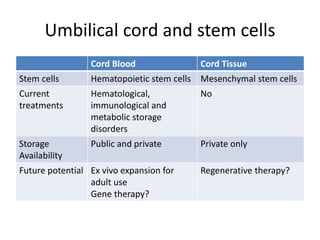
Umbilical cord and stem cells
Cord Blood Cord Tissue
Stem cells Hematopoietic stem cells Mesenchymal stem cells
Current
treatments
Hematological,
immunological and
metabolic storage
disorders
No
Storage
Availability
Public and private Private only
Future potential Ex vivo expansion for
adult use
Gene therapy?
Regenerative therapy?
Hong Kong
• Public
– Hong Kong Red Cross (since 1998)
– KWH only due to logistic reasons
• Private
– Healthybaby
– Cordlife
– Cryolife
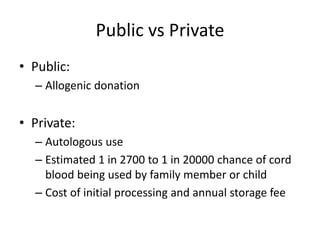
Public vs Private
• Public:
– Allogenic donation
• Private:
– Autologous use
– Estimated 1 in 2700 to 1 in 20000 chance of cord
blood being used by family member or child
– Cost of initial processing and annual storage fee
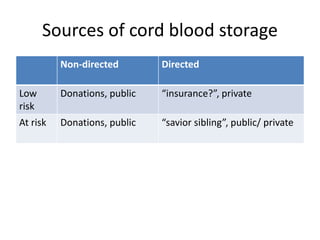
Sources of cord blood storage
Non-directed Directed
Low
risk
Donations, public “insurance?”, private
At risk Donations, public “savior sibling”, public/ private
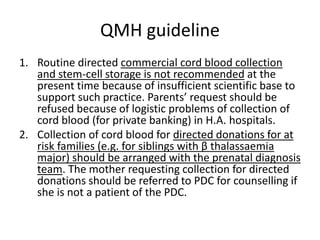
QMH guideline
1. Routine directed commercial cord blood collection
and stem-cell storage is not recommended at the
present time because of insufficient scientific base to
support such practice. Parents’ request should be
refused because of logistic problems of collection of
cord blood (for private banking) in H.A. hospitals.
2. Collection of cord blood for directed donations for at
risk families (e.g. for siblings with β thalassaemia
major) should be arranged with the prenatal diagnosis
team. The mother requesting collection for directed
donations should be referred to PDC for counselling if
she is not a patient of the PDC.
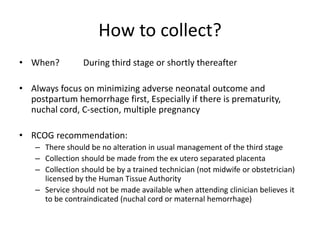
How to collect?
• When? During third stage or shortly thereafter
• Always focus on minimizing adverse neonatal outcome and
postpartum hemorrhage first, Especially if there is prematurity,
nuchal cord, C-section, multiple pregnancy
• RCOG recommendation:
– There should be no alteration in usual management of the third stage
– Collection should be made from the ex utero separated placenta
– Collection should be by a trained technician (not midwife or obstetrician)
licensed by the Human Tissue Authority
– Service should not be made available when attending clinician believes it
to be contraindicated (nuchal cord or maternal hemorrhage)
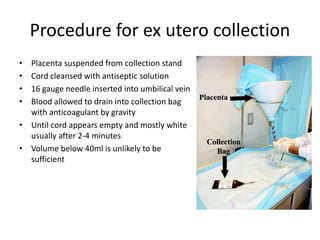
Procedure for ex utero collection
• Placenta suspended from collection stand
• Cord cleansed with antiseptic solution
• 16 gauge needle inserted into umbilical vein
• Blood allowed to drain into collection bag
with anticoagulant by gravity
• Until cord appears empty and mostly white
usually after 2-4 minutes
• Volume below 40ml is unlikely to be
sufficient
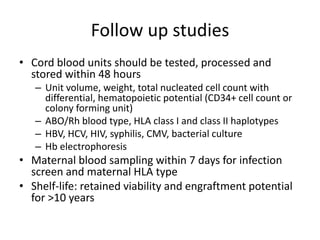
Follow up studies
• Cord blood units should be tested, processed and
stored within 48 hours
– Unit volume, weight, total nucleated cell count with
differential, hematopoietic potential (CD34+ cell count or
colony forming unit)
– ABO/Rh blood type, HLA class I and class II haplotypes
– HBV, HCV, HIV, syphilis, CMV, bacterial culture
– Hb electrophoresis
• Maternal blood sampling within 7 days for infection
screen and maternal HLA type
• Shelf-life: retained viability and engraftment potential
for >10 years
History of cord blood transplant
• First case in 1988 for Fanconi anemia
• Estimated more than 7000 transplants done
up to 2008
• Since 1998, 20% of stem cell transplants for
patients less than 20 years old are cord blood
transplants (mostly for ALL and AML)
– Data from international Bone Marrow
Transplantation Registry
On lists around the world
• >22.5 million potential adult bone marrow
donors
• >601,000 cord blood units
HLA typing
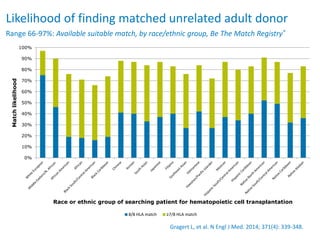
• A suitably matched adult donor is defined as
one matched with the patient at ≥7/8 HLA loci
(HLA-A, -B, -C, and -DRB1).
• A suitably matched CBU is defined as one
matched with the patient at ≥4/6 HLA loci
(HLA-A, -B, and -DRB1)
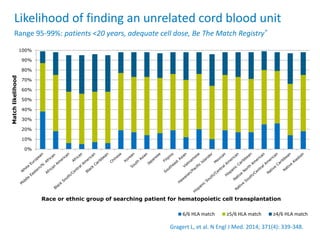
Likelihood of finding an unrelated cord blood unit
Range 95-99%: patients <20 years, adequate cell dose, Be The Match Registry®
0%
10%
20%
30%
40%
50%
60%
70%
80%
90%
100%
Matchlikelihood
Race or ethnic group of searching patient for hematopoietic cell transplantation
6/6 HLA match ≥5/6 HLA match ≥4/6 HLA match
Gragert L, et al. N Engl J Med. 2014; 371(4): 339-348.
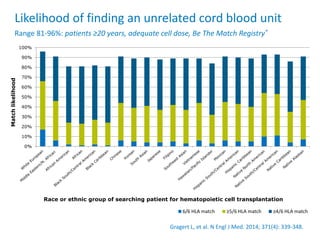
Likelihood of finding an unrelated cord blood unit
Range 81-96%: patients ≥20 years, adequate cell dose, Be The Match Registry®
0%
10%
20%
30%
40%
50%
60%
70%
80%
90%
100%
Matchlikelihood
Race or ethnic group of searching patient for hematopoietic cell transplantation
6/6 HLA match ≥5/6 HLA match ≥4/6 HLA match
Gragert L, et al. N Engl J Med. 2014; 371(4): 339-348.
0%
10%
20%
30%
40%
50%
60%
70%
80%
90%
100%
Matchlikelihood
Race or ethnic group of searching patient for hematopoietic cell transplantation
8/8 HLA match ≥7/8 HLA match
Likelihood of finding matched unrelated adult donor
Range 66-97%: Available suitable match, by race/ethnic group, Be The Match Registry®
Gragert L, et al. N Engl J Med. 2014; 371(4): 339-348.
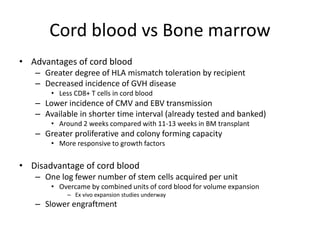
Cord blood vs Bone marrow
• Advantages of cord blood
– Greater degree of HLA mismatch toleration by recipient
– Decreased incidence of GVH disease
• Less CD8+ T cells in cord blood
– Lower incidence of CMV and EBV transmission
– Available in shorter time interval (already tested and banked)
• Around 2 weeks compared with 11-13 weeks in BM transplant
– Greater proliferative and colony forming capacity
• More responsive to growth factors
• Disadvantage of cord blood
– One log fewer number of stem cells acquired per unit
• Overcame by combined units of cord blood for volume expansion
– Ex vivo expansion studies underway
– Slower engraftment
Limitations of autologous cord blood transplant
• Inborn errors of metabolism or other genetic
diseases
– Genetic mutations already present in autologous stem
cells
• Somatic gene therapy research underway
• Childhood leukemia
– Chromosomal translocations in fetal blood have been
detected
– Negate the beneficial effect of graft vs leukemia effect in
allogenic stem cell transplants
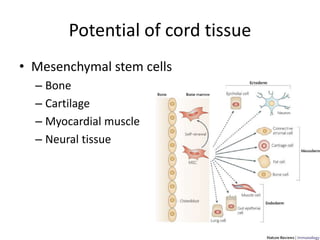
Potential of cord tissue
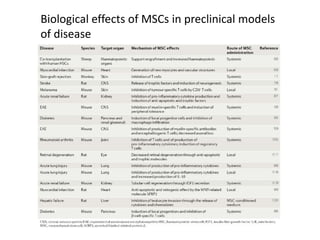
• Mesenchymal stem cells
– Bone
– Cartilage
– Myocardial muscle
– Neural tissue
Biological effects of MSCs in preclinical models
of disease
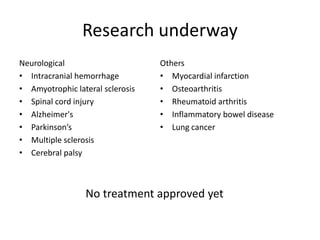
Research underway
Neurological
• Intracranial hemorrhage
• Amyotrophic lateral sclerosis
• Spinal cord injury
• Alzheimer's
• Parkinson’s
• Multiple sclerosis
• Cerebral palsy
Others
• Myocardial infarction
• Osteoarthritis
• Rheumatoid arthritis
• Inflammatory bowel disease
• Lung cancer
No treatment approved yet
Summary
• Non-directed donations
• Directed donations for at-risk families
• Personal commercial banking for low-risk
families
• No alteration in usual management of the
third stage
• Cord blood vs Bone Marrow
• Potential of MSCs and cord tissue
Reference
• Umbilical Cord Blood Banking: Scientific Advisory Committee Opinion
Paper 2, June 2006, Royal College of Obstetricians and Gynaecologists.
(reaffirmed 2011)
• ACOG Committee Opinion: Umbilical cord Blood Banking, Number 399,
February 2008 (Reaffirmed 2012)
• Moise KJ Jr. Umbilical cord stem cells. Obstet Gynecol 2005;106:1393-407
• Antonio Uccelli, Lorenzo Moretta & Vito Pistoia Mesenchymal stem cells in
health and disease Nature Reviews Immunology 8, 726-736 (September
2008) | doi:10.1038/nri2395
• QMH OG guideline
• Uptodate.com
• Bethematch.org

Cord blood and stem cells

  • 1.
    Cord blood storage andstem cells Keith Tsui
  • 2.
    Outline • Introduction • Thestate of cord blood in HK • Existing clinical applications • Potential therapies
  • 3.
    Umbilical cord andstem cells Cord Blood Cord Tissue Stem cells Hematopoietic stem cells Mesenchymal stem cells Current treatments Hematological, immunological and metabolic storage disorders No Storage Availability Public and private Private only Future potential Ex vivo expansion for adult use Gene therapy? Regenerative therapy?
  • 4.
    Hong Kong • Public –Hong Kong Red Cross (since 1998) – KWH only due to logistic reasons • Private – Healthybaby – Cordlife – Cryolife
  • 5.
    Public vs Private •Public: – Allogenic donation • Private: – Autologous use – Estimated 1 in 2700 to 1 in 20000 chance of cord blood being used by family member or child – Cost of initial processing and annual storage fee
  • 6.
    Sources of cordblood storage Non-directed Directed Low risk Donations, public “insurance?”, private At risk Donations, public “savior sibling”, public/ private
  • 7.
    QMH guideline 1. Routinedirected commercial cord blood collection and stem-cell storage is not recommended at the present time because of insufficient scientific base to support such practice. Parents’ request should be refused because of logistic problems of collection of cord blood (for private banking) in H.A. hospitals. 2. Collection of cord blood for directed donations for at risk families (e.g. for siblings with β thalassaemia major) should be arranged with the prenatal diagnosis team. The mother requesting collection for directed donations should be referred to PDC for counselling if she is not a patient of the PDC.
  • 8.
    How to collect? •When? During third stage or shortly thereafter • Always focus on minimizing adverse neonatal outcome and postpartum hemorrhage first, Especially if there is prematurity, nuchal cord, C-section, multiple pregnancy • RCOG recommendation: – There should be no alteration in usual management of the third stage – Collection should be made from the ex utero separated placenta – Collection should be by a trained technician (not midwife or obstetrician) licensed by the Human Tissue Authority – Service should not be made available when attending clinician believes it to be contraindicated (nuchal cord or maternal hemorrhage)
  • 9.
    Procedure for exutero collection • Placenta suspended from collection stand • Cord cleansed with antiseptic solution • 16 gauge needle inserted into umbilical vein • Blood allowed to drain into collection bag with anticoagulant by gravity • Until cord appears empty and mostly white usually after 2-4 minutes • Volume below 40ml is unlikely to be sufficient
  • 10.
    Follow up studies •Cord blood units should be tested, processed and stored within 48 hours – Unit volume, weight, total nucleated cell count with differential, hematopoietic potential (CD34+ cell count or colony forming unit) – ABO/Rh blood type, HLA class I and class II haplotypes – HBV, HCV, HIV, syphilis, CMV, bacterial culture – Hb electrophoresis • Maternal blood sampling within 7 days for infection screen and maternal HLA type • Shelf-life: retained viability and engraftment potential for >10 years
  • 11.
    History of cordblood transplant • First case in 1988 for Fanconi anemia • Estimated more than 7000 transplants done up to 2008 • Since 1998, 20% of stem cell transplants for patients less than 20 years old are cord blood transplants (mostly for ALL and AML) – Data from international Bone Marrow Transplantation Registry
  • 13.
    On lists aroundthe world • >22.5 million potential adult bone marrow donors • >601,000 cord blood units
  • 14.
    HLA typing • Asuitably matched adult donor is defined as one matched with the patient at ≥7/8 HLA loci (HLA-A, -B, -C, and -DRB1). • A suitably matched CBU is defined as one matched with the patient at ≥4/6 HLA loci (HLA-A, -B, and -DRB1)
  • 15.
    Likelihood of findingan unrelated cord blood unit Range 95-99%: patients <20 years, adequate cell dose, Be The Match Registry® 0% 10% 20% 30% 40% 50% 60% 70% 80% 90% 100% Matchlikelihood Race or ethnic group of searching patient for hematopoietic cell transplantation 6/6 HLA match ≥5/6 HLA match ≥4/6 HLA match Gragert L, et al. N Engl J Med. 2014; 371(4): 339-348.
  • 16.
    Likelihood of findingan unrelated cord blood unit Range 81-96%: patients ≥20 years, adequate cell dose, Be The Match Registry® 0% 10% 20% 30% 40% 50% 60% 70% 80% 90% 100% Matchlikelihood Race or ethnic group of searching patient for hematopoietic cell transplantation 6/6 HLA match ≥5/6 HLA match ≥4/6 HLA match Gragert L, et al. N Engl J Med. 2014; 371(4): 339-348.
  • 17.
    0% 10% 20% 30% 40% 50% 60% 70% 80% 90% 100% Matchlikelihood Race or ethnicgroup of searching patient for hematopoietic cell transplantation 8/8 HLA match ≥7/8 HLA match Likelihood of finding matched unrelated adult donor Range 66-97%: Available suitable match, by race/ethnic group, Be The Match Registry® Gragert L, et al. N Engl J Med. 2014; 371(4): 339-348.
  • 18.
    Cord blood vsBone marrow • Advantages of cord blood – Greater degree of HLA mismatch toleration by recipient – Decreased incidence of GVH disease • Less CD8+ T cells in cord blood – Lower incidence of CMV and EBV transmission – Available in shorter time interval (already tested and banked) • Around 2 weeks compared with 11-13 weeks in BM transplant – Greater proliferative and colony forming capacity • More responsive to growth factors • Disadvantage of cord blood – One log fewer number of stem cells acquired per unit • Overcame by combined units of cord blood for volume expansion – Ex vivo expansion studies underway – Slower engraftment
  • 19.
    Limitations of autologouscord blood transplant • Inborn errors of metabolism or other genetic diseases – Genetic mutations already present in autologous stem cells • Somatic gene therapy research underway • Childhood leukemia – Chromosomal translocations in fetal blood have been detected – Negate the beneficial effect of graft vs leukemia effect in allogenic stem cell transplants
  • 20.
    Potential of cordtissue • Mesenchymal stem cells – Bone – Cartilage – Myocardial muscle – Neural tissue
  • 21.
    Biological effects ofMSCs in preclinical models of disease
  • 22.
    Research underway Neurological • Intracranialhemorrhage • Amyotrophic lateral sclerosis • Spinal cord injury • Alzheimer's • Parkinson’s • Multiple sclerosis • Cerebral palsy Others • Myocardial infarction • Osteoarthritis • Rheumatoid arthritis • Inflammatory bowel disease • Lung cancer No treatment approved yet
  • 23.
    Summary • Non-directed donations •Directed donations for at-risk families • Personal commercial banking for low-risk families • No alteration in usual management of the third stage • Cord blood vs Bone Marrow • Potential of MSCs and cord tissue
  • 24.
    Reference • Umbilical CordBlood Banking: Scientific Advisory Committee Opinion Paper 2, June 2006, Royal College of Obstetricians and Gynaecologists. (reaffirmed 2011) • ACOG Committee Opinion: Umbilical cord Blood Banking, Number 399, February 2008 (Reaffirmed 2012) • Moise KJ Jr. Umbilical cord stem cells. Obstet Gynecol 2005;106:1393-407 • Antonio Uccelli, Lorenzo Moretta & Vito Pistoia Mesenchymal stem cells in health and disease Nature Reviews Immunology 8, 726-736 (September 2008) | doi:10.1038/nri2395 • QMH OG guideline • Uptodate.com • Bethematch.org

Editor's Notes

  • #16 Using human HLA data from the Be The Match Registry®, Gragert et al used extensive high-resolution, 4-locus haplotype frequencies to build population-based genetic models for 21 U.S. racial and ethnic groups. Suitable match likelihood for a cord blood unit, pediatric patients (<20 years): 95 percent to 99 percent will have at least one suitably matched (4 of 6 or higher) umbilical cord blood unit with adequate cell dose, with the highest for white European and several of the race groups for Black or African American at the lowest. The study was led by Bioinformatics scientists at the National Marrow Donor Program® (NMDP)/Be The Match®, through our research program CIBMTR (Center for International Blood and Marrow Transplant Research).
  • #17 Using human HLA data from the Be The Match Registry®, Gragert et al used extensive high-resolution, 4-locus haplotype frequencies to build population-based genetic models for 21 U.S. racial and ethnic groups. Suitable match likelihood for a cord blood unit, adult patients (≥20 years): 81 percent to 96 percent will have at least one suitably matched (4 of 6 or higher) umbilical cord blood unit with adequate cell dose, with the highest for white European and several of the race groups for Black or African American at the lowest. The study was led by Bioinformatics scientists at the National Marrow Donor Program® (NMDP)/Be The Match®, through our research program CIBMTR (Center for International Blood and Marrow Transplant Research).
  • #18 Using human HLA data from the Be The Match Registry®, Gragert et al used extensive high-resolution, 4-locus haplotype frequencies to build population-based genetic models for 21 U.S. racial and ethnic groups. Suitable match likelihood for adult donor: 66 percent to 97 percent will have a suitably matched (7 of 8 or better) and available adult donor, with the highest rates for White European and the lowest in Black South or Central American. Other groups of Black or African American have a higher rate. The study was led by Bioinformatics scientists at the National Marrow Donor Program® (NMDP)/Be The Match®, through our research program CIBMTR (Center for International Blood and Marrow Transplant Research).