Juliet N. Barker, MBBS (Hons), FRACP
Associate Attending
Director, Cord Blood Transplant Program
Memorial Sloan-Kettering Cancer Center
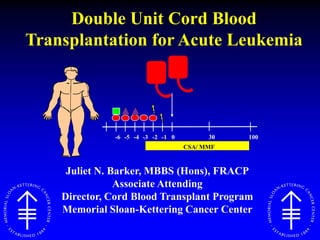
Double Unit Cord Blood
Transplantation for Acute Leukemia
CSA/ MMF
-3 -2 -1-4-6 -5 30 1000
Acknowledgements
U of Minnesota
John E. Wagner
NYBC
Pablo Rubinstein
Cladd Stevens
Machi Scaradavou
MSKCC
Staff of Adult & Pediatric
Transplant
Search: Courtney Byam, Rosanna Ferrante
Debbie Wells, Melissa Sideroff, Sinda Lee
Cell Therapy Lab
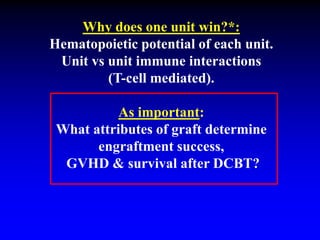
CB Research Staff: Marissa Lubin
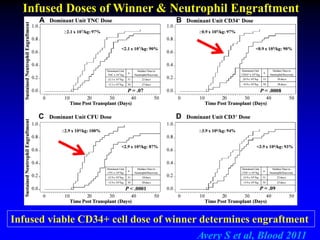
Anne Marie Gonzales , Katie Evans
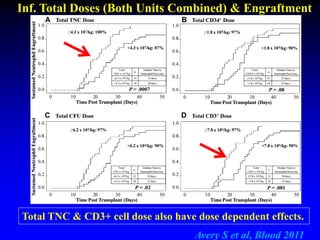
Cellular Immunology Lab: Kathy Smith
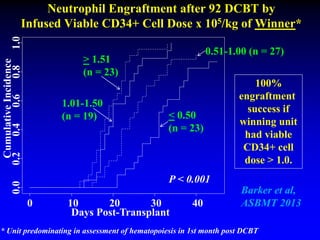
Pediatrics: Machi Scaradavou
Nancy Kernan & Richard O’Reilly
Adult BMT Service: Doris Ponce
Marcel van den Brink & Sergio Giralt
Funding
Gabrielle’s Angel Foundation for Cancer Research, the MSKCC Society,
MSKCC Translational and Integrative Medicine Research Grant,
P01 CA23766 NCI, NIH.
Original Reasons for Double Unit CB Grafts
• Platform for investigation of expansion or other
graft manipulation.
• Augment graft cell dose = improve engraftment,
reduce TRM, improve survival.
Reasons for Double Unit CB Grafts: Successful?
• Platform for investigation of expansion or other
graft manipulation?: YES
• Augment graft cell dose = improve engraftment,
reduce TRM, improve survival?: YES in adults,
children?
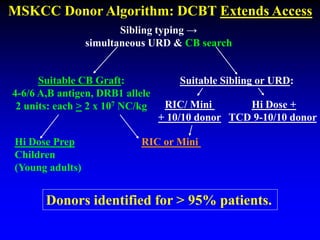
Sibling typing →
simultaneous URD & CB search
Suitable Sibling or URD:Suitable CB Graft:
4-6/6 A,B antigen, DRB1 allele
2 units: each > 2 x 10⁷ NC/kg
Hi Dose Prep RIC or Mini
Children
(Young adults)
RIC/ Mini
+ 10/10 donor
Hi Dose +
TCD 9-10/10 donor
MSKCC Donor Algorithm: DCBT Extends Access
Donors identified for > 95% patients.
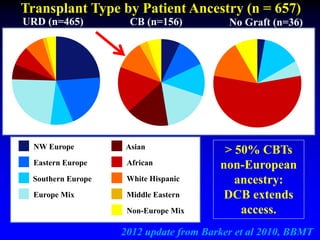
URD (n=465) CB (n=156) No Graft (n=36)
NW Europe Asian
Eastern Europe African
Southern Europe White Hispanic
Europe Mix Middle Eastern
Non-Europe Mix
Transplant Type by Patient Ancestry (n = 657)
> 50% CBTs
non-European
ancestry:
DCB extends
access.
2012 update from Barker et al 2010, BBMT
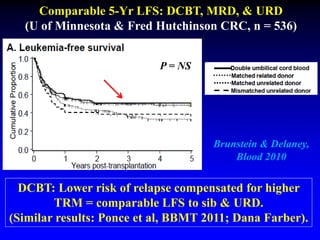
P = NS
Comparable 5-Yr LFS: DCBT, MRD, & URD
(U of Minnesota & Fred Hutchinson CRC, n = 536)
Brunstein & Delaney,
Blood 2010
DCBT: Lower risk of relapse compensated for higher
TRM = comparable LFS to sib & URD.
(Similar results: Ponce et al, BBMT 2011; Dana Farber).
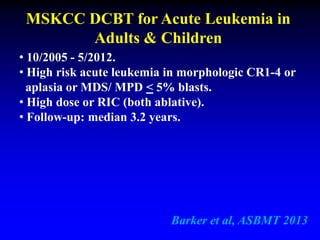
MSKCC DCBT for Acute Leukemia in
Adults & Children
• 10/2005 - 5/2012.
• High risk acute leukemia in morphologic CR1-4 or
aplasia or MDS/ MPD < 5% blasts.
• High dose or RIC (both ablative).
• Follow-up: median 3.2 years.
Barker et al, ASBMT 2013
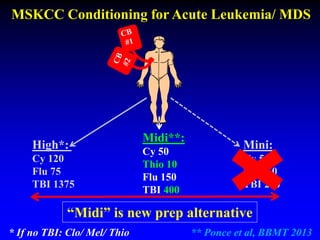
High*:
Cy 120
Flu 75
TBI 1375
“Midi” is new prep alternative
Mini:
Cy 50
Flu 150
TBI 200
Midi**:
Cy 50
Thio 10
Flu 150
TBI 400
MSKCC Conditioning for Acute Leukemia/ MDS
* If no TBI: Clo/ Mel/ Thio ** Ponce et al, BBMT 2013
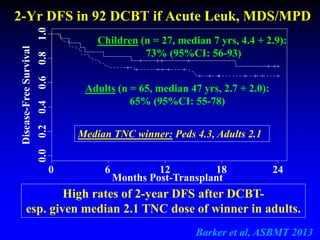
2-Yr DFS in 92 DCBT if Acute Leuk, MDS/MPD
Adults (n = 65, median 47 yrs, 2.7 + 2.0):
65% (95%CI: 55-78)
0.00.20.40.60.81.0
Months Post-Transplant
Disease-FreeSurvival
0 6 12 18 24
Children (n = 27, median 7 yrs, 4.4 + 2.9):
73% (95%CI: 56-93)
High rates of 2-year DFS after DCBT-
esp. given median 2.1 TNC dose of winner in adults.
Median TNC winner: Peds 4.3, Adults 2.1
Barker et al, ASBMT 2013
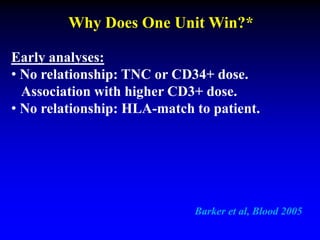
Early analyses:
• No relationship: TNC or CD34+ dose.
Association with higher CD3+ dose.
• No relationship: HLA-match to patient.
Why Does One Unit Win?*
Barker et al, Blood 2005
% of Viable
CD34+ Cells
Winner
(n = 44)
Loser
(n = 44)
< 75%
(n = 16)
1 15
≥ 75%
(n = 72)
43 29
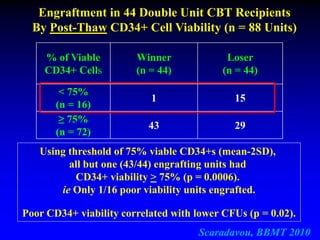
Engraftment in 44 Double Unit CBT Recipients
By Post-Thaw CD34+ Cell Viability (n = 88 Units)
Using threshold of 75% viable CD34+s (mean-2SD),
all but one (43/44) engrafting units had
CD34+ viability > 75% (p = 0.0006).
ie Only 1/16 poor viability units engrafted.
Poor CD34+ viability correlated with lower CFUs (p = 0.02).
Scaradavou, BBMT 2010
0%
10%
20%
30%
40%
50%
60%
70%
80%
90%
100%
NYBC
(n=149)
Other US
(n=123)
International
(n=94)
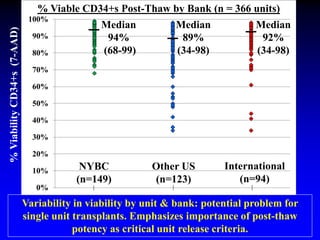
% Viable CD34+s Post-Thaw by Bank (n = 366 units)
Median
94%
(68-99)
Median
89%
(34-98)
Median
92%
(34-98)
%ViabilityCD34+s(7-AAD)
Variability in viability by unit & bank: potential problem for
single unit transplants. Emphasizes importance of post-thaw
potency as critical unit release criteria.
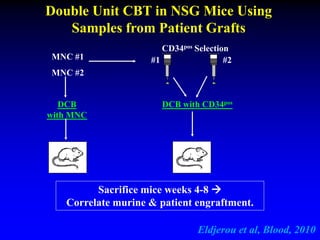
DCB with CD34pos
#1 #2
DCB
with MNC
MNC #1
MNC #2
CD34pos Selection
Sacrifice mice weeks 4-8 
Correlate murine & patient engraftment.
Double Unit CBT in NSG Mice Using
Samples from Patient Grafts
Eldjerou et al, Blood, 2010
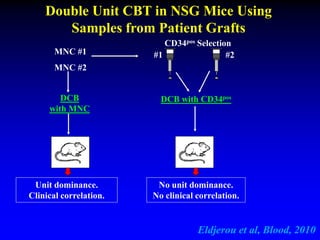
DCB with CD34pos
#1 #2
DCB
with MNC
MNC #1
MNC #2
CD34pos Selection
Unit dominance.
Clinical correlation.
Double Unit CBT in NSG Mice Using
Samples from Patient Grafts
Eldjerou et al, Blood, 2010
No unit dominance.
No clinical correlation.
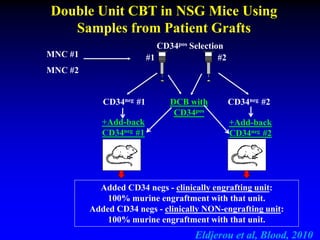
DCB with
CD34pos
CD34neg #2
+Add-back
CD34neg #2
#1 #2MNC #1
MNC #2
CD34neg #1
+Add-back
CD34neg #1
CD34pos Selection
Added CD34 negs - clinically engrafting unit:
100% murine engraftment with that unit.
Added CD34 negs - clinically NON-engrafting unit:
100% murine engraftment with that unit.
Double Unit CBT in NSG Mice Using
Samples from Patient Grafts
Eldjerou et al, Blood, 2010
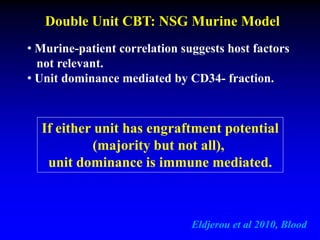
Double Unit CBT: NSG Murine Model
Eldjerou et al 2010, Blood
• Murine-patient correlation suggests host factors
not relevant.
• Unit dominance mediated by CD34- fraction.
If either unit has engraftment potential
(majority but not all),
unit dominance is immune mediated.
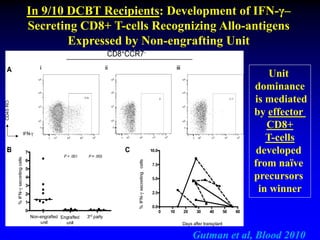
In 9/10 DCBT Recipients: Development of IFN-γ–
Secreting CD8+ T-cells Recognizing Allo-antigens
Expressed by Non-engrafting Unit
Gutman et al, Blood 2010
Unit
dominance
is mediated
by effector
CD8+
T-cells
developed
from naïve
precursors
in winner
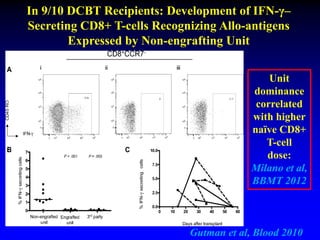
In 9/10 DCBT Recipients: Development of IFN-γ–
Secreting CD8+ T-cells Recognizing Allo-antigens
Expressed by Non-engrafting Unit
Gutman et al, Blood 2010
Unit
dominance
correlated
with higher
naïve CD8+
T-cell
dose:
Milano et al,
BBMT 2012
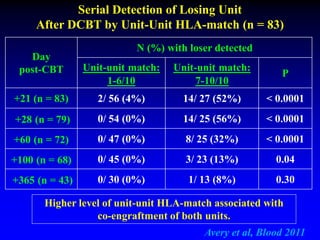
Day
post-CBT
N (%) with loser detected
Unit-unit match:
1-6/10
Unit-unit match:
7-10/10
P
+21 (n = 83) 2/ 56 (4%) 14/ 27 (52%) < 0.0001
+28 (n = 79) 0/ 54 (0%) 14/ 25 (56%) < 0.0001
+60 (n = 72) 0/ 47 (0%) 8/ 25 (32%) < 0.0001
+100 (n = 68) 0/ 45 (0%) 3/ 23 (13%) 0.04
+365 (n = 43) 0/ 30 (0%) 1/ 13 (8%) 0.30
Serial Detection of Losing Unit
After DCBT by Unit-Unit HLA-match (n = 83)
Higher level of unit-unit HLA-match associated with
co-engraftment of both units.
Avery et al, Blood 2011
Why does one unit win?*:
Hematopoietic potential of each unit.
Unit vs unit immune interactions
(T-cell mediated).
As important:
What attributes of graft determine
engraftment success,
GVHD & survival after DCBT?
Infused Doses of Winner & Neutrophil Engraftment
Avery S et al, Blood 2011
Infused viable CD34+ cell dose of winner determines engraftment
Inf. Total Doses (Both Units Combined) & Engraftment
Total TNC & CD3+ cell dose also have dose dependent effects.
Avery S et al, Blood 2011
Neutrophil Engraftment after 92 DCBT by
Infused Viable CD34+ Cell Dose x 105/kg of Winner*
0.00.20.40.60.81.0
Days Post-Transplant
CumulativeIncidence
0 10 20 30 40
< 0.50
(n = 23)
0.51-1.00 (n = 27)
1.01-1.50
(n = 19)
> 1.51
(n = 23)
100%
engraftment
success if
winning unit
had viable
CD34+ cell
dose > 1.0.
* Unit predominating in assessment of hematopoiesis in 1st month post DCBT
P < 0.001
Barker et al,
ASBMT 2013
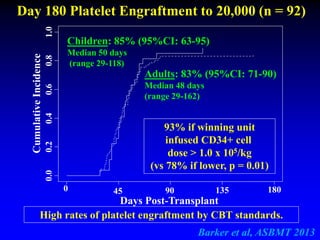
Day 180 Platelet Engraftment to 20,000 (n = 92)
0.00.20.40.60.81.0
Days Post-Transplant
CumulativeIncidence
0 45 90 135 180
Children: 85% (95%CI: 63-95)
Median 50 days
(range 29-118)
Adults: 83% (95%CI: 71-90)
Median 48 days
(range 29-162)
High rates of platelet engraftment by CBT standards.
93% if winning unit
infused CD34+ cell
dose > 1.0 x 10⁵/kg
(vs 78% if lower, p = 0.01)
Barker et al, ASBMT 2013
20
40
60
80
100
0
4-6/6 Allele
1-3/6 Allele
Months Post-Transplant
0
100
80
60
40
20
0
1-7/10 Allele
8-9/10 Allele
1 2 3 4 5 6 0 1 2 3 4 5 6
Ponce, D., BBMT 2013
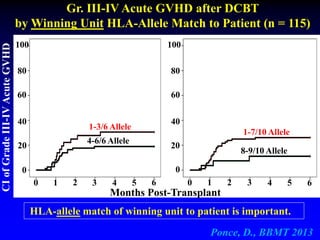
Gr. III-IV Acute GVHD after DCBT
by Winning Unit HLA-Allele Match to Patient (n = 115)
HLA-allele match of winning unit to patient is important.
Comparison 2-Yr DFS P Value
Age 0-15 years (n = 27)
> 16 years (n = 65)
73%
65%
0.32
Ancestry Europeans (n = 40)
Non-Europeans (n = 52)
69%
66%
0.86
Remission
Status
CR1 (n = 49)
All others (n = 43)
66%
69%
0.98
Conditioning
Intensity
High-dose (n = 54)
RIC (n = 38)
70%
64%
0.60
Recipient CMV
Sero-status
CMV+ (n = 51)
CMV- (n = 41)
54%
85%
0.01
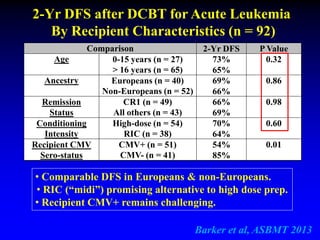
2-Yr DFS after DCBT for Acute Leukemia
By Recipient Characteristics (n = 92)
• Comparable DFS in Europeans & non-Europeans.
• RIC (“midi”) promising alternative to high dose prep.
• Recipient CMV+ remains challenging.
Barker et al, ASBMT 2013
Comparison 2-Yr DFS P Value
HLA-match
Dominant Unit
2-5/10 (n = 34)
6-7/10 (n = 39)
8-9/10 (n = 19)
69%
65%
68%
0.84
Inf. CD34+ Dose
Dominant Unit
< 1.0 (n = 50)
> 1.0 (n = 52)
64%
72%
0.13
Inf. TNC
Dominant Unit
< 2.0 (n = 34)
2.0-2.85 (n = 27)
> 2.85 (n = 31)
62%
74%
68%
0.29
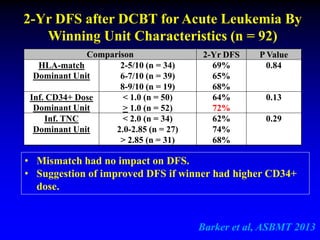
• Mismatch had no impact on DFS.
• Suggestion of improved DFS if winner had higher CD34+
dose.
2-Yr DFS after DCBT for Acute Leukemia By
Winning Unit Characteristics (n = 92)
Barker et al, ASBMT 2013
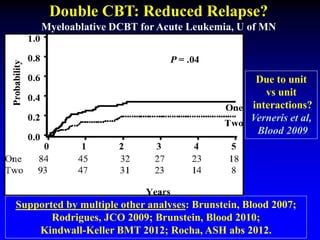
Due to unit
vs unit
interactions?
Verneris et al,
Blood 2009
Double CBT: Reduced Relapse?
Myeloablative DCBT for Acute Leukemia, U of MN
Supported by multiple other analyses: Brunstein, Blood 2007;
Rodrigues, JCO 2009; Brunstein, Blood 2010;
Kindwall-Keller BMT 2012; Rocha, ASH abs 2012.
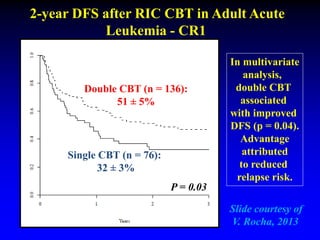
2-year DFS after RIC CBT in Adult Acute
Leukemia - CR1
P = 0.03
In multivariate
analysis,
double CBT
associated
with improved
DFS (p = 0.04).
Advantage
attributed
to reduced
relapse risk.
Double CBT (n = 136):
51 ± 5%
Single CBT (n = 76):
32 ± 3%
Slide courtesy of
V. Rocha, 2013
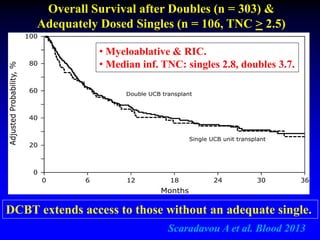
Overall Survival after Doubles (n = 303) &
Adequately Dosed Singles (n = 106, TNC > 2.5)
Scaradavou A et al. Blood 2013
• Myeloablative & RIC.
• Median inf. TNC: singles 2.8, doubles 3.7.
DCBT extends access to those without an adequate single.
100
0
20
40
60
80
0
100
20
40
60
80
Probability,%
Months 0 3 6 9 12
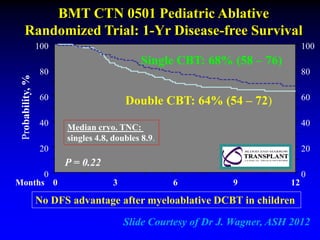
Double CBT: 64% (54 – 72)
Single CBT: 68% (58 – 76)
BMT CTN 0501 Pediatric Ablative
Randomized Trial: 1-Yr Disease-free Survival
P = 0.22
Slide Courtesy of Dr J. Wagner, ASH 2012
No DFS advantage after myeloablative DCBT in children
Median cryo. TNC:
singles 4.8, doubles 8.9.
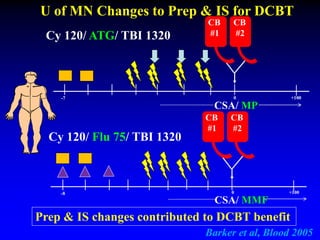
-7 0 +100
U of MN Changes to Prep & IS for DCBT
Cy 120/ Flu 75/ TBI 1320
CSA/ MP
CB
#2
CB
#1
-8 0 +100
Cy 120/ ATG/ TBI 1320
CB
#2
CB
#1
CSA/ MMF
Prep & IS changes contributed to DCBT benefit
Barker et al, Blood 2005
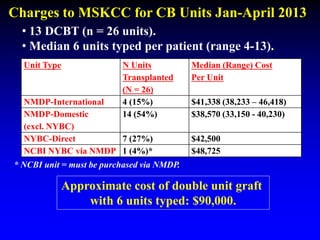
Unit Type N Units
Transplanted
(N = 26)
Median (Range) Cost
Per Unit
NMDP-International 4 (15%) $41,338 (38,233 – 46,418)
NMDP-Domestic
(excl. NYBC)
14 (54%) $38,570 (33,150 - 40,230)
NYBC-Direct 7 (27%) $42,500
NCBI NYBC via NMDP 1 (4%)* $48,725
Charges to MSKCC for CB Units Jan-April 2013
Approximate cost of double unit graft
with 6 units typed: $90,000.
* NCBI unit = must be purchased via NMDP.
• 13 DCBT (n = 26 units).
• Median 6 units typed per patient (range 4-13).
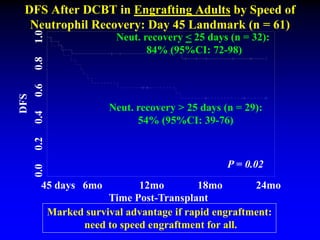
DFS After DCBT in Engrafting Adults by Speed of
Neutrophil Recovery: Day 45 Landmark (n = 61)
P = 0.02
0.00.20.40.60.81.0
Time Post-Transplant
DFS
45 days 6mo 12mo 18mo 24mo
Neut. recovery < 25 days (n = 32):
84% (95%CI: 72-98)
Neut. recovery > 25 days (n = 29):
54% (95%CI: 39-76)
Marked survival advantage if rapid engraftment:
need to speed engraftment for all.
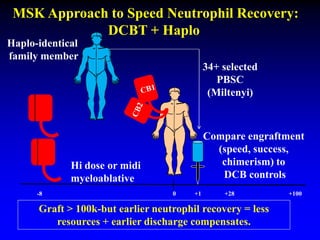
-8 0 +1 +28 +100
Compare engraftment
(speed, success,
chimerism) to
DCB controls
Hi dose or midi
myeloablative
MSK Approach to Speed Neutrophil Recovery:
DCBT + Haplo
Graft > 100k-but earlier neutrophil recovery = less
resources + earlier discharge compensates.
34+ selected
PBSC
(Miltenyi)
Haplo-identical
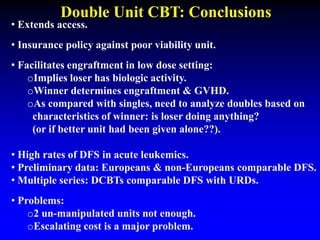
family member
Double Unit CBT: Conclusions
• Extends access.
• Insurance policy against poor viability unit.
• Facilitates engraftment in low dose setting:
oImplies loser has biologic activity.
oWinner determines engraftment & GVHD.
oAs compared with singles, need to analyze doubles based on
characteristics of winner: is loser doing anything?
(or if better unit had been given alone??).
• High rates of DFS in acute leukemics.
• Preliminary data: Europeans & non-Europeans comparable DFS.
• Multiple series: DCBTs comparable DFS with URDs.
• Problems:
o2 un-manipulated units not enough.
oEscalating cost is a major problem.

Double Unit Cord Blood Transplantation for Acute Leukemia

  • 1.
    Juliet N. Barker,MBBS (Hons), FRACP Associate Attending Director, Cord Blood Transplant Program Memorial Sloan-Kettering Cancer Center Double Unit Cord Blood Transplantation for Acute Leukemia CSA/ MMF -3 -2 -1-4-6 -5 30 1000
  • 2.
    Acknowledgements U of Minnesota JohnE. Wagner NYBC Pablo Rubinstein Cladd Stevens Machi Scaradavou MSKCC Staff of Adult & Pediatric Transplant Search: Courtney Byam, Rosanna Ferrante Debbie Wells, Melissa Sideroff, Sinda Lee Cell Therapy Lab CB Research Staff: Marissa Lubin Anne Marie Gonzales , Katie Evans Cellular Immunology Lab: Kathy Smith Pediatrics: Machi Scaradavou Nancy Kernan & Richard O’Reilly Adult BMT Service: Doris Ponce Marcel van den Brink & Sergio Giralt Funding Gabrielle’s Angel Foundation for Cancer Research, the MSKCC Society, MSKCC Translational and Integrative Medicine Research Grant, P01 CA23766 NCI, NIH.
  • 3.
    Original Reasons forDouble Unit CB Grafts • Platform for investigation of expansion or other graft manipulation. • Augment graft cell dose = improve engraftment, reduce TRM, improve survival.
  • 4.
    Reasons for DoubleUnit CB Grafts: Successful? • Platform for investigation of expansion or other graft manipulation?: YES • Augment graft cell dose = improve engraftment, reduce TRM, improve survival?: YES in adults, children?
  • 5.
    Sibling typing → simultaneousURD & CB search Suitable Sibling or URD:Suitable CB Graft: 4-6/6 A,B antigen, DRB1 allele 2 units: each > 2 x 10⁷ NC/kg Hi Dose Prep RIC or Mini Children (Young adults) RIC/ Mini + 10/10 donor Hi Dose + TCD 9-10/10 donor MSKCC Donor Algorithm: DCBT Extends Access Donors identified for > 95% patients.
  • 6.
    URD (n=465) CB(n=156) No Graft (n=36) NW Europe Asian Eastern Europe African Southern Europe White Hispanic Europe Mix Middle Eastern Non-Europe Mix Transplant Type by Patient Ancestry (n = 657) > 50% CBTs non-European ancestry: DCB extends access. 2012 update from Barker et al 2010, BBMT
  • 7.
    P = NS Comparable5-Yr LFS: DCBT, MRD, & URD (U of Minnesota & Fred Hutchinson CRC, n = 536) Brunstein & Delaney, Blood 2010 DCBT: Lower risk of relapse compensated for higher TRM = comparable LFS to sib & URD. (Similar results: Ponce et al, BBMT 2011; Dana Farber).
  • 8.
    MSKCC DCBT forAcute Leukemia in Adults & Children • 10/2005 - 5/2012. • High risk acute leukemia in morphologic CR1-4 or aplasia or MDS/ MPD < 5% blasts. • High dose or RIC (both ablative). • Follow-up: median 3.2 years. Barker et al, ASBMT 2013
  • 9.
    High*: Cy 120 Flu 75 TBI1375 “Midi” is new prep alternative Mini: Cy 50 Flu 150 TBI 200 Midi**: Cy 50 Thio 10 Flu 150 TBI 400 MSKCC Conditioning for Acute Leukemia/ MDS * If no TBI: Clo/ Mel/ Thio ** Ponce et al, BBMT 2013
  • 10.
    2-Yr DFS in92 DCBT if Acute Leuk, MDS/MPD Adults (n = 65, median 47 yrs, 2.7 + 2.0): 65% (95%CI: 55-78) 0.00.20.40.60.81.0 Months Post-Transplant Disease-FreeSurvival 0 6 12 18 24 Children (n = 27, median 7 yrs, 4.4 + 2.9): 73% (95%CI: 56-93) High rates of 2-year DFS after DCBT- esp. given median 2.1 TNC dose of winner in adults. Median TNC winner: Peds 4.3, Adults 2.1 Barker et al, ASBMT 2013
  • 11.
    Early analyses: • Norelationship: TNC or CD34+ dose. Association with higher CD3+ dose. • No relationship: HLA-match to patient. Why Does One Unit Win?* Barker et al, Blood 2005
  • 12.
    % of Viable CD34+Cells Winner (n = 44) Loser (n = 44) < 75% (n = 16) 1 15 ≥ 75% (n = 72) 43 29 Engraftment in 44 Double Unit CBT Recipients By Post-Thaw CD34+ Cell Viability (n = 88 Units) Using threshold of 75% viable CD34+s (mean-2SD), all but one (43/44) engrafting units had CD34+ viability > 75% (p = 0.0006). ie Only 1/16 poor viability units engrafted. Poor CD34+ viability correlated with lower CFUs (p = 0.02). Scaradavou, BBMT 2010
  • 13.
    0% 10% 20% 30% 40% 50% 60% 70% 80% 90% 100% NYBC (n=149) Other US (n=123) International (n=94) % ViableCD34+s Post-Thaw by Bank (n = 366 units) Median 94% (68-99) Median 89% (34-98) Median 92% (34-98) %ViabilityCD34+s(7-AAD) Variability in viability by unit & bank: potential problem for single unit transplants. Emphasizes importance of post-thaw potency as critical unit release criteria.
  • 14.
    DCB with CD34pos #1#2 DCB with MNC MNC #1 MNC #2 CD34pos Selection Sacrifice mice weeks 4-8  Correlate murine & patient engraftment. Double Unit CBT in NSG Mice Using Samples from Patient Grafts Eldjerou et al, Blood, 2010
  • 15.
    DCB with CD34pos #1#2 DCB with MNC MNC #1 MNC #2 CD34pos Selection Unit dominance. Clinical correlation. Double Unit CBT in NSG Mice Using Samples from Patient Grafts Eldjerou et al, Blood, 2010 No unit dominance. No clinical correlation.
  • 16.
    DCB with CD34pos CD34neg #2 +Add-back CD34neg#2 #1 #2MNC #1 MNC #2 CD34neg #1 +Add-back CD34neg #1 CD34pos Selection Added CD34 negs - clinically engrafting unit: 100% murine engraftment with that unit. Added CD34 negs - clinically NON-engrafting unit: 100% murine engraftment with that unit. Double Unit CBT in NSG Mice Using Samples from Patient Grafts Eldjerou et al, Blood, 2010
  • 17.
    Double Unit CBT:NSG Murine Model Eldjerou et al 2010, Blood • Murine-patient correlation suggests host factors not relevant. • Unit dominance mediated by CD34- fraction. If either unit has engraftment potential (majority but not all), unit dominance is immune mediated.
  • 18.
    In 9/10 DCBTRecipients: Development of IFN-γ– Secreting CD8+ T-cells Recognizing Allo-antigens Expressed by Non-engrafting Unit Gutman et al, Blood 2010 Unit dominance is mediated by effector CD8+ T-cells developed from naïve precursors in winner
  • 19.
    In 9/10 DCBTRecipients: Development of IFN-γ– Secreting CD8+ T-cells Recognizing Allo-antigens Expressed by Non-engrafting Unit Gutman et al, Blood 2010 Unit dominance correlated with higher naïve CD8+ T-cell dose: Milano et al, BBMT 2012
  • 20.
    Day post-CBT N (%) withloser detected Unit-unit match: 1-6/10 Unit-unit match: 7-10/10 P +21 (n = 83) 2/ 56 (4%) 14/ 27 (52%) < 0.0001 +28 (n = 79) 0/ 54 (0%) 14/ 25 (56%) < 0.0001 +60 (n = 72) 0/ 47 (0%) 8/ 25 (32%) < 0.0001 +100 (n = 68) 0/ 45 (0%) 3/ 23 (13%) 0.04 +365 (n = 43) 0/ 30 (0%) 1/ 13 (8%) 0.30 Serial Detection of Losing Unit After DCBT by Unit-Unit HLA-match (n = 83) Higher level of unit-unit HLA-match associated with co-engraftment of both units. Avery et al, Blood 2011
  • 21.
    Why does oneunit win?*: Hematopoietic potential of each unit. Unit vs unit immune interactions (T-cell mediated). As important: What attributes of graft determine engraftment success, GVHD & survival after DCBT?
  • 22.
    Infused Doses ofWinner & Neutrophil Engraftment Avery S et al, Blood 2011 Infused viable CD34+ cell dose of winner determines engraftment
  • 23.
    Inf. Total Doses(Both Units Combined) & Engraftment Total TNC & CD3+ cell dose also have dose dependent effects. Avery S et al, Blood 2011
  • 24.
    Neutrophil Engraftment after92 DCBT by Infused Viable CD34+ Cell Dose x 105/kg of Winner* 0.00.20.40.60.81.0 Days Post-Transplant CumulativeIncidence 0 10 20 30 40 < 0.50 (n = 23) 0.51-1.00 (n = 27) 1.01-1.50 (n = 19) > 1.51 (n = 23) 100% engraftment success if winning unit had viable CD34+ cell dose > 1.0. * Unit predominating in assessment of hematopoiesis in 1st month post DCBT P < 0.001 Barker et al, ASBMT 2013
  • 25.
    Day 180 PlateletEngraftment to 20,000 (n = 92) 0.00.20.40.60.81.0 Days Post-Transplant CumulativeIncidence 0 45 90 135 180 Children: 85% (95%CI: 63-95) Median 50 days (range 29-118) Adults: 83% (95%CI: 71-90) Median 48 days (range 29-162) High rates of platelet engraftment by CBT standards. 93% if winning unit infused CD34+ cell dose > 1.0 x 10⁵/kg (vs 78% if lower, p = 0.01) Barker et al, ASBMT 2013
  • 26.
    20 40 60 80 100 0 4-6/6 Allele 1-3/6 Allele MonthsPost-Transplant 0 100 80 60 40 20 0 1-7/10 Allele 8-9/10 Allele 1 2 3 4 5 6 0 1 2 3 4 5 6 Ponce, D., BBMT 2013 Gr. III-IV Acute GVHD after DCBT by Winning Unit HLA-Allele Match to Patient (n = 115) HLA-allele match of winning unit to patient is important.
  • 27.
    Comparison 2-Yr DFSP Value Age 0-15 years (n = 27) > 16 years (n = 65) 73% 65% 0.32 Ancestry Europeans (n = 40) Non-Europeans (n = 52) 69% 66% 0.86 Remission Status CR1 (n = 49) All others (n = 43) 66% 69% 0.98 Conditioning Intensity High-dose (n = 54) RIC (n = 38) 70% 64% 0.60 Recipient CMV Sero-status CMV+ (n = 51) CMV- (n = 41) 54% 85% 0.01 2-Yr DFS after DCBT for Acute Leukemia By Recipient Characteristics (n = 92) • Comparable DFS in Europeans & non-Europeans. • RIC (“midi”) promising alternative to high dose prep. • Recipient CMV+ remains challenging. Barker et al, ASBMT 2013
  • 28.
    Comparison 2-Yr DFSP Value HLA-match Dominant Unit 2-5/10 (n = 34) 6-7/10 (n = 39) 8-9/10 (n = 19) 69% 65% 68% 0.84 Inf. CD34+ Dose Dominant Unit < 1.0 (n = 50) > 1.0 (n = 52) 64% 72% 0.13 Inf. TNC Dominant Unit < 2.0 (n = 34) 2.0-2.85 (n = 27) > 2.85 (n = 31) 62% 74% 68% 0.29 • Mismatch had no impact on DFS. • Suggestion of improved DFS if winner had higher CD34+ dose. 2-Yr DFS after DCBT for Acute Leukemia By Winning Unit Characteristics (n = 92) Barker et al, ASBMT 2013
  • 29.
    Due to unit vsunit interactions? Verneris et al, Blood 2009 Double CBT: Reduced Relapse? Myeloablative DCBT for Acute Leukemia, U of MN Supported by multiple other analyses: Brunstein, Blood 2007; Rodrigues, JCO 2009; Brunstein, Blood 2010; Kindwall-Keller BMT 2012; Rocha, ASH abs 2012.
  • 30.
    2-year DFS afterRIC CBT in Adult Acute Leukemia - CR1 P = 0.03 In multivariate analysis, double CBT associated with improved DFS (p = 0.04). Advantage attributed to reduced relapse risk. Double CBT (n = 136): 51 ± 5% Single CBT (n = 76): 32 ± 3% Slide courtesy of V. Rocha, 2013
  • 31.
    Overall Survival afterDoubles (n = 303) & Adequately Dosed Singles (n = 106, TNC > 2.5) Scaradavou A et al. Blood 2013 • Myeloablative & RIC. • Median inf. TNC: singles 2.8, doubles 3.7. DCBT extends access to those without an adequate single.
  • 32.
    100 0 20 40 60 80 0 100 20 40 60 80 Probability,% Months 0 36 9 12 Double CBT: 64% (54 – 72) Single CBT: 68% (58 – 76) BMT CTN 0501 Pediatric Ablative Randomized Trial: 1-Yr Disease-free Survival P = 0.22 Slide Courtesy of Dr J. Wagner, ASH 2012 No DFS advantage after myeloablative DCBT in children Median cryo. TNC: singles 4.8, doubles 8.9.
  • 33.
    -7 0 +100 Uof MN Changes to Prep & IS for DCBT Cy 120/ Flu 75/ TBI 1320 CSA/ MP CB #2 CB #1 -8 0 +100 Cy 120/ ATG/ TBI 1320 CB #2 CB #1 CSA/ MMF Prep & IS changes contributed to DCBT benefit Barker et al, Blood 2005
  • 34.
    Unit Type NUnits Transplanted (N = 26) Median (Range) Cost Per Unit NMDP-International 4 (15%) $41,338 (38,233 – 46,418) NMDP-Domestic (excl. NYBC) 14 (54%) $38,570 (33,150 - 40,230) NYBC-Direct 7 (27%) $42,500 NCBI NYBC via NMDP 1 (4%)* $48,725 Charges to MSKCC for CB Units Jan-April 2013 Approximate cost of double unit graft with 6 units typed: $90,000. * NCBI unit = must be purchased via NMDP. • 13 DCBT (n = 26 units). • Median 6 units typed per patient (range 4-13).
  • 35.
    DFS After DCBTin Engrafting Adults by Speed of Neutrophil Recovery: Day 45 Landmark (n = 61) P = 0.02 0.00.20.40.60.81.0 Time Post-Transplant DFS 45 days 6mo 12mo 18mo 24mo Neut. recovery < 25 days (n = 32): 84% (95%CI: 72-98) Neut. recovery > 25 days (n = 29): 54% (95%CI: 39-76) Marked survival advantage if rapid engraftment: need to speed engraftment for all.
  • 36.
    -8 0 +1+28 +100 Compare engraftment (speed, success, chimerism) to DCB controls Hi dose or midi myeloablative MSK Approach to Speed Neutrophil Recovery: DCBT + Haplo Graft > 100k-but earlier neutrophil recovery = less resources + earlier discharge compensates. 34+ selected PBSC (Miltenyi) Haplo-identical family member
  • 37.
    Double Unit CBT:Conclusions • Extends access. • Insurance policy against poor viability unit. • Facilitates engraftment in low dose setting: oImplies loser has biologic activity. oWinner determines engraftment & GVHD. oAs compared with singles, need to analyze doubles based on characteristics of winner: is loser doing anything? (or if better unit had been given alone??). • High rates of DFS in acute leukemics. • Preliminary data: Europeans & non-Europeans comparable DFS. • Multiple series: DCBTs comparable DFS with URDs. • Problems: o2 un-manipulated units not enough. oEscalating cost is a major problem.