Understanding Cancer and Related Topics
Understanding Blood Stem Cell Transplantation
These PowerPoint slides are not locked files. You can mix and match slides from different tutorials as
you prepare your own lectures. In the Notes section, you will find explanations of the graphics.
The art in this tutorial is copyrighted and may not be reused for commercial gain.
Please do not remove the NCI logo or the copyright mark from any slide.
These tutorials may be copied only if they are distributed free of charge for educational purposes.
Developed by:
Donna Kerrigan, M.S.
Kathryn Hollen
Jeanne Kelly
Brian Hollen
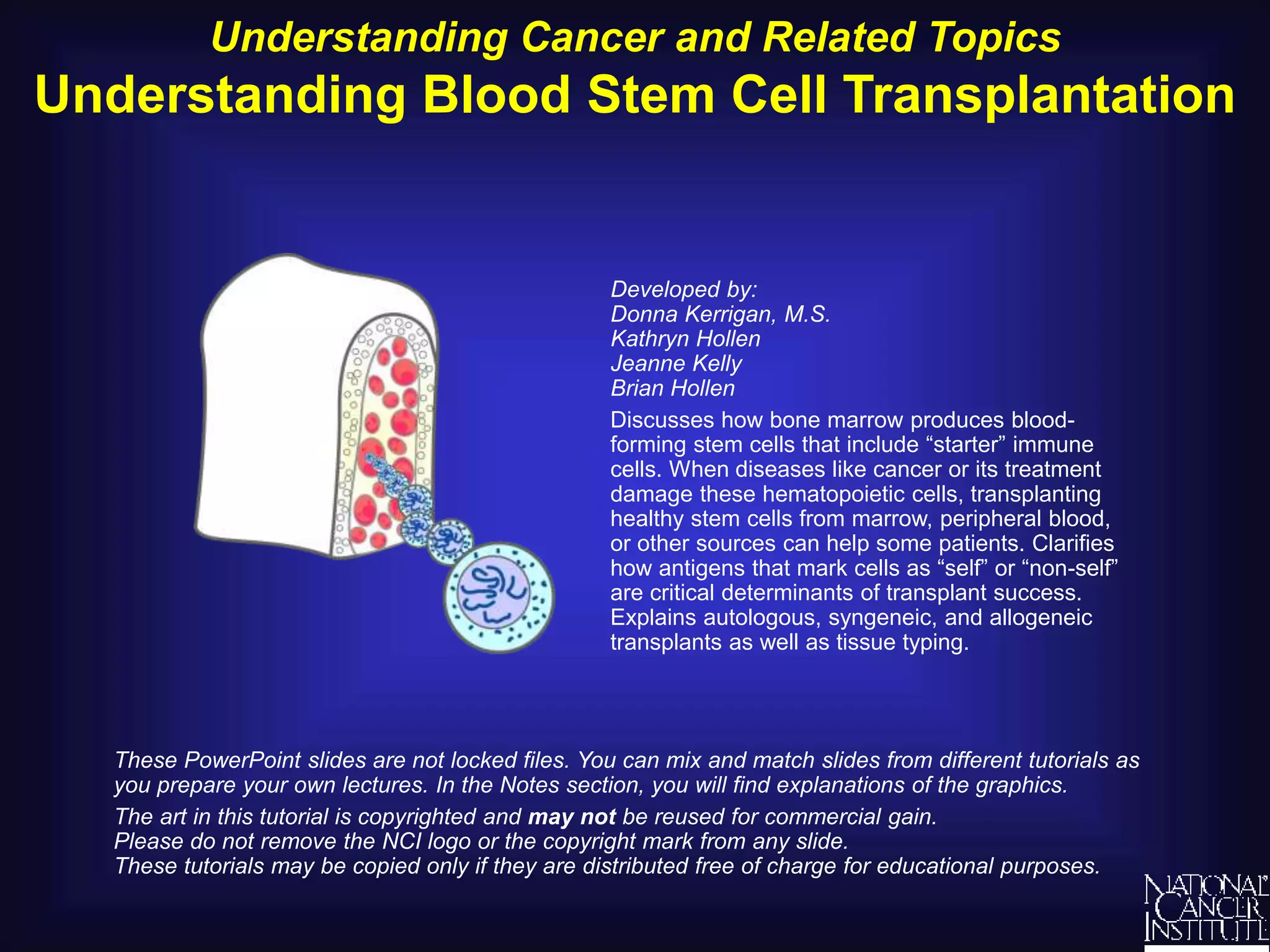
Discusses how bone marrow produces blood-
forming stem cells that include “starter” immune
cells. When diseases like cancer or its treatment
damage these hematopoietic cells, transplanting
healthy stem cells from marrow, peripheral blood,
or other sources can help some patients. Clarifies
how antigens that mark cells as “self” or “non-self”
are critical determinants of transplant success.
Explains autologous, syngeneic, and allogeneic
transplants as well as tissue typing.
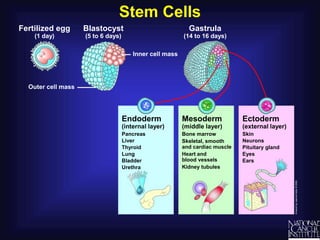
Stem Cells
Gastrula
(14 to 16 days)
Fertilized egg
(1 day)
Outer cell mass
Inner cell mass
Blastocyst
(5 to 6 days)
Ectoderm
(external layer)
Skin
Neurons
Pituitary gland
Eyes
Ears
Endoderm
(internal layer)
Pancreas
Liver
Thyroid
Lung
Bladder
Urethra
Mesoderm
(middle layer)
Bone marrow
Skeletal, smooth
and cardiac muscle
Heart and
blood vessels
Kidney tubules
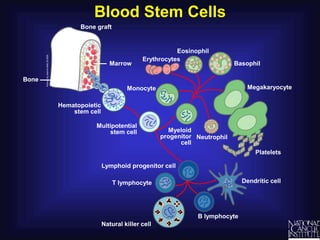
Blood Stem Cells
Bone graft
Multipotential
stem cell
Hematopoietic
stem cell
Platelets
Erythrocytes
Eosinophil
Neutrophil
Megakaryocyte
Basophil
T lymphocyte
Natural killer cell
Dendritic cell
B lymphocyte
Lymphoid progenitor cell
Myeloid
progenitor
cell
Monocyte
Marrow
Bone
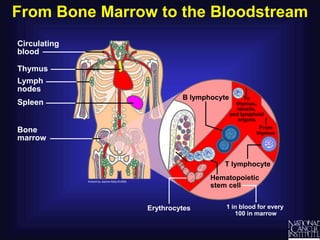
From Bone Marrow to the Bloodstream
T lymphocyte
Hematopoietic
stem cell
Erythrocytes
Circulating
blood
Thymus
Lymph
nodes
Spleen
Bone
marrow
To
thymus,
tonsils,
and lymphoid
organs
1 in blood for every
100 in marrow
B lymphocyte
From
thymus
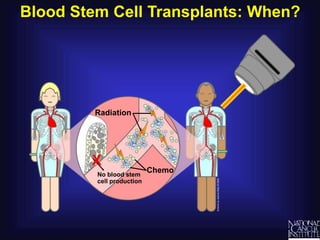
Blood Stem Cell Transplants: When?
No blood stem
cell production
Chemo
Radiation
X
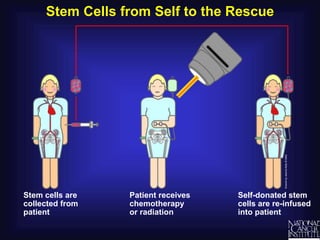
Stem Cells from Self to the Rescue
Patient receives
chemotherapy
or radiation
Self-donated stem
cells are re-infused
into patient
Stem cells are
collected from
patient
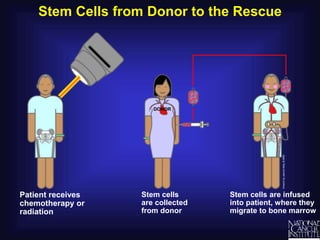
Stem Cells from Donor to the Rescue
Stem cells
are collected
from donor
Stem cells are infused
into patient, where they
migrate to bone marrow
Patient receives
chemotherapy or
radiation
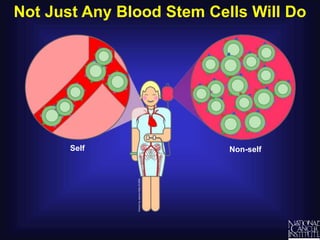
Not Just Any Blood Stem Cells Will Do
Self Non-self
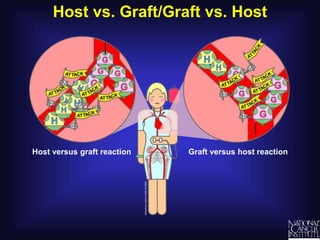
Host vs. Graft/Graft vs. Host
Host versus graft reaction Graft versus host reaction
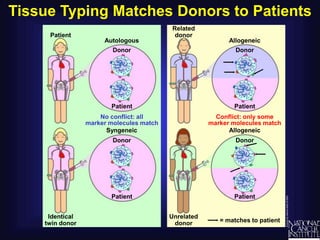
Tissue Typing Matches Donors to Patients
Allogeneic
Patient
= matches to patient
Conflict: only some
marker molecules match
No conflict: all
marker molecules match
Patient
Syngeneic
Autologous
Donor
Identical
twin donor
Unrelated
donor
Related
donor
Allogeneic
Patient
Donor
Patient
Donor
Patient
Donor
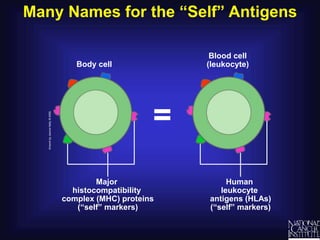
Many Names for the “Self” Antigens
Major
histocompatibility
complex (MHC) proteins
(“self” markers)
Blood cell
(leukocyte)
Body cell
Human
leukocyte
antigens (HLAs)
(“self” markers)
=
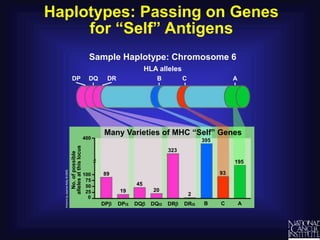
Haplotypes: Passing on Genes
for “Self” Antigens
DP DR
DQ
No.
of
possible
alleles
at
this
locus
Many Varieties of MHC “Self” Genes
Sample Haplotype: Chromosome 6
DP DQ
A
C
HLA alleles
DR
45
89
19 20
2
323
75
50
25
400
100
0
DP DQ DR
B
93
195
395
B C A
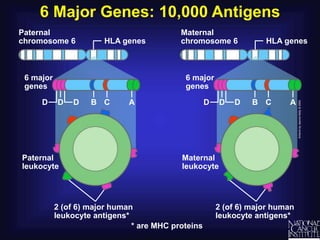
6 Major Genes: 10,000 Antigens
HLA genes
Paternal
chromosome 6
Maternal
chromosome 6
Maternal
leukocyte
Paternal
leukocyte
HLA genes
D B C
D A
D
D B C
D A
D
* are MHC proteins
2 (of 6) major human
leukocyte antigens*
6 major
genes
6 major
genes
2 (of 6) major human
leukocyte antigens*
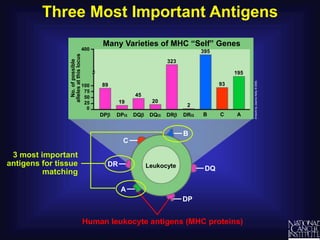
Three Most Important Antigens
3 most important
antigens for tissue
matching
Leukocyte
Human leukocyte antigens (MHC proteins)
DP
DQ
B
C
DR
A
No.
of
possible
alleles
at
this
locus
Many Varieties of MHC “Self” Genes
DP DQ DR
45
89
19 20
2
323
75
50
25
400
100
0
DP DQ DR
93
195
395
B C A
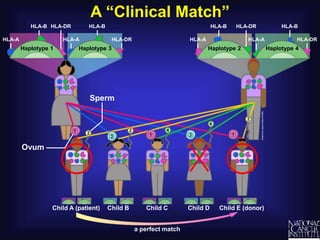
A “Clinical Match”
Child A (patient)
HLA-A
HLA-B
Child E (donor)
a perfect match
Child D
Haplotype 3
Child C
Sperm
Ovum
Child B
Haplotype 1
HLA-A HLA-DR
HLA-B
HLA-DR
HLA-A
HLA-B
Haplotype 4
Haplotype 2
HLA-A HLA-DR
HLA-B
HLA-DR
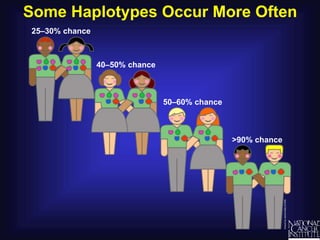
Some Haplotypes Occur More Often
25–30% chance
>90% chance
50–60% chance
40–50% chance
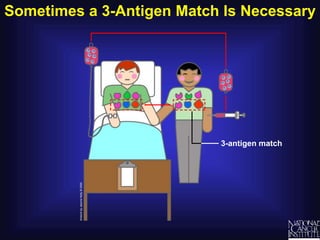
Sometimes a 3-Antigen Match Is Necessary
3-antigen match
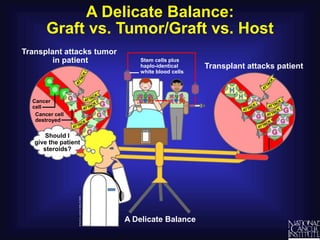
A Delicate Balance:
Graft vs. Tumor/Graft vs. Host
Stem cells plus
haplo-identical
white blood cells
Cancer cell
destroyed
Cancer
cell
Transplant attacks patient
Transplant attacks tumor
in patient
A Delicate Balance
Should I
give the patient
steroids?
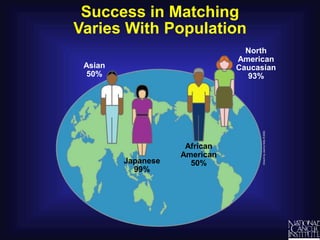
Success in Matching
Varies With Population
Japanese
99%
African
American
50%
North
American
Caucasian
93%
Asian
50%
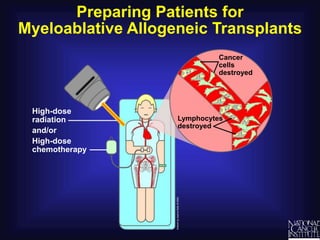
Preparing Patients for
Myeloablative Allogeneic Transplants
High-dose
radiation
and/or
High-dose
chemotherapy
Lymphocytes
destroyed
Cancer
cells
destroyed
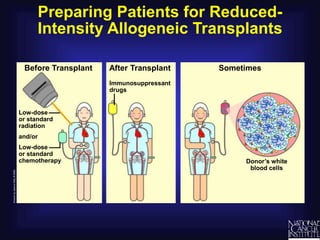
Preparing Patients for Reduced-
Intensity Allogeneic Transplants
Before Transplant
Donor’s white
blood cells
Sometimes
After Transplant
Low-dose
or standard
radiation
and/or
Low-dose
or standard
chemotherapy
Immunosuppressant
drugs
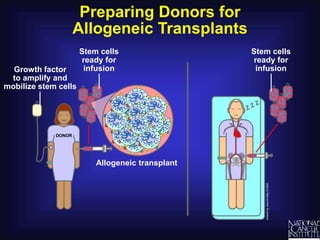
Preparing Donors for
Allogeneic Transplants
Growth factor
to amplify and
mobilize stem cells
Allogeneic transplant
Stem cells
ready for
infusion
Stem cells
ready for
infusion
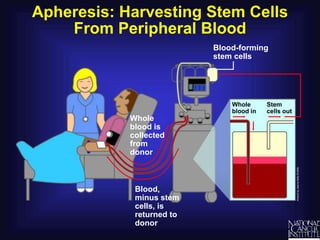
Apheresis: Harvesting Stem Cells
From Peripheral Blood
Whole
blood is
collected
from
donor
Blood,
minus stem
cells, is
returned to
donor
Stem
cells out
Whole
blood in
Blood-forming
stem cells
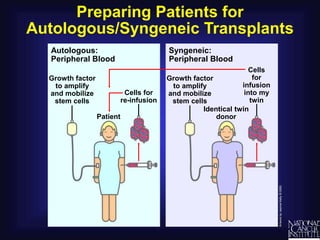
Preparing Patients for
Autologous/Syngeneic Transplants
Syngeneic:
Peripheral Blood
Growth factor
to amplify
and mobilize
stem cells
Patient
Autologous:
Peripheral Blood
Cells
for
infusion
into my
twin
Identical twin
donor
Cells for
re-infusion
Growth factor
to amplify
and mobilize
stem cells
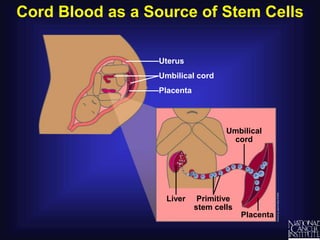
Cord Blood as a Source of Stem Cells
Placenta
Umbilical cord
Placenta
Primitive
stem cells
Liver
Uterus
Umbilical
cord
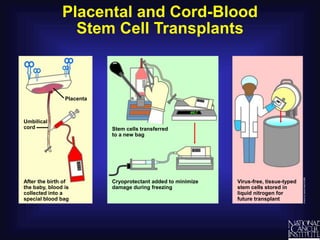
Placental and Cord-Blood
Stem Cell Transplants
After the birth of
the baby, blood is
collected into a
special blood bag
Umbilical
cord
Placenta
Virus-free, tissue-typed
stem cells stored in
liquid nitrogen for
future transplant
Cryoprotectant added to minimize
damage during freezing
Stem cells transferred
to a new bag
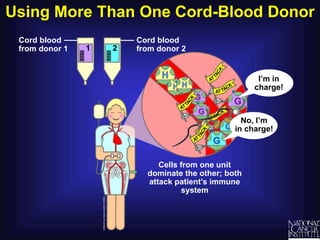
Using More Than One Cord-Blood Donor
Cells from one unit
dominate the other; both
attack patient’s immune
system
Cord blood
from donor 2
Cord blood
from donor 1
No, I’m
in charge!
I’m in
charge!
2
1
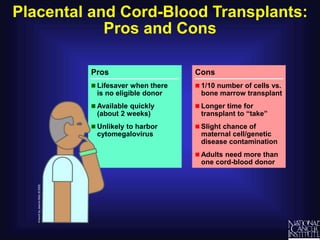
Placental and Cord-Blood Transplants:
Pros and Cons
Cons
 1/10 number of cells vs.
bone marrow transplant
 Longer time for
transplant to “take”
 Slight chance of
maternal cell/genetic
disease contamination
 Adults need more than
one cord-blood donor
Pros
 Lifesaver when there
is no eligible donor
 Available quickly
(about 2 weeks)
 Unlikely to harbor
cytomegalovirus
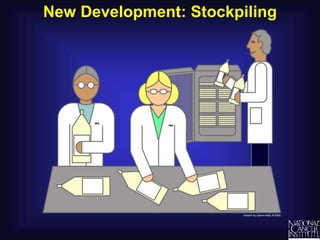
New Development: Stockpiling
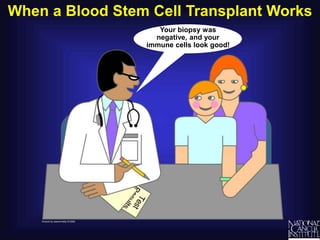
When a Blood Stem Cell Transplant Works
Your biopsy was
negative, and your
immune cells look good!
National Marrow Donor Program Helps Many
Thank you, DONORS!
We would like to hear from you . . .
If you have questions about this tutorial’s content, suggestions for new topics, or
other feedback on the Web site, please send an e-mail to kerrigad@mail.nih.gov.
If you have questions about this tutorial’s artwork or want permission to use it,
please send an e-mail to beankelly@verizon.net.

StemCell.ppt

  • 1.
    Understanding Cancer andRelated Topics Understanding Blood Stem Cell Transplantation These PowerPoint slides are not locked files. You can mix and match slides from different tutorials as you prepare your own lectures. In the Notes section, you will find explanations of the graphics. The art in this tutorial is copyrighted and may not be reused for commercial gain. Please do not remove the NCI logo or the copyright mark from any slide. These tutorials may be copied only if they are distributed free of charge for educational purposes. Developed by: Donna Kerrigan, M.S. Kathryn Hollen Jeanne Kelly Brian Hollen Discusses how bone marrow produces blood- forming stem cells that include “starter” immune cells. When diseases like cancer or its treatment damage these hematopoietic cells, transplanting healthy stem cells from marrow, peripheral blood, or other sources can help some patients. Clarifies how antigens that mark cells as “self” or “non-self” are critical determinants of transplant success. Explains autologous, syngeneic, and allogeneic transplants as well as tissue typing.
  • 2.
    Stem Cells Gastrula (14 to16 days) Fertilized egg (1 day) Outer cell mass Inner cell mass Blastocyst (5 to 6 days) Ectoderm (external layer) Skin Neurons Pituitary gland Eyes Ears Endoderm (internal layer) Pancreas Liver Thyroid Lung Bladder Urethra Mesoderm (middle layer) Bone marrow Skeletal, smooth and cardiac muscle Heart and blood vessels Kidney tubules
  • 3.
    Blood Stem Cells Bonegraft Multipotential stem cell Hematopoietic stem cell Platelets Erythrocytes Eosinophil Neutrophil Megakaryocyte Basophil T lymphocyte Natural killer cell Dendritic cell B lymphocyte Lymphoid progenitor cell Myeloid progenitor cell Monocyte Marrow Bone
  • 4.
    From Bone Marrowto the Bloodstream T lymphocyte Hematopoietic stem cell Erythrocytes Circulating blood Thymus Lymph nodes Spleen Bone marrow To thymus, tonsils, and lymphoid organs 1 in blood for every 100 in marrow B lymphocyte From thymus
  • 5.
    Blood Stem CellTransplants: When? No blood stem cell production Chemo Radiation X
  • 6.
    Stem Cells fromSelf to the Rescue Patient receives chemotherapy or radiation Self-donated stem cells are re-infused into patient Stem cells are collected from patient
  • 7.
    Stem Cells fromDonor to the Rescue Stem cells are collected from donor Stem cells are infused into patient, where they migrate to bone marrow Patient receives chemotherapy or radiation
  • 8.
    Not Just AnyBlood Stem Cells Will Do Self Non-self
  • 9.
    Host vs. Graft/Graftvs. Host Host versus graft reaction Graft versus host reaction
  • 10.
    Tissue Typing MatchesDonors to Patients Allogeneic Patient = matches to patient Conflict: only some marker molecules match No conflict: all marker molecules match Patient Syngeneic Autologous Donor Identical twin donor Unrelated donor Related donor Allogeneic Patient Donor Patient Donor Patient Donor
  • 11.
    Many Names forthe “Self” Antigens Major histocompatibility complex (MHC) proteins (“self” markers) Blood cell (leukocyte) Body cell Human leukocyte antigens (HLAs) (“self” markers) =
  • 12.
    Haplotypes: Passing onGenes for “Self” Antigens DP DR DQ No. of possible alleles at this locus Many Varieties of MHC “Self” Genes Sample Haplotype: Chromosome 6 DP DQ A C HLA alleles DR 45 89 19 20 2 323 75 50 25 400 100 0 DP DQ DR B 93 195 395 B C A
  • 13.
    6 Major Genes:10,000 Antigens HLA genes Paternal chromosome 6 Maternal chromosome 6 Maternal leukocyte Paternal leukocyte HLA genes D B C D A D D B C D A D * are MHC proteins 2 (of 6) major human leukocyte antigens* 6 major genes 6 major genes 2 (of 6) major human leukocyte antigens*
  • 14.
    Three Most ImportantAntigens 3 most important antigens for tissue matching Leukocyte Human leukocyte antigens (MHC proteins) DP DQ B C DR A No. of possible alleles at this locus Many Varieties of MHC “Self” Genes DP DQ DR 45 89 19 20 2 323 75 50 25 400 100 0 DP DQ DR 93 195 395 B C A
  • 15.
    A “Clinical Match” ChildA (patient) HLA-A HLA-B Child E (donor) a perfect match Child D Haplotype 3 Child C Sperm Ovum Child B Haplotype 1 HLA-A HLA-DR HLA-B HLA-DR HLA-A HLA-B Haplotype 4 Haplotype 2 HLA-A HLA-DR HLA-B HLA-DR
  • 16.
    Some Haplotypes OccurMore Often 25–30% chance >90% chance 50–60% chance 40–50% chance
  • 17.
    Sometimes a 3-AntigenMatch Is Necessary 3-antigen match
  • 18.
    A Delicate Balance: Graftvs. Tumor/Graft vs. Host Stem cells plus haplo-identical white blood cells Cancer cell destroyed Cancer cell Transplant attacks patient Transplant attacks tumor in patient A Delicate Balance Should I give the patient steroids?
  • 19.
    Success in Matching VariesWith Population Japanese 99% African American 50% North American Caucasian 93% Asian 50%
  • 20.
    Preparing Patients for MyeloablativeAllogeneic Transplants High-dose radiation and/or High-dose chemotherapy Lymphocytes destroyed Cancer cells destroyed
  • 21.
    Preparing Patients forReduced- Intensity Allogeneic Transplants Before Transplant Donor’s white blood cells Sometimes After Transplant Low-dose or standard radiation and/or Low-dose or standard chemotherapy Immunosuppressant drugs
  • 22.
    Preparing Donors for AllogeneicTransplants Growth factor to amplify and mobilize stem cells Allogeneic transplant Stem cells ready for infusion Stem cells ready for infusion
  • 23.
    Apheresis: Harvesting StemCells From Peripheral Blood Whole blood is collected from donor Blood, minus stem cells, is returned to donor Stem cells out Whole blood in Blood-forming stem cells
  • 24.
    Preparing Patients for Autologous/SyngeneicTransplants Syngeneic: Peripheral Blood Growth factor to amplify and mobilize stem cells Patient Autologous: Peripheral Blood Cells for infusion into my twin Identical twin donor Cells for re-infusion Growth factor to amplify and mobilize stem cells
  • 25.
    Cord Blood asa Source of Stem Cells Placenta Umbilical cord Placenta Primitive stem cells Liver Uterus Umbilical cord
  • 26.
    Placental and Cord-Blood StemCell Transplants After the birth of the baby, blood is collected into a special blood bag Umbilical cord Placenta Virus-free, tissue-typed stem cells stored in liquid nitrogen for future transplant Cryoprotectant added to minimize damage during freezing Stem cells transferred to a new bag
  • 27.
    Using More ThanOne Cord-Blood Donor Cells from one unit dominate the other; both attack patient’s immune system Cord blood from donor 2 Cord blood from donor 1 No, I’m in charge! I’m in charge! 2 1
  • 28.
    Placental and Cord-BloodTransplants: Pros and Cons Cons  1/10 number of cells vs. bone marrow transplant  Longer time for transplant to “take”  Slight chance of maternal cell/genetic disease contamination  Adults need more than one cord-blood donor Pros  Lifesaver when there is no eligible donor  Available quickly (about 2 weeks)  Unlikely to harbor cytomegalovirus
  • 29.
  • 30.
    When a BloodStem Cell Transplant Works Your biopsy was negative, and your immune cells look good!
  • 31.
    National Marrow DonorProgram Helps Many Thank you, DONORS!
  • 32.
    We would liketo hear from you . . . If you have questions about this tutorial’s content, suggestions for new topics, or other feedback on the Web site, please send an e-mail to kerrigad@mail.nih.gov. If you have questions about this tutorial’s artwork or want permission to use it, please send an e-mail to beankelly@verizon.net.

Editor's Notes

  • #2 NCI Web site: http://cancer.gov/cancertopics/understandingcancer
  • #3 NCI Web site: http://cancer.gov/cancertopics/understandingcancer
  • #4 NCI Web site: http://cancer.gov/cancertopics/understandingcancer
  • #5 NCI Web site: http://cancer.gov/cancertopics/understandingcancer
  • #6 NCI Web site: http://cancer.gov/cancertopics/understandingcancer
  • #7 NCI Web site: http://cancer.gov/cancertopics/understandingcancer
  • #8 NCI Web site: http://cancer.gov/cancertopics/understandingcancer
  • #9 NCI Web site: http://cancer.gov/cancertopics/understandingcancer
  • #10 NCI Web site: http://cancer.gov/cancertopics/understandingcancer
  • #11 NCI Web site: http://cancer.gov/cancertopics/understandingcancer
  • #12 NCI Web site: http://cancer.gov/cancertopics/understandingcancer
  • #13 NCI Web site: http://cancer.gov/cancertopics/understandingcancer
  • #14 NCI Web site: http://cancer.gov/cancertopics/understandingcancer
  • #15 NCI Web site: http://cancer.gov/cancertopics/understandingcancer
  • #16 NCI Web site: http://cancer.gov/cancertopics/understandingcancer
  • #17 NCI Web site: http://cancer.gov/cancertopics/understandingcancer
  • #18 NCI Web site: http://cancer.gov/cancertopics/understandingcancer
  • #19 NCI Web site: http://cancer.gov/cancertopics/understandingcancer
  • #20 NCI Web site: http://cancer.gov/cancertopics/understandingcancer
  • #21 NCI Web site: http://cancer.gov/cancertopics/understandingcancer
  • #22 NCI Web site: http://cancer.gov/cancertopics/understandingcancer
  • #23 NCI Web site: http://cancer.gov/cancertopics/understandingcancer
  • #24 NCI Web site: http://cancer.gov/cancertopics/understandingcancer
  • #25 NCI Web site: http://cancer.gov/cancertopics/understandingcancer
  • #26 NCI Web site: http://cancer.gov/cancertopics/understandingcancer
  • #27 NCI Web site: http://cancer.gov/cancertopics/understandingcancer
  • #28 NCI Web site: http://cancer.gov/cancertopics/understandingcancer
  • #29 NCI Web site: http://cancer.gov/cancertopics/understandingcancer
  • #30 NCI Web site: http://cancer.gov/cancertopics/understandingcancer
  • #31 NCI Web site: http://cancer.gov/cancertopics/understandingcancer
  • #32 NCI Web site: http://cancer.gov/cancertopics/understandingcancer
  • #33 NCI Web site: http://cancer.gov/cancertopics/understandingcancer