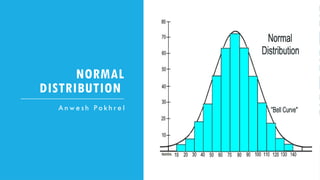
NORMAL
DISTRIBUTION
A n we s h Po k h r e l
AGENDA
2
•Continuous Probability
Distribution
•Difference between
discrete and continuous
variable
•Normal Distribution
•Characteristics
•Example
•Z transformation formula
•Example
CONTINUOUS
PROBABILITY
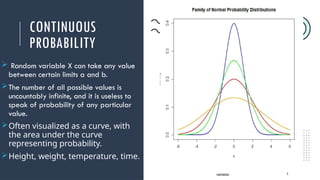
 Random variable X can take any value
between certain limits a and b.
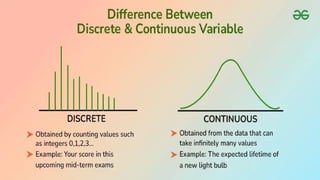
The number of all possible values is
uncountably infinite, and it is useless to
speak of probability of any particular
value.
Often visualized as a curve, with
the area under the curve
representing probability.
Height, weight, temperature, time.
CONTINUOUS 3
08/02/2025 PDF 5
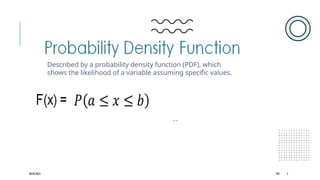
Described by a probability density function (PDF), which
shows the likelihood of a variable assuming specific values.
NORMAL
DISTRIBUTION
Johann Friedrich
Carl Gauss the
greatest German
mathematician in
1809 introduce
normal distribution.
Therefore, it is also
called as Gaussian
Distribution.
Johann Fredrich
Carl Gauss first
described normal
distribution when
he measured
errors in
astronomy.
08/02/2025 7
The normal distribution, also
known as the Gaussian
distribution, is a continuous
probability distribution that is
symmetrical around its mean
A normal distribution is significant in
statistics and is often used in the natural
sciences and social arts to describe
real-valued random variables whose
distributions are unknown.
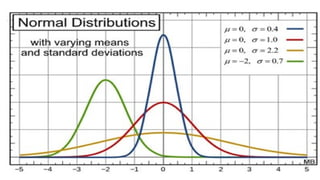
The graph of normal
distribution is called
normal curve which is
bell shaped and is
symmetrical about the
line x = µ (mi)
A classic example of a normal
probability distribution is the
distribution of human heights. Most
people's heights will cluster around the
average height, with fewer people
being significantly taller or shorter
than average
CHARACTERISTICS
08/02/2025
8
In a normal distribution, the mean, median and
mode are equal.(i.e., Mean = Median= Mode).
The total area under the curve should be equal to
1.
Mean = µ, Standard Deviation = (
σ sigma),
Skewness = 0 and kurtosis = 3
The normally distributed curve should be
symmetric at the center.
There should be exactly half of the values are to
the right of the center and exactly half of the
values are to the left of the center.
08/02/2025 9
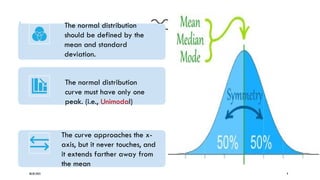
The normal distribution
should be defined by the
mean and standard
deviation.
The normal distribution
curve must have only one
peak. (i.e., Unimodal)
The curve approaches the x-
axis, but it never touches, and
it extends farther away from
the mean
08/02/2025 10
08/02/2025 FORMULA 11
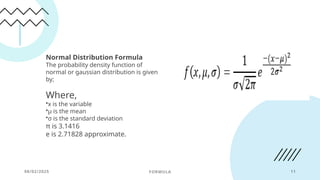
Normal Distribution Formula
The probability density function of
normal or gaussian distribution is given
by;
Where,
•x is the variable
•μ is the mean
•σ is the standard deviation
π is 3.1416
e is 2.71828 approximate.
ONE EXAMPLE
08/02/2025 12
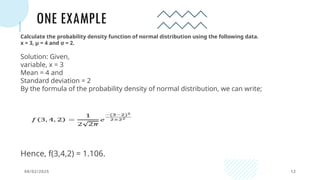
Calculate the probability density function of normal distribution using the following data.
x = 3, μ = 4 and σ = 2.
Solution: Given,
variable, x = 3
Mean = 4 and
Standard deviation = 2
By the formula of the probability density of normal distribution, we can write;
Hence, f(3,4,2) = 1.106.
NORMAL
DISTRIBUTION
STANDARD
DEVIATION
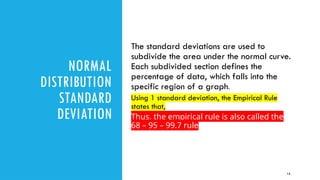
The standard deviations are used to
subdivide the area under the normal curve.
Each subdivided section defines the
percentage of data, which falls into the
specific region of a graph.
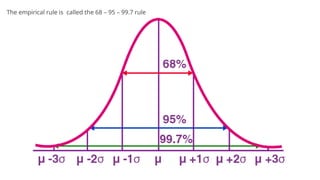
Using 1 standard deviation, the Empirical Rule
states that,
Thus, the empirical rule is also called the
68 – 95 – 99.7 rule
13
08/02/2025 14
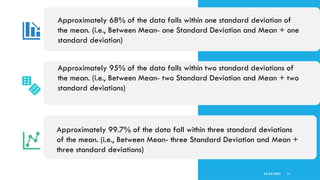
Approximately 95% of the data falls within two standard deviations of
the mean. (i.e., Between Mean- two Standard Deviation and Mean + two
standard deviations)
Approximately 99.7% of the data fall within three standard deviations
of the mean. (i.e., Between Mean- three Standard Deviation and Mean +
three standard deviations)
Approximately 68% of the data falls within one standard deviation of
the mean. (i.e., Between Mean- one Standard Deviation and Mean + one
standard deviation)
15
The empirical rule is called the 68 – 95 – 99.7 rule
COMPUTING
NORMAL
PROBABILITIES
To compute normal probabilities, at
first convert a normally distributed
variable ,X to a standardized normal
variable, Z using transformation
formula
08/02/2025 16
Z TRANSFORMATIVE
FORMULA
08/02/2025 17
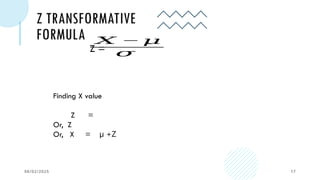
𝑋 − 𝜇
𝜎
Z =
Finding X value
Z =
Or, Z
Or, X = µ +Z
08/02/2025 PRESENTATION TITLE 18
19
For some computers, the time period between charges of the battery is normally distributed
with a mean of 50 hours and a standard deviation of 15 hours. Mr. A has one of these
computers and needs to know the probability that the time period will be between 50 and 70
hours.
Solution: Let x be the random variable that represents the time period.
Given
Mean, μ= 50
and standard deviation, σ = 15
To find: Probability that x is between 50 and 70 or P( 50< x < 70)
By using the transformation equation, we know;
z = (X – μ) / σ
For x = 50 , z = (50 – 50) / 15 = 0
For x = 70 , z = (70 – 50) / 15 = 1.33
P( 50< x < 70) = P( 0< z < 1.33) = [area to the left of z = 1.33] – [area to the left of z = 0]
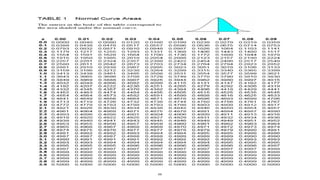
From the table we get the value, such as;
P( 0< z < 1.33) = 0.9082 – 0.5 = 0.4082
The probability that Rohan’s computer has a time period between 50 and 70 hours is equal to
0.4082.
A PICTURE IS
WORTH THAN
THOUSAND
WORDS
08/02/2025 THANKS 20
Thank You !

The normal distribution, also called the Gaussian distribution

  • 1.
  • 2.
    AGENDA 2 •Continuous Probability Distribution •Difference between discreteand continuous variable •Normal Distribution •Characteristics •Example •Z transformation formula •Example
  • 3.
    CONTINUOUS PROBABILITY  Random variableX can take any value between certain limits a and b. The number of all possible values is uncountably infinite, and it is useless to speak of probability of any particular value. Often visualized as a curve, with the area under the curve representing probability. Height, weight, temperature, time. CONTINUOUS 3
  • 5.
    08/02/2025 PDF 5 Describedby a probability density function (PDF), which shows the likelihood of a variable assuming specific values.
  • 6.
    NORMAL DISTRIBUTION Johann Friedrich Carl Gaussthe greatest German mathematician in 1809 introduce normal distribution. Therefore, it is also called as Gaussian Distribution. Johann Fredrich Carl Gauss first described normal distribution when he measured errors in astronomy.
  • 7.
    08/02/2025 7 The normaldistribution, also known as the Gaussian distribution, is a continuous probability distribution that is symmetrical around its mean A normal distribution is significant in statistics and is often used in the natural sciences and social arts to describe real-valued random variables whose distributions are unknown. The graph of normal distribution is called normal curve which is bell shaped and is symmetrical about the line x = µ (mi) A classic example of a normal probability distribution is the distribution of human heights. Most people's heights will cluster around the average height, with fewer people being significantly taller or shorter than average
  • 8.
    CHARACTERISTICS 08/02/2025 8 In a normaldistribution, the mean, median and mode are equal.(i.e., Mean = Median= Mode). The total area under the curve should be equal to 1. Mean = µ, Standard Deviation = ( σ sigma), Skewness = 0 and kurtosis = 3 The normally distributed curve should be symmetric at the center. There should be exactly half of the values are to the right of the center and exactly half of the values are to the left of the center.
  • 9.
    08/02/2025 9 The normaldistribution should be defined by the mean and standard deviation. The normal distribution curve must have only one peak. (i.e., Unimodal) The curve approaches the x- axis, but it never touches, and it extends farther away from the mean
  • 10.
  • 11.
    08/02/2025 FORMULA 11 NormalDistribution Formula The probability density function of normal or gaussian distribution is given by; Where, •x is the variable •μ is the mean •σ is the standard deviation π is 3.1416 e is 2.71828 approximate.
  • 12.
    ONE EXAMPLE 08/02/2025 12 Calculatethe probability density function of normal distribution using the following data. x = 3, μ = 4 and σ = 2. Solution: Given, variable, x = 3 Mean = 4 and Standard deviation = 2 By the formula of the probability density of normal distribution, we can write; Hence, f(3,4,2) = 1.106.
  • 13.
    NORMAL DISTRIBUTION STANDARD DEVIATION The standard deviationsare used to subdivide the area under the normal curve. Each subdivided section defines the percentage of data, which falls into the specific region of a graph. Using 1 standard deviation, the Empirical Rule states that, Thus, the empirical rule is also called the 68 – 95 – 99.7 rule 13
  • 14.
    08/02/2025 14 Approximately 95%of the data falls within two standard deviations of the mean. (i.e., Between Mean- two Standard Deviation and Mean + two standard deviations) Approximately 99.7% of the data fall within three standard deviations of the mean. (i.e., Between Mean- three Standard Deviation and Mean + three standard deviations) Approximately 68% of the data falls within one standard deviation of the mean. (i.e., Between Mean- one Standard Deviation and Mean + one standard deviation)
  • 15.
    15 The empirical ruleis called the 68 – 95 – 99.7 rule
  • 16.
    COMPUTING NORMAL PROBABILITIES To compute normalprobabilities, at first convert a normally distributed variable ,X to a standardized normal variable, Z using transformation formula 08/02/2025 16
  • 17.
    Z TRANSFORMATIVE FORMULA 08/02/2025 17 𝑋− 𝜇 𝜎 Z = Finding X value Z = Or, Z Or, X = µ +Z
  • 18.
  • 19.
    19 For some computers,the time period between charges of the battery is normally distributed with a mean of 50 hours and a standard deviation of 15 hours. Mr. A has one of these computers and needs to know the probability that the time period will be between 50 and 70 hours. Solution: Let x be the random variable that represents the time period. Given Mean, μ= 50 and standard deviation, σ = 15 To find: Probability that x is between 50 and 70 or P( 50< x < 70) By using the transformation equation, we know; z = (X – μ) / σ For x = 50 , z = (50 – 50) / 15 = 0 For x = 70 , z = (70 – 50) / 15 = 1.33 P( 50< x < 70) = P( 0< z < 1.33) = [area to the left of z = 1.33] – [area to the left of z = 0] From the table we get the value, such as; P( 0< z < 1.33) = 0.9082 – 0.5 = 0.4082 The probability that Rohan’s computer has a time period between 50 and 70 hours is equal to 0.4082.
  • 20.
    A PICTURE IS WORTHTHAN THOUSAND WORDS 08/02/2025 THANKS 20 Thank You !