Chronic obstructive pulmonary
disease (СOPD)
Definition
A chronic disease in which pathological changes
(emphysema and fibrosis of the small
bronchus) leads to retention of air in the lungs
and progressive airflow limitation, clinically
manifested by shortness of breath and other
symptoms characteristic of COPD.
Chronic inflammation in response to pathogens
particles or gas can cause destruction of
parenchyma (emphysema development) and
disorder of normal reconstructive process
and defense mechanisms (resulting in fibrosis
bronchial tubes).
Acute and comorbidities In many patients
of can influence the overall severity of
COPD.
Emphysema (determination of the
European Respiratory Society) –
inconvertible abnormal increase
of acinar or of anatomical
part due to the degradation of
elastic fibers of the lung tissue.
Risk Factors
1) genetic predisposition
2) inhalation
• smoking
• second hand smoke
• occupational hazards (organic and inorganic dust,
chemical agents and dust)
• atmospheric pollution
• Indoor air pollution due to cooking and heating with
biomass fuels in poorly ventilated areas
3) violation of the growth and lung development in fetal.
4) Oxidation process
Risk Factors
5) male (but in developed countries, men and
women, the incidence of COPD is approximately
the same, which probably reflects the pattern of
smoking.
6) Age - over 40 years.
7) respiratory infections (bacterial and viral)
8) Socio-economic status
9) food
10) associated diseases (asthma can be a risk factor
for chronic obstructive pulmonary disease)
Oxidative proсess.
If imbalance between oxidant lung
(inhalation) and antioxidant
(enzymatic and non-enzymatic
system in the lungs) develops
oxidative stress, damaging the lungs
and trigger inflammation.
Stage of COPD:
І – mild
ІІ – moderately severe
ІІІ – severe
ІV - very severe
Clinical classification:
І – mild
Easy airflow limitation
(FEV1 / VC is less than 0.70
FEV1 greater than 80% due value)
Clinic: chronic cough with or without sputum. At
this stage, patients usually do not seek medical
help.
FEV1 - forced expiratory volume
VC - vital capacity
ІІ – moderately severe
Progressive airflow limitation
(FEV1 / VC is less than 0.70
FEV1 50 to 80% of due value)
Clinic: cough, shortness of breath on
exertion.Patients seek medical attention
because of chronic respiratory symptoms or
an exacerbation of the disease.
ІІІ – severe
Further progress airflow limitation
(FEV1 / VC is less than 0.70
FEV1 30 to 50% of predicted).
Clinic: enhanced shortness of breath, reduced
exercise capacity, fatigue, repeated
exacerbation of the disease, which reduce the
quality of life.
ІV - very severe
Severe airflow limitation
(FEV1 / VC is less than 0.7
0FEV1 less than 30% of predicted combined with
chronic respiratory failure).
Clinic: dyspnea at the slightest exertion, fatigue,
often repeated exacerbations, reduced quality of
life threaten the patient's life.
Signs of pulmonary heart (right heart failure).
Stage IV patient may be diagnosed, even if the
FEV1 greater than 30%, but there are
complications (right ventricular failure)
Signs of pulmonary heart (right heart failure) –
elevated central venous pressure in the right
atrium and swelling in the legs.
"Chronic pulmonary heart» (Cor pulmonale) -
hypertrophy and / or dilatation of the right
ventricle, which develop due to diseases that
affect the structure or function of the lungs
break. Depending on the presence or absence
of a sign of congestive in the systemic
circulation may be compensated and
decompensated (chronic heart failure),
chronic pulmonary heart.
Systemic manifestations
Especially in severe disease reduces the survivability
of patients.
• Cachexia
• Increased risk of osteoporosis
• Depression
• Anemia
• Increased risk of cardiovascular disease
The main causes of death in patients with COPD are
cardiovascular diseases, lung cancer, respiratory failure.
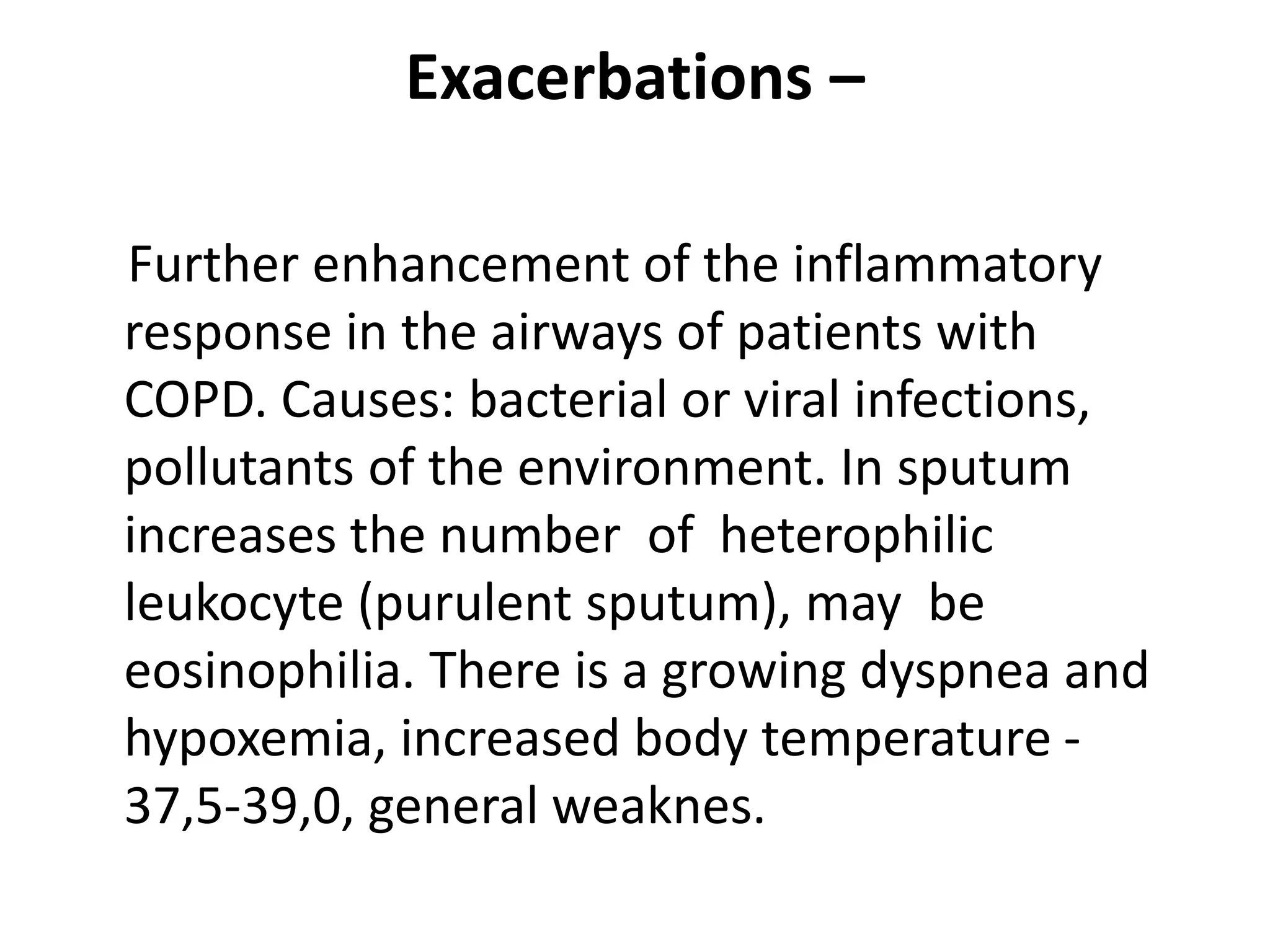
Exacerbations –
Further enhancement of the inflammatory
response in the airways of patients with
COPD. Causes: bacterial or viral infections,
pollutants of the environment. In sputum
increases the number of heterophilic
leukocyte (purulent sputum), may be
eosinophilia. There is a growing dyspnea and
hypoxemia, increased body temperature -
37,5-39,0, general weaknes.
Character of inflammation in
asthma and COPD.
For asthma and COPD characterized by chronic
inflammation.
When asthma and COPD nature of
inflammation and the clinical picture is
different.
In severe asthma and COPD nature of
inflammation and the clinical picture is similar.
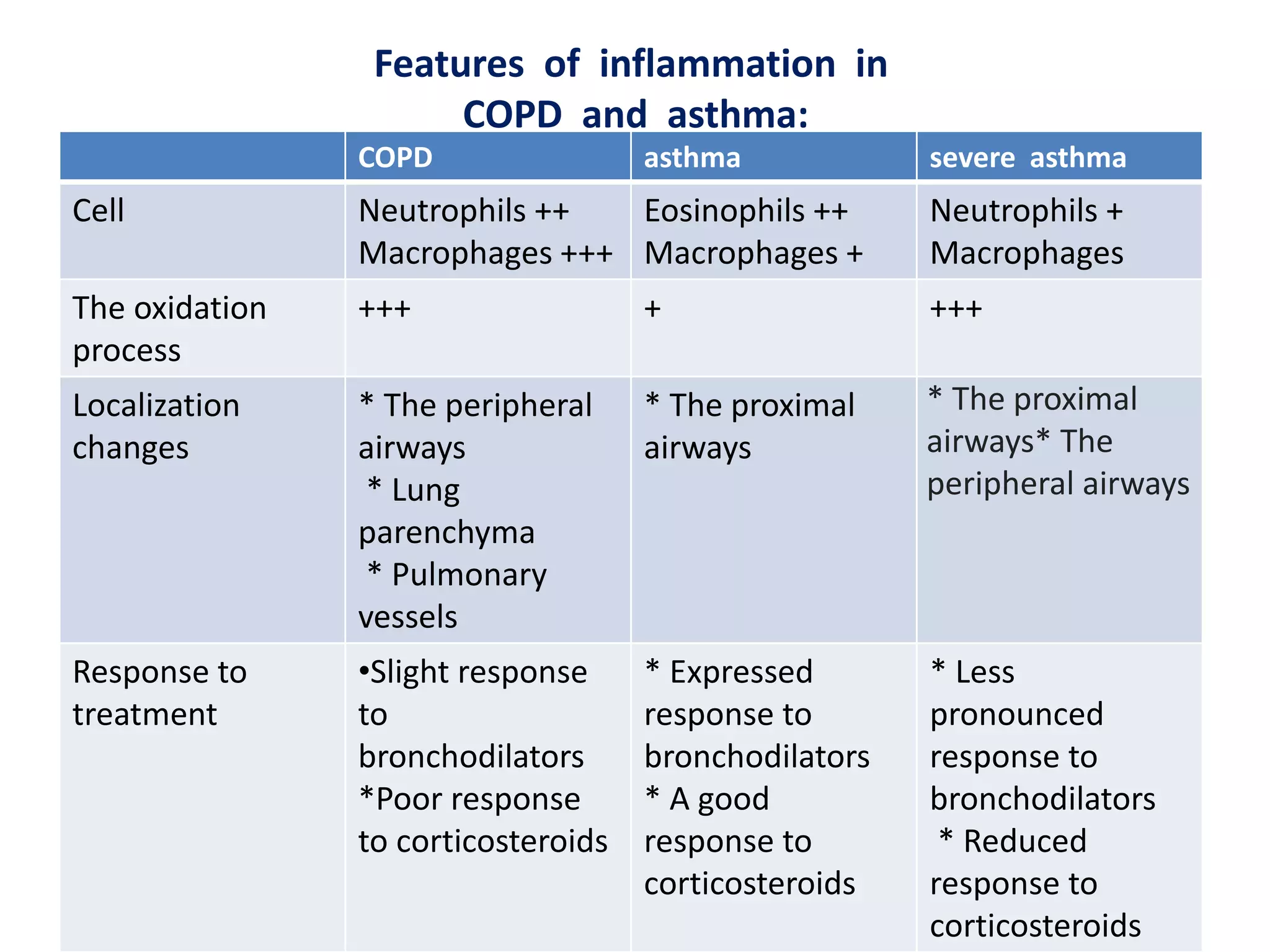
Features of inflammation in
COPD and asthma:
COPD asthma severe asthma
Cell Neutrophils ++
Macrophages +++
Eosinophils ++
Macrophages +
Neutrophils +
Macrophages
The oxidation
process
+++ + +++
Localization
changes
* The peripheral
airways
* Lung
parenchyma
* Pulmonary
vessels
* The proximal
airways
* The proximal
airways* The
peripheral airways
Response to
treatment
•Slight response
to
bronchodilators
*Poor response
to corticosteroids
* Expressed
response to
bronchodilators
* A good
response to
corticosteroids
* Less
pronounced
response to
bronchodilators
* Reduced
response to
corticosteroids
Diagnostics
The diagnosis of COPD should be suspected in all patients with
shortness of breath, chronic cough or sputum production,
taking into account the impact of risk factors in history.
Diagnostic criteria:
1. Age - over 40 years
2. expiratory dyspnea - progresses (gets worse over time),
increased during exercise, there is daily. "There is not
enough air," " asphyxy".
3. Chronic cough. It may be episodic and can be non-
productive cough.
4. Chronic expectoration of sputum. Any case of chronic
sputum production may indicate COPD.
5. The risk factor in history.
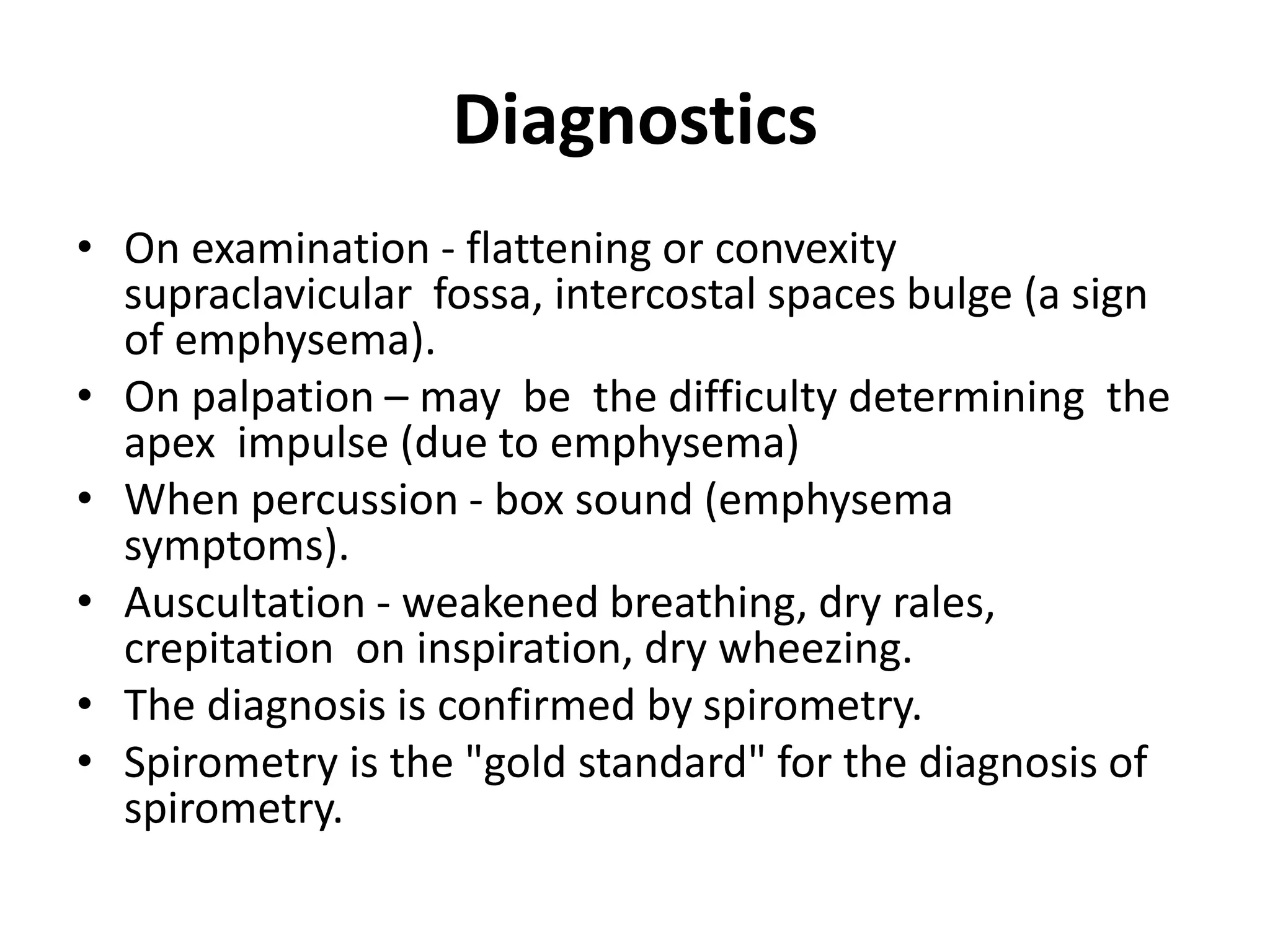
Diagnostics
• On examination - flattening or convexity
supraclavicular fossa, intercostal spaces bulge (a sign
of emphysema).
• On palpation – may be the difficulty determining the
apex impulse (due to emphysema)
• When percussion - box sound (emphysema
symptoms).
• Auscultation - weakened breathing, dry rales,
crepitation on inspiration, dry wheezing.
• The diagnosis is confirmed by spirometry.
• Spirometry is the "gold standard" for the diagnosis of
spirometry.
Spirometric classification of COPD, based on post-
bronchodilator FEV1:
І – mild Easy airflow limitation
(FEV1 / VC is less than 0.70
FEV1 greater than 80% due value)
ІІ – moderately
severe
Progressive airflow limitation
(FEV1 / VC is less than 0.70F
EV1 50 to 80% of due value)
ІІІ – severe Further progress airflow limitation
(FEV1 / VC is less than 0.70
FEV1 30 to 50% of predicted).
ІV - very severe Severe airflow limitation(FEV1 / VC is less than 0.70
FEV1 less than 30% of predicted combined with chronic
respiratory failure).
Signs of pulmonary heart (right heart failure).Stage IV
patient may be diagnosed, even if the FEV1 greater than
30%, but there are complications (right ventricular failure)
Testing the reversibility of airflow
obstruction using a bronchodilator:
Preparation
• The test is performed when the patient is
clinically stable and does not suffer from
respiratory infection
• The patient cancel short-acting
bronchodilators for 6 hours before the test,
dlitelnodeystvuyuschiebronholitiki - within 12
hours before the test, theophylline - within 24
hours before the test.
Spirometry
• Before taking bronchodilator FEV1 is measured
• inhaled bronchodilator is administered via a spacer or a
nebuliser.
• 400 g B2-agonist or anticholinergic 160 mcg, or a
combination of these drugs. FEV1 was measured again
after 10-15 minutes after administration of short
anticholinergic (30-40 minutes after administration of
the combination).
Results
The increase of FEV1 in the amount of more than
200ml or 12% relative to the receiving bronchodilator
FEV1 is significant.
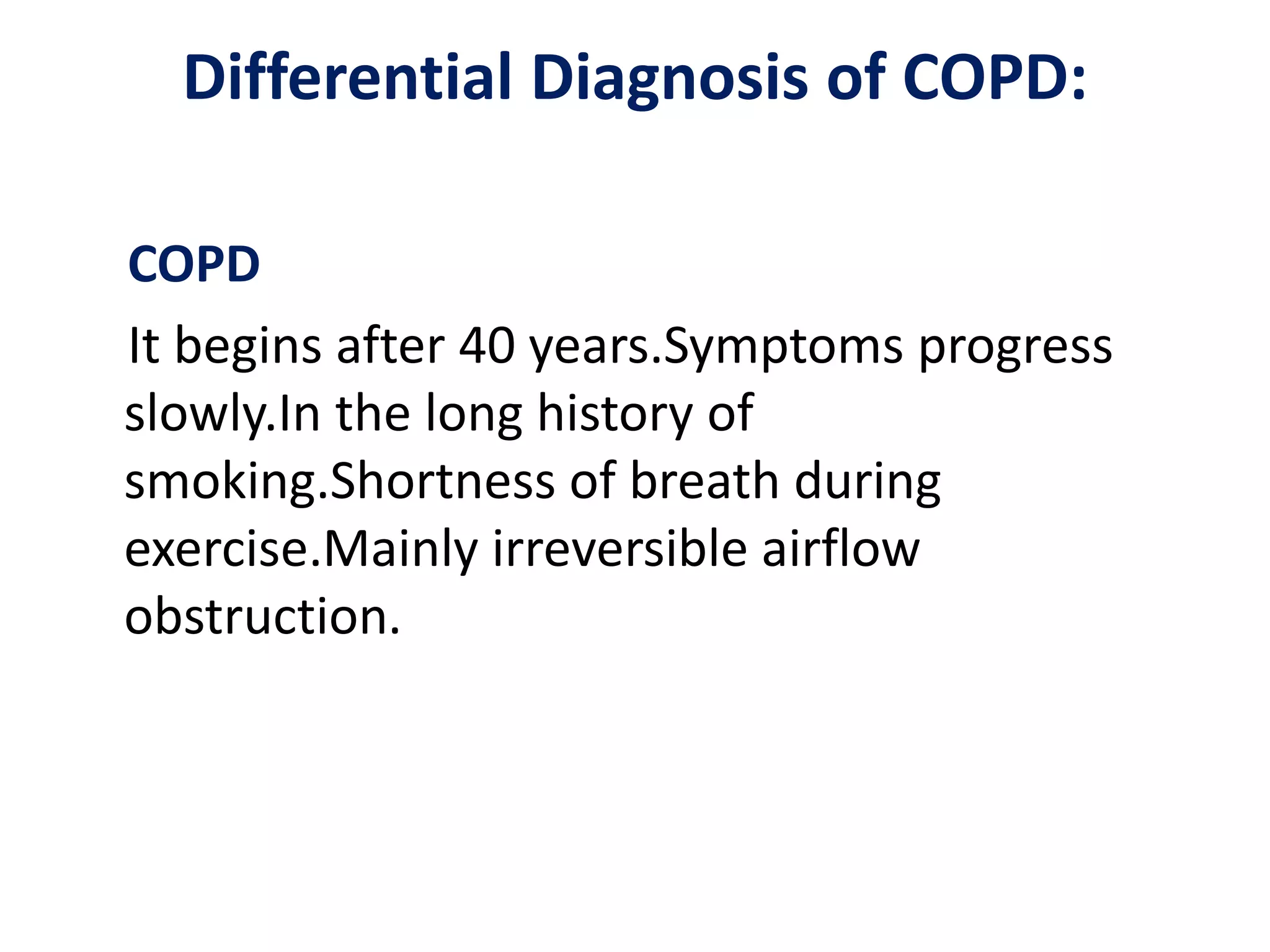
Differential Diagnosis of COPD:
COPD
It begins after 40 years.Symptoms progress
slowly.In the long history of
smoking.Shortness of breath during
exercise.Mainly irreversible airflow
obstruction.
Differential Diagnosis of COPD:
Asthma
Starting at a young age (often a child). The
symptoms vary during the day (asthma
characteristic in the night or early in the
morning, in the cold, under stress). The
history of allergy, rhinitis, eczema. A family
history of allergy. Mainly reversible airflow
obstruction.
Differential Diagnosis of COPD:
Congestive heart failure
Auscultation - crepitation or crackles in the
lower regions of the lungs (with an increase in
heart failure dry rale or crepitation rise to
the scapula angle or be heard across the
surface of the lungs).X-ray of thoracic organs:
expansion of the shadow of the heart,
pulmonary edema.Spirometry: restriction, not
obstruction
Differential Diagnosis of COPD:
Bronchiectatic disease
Selecting a large number of purulent sputum.In
sputum - a bacterial infection.Dry rales on
auscultation.X-ray of lungs characteristic
bronchiectasis, bronchial wall thickening.
Differential Diagnosis of COPD:
Tuberculosis
Starting at any age.X-ray of the lungs: rounded
lobular shadow or diffusely located in the
shadow of the lungs.In sputum -
Mycobacterium tuberculosis.In history -
contact with TB patients.
Differential Diagnosis of COPD:
Bronchiolitis obliterans
Starting at a young age in non-smokers. The
history may be rheumatoid arthritis or
exposure to harmful gases. CT exhale - areas
with low density.
Treatment
1. Stop smoking
2. Short-acting beta2-agonists
• Salbutamol
• Fenoterolum
3. Long-acting beta2-agonist
• Formoterolum
• Salmrterol
4. Short-acting anticholinergic
• Ipratropium bromide
Treatment
5. long-acting anticholinergic
• Tiotropiumbromide (Spiriva)
6. Combinatory (beta2-agonists +
anticholinergic)
• Ipratropiumbromide/Salbutamol
(Combivent)
• Ipratropium bromide/ Fenoterol (Berodual)
Treatment
7. Inhaled GCS
• Beclomethasonum
• Budesonidum
• Fluticasonum
8. Combinatory long-acting beta2-agonist and
GCS together:
• Formoterolum/ Budesonidum (Symbicort)
• Salmrterol/ Fluticasonum (Seretide Evohaler)
Treatment
9. Methylxanthine
• Aminophyllinum
• Teophyllinum
10. Antibiotic
• Ceftriaxonum
• Cefepinum
• Meronem
Treatment
11. Mucolytic
• Ambroxolum
• N-acetilcysteine
12. Anti-oxidant
• N-acetilcysteine

Copd

  • 1.
  • 2.
    Definition A chronic diseasein which pathological changes (emphysema and fibrosis of the small bronchus) leads to retention of air in the lungs and progressive airflow limitation, clinically manifested by shortness of breath and other symptoms characteristic of COPD. Chronic inflammation in response to pathogens particles or gas can cause destruction of parenchyma (emphysema development) and disorder of normal reconstructive process and defense mechanisms (resulting in fibrosis bronchial tubes).
  • 3.
    Acute and comorbiditiesIn many patients of can influence the overall severity of COPD. Emphysema (determination of the European Respiratory Society) – inconvertible abnormal increase of acinar or of anatomical part due to the degradation of elastic fibers of the lung tissue.
  • 4.
    Risk Factors 1) geneticpredisposition 2) inhalation • smoking • second hand smoke • occupational hazards (organic and inorganic dust, chemical agents and dust) • atmospheric pollution • Indoor air pollution due to cooking and heating with biomass fuels in poorly ventilated areas 3) violation of the growth and lung development in fetal. 4) Oxidation process
  • 5.
    Risk Factors 5) male(but in developed countries, men and women, the incidence of COPD is approximately the same, which probably reflects the pattern of smoking. 6) Age - over 40 years. 7) respiratory infections (bacterial and viral) 8) Socio-economic status 9) food 10) associated diseases (asthma can be a risk factor for chronic obstructive pulmonary disease)
  • 6.
    Oxidative proсess. If imbalancebetween oxidant lung (inhalation) and antioxidant (enzymatic and non-enzymatic system in the lungs) develops oxidative stress, damaging the lungs and trigger inflammation.
  • 7.
    Stage of COPD: І– mild ІІ – moderately severe ІІІ – severe ІV - very severe
  • 8.
    Clinical classification: І –mild Easy airflow limitation (FEV1 / VC is less than 0.70 FEV1 greater than 80% due value) Clinic: chronic cough with or without sputum. At this stage, patients usually do not seek medical help. FEV1 - forced expiratory volume VC - vital capacity
  • 9.
    ІІ – moderatelysevere Progressive airflow limitation (FEV1 / VC is less than 0.70 FEV1 50 to 80% of due value) Clinic: cough, shortness of breath on exertion.Patients seek medical attention because of chronic respiratory symptoms or an exacerbation of the disease.
  • 10.
    ІІІ – severe Furtherprogress airflow limitation (FEV1 / VC is less than 0.70 FEV1 30 to 50% of predicted). Clinic: enhanced shortness of breath, reduced exercise capacity, fatigue, repeated exacerbation of the disease, which reduce the quality of life.
  • 11.
    ІV - verysevere Severe airflow limitation (FEV1 / VC is less than 0.7 0FEV1 less than 30% of predicted combined with chronic respiratory failure). Clinic: dyspnea at the slightest exertion, fatigue, often repeated exacerbations, reduced quality of life threaten the patient's life. Signs of pulmonary heart (right heart failure). Stage IV patient may be diagnosed, even if the FEV1 greater than 30%, but there are complications (right ventricular failure)
  • 12.
    Signs of pulmonaryheart (right heart failure) – elevated central venous pressure in the right atrium and swelling in the legs. "Chronic pulmonary heart» (Cor pulmonale) - hypertrophy and / or dilatation of the right ventricle, which develop due to diseases that affect the structure or function of the lungs break. Depending on the presence or absence of a sign of congestive in the systemic circulation may be compensated and decompensated (chronic heart failure), chronic pulmonary heart.
  • 13.
    Systemic manifestations Especially insevere disease reduces the survivability of patients. • Cachexia • Increased risk of osteoporosis • Depression • Anemia • Increased risk of cardiovascular disease The main causes of death in patients with COPD are cardiovascular diseases, lung cancer, respiratory failure.
  • 14.
    Exacerbations – Further enhancementof the inflammatory response in the airways of patients with COPD. Causes: bacterial or viral infections, pollutants of the environment. In sputum increases the number of heterophilic leukocyte (purulent sputum), may be eosinophilia. There is a growing dyspnea and hypoxemia, increased body temperature - 37,5-39,0, general weaknes.
  • 15.
    Character of inflammationin asthma and COPD. For asthma and COPD characterized by chronic inflammation. When asthma and COPD nature of inflammation and the clinical picture is different. In severe asthma and COPD nature of inflammation and the clinical picture is similar.
  • 16.
    Features of inflammationin COPD and asthma: COPD asthma severe asthma Cell Neutrophils ++ Macrophages +++ Eosinophils ++ Macrophages + Neutrophils + Macrophages The oxidation process +++ + +++ Localization changes * The peripheral airways * Lung parenchyma * Pulmonary vessels * The proximal airways * The proximal airways* The peripheral airways Response to treatment •Slight response to bronchodilators *Poor response to corticosteroids * Expressed response to bronchodilators * A good response to corticosteroids * Less pronounced response to bronchodilators * Reduced response to corticosteroids
  • 17.
    Diagnostics The diagnosis ofCOPD should be suspected in all patients with shortness of breath, chronic cough or sputum production, taking into account the impact of risk factors in history. Diagnostic criteria: 1. Age - over 40 years 2. expiratory dyspnea - progresses (gets worse over time), increased during exercise, there is daily. "There is not enough air," " asphyxy". 3. Chronic cough. It may be episodic and can be non- productive cough. 4. Chronic expectoration of sputum. Any case of chronic sputum production may indicate COPD. 5. The risk factor in history.
  • 18.
    Diagnostics • On examination- flattening or convexity supraclavicular fossa, intercostal spaces bulge (a sign of emphysema). • On palpation – may be the difficulty determining the apex impulse (due to emphysema) • When percussion - box sound (emphysema symptoms). • Auscultation - weakened breathing, dry rales, crepitation on inspiration, dry wheezing. • The diagnosis is confirmed by spirometry. • Spirometry is the "gold standard" for the diagnosis of spirometry.
  • 19.
    Spirometric classification ofCOPD, based on post- bronchodilator FEV1: І – mild Easy airflow limitation (FEV1 / VC is less than 0.70 FEV1 greater than 80% due value) ІІ – moderately severe Progressive airflow limitation (FEV1 / VC is less than 0.70F EV1 50 to 80% of due value) ІІІ – severe Further progress airflow limitation (FEV1 / VC is less than 0.70 FEV1 30 to 50% of predicted). ІV - very severe Severe airflow limitation(FEV1 / VC is less than 0.70 FEV1 less than 30% of predicted combined with chronic respiratory failure). Signs of pulmonary heart (right heart failure).Stage IV patient may be diagnosed, even if the FEV1 greater than 30%, but there are complications (right ventricular failure)
  • 20.
    Testing the reversibilityof airflow obstruction using a bronchodilator: Preparation • The test is performed when the patient is clinically stable and does not suffer from respiratory infection • The patient cancel short-acting bronchodilators for 6 hours before the test, dlitelnodeystvuyuschiebronholitiki - within 12 hours before the test, theophylline - within 24 hours before the test.
  • 21.
    Spirometry • Before takingbronchodilator FEV1 is measured • inhaled bronchodilator is administered via a spacer or a nebuliser. • 400 g B2-agonist or anticholinergic 160 mcg, or a combination of these drugs. FEV1 was measured again after 10-15 minutes after administration of short anticholinergic (30-40 minutes after administration of the combination). Results The increase of FEV1 in the amount of more than 200ml or 12% relative to the receiving bronchodilator FEV1 is significant.
  • 22.
    Differential Diagnosis ofCOPD: COPD It begins after 40 years.Symptoms progress slowly.In the long history of smoking.Shortness of breath during exercise.Mainly irreversible airflow obstruction.
  • 23.
    Differential Diagnosis ofCOPD: Asthma Starting at a young age (often a child). The symptoms vary during the day (asthma characteristic in the night or early in the morning, in the cold, under stress). The history of allergy, rhinitis, eczema. A family history of allergy. Mainly reversible airflow obstruction.
  • 24.
    Differential Diagnosis ofCOPD: Congestive heart failure Auscultation - crepitation or crackles in the lower regions of the lungs (with an increase in heart failure dry rale or crepitation rise to the scapula angle or be heard across the surface of the lungs).X-ray of thoracic organs: expansion of the shadow of the heart, pulmonary edema.Spirometry: restriction, not obstruction
  • 25.
    Differential Diagnosis ofCOPD: Bronchiectatic disease Selecting a large number of purulent sputum.In sputum - a bacterial infection.Dry rales on auscultation.X-ray of lungs characteristic bronchiectasis, bronchial wall thickening.
  • 26.
    Differential Diagnosis ofCOPD: Tuberculosis Starting at any age.X-ray of the lungs: rounded lobular shadow or diffusely located in the shadow of the lungs.In sputum - Mycobacterium tuberculosis.In history - contact with TB patients.
  • 27.
    Differential Diagnosis ofCOPD: Bronchiolitis obliterans Starting at a young age in non-smokers. The history may be rheumatoid arthritis or exposure to harmful gases. CT exhale - areas with low density.
  • 28.
    Treatment 1. Stop smoking 2.Short-acting beta2-agonists • Salbutamol • Fenoterolum 3. Long-acting beta2-agonist • Formoterolum • Salmrterol 4. Short-acting anticholinergic • Ipratropium bromide
  • 29.
    Treatment 5. long-acting anticholinergic •Tiotropiumbromide (Spiriva) 6. Combinatory (beta2-agonists + anticholinergic) • Ipratropiumbromide/Salbutamol (Combivent) • Ipratropium bromide/ Fenoterol (Berodual)
  • 30.
    Treatment 7. Inhaled GCS •Beclomethasonum • Budesonidum • Fluticasonum 8. Combinatory long-acting beta2-agonist and GCS together: • Formoterolum/ Budesonidum (Symbicort) • Salmrterol/ Fluticasonum (Seretide Evohaler)
  • 31.
    Treatment 9. Methylxanthine • Aminophyllinum •Teophyllinum 10. Antibiotic • Ceftriaxonum • Cefepinum • Meronem
  • 32.
    Treatment 11. Mucolytic • Ambroxolum •N-acetilcysteine 12. Anti-oxidant • N-acetilcysteine