: All about Coordination,
:Coordination Test,
:Exercises that improve
Coordination
Sabigan ᴥ Lomugdang ᴥ Peña ᴥ Ricafrente ᴥ
Valenciano ᴥ Caraang ᴥ Edquila ᴥ Jumalon ᴥ
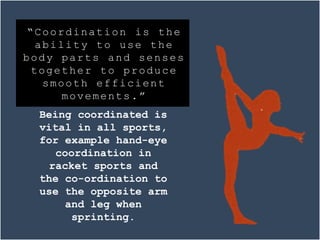
Being coordinated is
vital in all sports,
for example hand-eye
coordination in
racket sports and
the co-ordination to
use the opposite arm
and leg when
sprinting.
“Coordination is the
ability to use the
body parts and senses
together to produce
smooth efficient
movements.”
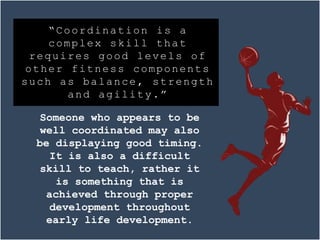
Someone who appears to be
well coordinated may also
be displaying good timing.
It is also a difficult
skill to teach, rather it
is something that is
achieved through proper
development throughout
early life development.
“Coordination is a
complex skill that
requires good levels of
other fitness components
such as balance, strength
and agility.”
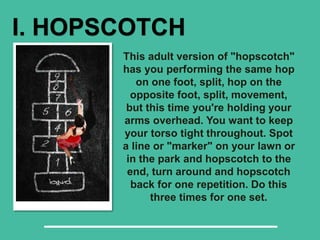
I. HOPSCOTCH
This adult version of "hopscotch"
has you performing the same hop
on one foot, split, hop on the
opposite foot, split, movement,
but this time you're holding your
arms overhead. You want to keep
your torso tight throughout. Spot
a line or "marker" on your lawn or
in the park and hopscotch to the
end, turn around and hopscotch
back for one repetition. Do this
three times for one set.
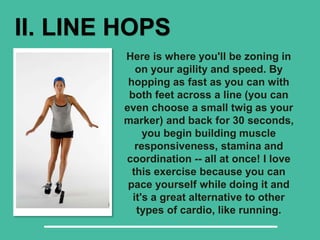
II. LINE HOPS
Here is where you'll be zoning in
on your agility and speed. By
hopping as fast as you can with
both feet across a line (you can
even choose a small twig as your
marker) and back for 30 seconds,
you begin building muscle
responsiveness, stamina and
coordination -- all at once! I love
this exercise because you can
pace yourself while doing it and
it's a great alternative to other
types of cardio, like running.
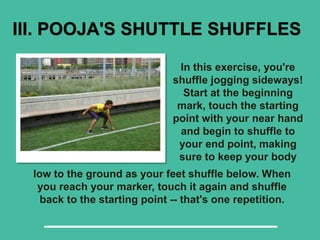
III. POOJA'S SHUTTLE SHUFFLES
In this exercise, you're
shuffle jogging sideways!
Start at the beginning
mark, touch the starting
point with your near hand
and begin to shuffle to
your end point, making
sure to keep your body
low to the ground as your feet shuffle below. When
you reach your marker, touch it again and shuffle
back to the starting point -- that's one repetition.
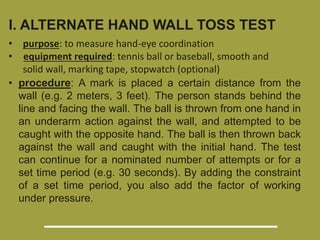
I. ALTERNATE HAND WALL TOSS TEST
• purpose: to measure hand-eye coordination
• equipment required: tennis ball or baseball, smooth and
solid wall, marking tape, stopwatch (optional)
• procedure: A mark is placed a certain distance from the
wall (e.g. 2 meters, 3 feet). The person stands behind the
line and facing the wall. The ball is thrown from one hand in
an underarm action against the wall, and attempted to be
caught with the opposite hand. The ball is then thrown back
against the wall and caught with the initial hand. The test
can continue for a nominated number of attempts or for a
set time period (e.g. 30 seconds). By adding the constraint
of a set time period, you also add the factor of working
under pressure.
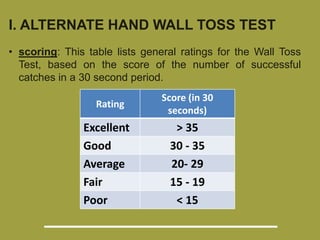
I. ALTERNATE HAND WALL TOSS TEST
• scoring: This table lists general ratings for the Wall Toss
Test, based on the score of the number of successful
catches in a 30 second period.
Rating
Score (in 30
seconds)
Excellent > 35
Good 30 - 35
Average 20- 29
Fair 15 - 19
Poor < 15
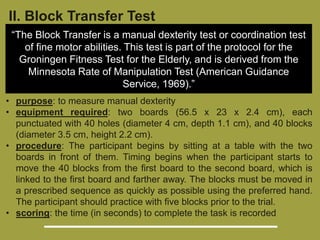
II. Block Transfer Test
“The Block Transfer is a manual dexterity test or coordination test
of fine motor abilities. This test is part of the protocol for the
Groningen Fitness Test for the Elderly, and is derived from the
Minnesota Rate of Manipulation Test (American Guidance
Service, 1969).”
• purpose: to measure manual dexterity
• equipment required: two boards (56.5 x 23 x 2.4 cm), each
punctuated with 40 holes (diameter 4 cm, depth 1.1 cm), and 40 blocks
(diameter 3.5 cm, height 2.2 cm).
• procedure: The participant begins by sitting at a table with the two
boards in front of them. Timing begins when the participant starts to
move the 40 blocks from the first board to the second board, which is
linked to the first board and farther away. The blocks must be moved in
a prescribed sequence as quickly as possible using the preferred hand.
The participant should practice with five blocks prior to the trial.
• scoring: the time (in seconds) to complete the task is recorded
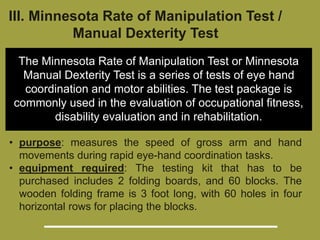
III. Minnesota Rate of Manipulation Test /
Manual Dexterity Test
The Minnesota Rate of Manipulation Test or Minnesota
Manual Dexterity Test is a series of tests of eye hand
coordination and motor abilities. The test package is
commonly used in the evaluation of occupational fitness,
disability evaluation and in rehabilitation.
• purpose: measures the speed of gross arm and hand
movements during rapid eye-hand coordination tasks.
• equipment required: The testing kit that has to be
purchased includes 2 folding boards, and 60 blocks. The
wooden folding frame is 3 foot long, with 60 holes in four
horizontal rows for placing the blocks.
III. Minnesota Rate of Manipulation Test /
Manual Dexterity Test
• procedure: The complete test consists of a battery of
five sub-tests: Placing, Turning, Displacing, One-Hand
Turning and Placing and Two-Hand Turning and Placing.
The tests are performed while standing. Each test is
started with a practice trial, and then each test tested 3-5
times. Both hands can be tested and compared.
FIN.

Coordination

  • 1.
    : All aboutCoordination, :Coordination Test, :Exercises that improve Coordination Sabigan ᴥ Lomugdang ᴥ Peña ᴥ Ricafrente ᴥ Valenciano ᴥ Caraang ᴥ Edquila ᴥ Jumalon ᴥ
  • 2.
    Being coordinated is vitalin all sports, for example hand-eye coordination in racket sports and the co-ordination to use the opposite arm and leg when sprinting. “Coordination is the ability to use the body parts and senses together to produce smooth efficient movements.”
  • 3.
    Someone who appearsto be well coordinated may also be displaying good timing. It is also a difficult skill to teach, rather it is something that is achieved through proper development throughout early life development. “Coordination is a complex skill that requires good levels of other fitness components such as balance, strength and agility.”
  • 5.
    I. HOPSCOTCH This adultversion of "hopscotch" has you performing the same hop on one foot, split, hop on the opposite foot, split, movement, but this time you're holding your arms overhead. You want to keep your torso tight throughout. Spot a line or "marker" on your lawn or in the park and hopscotch to the end, turn around and hopscotch back for one repetition. Do this three times for one set.
  • 6.
    II. LINE HOPS Hereis where you'll be zoning in on your agility and speed. By hopping as fast as you can with both feet across a line (you can even choose a small twig as your marker) and back for 30 seconds, you begin building muscle responsiveness, stamina and coordination -- all at once! I love this exercise because you can pace yourself while doing it and it's a great alternative to other types of cardio, like running.
  • 7.
    III. POOJA'S SHUTTLESHUFFLES In this exercise, you're shuffle jogging sideways! Start at the beginning mark, touch the starting point with your near hand and begin to shuffle to your end point, making sure to keep your body low to the ground as your feet shuffle below. When you reach your marker, touch it again and shuffle back to the starting point -- that's one repetition.
  • 9.
    I. ALTERNATE HANDWALL TOSS TEST • purpose: to measure hand-eye coordination • equipment required: tennis ball or baseball, smooth and solid wall, marking tape, stopwatch (optional) • procedure: A mark is placed a certain distance from the wall (e.g. 2 meters, 3 feet). The person stands behind the line and facing the wall. The ball is thrown from one hand in an underarm action against the wall, and attempted to be caught with the opposite hand. The ball is then thrown back against the wall and caught with the initial hand. The test can continue for a nominated number of attempts or for a set time period (e.g. 30 seconds). By adding the constraint of a set time period, you also add the factor of working under pressure.
  • 10.
    I. ALTERNATE HANDWALL TOSS TEST • scoring: This table lists general ratings for the Wall Toss Test, based on the score of the number of successful catches in a 30 second period. Rating Score (in 30 seconds) Excellent > 35 Good 30 - 35 Average 20- 29 Fair 15 - 19 Poor < 15
  • 11.
    II. Block TransferTest “The Block Transfer is a manual dexterity test or coordination test of fine motor abilities. This test is part of the protocol for the Groningen Fitness Test for the Elderly, and is derived from the Minnesota Rate of Manipulation Test (American Guidance Service, 1969).” • purpose: to measure manual dexterity • equipment required: two boards (56.5 x 23 x 2.4 cm), each punctuated with 40 holes (diameter 4 cm, depth 1.1 cm), and 40 blocks (diameter 3.5 cm, height 2.2 cm). • procedure: The participant begins by sitting at a table with the two boards in front of them. Timing begins when the participant starts to move the 40 blocks from the first board to the second board, which is linked to the first board and farther away. The blocks must be moved in a prescribed sequence as quickly as possible using the preferred hand. The participant should practice with five blocks prior to the trial. • scoring: the time (in seconds) to complete the task is recorded
  • 12.
    III. Minnesota Rateof Manipulation Test / Manual Dexterity Test The Minnesota Rate of Manipulation Test or Minnesota Manual Dexterity Test is a series of tests of eye hand coordination and motor abilities. The test package is commonly used in the evaluation of occupational fitness, disability evaluation and in rehabilitation. • purpose: measures the speed of gross arm and hand movements during rapid eye-hand coordination tasks. • equipment required: The testing kit that has to be purchased includes 2 folding boards, and 60 blocks. The wooden folding frame is 3 foot long, with 60 holes in four horizontal rows for placing the blocks.
  • 13.
    III. Minnesota Rateof Manipulation Test / Manual Dexterity Test • procedure: The complete test consists of a battery of five sub-tests: Placing, Turning, Displacing, One-Hand Turning and Placing and Two-Hand Turning and Placing. The tests are performed while standing. Each test is started with a practice trial, and then each test tested 3-5 times. Both hands can be tested and compared.
  • 14.

Editor's Notes

  • #6 Carbon dating- no more than 28,ooo years ago
  • #7 Carbon dating- no more than 28,ooo years ago
  • #8 Carbon dating- no more than 28,ooo years ago