FITNESS TESTING
AND ASSESSMENT
GOALS
• TO DETERMINE THE LEVEL OF FITNESS.
• IDENTIFY STRENGHTS AND AREAS FOR IMPROVEMENT.
• IDENTIFY BASES FOR PHYSICAL ACTIVITIES.
• GATHER AND ANALYZE DATA FOR NORMS AND STANDARD
SETTING.
• CHOOSE SPORT ACTIVITIES YOU WOULD LIKE TO PARTICIPATE
IN.
PART 1
•Physical fitness testing helps determine
the state of your well-being and
measures the level of performance of
your muscles, heart, and lungs.
The test is divided into two parts. The health-
related fitness test, includes testing for body
composition, waist circumference, flexibility,
cardiovascular endurance, and strength. The
skill- related fitness test includes testing for
speed, power, agility, reaction time,
coordination, and balance.
HEALTH – RELATED FITNESS TEST
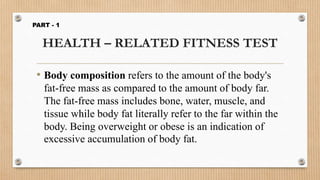
• Body composition refers to the amount of the body's
fat-free mass as compared to the amount of body far.
The fat-free mass includes bone, water, muscle, and
tissue while body fat literally refer to the far within the
body. Being overweight or obese is an indication of
excessive accumulation of body fat.
PART - 1
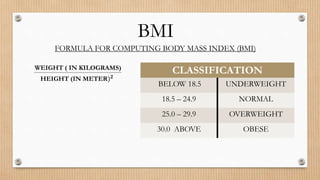
BMI
FORMULA FOR COMPUTING BODY MASS INDEX (BMI)
WEIGHT ( IN KILOGRAMS)
HEIGHT (IN METER)𝟐
CLASSIFICATION
BELOW 18.5 UNDERWEIGHT
18.5 – 24.9 NORMAL
25.0 – 29.9 OVERWEIGHT
30.0 ABOVE OBESE
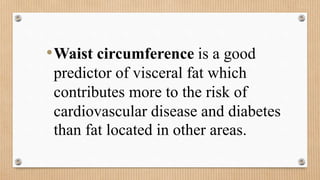
•Waist circumference is a good
predictor of visceral fat which
contributes more to the risk of
cardiovascular disease and diabetes
than fat located in other areas.
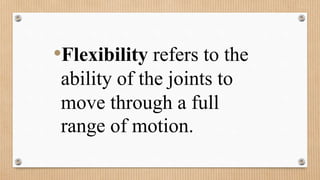
•Flexibility refers to the
ability of the joints to
move through a full
range of motion.
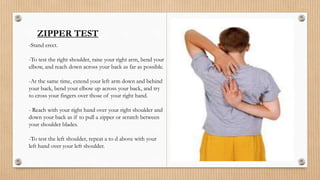
ZIPPER TEST
-Stand erect.
-To test the right shoulder, raise your right arm, bend your
elbow, and reach down across your back as far as possible.
-At the same time, extend your left arm down and behind
your back, bend your elbow up across your back, and try
to cross your fingers over those of your right hand.
- Reach with your right hand over your right shoulder and
down your back as if to pull a zipper or scratch between
your shoulder blades.
-To test the left shoulder, repeat a to d above with your
left hand over your left shoulder.
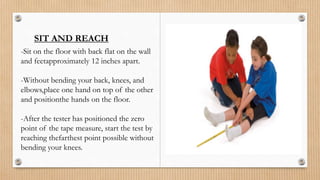
SIT AND REACH
-Sit on the floor with back flat on the wall
and feetapproximately 12 inches apart.
-Without bending your back, knees, and
elbows,place one hand on top of the other
and positionthe hands on the floor.
-After the tester has positioned the zero
point of the tape measure, start the test by
reaching thefarthest point possible without
bending your knees.
•Cardiovascular endurance is the
ability of the heart, lungs, and blood
vessels to deliver oxygen to working
muscles and tissues, as well as the
ability of those muscles and tissues to
utilize that oxygen.
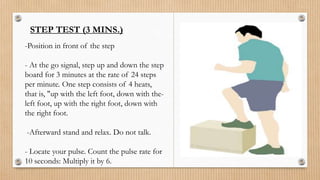
STEP TEST (3 MINS.)
-Position in front of the step
- At the go signal, step up and down the step
board for 3 minutes at the rate of 24 steps
per minute. One step consists of 4 heats,
that is, "up with the left foot, down with the-
left foot, up with the right foot, down with
the right foot.
-Afterward stand and relax. Do not talk.
- Locate your pulse. Count the pulse rate for
10 seconds: Multiply it by 6.
•Strength refers to
the muscle's ability to
generate force against
physical objects.
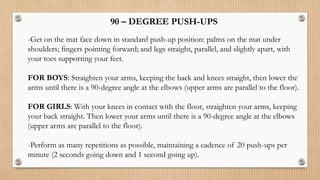
-Get on the mat face down in standard push-up position: palms on the mat under
shoulders; fingers pointing forward; and legs straight, parallel, and slightly apart, with
your toes supporting your feet.
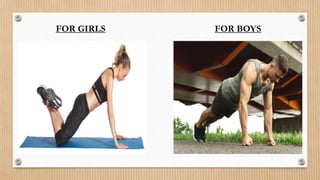
FOR BOYS: Straighten your arms, keeping the back and knees straight, then lower the
arms until there is a 90-degree angle at the elbows (upper arms are parallel to the floor).
FOR GIRLS: With your knees in contact with the floor, straighten your arms, keeping
your back straight. Then lower your arms until there is a 90-degree angle at the elbows
(upper arms are parallel to the floor).
-Perform as many repetitions as possible, maintaining a cadence of 20 push-ups per
minute (2 seconds going down and 1 second going up).
90 – DEGREE PUSH-UPS
FOR GIRLS FOR BOYS
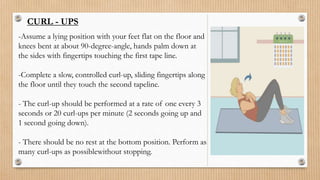
CURL - UPS
-Assume a lying position with your feet flat on the floor and
knees bent at about 90-degree-angle, hands palm down at
the sides with fingertips touching the first tape line.
-Complete a slow, controlled curl-up, sliding fingertips along
the floor until they touch the second tapeline.
- The curl-up should be performed at a rate of one every 3
seconds or 20 curl-ups per minute (2 seconds going up and
1 second going down).
- There should be no rest at the bottom position. Perform as
many curl-ups as possiblewithout stopping.
SKILL – RELATED FITNESS
•SPEED IS THE ABILITY TO
PERFORM A MOVEMENT IN A
SHORT PERIOD.
PART - 2
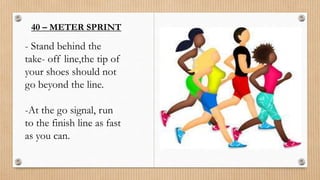
40 – METER SPRINT
- Stand behind the
take- off line,the tip of
your shoes should not
go beyond the line.
-At the go signal, run
to the finish line as fast
as you can.
•POWER IS THE ABILITY
TO TRANSFER ENERGY
INTO A FORCE AT A FAST
RATE.
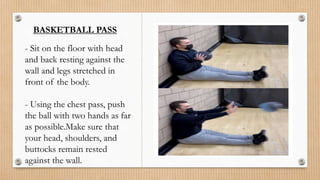
BASKETBALL PASS
- Sit on the floor with head
and back resting against the
wall and legs stretched in
front of the body.
- Using the chest pass, push
the ball with two hands as far
as possible.Make sure that
your head, shoulders, and
buttocks remain rested
against the wall.
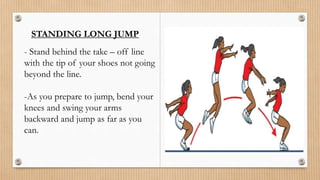
STANDING LONG JUMP
- Stand behind the take – off line
with the tip of your shoes not going
beyond the line.
-As you prepare to jump, bend your
knees and swing your arms
backward and jump as far as you
can.
•AGILITY IS THE ABILITY TO
CHANGE DIRECTION
QUICKLY USING A
COMBINATION OF BALANCE,
COORDINATION, SPEED,
STRENGHT, AND
ENDURANCE.
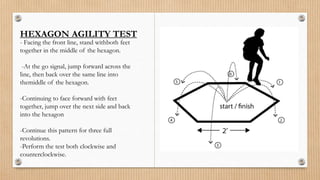
HEXAGON AGILITY TEST
- Facing the front line, stand withboth feet
together in the middle of the hexagon.
-At the go signal, jump forward across the
line, then back over the same line into
themiddle of the hexagon.
-Continuing to face forward with feet
together, jump over the next side and back
into the hexagon
-Continue this pattern for three full
revolutions.
-Perform the test both clockwise and
counterclockwise.
•REACTION TIME IS THE
TIME ELAPSED BETWEEN
STIMULATION AND THE
BEGINNING OF REACTION
TO THE STIMULUS.
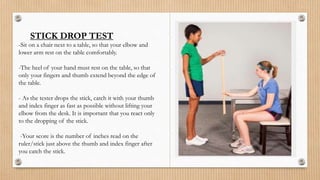
STICK DROP TEST
-Sit on a chair next to a table, so that your elbow and
lower arm rest on the table comfortably.
-The heel of your hand must rest on the table, so that
only your fingers and thumb extend beyond the edge of
the table.
- As the tester drops the stick, catch it with your thumb
and index finger as fast as possible without lifting your
elbow from the desk. It is important that you react only
to the dropping of the stick.
-Your score is the number of inches read on the
ruler/stick just above the thumb and index finger after
you catch the stick.
•COORDINATION IS THE
ABILITY TO USE THE
SENSES WITH THE BODY
PARTS TO PERFORM
MOTOR TASK SMOOTHLY
AND ACCURATELY.
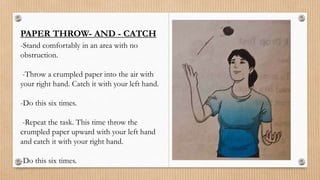
PAPER THROW- AND - CATCH
-Stand comfortably in an area with no
obstruction.
-Throw a crumpled paper into the air with
your right hand. Catch it with your left hand.
-Do this six times.
-Repeat the task. This time throw the
crumpled paper upward with your left hand
and catch it with your right hand.
-Do this six times.
•BALANCE IS THE
MAINTENANCE OF
EQUILIBRIUM WHILE
IN STATIONARY OR
MOVING POSITION.
STORK BALANCE
STAND TEST
-Remove your shoes and place
your hand in your hips.
-Position the non-supporting
foot against the inside knee of
the supporting leg.
-Raise the heel to balance on
the ball of your foot.
1.WHAT IS BALANCE?
2.WHAT IS SPEED?
3.WHAT IS POWER?
4.WHAT IS STRENGHT?
5.WHAT IS FLEXIBILITY?
6-10.WHAT DID YOU LEARN?
GOODLUCK!

FITNESS TESTING AND ASSESSMENT phys.pptx

  • 1.
  • 2.
    GOALS • TO DETERMINETHE LEVEL OF FITNESS. • IDENTIFY STRENGHTS AND AREAS FOR IMPROVEMENT. • IDENTIFY BASES FOR PHYSICAL ACTIVITIES. • GATHER AND ANALYZE DATA FOR NORMS AND STANDARD SETTING. • CHOOSE SPORT ACTIVITIES YOU WOULD LIKE TO PARTICIPATE IN.
  • 3.
    PART 1 •Physical fitnesstesting helps determine the state of your well-being and measures the level of performance of your muscles, heart, and lungs.
  • 4.
    The test isdivided into two parts. The health- related fitness test, includes testing for body composition, waist circumference, flexibility, cardiovascular endurance, and strength. The skill- related fitness test includes testing for speed, power, agility, reaction time, coordination, and balance.
  • 5.
    HEALTH – RELATEDFITNESS TEST • Body composition refers to the amount of the body's fat-free mass as compared to the amount of body far. The fat-free mass includes bone, water, muscle, and tissue while body fat literally refer to the far within the body. Being overweight or obese is an indication of excessive accumulation of body fat. PART - 1
  • 6.
    BMI FORMULA FOR COMPUTINGBODY MASS INDEX (BMI) WEIGHT ( IN KILOGRAMS) HEIGHT (IN METER)𝟐 CLASSIFICATION BELOW 18.5 UNDERWEIGHT 18.5 – 24.9 NORMAL 25.0 – 29.9 OVERWEIGHT 30.0 ABOVE OBESE
  • 7.
    •Waist circumference isa good predictor of visceral fat which contributes more to the risk of cardiovascular disease and diabetes than fat located in other areas.
  • 8.
    •Flexibility refers tothe ability of the joints to move through a full range of motion.
  • 9.
    ZIPPER TEST -Stand erect. -Totest the right shoulder, raise your right arm, bend your elbow, and reach down across your back as far as possible. -At the same time, extend your left arm down and behind your back, bend your elbow up across your back, and try to cross your fingers over those of your right hand. - Reach with your right hand over your right shoulder and down your back as if to pull a zipper or scratch between your shoulder blades. -To test the left shoulder, repeat a to d above with your left hand over your left shoulder.
  • 10.
    SIT AND REACH -Siton the floor with back flat on the wall and feetapproximately 12 inches apart. -Without bending your back, knees, and elbows,place one hand on top of the other and positionthe hands on the floor. -After the tester has positioned the zero point of the tape measure, start the test by reaching thefarthest point possible without bending your knees.
  • 11.
    •Cardiovascular endurance isthe ability of the heart, lungs, and blood vessels to deliver oxygen to working muscles and tissues, as well as the ability of those muscles and tissues to utilize that oxygen.
  • 12.
    STEP TEST (3MINS.) -Position in front of the step - At the go signal, step up and down the step board for 3 minutes at the rate of 24 steps per minute. One step consists of 4 heats, that is, "up with the left foot, down with the- left foot, up with the right foot, down with the right foot. -Afterward stand and relax. Do not talk. - Locate your pulse. Count the pulse rate for 10 seconds: Multiply it by 6.
  • 13.
    •Strength refers to themuscle's ability to generate force against physical objects.
  • 14.
    -Get on themat face down in standard push-up position: palms on the mat under shoulders; fingers pointing forward; and legs straight, parallel, and slightly apart, with your toes supporting your feet. FOR BOYS: Straighten your arms, keeping the back and knees straight, then lower the arms until there is a 90-degree angle at the elbows (upper arms are parallel to the floor). FOR GIRLS: With your knees in contact with the floor, straighten your arms, keeping your back straight. Then lower your arms until there is a 90-degree angle at the elbows (upper arms are parallel to the floor). -Perform as many repetitions as possible, maintaining a cadence of 20 push-ups per minute (2 seconds going down and 1 second going up). 90 – DEGREE PUSH-UPS
  • 15.
  • 16.
    CURL - UPS -Assumea lying position with your feet flat on the floor and knees bent at about 90-degree-angle, hands palm down at the sides with fingertips touching the first tape line. -Complete a slow, controlled curl-up, sliding fingertips along the floor until they touch the second tapeline. - The curl-up should be performed at a rate of one every 3 seconds or 20 curl-ups per minute (2 seconds going up and 1 second going down). - There should be no rest at the bottom position. Perform as many curl-ups as possiblewithout stopping.
  • 17.
    SKILL – RELATEDFITNESS •SPEED IS THE ABILITY TO PERFORM A MOVEMENT IN A SHORT PERIOD. PART - 2
  • 18.
    40 – METERSPRINT - Stand behind the take- off line,the tip of your shoes should not go beyond the line. -At the go signal, run to the finish line as fast as you can.
  • 19.
    •POWER IS THEABILITY TO TRANSFER ENERGY INTO A FORCE AT A FAST RATE.
  • 20.
    BASKETBALL PASS - Siton the floor with head and back resting against the wall and legs stretched in front of the body. - Using the chest pass, push the ball with two hands as far as possible.Make sure that your head, shoulders, and buttocks remain rested against the wall.
  • 21.
    STANDING LONG JUMP -Stand behind the take – off line with the tip of your shoes not going beyond the line. -As you prepare to jump, bend your knees and swing your arms backward and jump as far as you can.
  • 22.
    •AGILITY IS THEABILITY TO CHANGE DIRECTION QUICKLY USING A COMBINATION OF BALANCE, COORDINATION, SPEED, STRENGHT, AND ENDURANCE.
  • 23.
    HEXAGON AGILITY TEST -Facing the front line, stand withboth feet together in the middle of the hexagon. -At the go signal, jump forward across the line, then back over the same line into themiddle of the hexagon. -Continuing to face forward with feet together, jump over the next side and back into the hexagon -Continue this pattern for three full revolutions. -Perform the test both clockwise and counterclockwise.
  • 24.
    •REACTION TIME ISTHE TIME ELAPSED BETWEEN STIMULATION AND THE BEGINNING OF REACTION TO THE STIMULUS.
  • 25.
    STICK DROP TEST -Siton a chair next to a table, so that your elbow and lower arm rest on the table comfortably. -The heel of your hand must rest on the table, so that only your fingers and thumb extend beyond the edge of the table. - As the tester drops the stick, catch it with your thumb and index finger as fast as possible without lifting your elbow from the desk. It is important that you react only to the dropping of the stick. -Your score is the number of inches read on the ruler/stick just above the thumb and index finger after you catch the stick.
  • 26.
    •COORDINATION IS THE ABILITYTO USE THE SENSES WITH THE BODY PARTS TO PERFORM MOTOR TASK SMOOTHLY AND ACCURATELY.
  • 27.
    PAPER THROW- AND- CATCH -Stand comfortably in an area with no obstruction. -Throw a crumpled paper into the air with your right hand. Catch it with your left hand. -Do this six times. -Repeat the task. This time throw the crumpled paper upward with your left hand and catch it with your right hand. -Do this six times.
  • 28.
    •BALANCE IS THE MAINTENANCEOF EQUILIBRIUM WHILE IN STATIONARY OR MOVING POSITION.
  • 29.
    STORK BALANCE STAND TEST -Removeyour shoes and place your hand in your hips. -Position the non-supporting foot against the inside knee of the supporting leg. -Raise the heel to balance on the ball of your foot.
  • 31.
    1.WHAT IS BALANCE? 2.WHATIS SPEED? 3.WHAT IS POWER? 4.WHAT IS STRENGHT? 5.WHAT IS FLEXIBILITY? 6-10.WHAT DID YOU LEARN? GOODLUCK!