

Coordination

San Shway Wynn
2nd February 2013
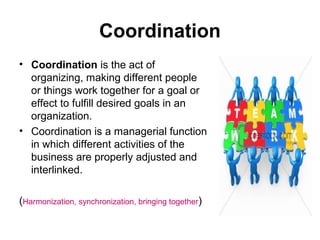
Coordination
• Coordination is the act of
organizing, making different people
or things work together for a goal or
effect to fulfill desired goals in an
organization.
• Coordination is a managerial function
in which different activities of the
business are properly adjusted and
interlinked.
(Harmonization, synchronization, bringing together)
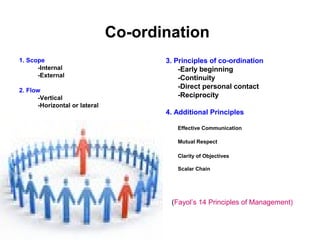
Co-ordination
1. Scope
-Internal
-External
2. Flow
-Vertical
-Horizontal or lateral

3. Principles of co-ordination
-Early beginning
-Continuity
-Direct personal contact
-Reciprocity
4. Additional Principles
Effective Communication
Mutual Respect
Clarity of Objectives
Scalar Chain

(Fayol’s 14 Principles of Management)
Collaboration
• Collaboration is working together
to achieve a goal.
• It is a recursive process where two
or more people or organizations
work together to realize shared
goals, but a deep, collective,
determination to reach an identical
objective.
• An endeavor that is creative in
nature by sharing knowledge,
learning and building consensus.
(Team work, partnership, group effort,
association)
Cooperation
• Cooperation is the process
of working or acting together.
• In its simplest form it involves
things working in harmony.
• It is the opposite of working
separately in competition.
(Assistance, support, help, mutual aid)
Community
• The concept of “community” implies a group of
people sharing something in common.
Green, 2007

• Communities are formed by people who are
connected to each other in distinct and varied
ways.
• Communities are diverse and dynamic, and
one person may be part of more than one
community.
• Community members may be connected by
living in the same area or by shared
experiences, health and other challenges,
living situations, culture, religion, identity or
values.
Global Fund, 2010
Concept of community participation
Participation is not getting people to
do what professional want.
 People as responsible
persons for their health / care
givers.
 People as patients and
customers.
 People as health workers.
 People as purchasers of care.
 People as managers of health
services.
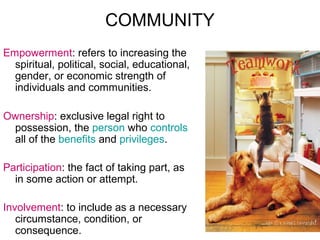
COMMUNITY
Empowerment: refers to increasing the
spiritual, political, social, educational,
gender, or economic strength of
individuals and communities.
Ownership: exclusive legal right to
possession, the person who controls
all of the benefits and privileges.
Participation: the fact of taking part, as
in some action or attempt.
Involvement: to include as a necessary
circumstance, condition, or
consequence.
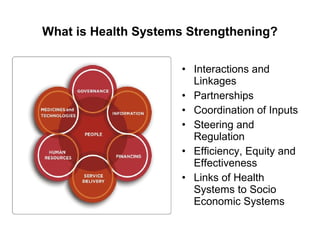
What is Health Systems Strengthening?

What is Health Systems Strengthening?

What is Health Systems Strengthening?
• Interactions and
Linkages
• Partnerships
• Coordination of Inputs
• Steering and
Regulation
• Efficiency, Equity and
Effectiveness
• Links of Health
Systems to Socio
Economic Systems
Enabling Factors
•
•
•
•
•
•
•
•

Man
Money
Materials
Methods
Motivation
Monitor
Match
Management
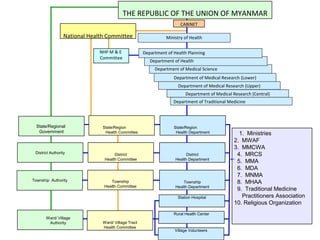
THE REPUBLIC OF THE UNION OF MYANMAR
CABINET

National Health Committee
NHP M & E
Committee

Ministry of Health
Department of Health Planning
Department of Health
Department of Medical Science
Department of Medical Research (Lower)
Department of Medical Research (Upper)
Department of Medical Research (Central)
Department of Traditional Medicine

State/Regional
Government

State/Region
Health Committee

State/Region
Health Department

District Authority

District
Health Committee

District
Health Department

Township Authority

Township
Health Committee

Township
Health Department
Station Hospital

Ward/ Village
Authority

Rural Health Center
Ward/ Village Tract
Health Committee

Village Volunteers

1. Ministries
2. MWAF
3. MMCWA
4. MRCS
5. MMA
6. MDA
7. MNMA
8. MHAA
9. Traditional Medicine
Practitioners Association
10. Religious Organization
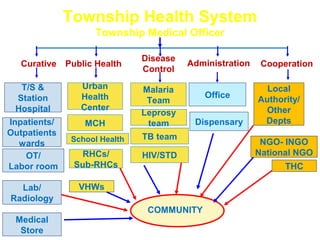
Township Health System
Township Medical Officer
Curative Public Health
T/S &
Station
Hospital
Inpatients/
Outpatients
wards
OT/
Labor room
Lab/
Radiology
Medical
Store

Urban
Health
Center
MCH
School Health

RHCs/
Sub-RHCs

Disease
Control
Malaria
Team
Leprosy
team
TB team

Administration
Office
Dispensary

HIV/STD

Cooperation
Local
Authority/
Other
Depts
NGO- INGO
National NGO
THC

VHWs
COMMUNITY
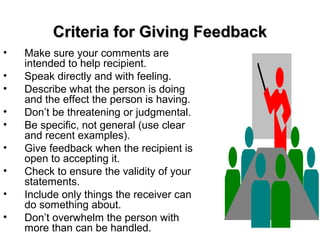
Criteria for Giving Feedback
•
•
•
•
•
•
•
•
•

Make sure your comments are
intended to help recipient.
Speak directly and with feeling.
Describe what the person is doing
and the effect the person is having.
Don’t be threatening or judgmental.
Be specific, not general (use clear
and recent examples).
Give feedback when the recipient is
open to accepting it.
Check to ensure the validity of your
statements.
Include only things the receiver can
do something about.
Don’t overwhelm the person with
more than can be handled.
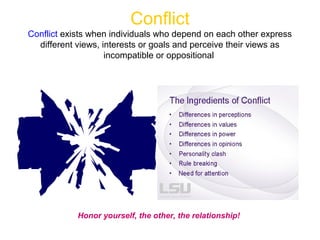
Conflict
Conflict exists when individuals who depend on each other express
different views, interests or goals and perceive their views as
incompatible or oppositional

Honor yourself, the other, the relationship!
Major Functions of HSSO
1) Identify problems and
needs
2) Facilitate, selecting and
setting priorities
3) Plan development
4) Implement effectively
5) Follow-up and evaluate
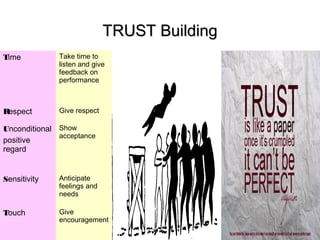
TRUST Building
Time

Take time to
listen and give
feedback on
performance

Respect

Give respect

Unconditional Show
acceptance
positive
regard

Sensitivity

Anticipate
feelings and
needs

Touch

Give
encouragement
Take ownership of your job
• Any job you do is going to
"have your fingerprints all
over it."
• That is why it is so important
to take ownership of your job,
any job you do, and really
own it.
• Do it the best you can; do it
the best it can be done.
• That is how you succeed.
Health Systems Strengthening
Coordination

Coordination

  • 1.
  • 2.
    Coordination • Coordination isthe act of organizing, making different people or things work together for a goal or effect to fulfill desired goals in an organization. • Coordination is a managerial function in which different activities of the business are properly adjusted and interlinked. (Harmonization, synchronization, bringing together)
  • 3.
    Co-ordination 1. Scope -Internal -External 2. Flow -Vertical -Horizontalor lateral 3. Principles of co-ordination -Early beginning -Continuity -Direct personal contact -Reciprocity 4. Additional Principles Effective Communication Mutual Respect Clarity of Objectives Scalar Chain (Fayol’s 14 Principles of Management)
  • 5.
    Collaboration • Collaboration isworking together to achieve a goal. • It is a recursive process where two or more people or organizations work together to realize shared goals, but a deep, collective, determination to reach an identical objective. • An endeavor that is creative in nature by sharing knowledge, learning and building consensus. (Team work, partnership, group effort, association)
  • 6.
    Cooperation • Cooperation isthe process of working or acting together. • In its simplest form it involves things working in harmony. • It is the opposite of working separately in competition. (Assistance, support, help, mutual aid)
  • 7.
    Community • The conceptof “community” implies a group of people sharing something in common. Green, 2007 • Communities are formed by people who are connected to each other in distinct and varied ways. • Communities are diverse and dynamic, and one person may be part of more than one community. • Community members may be connected by living in the same area or by shared experiences, health and other challenges, living situations, culture, religion, identity or values. Global Fund, 2010
  • 8.
    Concept of communityparticipation Participation is not getting people to do what professional want.  People as responsible persons for their health / care givers.  People as patients and customers.  People as health workers.  People as purchasers of care.  People as managers of health services.
  • 9.
    COMMUNITY Empowerment: refers toincreasing the spiritual, political, social, educational, gender, or economic strength of individuals and communities. Ownership: exclusive legal right to possession, the person who controls all of the benefits and privileges. Participation: the fact of taking part, as in some action or attempt. Involvement: to include as a necessary circumstance, condition, or consequence.
  • 10.
    What is HealthSystems Strengthening? What is Health Systems Strengthening? What is Health Systems Strengthening? What is Health Systems Strengthening? • Interactions and Linkages • Partnerships • Coordination of Inputs • Steering and Regulation • Efficiency, Equity and Effectiveness • Links of Health Systems to Socio Economic Systems
  • 11.
  • 12.
    THE REPUBLIC OFTHE UNION OF MYANMAR CABINET National Health Committee NHP M & E Committee Ministry of Health Department of Health Planning Department of Health Department of Medical Science Department of Medical Research (Lower) Department of Medical Research (Upper) Department of Medical Research (Central) Department of Traditional Medicine State/Regional Government State/Region Health Committee State/Region Health Department District Authority District Health Committee District Health Department Township Authority Township Health Committee Township Health Department Station Hospital Ward/ Village Authority Rural Health Center Ward/ Village Tract Health Committee Village Volunteers 1. Ministries 2. MWAF 3. MMCWA 4. MRCS 5. MMA 6. MDA 7. MNMA 8. MHAA 9. Traditional Medicine Practitioners Association 10. Religious Organization
  • 13.
    Township Health System TownshipMedical Officer Curative Public Health T/S & Station Hospital Inpatients/ Outpatients wards OT/ Labor room Lab/ Radiology Medical Store Urban Health Center MCH School Health RHCs/ Sub-RHCs Disease Control Malaria Team Leprosy team TB team Administration Office Dispensary HIV/STD Cooperation Local Authority/ Other Depts NGO- INGO National NGO THC VHWs COMMUNITY
  • 14.
    Criteria for GivingFeedback • • • • • • • • • Make sure your comments are intended to help recipient. Speak directly and with feeling. Describe what the person is doing and the effect the person is having. Don’t be threatening or judgmental. Be specific, not general (use clear and recent examples). Give feedback when the recipient is open to accepting it. Check to ensure the validity of your statements. Include only things the receiver can do something about. Don’t overwhelm the person with more than can be handled.
  • 15.
    Conflict Conflict exists whenindividuals who depend on each other express different views, interests or goals and perceive their views as incompatible or oppositional Honor yourself, the other, the relationship!
  • 16.
    Major Functions ofHSSO 1) Identify problems and needs 2) Facilitate, selecting and setting priorities 3) Plan development 4) Implement effectively 5) Follow-up and evaluate
  • 17.
    TRUST Building Time Take timeto listen and give feedback on performance Respect Give respect Unconditional Show acceptance positive regard Sensitivity Anticipate feelings and needs Touch Give encouragement
  • 18.
    Take ownership ofyour job • Any job you do is going to "have your fingerprints all over it." • That is why it is so important to take ownership of your job, any job you do, and really own it. • Do it the best you can; do it the best it can be done. • That is how you succeed.
  • 21.