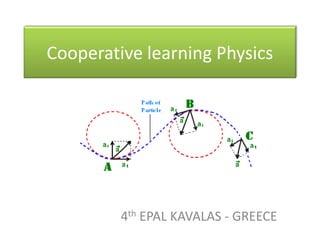
Cooperative learning Physics
4th EPAL KAVALAS - GREECE
Acceleration taught using the method of
co-operative approach
• The chosen subject was acceleration. The students were divided
into groups of four and they worked in our school’s computer
laboratory so as to have access to the internet.
• The sub-topics of the main topic were:
• What is acceleration and how is it defined? Is it a scalar or a vector
quantity? What is the unit of measurement of acceleration?
• What do we call uniform linear motion and what is the graph of
acceleration-velocity like?
• How do we define velocity in uniform linear motion and how do we
prove the formula u=u0+at? What is the graph of velocity-time like?
• How do we define displacement in uniform linear motion and how
do we prove the formula S=u0t+1/2 at2? What is the graph of
displacent-time like?
What are the benefits of the co-operative
method in relation to the teacher-centered one
• The student is inspired by a sense of team
cooperation, tolerance and fraternity.
• Within the group, the student acquires more self-
discovery, initiative and self-esteem.
• Students learn to work by themselves and they
come in direct contact with the object of the
particular knowledge.
• The issue of indiscipline is limited and what
predomines is healthy competition as well as co-
operation within the group.
The potential disadvantages are:
• It is more time-consuming, as it demands
more tuition time.
• Often the use of computers is required, in
most schools the computer rooms are not
enough for all classes.
• Students don’t get the chance to practise for a
long time on the application of the formulas
they are taught through the exercises.
Cooperative learning physics

Cooperative learning physics

  • 1.
    Cooperative learning Physics 4thEPAL KAVALAS - GREECE
  • 2.
    Acceleration taught usingthe method of co-operative approach • The chosen subject was acceleration. The students were divided into groups of four and they worked in our school’s computer laboratory so as to have access to the internet. • The sub-topics of the main topic were: • What is acceleration and how is it defined? Is it a scalar or a vector quantity? What is the unit of measurement of acceleration? • What do we call uniform linear motion and what is the graph of acceleration-velocity like? • How do we define velocity in uniform linear motion and how do we prove the formula u=u0+at? What is the graph of velocity-time like? • How do we define displacement in uniform linear motion and how do we prove the formula S=u0t+1/2 at2? What is the graph of displacent-time like?
  • 3.
    What are thebenefits of the co-operative method in relation to the teacher-centered one • The student is inspired by a sense of team cooperation, tolerance and fraternity. • Within the group, the student acquires more self- discovery, initiative and self-esteem. • Students learn to work by themselves and they come in direct contact with the object of the particular knowledge. • The issue of indiscipline is limited and what predomines is healthy competition as well as co- operation within the group.
  • 4.
    The potential disadvantagesare: • It is more time-consuming, as it demands more tuition time. • Often the use of computers is required, in most schools the computer rooms are not enough for all classes. • Students don’t get the chance to practise for a long time on the application of the formulas they are taught through the exercises.