An Action Research Study
           By:
    Jessica Lambert
This two-cycle action research project investigated
the use of cooperative learning strategies within a 5th
grade classroom as a motivation and intervention tool.
Both qualitative and quantitative data were gathered and
analyzed according to a mixed-methods research design.
This study looked at the implications on classroom
behaviors when cooperative learning group strategies were
used to increase motivation as well as student
achievement. It also analyzed the impact that cooperative
learning strategies have on each individual subgroup within
the classroom to determine if using this strategy also
improved social justice and equality within a multicultural
classroom.
      Findings indicated that cooperative learning
strategies did increase motivation and achievement. In
addition to motivation and achievement research indicated
that cultural subgroups benefitted equally from the
incorporation of cooperative learning strategies.
 Intervention   needed to motivate students.

 Lowperforming students demonstrate lack of
 motivation not ability.

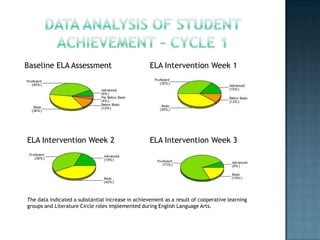
 Students   are not engaged.
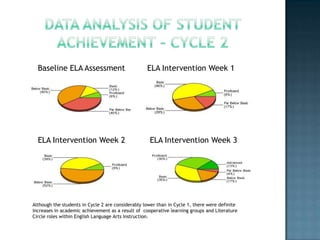
   In what specific and measurable ways does the
    implementation of cooperative learning groups
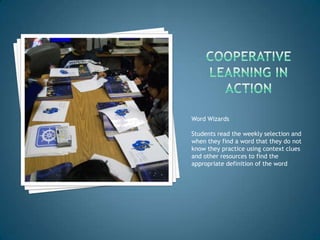
    affect student performance when used as an
    intervention for lower achieving students to
    increase motivation and overall academic
    performance?
       Does being accountable to a group for completing
        homework assignments decrease the frequency of
        missing or late assignments?
       Has there been a marked change in observable
        behaviors among the focus students as a result of the
        implementation of cooperative learning groups?
       How does the assignment of group roles and
        responsibilities add to the effectiveness of
        collaboration for focus students?
 Inwhat specific and measurable ways does
  the implementation of cooperative learning
  groups increase social justice in a
  multicultural classroom?
     Do all three subgroups within the classroom
      respond in similar ways to the use of cooperative
      learning strategies?
 Inthe early 1900’s, well known theorists
  begin inquiries into human behavior and
  educational psychology.
 Some big names driving this research were:
  John Dewey, Kurt Koffka, Jean Piaget, and
  Lev Vygotzky.
 The research that follows is the result of
  three main theoretical perspectives:
     Behavioral Theory
     Cognitive-Developmental Theory
     Social Interdependence Theory
 In his book, Democracy and Education
  (1916), he proposes that the processes of
  learning should be social and interactive.
     If students are to learn to live in a democracy
      then they should experience this process in
      classroom life.
     Students should have opportunities to engage in
      learning while making meaningful choices and
      building productive relationships based on
      genuine interpersonal respect and empathy
      (Baloche, 1998).
 Cooperative  efforts within groups are
  rewarded with extrinsic factors known as
  reinforcers.
 All human behavior is the result of
  antecendences and consequences or
  reinforcers.
    The consequence or reinforcer determines future
     behavior which either strengthens or extinguishes
     motivation.
 When   students work together they provide
  each other with new information and varying
  ways to think about information.
 Students receive immediate “rewards” as
  their contributions to the group are accepted
  and used.
 Students engage in Vygotzky’s “mediation”
  within heterogeneous groups when they
  coach and teach each other according to
  their different cognitive learning levels.
 Alligns with MSJE approach.
 Cooperative efforts are intrinsically
  motivated by common aspirations of
  achieving the same goal.
 Cooperative learning structures promote
  social interaction as group members
  encourage and ease each other’s efforts to
  learn.
 Achievement    gap? Race relations crisis?
 Social skills crisis? Experts label the lowered
 US educational performance of students with
 various names. Cooperative learning can
 address many of these issues.
    Preliminary research indicates that cooperative
     learning helps bridge these gaps.
        Students work together and increase social skills.
        Students work together and increase race relations.
        Students work together and acquire 21st century skills
         that will help them as they navigate from classroom to
         career.
 Cooperative learning can build social skills
  while diminishing racial tension and still
  mastering grade level standards.
 Cooperative learning should be used in the
  classroom to develop skills and attitudes of
  cooperation.
     Group Process Skills
         Conflict management
         Listening skills
 Heterogeneous  groups are a key to successful
 cooperative learning; but often when
 grouped this way students do not know or
 like each other so activities that build
 teamwork and trust are imperative. Some
 examples of teambuilding activities:
    “About Me” posters and collages
    Team identity posters
    This is my friend (partners introduce each other)
    Team Interviews
    Team Windows
 The  younger the student, the greater the
  need for social skill building when working
  together becomes.
 Dr. Spencer Kagan (2009) says, “Good
  teammates are made, not born.”
     Students do not always get along it is important
      to see these situations as learning opportunities.
     Teachers should be prepared for these
      situations, understand that they are a natural
      occurrence, rather than a reason to abandon
      cooperative learning, and model effective
      problem solving skills when groups experience
      difficulties.
 What makes cooperative learning different
  from ordinary group work is that each
  member has a specific role.
 Some ideas for job titles or roles are:
               Facilitator
               Checker
               Timekeeper
               Speaker or Presenter
               Encourager or Cheerleader
               Sherriff
               Focus Keeper
               Recorder
               Quiet Captain
               Materials Monitor
 The research proved that there is a wide
 variety of group structures. The four that
 were implemented in my project and will be
 explained in the following slides were:
    Jigsaw
    Group Investigation
    Literature Circles
    Numbered Heads Together
There are many ways that this structure can
be adapted. In this study heterogeneous
groups of four were numbered one through
four. Each number then meets with a
different group to become experts on a
topic. They then return to their group to
share what they learned and contribute to
the group, while learning from the
contributions of other group members who
became experts on a different subtopic.
Students are required to gather
data, interpret the data through
discussion, and synthesize individual
contributions into a group project. This can
be used for all ages, but the younger the
student the more support and guidance will
be required by the teacher as well as
scaffolding of investigative materials that are
age appropriate.
Students are assigned to small, cooperative
reading groups and each takes on a different
role that develops a comprehension strategy.
Example roles:
     Plot Pilot – traces plot.
     Word Wizard – uses context clues to find
            meanings of difficult words.
     Story Shrinker – Summarizes selection.
     Character Captain – Analyzes what a
            character does and says to draw
            conclusions about them.
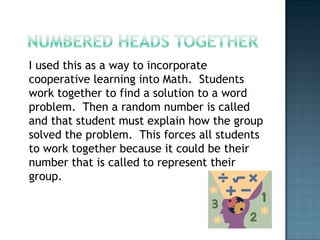
I used this as a way to incorporate
cooperative learning into Math. Students
work together to find a solution to a word
problem. Then a random number is called
and that student must explain how the group
solved the problem. This forces all students
to work together because it could be their
number that is called to represent their
group.
Subjects – 5th grade students at West Fresno Elementary School.
  Focus students for each cycle were 4 low performing students
  that exhibited similar motivational and behavioral
  characteristics.
Instrumentation – Student surveys, formative assessments
   (quizzes, worksheets, homework, and other student generated
   artifacts), summative assessments (unit and district
   benchmarks), observation checklists, and transcribed notes from
   structured interviews.
Reliability and Validity – Established by the triangulation of the
  multiple forms of data gathered.
Data Analysis and Results – Results were presented using descriptive
  statistics as they relate to the cooperative learning intervention
  for the 4 focus students as well as the remaining student
  population within the classroom. The data was organized into
  subcategories for analysis.
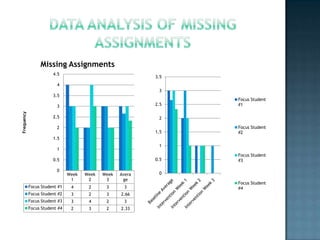
Missing Assignments
                       4.5
                                                            3.5
                         4
                                                             3
                       3.5
                                                                  Focus Student
                         3                                  2.5   #1
Frequency


                       2.5                                   2

                         2                                        Focus Student
                                                            1.5   #2
                       1.5
                                                             1
                         1
                                                                  Focus Student
                       0.5                                  0.5   #3

                         0
                               Week   Week   Week   Avera    0
                                1      2      3      ge
                                                                  Focus Student
            Focus Student #1    4      2      3      3            #4
            Focus Student #2    3      2      3     2.66
            Focus Student #3    3      4      2      3
            Focus Student #4    2      3      2     2.33
The observation checklists indicated that
 student on task behavior improved as a result
 of cooperative learning lesson activities.

Student surveys indicated that students also
  felt their on task behavior improved while
  undesired behaviors decreased.

Student interviews also indicated that group
  work helped them stay on task while
  accountability to others decreased undesired
  behaviors.
Baseline ELA Assessment                            ELA Intervention Week 1


ELA Intervention Week 2                            ELA Intervention Week 3


The data indicated a substantial increase in achievement as a result of cooperative learning
groups and Literature Circle roles implemented during English Language Arts.
Baseline ELA Assessment                          ELA Intervention Week 1


  ELA Intervention Week 2                           ELA Intervention Week 3


Although the students in Cycle 2 are considerably lower than in Cycle 1, there were definite
increases in academic achievement as a result of cooperative learning groups and Literature
Circle roles within English Language Arts instruction.
 Increases   peer accountability.
    Leading to an increased motivation for
     completing both homework and class work.
 Engages    students in learning.
    Students loved “job titles” and were excited to
     do their “jobs” well.
 Decreases    off task behavior.
    Students know that their contribution is vital to
     the group.
 Increases   academic achievement.
    Engaged learners are much more likely to master
     standards and do well on both formative and
     summative assessments.
Word Wizards

Students read the weekly selection and
when they find a word that they do not
know they practice using context clues
and other resources to find the
appropriate definition of the word
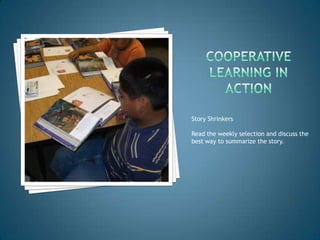
Story Shrinkers

Read the weekly selection and discuss the
best way to summarize the story.
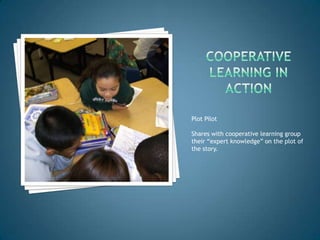
Plot Pilot

Shares with cooperative learning group
their “expert knowledge” on the plot of
the story.
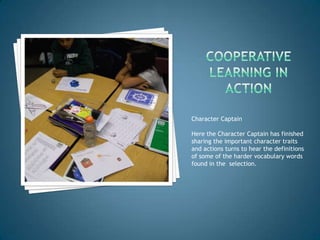
Character Captain

Here the Character Captain has finished
sharing the important character traits
and actions turns to hear the definitions
of some of the harder vocabulary words
found in the selection.
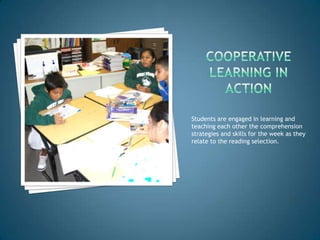
Students are engaged in learning and
teaching each other the comprehension
strategies and skills for the week as they
relate to the reading selection.
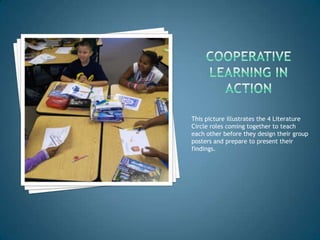
This picture illustrates the 4 Literature
Circle roles coming together to teach
each other before they design their group
posters and prepare to present their
findings.
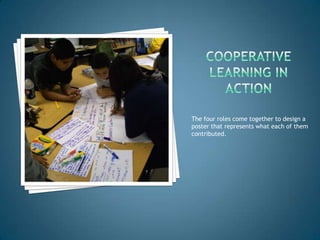
The four roles come together to design a
poster that represents what each of them
contributed.
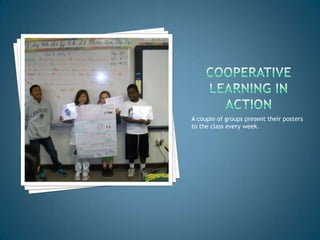
A couple of groups present their posters
to the class every week.

Cooperative Learning

  • 1.
    An Action ResearchStudy By: Jessica Lambert
  • 2.
    This two-cycle actionresearch project investigated the use of cooperative learning strategies within a 5th grade classroom as a motivation and intervention tool. Both qualitative and quantitative data were gathered and analyzed according to a mixed-methods research design. This study looked at the implications on classroom behaviors when cooperative learning group strategies were used to increase motivation as well as student achievement. It also analyzed the impact that cooperative learning strategies have on each individual subgroup within the classroom to determine if using this strategy also improved social justice and equality within a multicultural classroom. Findings indicated that cooperative learning strategies did increase motivation and achievement. In addition to motivation and achievement research indicated that cultural subgroups benefitted equally from the incorporation of cooperative learning strategies.
  • 3.
     Intervention needed to motivate students.  Lowperforming students demonstrate lack of motivation not ability.  Students are not engaged.
  • 4.
    In what specific and measurable ways does the implementation of cooperative learning groups affect student performance when used as an intervention for lower achieving students to increase motivation and overall academic performance?  Does being accountable to a group for completing homework assignments decrease the frequency of missing or late assignments?  Has there been a marked change in observable behaviors among the focus students as a result of the implementation of cooperative learning groups?  How does the assignment of group roles and responsibilities add to the effectiveness of collaboration for focus students?
  • 5.
     Inwhat specificand measurable ways does the implementation of cooperative learning groups increase social justice in a multicultural classroom?  Do all three subgroups within the classroom respond in similar ways to the use of cooperative learning strategies?
  • 6.
     Inthe early1900’s, well known theorists begin inquiries into human behavior and educational psychology.  Some big names driving this research were: John Dewey, Kurt Koffka, Jean Piaget, and Lev Vygotzky.  The research that follows is the result of three main theoretical perspectives:  Behavioral Theory  Cognitive-Developmental Theory  Social Interdependence Theory
  • 7.
     In hisbook, Democracy and Education (1916), he proposes that the processes of learning should be social and interactive.  If students are to learn to live in a democracy then they should experience this process in classroom life.  Students should have opportunities to engage in learning while making meaningful choices and building productive relationships based on genuine interpersonal respect and empathy (Baloche, 1998).
  • 8.
     Cooperative efforts within groups are rewarded with extrinsic factors known as reinforcers.  All human behavior is the result of antecendences and consequences or reinforcers.  The consequence or reinforcer determines future behavior which either strengthens or extinguishes motivation.
  • 9.
     When students work together they provide each other with new information and varying ways to think about information.  Students receive immediate “rewards” as their contributions to the group are accepted and used.  Students engage in Vygotzky’s “mediation” within heterogeneous groups when they coach and teach each other according to their different cognitive learning levels.
  • 10.
     Alligns withMSJE approach.  Cooperative efforts are intrinsically motivated by common aspirations of achieving the same goal.  Cooperative learning structures promote social interaction as group members encourage and ease each other’s efforts to learn.
  • 11.
     Achievement gap? Race relations crisis? Social skills crisis? Experts label the lowered US educational performance of students with various names. Cooperative learning can address many of these issues.  Preliminary research indicates that cooperative learning helps bridge these gaps.  Students work together and increase social skills.  Students work together and increase race relations.  Students work together and acquire 21st century skills that will help them as they navigate from classroom to career.
  • 12.
     Cooperative learningcan build social skills while diminishing racial tension and still mastering grade level standards.  Cooperative learning should be used in the classroom to develop skills and attitudes of cooperation.  Group Process Skills  Conflict management  Listening skills
  • 13.
     Heterogeneous groups are a key to successful cooperative learning; but often when grouped this way students do not know or like each other so activities that build teamwork and trust are imperative. Some examples of teambuilding activities:  “About Me” posters and collages  Team identity posters  This is my friend (partners introduce each other)  Team Interviews  Team Windows
  • 14.
     The younger the student, the greater the need for social skill building when working together becomes.  Dr. Spencer Kagan (2009) says, “Good teammates are made, not born.”  Students do not always get along it is important to see these situations as learning opportunities.  Teachers should be prepared for these situations, understand that they are a natural occurrence, rather than a reason to abandon cooperative learning, and model effective problem solving skills when groups experience difficulties.
  • 15.
     What makescooperative learning different from ordinary group work is that each member has a specific role.  Some ideas for job titles or roles are:  Facilitator  Checker  Timekeeper  Speaker or Presenter  Encourager or Cheerleader  Sherriff  Focus Keeper  Recorder  Quiet Captain  Materials Monitor
  • 16.
     The researchproved that there is a wide variety of group structures. The four that were implemented in my project and will be explained in the following slides were:  Jigsaw  Group Investigation  Literature Circles  Numbered Heads Together
  • 17.
    There are manyways that this structure can be adapted. In this study heterogeneous groups of four were numbered one through four. Each number then meets with a different group to become experts on a topic. They then return to their group to share what they learned and contribute to the group, while learning from the contributions of other group members who became experts on a different subtopic.
  • 18.
    Students are requiredto gather data, interpret the data through discussion, and synthesize individual contributions into a group project. This can be used for all ages, but the younger the student the more support and guidance will be required by the teacher as well as scaffolding of investigative materials that are age appropriate.
  • 19.
    Students are assignedto small, cooperative reading groups and each takes on a different role that develops a comprehension strategy. Example roles: Plot Pilot – traces plot. Word Wizard – uses context clues to find meanings of difficult words. Story Shrinker – Summarizes selection. Character Captain – Analyzes what a character does and says to draw conclusions about them.
  • 20.
    I used thisas a way to incorporate cooperative learning into Math. Students work together to find a solution to a word problem. Then a random number is called and that student must explain how the group solved the problem. This forces all students to work together because it could be their number that is called to represent their group.
  • 21.
    Subjects – 5thgrade students at West Fresno Elementary School. Focus students for each cycle were 4 low performing students that exhibited similar motivational and behavioral characteristics. Instrumentation – Student surveys, formative assessments (quizzes, worksheets, homework, and other student generated artifacts), summative assessments (unit and district benchmarks), observation checklists, and transcribed notes from structured interviews. Reliability and Validity – Established by the triangulation of the multiple forms of data gathered. Data Analysis and Results – Results were presented using descriptive statistics as they relate to the cooperative learning intervention for the 4 focus students as well as the remaining student population within the classroom. The data was organized into subcategories for analysis.
  • 22.
    Missing Assignments 4.5 3.5 4 3 3.5 Focus Student 3 2.5 #1 Frequency 2.5 2 2 Focus Student 1.5 #2 1.5 1 1 Focus Student 0.5 0.5 #3 0 Week Week Week Avera 0 1 2 3 ge Focus Student Focus Student #1 4 2 3 3 #4 Focus Student #2 3 2 3 2.66 Focus Student #3 3 4 2 3 Focus Student #4 2 3 2 2.33
  • 23.
    The observation checklistsindicated that student on task behavior improved as a result of cooperative learning lesson activities. Student surveys indicated that students also felt their on task behavior improved while undesired behaviors decreased. Student interviews also indicated that group work helped them stay on task while accountability to others decreased undesired behaviors.
  • 24.
    Baseline ELA Assessment ELA Intervention Week 1 ELA Intervention Week 2 ELA Intervention Week 3 The data indicated a substantial increase in achievement as a result of cooperative learning groups and Literature Circle roles implemented during English Language Arts.
  • 25.
    Baseline ELA Assessment ELA Intervention Week 1 ELA Intervention Week 2 ELA Intervention Week 3 Although the students in Cycle 2 are considerably lower than in Cycle 1, there were definite increases in academic achievement as a result of cooperative learning groups and Literature Circle roles within English Language Arts instruction.
  • 26.
     Increases peer accountability.  Leading to an increased motivation for completing both homework and class work.  Engages students in learning.  Students loved “job titles” and were excited to do their “jobs” well.  Decreases off task behavior.  Students know that their contribution is vital to the group.  Increases academic achievement.  Engaged learners are much more likely to master standards and do well on both formative and summative assessments.
  • 27.
    Word Wizards Students readthe weekly selection and when they find a word that they do not know they practice using context clues and other resources to find the appropriate definition of the word
  • 28.
    Story Shrinkers Read theweekly selection and discuss the best way to summarize the story.
  • 29.
    Plot Pilot Shares withcooperative learning group their “expert knowledge” on the plot of the story.
  • 30.
    Character Captain Here theCharacter Captain has finished sharing the important character traits and actions turns to hear the definitions of some of the harder vocabulary words found in the selection.
  • 31.
    Students are engagedin learning and teaching each other the comprehension strategies and skills for the week as they relate to the reading selection.
  • 32.
    This picture illustratesthe 4 Literature Circle roles coming together to teach each other before they design their group posters and prepare to present their findings.
  • 33.
    The four rolescome together to design a poster that represents what each of them contributed.
  • 34.
    A couple ofgroups present their posters to the class every week.