Cooperation Learning and
Application in Teaching English
1
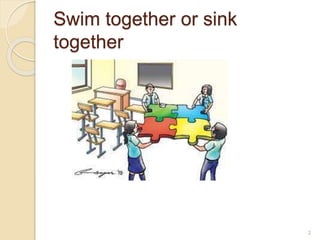
Swim together or sink
together
2
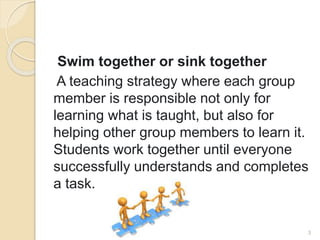
Swim together or sink together
A teaching strategy where each group
member is responsible not only for
learning what is taught, but also for
helping other group members to learn it.
Students work together until everyone
successfully understands and completes
a task.
3
Learning Outcomes
• Outline the teaching method of
cooperative learning.
• Discuss the elements of cooperative
learning.
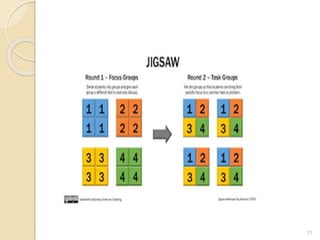
• Enumerate three cooperative learning
methods.
4
5
 Cooperative learning /Group work
 Cooperative learning takes place in groups of
learners with mixed ability levels. In cooperative
learning, the group's success is rewarded instead
of the individual successes of its members.
Cooperative learning was introduced into
American classrooms in the early twentieth
century by John Dewey, who saw experience and
education as being closely linked and believed
that people needed extensive experience in
cooperation to function effectively in groups.
(Zhang, 2018)
6
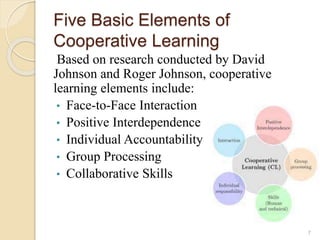
Five Basic Elements of
Cooperative Learning
Based on research conducted by David
Johnson and Roger Johnson, cooperative
learning elements include:
• Face-to-Face Interaction
• Positive Interdependence
• Individual Accountability
• Group Processing
• Collaborative Skills
7
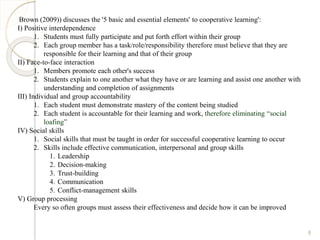
Brown (2009)) discusses the '5 basic and essential elements' to cooperative learning':
I) Positive interdependence
1. Students must fully participate and put forth effort within their group
2. Each group member has a task/role/responsibility therefore must believe that they are
responsible for their learning and that of their group
II) Face-to-face interaction
1. Members promote each other's success
2. Students explain to one another what they have or are learning and assist one another with
understanding and completion of assignments
III) Individual and group accountability
1. Each student must demonstrate mastery of the content being studied
2. Each student is accountable for their learning and work, therefore eliminating “social
loafing”
IV) Social skills
1. Social skills that must be taught in order for successful cooperative learning to occur
2. Skills include effective communication, interpersonal and group skills
1. Leadership
2. Decision-making
3. Trust-building
4. Communication
5. Conflict-management skills
V) Group processing
Every so often groups must assess their effectiveness and decide how it can be improved
8
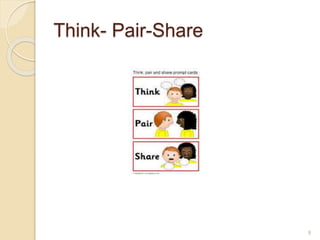
Think- Pair-Share
9
10
11
References
 Brown, H., & Ciuffetelli, D. C. (2009). Foundational methods:
Understanding teaching and learning. Toronto: Pearson
Education.
 Johnson, D. W., & Johnson, R. T. (2013). An educational
psychology success story: Social interdependence theory and
cooperative learning. Educational Researcher, 38(b), 365-
379.
 Zhang, Y. (2018). Application of Cooperative Learning
Theory in Comprehensive English Course Teaching.
Proceedings of 2018 2nd International Conference on Social
Sciences, Arts and Humanities (SSAH 2018). Research
Institute of Management Science and Industrial
Engineering: Computer Science and Electronic Technology
International Society.
12
Thank you
13

cooperation.pptx

  • 1.
  • 2.
    Swim together orsink together 2
  • 3.
    Swim together orsink together A teaching strategy where each group member is responsible not only for learning what is taught, but also for helping other group members to learn it. Students work together until everyone successfully understands and completes a task. 3
  • 4.
    Learning Outcomes • Outlinethe teaching method of cooperative learning. • Discuss the elements of cooperative learning. • Enumerate three cooperative learning methods. 4
  • 5.
  • 6.
     Cooperative learning/Group work  Cooperative learning takes place in groups of learners with mixed ability levels. In cooperative learning, the group's success is rewarded instead of the individual successes of its members. Cooperative learning was introduced into American classrooms in the early twentieth century by John Dewey, who saw experience and education as being closely linked and believed that people needed extensive experience in cooperation to function effectively in groups. (Zhang, 2018) 6
  • 7.
    Five Basic Elementsof Cooperative Learning Based on research conducted by David Johnson and Roger Johnson, cooperative learning elements include: • Face-to-Face Interaction • Positive Interdependence • Individual Accountability • Group Processing • Collaborative Skills 7
  • 8.
    Brown (2009)) discussesthe '5 basic and essential elements' to cooperative learning': I) Positive interdependence 1. Students must fully participate and put forth effort within their group 2. Each group member has a task/role/responsibility therefore must believe that they are responsible for their learning and that of their group II) Face-to-face interaction 1. Members promote each other's success 2. Students explain to one another what they have or are learning and assist one another with understanding and completion of assignments III) Individual and group accountability 1. Each student must demonstrate mastery of the content being studied 2. Each student is accountable for their learning and work, therefore eliminating “social loafing” IV) Social skills 1. Social skills that must be taught in order for successful cooperative learning to occur 2. Skills include effective communication, interpersonal and group skills 1. Leadership 2. Decision-making 3. Trust-building 4. Communication 5. Conflict-management skills V) Group processing Every so often groups must assess their effectiveness and decide how it can be improved 8
  • 9.
  • 10.
  • 11.
  • 12.
    References  Brown, H.,& Ciuffetelli, D. C. (2009). Foundational methods: Understanding teaching and learning. Toronto: Pearson Education.  Johnson, D. W., & Johnson, R. T. (2013). An educational psychology success story: Social interdependence theory and cooperative learning. Educational Researcher, 38(b), 365- 379.  Zhang, Y. (2018). Application of Cooperative Learning Theory in Comprehensive English Course Teaching. Proceedings of 2018 2nd International Conference on Social Sciences, Arts and Humanities (SSAH 2018). Research Institute of Management Science and Industrial Engineering: Computer Science and Electronic Technology International Society. 12
  • 13.