6th Summer School AACIMP - Kyiv Polytechnic Institute (KPI) - National Technical University of Ukraine, 8-20 August 2011


          Cooperative Game Theory. Operations Research
             Games. Applications to Interval Games
                    Lecture 3: Cooperation under Interval Uncertainty


                                Sırma Zeynep Alparslan G¨k
                                                        o
                               S¨leyman Demirel University
                                u
                              Faculty of Arts and Sciences
                                Department of Mathematics
                                     Isparta, Turkey
                             email:zeynepalparslan@yahoo.com


                                          August 13-16, 2011
6th Summer School AACIMP - Kyiv Polytechnic Institute (KPI) - National Technical University of Ukraine, 8-20 August 2011


Outline

      Introduction

      Preliminaries on classical games in coalitional form

      Cooperative games under interval uncertainty

      On two-person cooperative games under interval uncertainty

      Some economic examples

      References
6th Summer School AACIMP - Kyiv Polytechnic Institute (KPI) - National Technical University of Ukraine, 8-20 August 2011
  Introduction


Introduction


      This lecture is based on the paper

                             Cooperation under interval uncertainty
                               by Alparslan G¨k, Miquel and Tijs
                                             o

      which was published in

                      Mathematical Methods of Operations Research.
6th Summer School AACIMP - Kyiv Polytechnic Institute (KPI) - National Technical University of Ukraine, 8-20 August 2011
  Introduction


Introduction


      Classical cooperative game theory deals with coalitions who
      coordinate their actions and pool their winnings.
      One of the problems is how to divide the rewards or costs among
      the members of the formed coalition.
      Generally, the situations are considered from a deterministic point
      of view.
      However, in most economical situations rewards or costs are not
      known precisely, but it is possible to estimate intervals to which
      they belong.
6th Summer School AACIMP - Kyiv Polytechnic Institute (KPI) - National Technical University of Ukraine, 8-20 August 2011
  Introduction


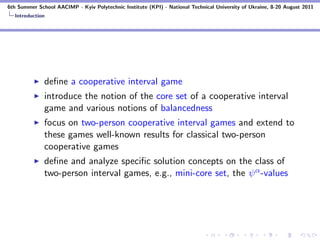
              define a cooperative interval game
              introduce the notion of the core set of a cooperative interval
              game and various notions of balancedness
              focus on two-person cooperative interval games and extend to
              these games well-known results for classical two-person
              cooperative games
              define and analyze specific solution concepts on the class of
              two-person interval games, e.g., mini-core set, the ψ α -values
6th Summer School AACIMP - Kyiv Polytechnic Institute (KPI) - National Technical University of Ukraine, 8-20 August 2011
  Preliminaries on classical games in coalitional form


Preliminaries on classical games in coalitional form


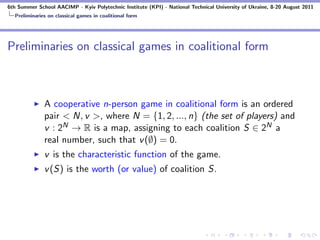
              A cooperative n-person game in coalitional form is an ordered
              pair < N, v >, where N = {1, 2, ..., n} (the set of players) and
              v : 2N → R is a map, assigning to each coalition S ∈ 2N a
              real number, such that v (∅) = 0.
              v is the characteristic function of the game.
              v (S) is the worth (or value) of coalition S.
6th Summer School AACIMP - Kyiv Polytechnic Institute (KPI) - National Technical University of Ukraine, 8-20 August 2011
  Preliminaries on classical games in coalitional form


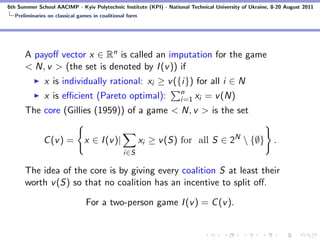
      A payoff vector x ∈ Rn is called an imputation for the game
      < N, v > (the set is denoted by I (v )) if
              x is individually rational: xi ≥ v ({i}) for all i ∈ N
                                                                   n
              x is efficient (Pareto optimal):                       i=1 xi    = v (N)
      The core (Gillies (1959)) of a game < N, v > is the set


              C (v ) =         x ∈ I (v )|               xi ≥ v (S) for all S ∈ 2N  {∅} .
                                                i∈S

      The idea of the core is by giving every coalition S at least their
      worth v (S) so that no coalition has an incentive to split off.

                                For a two-person game I (v ) = C (v ).
6th Summer School AACIMP - Kyiv Polytechnic Institute (KPI) - National Technical University of Ukraine, 8-20 August 2011
  Preliminaries on classical games in coalitional form


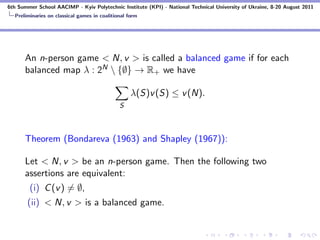
      An n-person game < N, v > is called a balanced game if for each
      balanced map λ : 2N  {∅} → R+ we have

                                                   λ(S)v (S) ≤ v (N).
                                              S


      Theorem (Bondareva (1963) and Shapley (1967)):

      Let < N, v > be an n-person game. Then the following two
      assertions are equivalent:
        (i) C (v ) = ∅,
       (ii) < N, v > is a balanced game.
6th Summer School AACIMP - Kyiv Polytechnic Institute (KPI) - National Technical University of Ukraine, 8-20 August 2011
  Preliminaries on classical games in coalitional form


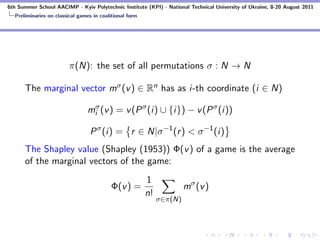
                         π(N): the set of all permutations σ : N → N

      The marginal vector mσ (v ) ∈ Rn has as i-th coordinate (i ∈ N)

                                miσ (v ) = v (P σ (i) ∪ {i}) − v (P σ (i))

                                 P σ (i) = r ∈ N|σ −1 (r ) < σ −1 (i)
      The Shapley value (Shapley (1953)) Φ(v ) of a game is the average
      of the marginal vectors of the game:
                                                         1
                                          Φ(v ) =                      mσ (v )
                                                         n!
                                                              σ∈π(N)
6th Summer School AACIMP - Kyiv Polytechnic Institute (KPI) - National Technical University of Ukraine, 8-20 August 2011
  Preliminaries on classical games in coalitional form


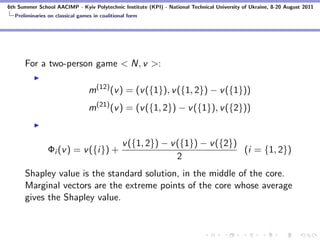
      For a two-person game < N, v >:

                                 m(12) (v ) = (v ({1}), v ({1, 2}) − v ({1}))
                                 m(21) (v ) = (v ({1, 2}) − v ({1}), v ({2}))


                                               v ({1, 2}) − v ({1}) − v ({2})
                Φi (v ) = v ({i}) +                                           (i = {1, 2})
                                                              2
      Shapley value is the standard solution, in the middle of the core.
      Marginal vectors are the extreme points of the core whose average
      gives the Shapley value.
6th Summer School AACIMP - Kyiv Polytechnic Institute (KPI) - National Technical University of Ukraine, 8-20 August 2011
  Preliminaries on classical games in coalitional form


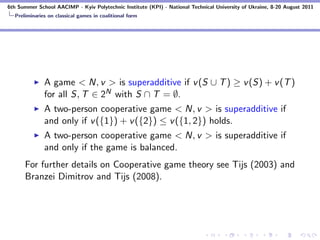
              A game < N, v > is superadditive if v (S ∪ T ) ≥ v (S) + v (T )
              for all S, T ∈ 2N with S ∩ T = ∅.
              A two-person cooperative game < N, v > is superadditive if
              and only if v ({1}) + v ({2}) ≤ v ({1, 2}) holds.
              A two-person cooperative game < N, v > is superadditive if
              and only if the game is balanced.
      For further details on Cooperative game theory see Tijs (2003) and
      Branzei Dimitrov and Tijs (2008).
6th Summer School AACIMP - Kyiv Polytechnic Institute (KPI) - National Technical University of Ukraine, 8-20 August 2011
  Cooperative games under interval uncertainty


Cooperative games under interval uncertainty
      A cooperative n-person interval game in coalitional form is an
      ordered pair < N, w >:
              N := {1, 2, . . . , n} is the set of players
              w : 2N → I (R) is the characteristic function which assigns to
              each coalition S ∈ 2N a closed interval w (S) ∈ I (R)
              I (R) is the set of all closed intervals in R such that
              w (∅) = [0, 0]
      The worth interval w (S) is denoted by [w (S), w (S)].
      Here, w (S) is the lower bound and w (S) is the upper bound.
      If all the worth intervals are degenerate intervals, i.e.,
      w (S) = w (S), then the interval game < N, w > corresponds to
      the classical cooperative game < N, v >, where v (S) = w (S).
6th Summer School AACIMP - Kyiv Polytechnic Institute (KPI) - National Technical University of Ukraine, 8-20 August 2011
  Cooperative games under interval uncertainty


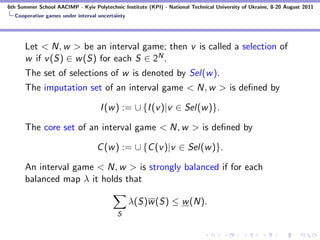
      Let < N, w > be an interval game; then v is called a selection of
      w if v (S) ∈ w (S) for each S ∈ 2N .
      The set of selections of w is denoted by Sel(w ).
      The imputation set of an interval game < N, w > is defined by

                                    I (w ) := ∪ {I (v )|v ∈ Sel(w )}.

      The core set of an interval game < N, w > is defined by

                                   C (w ) := ∪ {C (v )|v ∈ Sel(w )}.

      An interval game < N, w > is strongly balanced if for each
      balanced map λ it holds that

                                                 λ(S)w (S) ≤ w (N).
                                           S
6th Summer School AACIMP - Kyiv Polytechnic Institute (KPI) - National Technical University of Ukraine, 8-20 August 2011
  Cooperative games under interval uncertainty


      Proposition: Let < N, w > be an interval game. Then, the
      following three statements are equivalent:
        (i) For each v ∈ Sel(w ) the game < N, v > is balanced.
       (ii) For each v ∈ Sel(w ), C (v ) = ∅.
      (iii) The interval game < N, w > is strongly balanced.
      Proof: (i) ⇔ (ii) follows from Bondareva and Shapley theorem.
      (i) ⇔ (iii) follows using the inequalities:

                                         w (N) ≤ v (N) ≤ w (N)

                            λ(S)w (S) ≤                λ(S)v (S) ≤               λ(S)w (S)
6th Summer School AACIMP - Kyiv Polytechnic Institute (KPI) - National Technical University of Ukraine, 8-20 August 2011
  On two-person cooperative games under interval uncertainty


Balancedness and related topics
      Let < N, w > be a two-person interval game:
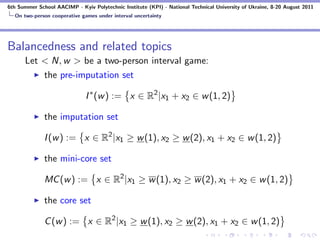
          the pre-imputation set

                              I ∗ (w ) := x ∈ R2 |x1 + x2 ∈ w (1, 2)

              the imputation set

              I (w ) := x ∈ R2 |x1 ≥ w (1), x2 ≥ w (2), x1 + x2 ∈ w (1, 2)

              the mini-core set

              MC (w ) := x ∈ R2 |x1 ≥ w (1), x2 ≥ w (2), x1 + x2 ∈ w (1, 2)

              the core set

              C (w ) := x ∈ R2 |x1 ≥ w (1), x2 ≥ w (2), x1 + x2 ∈ w (1, 2)
6th Summer School AACIMP - Kyiv Polytechnic Institute (KPI) - National Technical University of Ukraine, 8-20 August 2011
  On two-person cooperative games under interval uncertainty


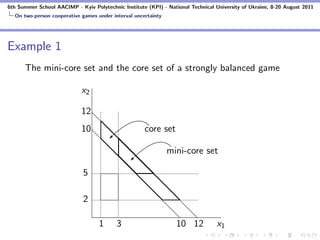
Example 1
      The mini-core set and the core set of a strongly balanced game

                            x2

                            12
                                 d
                            10  d       core set
                               d ©
                                 d
                                d d
                                 d d          mini-core set
                                   d ©d
                             5      d d
                                      d d
                                        d d
                             2            d d
                                            d d
                                               d d
                                   1      3                       10 12          x1
6th Summer School AACIMP - Kyiv Polytechnic Institute (KPI) - National Technical University of Ukraine, 8-20 August 2011
  On two-person cooperative games under interval uncertainty


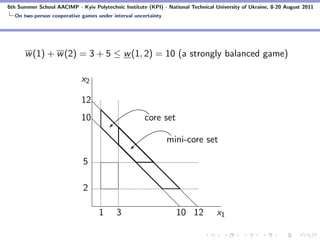
      w (1) + w (2) = 3 + 5 ≤ w (1, 2) = 10 (a strongly balanced game)

                            x2

                            12
                                 d
                            10  d      core set
                               d ©
                                 d
                                d d
                                  d d        mini-core set
                                    ©
                                   d d
                             5      d d
                                     d d
                                       d d
                             2           d d
                                           d d
                                              d d
                                   1      3                       10 12          x1
6th Summer School AACIMP - Kyiv Polytechnic Institute (KPI) - National Technical University of Ukraine, 8-20 August 2011
  On two-person cooperative games under interval uncertainty


Balancedness and related topics

                  s1 ∈ w (1) = [w (1), w (1)], s2 ∈ w (2) = [w (2), w (2)]
                                   t ∈ w (1, 2) = [w (1, 2), w (1, 2)]


      w s1 ,s2 ,t : the selection of w corresponding to s1 , s2 and t

            C (w ) = ∪ C (w s1 ,s2 ,t )|(s1 , s2 , t) ∈ w (1) × w (2) × w (1, 2)

          MC (w ) = ∪ C (w s1 ,s2 ,t )|s1 ∈ [w (1), w (1)], s2 ∈ [w (2), w (2)]
            MC (w ) ⊂ ∪ C (w s1 ,s2 ,t )|s1 ∈ w (1), s2 ∈ w (2), t ∈ w (1, 2)
      The mini-core set is interesting because for each s1 , s2 and t all
      points in MC (w ) with x1 + x2 = t are also in C (w s1 ,s2 ,t ).
6th Summer School AACIMP - Kyiv Polytechnic Institute (KPI) - National Technical University of Ukraine, 8-20 August 2011
  On two-person cooperative games under interval uncertainty


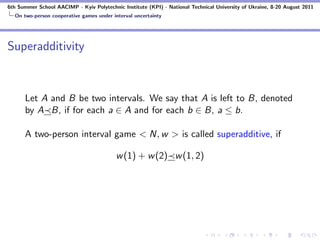
Superadditivity


      Let A and B be two intervals. We say that A is left to B, denoted
      by A B, if for each a ∈ A and for each b ∈ B, a ≤ b.

      A two-person interval game < N, w > is called superadditive, if

                                          w (1) + w (2) w (1, 2)
6th Summer School AACIMP - Kyiv Polytechnic Institute (KPI) - National Technical University of Ukraine, 8-20 August 2011
  On two-person cooperative games under interval uncertainty


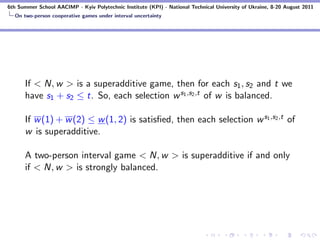
      If < N, w > is a superadditive game, then for each s1 , s2 and t we
      have s1 + s2 ≤ t. So, each selection w s1 ,s2 ,t of w is balanced.

      If w (1) + w (2) ≤ w (1, 2) is satisfied, then each selection w s1 ,s2 ,t of
      w is superadditive.

      A two-person interval game < N, w > is superadditive if and only
      if < N, w > is strongly balanced.
6th Summer School AACIMP - Kyiv Polytechnic Institute (KPI) - National Technical University of Ukraine, 8-20 August 2011
  On two-person cooperative games under interval uncertainty


ψ α -values and their axiomatization


      α = (α1 , α2 ) ∈ [0, 1] × [0, 1]: the optimism vector
                             α
                            s1 1 (w ) := α1 w (1) + (1 − α1 )w (1)

                             α
                            s2 2 (w ) := α2 w (2) + (1 − α2 )w (2)
6th Summer School AACIMP - Kyiv Polytechnic Institute (KPI) - National Technical University of Ukraine, 8-20 August 2011
  On two-person cooperative games under interval uncertainty


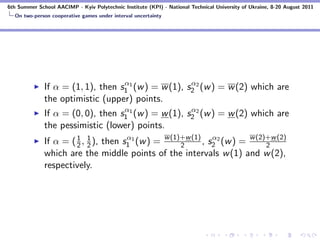
                                   α                  α
              If α = (1, 1), then s1 1 (w ) = w (1), s2 2 (w ) = w (2) which are
              the optimistic (upper) points.
                                   α                  α
              If α = (0, 0), then s1 1 (w ) = w (1), s2 2 (w ) = w (2) which are
              the pessimistic (lower) points.
              If α = ( 1 , 1 ), then s1 1 (w ) = w (1)+w (1) , s2 2 (w ) = w (2)+w (2)
                       2 2
                                      α
                                                      2
                                                                α
                                                                                2
              which are the middle points of the intervals w (1) and w (2),
              respectively.
6th Summer School AACIMP - Kyiv Polytechnic Institute (KPI) - National Technical University of Ukraine, 8-20 August 2011
  On two-person cooperative games under interval uncertainty


      A map F : IG {1,2} → K(R2 ) assigning to each interval game w
      a unique curve

                                   F (w ) : [w (1, 2), w (1, 2)] → R2

      for t ∈ [w (1, 2), w (1, 2)], i ∈ {1, 2}, in K(R2 ) is called a solution.

      IG {1,2} : the family of all interval games with player set {1, 2}
6th Summer School AACIMP - Kyiv Polytechnic Institute (KPI) - National Technical University of Ukraine, 8-20 August 2011
  On two-person cooperative games under interval uncertainty


      F has the following properties:
        (i) efficiency (EFF), if for all w ∈ IG {1,2} and
            t ∈ [w (1, 2), w (1, 2)]; i∈N F (w )(t)i = t.

       (ii) α-symmetry (α-SYM), if for all w ∈ IG {1,2} and
                                           α           α
            t ∈ [w (1, 2), w (1, 2)] with s1 1 (w ) = s2 2 (w );
            F (w )(t)1 = F (w )(t)2 .

      (iii) covariance with respect to translations (COV), if for all
            w ∈ IG {1,2} , t ∈ [w (1, 2), w (1, 2)] and a = (a1 , a2 ) ∈ R2
                                F (w + ˆ)(a1 + a2 + t) = F (w )(t) + a.
                                       a
6th Summer School AACIMP - Kyiv Polytechnic Institute (KPI) - National Technical University of Ukraine, 8-20 August 2011
  On two-person cooperative games under interval uncertainty


ψ α -values and their axiomatization

      ˆ ∈ IG {1,2} is defined by
      a

                                ˆ({1}) = [a1 , a1 ], ˆ({2}) = [a2 , a2 ]
                                a                    a

                                    ˆ({1, 2}) = [a1 + a2 , a1 + a2 ]
                                    a
      w + ˆ ∈ IG {1,2} is defined by
          a

                                       (w + ˆ)(s) = w (s) + ˆ(s)
                                            a               a

      for
                                          s ∈ {{1} , {2} , {1, 2}}
6th Summer School AACIMP - Kyiv Polytechnic Institute (KPI) - National Technical University of Ukraine, 8-20 August 2011
  On two-person cooperative games under interval uncertainty


      For each w ∈ IG {1,2} and t ∈ [w (1, 2), w (1, 2)]
      we define the map

                                          ψ α : IG {1,2} → K(R2 )

      such that
                                         α              α
                        ψ α (w )(t) := (s1 1 (w ) + β, s2 2 (w ) + β),

      where
                                       1      α           α
                                    β = (t − s1 1 (w ) − s2 2 (w )).
                                       2
6th Summer School AACIMP - Kyiv Polytechnic Institute (KPI) - National Technical University of Ukraine, 8-20 August 2011
  On two-person cooperative games under interval uncertainty


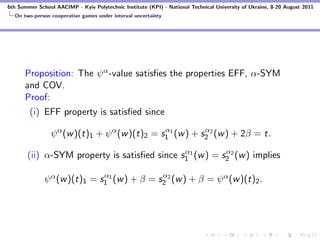
      Proposition: The ψ α -value satisfies the properties EFF, α-SYM
      and COV.
      Proof:
        (i) EFF property is satisfied since
                                               α           α
                ψ α (w )(t)1 + ψ α (w )(t)2 = s1 1 (w ) + s2 2 (w ) + 2β = t.
                                              α           α
       (ii) α-SYM property is satisfied since s1 1 (w ) = s2 2 (w ) implies

                              α               α
              ψ α (w )(t)1 = s1 1 (w ) + β = s2 2 (w ) + β = ψ α (w )(t)2 .
6th Summer School AACIMP - Kyiv Polytechnic Institute (KPI) - National Technical University of Ukraine, 8-20 August 2011
  On two-person cooperative games under interval uncertainty


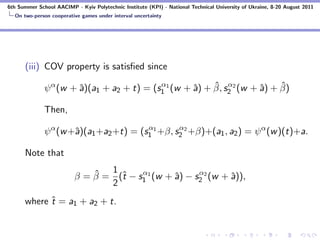
      (iii) COV property is satisfied since
                                           α             ˆ α               ˆ
              ψ α (w + ˆ)(a1 + a2 + t) = (s1 1 (w + ˆ) + β, s2 2 (w + ˆ) + β)
                       a                            a                 a

              Then,
                                        α        α
              ψ α (w +ˆ)(a1 +a2 +t) = (s1 1 +β, s2 2 +β)+(a1 , a2 ) = ψ α (w )(t)+a.
                      a

      Note that

                              ˆ 1 t     α              α
                          β = β = (ˆ − s1 1 (w + ˆ) − s2 2 (w + ˆ)),
                                                 a              a
                                 2
      where ˆ = a1 + a2 + t.
            t
6th Summer School AACIMP - Kyiv Polytechnic Institute (KPI) - National Technical University of Ukraine, 8-20 August 2011
  On two-person cooperative games under interval uncertainty


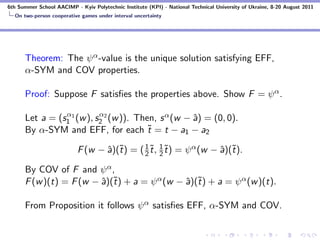
      Theorem: The ψ α -value is the unique solution satisfying EFF,
      α-SYM and COV properties.

      Proof: Suppose F satisfies the properties above. Show F = ψ α .

                α          α
      Let a = (s1 1 (w ), s2 2 (w )). Then, s α (w − ˆ) = (0, 0).
                                                     a
      By α-SYM and EFF, for each ˜ = t − a1 − a2
                                         t

                           F (w − ˆ)(˜) = ( 1 ˜, 2 ˜) = ψ α (w − ˆ)(˜).
                                  a t       2t
                                                 1
                                                   t             a t

      By COV of F and ψ α ,
      F (w )(t) = F (w − ˆ)(˜) + a = ψ α (w − ˆ)(˜) + a = ψ α (w )(t).
                         a t                  a t

      From Proposition it follows ψ α satisfies EFF, α-SYM and COV.
6th Summer School AACIMP - Kyiv Polytechnic Institute (KPI) - National Technical University of Ukraine, 8-20 August 2011
  On two-person cooperative games under interval uncertainty


Marginal curves and the Shapley-like solution

      The marginal curves for a two-person game < N, w > are defined
      by
                     mσ,α (w ) : [w (1, 2), w (1, 2)] → R2 ,
      where
                                                  α              α
                             m(1,2),α (w )(t) = (s1 1 (w ), t − s1 1 (w )),
                                                      α          α
                             m(2,1),α (w )(t) = (t − s2 2 (w ), s2 2 (w )).
      The Shapley-like solution ψ α is equal to
                                   1
                         ψ α (w ) = (m(1,2),α (w ) + m(2,1),α (w )).
                                   2
6th Summer School AACIMP - Kyiv Polytechnic Institute (KPI) - National Technical University of Ukraine, 8-20 August 2011
  Some economic examples


Example 2

      A bankruptcy situation with two claimants with demands d1 = 70
      and d2 = 90 on (uncertain) estate E = [100, 120].

           w (∅) = [0, 0], w (1) = [(E − d2 )+ , (E − d2 )+ ] = [10, 30]


      w (2) = [(E − d1 )+ , (E − d1 )+ ] = [30, 50], w (1, 2) = [100, 120].

                           w (1) + w (2) = 30 + 50 ≤ w (1, 2) = 100

                                      (a strongly balanced game)
6th Summer School AACIMP - Kyiv Polytechnic Institute (KPI) - National Technical University of Ukraine, 8-20 August 2011
  Some economic examples


                                                 1
      ψ (0,0) (w )(t) = (10 + β, 30 + β) with β = (t − 40) and t ∈ [100, 120]
                                                 2

                                                                      
        t                   100      106      110      114      120
        β                  30       33       35       37       40     
        ψ (0,0) (w )(t)   (40, 60) (43, 63) (45, 65) (47, 67) (50, 70)
6th Summer School AACIMP - Kyiv Polytechnic Institute (KPI) - National Technical University of Ukraine, 8-20 August 2011
  Some economic examples


         The mini-core set and the ψ (0,0) -values of the game < N, w >,
                     where L = {ψ α (w )(t)|t ∈ [100, 120]}.

                            x2

                           120
                                 d
                           100 d
                               d d
                                d d
                                 d Ld
                                   d d     mini-core
                            50      d ©d
                                      d d
                            30         d d
                                        d d
                                          d d
                                           d d
                                   10 30                          100 120 x1
6th Summer School AACIMP - Kyiv Polytechnic Institute (KPI) - National Technical University of Ukraine, 8-20 August 2011
  Some economic examples


Example 3

      A reward game with N = {1, 2} which is not strongly balanced.

         w (∅) = [0, 0], w (1) = [1, 3], w (2) = [2, 5], w (1, 2) = [6, 10].


      ψ (0,0) (w )(t) = (1 + β, 2 + β) with 3 + 2β = t and t ∈ [6, 10].

                                                                              
        t                      6         7         8         9        10
        β                   11 2        2       21 2        3       31 2
                                                                               
          (0,0) (w )(t)      1     1             1     1             1     1
        ψ                 (2 2 , 3 2 ) (3, 4) (3 2 , 4 2 ) (4, 5) (4 2 , 5 2 )
6th Summer School AACIMP - Kyiv Polytechnic Institute (KPI) - National Technical University of Ukraine, 8-20 August 2011
  Some economic examples


                              x2

                              10
                                   d
                                       d
                                        d
                              6          d
                                         ©      mini-core
                              5 d          d
                                       d   d
                                        dL
                                              d
                              2          d      d
                                           d     d
                                            d       d
                          1 3        6         10       x1
         The mini-core set and the ψ α -values of an interval game, where

                           L = {ψ α (w )(t)|t ∈ [6, 10]}.
6th Summer School AACIMP - Kyiv Polytechnic Institute (KPI) - National Technical University of Ukraine, 8-20 August 2011
  References


References


      [1] Alparslan G¨k S.Z., Miquel S. and Tijs S., “Cooperation under
                      o
      interval uncertainty”, Mathematical Methods of Operations
      Research, Vol. 69 (2009) 99-109.
      [2] Bondareva O.N., “Certain applications of the methods of linear
      programming to the theory of cooperative games”, Problemly
      Kibernetiki 10 (1963) 119-139 (in Russian).
      [3] Branzei R., Dimitrov D. and Tijs S., “Models in Cooperative
      Game Theory”, Springer-Verlag Berlin (2008).
      [4] Gillies D.B., “Some Theorems on n-person Games”, Ph.D.
      Thesis, Princeton University Press (1953).
6th Summer School AACIMP - Kyiv Polytechnic Institute (KPI) - National Technical University of Ukraine, 8-20 August 2011
  References


      [5] Shapley L.S., “A value for n-person games”, Annals of
      Mathematics Studies 28 (1953) 307-317.
      [6] Shapley L.S., “On balanced sets and cores”, Naval Research
      Logistics Quarterly 14 (1967) 453-460.
      [7] Tijs S., “Introduction to Game Theory”, SIAM, Hindustan
      Book Agency, India (2003).

Cooperation under Interval Uncertainty

  • 1.
    6th Summer SchoolAACIMP - Kyiv Polytechnic Institute (KPI) - National Technical University of Ukraine, 8-20 August 2011 Cooperative Game Theory. Operations Research Games. Applications to Interval Games Lecture 3: Cooperation under Interval Uncertainty Sırma Zeynep Alparslan G¨k o S¨leyman Demirel University u Faculty of Arts and Sciences Department of Mathematics Isparta, Turkey email:zeynepalparslan@yahoo.com August 13-16, 2011
  • 2.
    6th Summer SchoolAACIMP - Kyiv Polytechnic Institute (KPI) - National Technical University of Ukraine, 8-20 August 2011 Outline Introduction Preliminaries on classical games in coalitional form Cooperative games under interval uncertainty On two-person cooperative games under interval uncertainty Some economic examples References
  • 3.
    6th Summer SchoolAACIMP - Kyiv Polytechnic Institute (KPI) - National Technical University of Ukraine, 8-20 August 2011 Introduction Introduction This lecture is based on the paper Cooperation under interval uncertainty by Alparslan G¨k, Miquel and Tijs o which was published in Mathematical Methods of Operations Research.
  • 4.
    6th Summer SchoolAACIMP - Kyiv Polytechnic Institute (KPI) - National Technical University of Ukraine, 8-20 August 2011 Introduction Introduction Classical cooperative game theory deals with coalitions who coordinate their actions and pool their winnings. One of the problems is how to divide the rewards or costs among the members of the formed coalition. Generally, the situations are considered from a deterministic point of view. However, in most economical situations rewards or costs are not known precisely, but it is possible to estimate intervals to which they belong.
  • 5.
    6th Summer SchoolAACIMP - Kyiv Polytechnic Institute (KPI) - National Technical University of Ukraine, 8-20 August 2011 Introduction define a cooperative interval game introduce the notion of the core set of a cooperative interval game and various notions of balancedness focus on two-person cooperative interval games and extend to these games well-known results for classical two-person cooperative games define and analyze specific solution concepts on the class of two-person interval games, e.g., mini-core set, the ψ α -values
  • 6.
    6th Summer SchoolAACIMP - Kyiv Polytechnic Institute (KPI) - National Technical University of Ukraine, 8-20 August 2011 Preliminaries on classical games in coalitional form Preliminaries on classical games in coalitional form A cooperative n-person game in coalitional form is an ordered pair < N, v >, where N = {1, 2, ..., n} (the set of players) and v : 2N → R is a map, assigning to each coalition S ∈ 2N a real number, such that v (∅) = 0. v is the characteristic function of the game. v (S) is the worth (or value) of coalition S.
  • 7.
    6th Summer SchoolAACIMP - Kyiv Polytechnic Institute (KPI) - National Technical University of Ukraine, 8-20 August 2011 Preliminaries on classical games in coalitional form A payoff vector x ∈ Rn is called an imputation for the game < N, v > (the set is denoted by I (v )) if x is individually rational: xi ≥ v ({i}) for all i ∈ N n x is efficient (Pareto optimal): i=1 xi = v (N) The core (Gillies (1959)) of a game < N, v > is the set C (v ) = x ∈ I (v )| xi ≥ v (S) for all S ∈ 2N {∅} . i∈S The idea of the core is by giving every coalition S at least their worth v (S) so that no coalition has an incentive to split off. For a two-person game I (v ) = C (v ).
  • 8.
    6th Summer SchoolAACIMP - Kyiv Polytechnic Institute (KPI) - National Technical University of Ukraine, 8-20 August 2011 Preliminaries on classical games in coalitional form An n-person game < N, v > is called a balanced game if for each balanced map λ : 2N {∅} → R+ we have λ(S)v (S) ≤ v (N). S Theorem (Bondareva (1963) and Shapley (1967)): Let < N, v > be an n-person game. Then the following two assertions are equivalent: (i) C (v ) = ∅, (ii) < N, v > is a balanced game.
  • 9.
    6th Summer SchoolAACIMP - Kyiv Polytechnic Institute (KPI) - National Technical University of Ukraine, 8-20 August 2011 Preliminaries on classical games in coalitional form π(N): the set of all permutations σ : N → N The marginal vector mσ (v ) ∈ Rn has as i-th coordinate (i ∈ N) miσ (v ) = v (P σ (i) ∪ {i}) − v (P σ (i)) P σ (i) = r ∈ N|σ −1 (r ) < σ −1 (i) The Shapley value (Shapley (1953)) Φ(v ) of a game is the average of the marginal vectors of the game: 1 Φ(v ) = mσ (v ) n! σ∈π(N)
  • 10.
    6th Summer SchoolAACIMP - Kyiv Polytechnic Institute (KPI) - National Technical University of Ukraine, 8-20 August 2011 Preliminaries on classical games in coalitional form For a two-person game < N, v >: m(12) (v ) = (v ({1}), v ({1, 2}) − v ({1})) m(21) (v ) = (v ({1, 2}) − v ({1}), v ({2})) v ({1, 2}) − v ({1}) − v ({2}) Φi (v ) = v ({i}) + (i = {1, 2}) 2 Shapley value is the standard solution, in the middle of the core. Marginal vectors are the extreme points of the core whose average gives the Shapley value.
  • 11.
    6th Summer SchoolAACIMP - Kyiv Polytechnic Institute (KPI) - National Technical University of Ukraine, 8-20 August 2011 Preliminaries on classical games in coalitional form A game < N, v > is superadditive if v (S ∪ T ) ≥ v (S) + v (T ) for all S, T ∈ 2N with S ∩ T = ∅. A two-person cooperative game < N, v > is superadditive if and only if v ({1}) + v ({2}) ≤ v ({1, 2}) holds. A two-person cooperative game < N, v > is superadditive if and only if the game is balanced. For further details on Cooperative game theory see Tijs (2003) and Branzei Dimitrov and Tijs (2008).
  • 12.
    6th Summer SchoolAACIMP - Kyiv Polytechnic Institute (KPI) - National Technical University of Ukraine, 8-20 August 2011 Cooperative games under interval uncertainty Cooperative games under interval uncertainty A cooperative n-person interval game in coalitional form is an ordered pair < N, w >: N := {1, 2, . . . , n} is the set of players w : 2N → I (R) is the characteristic function which assigns to each coalition S ∈ 2N a closed interval w (S) ∈ I (R) I (R) is the set of all closed intervals in R such that w (∅) = [0, 0] The worth interval w (S) is denoted by [w (S), w (S)]. Here, w (S) is the lower bound and w (S) is the upper bound. If all the worth intervals are degenerate intervals, i.e., w (S) = w (S), then the interval game < N, w > corresponds to the classical cooperative game < N, v >, where v (S) = w (S).
  • 13.
    6th Summer SchoolAACIMP - Kyiv Polytechnic Institute (KPI) - National Technical University of Ukraine, 8-20 August 2011 Cooperative games under interval uncertainty Let < N, w > be an interval game; then v is called a selection of w if v (S) ∈ w (S) for each S ∈ 2N . The set of selections of w is denoted by Sel(w ). The imputation set of an interval game < N, w > is defined by I (w ) := ∪ {I (v )|v ∈ Sel(w )}. The core set of an interval game < N, w > is defined by C (w ) := ∪ {C (v )|v ∈ Sel(w )}. An interval game < N, w > is strongly balanced if for each balanced map λ it holds that λ(S)w (S) ≤ w (N). S
  • 14.
    6th Summer SchoolAACIMP - Kyiv Polytechnic Institute (KPI) - National Technical University of Ukraine, 8-20 August 2011 Cooperative games under interval uncertainty Proposition: Let < N, w > be an interval game. Then, the following three statements are equivalent: (i) For each v ∈ Sel(w ) the game < N, v > is balanced. (ii) For each v ∈ Sel(w ), C (v ) = ∅. (iii) The interval game < N, w > is strongly balanced. Proof: (i) ⇔ (ii) follows from Bondareva and Shapley theorem. (i) ⇔ (iii) follows using the inequalities: w (N) ≤ v (N) ≤ w (N) λ(S)w (S) ≤ λ(S)v (S) ≤ λ(S)w (S)
  • 15.
    6th Summer SchoolAACIMP - Kyiv Polytechnic Institute (KPI) - National Technical University of Ukraine, 8-20 August 2011 On two-person cooperative games under interval uncertainty Balancedness and related topics Let < N, w > be a two-person interval game: the pre-imputation set I ∗ (w ) := x ∈ R2 |x1 + x2 ∈ w (1, 2) the imputation set I (w ) := x ∈ R2 |x1 ≥ w (1), x2 ≥ w (2), x1 + x2 ∈ w (1, 2) the mini-core set MC (w ) := x ∈ R2 |x1 ≥ w (1), x2 ≥ w (2), x1 + x2 ∈ w (1, 2) the core set C (w ) := x ∈ R2 |x1 ≥ w (1), x2 ≥ w (2), x1 + x2 ∈ w (1, 2)
  • 16.
    6th Summer SchoolAACIMP - Kyiv Polytechnic Institute (KPI) - National Technical University of Ukraine, 8-20 August 2011 On two-person cooperative games under interval uncertainty Example 1 The mini-core set and the core set of a strongly balanced game x2 12 d 10 d core set d © d d d d d mini-core set d ©d 5 d d d d d d 2 d d d d d d 1 3 10 12 x1
  • 17.
    6th Summer SchoolAACIMP - Kyiv Polytechnic Institute (KPI) - National Technical University of Ukraine, 8-20 August 2011 On two-person cooperative games under interval uncertainty w (1) + w (2) = 3 + 5 ≤ w (1, 2) = 10 (a strongly balanced game) x2 12 d 10 d core set d © d d d d d mini-core set © d d 5 d d d d d d 2 d d d d d d 1 3 10 12 x1
  • 18.
    6th Summer SchoolAACIMP - Kyiv Polytechnic Institute (KPI) - National Technical University of Ukraine, 8-20 August 2011 On two-person cooperative games under interval uncertainty Balancedness and related topics s1 ∈ w (1) = [w (1), w (1)], s2 ∈ w (2) = [w (2), w (2)] t ∈ w (1, 2) = [w (1, 2), w (1, 2)] w s1 ,s2 ,t : the selection of w corresponding to s1 , s2 and t C (w ) = ∪ C (w s1 ,s2 ,t )|(s1 , s2 , t) ∈ w (1) × w (2) × w (1, 2) MC (w ) = ∪ C (w s1 ,s2 ,t )|s1 ∈ [w (1), w (1)], s2 ∈ [w (2), w (2)] MC (w ) ⊂ ∪ C (w s1 ,s2 ,t )|s1 ∈ w (1), s2 ∈ w (2), t ∈ w (1, 2) The mini-core set is interesting because for each s1 , s2 and t all points in MC (w ) with x1 + x2 = t are also in C (w s1 ,s2 ,t ).
  • 19.
    6th Summer SchoolAACIMP - Kyiv Polytechnic Institute (KPI) - National Technical University of Ukraine, 8-20 August 2011 On two-person cooperative games under interval uncertainty Superadditivity Let A and B be two intervals. We say that A is left to B, denoted by A B, if for each a ∈ A and for each b ∈ B, a ≤ b. A two-person interval game < N, w > is called superadditive, if w (1) + w (2) w (1, 2)
  • 20.
    6th Summer SchoolAACIMP - Kyiv Polytechnic Institute (KPI) - National Technical University of Ukraine, 8-20 August 2011 On two-person cooperative games under interval uncertainty If < N, w > is a superadditive game, then for each s1 , s2 and t we have s1 + s2 ≤ t. So, each selection w s1 ,s2 ,t of w is balanced. If w (1) + w (2) ≤ w (1, 2) is satisfied, then each selection w s1 ,s2 ,t of w is superadditive. A two-person interval game < N, w > is superadditive if and only if < N, w > is strongly balanced.
  • 21.
    6th Summer SchoolAACIMP - Kyiv Polytechnic Institute (KPI) - National Technical University of Ukraine, 8-20 August 2011 On two-person cooperative games under interval uncertainty ψ α -values and their axiomatization α = (α1 , α2 ) ∈ [0, 1] × [0, 1]: the optimism vector α s1 1 (w ) := α1 w (1) + (1 − α1 )w (1) α s2 2 (w ) := α2 w (2) + (1 − α2 )w (2)
  • 22.
    6th Summer SchoolAACIMP - Kyiv Polytechnic Institute (KPI) - National Technical University of Ukraine, 8-20 August 2011 On two-person cooperative games under interval uncertainty α α If α = (1, 1), then s1 1 (w ) = w (1), s2 2 (w ) = w (2) which are the optimistic (upper) points. α α If α = (0, 0), then s1 1 (w ) = w (1), s2 2 (w ) = w (2) which are the pessimistic (lower) points. If α = ( 1 , 1 ), then s1 1 (w ) = w (1)+w (1) , s2 2 (w ) = w (2)+w (2) 2 2 α 2 α 2 which are the middle points of the intervals w (1) and w (2), respectively.
  • 23.
    6th Summer SchoolAACIMP - Kyiv Polytechnic Institute (KPI) - National Technical University of Ukraine, 8-20 August 2011 On two-person cooperative games under interval uncertainty A map F : IG {1,2} → K(R2 ) assigning to each interval game w a unique curve F (w ) : [w (1, 2), w (1, 2)] → R2 for t ∈ [w (1, 2), w (1, 2)], i ∈ {1, 2}, in K(R2 ) is called a solution. IG {1,2} : the family of all interval games with player set {1, 2}
  • 24.
    6th Summer SchoolAACIMP - Kyiv Polytechnic Institute (KPI) - National Technical University of Ukraine, 8-20 August 2011 On two-person cooperative games under interval uncertainty F has the following properties: (i) efficiency (EFF), if for all w ∈ IG {1,2} and t ∈ [w (1, 2), w (1, 2)]; i∈N F (w )(t)i = t. (ii) α-symmetry (α-SYM), if for all w ∈ IG {1,2} and α α t ∈ [w (1, 2), w (1, 2)] with s1 1 (w ) = s2 2 (w ); F (w )(t)1 = F (w )(t)2 . (iii) covariance with respect to translations (COV), if for all w ∈ IG {1,2} , t ∈ [w (1, 2), w (1, 2)] and a = (a1 , a2 ) ∈ R2 F (w + ˆ)(a1 + a2 + t) = F (w )(t) + a. a
  • 25.
    6th Summer SchoolAACIMP - Kyiv Polytechnic Institute (KPI) - National Technical University of Ukraine, 8-20 August 2011 On two-person cooperative games under interval uncertainty ψ α -values and their axiomatization ˆ ∈ IG {1,2} is defined by a ˆ({1}) = [a1 , a1 ], ˆ({2}) = [a2 , a2 ] a a ˆ({1, 2}) = [a1 + a2 , a1 + a2 ] a w + ˆ ∈ IG {1,2} is defined by a (w + ˆ)(s) = w (s) + ˆ(s) a a for s ∈ {{1} , {2} , {1, 2}}
  • 26.
    6th Summer SchoolAACIMP - Kyiv Polytechnic Institute (KPI) - National Technical University of Ukraine, 8-20 August 2011 On two-person cooperative games under interval uncertainty For each w ∈ IG {1,2} and t ∈ [w (1, 2), w (1, 2)] we define the map ψ α : IG {1,2} → K(R2 ) such that α α ψ α (w )(t) := (s1 1 (w ) + β, s2 2 (w ) + β), where 1 α α β = (t − s1 1 (w ) − s2 2 (w )). 2
  • 27.
    6th Summer SchoolAACIMP - Kyiv Polytechnic Institute (KPI) - National Technical University of Ukraine, 8-20 August 2011 On two-person cooperative games under interval uncertainty Proposition: The ψ α -value satisfies the properties EFF, α-SYM and COV. Proof: (i) EFF property is satisfied since α α ψ α (w )(t)1 + ψ α (w )(t)2 = s1 1 (w ) + s2 2 (w ) + 2β = t. α α (ii) α-SYM property is satisfied since s1 1 (w ) = s2 2 (w ) implies α α ψ α (w )(t)1 = s1 1 (w ) + β = s2 2 (w ) + β = ψ α (w )(t)2 .
  • 28.
    6th Summer SchoolAACIMP - Kyiv Polytechnic Institute (KPI) - National Technical University of Ukraine, 8-20 August 2011 On two-person cooperative games under interval uncertainty (iii) COV property is satisfied since α ˆ α ˆ ψ α (w + ˆ)(a1 + a2 + t) = (s1 1 (w + ˆ) + β, s2 2 (w + ˆ) + β) a a a Then, α α ψ α (w +ˆ)(a1 +a2 +t) = (s1 1 +β, s2 2 +β)+(a1 , a2 ) = ψ α (w )(t)+a. a Note that ˆ 1 t α α β = β = (ˆ − s1 1 (w + ˆ) − s2 2 (w + ˆ)), a a 2 where ˆ = a1 + a2 + t. t
  • 29.
    6th Summer SchoolAACIMP - Kyiv Polytechnic Institute (KPI) - National Technical University of Ukraine, 8-20 August 2011 On two-person cooperative games under interval uncertainty Theorem: The ψ α -value is the unique solution satisfying EFF, α-SYM and COV properties. Proof: Suppose F satisfies the properties above. Show F = ψ α . α α Let a = (s1 1 (w ), s2 2 (w )). Then, s α (w − ˆ) = (0, 0). a By α-SYM and EFF, for each ˜ = t − a1 − a2 t F (w − ˆ)(˜) = ( 1 ˜, 2 ˜) = ψ α (w − ˆ)(˜). a t 2t 1 t a t By COV of F and ψ α , F (w )(t) = F (w − ˆ)(˜) + a = ψ α (w − ˆ)(˜) + a = ψ α (w )(t). a t a t From Proposition it follows ψ α satisfies EFF, α-SYM and COV.
  • 30.
    6th Summer SchoolAACIMP - Kyiv Polytechnic Institute (KPI) - National Technical University of Ukraine, 8-20 August 2011 On two-person cooperative games under interval uncertainty Marginal curves and the Shapley-like solution The marginal curves for a two-person game < N, w > are defined by mσ,α (w ) : [w (1, 2), w (1, 2)] → R2 , where α α m(1,2),α (w )(t) = (s1 1 (w ), t − s1 1 (w )), α α m(2,1),α (w )(t) = (t − s2 2 (w ), s2 2 (w )). The Shapley-like solution ψ α is equal to 1 ψ α (w ) = (m(1,2),α (w ) + m(2,1),α (w )). 2
  • 31.
    6th Summer SchoolAACIMP - Kyiv Polytechnic Institute (KPI) - National Technical University of Ukraine, 8-20 August 2011 Some economic examples Example 2 A bankruptcy situation with two claimants with demands d1 = 70 and d2 = 90 on (uncertain) estate E = [100, 120]. w (∅) = [0, 0], w (1) = [(E − d2 )+ , (E − d2 )+ ] = [10, 30] w (2) = [(E − d1 )+ , (E − d1 )+ ] = [30, 50], w (1, 2) = [100, 120]. w (1) + w (2) = 30 + 50 ≤ w (1, 2) = 100 (a strongly balanced game)
  • 32.
    6th Summer SchoolAACIMP - Kyiv Polytechnic Institute (KPI) - National Technical University of Ukraine, 8-20 August 2011 Some economic examples 1 ψ (0,0) (w )(t) = (10 + β, 30 + β) with β = (t − 40) and t ∈ [100, 120] 2   t 100 106 110 114 120 β  30 33 35 37 40  ψ (0,0) (w )(t) (40, 60) (43, 63) (45, 65) (47, 67) (50, 70)
  • 33.
    6th Summer SchoolAACIMP - Kyiv Polytechnic Institute (KPI) - National Technical University of Ukraine, 8-20 August 2011 Some economic examples The mini-core set and the ψ (0,0) -values of the game < N, w >, where L = {ψ α (w )(t)|t ∈ [100, 120]}. x2 120 d 100 d d d d d d Ld d d mini-core 50 d ©d d d 30 d d d d d d d d 10 30 100 120 x1
  • 34.
    6th Summer SchoolAACIMP - Kyiv Polytechnic Institute (KPI) - National Technical University of Ukraine, 8-20 August 2011 Some economic examples Example 3 A reward game with N = {1, 2} which is not strongly balanced. w (∅) = [0, 0], w (1) = [1, 3], w (2) = [2, 5], w (1, 2) = [6, 10]. ψ (0,0) (w )(t) = (1 + β, 2 + β) with 3 + 2β = t and t ∈ [6, 10].   t 6 7 8 9 10 β  11 2 2 21 2 3 31 2  (0,0) (w )(t) 1 1 1 1 1 1 ψ (2 2 , 3 2 ) (3, 4) (3 2 , 4 2 ) (4, 5) (4 2 , 5 2 )
  • 35.
    6th Summer SchoolAACIMP - Kyiv Polytechnic Institute (KPI) - National Technical University of Ukraine, 8-20 August 2011 Some economic examples x2 10 d d d 6 d © mini-core 5 d d d   d dL   d 2 d d d d d d 1 3 6 10 x1 The mini-core set and the ψ α -values of an interval game, where L = {ψ α (w )(t)|t ∈ [6, 10]}.
  • 36.
    6th Summer SchoolAACIMP - Kyiv Polytechnic Institute (KPI) - National Technical University of Ukraine, 8-20 August 2011 References References [1] Alparslan G¨k S.Z., Miquel S. and Tijs S., “Cooperation under o interval uncertainty”, Mathematical Methods of Operations Research, Vol. 69 (2009) 99-109. [2] Bondareva O.N., “Certain applications of the methods of linear programming to the theory of cooperative games”, Problemly Kibernetiki 10 (1963) 119-139 (in Russian). [3] Branzei R., Dimitrov D. and Tijs S., “Models in Cooperative Game Theory”, Springer-Verlag Berlin (2008). [4] Gillies D.B., “Some Theorems on n-person Games”, Ph.D. Thesis, Princeton University Press (1953).
  • 37.
    6th Summer SchoolAACIMP - Kyiv Polytechnic Institute (KPI) - National Technical University of Ukraine, 8-20 August 2011 References [5] Shapley L.S., “A value for n-person games”, Annals of Mathematics Studies 28 (1953) 307-317. [6] Shapley L.S., “On balanced sets and cores”, Naval Research Logistics Quarterly 14 (1967) 453-460. [7] Tijs S., “Introduction to Game Theory”, SIAM, Hindustan Book Agency, India (2003).