MPA 210 Community Organizing
and Cooperative Development
Origin, Philosophy
and Concepts of Co-ops
Koop Balitaan thru
Tulong Balita Online
Josefina B. Bitonio
Regional Director
CDA Regional Office -I
Robert Owen Scotland
William King UK
The Rochdale Pioneers
Great Britain
Charles Fourier France
Charles Gide France
Beatrice Webb UK
Friedrich Raiffeisen
Germany
Key Theorists
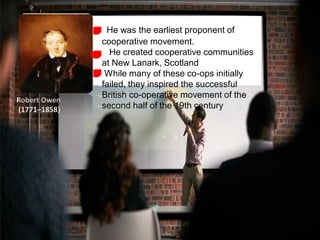
He was the earliest proponent of
cooperative movement.
He created cooperative communities
at New Lanark, Scotland
While many of these co-ops initially
failed, they inspired the successful
British co-operative movement of the
second half of the 19th century
Robert Owen
(1771–1858)
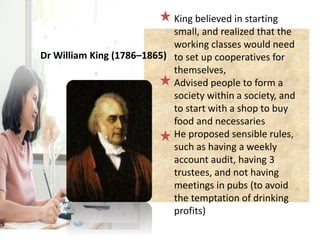
King believed in starting
small, and realized that the
working classes would need
to set up cooperatives for
themselves,
Advised people to form a
society within a society, and
to start with a shop to buy
food and necessaries
He proposed sensible rules,
such as having a weekly
account audit, having 3
trustees, and not having
meetings in pubs (to avoid
the temptation of drinking
profits)
Dr William King (1786–1865)
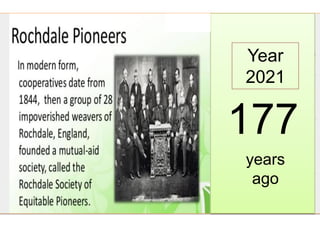
Year
2021
177
years
ago
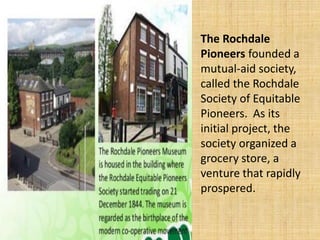
The Rochdale
Pioneers founded a
mutual-aid society,
called the Rochdale
Society of Equitable
Pioneers. As its
initial project, the
society organized a
grocery store, a
venture that rapidly
prospered.
The Rochdale Pioneers
A few poor weavers joined together to
form the Rochdale Equitable Pioneers
Society .The Rochdale Pioneers, as they
became known, set out the Rochdale
Principles in 1844, which have been highly
influential throughout the cooperative
movement
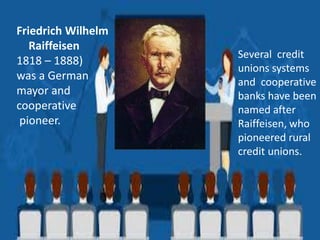
Friedrich Wilhelm
Raiffeisen
1818 – 1888)
was a German
mayor and
cooperative
pioneer.
Several credit
unions systems
and cooperative
banks have been
named after
Raiffeisen, who
pioneered rural
credit unions.
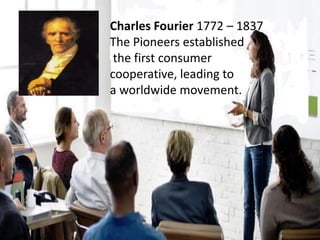
Charles Fourier 1772 – 1837
The Pioneers established
the first consumer
cooperative, leading to
a worldwide movement.
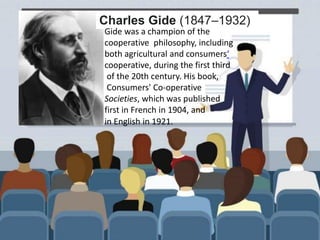
Charles Gide 1847–1932
Charles Gide (1847–1932)
Gide was a champion of the
cooperative philosophy, including
both agricultural and consumers‘
cooperative, during the first third
of the 20th century. His book,
Consumers' Co-operative
Societies, which was published
first in French in 1904, and
in English in 1921.
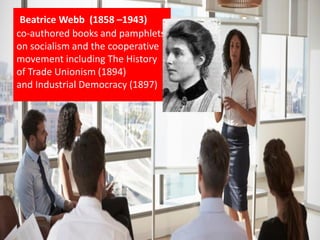
Beatrice Webb (1858 –1943)
co-authored books and pamphlets
on socialism and the cooperative
movement including The History
of Trade Unionism (1894)
and Industrial Democracy (1897)
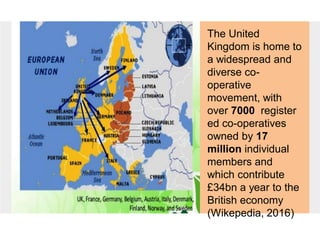
The United
Kingdom is home to
a widespread and
diverse co-
operative
movement, with
over 7000 register
ed co-operatives
owned by 17
million individual
members and
which contribute
£34bn a year to the
British economy
(Wikepedia, 2016)
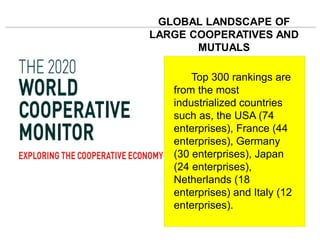
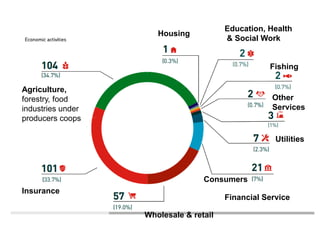
GLOBAL LANDSCAPE OF
LARGE COOPERATIVES AND
MUTUALS
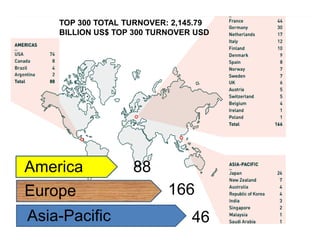
Top 300 rankings are
from the most
industrialized countries
such as, the USA (74
enterprises), France (44
enterprises), Germany
(30 enterprises), Japan
(24 enterprises),
Netherlands (18
enterprises) and Italy (12
enterprises).
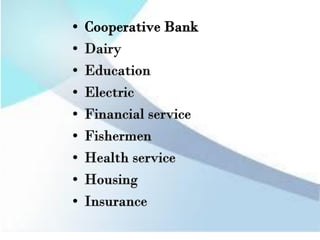
Agriculture,
forestry, food
industries under
producers coops
Housing
Education, Health
& Social Work
Fishing
Other
Services
Utilities
Consumers
Insurance
Wholesale & retail
Financial Service
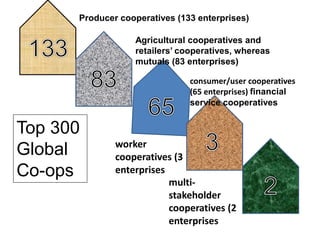
Agricultural cooperatives and
retailers’ cooperatives, whereas
mutuals (83 enterprises)
consumer/user cooperatives
(65 enterprises) financial
service cooperatives
worker
cooperatives (3
enterprises
multi-
stakeholder
cooperatives (2
enterprises
Producer cooperatives (133 enterprises)
Top 300
Global
Co-ops
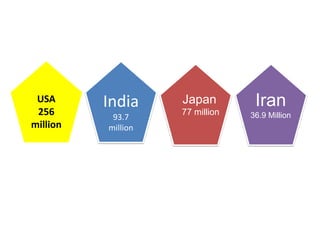
India
93.7
million
USA
256
million
Japan
77 million
Iran
36.9 Million
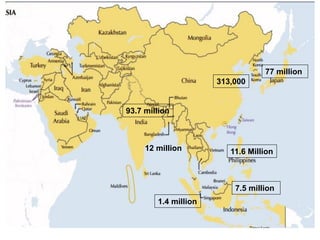
77 million
7.5 million
1.4 million
313,000
12 million 11.6 Million
93.7 million
TOP 300 TOTAL TURNOVER: 2,145.79
BILLION US$ TOP 300 TURNOVER USD
America
Europe
Asia-Pacific
88
166
46
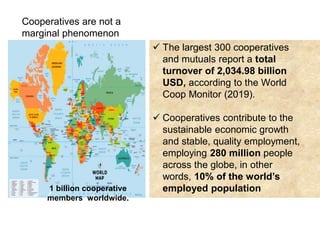
 The largest 300 cooperatives
and mutuals report a total
turnover of 2,034.98 billion
USD, according to the World
Coop Monitor (2019).
 Cooperatives contribute to the
sustainable economic growth
and stable, quality employment,
employing 280 million people
across the globe, in other
words, 10% of the world’s
employed population
Cooperatives are not a
marginal phenomenon
1 billion cooperative
members worldwide.
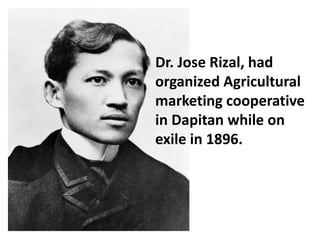
Dr. Jose Rizal, had
organized Agricultural
marketing cooperative
in Dapitan while on
exile in 1896.
Where are we now?
CONSTITUTIONAL MANDATE
Sec 15, Article XII
1987 Philippine
Constitution
The Congress shall
create an Agency to
promote the viability
and growth of
cooperatives as
instruments for social
justice and economic
development
Exec. Order No. 1
Series , 2016
CDA back to OP
Under the supervision of the
Cabinet Secretary
The Authority shall be an
agency attached to the
Department of Trade and
Industry (DTI) for policy
and program coordination
for cooperatives.
- - - - - - - - - - - - - - -
- - - - - -
EO No. 67, series of 2018.
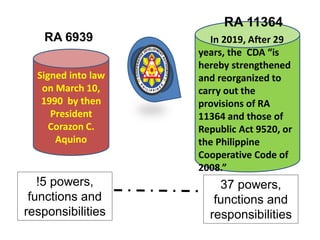
Signed into law
on March 10,
1990 by then
President
Corazon C.
Aquino
RA 6939 In 2019, After 29
years, the CDA “is
hereby strengthened
and reorganized to
carry out the
provisions of RA
11364 and those of
Republic Act 9520, or
the Philippine
Cooperative Code of
2008.”
RA 11364
!5 powers,
functions and
responsibilities
37 powers,
functions and
responsibilities
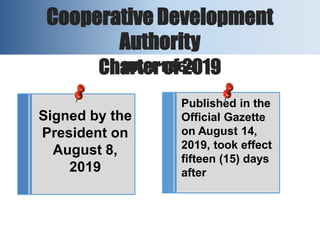
Published in the
Official Gazette
on August 14,
2019, took effect
fifteen (15) days
after
Cooperative Development
Authority
Charter of 2019
RA 11364
Signed by the
President on
August 8,
2019
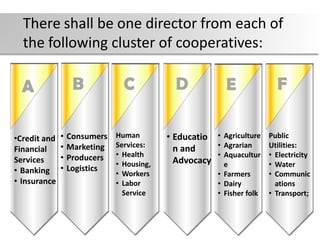
•Credit and
Financial
Services
• Banking
• Insurance
A
Human
Services:
• Health
• Housing,
• Workers
• Labor
Service
C
• Educatio
n and
Advocacy
D
• Agriculture
• Agrarian
• Aquacultur
e
• Farmers
• Dairy
• Fisher folk
E
There shall be one director from each of
the following cluster of cooperatives:
• Consumers
• Marketing
• Producers
• Logistics
B
Public
Utilities:
• Electricity
• Water
• Communic
ations
• Transport;
F
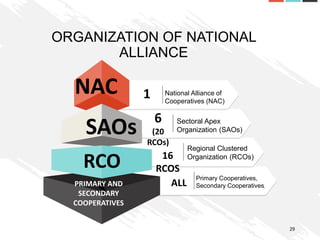
NAC
SAOs
RCO
s
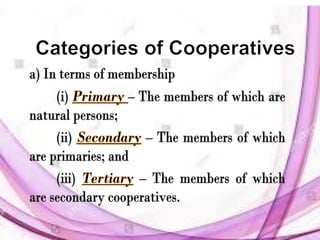
PRIMARY AND
SECONDARY
COOPERATIVES
1 National Alliance of
Cooperatives (NAC)
ORGANIZATION OF NATIONAL
ALLIANCE
29
Sectoral Apex
Organization (SAOs)
Regional Clustered
Organization (RCOs)
Primary Cooperatives,
Secondary Cooperatives,
6
(20
RCOs)
16
RCOS
ALL
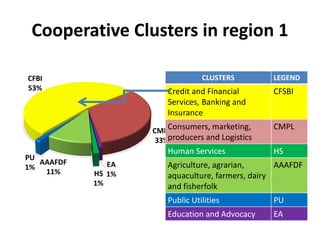
Cooperative Clusters in region 1
CLUSTERS LEGEND
Credit and Financial
Services, Banking and
Insurance
CFSBI
Consumers, marketing,
producers and Logistics
CMPL
Human Services HS
Agriculture, agrarian,
aquaculture, farmers, dairy
and fisherfolk
AAAFDF
Public Utilities PU
Education and Advocacy EA
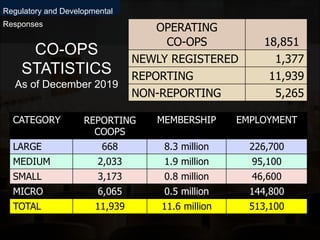
Regulatory and Developmental
Responses
OPERATING
CO-OPS 18,851
NEWLY REGISTERED 1,377
REPORTING 11,939
NON-REPORTING 5,265
CO-OPS
STATISTICS
As of December 2019
CATEGORY REPORTING
COOPS
MEMBERSHIP EMPLOYMENT
LARGE 668 8.3 million 226,700
MEDIUM 2,033 1.9 million 95,100
SMALL 3,173 0.8 million 46,600
MICRO 6,065 0.5 million 144,800
TOTAL 11,939 11.6 million 513,100
Philosophy
• They are based on the powerful idea that
together, a group of people can achieve goals
that none of them could achieve alone.
• Cooperatives are formed to meet peoples’
mutual needs.
Cooperatives are based on basic values and
principles. Cooperative values are general
norms that cooperators, cooperative leaders
and cooperative staff should share and which
should determine their way of thinking and
acting.
The values, which are articulated by the ICA in a
statement in 1995. The values statement further
articulates values of personal and ethical behavior that
cooperators actualize in enterprises. They describe the
kind of people cooperators strive to be and
the traits they hope to encourage through
cooperation.
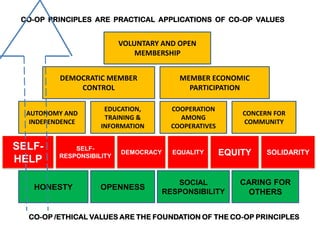
Cooperative principles on the other hand, are
guidelines by which cooperatives put their values
into practice. The principles rest on a distinct
philosophy and view of society that helps members
judge their accomplishments and make decisions
AUTONOMY AND
INDEPENDENCE
EDUCATION,
TRAINING &
INFORMATION
COOPERATION
AMONG
COOPERATIVES
CONCERN FOR
COMMUNITY
DEMOCRATIC MEMBER
CONTROL
MEMBER ECONOMIC
PARTICIPATION
VOLUNTARY AND OPEN
MEMBERSHIP
SELF-
HELP
SELF-
RESPONSIBILITY
EQUALITY
HONESTY OPENNESS
SOCIAL
RESPONSIBILITY
DEMOCRACY
CARING FOR
OTHERS
SOLIDARITY
CO-OP PRINCIPLES ARE PRACTICAL APPLICATIONS OF CO-OP VALUES
CO-OP /ETHICAL VALUES ARE THE FOUNDATION OF THE CO-OP PRINCIPLES
EQUITY
Concepts of
Cooperatives
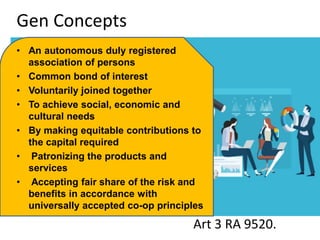
Gen Concepts
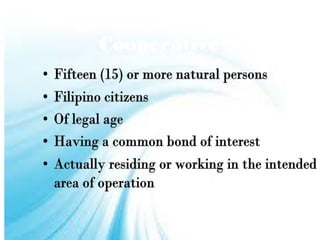
• An autonomous duly registered
association of persons
• Common bond of interest
• Voluntarily joined together
• To achieve social, economic and
cultural needs
• By making equitable contributions to
the capital required
• Patronizing the products and
services
• Accepting fair share of the risk and
benefits in accordance with
universally accepted co-op principles
Art 3 RA 9520.
Hybrid cooperatives are defined by
the ICA as “a cooperative that has issued
equity shares to non member investors”
(ICA 2015, p. 100). We here consider a
broader approach, as a substantial
challenge for cooperatives is the
discussions around “hybridized forms of
governance, where there may seem to be
an appearance of autonomy, whilst
control is continually conferred to the
same actors” (Roelants et al. 2009, p. 73
Isomorphization has two distinctive features: the
alignment of cooperatives on capitalist enterprises
and the process which concerns enterprises formally
constituted and incorporated in a legal form different
from cooperative status that tend to operate
according to some cooperative principles. According
to the ICA, it is important for cooperatives themselves
to resist any tendency to imitate investor-owned
enterprises in operational, management and
governance practices which do not reflect the
distinctiveness of cooperatives
Isomorphization. A similar idea was
pointed out as the “degeneration thesis”:
market pressures tend, over the course of
time, to lead to cooperatives becoming similar
to other kinds of enterprise, particularly
capitalist enterprise (Vienney 1980; Cornforth
et al. 1988; Sommerville 2007).
False Cooperative As they do not
voluntarily comply with the
cooperative principles or do not follow
the principles at all, false cooperatives
are entities which try to elude more
restrictive rules without necessarily
being moved by any cooperative ideal.
The issue of what is also called
“pseudo cooperatives” (Roelants et al.
2014, p. 111)
False Cooperative The ILO recommendation
No. 193 emphasizes the need to “ensure that
cooperatives are not set up for, or used for,
non-compliance with labor law, or used to
establish disguised labor relationships”.
Hence, national policies are invited to ensure
that labor legislation is applied in all
cooperatives and combat pseudo cooperatives
that violate workers’ rights.
• RA 11364
Can all those who are poor
today level up to middle class
in 20 years?
To be a middle-class society,
the Philippines needs to keep
up or surpass its 7.1%
economic growth rate for 20
years
• The government were to produce 1.3 million to 1.5
million jobs every year for the next 20 years
• "The rule of thumb is 6-7% growth yearly for every
decade doubles your GDP per capita," .Based on this
calculations, 10 years of 6-7% growth could make the
Philippine economy equivalent to Thailand's.
Another 10 years, we can compare ourselves to
Malaysia. A 3rd decade of such growth brings us to
the level of South Korea
By
2040, Filipinos
enjoy a strongly
rooted,
comfortable, and
secure life.
Question. No 4
Why cooperatives is the preferred enterprises
in the community? Discuss your answers
Question No. 5
What are the elements to make the
cooperative successful? Discuss your
answers

Coop Development

  • 1.
    MPA 210 CommunityOrganizing and Cooperative Development
  • 2.
    Origin, Philosophy and Conceptsof Co-ops Koop Balitaan thru Tulong Balita Online Josefina B. Bitonio Regional Director CDA Regional Office -I
  • 3.
    Robert Owen Scotland WilliamKing UK The Rochdale Pioneers Great Britain Charles Fourier France Charles Gide France Beatrice Webb UK Friedrich Raiffeisen Germany Key Theorists
  • 4.
    He was theearliest proponent of cooperative movement. He created cooperative communities at New Lanark, Scotland While many of these co-ops initially failed, they inspired the successful British co-operative movement of the second half of the 19th century Robert Owen (1771–1858)
  • 5.
    King believed instarting small, and realized that the working classes would need to set up cooperatives for themselves, Advised people to form a society within a society, and to start with a shop to buy food and necessaries He proposed sensible rules, such as having a weekly account audit, having 3 trustees, and not having meetings in pubs (to avoid the temptation of drinking profits) Dr William King (1786–1865)
  • 6.
  • 7.
    The Rochdale Pioneers foundeda mutual-aid society, called the Rochdale Society of Equitable Pioneers. As its initial project, the society organized a grocery store, a venture that rapidly prospered.
  • 8.
    The Rochdale Pioneers Afew poor weavers joined together to form the Rochdale Equitable Pioneers Society .The Rochdale Pioneers, as they became known, set out the Rochdale Principles in 1844, which have been highly influential throughout the cooperative movement
  • 9.
    Friedrich Wilhelm Raiffeisen 1818 –1888) was a German mayor and cooperative pioneer. Several credit unions systems and cooperative banks have been named after Raiffeisen, who pioneered rural credit unions.
  • 10.
    Charles Fourier 1772– 1837 The Pioneers established the first consumer cooperative, leading to a worldwide movement.
  • 11.
    Charles Gide 1847–1932 CharlesGide (1847–1932) Gide was a champion of the cooperative philosophy, including both agricultural and consumers‘ cooperative, during the first third of the 20th century. His book, Consumers' Co-operative Societies, which was published first in French in 1904, and in English in 1921.
  • 12.
    Beatrice Webb (1858–1943) co-authored books and pamphlets on socialism and the cooperative movement including The History of Trade Unionism (1894) and Industrial Democracy (1897)
  • 13.
    The United Kingdom ishome to a widespread and diverse co- operative movement, with over 7000 register ed co-operatives owned by 17 million individual members and which contribute £34bn a year to the British economy (Wikepedia, 2016)
  • 14.
    GLOBAL LANDSCAPE OF LARGECOOPERATIVES AND MUTUALS Top 300 rankings are from the most industrialized countries such as, the USA (74 enterprises), France (44 enterprises), Germany (30 enterprises), Japan (24 enterprises), Netherlands (18 enterprises) and Italy (12 enterprises).
  • 15.
    Agriculture, forestry, food industries under producerscoops Housing Education, Health & Social Work Fishing Other Services Utilities Consumers Insurance Wholesale & retail Financial Service
  • 16.
    Agricultural cooperatives and retailers’cooperatives, whereas mutuals (83 enterprises) consumer/user cooperatives (65 enterprises) financial service cooperatives worker cooperatives (3 enterprises multi- stakeholder cooperatives (2 enterprises Producer cooperatives (133 enterprises) Top 300 Global Co-ops
  • 17.
  • 18.
    77 million 7.5 million 1.4million 313,000 12 million 11.6 Million 93.7 million
  • 19.
    TOP 300 TOTALTURNOVER: 2,145.79 BILLION US$ TOP 300 TURNOVER USD America Europe Asia-Pacific 88 166 46
  • 20.
     The largest300 cooperatives and mutuals report a total turnover of 2,034.98 billion USD, according to the World Coop Monitor (2019).  Cooperatives contribute to the sustainable economic growth and stable, quality employment, employing 280 million people across the globe, in other words, 10% of the world’s employed population Cooperatives are not a marginal phenomenon 1 billion cooperative members worldwide.
  • 21.
    Dr. Jose Rizal,had organized Agricultural marketing cooperative in Dapitan while on exile in 1896.
  • 22.
  • 23.
    CONSTITUTIONAL MANDATE Sec 15,Article XII 1987 Philippine Constitution The Congress shall create an Agency to promote the viability and growth of cooperatives as instruments for social justice and economic development
  • 24.
    Exec. Order No.1 Series , 2016 CDA back to OP Under the supervision of the Cabinet Secretary
  • 25.
    The Authority shallbe an agency attached to the Department of Trade and Industry (DTI) for policy and program coordination for cooperatives. - - - - - - - - - - - - - - - - - - - - - EO No. 67, series of 2018.
  • 26.
    Signed into law onMarch 10, 1990 by then President Corazon C. Aquino RA 6939 In 2019, After 29 years, the CDA “is hereby strengthened and reorganized to carry out the provisions of RA 11364 and those of Republic Act 9520, or the Philippine Cooperative Code of 2008.” RA 11364 !5 powers, functions and responsibilities 37 powers, functions and responsibilities
  • 27.
    Published in the OfficialGazette on August 14, 2019, took effect fifteen (15) days after Cooperative Development Authority Charter of 2019 RA 11364 Signed by the President on August 8, 2019
  • 28.
    •Credit and Financial Services • Banking •Insurance A Human Services: • Health • Housing, • Workers • Labor Service C • Educatio n and Advocacy D • Agriculture • Agrarian • Aquacultur e • Farmers • Dairy • Fisher folk E There shall be one director from each of the following cluster of cooperatives: • Consumers • Marketing • Producers • Logistics B Public Utilities: • Electricity • Water • Communic ations • Transport; F
  • 29.
    NAC SAOs RCO s PRIMARY AND SECONDARY COOPERATIVES 1 NationalAlliance of Cooperatives (NAC) ORGANIZATION OF NATIONAL ALLIANCE 29 Sectoral Apex Organization (SAOs) Regional Clustered Organization (RCOs) Primary Cooperatives, Secondary Cooperatives, 6 (20 RCOs) 16 RCOS ALL
  • 30.
    Cooperative Clusters inregion 1 CLUSTERS LEGEND Credit and Financial Services, Banking and Insurance CFSBI Consumers, marketing, producers and Logistics CMPL Human Services HS Agriculture, agrarian, aquaculture, farmers, dairy and fisherfolk AAAFDF Public Utilities PU Education and Advocacy EA
  • 31.
    Regulatory and Developmental Responses OPERATING CO-OPS18,851 NEWLY REGISTERED 1,377 REPORTING 11,939 NON-REPORTING 5,265 CO-OPS STATISTICS As of December 2019 CATEGORY REPORTING COOPS MEMBERSHIP EMPLOYMENT LARGE 668 8.3 million 226,700 MEDIUM 2,033 1.9 million 95,100 SMALL 3,173 0.8 million 46,600 MICRO 6,065 0.5 million 144,800 TOTAL 11,939 11.6 million 513,100
  • 32.
  • 33.
    • They arebased on the powerful idea that together, a group of people can achieve goals that none of them could achieve alone. • Cooperatives are formed to meet peoples’ mutual needs.
  • 34.
    Cooperatives are basedon basic values and principles. Cooperative values are general norms that cooperators, cooperative leaders and cooperative staff should share and which should determine their way of thinking and acting.
  • 35.
    The values, whichare articulated by the ICA in a statement in 1995. The values statement further articulates values of personal and ethical behavior that cooperators actualize in enterprises. They describe the kind of people cooperators strive to be and the traits they hope to encourage through cooperation.
  • 36.
    Cooperative principles onthe other hand, are guidelines by which cooperatives put their values into practice. The principles rest on a distinct philosophy and view of society that helps members judge their accomplishments and make decisions
  • 37.
    AUTONOMY AND INDEPENDENCE EDUCATION, TRAINING & INFORMATION COOPERATION AMONG COOPERATIVES CONCERNFOR COMMUNITY DEMOCRATIC MEMBER CONTROL MEMBER ECONOMIC PARTICIPATION VOLUNTARY AND OPEN MEMBERSHIP SELF- HELP SELF- RESPONSIBILITY EQUALITY HONESTY OPENNESS SOCIAL RESPONSIBILITY DEMOCRACY CARING FOR OTHERS SOLIDARITY CO-OP PRINCIPLES ARE PRACTICAL APPLICATIONS OF CO-OP VALUES CO-OP /ETHICAL VALUES ARE THE FOUNDATION OF THE CO-OP PRINCIPLES EQUITY
  • 38.
  • 39.
    Gen Concepts • Anautonomous duly registered association of persons • Common bond of interest • Voluntarily joined together • To achieve social, economic and cultural needs • By making equitable contributions to the capital required • Patronizing the products and services • Accepting fair share of the risk and benefits in accordance with universally accepted co-op principles Art 3 RA 9520.
  • 52.
    Hybrid cooperatives aredefined by the ICA as “a cooperative that has issued equity shares to non member investors” (ICA 2015, p. 100). We here consider a broader approach, as a substantial challenge for cooperatives is the discussions around “hybridized forms of governance, where there may seem to be an appearance of autonomy, whilst control is continually conferred to the same actors” (Roelants et al. 2009, p. 73
  • 53.
    Isomorphization has twodistinctive features: the alignment of cooperatives on capitalist enterprises and the process which concerns enterprises formally constituted and incorporated in a legal form different from cooperative status that tend to operate according to some cooperative principles. According to the ICA, it is important for cooperatives themselves to resist any tendency to imitate investor-owned enterprises in operational, management and governance practices which do not reflect the distinctiveness of cooperatives
  • 54.
    Isomorphization. A similaridea was pointed out as the “degeneration thesis”: market pressures tend, over the course of time, to lead to cooperatives becoming similar to other kinds of enterprise, particularly capitalist enterprise (Vienney 1980; Cornforth et al. 1988; Sommerville 2007).
  • 55.
    False Cooperative Asthey do not voluntarily comply with the cooperative principles or do not follow the principles at all, false cooperatives are entities which try to elude more restrictive rules without necessarily being moved by any cooperative ideal. The issue of what is also called “pseudo cooperatives” (Roelants et al. 2014, p. 111)
  • 56.
    False Cooperative TheILO recommendation No. 193 emphasizes the need to “ensure that cooperatives are not set up for, or used for, non-compliance with labor law, or used to establish disguised labor relationships”. Hence, national policies are invited to ensure that labor legislation is applied in all cooperatives and combat pseudo cooperatives that violate workers’ rights.
  • 58.
    • RA 11364 Canall those who are poor today level up to middle class in 20 years? To be a middle-class society, the Philippines needs to keep up or surpass its 7.1% economic growth rate for 20 years
  • 59.
    • The governmentwere to produce 1.3 million to 1.5 million jobs every year for the next 20 years • "The rule of thumb is 6-7% growth yearly for every decade doubles your GDP per capita," .Based on this calculations, 10 years of 6-7% growth could make the Philippine economy equivalent to Thailand's. Another 10 years, we can compare ourselves to Malaysia. A 3rd decade of such growth brings us to the level of South Korea
  • 60.
    By 2040, Filipinos enjoy astrongly rooted, comfortable, and secure life.
  • 61.
    Question. No 4 Whycooperatives is the preferred enterprises in the community? Discuss your answers Question No. 5 What are the elements to make the cooperative successful? Discuss your answers