Unit-3: Cooperation
https://
www.youtube.com/watch?v=4duPBWzf46
E
Meaning of Cooperation
 Cooperation refers to the act of working together towards a common goal.
 It is a fundamental social process where individuals, groups, or organizations
collaborate to achieve shared objectives.
 Cooperation can exist at different levels—between individuals, within communities, in
businesses, and even among nations.
 Cooperation is based on mutual assistance, shared responsibilities, and collective
benefits, making it essential for social harmony, economic development, and
organizational success.
Benefits of Cooperation in the Agricultural
Sector
Cost Reduction
Better Access to Credit
Higher Income and Profitability
Knowledge Sharing and Training
Risk Management
Better Market Access
Empowerment of Small and Marginal
Farmers
Characteristics of Cooperative and
Cooperative structure in India
 The cooperative movement was started in England during 19th Century mainly to protect the interest of
workers who spread throughout the world.
 It spread from there to all parts of the world. But, the movement’s objectives are differing from one
country to the other, depending upon the circumstances.
 Cooperatives are in all sectors like agriculture, industry and service, to help the members in the form of
wages, employment, productivity and marketing facilities.
 The cooperatives are differ from one perspective to the other like consumer cooperatives (food and other
related products), workers cooperatives (decent work), credit cooperatives (savings and credit), agricultural
cooperatives (input to agricultural production, pricing and marketing) etc.,
 Today, the cooperative movement is very much successful with widespread inclusive policy.
Characteristics of Cooperatives
Voluntary Membership
Democratic Control
Member Economic Participation
Autonomy and Independence
Education, Training, and Information
• Freedom to Join
• Freedom to Exit
• Non-Discriminatory Nature
• Equal Voting Rights
• Elected Leadership
• Collective Decision-Making
• Contribution to Capital
• Limited Returns on Capital Investment
• Use of Surplus for Common Benefits
• Self-Governing Structure
• Independence Despite Government Support
• Financial Independence
• Member Education for Effective Participation
• Skill Development for Employees
• Awareness and Information Sharing
Weaknesses of Cooperatives
Limited Capital and Financial Constraints
Inefficiency in Decision-Making
Lack of Skilled Leadership
Internal Conflicts and Political Interference
Risk of Mismanagement and Corruption
Resistance to Change and Innovation
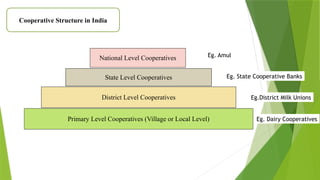
Cooperative Structure in India
Primary Level Cooperatives (Village or Local Level)
District Level Cooperatives
State Level Cooperatives
National Level Cooperatives
Eg. Dairy Cooperatives
Eg.District Milk Unions
Eg. State Cooperative Banks
Eg. Amul
https://www.youtube.com/watch?v=bRHsVzfXtcU
Cooperative Farming
Cooperative farming refers to a system
where farmers pool their resources,
land, labor, or capital to improve
agricultural productivity and market
access while maintaining ownership. It
is widely used in developing economies
to support small-scale farmers.
Types of Cooperative Farming
Service Co-operatives
Production Co-operatives
Marketing Co-operatives
Credit Co-operatives
Benefits of Cooperative Farming
Economies of Scale
Better Market Access
Risk Sharing
Access to Credit & Subsidies
Increased Productivity
Infrastructure Development
Employment Generation
Challenges in Cooperative Farming
Management Inefficiencies
Member Disputes
Market Competition
Government Policies
Low Participation & Commitment
Corruption & Misuse of Funds
Dependence on External Support
Co-operative Marketing
• Co-operative marketing in India plays a crucial role in
ensuring fair prices, reducing exploitation by middlemen,
and providing small-scale farmers and producers with a
collective platform for selling their goods.
• It is an organized system where producers pool their
resources to market their products effectively, ensuring
better bargaining power and income stability.
• Co-operative marketing refers to the collective selling of
agricultural and other products by co-operatives to secure
better price realization for members.
• These societies protect farmers from middlemen, provide
credit, and ensure transparent transactions.
Objectives of Co-operative Marketing
Eliminate Middlemen
Ensure Fair Prices
Improve Bargaining Power
Provide Storage & Warehousing
Facilitate Credit & Inputs
Standardization & Grading
Role of Co-operative Marketing in
Agriculture
Providing market access to small farmers
Ensuring timely payments and reducing credit
dependency.
Improving quality control through grading and
standardization.
Promoting export of agricultural goods.
Challenges Faced by Co-operative Marketing
in India
Lack of Infrastructure
Financial Constraints
Poor Management and Governance
Market Competition
Limited Technological Integration
Low Consumer Awareness and Trust Issues
Pricing and Procurement Issues
Key Co-operative Marketing
Organizations in India
Handles procurement and distribution
of agricultural produce
Function at the state level. Supports marketing of tribal products.
https://www.youtube.com/watch?v=1qOfuqKzmzA
Co-operatives in a Global
Perspective
Co-operatives are member-owned,
democratically controlled enterprises that
prioritize social and economic benefits for
their members over profit maximization.
They operate based on
• the principles of voluntary membership,
• democratic governance,
• member economic participation,
• autonomy, education, cooperation,
• concern for the community.
A co-operative is an autonomous association of individuals
united voluntarily to meet their common economic, social, and
cultural needs through a jointly owned and democratically
controlled enterprise.
Historical Background of Cooperatives
The cooperative movement originated in the context of the Industrial Revolution, which began in the late
18th century in Britain. This was a period of rapid industrialization and urbanization. While it brought
technological progress and increased production, it also led to severe social and economic problems for the
working class. The following issues were prevalent:
• Low wages and long working hours.
• Poor living conditions in crowded cities.
• Job insecurity and exploitation.
• High prices of essential goods controlled by private capitalists.
• Little to no social protection or workers' rights.
As a result of these harsh conditions, workers, artisans, and small producers started looking for ways to
support each other, secure fair prices, and improve their standard of living. One of the most innovative
solutions was the idea of forming cooperatives—organizations owned and run collectively by members for
their mutual benefit.
Historical Background of Cooperatives
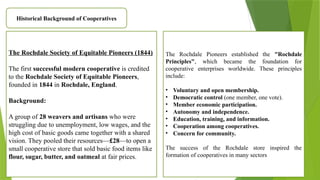
The Rochdale Society of Equitable Pioneers (1844)
The first successful modern cooperative is credited
to the Rochdale Society of Equitable Pioneers,
founded in 1844 in Rochdale, England.
Background:
A group of 28 weavers and artisans who were
struggling due to unemployment, low wages, and the
high cost of basic goods came together with a shared
vision. They pooled their resources—£28—to open a
small cooperative store that sold basic food items like
flour, sugar, butter, and oatmeal at fair prices.
The Rochdale Pioneers established the "Rochdale
Principles", which became the foundation for
cooperative enterprises worldwide. These principles
include:
• Voluntary and open membership.
• Democratic control (one member, one vote).
• Member economic participation.
• Autonomy and independence.
• Education, training, and information.
• Cooperation among cooperatives.
• Concern for community.
The success of the Rochdale store inspired the
formation of cooperatives in many sectors
Co-operatives in a Global
Perspective
Types of Co-operatives Worldwide
• Agricultural Co-operatives (farming,
dairy, fisheries)
• Consumer Co-operatives (retail,
wholesale)
• Credit Co-operatives (credit unions,
banks)
• Housing Co-operatives
• Worker Co-operatives
• Marketing Co-operatives
• Service Co-operatives (utilities, health
care)
Role of Cooperatives in the Global Economy
Massive Membership Base
Significant Employment Generation
Global Presence
Economic Democracy and Empowerment
Key Players in Vital Economic Sectors
Crisis Resilience
Empowers marginalized groups
Reduces poverty and inequality
Declared 2012 as the International
Year of Co-operatives to highlight
their impact.
Global Organizations Promoting Co-operatives
Credit Cooperative Societies
Credit cooperative societies are financial institutions
that provide credit to their members at reasonable
interest rates.
They help promote thrift, savings, and self-sufficiency
among their members, particularly in rural and semi-
urban areas where access to formal banking services
is limited.
Types of Credit Cooperatives
A. Rural Credit Cooperatives
B. Urban Credit Cooperatives
C. Multi-State Cooperative Credit Societies
Objectives
To promote financial inclusion by offering
credit to people who lack access to formal
banking.
To encourage savings among members.
To provide loans at lower interest rates.
To reduce the dependence of members on
moneylenders and informal credit sources.
To uplift economically weaker sections and
promote self-reliance.
 Lower interest rates compared to
moneylenders.

Easy access to credit.

Encourages collective welfare.

Dividends or returns on shares to
members.

Financial education and support.
• Mismanagement and lack of
professional expertise.
•
Political interference.
•
Poor recovery of loans (NPA issues).
•
Limited scope and resources.
•
Sometimes weaker regulatory
oversight.
Benefits Challenges
COOPERATIVE EDUCATION
• The term cooperative education pertains to educational training programmes provided by
the cooperative movement for the fulfillment of its own aims and objectives.
• Cooperative member education refers to the programmes which seek to improve on the
knowledge and understanding of members, prospective members and elected leaders of the
cooperatives.
• Indian masses live in rural areas and engage themselves in agricultural and allied occupations,
the main focus of cooperative efforts has been on agricultural cooperation. The state, state
cooperative unions and the agricultural universities have a decisive role to play in the
matter of providing education and training facilities.
OBJECTIVES
The objectives of cooperative education
• To create and sustain faith in the cooperative
ideology.
• To impress the spirit of self-help and self-reliance
among the members.
• Creation of right type of leadership, possessing
vision, foresight and ability to lead the masses on
right path.
• Education must make the members feel that they
are not only of the cooperative society but also a
movement i.e. movement of ideas, new concepts
and a new organisation of human relationship.
The objective of cooperative training
• To improve the effectiveness and efficiency of the
organization.
• To build up necessary knowledge, skills, attitudes
among the personnel so that they are competent
enough to accomplish the jobs assigned to them.
• To motivate the workers to perform their jobs in
the interest of the organisation and to attract right
type of personnel to the organisation.


Unit 3.pptx..............................

  • 1.
  • 3.
  • 4.
    Meaning of Cooperation Cooperation refers to the act of working together towards a common goal.  It is a fundamental social process where individuals, groups, or organizations collaborate to achieve shared objectives.  Cooperation can exist at different levels—between individuals, within communities, in businesses, and even among nations.  Cooperation is based on mutual assistance, shared responsibilities, and collective benefits, making it essential for social harmony, economic development, and organizational success.
  • 6.
    Benefits of Cooperationin the Agricultural Sector Cost Reduction Better Access to Credit Higher Income and Profitability Knowledge Sharing and Training Risk Management Better Market Access Empowerment of Small and Marginal Farmers
  • 7.
    Characteristics of Cooperativeand Cooperative structure in India  The cooperative movement was started in England during 19th Century mainly to protect the interest of workers who spread throughout the world.  It spread from there to all parts of the world. But, the movement’s objectives are differing from one country to the other, depending upon the circumstances.  Cooperatives are in all sectors like agriculture, industry and service, to help the members in the form of wages, employment, productivity and marketing facilities.  The cooperatives are differ from one perspective to the other like consumer cooperatives (food and other related products), workers cooperatives (decent work), credit cooperatives (savings and credit), agricultural cooperatives (input to agricultural production, pricing and marketing) etc.,  Today, the cooperative movement is very much successful with widespread inclusive policy.
  • 8.
    Characteristics of Cooperatives VoluntaryMembership Democratic Control Member Economic Participation Autonomy and Independence Education, Training, and Information • Freedom to Join • Freedom to Exit • Non-Discriminatory Nature • Equal Voting Rights • Elected Leadership • Collective Decision-Making • Contribution to Capital • Limited Returns on Capital Investment • Use of Surplus for Common Benefits • Self-Governing Structure • Independence Despite Government Support • Financial Independence • Member Education for Effective Participation • Skill Development for Employees • Awareness and Information Sharing
  • 9.
    Weaknesses of Cooperatives LimitedCapital and Financial Constraints Inefficiency in Decision-Making Lack of Skilled Leadership Internal Conflicts and Political Interference Risk of Mismanagement and Corruption Resistance to Change and Innovation
  • 10.
    Cooperative Structure inIndia Primary Level Cooperatives (Village or Local Level) District Level Cooperatives State Level Cooperatives National Level Cooperatives Eg. Dairy Cooperatives Eg.District Milk Unions Eg. State Cooperative Banks Eg. Amul
  • 11.
  • 12.
    Cooperative Farming Cooperative farmingrefers to a system where farmers pool their resources, land, labor, or capital to improve agricultural productivity and market access while maintaining ownership. It is widely used in developing economies to support small-scale farmers.
  • 13.
    Types of CooperativeFarming Service Co-operatives Production Co-operatives Marketing Co-operatives Credit Co-operatives
  • 14.
    Benefits of CooperativeFarming Economies of Scale Better Market Access Risk Sharing Access to Credit & Subsidies Increased Productivity Infrastructure Development Employment Generation
  • 15.
    Challenges in CooperativeFarming Management Inefficiencies Member Disputes Market Competition Government Policies Low Participation & Commitment Corruption & Misuse of Funds Dependence on External Support
  • 16.
    Co-operative Marketing • Co-operativemarketing in India plays a crucial role in ensuring fair prices, reducing exploitation by middlemen, and providing small-scale farmers and producers with a collective platform for selling their goods. • It is an organized system where producers pool their resources to market their products effectively, ensuring better bargaining power and income stability. • Co-operative marketing refers to the collective selling of agricultural and other products by co-operatives to secure better price realization for members. • These societies protect farmers from middlemen, provide credit, and ensure transparent transactions.
  • 17.
    Objectives of Co-operativeMarketing Eliminate Middlemen Ensure Fair Prices Improve Bargaining Power Provide Storage & Warehousing Facilitate Credit & Inputs Standardization & Grading
  • 18.
    Role of Co-operativeMarketing in Agriculture Providing market access to small farmers Ensuring timely payments and reducing credit dependency. Improving quality control through grading and standardization. Promoting export of agricultural goods.
  • 19.
    Challenges Faced byCo-operative Marketing in India Lack of Infrastructure Financial Constraints Poor Management and Governance Market Competition Limited Technological Integration Low Consumer Awareness and Trust Issues Pricing and Procurement Issues
  • 20.
    Key Co-operative Marketing Organizationsin India Handles procurement and distribution of agricultural produce Function at the state level. Supports marketing of tribal products.
  • 21.
  • 22.
    Co-operatives in aGlobal Perspective Co-operatives are member-owned, democratically controlled enterprises that prioritize social and economic benefits for their members over profit maximization. They operate based on • the principles of voluntary membership, • democratic governance, • member economic participation, • autonomy, education, cooperation, • concern for the community. A co-operative is an autonomous association of individuals united voluntarily to meet their common economic, social, and cultural needs through a jointly owned and democratically controlled enterprise.
  • 23.
    Historical Background ofCooperatives The cooperative movement originated in the context of the Industrial Revolution, which began in the late 18th century in Britain. This was a period of rapid industrialization and urbanization. While it brought technological progress and increased production, it also led to severe social and economic problems for the working class. The following issues were prevalent: • Low wages and long working hours. • Poor living conditions in crowded cities. • Job insecurity and exploitation. • High prices of essential goods controlled by private capitalists. • Little to no social protection or workers' rights. As a result of these harsh conditions, workers, artisans, and small producers started looking for ways to support each other, secure fair prices, and improve their standard of living. One of the most innovative solutions was the idea of forming cooperatives—organizations owned and run collectively by members for their mutual benefit.
  • 24.
    Historical Background ofCooperatives The Rochdale Society of Equitable Pioneers (1844) The first successful modern cooperative is credited to the Rochdale Society of Equitable Pioneers, founded in 1844 in Rochdale, England. Background: A group of 28 weavers and artisans who were struggling due to unemployment, low wages, and the high cost of basic goods came together with a shared vision. They pooled their resources—£28—to open a small cooperative store that sold basic food items like flour, sugar, butter, and oatmeal at fair prices. The Rochdale Pioneers established the "Rochdale Principles", which became the foundation for cooperative enterprises worldwide. These principles include: • Voluntary and open membership. • Democratic control (one member, one vote). • Member economic participation. • Autonomy and independence. • Education, training, and information. • Cooperation among cooperatives. • Concern for community. The success of the Rochdale store inspired the formation of cooperatives in many sectors
  • 25.
    Co-operatives in aGlobal Perspective Types of Co-operatives Worldwide • Agricultural Co-operatives (farming, dairy, fisheries) • Consumer Co-operatives (retail, wholesale) • Credit Co-operatives (credit unions, banks) • Housing Co-operatives • Worker Co-operatives • Marketing Co-operatives • Service Co-operatives (utilities, health care)
  • 26.
    Role of Cooperativesin the Global Economy Massive Membership Base Significant Employment Generation Global Presence Economic Democracy and Empowerment Key Players in Vital Economic Sectors Crisis Resilience Empowers marginalized groups Reduces poverty and inequality
  • 27.
    Declared 2012 asthe International Year of Co-operatives to highlight their impact. Global Organizations Promoting Co-operatives
  • 28.
    Credit Cooperative Societies Creditcooperative societies are financial institutions that provide credit to their members at reasonable interest rates. They help promote thrift, savings, and self-sufficiency among their members, particularly in rural and semi- urban areas where access to formal banking services is limited. Types of Credit Cooperatives A. Rural Credit Cooperatives B. Urban Credit Cooperatives C. Multi-State Cooperative Credit Societies Objectives To promote financial inclusion by offering credit to people who lack access to formal banking. To encourage savings among members. To provide loans at lower interest rates. To reduce the dependence of members on moneylenders and informal credit sources. To uplift economically weaker sections and promote self-reliance.
  • 29.
     Lower interestrates compared to moneylenders.  Easy access to credit.  Encourages collective welfare.  Dividends or returns on shares to members.  Financial education and support. • Mismanagement and lack of professional expertise. • Political interference. • Poor recovery of loans (NPA issues). • Limited scope and resources. • Sometimes weaker regulatory oversight. Benefits Challenges
  • 30.
    COOPERATIVE EDUCATION • Theterm cooperative education pertains to educational training programmes provided by the cooperative movement for the fulfillment of its own aims and objectives. • Cooperative member education refers to the programmes which seek to improve on the knowledge and understanding of members, prospective members and elected leaders of the cooperatives. • Indian masses live in rural areas and engage themselves in agricultural and allied occupations, the main focus of cooperative efforts has been on agricultural cooperation. The state, state cooperative unions and the agricultural universities have a decisive role to play in the matter of providing education and training facilities.
  • 31.
    OBJECTIVES The objectives ofcooperative education • To create and sustain faith in the cooperative ideology. • To impress the spirit of self-help and self-reliance among the members. • Creation of right type of leadership, possessing vision, foresight and ability to lead the masses on right path. • Education must make the members feel that they are not only of the cooperative society but also a movement i.e. movement of ideas, new concepts and a new organisation of human relationship. The objective of cooperative training • To improve the effectiveness and efficiency of the organization. • To build up necessary knowledge, skills, attitudes among the personnel so that they are competent enough to accomplish the jobs assigned to them. • To motivate the workers to perform their jobs in the interest of the organisation and to attract right type of personnel to the organisation.