Pre-
Membership
Education
Seminar
Santa Monica Credit Cooperative
Topics for Discussion:
2
Why PMES?
• RA 9520
• CDA’s Function
Why
Cooperative?
• Nature and
Characteristics
• Types and
Categories of
Cooperatives
• Services of
Coops
Why Santa
Monica Credit
Cooperative?
• Services and
Program offers
1. Why PMES?
4
OBJECTIVES:
 To know the legal basis of the
conduct of PMES, and
 To explain the reasons for
attending the PMES
LEGAL
FRAMEWORK:
• AN ACT AMENDING THE COOPERATIVE CODE OF THE
PHILIPPINES TO BE KNOWN AS THE "PHILIPPINE
COOPERATIVE CODE OF 2008"
R.A. 9520
•AN ACT CREATING THE COOPERATIVE DEVELOPMENT AUTHORITY TO PROMOTE THE
VIABILITY AND GROWTH OF COOPERATIVES AS INSTRUMENTS OF EQUITY, SOCIAL JUSTICE
AND ECONOMIC DEVELOPMENT, DEFINING ITS POWERS, FUNCTIONS AND
RESPONSIBILITIES, RATIONALIZING GOVERNMENT POLICIES AND AGENCIES WITH
COOPERATIVE FUNCTIONS, SUPPORTING COOPERATIVE DEVELOPMENT, TRANSFERRING
THE REGISTRATION AND REGULATION FUNCTIONS OF EXISTING GOVERNMENT AGENCIES
ON COOPERATIVES AS SUCH AND CONSOLIDATING THE SAME WITH THE AUTHORITY,
APPROPRIATING FUNDS THEREFOR, AND FOR OTHER PURPOSES
R.A. 6939
LEGAL
FRAMEWORK:
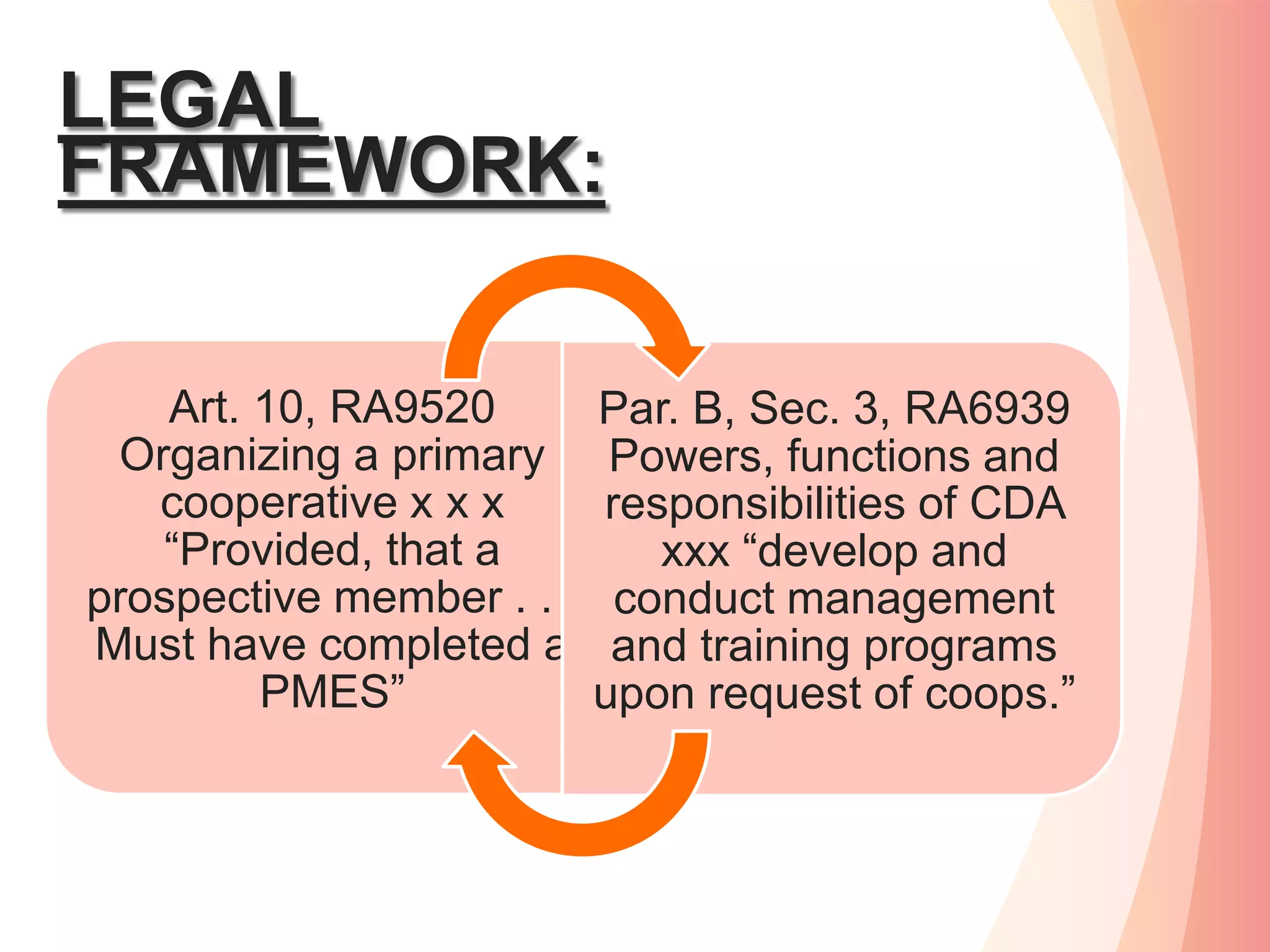
Art. 10, RA9520
Organizing a primary
cooperative x x x
“Provided, that a
prospective member . . .
Must have completed a
PMES”
Par. B, Sec. 3, RA6939
Powers, functions and
responsibilities of CDA
xxx “develop and
conduct management
and training programs
upon request of coops.”
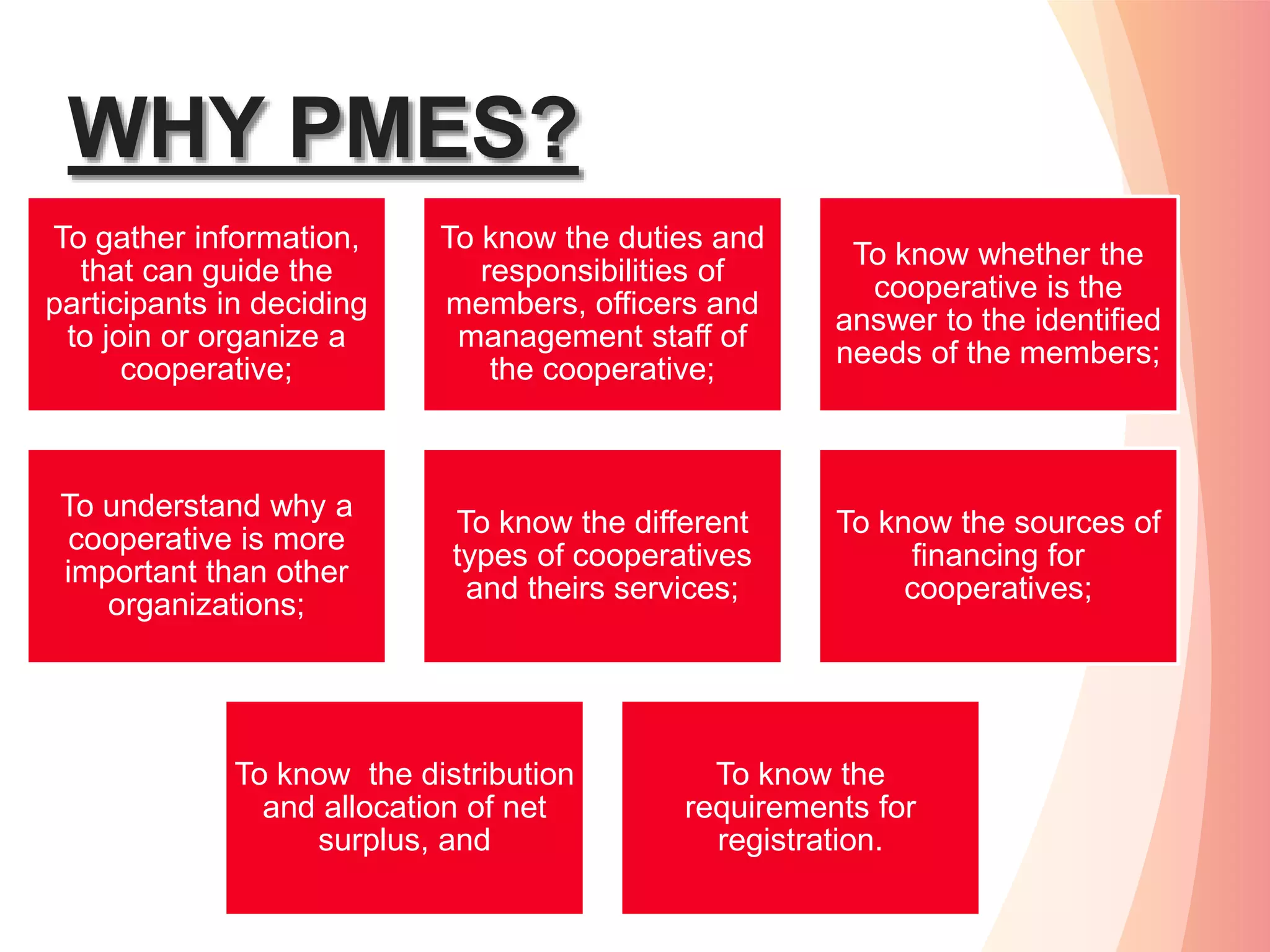
WHY PMES?
To gather information,
that can guide the
participants in deciding
to join or organize a
cooperative;
To know the duties and
responsibilities of
members, officers and
management staff of
the cooperative;
To know whether the
cooperative is the
answer to the identified
needs of the members;
To understand why a
cooperative is more
important than other
organizations;
To know the different
types of cooperatives
and theirs services;
To know the sources of
financing for
cooperatives;
To know the distribution
and allocation of net
surplus, and
To know the
requirements for
registration.
What is CDA?
◦ A government agency created by virtue of RA 6939
which was signed into law on March 10, 1990.
◦ In compliance with the provisions of Section 15,
Article XII of the Philippine Constitution of 1987
which mandates Congress to create and agency to
promote the viability and growth of
cooperatives as instruments for equity, social
justice and sustainable economic development.
9
“
10
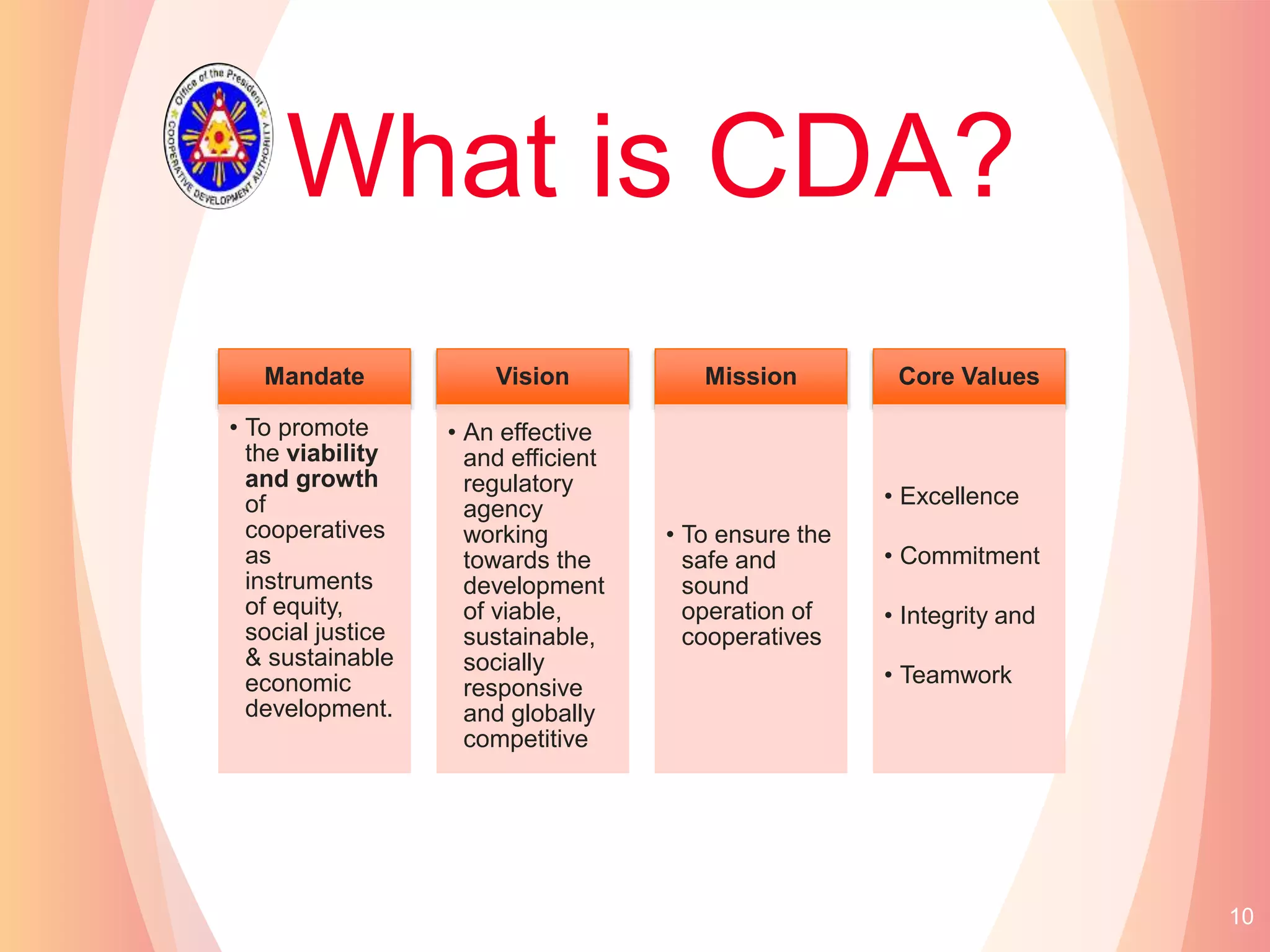
What is CDA?
Mandate
• To promote
the viability
and growth
of
cooperatives
as
instruments
of equity,
social justice
& sustainable
economic
development.
Vision
• An effective
and efficient
regulatory
agency
working
towards the
development
of viable,
sustainable,
socially
responsive
and globally
competitive
Mission
• To ensure the
safe and
sound
operation of
cooperatives
Core Values
• Excellence
• Commitment
• Integrity and
• Teamwork
2. Why Cooperative?
12
Why Cooperative?
“Art. XII, Section 15 of
the 1987 Constitution. .
. Recognizes
cooperatives as
instrument of equity,
social justice and
sustainable economic
development. ”
13
14
The acknowledge leader in economic,
social and environmental sustainability
The model preferred by people
The fastest growing form of enterprise
15
“The Co-operative Movement
brings together over One Billion
people around the world. The
UN estimated in 1994 that
livelihood of nearly 3 billion
people, or half of the world’s
population, was made secure by
coop enterprises…”
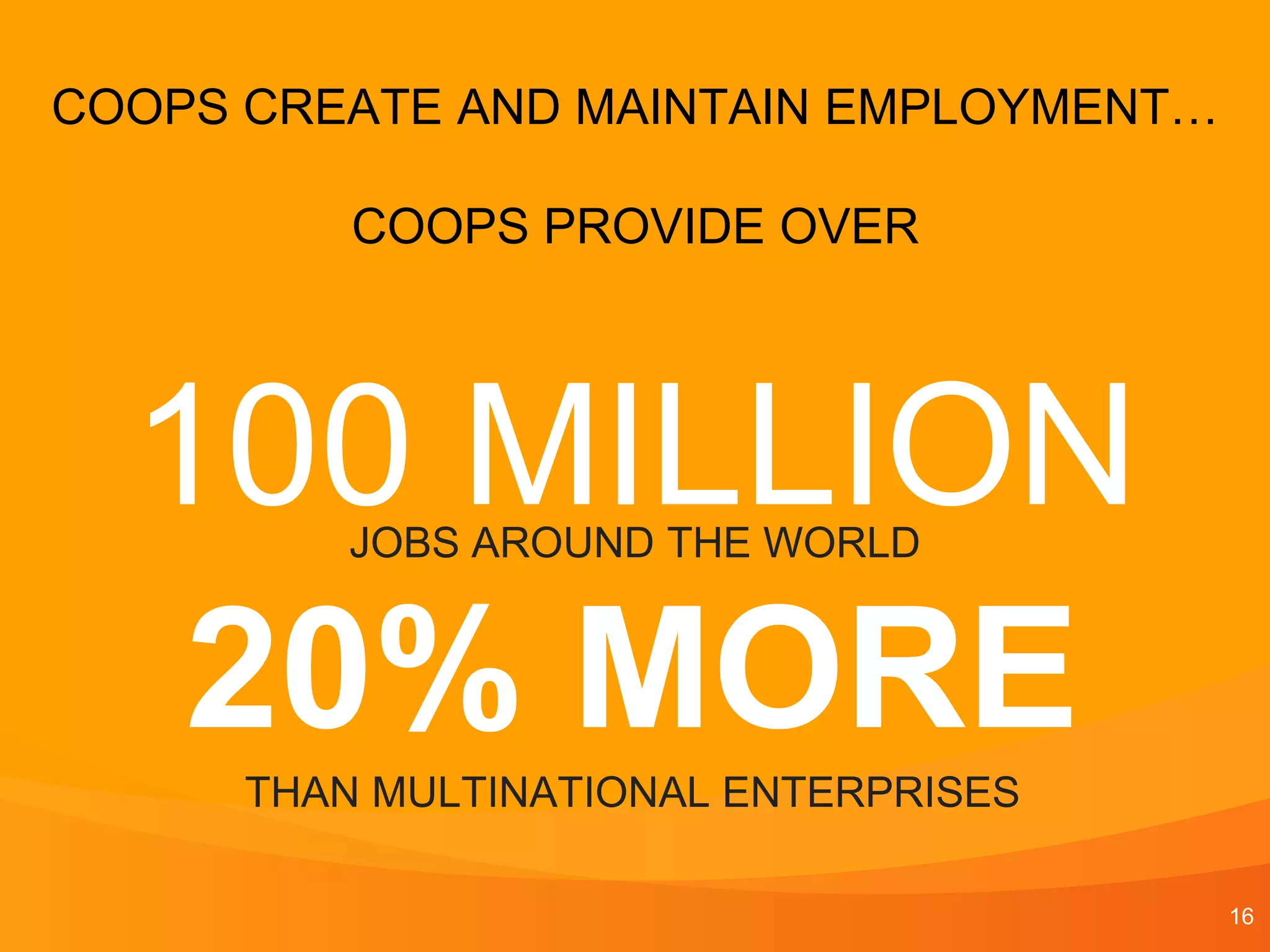
100 MILLIONJOBS AROUND THE WORLD
16
COOPS CREATE AND MAINTAIN EMPLOYMENT…
COOPS PROVIDE OVER
20% MORETHAN MULTINATIONAL ENTERPRISES
17
What is a
Cooperative?
18
What is a Cooperative?
An autonomous and duly registered
association of persons, with a common bond of
interest, who have voluntarily joined together
to achieve their social, economic and cultural
needs and aspirations by making equitable
contributions to the capital required,
patronizing their products and services, and
accepting a fair share of the risks and benefits
of the undertaking in accordance with
universally accepted cooperative principles.
19
Autonomous and
duly registered
Common bond of
membership
Social, economic, &
cultural
needs/aspirations
Equitable
contribution to the
capital
Patronizing the
products and
services and
Fair share of risks
and benefits of the
undertaking.
A Cooperative is ...
“
20
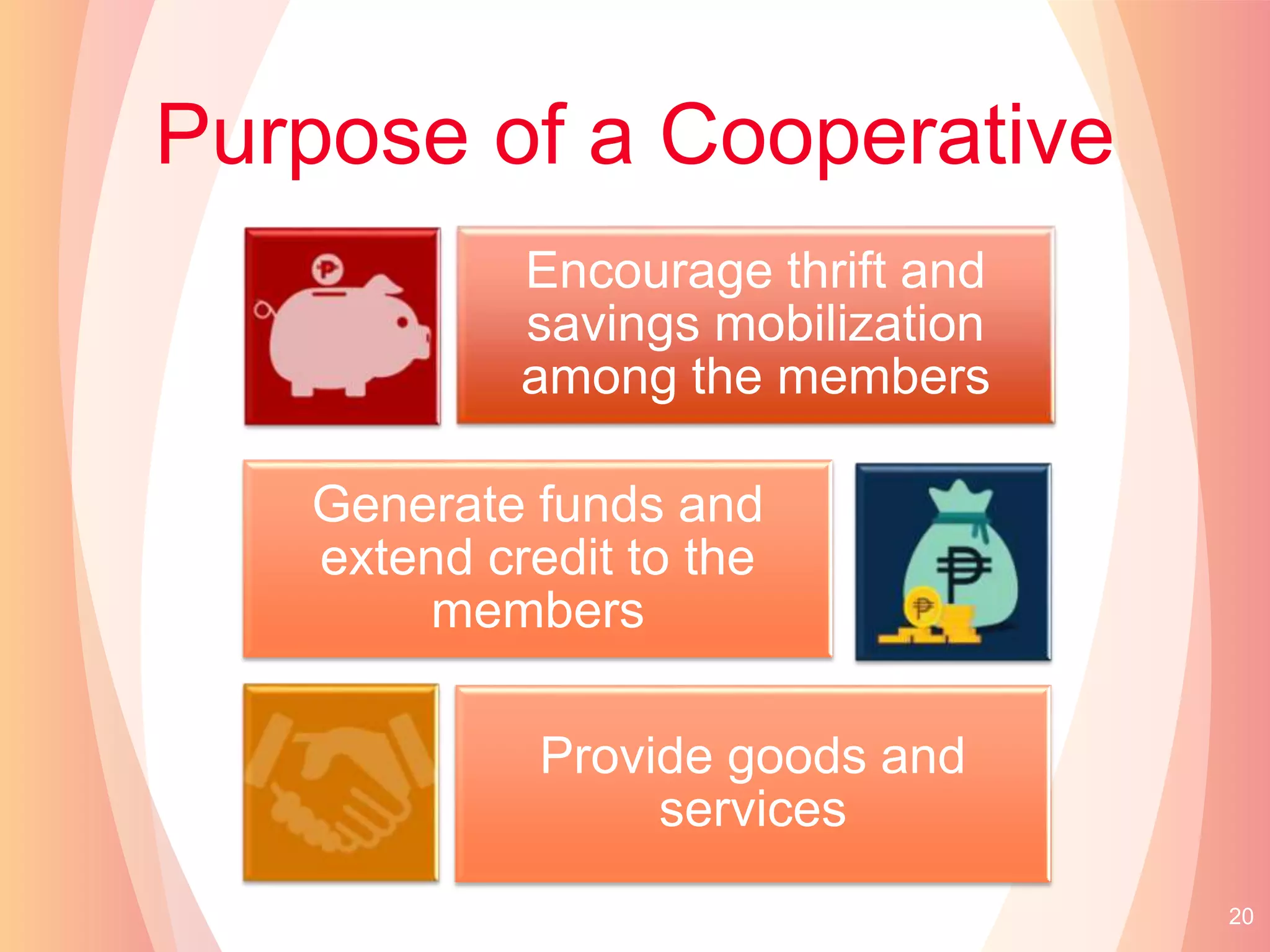
Encourage thrift and
savings mobilization
among the members
Generate funds and
extend credit to the
members
Provide goods and
services
Purpose of a Cooperative
COOPERATIVES are...
MEMBER-BASED
MEMBER-OWNED
MEMBER-FRIENDLY
MEMBER-CO-OPERATION
21
“
“In Short, MEMBERS are
the key to the SUCCESS
or FAILURE of the
Cooperative”
22
Common Bond of Membership
23
Residential
Institutional
Associational
Occupational
24
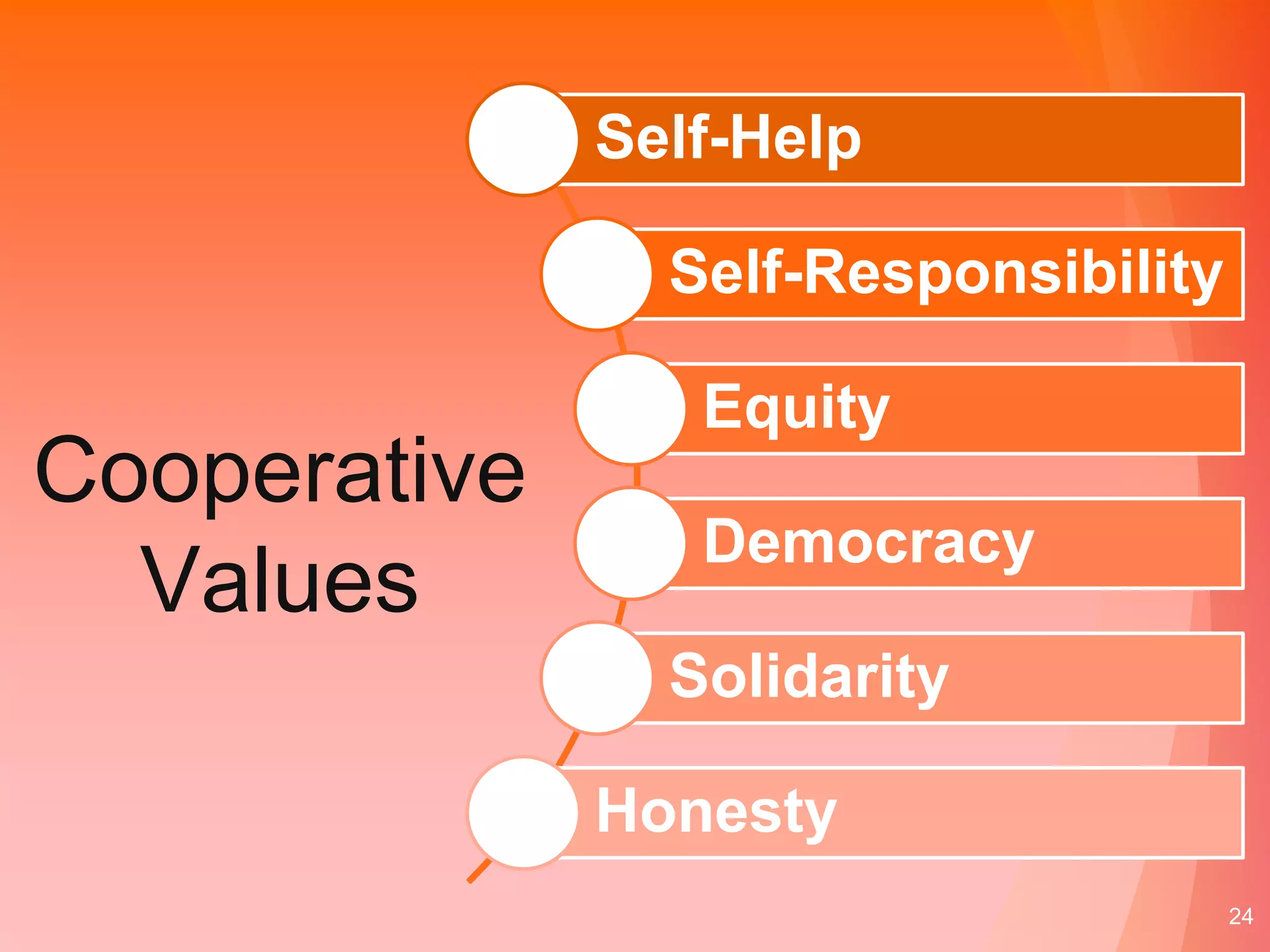
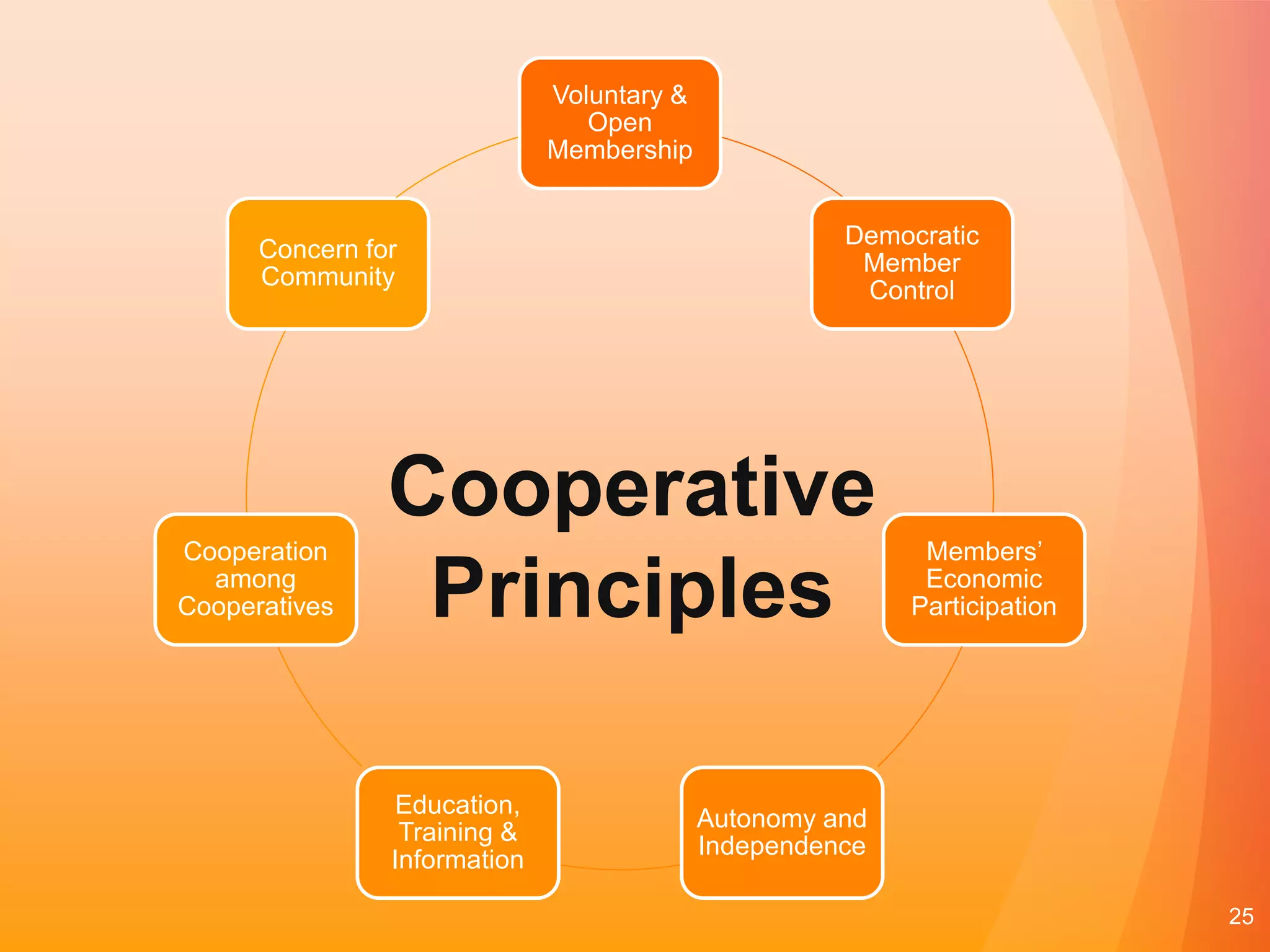
Cooperative
Values
Self-Help
Self-Responsibility
Equity
Democracy
Solidarity
Honesty
Voluntary &
Open
Membership
Democratic
Member
Control
Members’
Economic
Participation
Autonomy and
Independence
Education,
Training &
Information
Cooperation
among
Cooperatives
Concern for
Community
25
Cooperative
Principles
What are the types of
Cooperatives?
26
27
Credit Consumers Producers Marketing Service
Multi-Purpose Advocacy
Cooperative
Bank
Agrarian Reform Dairy
Education
Financial
Service
Health Services Housing Insurance
Electric Water Service Transport Fishermen Workers
Types of Cooperatives
CATEGORIES OF
COOPERATIVES
28
PRIMARY
COOPS
the members of which
are natural persons.
TERTIARY
COOPS
the members of which are
secondary cooperatives.
SECONDARY
COOPS
the members of which are
primaries.
03
01 02
“
29
The Cooperative
Difference
COOPERATIVES ARE ENTERPRISES
THAT PUT PEOPLE AT THE CENTRE OF
THEIR BUSINESS AND NOT CAPITAL.
COOPERATIVES PUT PEOPLE AT THE
HEART OF ALL THEIR BUSINESS.
COOPERATIVES ARE ALSO
ENTERPRISES THAT FOLLOW A SET OF
PRINCIPLES AND VALUES.
30
Nature and Character of
Cooperatives
Service Oriented
Community
Oriented
People Oriented
Owned,
Managed and
Patronized by
their members
Business
Enterprises
Develop Best
Thru Self help
and Mutual Help
Serve Best when
they answer the
real needs of
members
Develop Best
from Bottom to
Top
Enhanced thru
Multisectoral
Approach
Unique
Identity
of a
Coop
It is both an
association of
people and a
business
enterprise.
Members come
together to
achieve a
common goal
That common
goal is to help
them acquire a
product or service
to satisfy an
economic need.
To achieve these
goals, they go
into business
themselves
THE
COOPERATIVE
PHILOSOPHY
Help One
Self
Thru the
Coop
Help
Others
2. Through
the COOP,
help
OTHERS.
1. Help
ONESELF
thru the
coop
Core
Philosophy
of the
Cooperative
3. WHY Santa Monica Credit Cooperative?
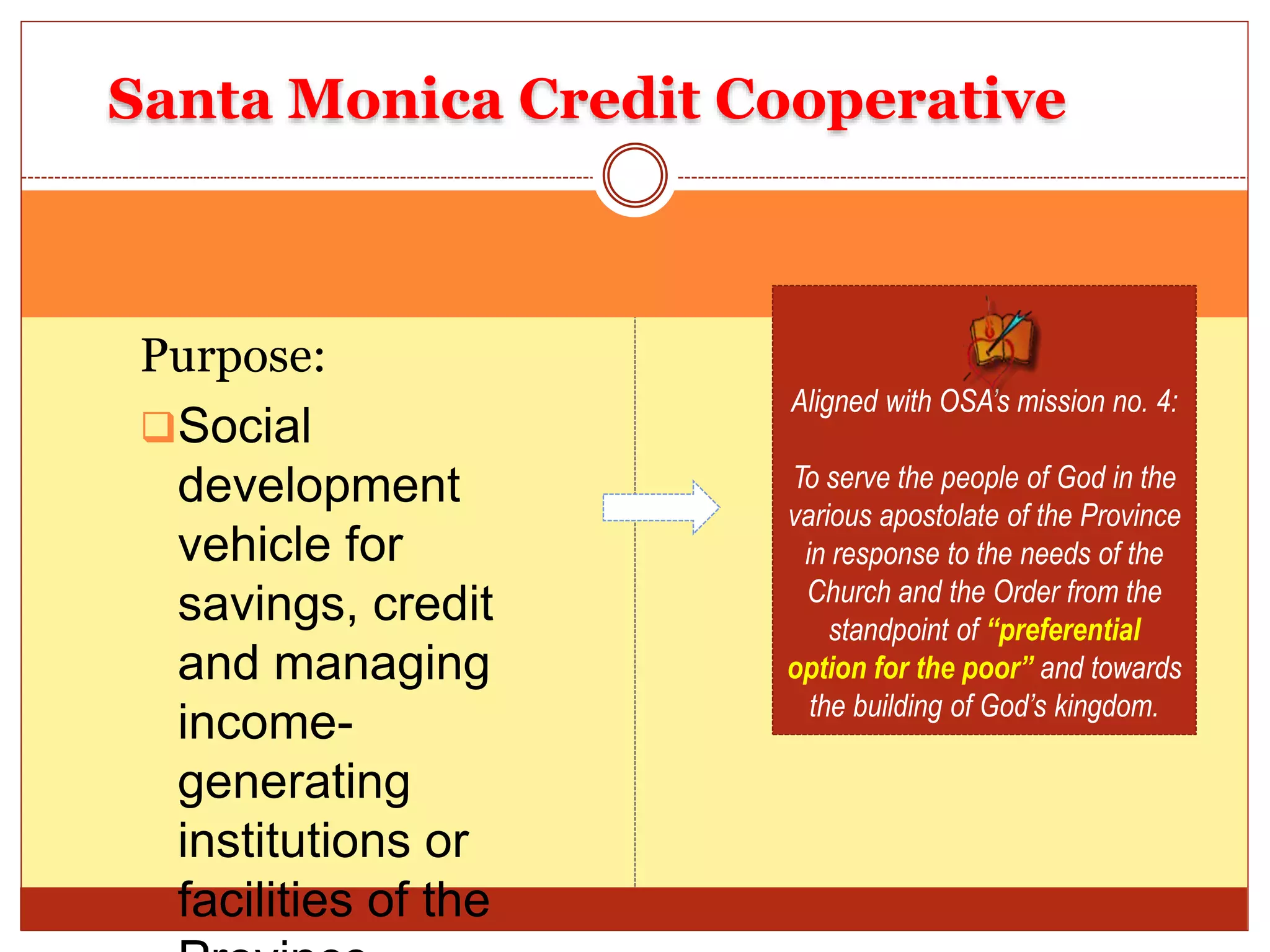
Santa Monica Credit Cooperative
Purpose:
Social
development
vehicle for
savings, credit
and managing
income-
generating
institutions or
facilities of the
Aligned with OSA’s mission no. 4:
To serve the people of God in the
various apostolate of the Province
in response to the needs of the
Church and the Order from the
standpoint of “preferential
option for the poor” and towards
the building of God’s kingdom.
Primary Purpose/ Objectives
It aspires to be the leading faith based cooperative
embracing Augustinian values centered on human
dignity and kindness.
 To uphold Christian Values for financial stewardship;
 To enhance capacities of members through capability
building towards economic sustainability and
empowerment;
 To generate productive economic activities to help
eliminate poverty and contribute to community building.
Secondary Objectives
1. To encourage thrift and savings mobilization among the members;
2. To generate funds and extend credit to the members for productive and
provident purposes;
3. To encourage and support members the systematic production, value
addition and marketing activities;
4. To develop expertise and skills among its members;
5. To provide protection to the loans and funds of the members;
6. To promote and advance the economic and social
status of the members;
7. To coordinate and facilitate the activities of cooperatives;
8. To advocate for the cause of the cooperative movements;
9. To ensure the viability of cooperatives through the utilization of new
technologies; and
10. To encourage and promote self-help or self-employment as an engine for
economic growth and poverty alleviation.
Kinds of Membership
 Regular Members are those who have complied with all
the membership requirements and are entitled to all the
rights and privileges of membership.
 Associate Members are those who have no right to
vote nor be voted upon and are entitled only to limited
rights, privileges and membership duration as provided
in the By-laws of the Cooperative, the Philippine
Cooperative Code of 2008, and its Implementing Rules
and Regulation.
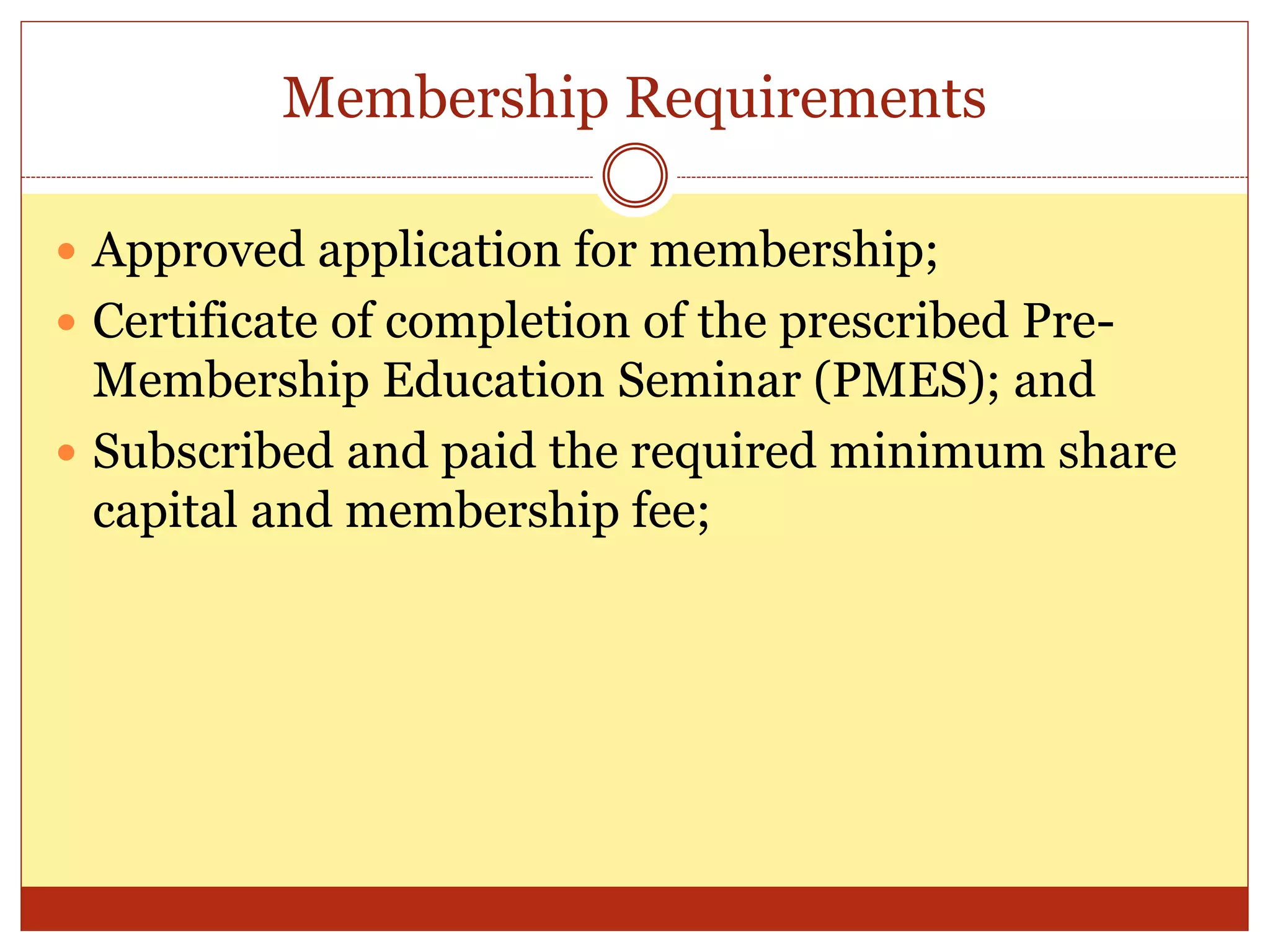
Membership Requirements
 Approved application for membership;
 Certificate of completion of the prescribed Pre-
Membership Education Seminar (PMES); and
 Subscribed and paid the required minimum share
capital and membership fee;
Registration and Legalities
CDA Registration
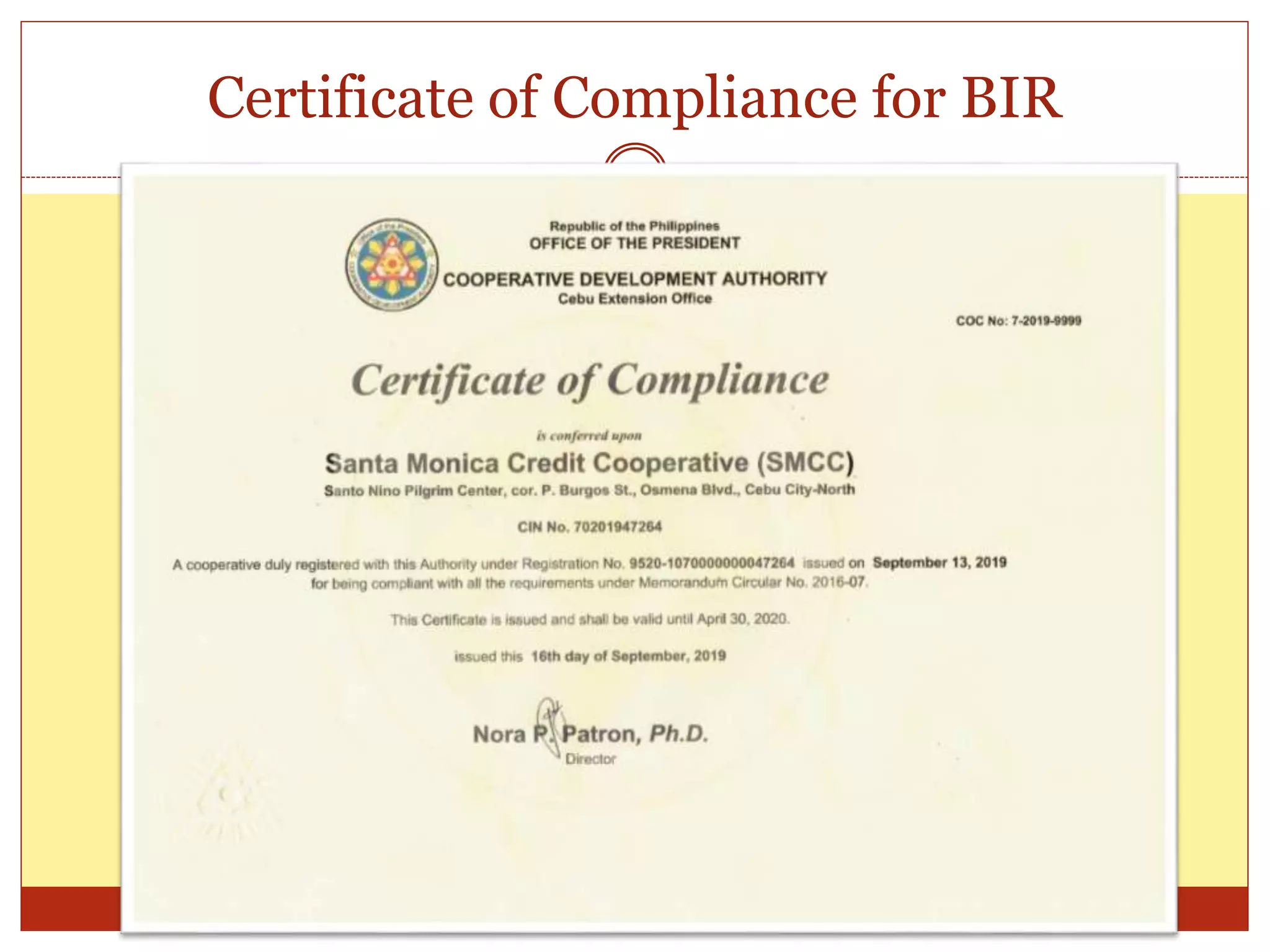
Certificate of Compliance for BIR
Certificate of Registration (BIR)
Business Permit
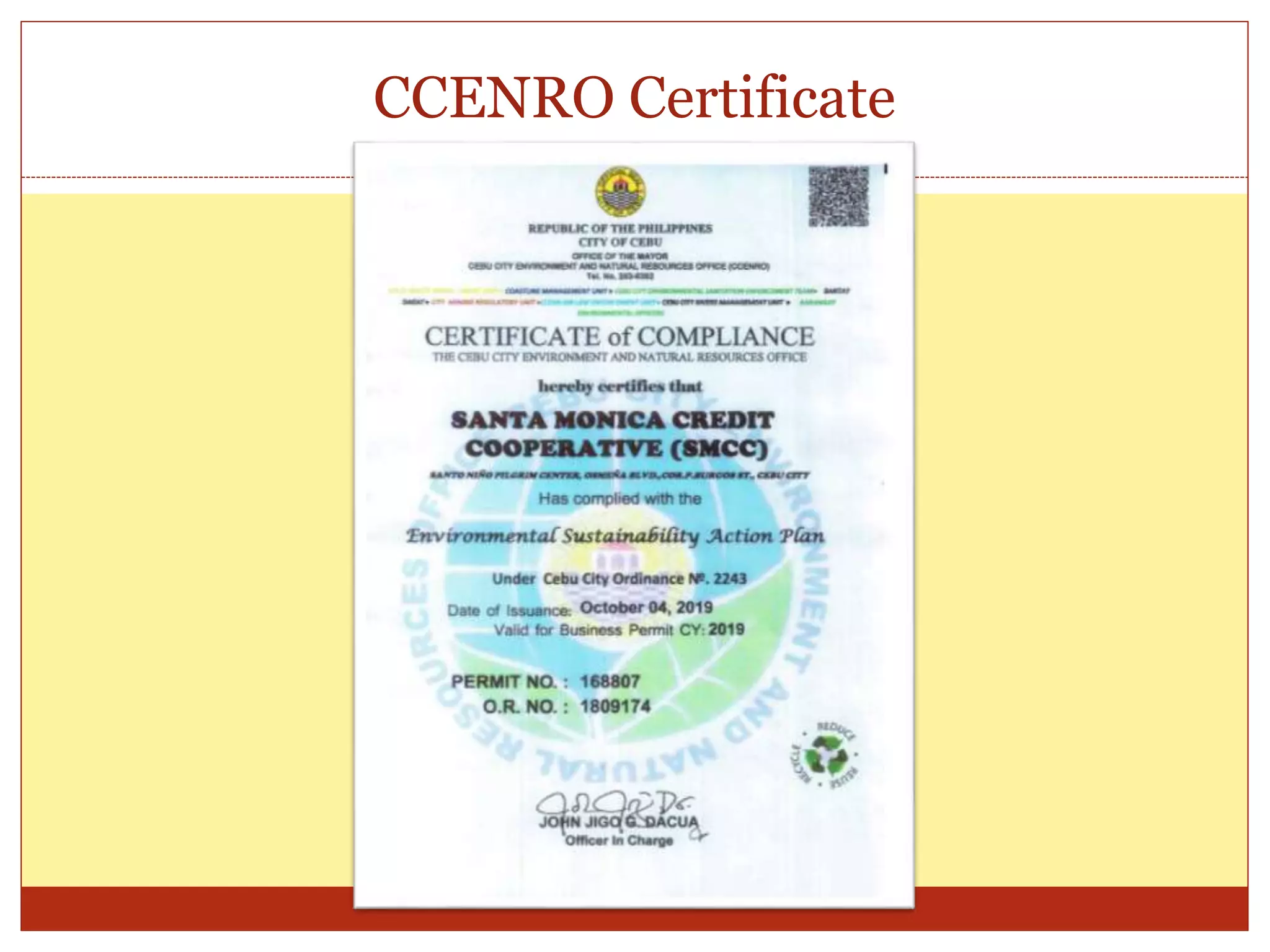
CCENRO Certificate
Fire Safety Inspection Certificate
Sanitary Permit
What are the activities undertaken?
Pre Registration Seminar (PRS)
Cooperator's Plenum
Pre-Membership Education Seminar (PMES)
Board of Directors Meeting
Special General Assembly
Blessing and Launching of SMCC
Special General Assembly
Loans Offered
Different Types of Loans
 Petty Cash Loans
 Rice Loan
 Jewelry Loan
 Retirement Loan
 Calamity Loan
 Educational Loan
 Vocation Educational
Loan
 Medical Loan
 Dental Loan
 Optical Loan
 Gift Check loans
 Travel and Tours Loan
 Salary Loan
 Agricultural Loan
 Regular Loan
 Financing Loan
 Business Related Loan
 Housing and Lot
Purchase Loan
 Special Projects
 Funeral Services Loan
Loan Policies for members
 Loans maybe granted to members in good standing
either for provident or productive purposes.
 The Board of Directors shall prescribe the terms and
conditions for the granting of loans.
 The classification of a member shall determine his
loan multiple, as well as the types of loan he may
avail.
Loans and Savings
Loan Charge
 0.79% – 2% per month
 24% per annum
Savings Interest
 3-4 % per annum
The People Behind
Provincialate- Management Team
Marie Claire Sandoval
Accountant
Anna Liza Villacorta
Bookkeeper
Gena Ventanilla
Cashier
Sarah B. Rabadon
Collector
Marivic Y. Codinera
Gen. Manager
Be a member now!
 Approved application for membership; (membership P250)
inclusive of Insurance Card (I-CARD)
 Certificate of completion of the prescribed Pre-Membership
Education Seminar (PMES); and
 Subscribed and paid the required minimum share capital
and membership fee;
I- Card
 The applicant shall subscribe for at least One Hundred (100)
Shares with a corresponding value of Ten Thousand Pesos
(Php 10,000.00).
 A member, upon submission of the application to Santa
Monica Credit Cooperative (SMCC) shall at least pay a
minimum of Five Thousand Pesos (Php 5,000.00) as Initial
Paid-up Capital. (but can be paid on maximum of 12 months/
p420 per month/ p105 per week/ p15 per day ??)
 No member shall own or hold more than ten percent (10%) of
the total subscribed share capital of the Cooperative.
oPMES is every first Saturday of the
month;
For inquiries:
You may contact Ms. Marivic Y. Codinera
09434329861
Santamonica.creditcoop@gmail.com
Visibility
https://www.facebook.com/SantaMonicaCC
Register as a
Member of
SMCC
Share the love
of Cooperative
Like the
Presentation
DAGHANG SALAMAT

PMES

  • 1.
  • 2.
    Topics for Discussion: 2 WhyPMES? • RA 9520 • CDA’s Function Why Cooperative? • Nature and Characteristics • Types and Categories of Cooperatives • Services of Coops Why Santa Monica Credit Cooperative? • Services and Program offers
  • 3.
  • 4.
  • 5.
    OBJECTIVES:  To knowthe legal basis of the conduct of PMES, and  To explain the reasons for attending the PMES
  • 6.
    LEGAL FRAMEWORK: • AN ACTAMENDING THE COOPERATIVE CODE OF THE PHILIPPINES TO BE KNOWN AS THE "PHILIPPINE COOPERATIVE CODE OF 2008" R.A. 9520 •AN ACT CREATING THE COOPERATIVE DEVELOPMENT AUTHORITY TO PROMOTE THE VIABILITY AND GROWTH OF COOPERATIVES AS INSTRUMENTS OF EQUITY, SOCIAL JUSTICE AND ECONOMIC DEVELOPMENT, DEFINING ITS POWERS, FUNCTIONS AND RESPONSIBILITIES, RATIONALIZING GOVERNMENT POLICIES AND AGENCIES WITH COOPERATIVE FUNCTIONS, SUPPORTING COOPERATIVE DEVELOPMENT, TRANSFERRING THE REGISTRATION AND REGULATION FUNCTIONS OF EXISTING GOVERNMENT AGENCIES ON COOPERATIVES AS SUCH AND CONSOLIDATING THE SAME WITH THE AUTHORITY, APPROPRIATING FUNDS THEREFOR, AND FOR OTHER PURPOSES R.A. 6939
  • 7.
    LEGAL FRAMEWORK: Art. 10, RA9520 Organizinga primary cooperative x x x “Provided, that a prospective member . . . Must have completed a PMES” Par. B, Sec. 3, RA6939 Powers, functions and responsibilities of CDA xxx “develop and conduct management and training programs upon request of coops.”
  • 8.
    WHY PMES? To gatherinformation, that can guide the participants in deciding to join or organize a cooperative; To know the duties and responsibilities of members, officers and management staff of the cooperative; To know whether the cooperative is the answer to the identified needs of the members; To understand why a cooperative is more important than other organizations; To know the different types of cooperatives and theirs services; To know the sources of financing for cooperatives; To know the distribution and allocation of net surplus, and To know the requirements for registration.
  • 9.
    What is CDA? ◦A government agency created by virtue of RA 6939 which was signed into law on March 10, 1990. ◦ In compliance with the provisions of Section 15, Article XII of the Philippine Constitution of 1987 which mandates Congress to create and agency to promote the viability and growth of cooperatives as instruments for equity, social justice and sustainable economic development. 9
  • 10.
    “ 10 What is CDA? Mandate •To promote the viability and growth of cooperatives as instruments of equity, social justice & sustainable economic development. Vision • An effective and efficient regulatory agency working towards the development of viable, sustainable, socially responsive and globally competitive Mission • To ensure the safe and sound operation of cooperatives Core Values • Excellence • Commitment • Integrity and • Teamwork
  • 11.
  • 12.
    12 Why Cooperative? “Art. XII,Section 15 of the 1987 Constitution. . . Recognizes cooperatives as instrument of equity, social justice and sustainable economic development. ”
  • 13.
  • 14.
    14 The acknowledge leaderin economic, social and environmental sustainability The model preferred by people The fastest growing form of enterprise
  • 15.
    15 “The Co-operative Movement bringstogether over One Billion people around the world. The UN estimated in 1994 that livelihood of nearly 3 billion people, or half of the world’s population, was made secure by coop enterprises…”
  • 16.
    100 MILLIONJOBS AROUNDTHE WORLD 16 COOPS CREATE AND MAINTAIN EMPLOYMENT… COOPS PROVIDE OVER 20% MORETHAN MULTINATIONAL ENTERPRISES
  • 17.
  • 18.
    18 What is aCooperative? An autonomous and duly registered association of persons, with a common bond of interest, who have voluntarily joined together to achieve their social, economic and cultural needs and aspirations by making equitable contributions to the capital required, patronizing their products and services, and accepting a fair share of the risks and benefits of the undertaking in accordance with universally accepted cooperative principles.
  • 19.
    19 Autonomous and duly registered Commonbond of membership Social, economic, & cultural needs/aspirations Equitable contribution to the capital Patronizing the products and services and Fair share of risks and benefits of the undertaking. A Cooperative is ...
  • 20.
    “ 20 Encourage thrift and savingsmobilization among the members Generate funds and extend credit to the members Provide goods and services Purpose of a Cooperative
  • 21.
  • 22.
    “ “In Short, MEMBERSare the key to the SUCCESS or FAILURE of the Cooperative” 22
  • 23.
    Common Bond ofMembership 23 Residential Institutional Associational Occupational
  • 24.
  • 25.
    Voluntary & Open Membership Democratic Member Control Members’ Economic Participation Autonomy and Independence Education, Training& Information Cooperation among Cooperatives Concern for Community 25 Cooperative Principles
  • 26.
    What are thetypes of Cooperatives? 26
  • 27.
    27 Credit Consumers ProducersMarketing Service Multi-Purpose Advocacy Cooperative Bank Agrarian Reform Dairy Education Financial Service Health Services Housing Insurance Electric Water Service Transport Fishermen Workers Types of Cooperatives
  • 28.
    CATEGORIES OF COOPERATIVES 28 PRIMARY COOPS the membersof which are natural persons. TERTIARY COOPS the members of which are secondary cooperatives. SECONDARY COOPS the members of which are primaries. 03 01 02
  • 29.
    “ 29 The Cooperative Difference COOPERATIVES AREENTERPRISES THAT PUT PEOPLE AT THE CENTRE OF THEIR BUSINESS AND NOT CAPITAL. COOPERATIVES PUT PEOPLE AT THE HEART OF ALL THEIR BUSINESS. COOPERATIVES ARE ALSO ENTERPRISES THAT FOLLOW A SET OF PRINCIPLES AND VALUES.
  • 30.
    30 Nature and Characterof Cooperatives Service Oriented Community Oriented People Oriented Owned, Managed and Patronized by their members Business Enterprises Develop Best Thru Self help and Mutual Help Serve Best when they answer the real needs of members Develop Best from Bottom to Top Enhanced thru Multisectoral Approach
  • 31.
    Unique Identity of a Coop It isboth an association of people and a business enterprise. Members come together to achieve a common goal That common goal is to help them acquire a product or service to satisfy an economic need. To achieve these goals, they go into business themselves
  • 32.
  • 33.
    2. Through the COOP, help OTHERS. 1.Help ONESELF thru the coop Core Philosophy of the Cooperative
  • 34.
    3. WHY SantaMonica Credit Cooperative?
  • 35.
    Santa Monica CreditCooperative Purpose: Social development vehicle for savings, credit and managing income- generating institutions or facilities of the Aligned with OSA’s mission no. 4: To serve the people of God in the various apostolate of the Province in response to the needs of the Church and the Order from the standpoint of “preferential option for the poor” and towards the building of God’s kingdom.
  • 36.
    Primary Purpose/ Objectives Itaspires to be the leading faith based cooperative embracing Augustinian values centered on human dignity and kindness.  To uphold Christian Values for financial stewardship;  To enhance capacities of members through capability building towards economic sustainability and empowerment;  To generate productive economic activities to help eliminate poverty and contribute to community building.
  • 37.
    Secondary Objectives 1. Toencourage thrift and savings mobilization among the members; 2. To generate funds and extend credit to the members for productive and provident purposes; 3. To encourage and support members the systematic production, value addition and marketing activities; 4. To develop expertise and skills among its members; 5. To provide protection to the loans and funds of the members; 6. To promote and advance the economic and social status of the members; 7. To coordinate and facilitate the activities of cooperatives; 8. To advocate for the cause of the cooperative movements; 9. To ensure the viability of cooperatives through the utilization of new technologies; and 10. To encourage and promote self-help or self-employment as an engine for economic growth and poverty alleviation.
  • 38.
    Kinds of Membership Regular Members are those who have complied with all the membership requirements and are entitled to all the rights and privileges of membership.  Associate Members are those who have no right to vote nor be voted upon and are entitled only to limited rights, privileges and membership duration as provided in the By-laws of the Cooperative, the Philippine Cooperative Code of 2008, and its Implementing Rules and Regulation.
  • 40.
    Membership Requirements  Approvedapplication for membership;  Certificate of completion of the prescribed Pre- Membership Education Seminar (PMES); and  Subscribed and paid the required minimum share capital and membership fee;
  • 41.
  • 42.
  • 43.
  • 44.
  • 45.
  • 46.
  • 47.
  • 48.
  • 49.
    What are theactivities undertaken?
  • 50.
  • 51.
  • 52.
  • 53.
  • 54.
  • 55.
  • 56.
  • 57.
  • 58.
    Different Types ofLoans  Petty Cash Loans  Rice Loan  Jewelry Loan  Retirement Loan  Calamity Loan  Educational Loan  Vocation Educational Loan  Medical Loan  Dental Loan  Optical Loan  Gift Check loans  Travel and Tours Loan  Salary Loan  Agricultural Loan  Regular Loan  Financing Loan  Business Related Loan  Housing and Lot Purchase Loan  Special Projects  Funeral Services Loan
  • 59.
    Loan Policies formembers  Loans maybe granted to members in good standing either for provident or productive purposes.  The Board of Directors shall prescribe the terms and conditions for the granting of loans.  The classification of a member shall determine his loan multiple, as well as the types of loan he may avail.
  • 60.
    Loans and Savings LoanCharge  0.79% – 2% per month  24% per annum Savings Interest  3-4 % per annum
  • 61.
  • 65.
    Provincialate- Management Team MarieClaire Sandoval Accountant Anna Liza Villacorta Bookkeeper Gena Ventanilla Cashier Sarah B. Rabadon Collector Marivic Y. Codinera Gen. Manager
  • 66.
    Be a membernow!  Approved application for membership; (membership P250) inclusive of Insurance Card (I-CARD)  Certificate of completion of the prescribed Pre-Membership Education Seminar (PMES); and  Subscribed and paid the required minimum share capital and membership fee;
  • 67.
  • 68.
     The applicantshall subscribe for at least One Hundred (100) Shares with a corresponding value of Ten Thousand Pesos (Php 10,000.00).  A member, upon submission of the application to Santa Monica Credit Cooperative (SMCC) shall at least pay a minimum of Five Thousand Pesos (Php 5,000.00) as Initial Paid-up Capital. (but can be paid on maximum of 12 months/ p420 per month/ p105 per week/ p15 per day ??)  No member shall own or hold more than ten percent (10%) of the total subscribed share capital of the Cooperative.
  • 69.
    oPMES is everyfirst Saturday of the month; For inquiries: You may contact Ms. Marivic Y. Codinera 09434329861 Santamonica.creditcoop@gmail.com
  • 70.
  • 72.
    Register as a Memberof SMCC Share the love of Cooperative Like the Presentation
  • 73.

Editor's Notes

  • #32 It is both an association of people and a business enterprise. Members come together to achieve a common goal That common goal is to help them acquire a product or service to satisfy an economic need. To achieve these goals, they go into business themselves
  • #33 Madam, Not sure if the sequence is correct 