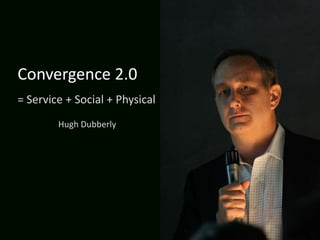
Convergence 2.0
= Service + Social + Physical
Hugh Dubberly
Hugh Dubberly
Dubberly Design Office (DDO) 創辦人

- 80s – 90s 蘋果電腦任職:負責cross-functional 小組,後期負責全
公司的創 意服務相關 (Knowledge Navigator)
- Director of Interface Design for Times Mirror
- Vice President of Design and managed groups responsible for the
design, engineering and production of Netscapes’s Web portal

http://www.design.cmu.edu/designthefuture/hugh_dubberly/
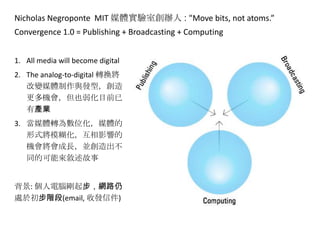
Nicholas Negroponte MIT 媒體實驗室創辦人 : "Move bits, not atoms.”
Convergence 1.0 = Publishing + Broadcasting + Computing
1. All media will become digital
2. The analog-to-digital 轉換將
改變媒體制作與發型,創造
更多機會,但也弱化目前已
有產業
3. 當媒體轉為數位化,媒體的
形式將模糊化,互相影響的
機會將會成長,並創造出不
同的可能來敘述故事

背景: 個人電腦剛起步,網路仍
處於初步階段(email, 收發信件)
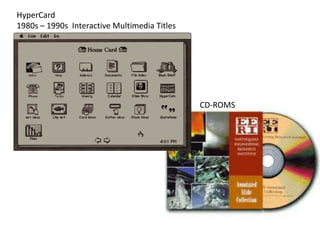
HyperCard
1980s – 1990s Interactive Multimedia Titles

CD-ROMS
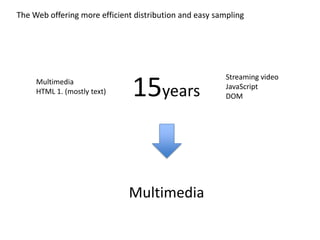
The Web offering more efficient distribution and easy sampling

Multimedia
HTML 1. (mostly text)

15years

Multimedia

Streaming video
JavaScript
DOM
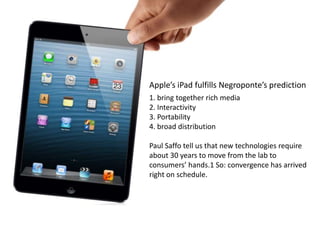
Apple’s iPad fulfills Negroponte’s prediction
1. bring together rich media
2. Interactivity
3. Portability
4. broad distribution
Paul Saffo tell us that new technologies require
about 30 years to move from the lab to
consumers’ hands.1 So: convergence has arrived
right on schedule.
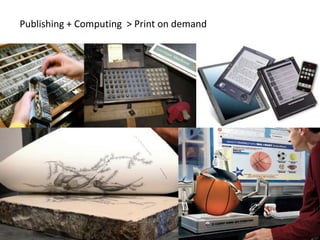
Publishing + Computing > Print on demand
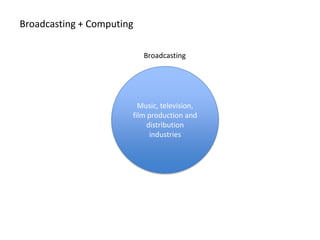
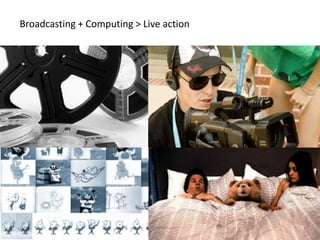
Broadcasting + Computing
Broadcasting

Music, television,
film production and
distribution
industries
Broadcasting + Computing > Live action
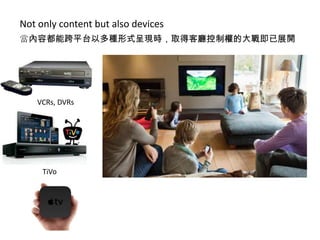
Not only content but also devices
當內容都能跨平台以多種形式呈現時,取得客廳控制權的大戰即已展開

VCRs, DVRs

TiVo
Apple dropped computer from its name
while turning itself into a consumer
electronics company.
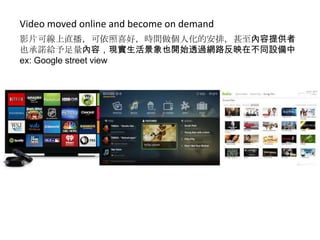
Video moved online and become on demand
影片可線上直播,可依照喜好,時間做個人化的安排,甚至內容提供者
也承諾給予足量內容,現實生活景象也開始透過網路反映在不同設備中
ex: Google street view
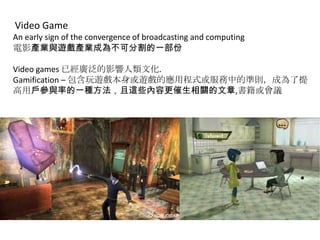
Video Game
An early sign of the convergence of broadcasting and computing
電影產業與遊戲產業成為不可分割的一部份
Video games 已經廣泛的影響人類文化.
Gamification – 包含玩遊戲本身或遊戲的應用程式或服務中的準則,成為了提
高用戶參與率的一種方法,且這些內容更催生相關的文章,書籍或會議
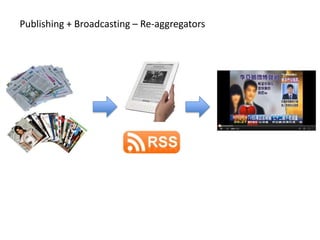
Publishing + Broadcasting – Re-aggregators
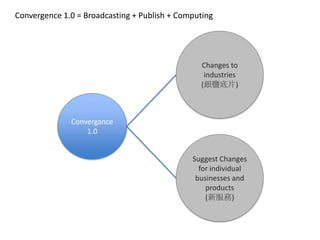
Convergence 1.0 = Broadcasting + Publish + Computing

Changes to
industries
(銀鹽底片)

Convergance
1.0
Suggest Changes
for individual
businesses and
products
(新服務)
Convergence 2.0
Andy Grove “All companies will be internet companies, or they will be dead.”
Tim Misner –
“All hardware products want to be web-sites.” Or that most human services will
become networked.
Tim O’Reilly observed –
“Virtually every application is a network application, relying on remote services to
perform its function.”
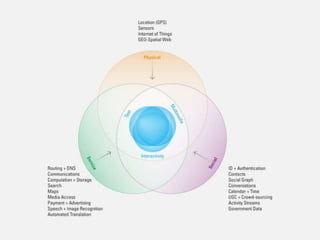
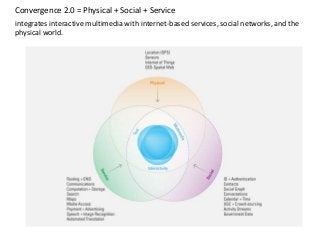
Convergence 2.0 = Physical + Social + Service
integrates interactive multimedia with internet-based services, social networks, and the
physical world.
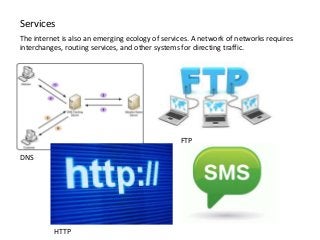
Services
The internet is also an emerging ecology of services. A network of networks requires
interchanges, routing services, and other systems for directing traffic.

FTP

DNS

HTTP
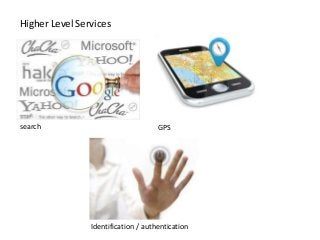
Higher Level Services

search

GPS

Identification / authentication
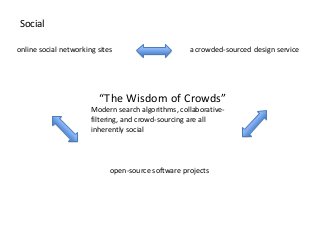
Social
online social networking sites

a crowded-sourced design service

“The Wisdom of Crowds”
Modern search algorithms, collaborativefiltering, and crowd-sourcing are all
inherently social

open-source software projects
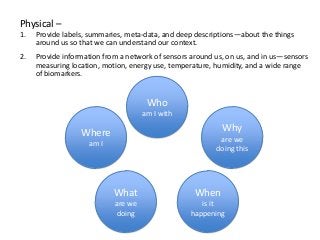
Physical –
1.

Provide labels, summaries, meta-data, and deep descriptions—about the things
around us so that we can understand our context.

2.

Provide information from a network of sensors around us, on us, and in us—sensors
measuring location, motion, energy use, temperature, humidity, and a wide range
of biomarkers.

Who
am I with

Why

Where

are we
doing this

am I

What

When

are we
doing

is it
happening
Designing with Convergence 2.0 In Mind
Books as digital text No more stacks of atoms means portability. (books + handheld
reader)
Books as multi-media Don’t just tell me; show me. (books + photos, videos,
animation, and sound)
Books as interactivity Tell me more or tell me less; let me try it myself. (books +
games, simulations, linking, and glosses—parallel texts)

Books as services Access on demand, integration with other systems. (books +
continuous updating, expert sources, etc, e.g. Lexis-Nexis)
Books as social nodes Conversation topics and learning from others. (books + online
social networks—shared interests, notes, highlights)
Books as places The reader device becomes a window on a virtual overlay of the
physical world providing details and explanations on demand. (books + objects

Convergence2 Hugh Dubberly 20131203

  • 1.
    Convergence 2.0 = Service+ Social + Physical Hugh Dubberly
  • 2.
    Hugh Dubberly Dubberly DesignOffice (DDO) 創辦人 - 80s – 90s 蘋果電腦任職:負責cross-functional 小組,後期負責全 公司的創 意服務相關 (Knowledge Navigator) - Director of Interface Design for Times Mirror - Vice President of Design and managed groups responsible for the design, engineering and production of Netscapes’s Web portal http://www.design.cmu.edu/designthefuture/hugh_dubberly/
  • 3.
    Nicholas Negroponte MIT媒體實驗室創辦人 : "Move bits, not atoms.” Convergence 1.0 = Publishing + Broadcasting + Computing 1. All media will become digital 2. The analog-to-digital 轉換將 改變媒體制作與發型,創造 更多機會,但也弱化目前已 有產業 3. 當媒體轉為數位化,媒體的 形式將模糊化,互相影響的 機會將會成長,並創造出不 同的可能來敘述故事 背景: 個人電腦剛起步,網路仍 處於初步階段(email, 收發信件)
  • 4.
    HyperCard 1980s – 1990sInteractive Multimedia Titles CD-ROMS
  • 5.
    The Web offeringmore efficient distribution and easy sampling Multimedia HTML 1. (mostly text) 15years Multimedia Streaming video JavaScript DOM
  • 6.
    Apple’s iPad fulfillsNegroponte’s prediction 1. bring together rich media 2. Interactivity 3. Portability 4. broad distribution Paul Saffo tell us that new technologies require about 30 years to move from the lab to consumers’ hands.1 So: convergence has arrived right on schedule.
  • 7.
    Publishing + Computing> Print on demand
  • 8.
    Broadcasting + Computing Broadcasting Music,television, film production and distribution industries
  • 9.
  • 10.
    Not only contentbut also devices 當內容都能跨平台以多種形式呈現時,取得客廳控制權的大戰即已展開 VCRs, DVRs TiVo
  • 11.
    Apple dropped computerfrom its name while turning itself into a consumer electronics company.
  • 12.
    Video moved onlineand become on demand 影片可線上直播,可依照喜好,時間做個人化的安排,甚至內容提供者 也承諾給予足量內容,現實生活景象也開始透過網路反映在不同設備中 ex: Google street view
  • 13.
    Video Game An earlysign of the convergence of broadcasting and computing 電影產業與遊戲產業成為不可分割的一部份 Video games 已經廣泛的影響人類文化. Gamification – 包含玩遊戲本身或遊戲的應用程式或服務中的準則,成為了提 高用戶參與率的一種方法,且這些內容更催生相關的文章,書籍或會議
  • 14.
    Publishing + Broadcasting– Re-aggregators
  • 15.
    Convergence 1.0 =Broadcasting + Publish + Computing Changes to industries (銀鹽底片) Convergance 1.0 Suggest Changes for individual businesses and products (新服務)
  • 16.
  • 17.
    Andy Grove “Allcompanies will be internet companies, or they will be dead.” Tim Misner – “All hardware products want to be web-sites.” Or that most human services will become networked. Tim O’Reilly observed – “Virtually every application is a network application, relying on remote services to perform its function.”
  • 18.
    Convergence 2.0 =Physical + Social + Service integrates interactive multimedia with internet-based services, social networks, and the physical world.
  • 19.
    Services The internet isalso an emerging ecology of services. A network of networks requires interchanges, routing services, and other systems for directing traffic. FTP DNS HTTP
  • 20.
  • 21.
    Social online social networkingsites a crowded-sourced design service “The Wisdom of Crowds” Modern search algorithms, collaborativefiltering, and crowd-sourcing are all inherently social open-source software projects
  • 22.
    Physical – 1. Provide labels,summaries, meta-data, and deep descriptions—about the things around us so that we can understand our context. 2. Provide information from a network of sensors around us, on us, and in us—sensors measuring location, motion, energy use, temperature, humidity, and a wide range of biomarkers. Who am I with Why Where are we doing this am I What When are we doing is it happening
  • 23.
    Designing with Convergence2.0 In Mind Books as digital text No more stacks of atoms means portability. (books + handheld reader) Books as multi-media Don’t just tell me; show me. (books + photos, videos, animation, and sound) Books as interactivity Tell me more or tell me less; let me try it myself. (books + games, simulations, linking, and glosses—parallel texts) Books as services Access on demand, integration with other systems. (books + continuous updating, expert sources, etc, e.g. Lexis-Nexis) Books as social nodes Conversation topics and learning from others. (books + online social networks—shared interests, notes, highlights) Books as places The reader device becomes a window on a virtual overlay of the physical world providing details and explanations on demand. (books + objects