Blogs, Pods and Web 2.0 Ray Schroeder University of Illinois at Springfield Veronica Halloway Illinois Department of Public Health
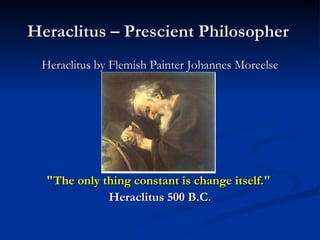
Heraclitus – Prescient Philosopher  Heraclitus by Flemish Painter Johannes Moreelse "The only thing constant is change itself."   Heraclitus 500 B.C.
Objectives Examine emergence of Web 2.0  Contemplate the challenge of when to move to the next generation Consider some key 2.0 technologies Look at the syndication thread that ties these technologies together Gaze into the future  Continuing discussion/collaboration
Web 2.0 What is the next BIG (or little) thing? Web 2.0 certainly is the context of what is coming! It is NOT static – not the web page of the ’90s It is a platform that is: Dynamic Interactive Engaging Syndicated Origin of Web 2.0 ?
Web 2.0 Web 2.0 –  So, what are some examples? If you want to find out what 2.0 means for example in education, you have to turn to a Web 2.0 technology – a Wiki! http://cpitwebtwoinfo.pbwiki.com/   In common: Dynamic, Interactive, Engaging, Syndicated and constantly changing!
When Do We Move to the Next Generation (both personal/state)? Driving forces Innovators and early adopters Both state agencies and individuals  Financial Considerations Open Source Competition – what our peers are doing Mitigating factors Knowledge  Licensing commitments Transition woes (the reluctant, hosting, support, training)
Blogs Blogs first emerged in 1997 A blog created every second Comment modes enable interaction The “Blogosphere” is an incredible network with massive worldwide reach
Blogs – Create your own! Blogger.com – owned by Google Most popular software – FREE! Here’s how to get started: http://blogger.com   Choose title Choose design Create  Configure Share
Ray’s Blogs Techo -News  – begun in 2000 Developed as a tool to share current research with students in graduate seminar Selected current readings for required critiques Ed Tech  – begun at request of state board of ed Online Learning Update Turned into something more Reach and Impact Reflections  – not just text
iPods and Podcasting iPods  First iPod released Oct 23, 2001 – latest (?) generation is the fifth generation http://www.ipodreview.co.uk/#1   http://www.md3d.com/  (6 th  generation mock-up by md3d) Podcasting = i POD  + broad CASTING (using blogs) iTunes version 4.9 and more recent aggregates the podcasts (using RSS) and auto-transfers them to iPod http:// audioblogger.com   415-856-0205
RSS “ Really Simple Syndication”  RSS 2.0 Xml format  – concisely describes a site  Enables a variety of tools to access and manipulate the feed iTunes, Sharp Reader, Yahoo, Firefox … all offer RSS aggregation  Have already seen dynamic web sites The thread that links many Web 2.0 apps
Where to from Here? We have dynamic, interactive, syndicated, engaging applications and sites Next steps commonly come from convergence Ubiquitous – WiMax? xMax?  BPL ?  Gigabeam ?  Motorola and Nokia announce cell/ wifi  phones Integration of devices  Phone/PDA/iPod/Computer all in one Microsoft/Samsung Origami  $1,099 OQO tablet  $2,000 Projection Keyboards   $199
Our Crystal Ball This second half of the first decade  Access, access, access – broadband via seamless mix Mobility – via merged devices Computers shrink into enhanced cell phones Open source rules – 3 rd  party support rises Distance learning becomes norm not exception Key will be to look beyond the newest deployments to those in the pipeline – begin looking  two  steps ahead
Contact We must all hang together, or assuredly we shall all hang separately. – BF Ray Schroeder http://people.uis.edu/rschr1/onlinelearning/blogger.html   [email_address] 217-206-7531 Veronica Halloway [email_address] http://onlinelearningupdate.com/iamg06.ppt
 

Iamg06

  • 1.
    Blogs, Pods andWeb 2.0 Ray Schroeder University of Illinois at Springfield Veronica Halloway Illinois Department of Public Health
  • 2.
    Heraclitus – PrescientPhilosopher Heraclitus by Flemish Painter Johannes Moreelse "The only thing constant is change itself." Heraclitus 500 B.C.
  • 3.
    Objectives Examine emergenceof Web 2.0 Contemplate the challenge of when to move to the next generation Consider some key 2.0 technologies Look at the syndication thread that ties these technologies together Gaze into the future Continuing discussion/collaboration
  • 4.
    Web 2.0 Whatis the next BIG (or little) thing? Web 2.0 certainly is the context of what is coming! It is NOT static – not the web page of the ’90s It is a platform that is: Dynamic Interactive Engaging Syndicated Origin of Web 2.0 ?
  • 5.
    Web 2.0 Web2.0 – So, what are some examples? If you want to find out what 2.0 means for example in education, you have to turn to a Web 2.0 technology – a Wiki! http://cpitwebtwoinfo.pbwiki.com/ In common: Dynamic, Interactive, Engaging, Syndicated and constantly changing!
  • 6.
    When Do WeMove to the Next Generation (both personal/state)? Driving forces Innovators and early adopters Both state agencies and individuals Financial Considerations Open Source Competition – what our peers are doing Mitigating factors Knowledge Licensing commitments Transition woes (the reluctant, hosting, support, training)
  • 7.
    Blogs Blogs firstemerged in 1997 A blog created every second Comment modes enable interaction The “Blogosphere” is an incredible network with massive worldwide reach
  • 8.
    Blogs – Createyour own! Blogger.com – owned by Google Most popular software – FREE! Here’s how to get started: http://blogger.com Choose title Choose design Create Configure Share
  • 9.
    Ray’s Blogs Techo-News – begun in 2000 Developed as a tool to share current research with students in graduate seminar Selected current readings for required critiques Ed Tech – begun at request of state board of ed Online Learning Update Turned into something more Reach and Impact Reflections – not just text
  • 10.
    iPods and PodcastingiPods First iPod released Oct 23, 2001 – latest (?) generation is the fifth generation http://www.ipodreview.co.uk/#1 http://www.md3d.com/ (6 th generation mock-up by md3d) Podcasting = i POD + broad CASTING (using blogs) iTunes version 4.9 and more recent aggregates the podcasts (using RSS) and auto-transfers them to iPod http:// audioblogger.com 415-856-0205
  • 11.
    RSS “ ReallySimple Syndication” RSS 2.0 Xml format – concisely describes a site Enables a variety of tools to access and manipulate the feed iTunes, Sharp Reader, Yahoo, Firefox … all offer RSS aggregation Have already seen dynamic web sites The thread that links many Web 2.0 apps
  • 12.
    Where to fromHere? We have dynamic, interactive, syndicated, engaging applications and sites Next steps commonly come from convergence Ubiquitous – WiMax? xMax? BPL ? Gigabeam ? Motorola and Nokia announce cell/ wifi phones Integration of devices Phone/PDA/iPod/Computer all in one Microsoft/Samsung Origami $1,099 OQO tablet $2,000 Projection Keyboards $199
  • 13.
    Our Crystal BallThis second half of the first decade Access, access, access – broadband via seamless mix Mobility – via merged devices Computers shrink into enhanced cell phones Open source rules – 3 rd party support rises Distance learning becomes norm not exception Key will be to look beyond the newest deployments to those in the pipeline – begin looking two steps ahead
  • 14.
    Contact We mustall hang together, or assuredly we shall all hang separately. – BF Ray Schroeder http://people.uis.edu/rschr1/onlinelearning/blogger.html [email_address] 217-206-7531 Veronica Halloway [email_address] http://onlinelearningupdate.com/iamg06.ppt
  • 15.