Talking with
Things
ECHELON MALAYSIA - 2017, PENANG, APR 13
What's Hot in Low-
Power Long-Range
IoT Connectivity
Disclaimer
English is not my mother tongue.
bear with me
What’s the heck an Indonesian
doing here in Penang :) ?
Well… I might have some stories/experiences to share with you
Internet of Things
Connectivity
First coined in 2009 by Kevin Ashton, RFID
pioneer and cofounder of the Auto-ID Center at
the Massachusetts Institute of Technology (MIT)
Internet of Things
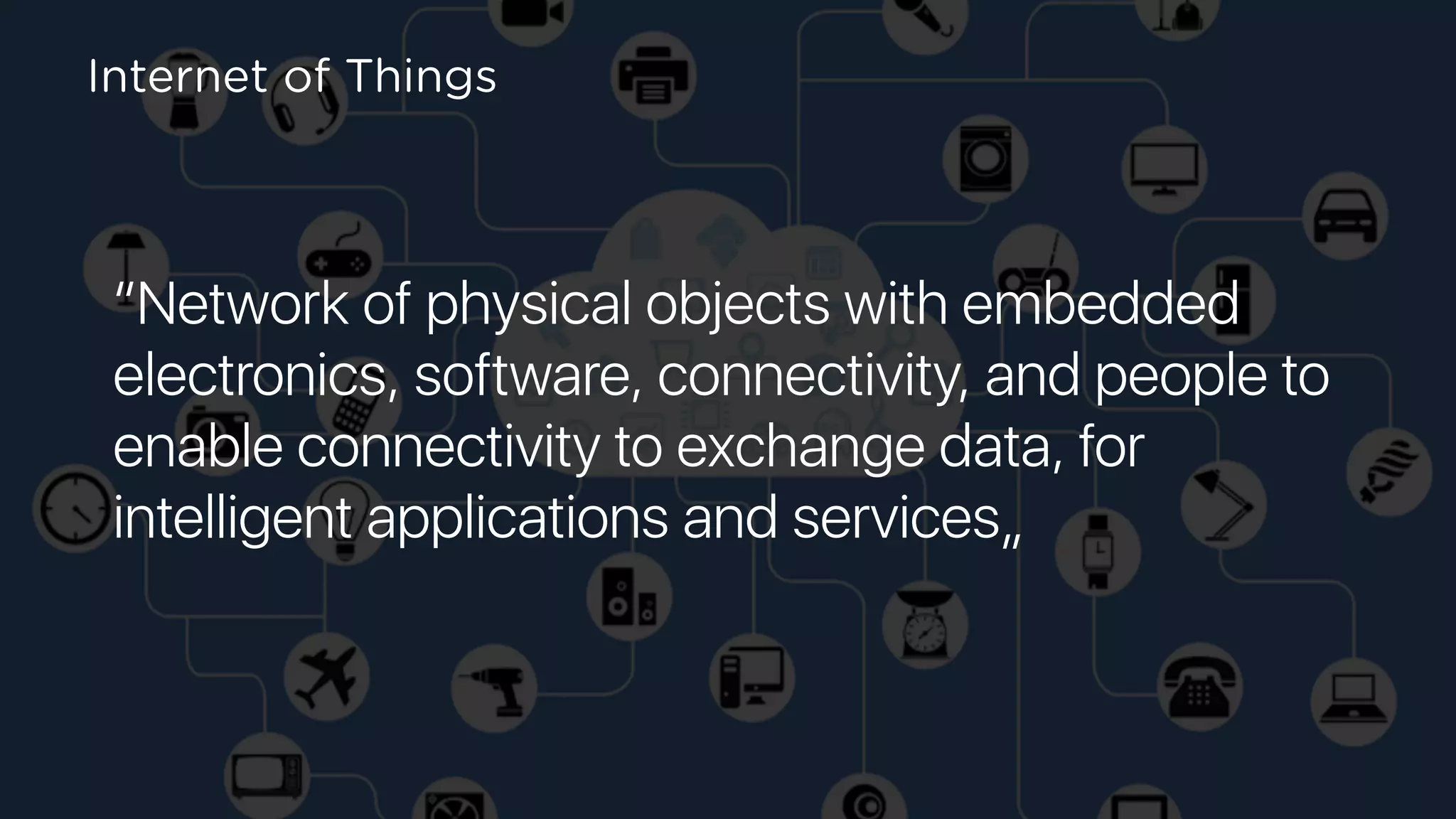
“Network of physical objects with embedded
electronics, software, connectivity, and people to
enable connectivity to exchange data, for
intelligent applications and services„
Internet of Things
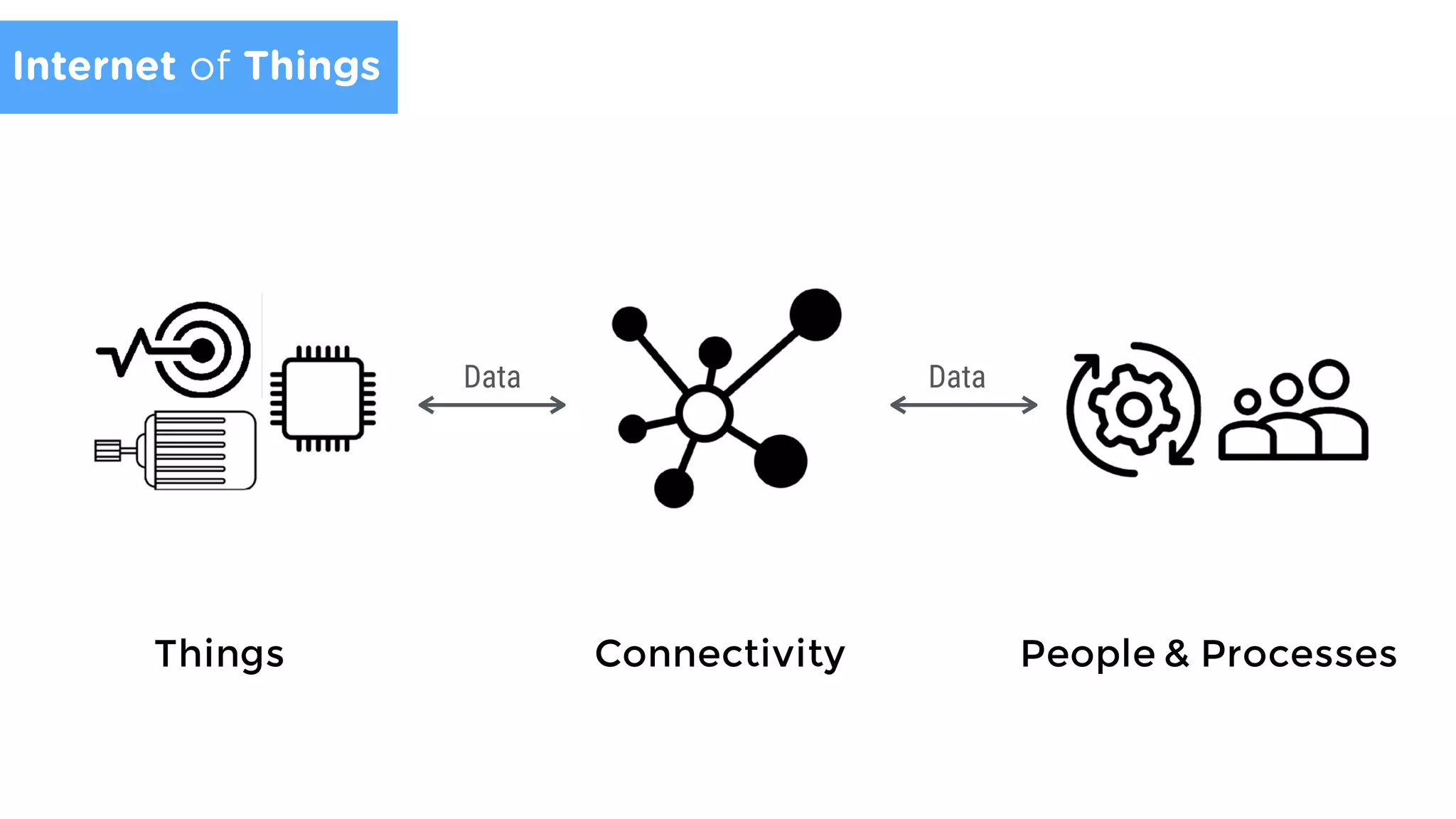
Things Connectivity People & Processes
Data Data
Internet of Things
A bit of story in 2003
around IoT connectivity
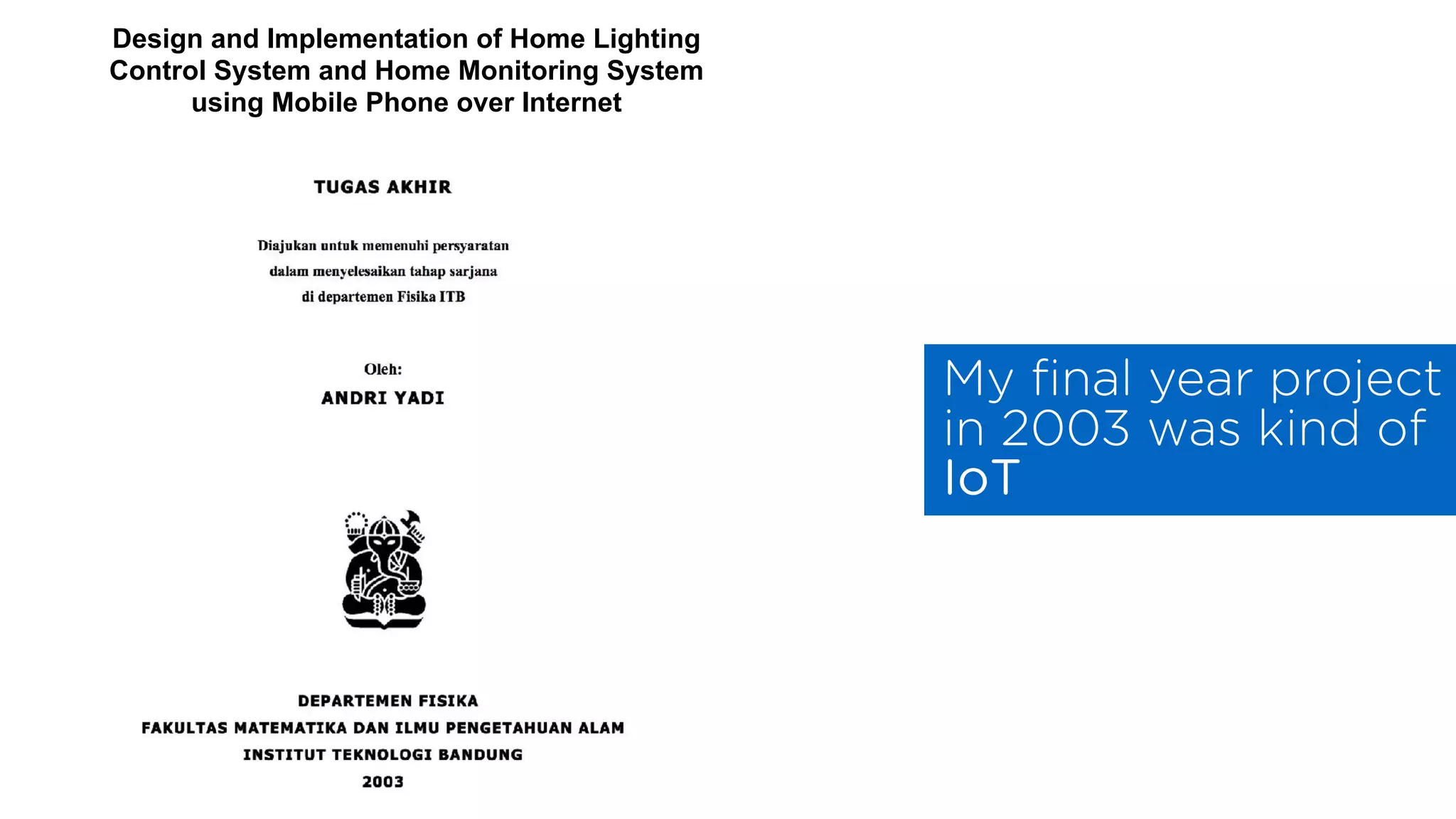
My final year project
in 2003 was kind of
IoT
Design and Implementation of Home Lighting
Control System and Home Monitoring System
using Mobile Phone over Internet
Circa 2003, original archive
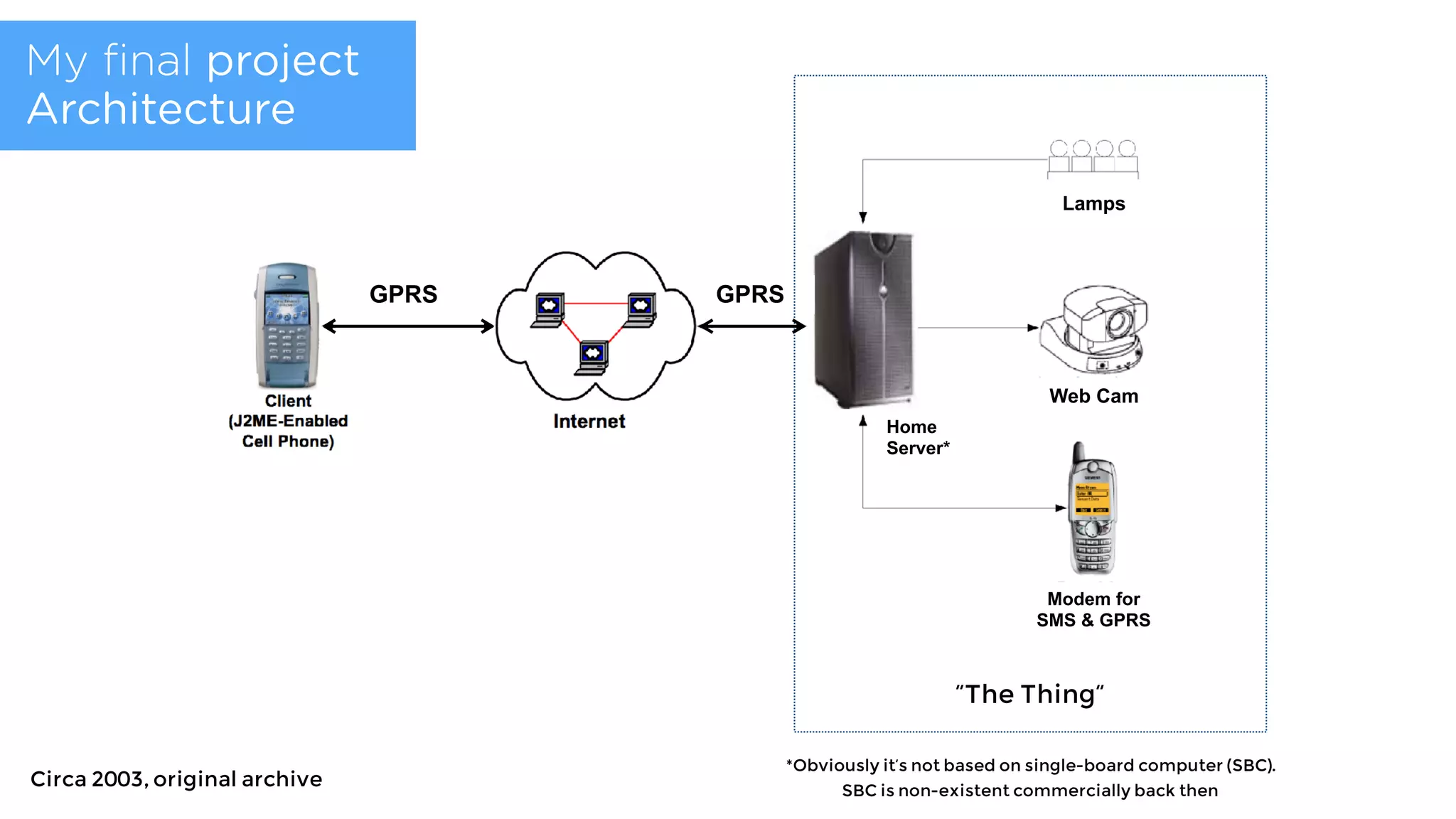
Lamps
Web Cam
Modem for
SMS & GPRS
Home
Server*
GPRS GPRS
My final project
Architecture
“The Thing”
*Obviously it’s not based on single-board computer (SBC).
SBC is non-existent commercially back then
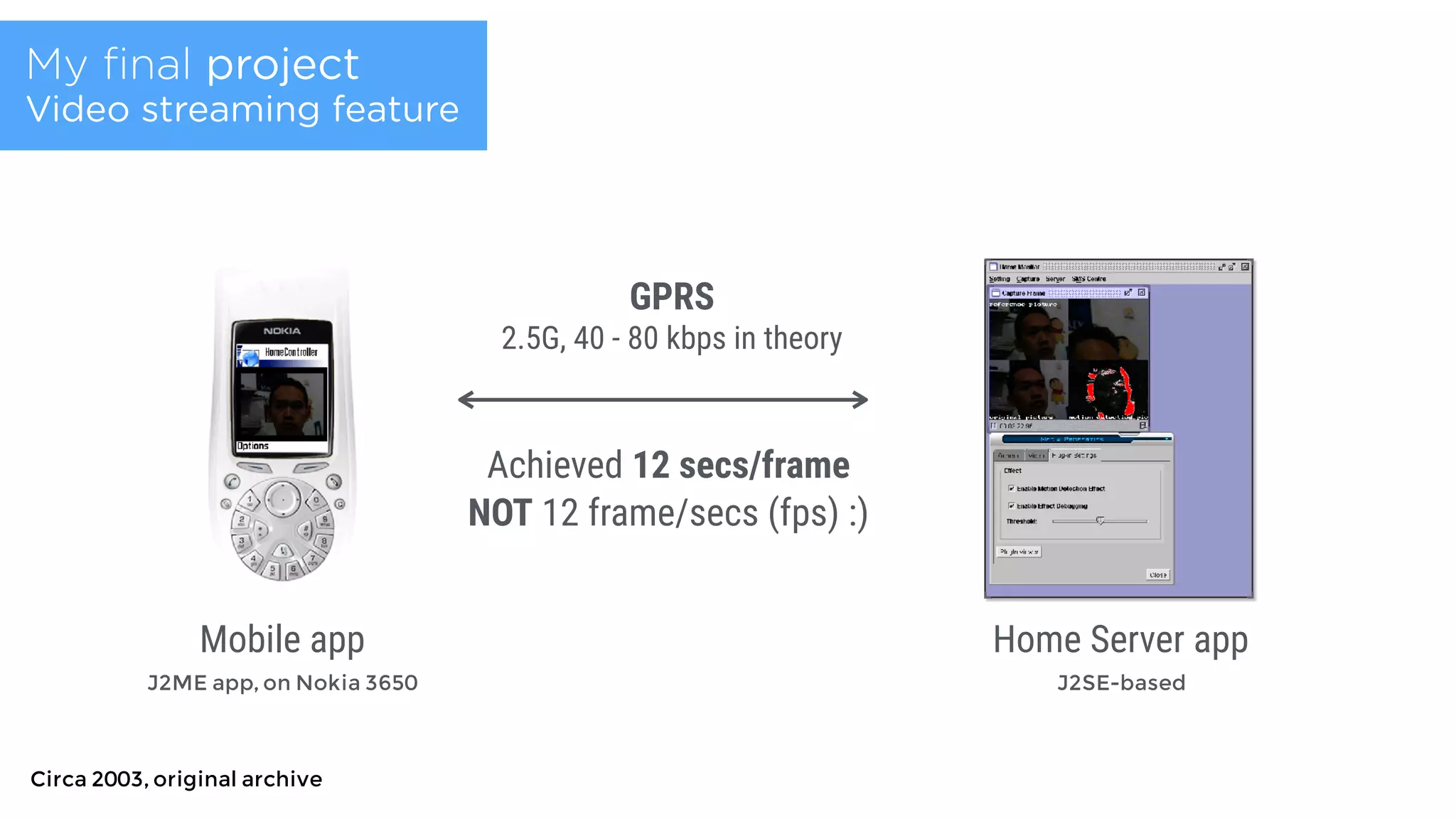
GPRS
2.5G, 40 - 80 kbps in theory
Mobile app Home Server app
Achieved 12 secs/frame
NOT 12 frame/secs (fps) :)
My final project
Video streaming feature
Circa 2003, original archive
J2ME app, on Nokia 3650 J2SE-based
That’s what I had in 2003
for wide area IoT connectivity
CONNECTIVITY
is one of the biggest challenges to
creating a true IoT
…yet, it always fascinates me!
Fast forward to now
oh hi…
Before continuing…
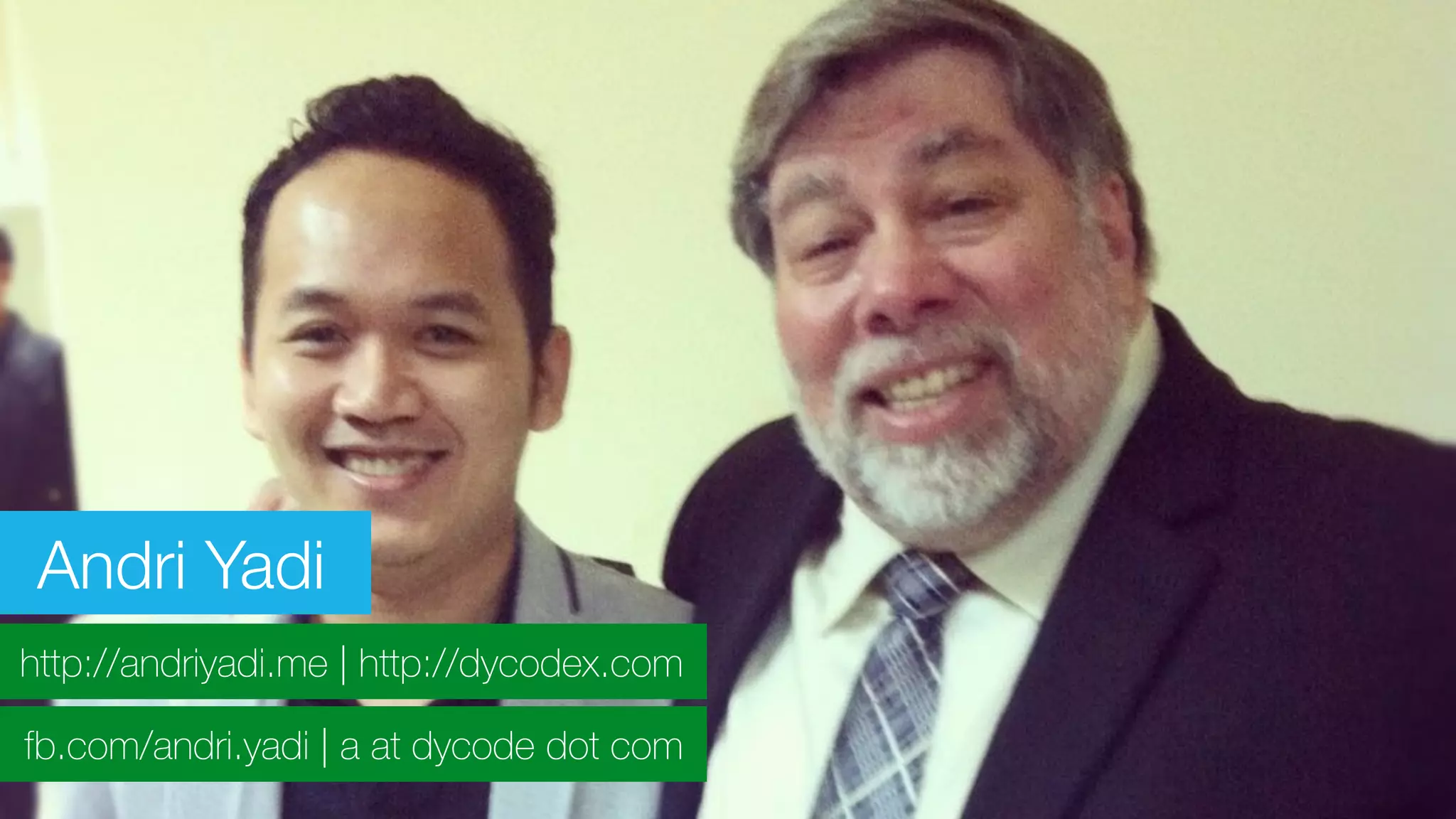
Andri Yadi
fb.com/andri.yadi | a at dycode dot com
http://andriyadi.me | http://dycodex.com
makestro.comCEO
ambassador
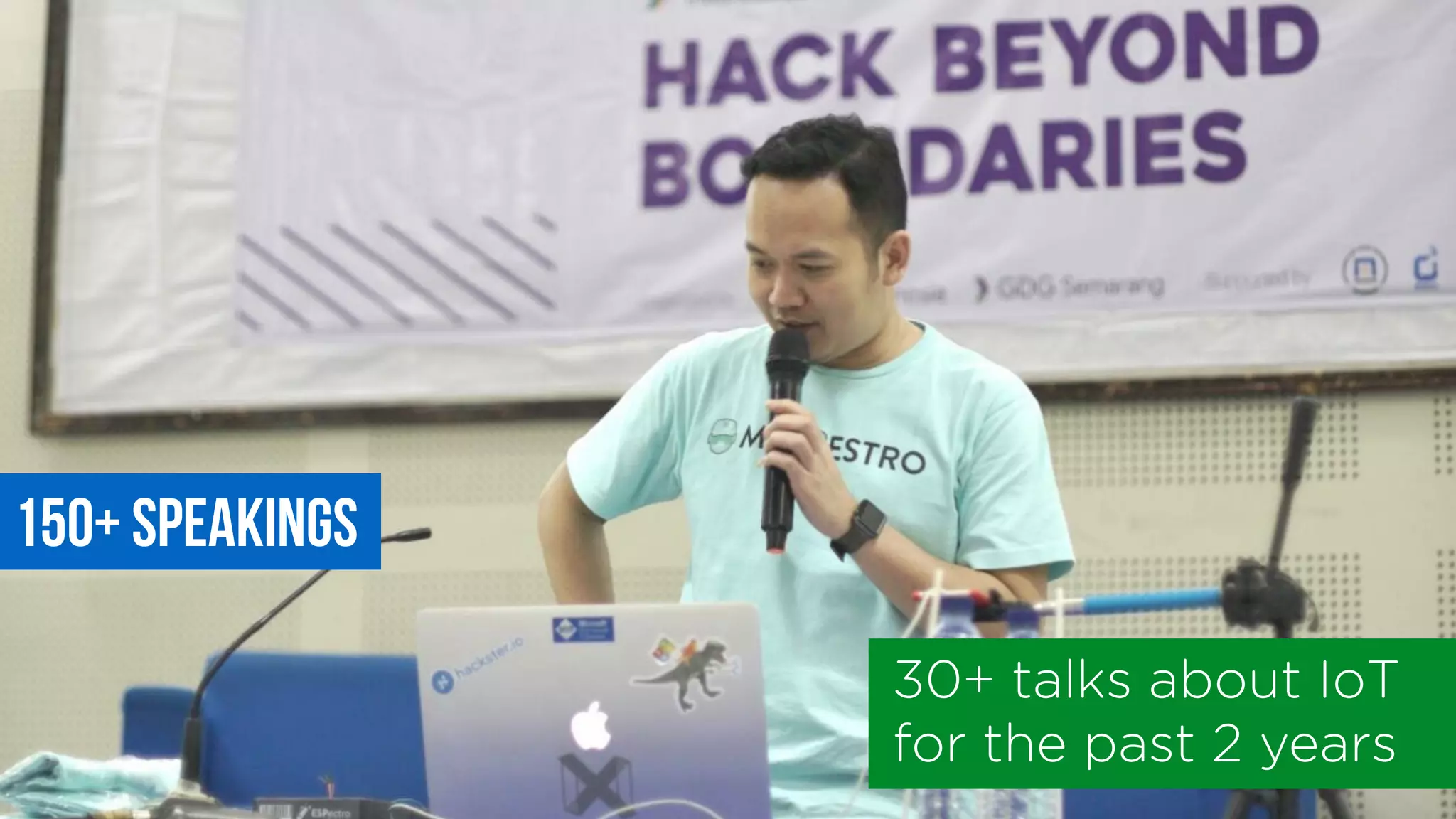
150+ Speakings
30+ talks about IoT
for the past 2 years
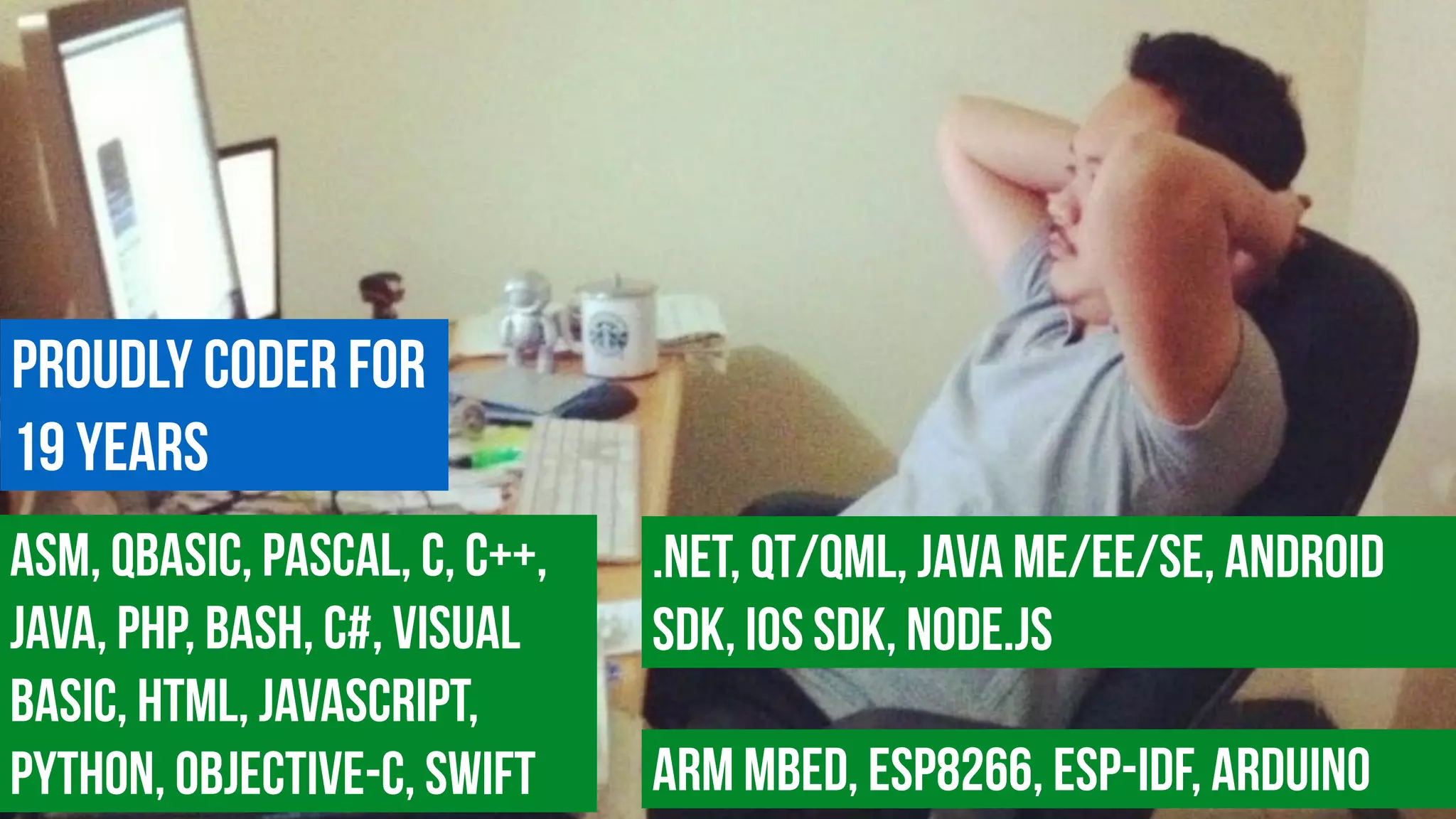
Proudly coder for 

19 years
ASM, QBasic, Pascal, c, C++,
Java, PHP, Bash, C#, Visual
Basic, HTML, JavaScript,
Python, Objective-C, Swift
.NET, Qt/QML, Java ME/EE/SE, Android
SDK, iOS SDK, Node.js
ARM MBED, ESP8266, ESP-IDF, Arduino
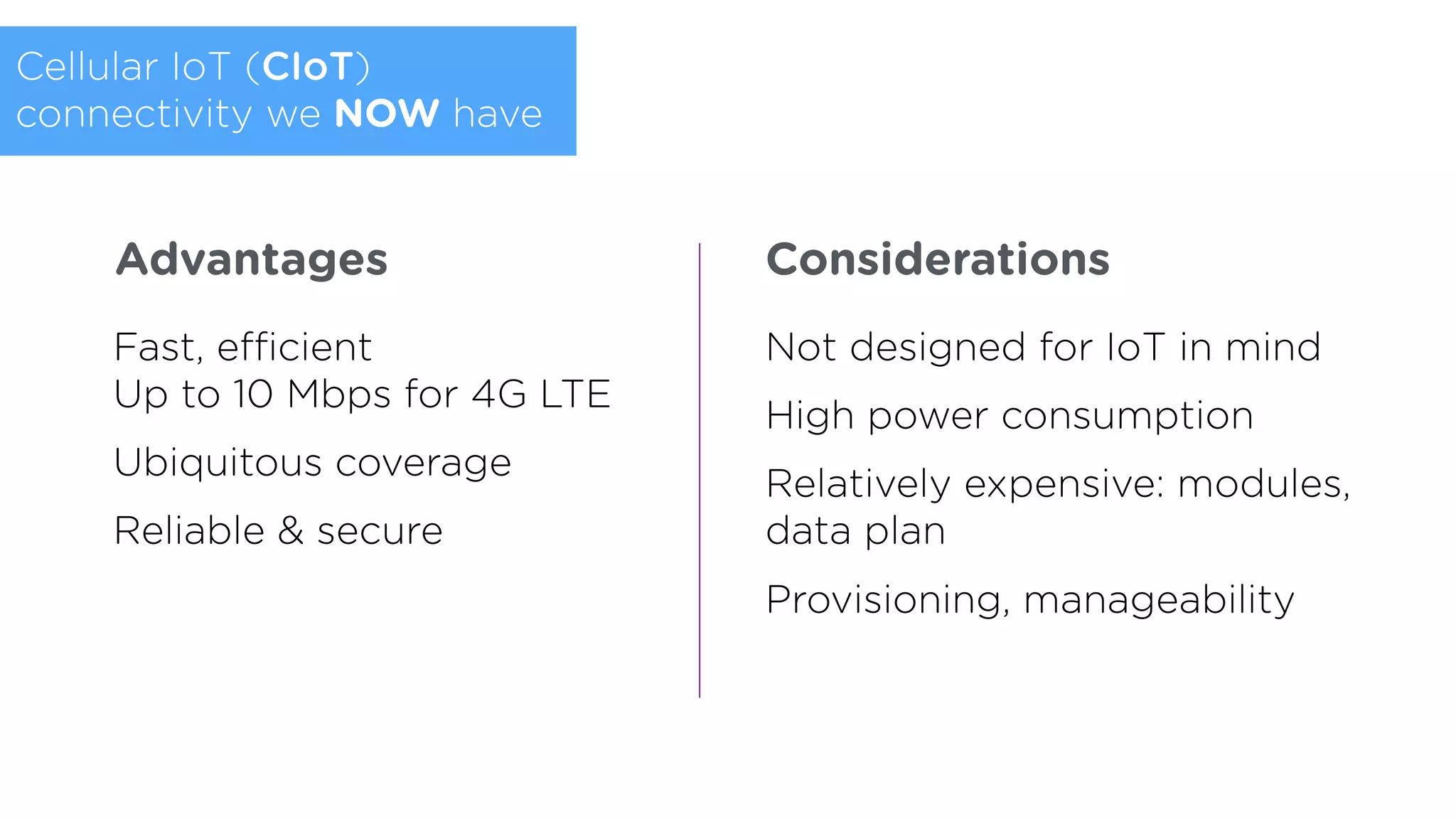
Cellular IoT (CIoT)
connectivity we NOW have
Fast, efficient 

Up to 10 Mbps for 4G LTE
Ubiquitous coverage
Reliable & secure
Not designed for IoT in mind
High power consumption
Relatively expensive: modules,
data plan
Provisioning, manageability
Advantages Considerations
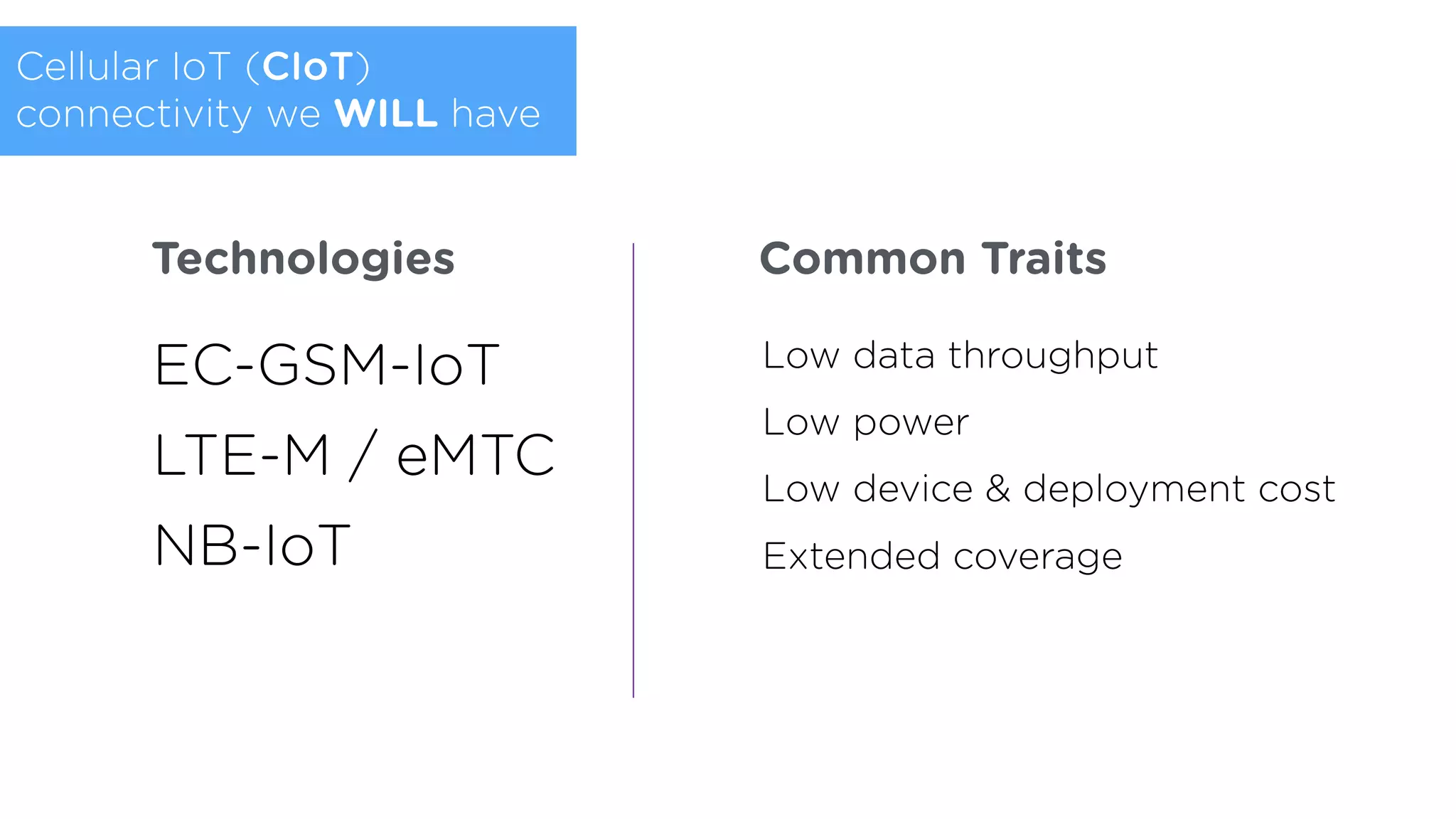
Cellular IoT (CIoT)
connectivity we WILL have
EC-GSM-IoT
LTE-M / eMTC
NB-IoT
Low data throughput
Low power
Low device & deployment cost
Extended coverage
Technologies Common Traits
3
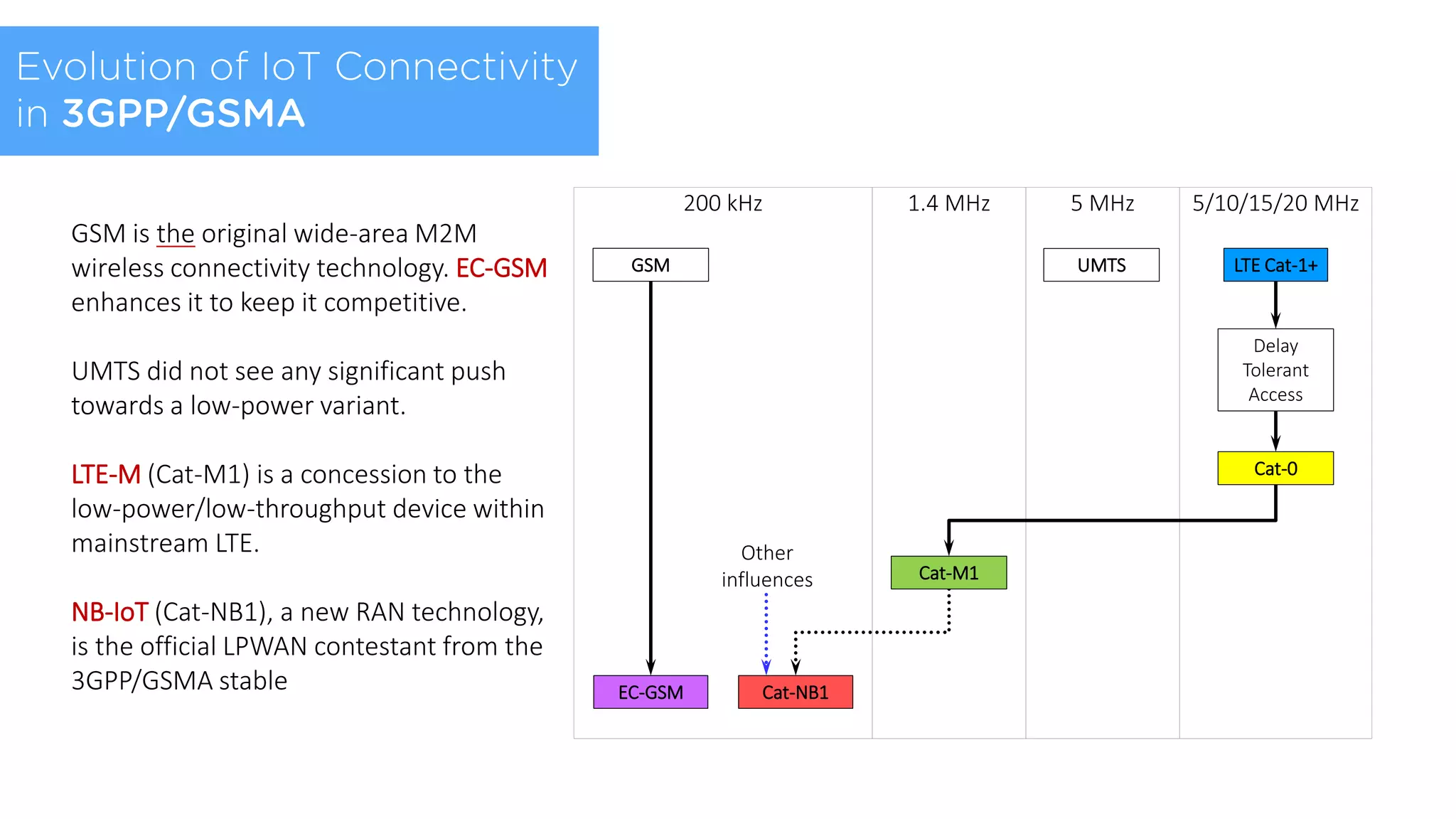
Evolution of IoT Connectivity in 3GPP/GSMA
5 MHz200 kHz 1.4 MHz 5/10/15/20 MHz
Other
influences
GSM LTE Cat-1+
Delay
Tolerant
Access
Cat-0
Cat-M1
Cat-NB1EC-GSM
UMTS
GSM is the original wide-area M2M
wireless connectivity technology. EC-GSM
enhances it to keep it competitive.
UMTS did not see any significant push
towards a low-power variant.
LTE-M (Cat-M1) is a concession to the
low-power/low-throughput device within
mainstream LTE.
NB-IoT (Cat-NB1), a new RAN technology,
is the official LPWAN contestant from the
3GPP/GSMA stable
Evolution of IoT Connectivity
in 3GPP/GSMA
LPWA
Competing technologies
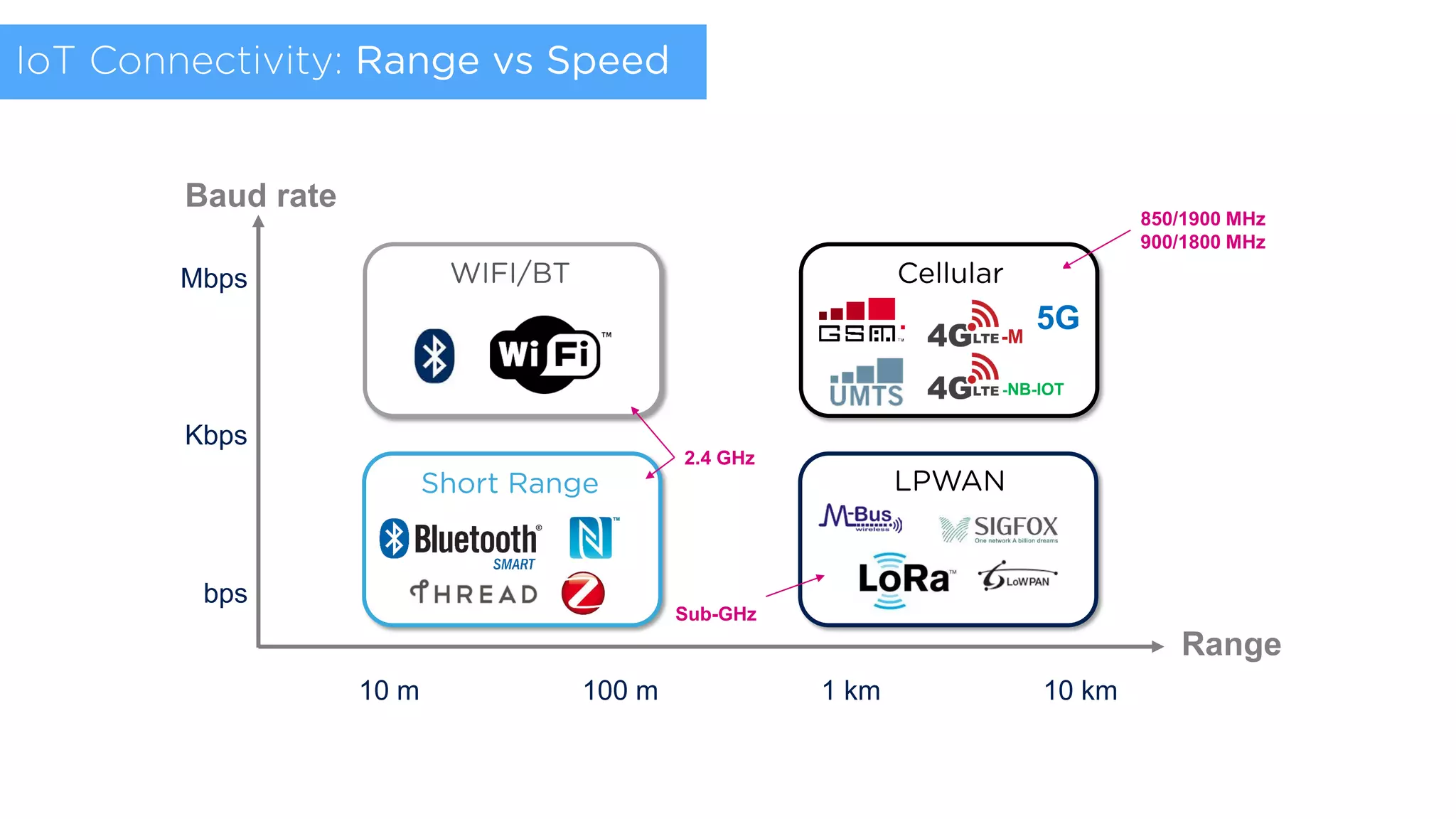
Communication Technologies - Overview
Mbps
Kbps
bps
10 m 100 m 1 km 10 km
Baud rate
Range
Wi-Fi / BT
Short Range LPWAN
ST Confidential
Cellular
-M
-NB-IOT
5G
850/1900 MHz
900/1800 MHz
Sub-GHz
2.4 GHz
WIFI/BT
Short Range LPWAN
Cellular
IoT Connectivity: Range vs Speed
tend to be less complex than mesh networks as
the endpoints can be connected directly to a
gateway or base station, rather than relying on a
relay system to transmit messages.
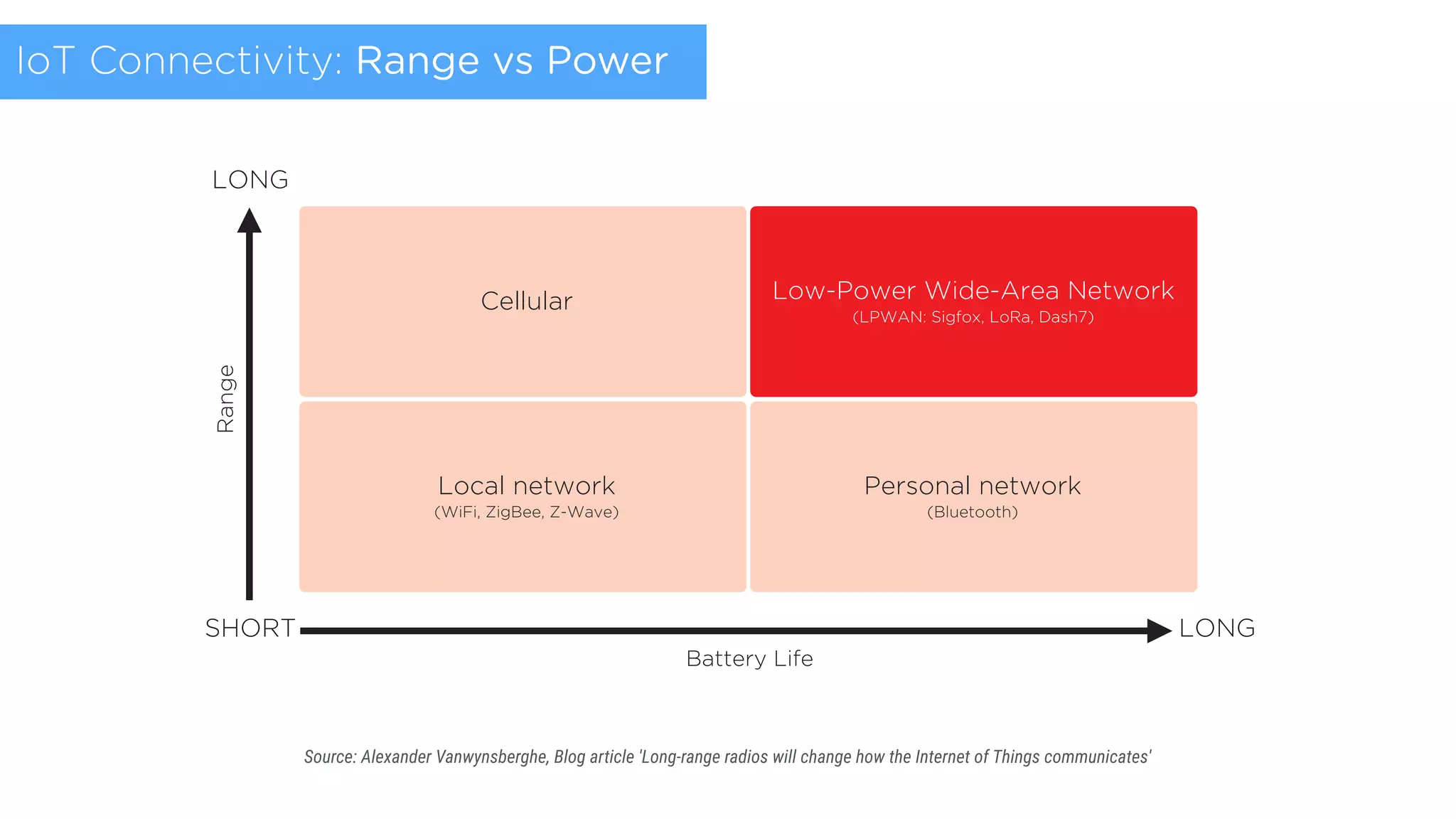
cellular technologies and WiFi tend to offer high
throughput rates, while new low power wide area
(LPWA) technologies and Bluetooth are low
energy technologies (see graphic).
Low power wide area options Proprietary LPWA technologies in
Cellular
Range
Battery Life
LONG
SHORT LONG
Local network
(WiFi, ZigBee, Z-Wave)
Personal network
(Bluetooth)
Low-Power Wide-Area Network
(LPWAN: Sigfox, LoRa, Dash7)
Source: Alexander Vanwynsberghe, Blog article 'Long-range radios will change how the Internet of Things communicates'
IoT Connectivity: Range vs Power
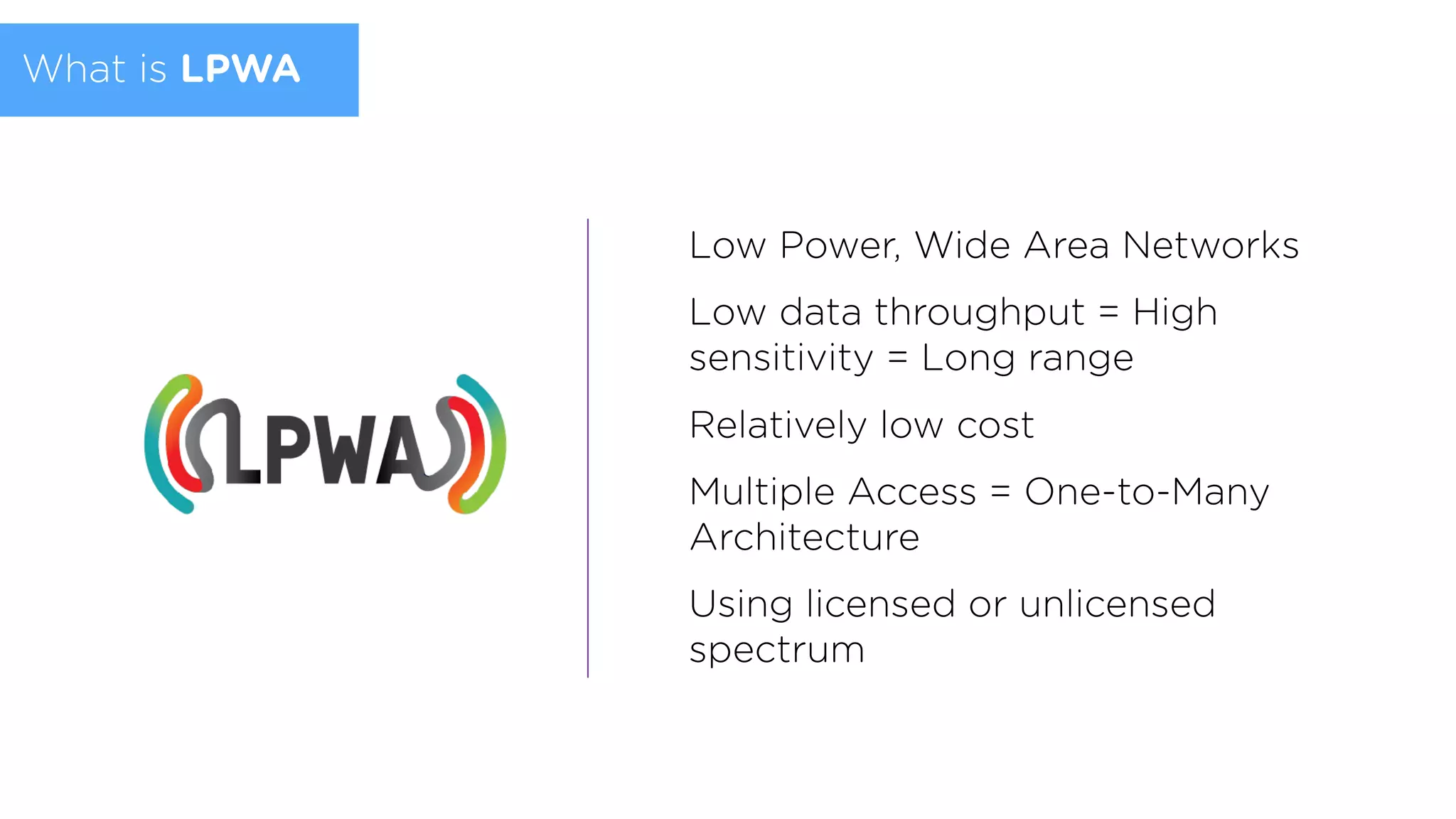
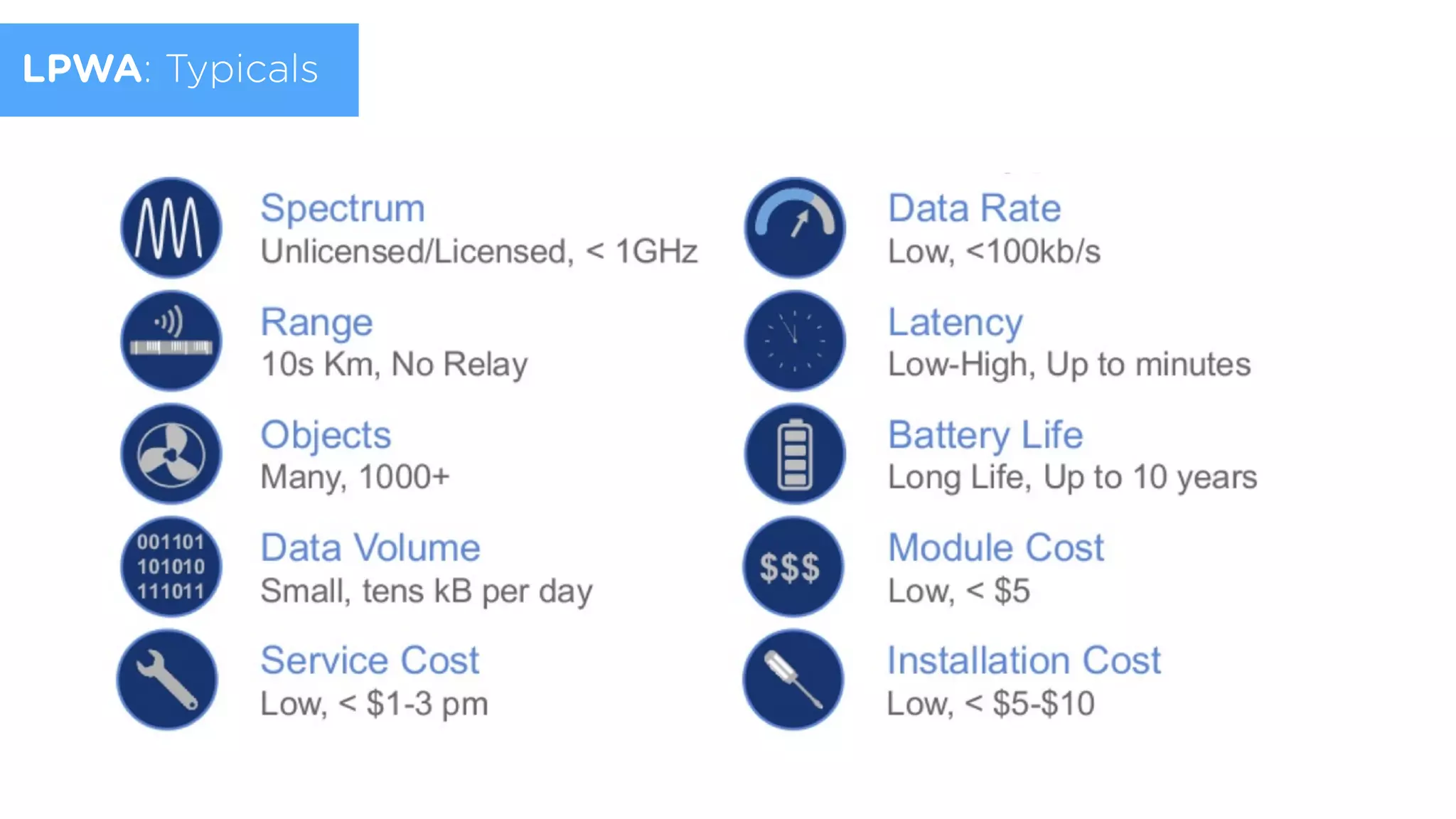
What is LPWA
Low Power, Wide Area Networks
Low data throughput = High
sensitivity = Long range
Relatively low cost
Multiple Access = One-to-Many
Architecture
Using licensed or unlicensed
spectrum
LPWA: Typicals
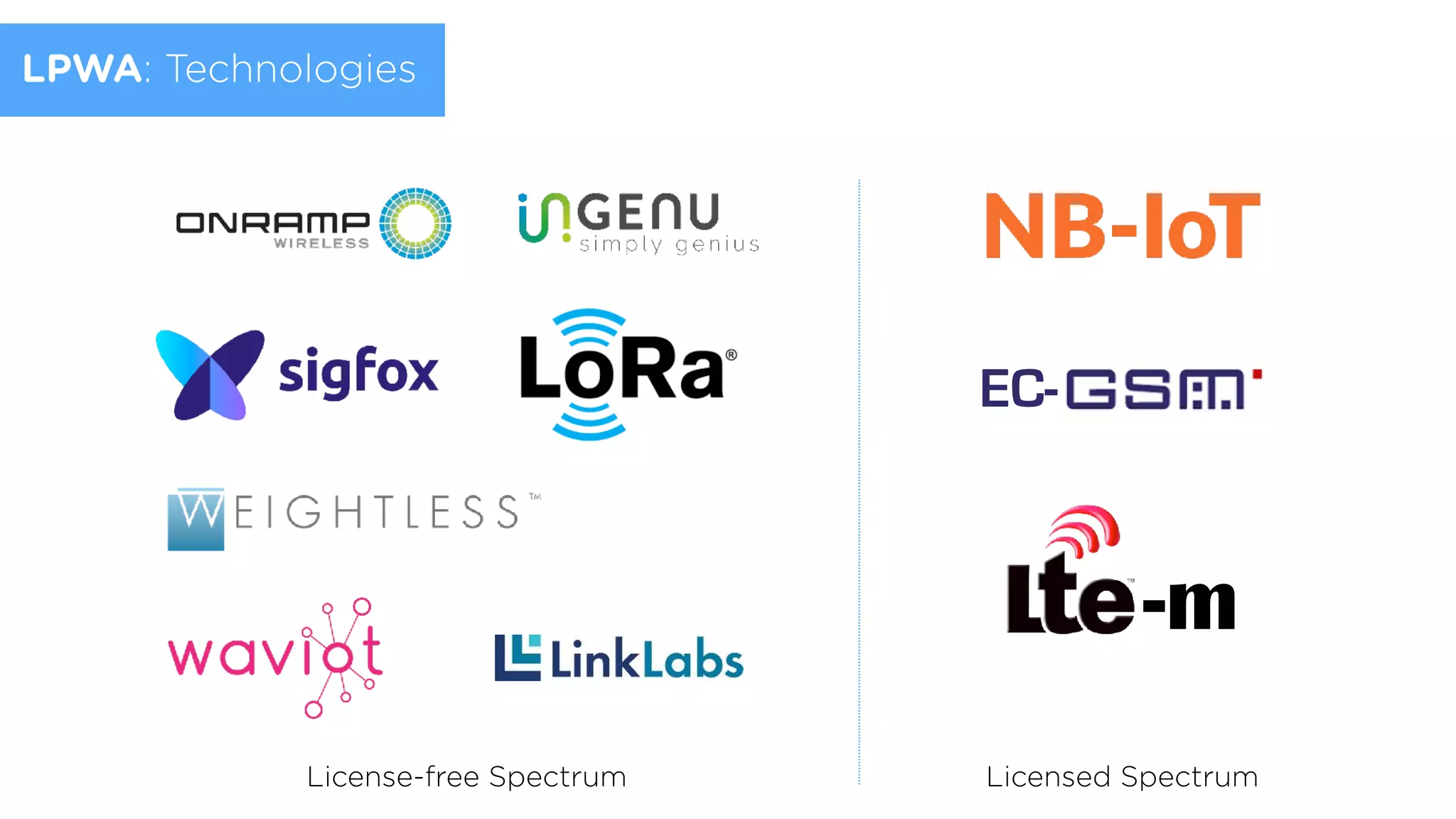
License-free Spectrum
EC-
-m
Licensed Spectrum
LPWA: Technologies
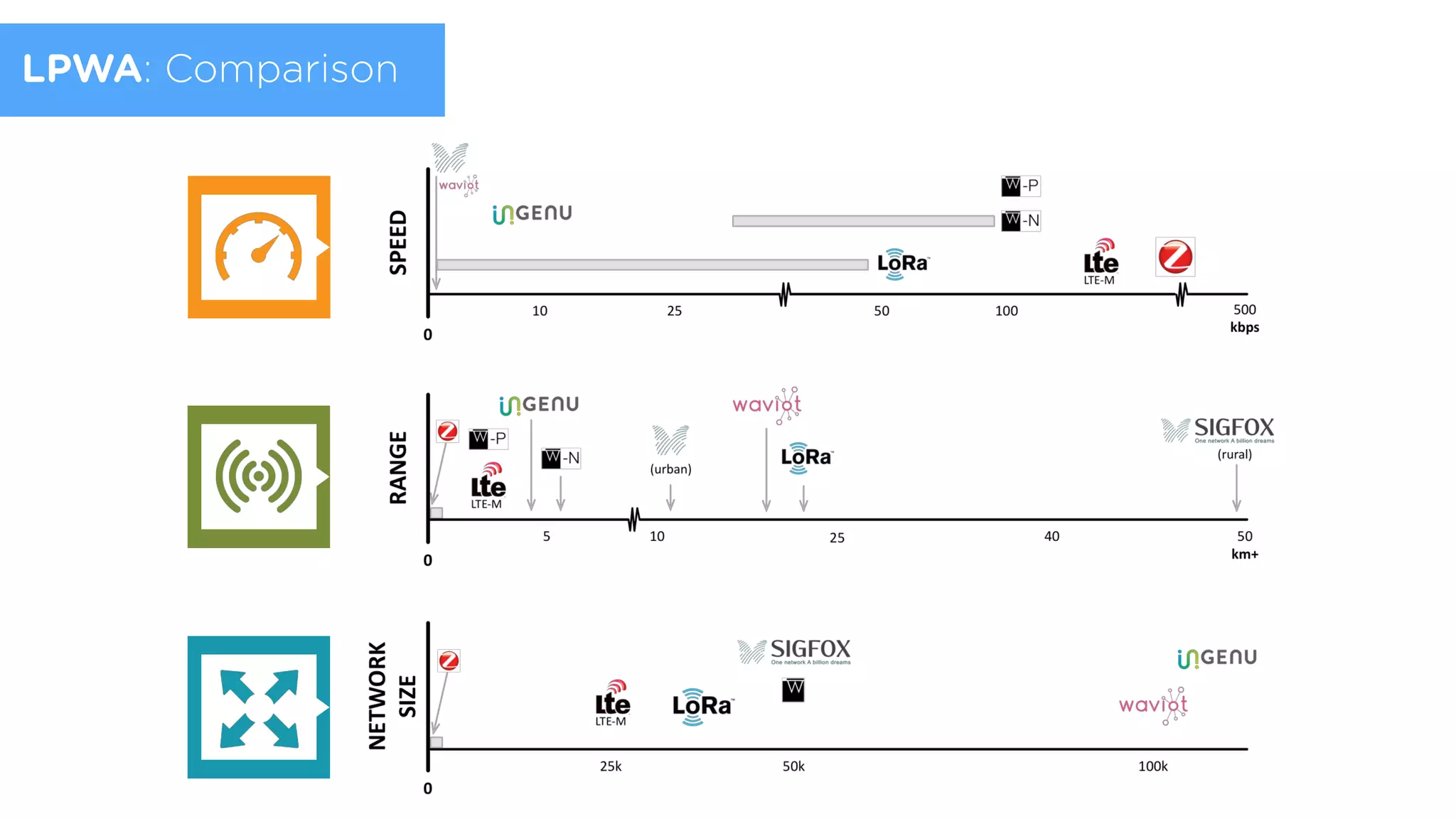
LPWAN - ComparisonsLPWA: Comparison
Disclaimer
Obviously, I can not go deep into each
technologies
30 minutes won’t be enough
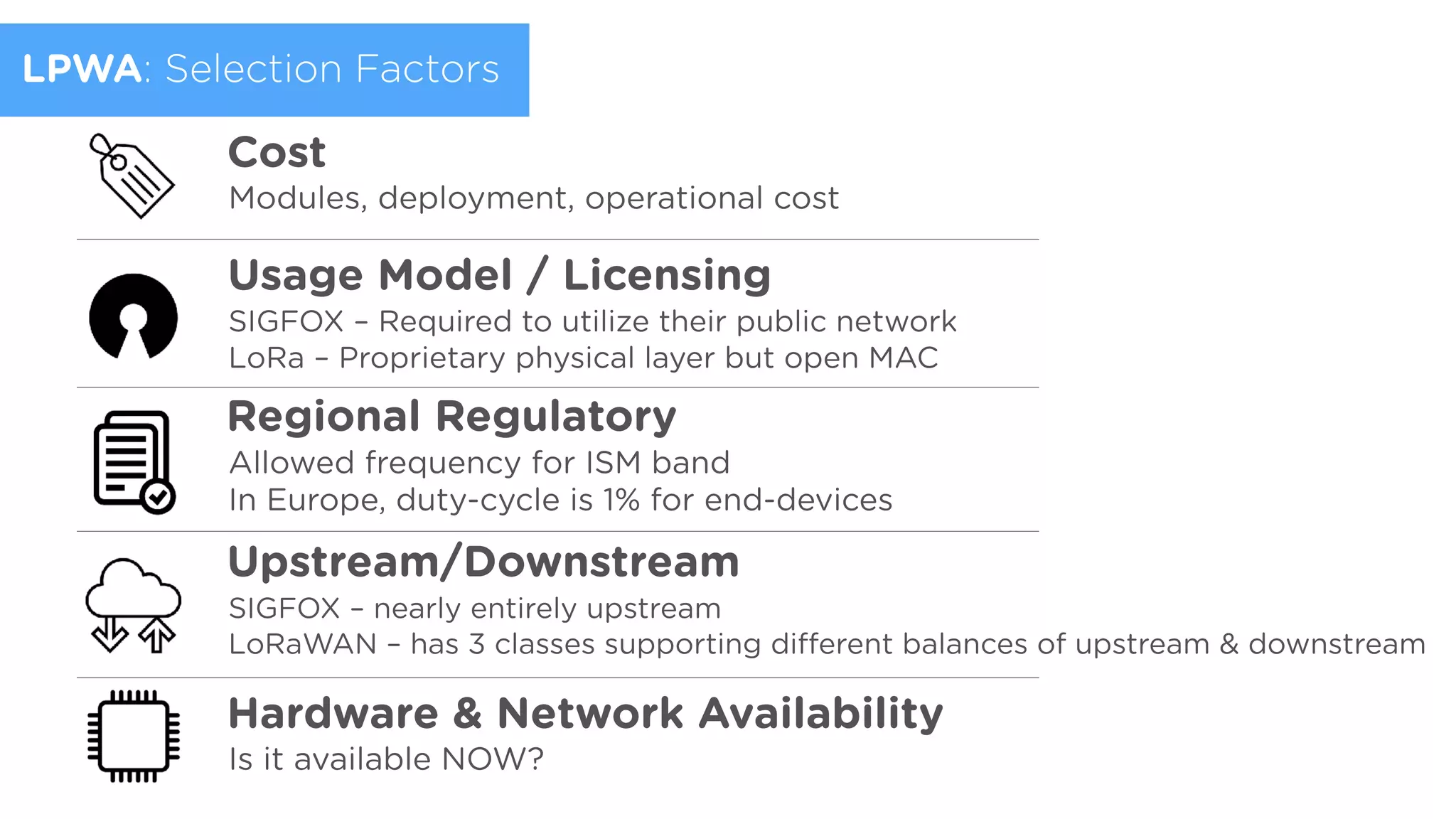
Cost
Modules, deployment, operational cost
Usage Model / Licensing
SIGFOX – Required to utilize their public network 
LoRa – Proprietary physical layer but open MAC
Regional Regulatory
Allowed frequency for ISM band

In Europe, duty-cycle is 1% for end-devices
Upstream/Downstream
SIGFOX – nearly entirely upstream 

LoRaWAN – has 3 classes supporting different balances of upstream & downstream
Hardware & Network Availability
Is it available NOW?
LPWA: Selection Factors
LoRa?
For that… we’ll focus on…
Not this woman :)
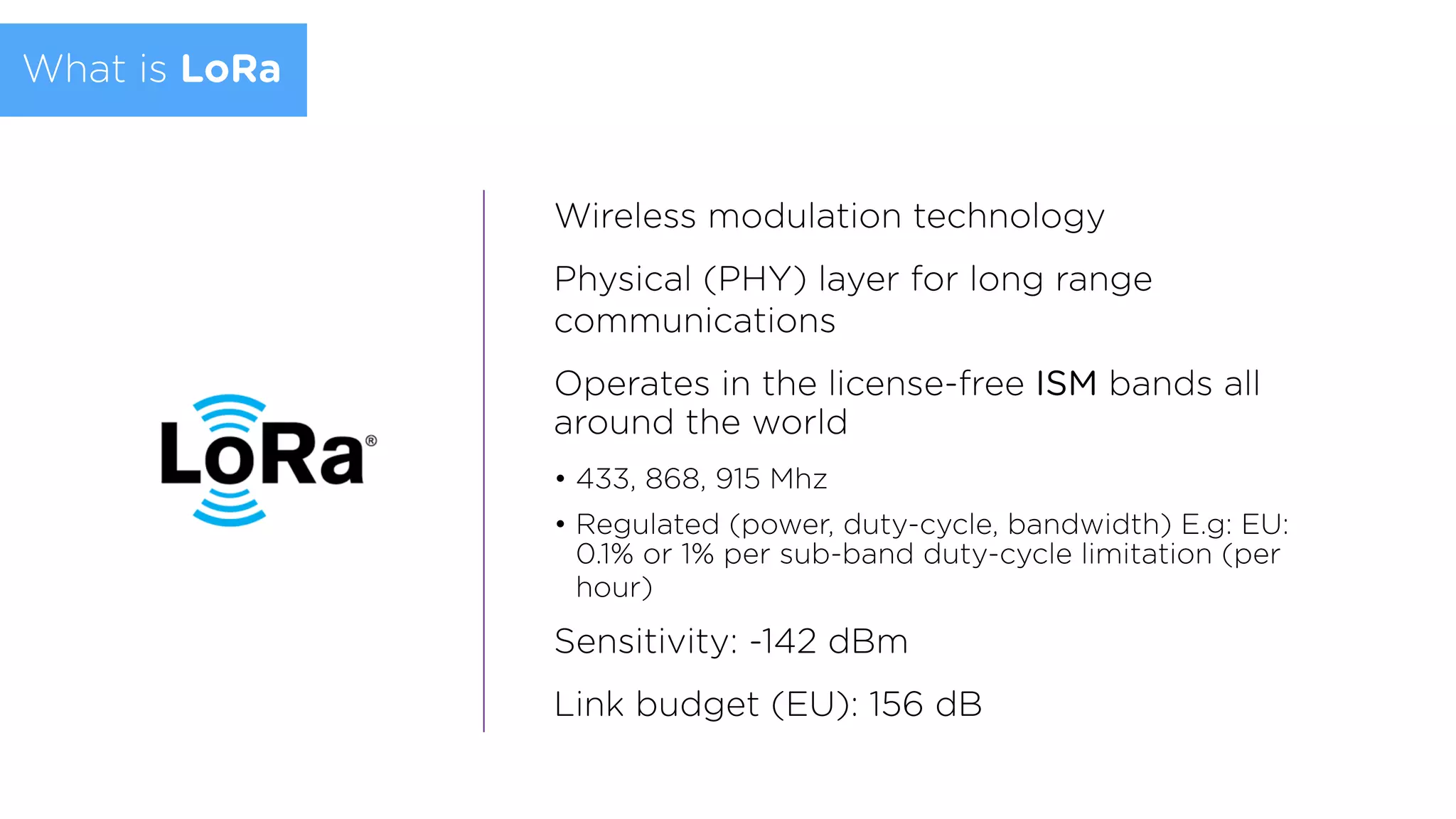
Wireless modulation technology
Physical (PHY) layer for long range
communications
Operates in the license-free ISM bands all
around the world
• 433, 868, 915 Mhz
• Regulated (power, duty-cycle, bandwidth) E.g: EU:
0.1% or 1% per sub-band duty-cycle limitation (per
hour)
Sensitivity: -142 dBm
Link budget (EU): 156 dB
What is LoRa
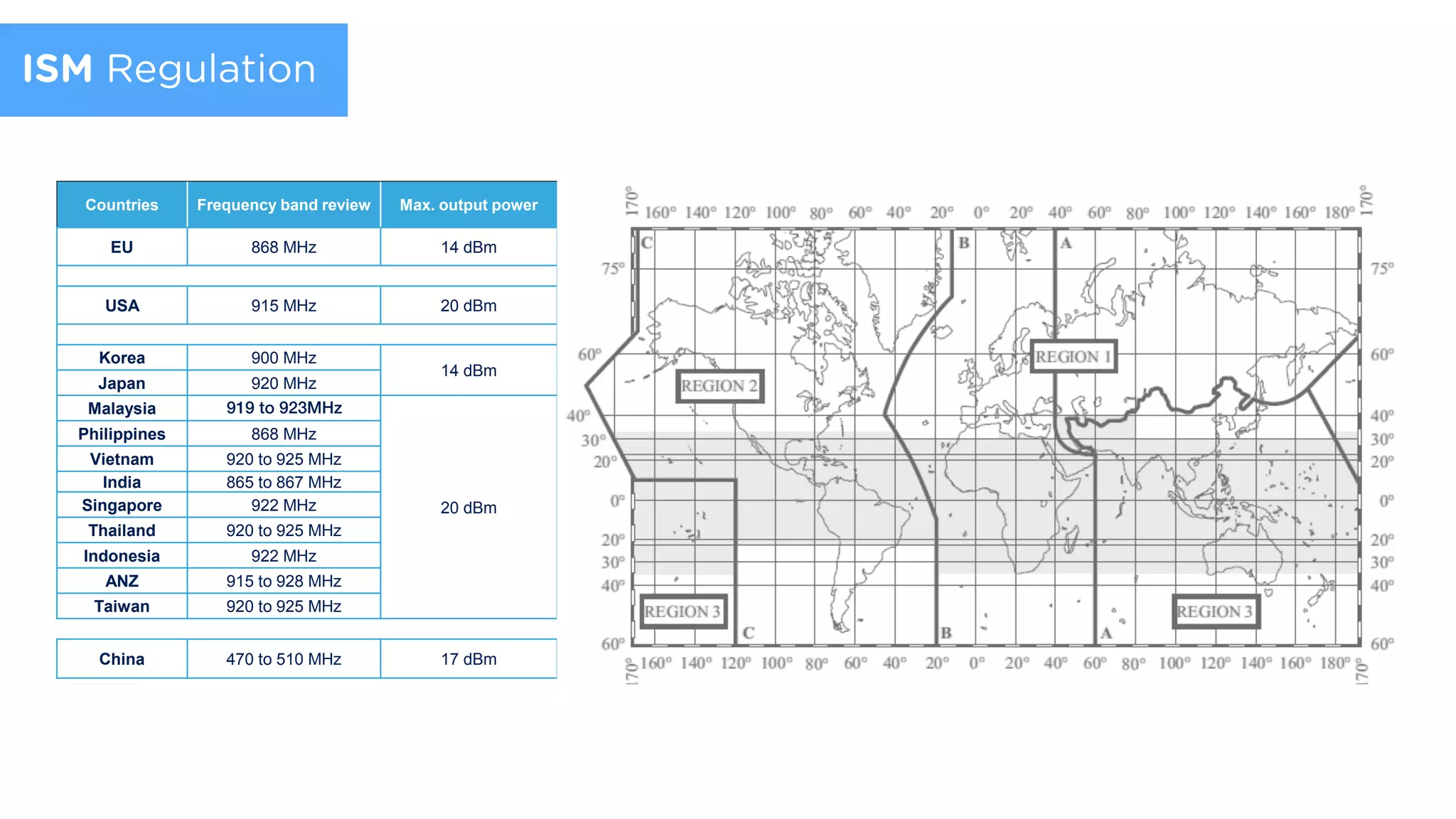
ISM Regulation ISM worldwide regulation 7
Output Power vs Duty Cycle
Countries Frequency band review Max. output power
EU 868 MHz 14 dBm
USA 915 MHz 20 dBm
Korea 900 MHz
14 dBm
Japan 920 MHz
Malaysia 862 to 875 MHz
20 dBm
Philippines 868 MHz
Vietnam 920 to 925 MHz
India 865 to 867 MHz
Singapore 922 MHz
Thailand 920 to 925 MHz
Indonesia 922 MHz
ANZ 915 to 928 MHz
Taiwan 920 to 925 MHz
China 470 to 510 MHz 17 dBm
919 to 923MHz
Communications protocol & architecture
utilizing the LoRa physical layer
Data rates are from 300bps to 5.5kbps 

Has 2 high-speed channels at 11kbps and 50kbps
(using FSK modulation)
It supports
• secure bi-directional communication,
• mobility
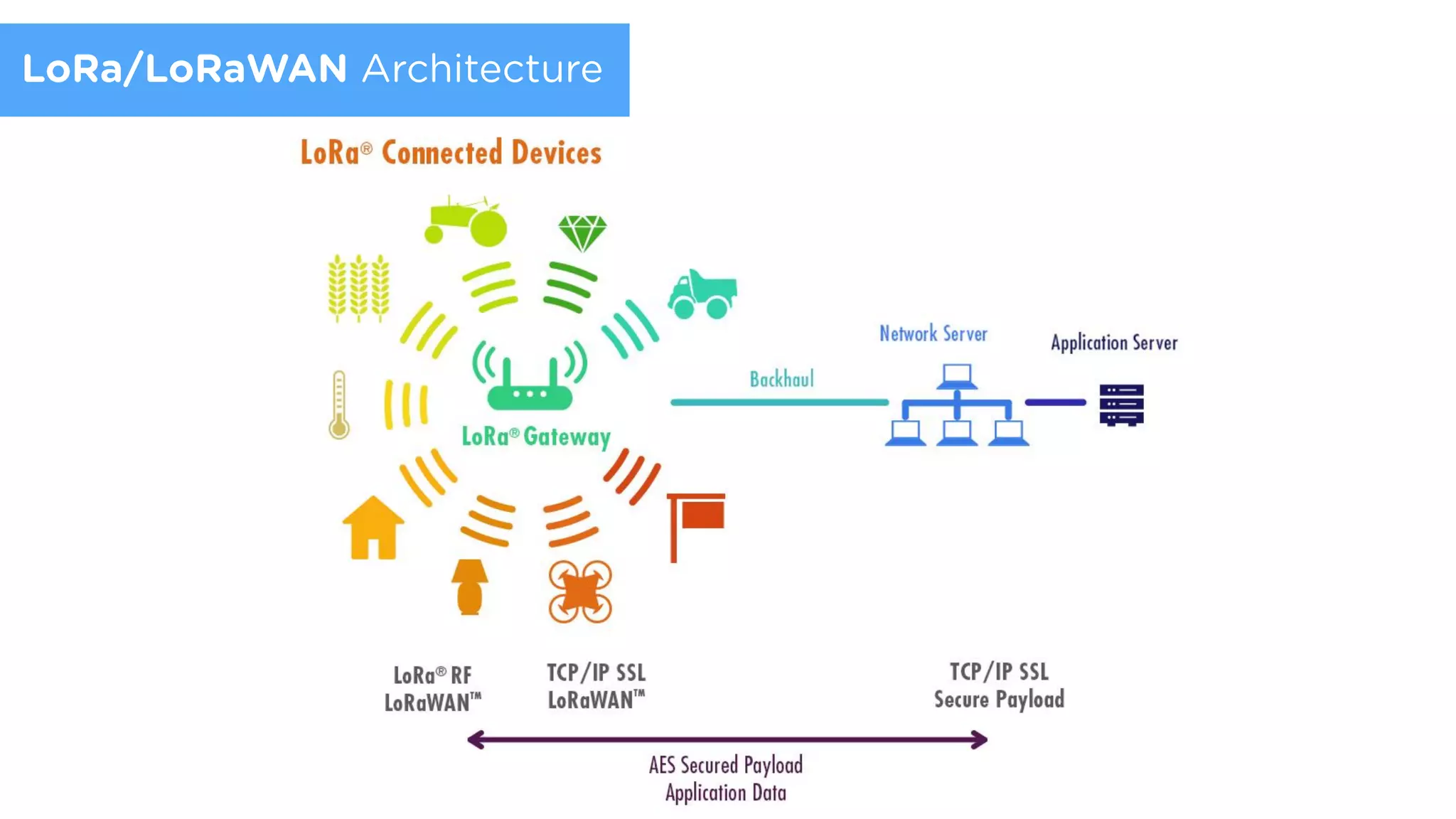
What is LoRaWAN
LoRa/LoRaWAN Architecture
ASSET TRACKING
A real-world use case, that we did…
(Planned) thousand of assets to track
Deployed in country-side: no cellular
coverage, hard to reach once
deployed
Battery should last at least 3 years
Trigger alert if asset is in-move and
track its movement
Requirement
Low power MCU: Microchip/Atmel ATSAMD21
Sufficient clock, flash, RAM, peripherals

Interrupt: RTC, external -> useful for wake-up
Brain
Sensor
IMU sensor: gyroscope, accelerometer. 

Will wake up MCU upon significant movement
Obviously, need GPS module to track location
Battery
Lithium-thionyl chloride cells (Li-SoCl2) to
reduce self-discharging rate
19Ah enough for 3+ years
Solution: Hardware-side
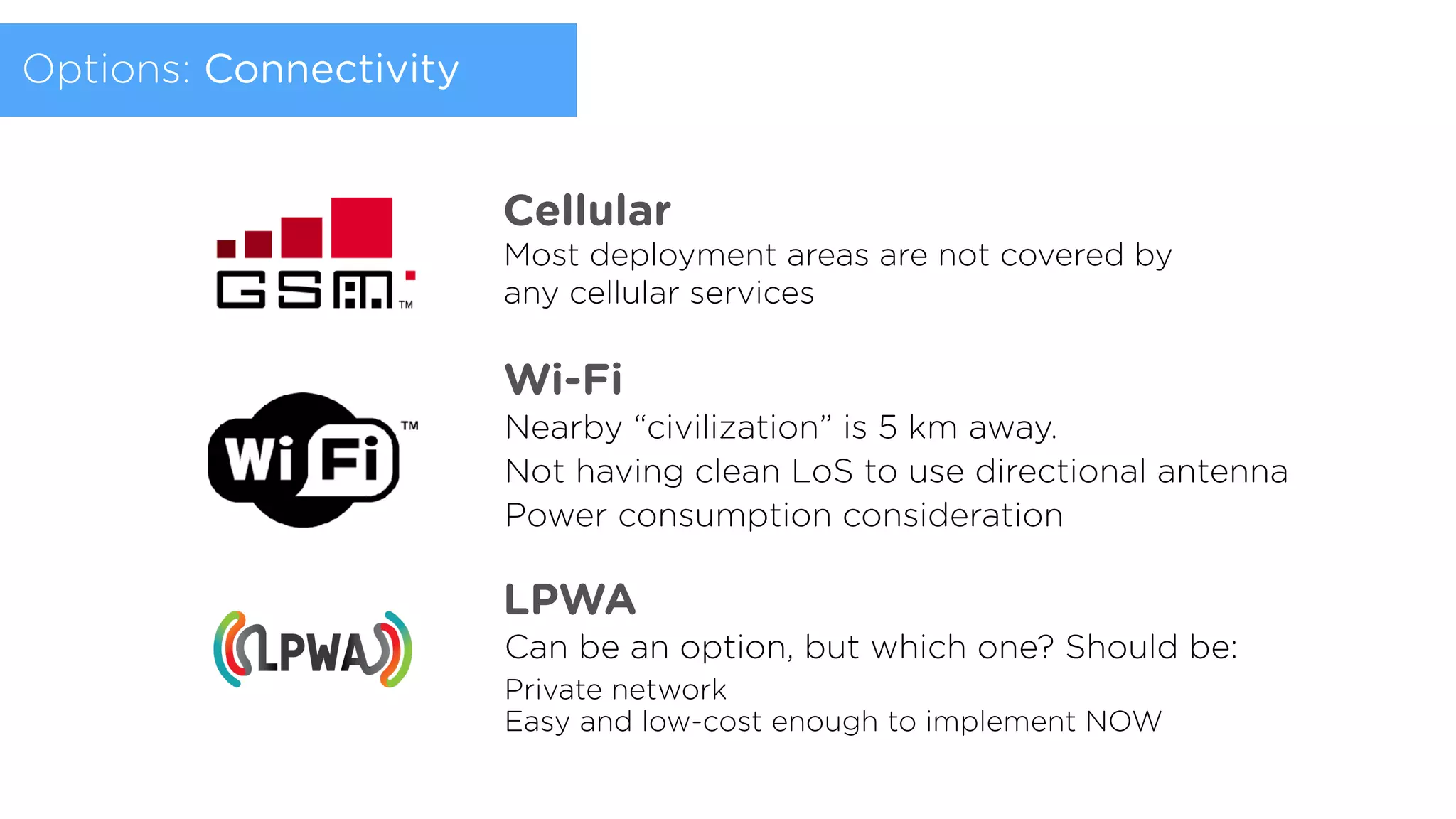
Most deployment areas are not covered by
any cellular services
Cellular
Wi-Fi
Nearby “civilization” is 5 km away.
Not having clean LoS to use directional antenna
Power consumption consideration
LPWA
Can be an option, but which one? Should be:
Private network

Easy and low-cost enough to implement NOW
Options: Connectivity
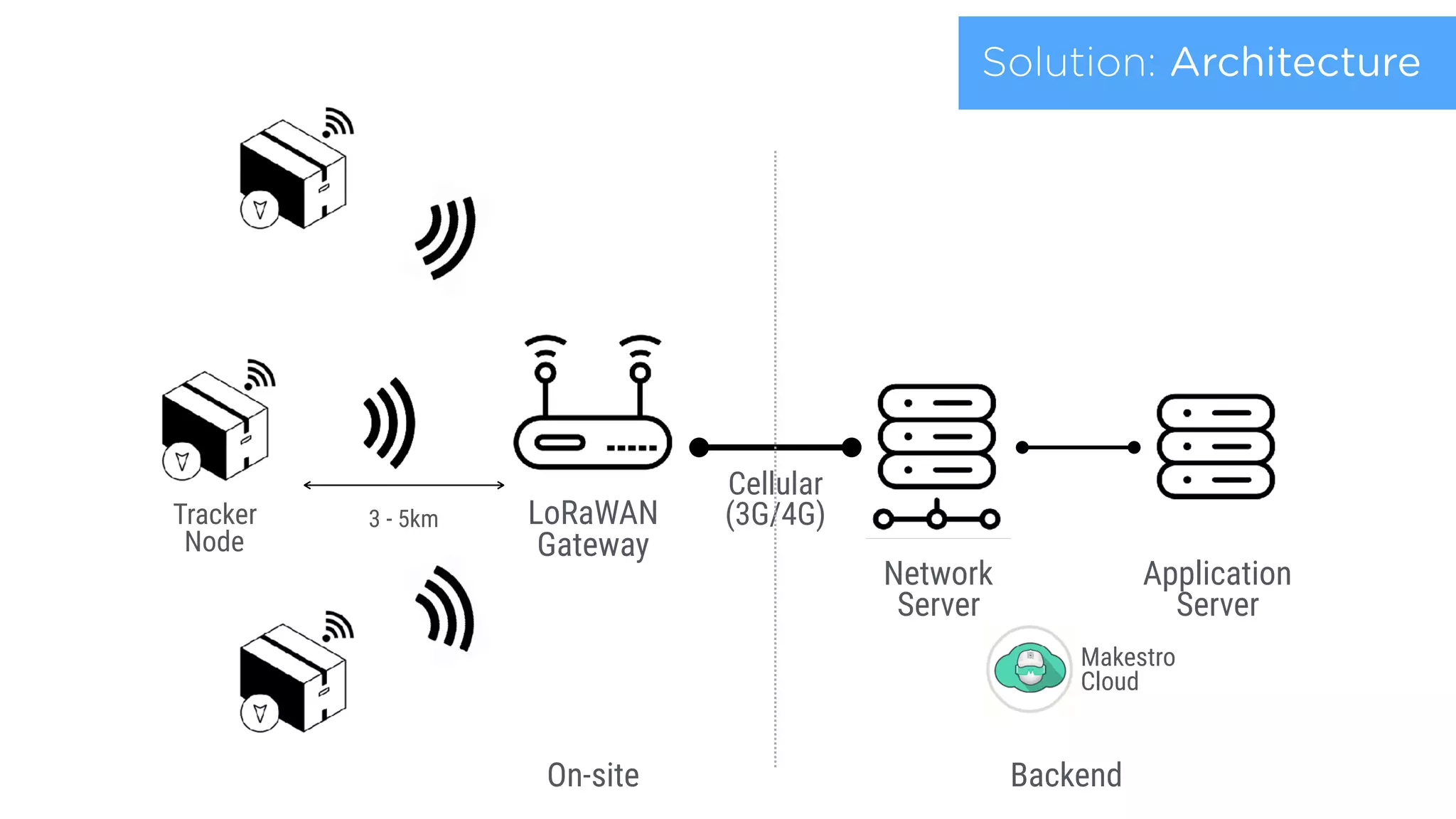
3 - 5km LoRaWAN

Gateway
Network

Server
Application

Server
Cellular
(3G/4G)
Backend
Tracker
Node
Solution: Architecture
Makestro
Cloud
On-site
System only wake up upon: timer interrupt and external
interrupt (significant motion & displacement)
During sleeping:

Turn off unneeded MCU peripherals

Turn off/make sleep GPS and radio

Keep IMU sensor alive with the lowest update frequency
Only transmit data:

By timer (depends on OTA configuration)

Upon alert/interrupt
Circuit design optimisation: reduce components, pull-ups, etc
Low power technique
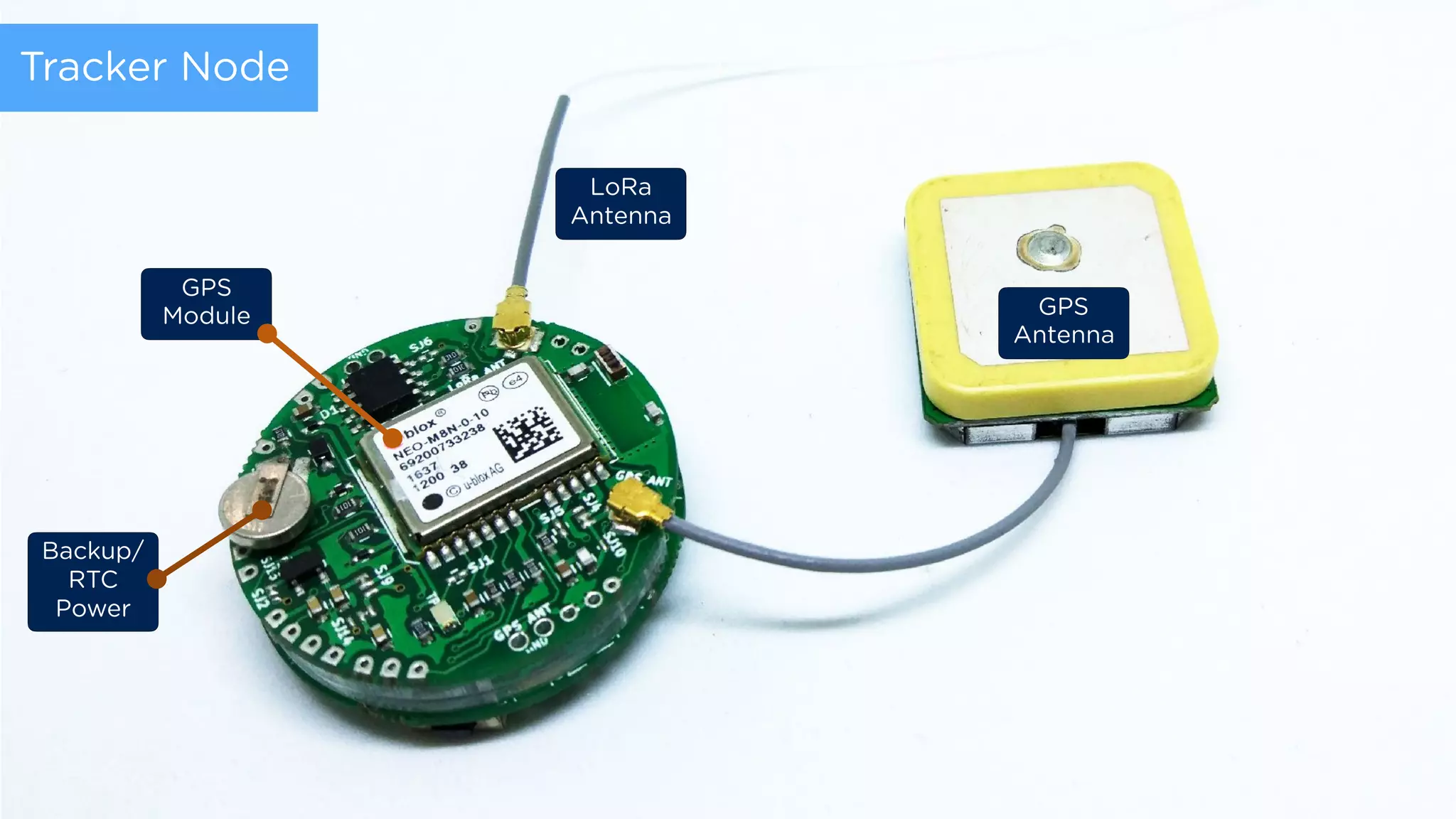
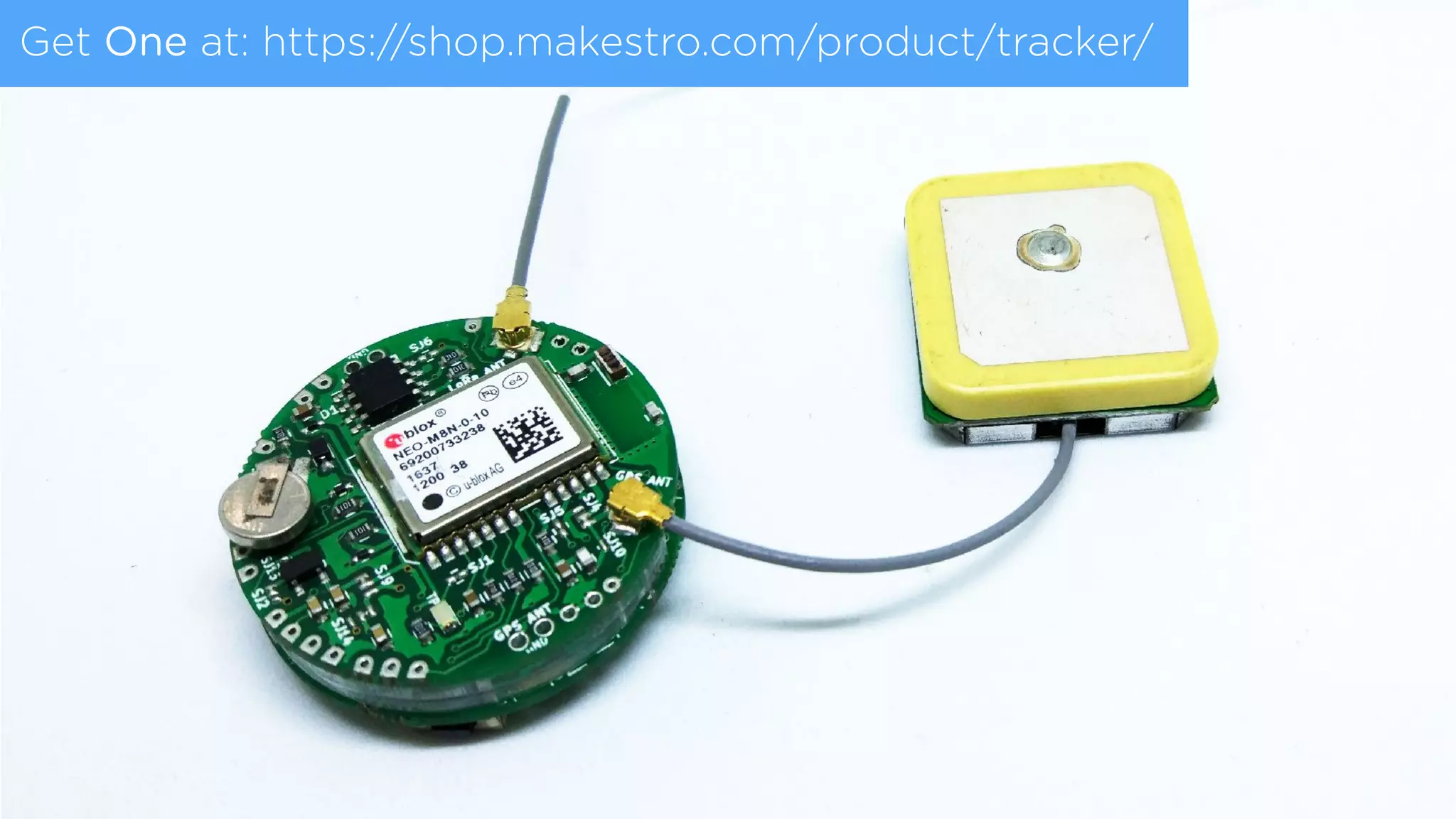
Tracker Node
GPS
Module
Backup/
RTC
Power
GPS
Antenna
LoRa
Antenna
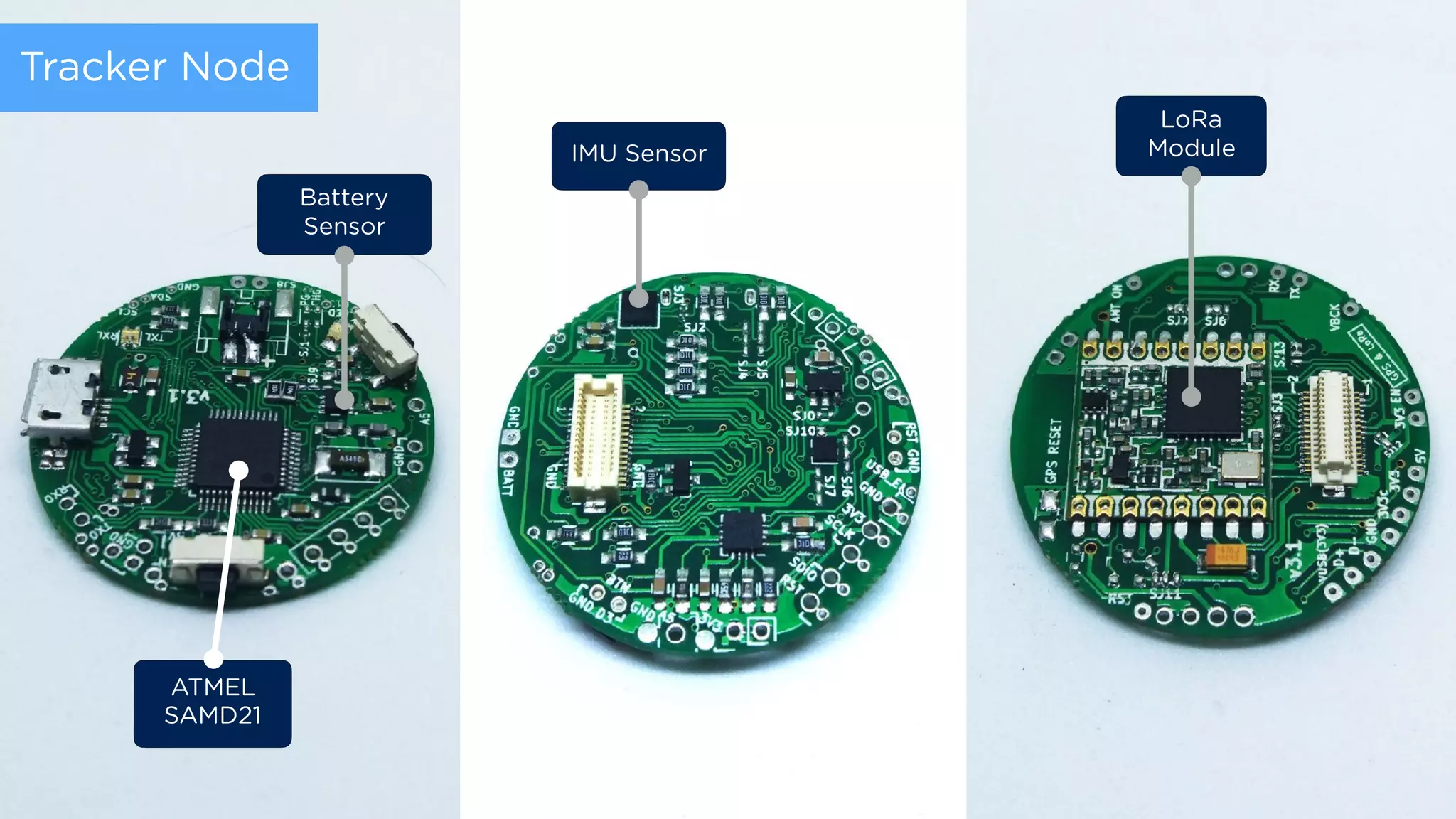
Tracker Node
ATMEL
SAMD21
IMU Sensor
LoRa 

Module
Battery
Sensor
Get One at: https://shop.makestro.com/product/tracker/
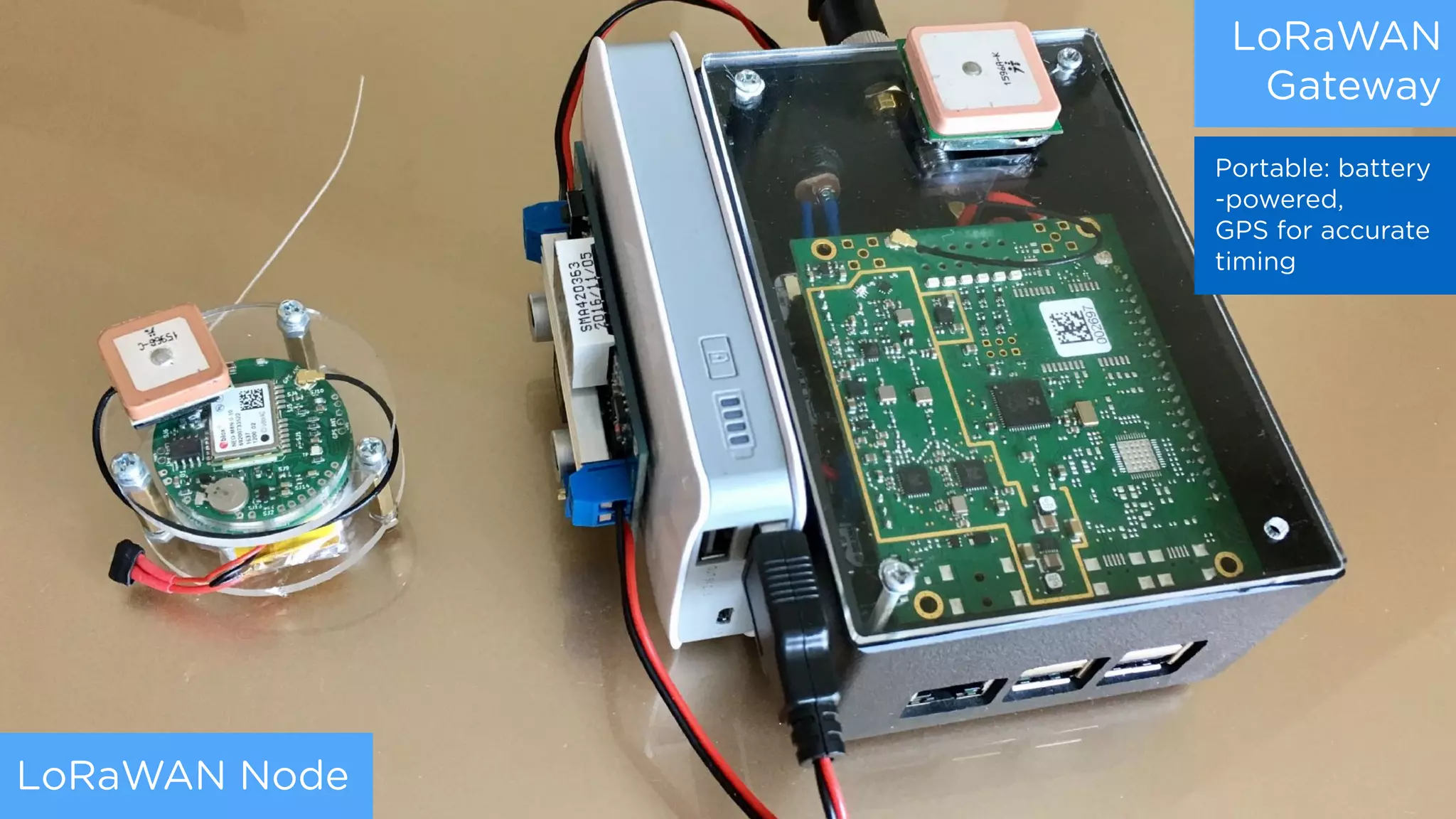
LoRaWAN
Gateway
LoRaWAN Node
Portable: battery
-powered,
GPS for accurate
timing
CLOSING
LPWA is NOW!
(arguably) a more accessible option,
NOW!
How to start?
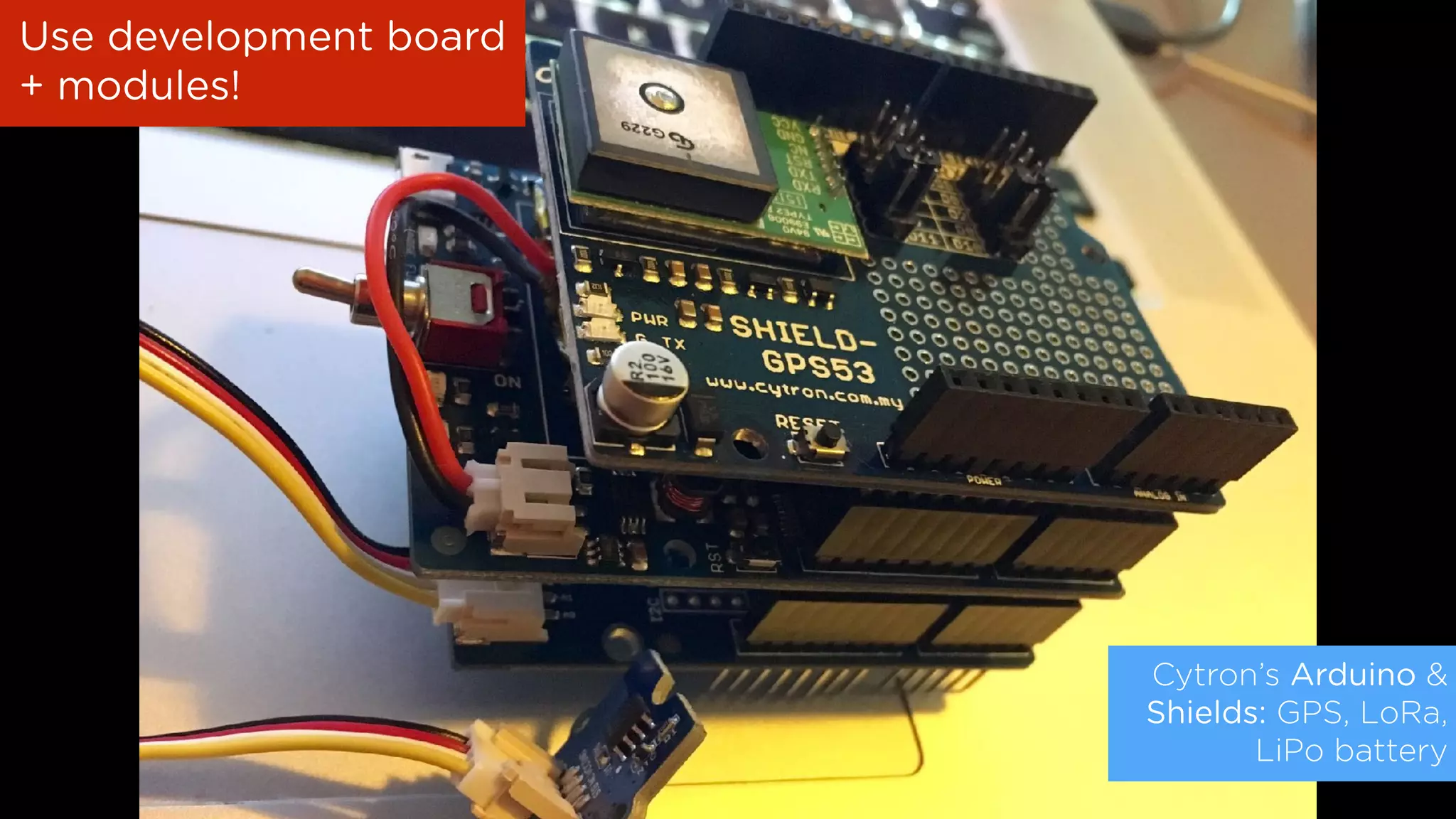
Cytron’s Arduino &
Shields: GPS, LoRa,
LiPo battery
Use development board
+ modules!
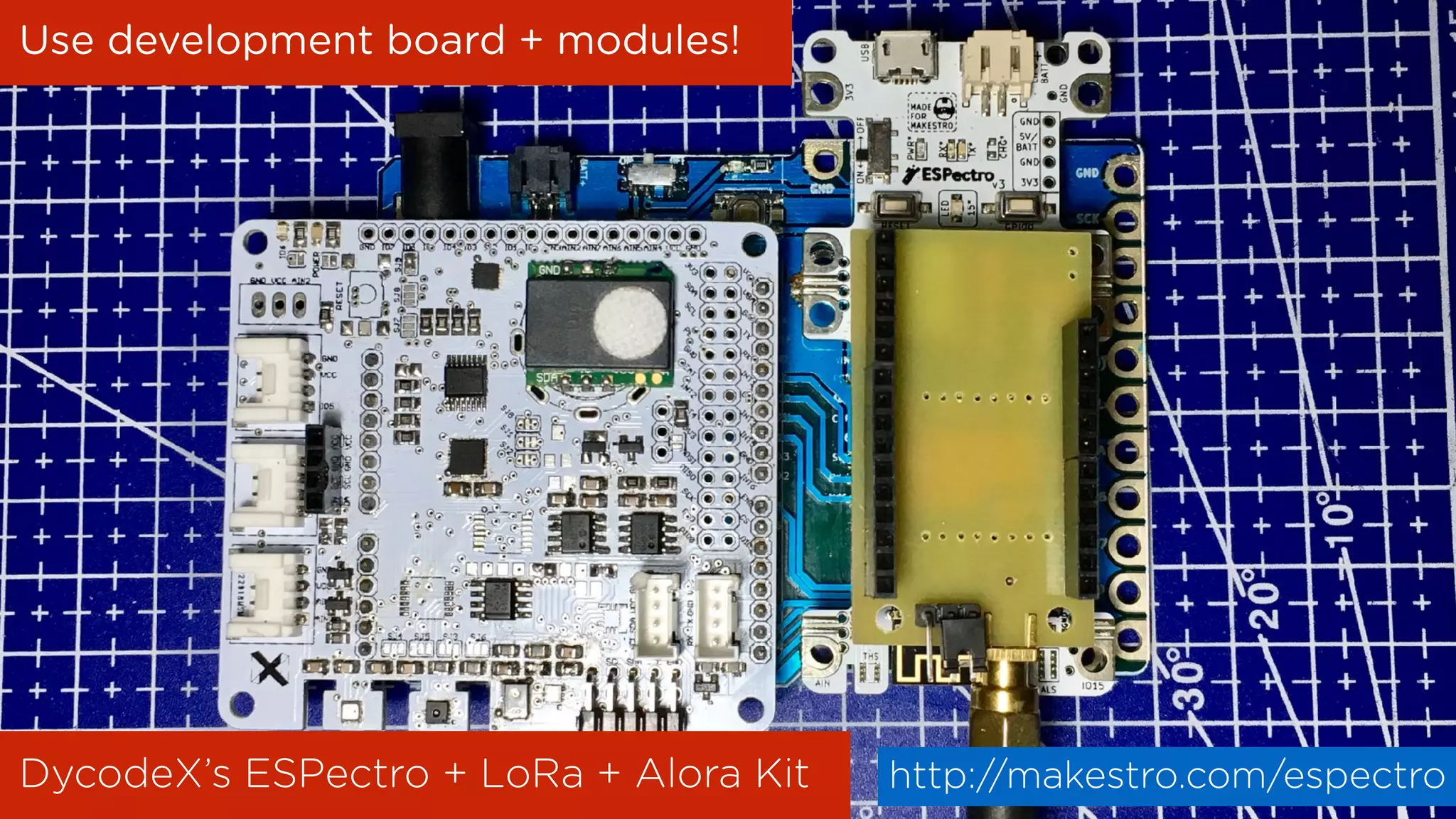
Use development board + modules!
DycodeX’s ESPectro + LoRa + Alora Kit http://makestro.com/espectro
COMING SOON!
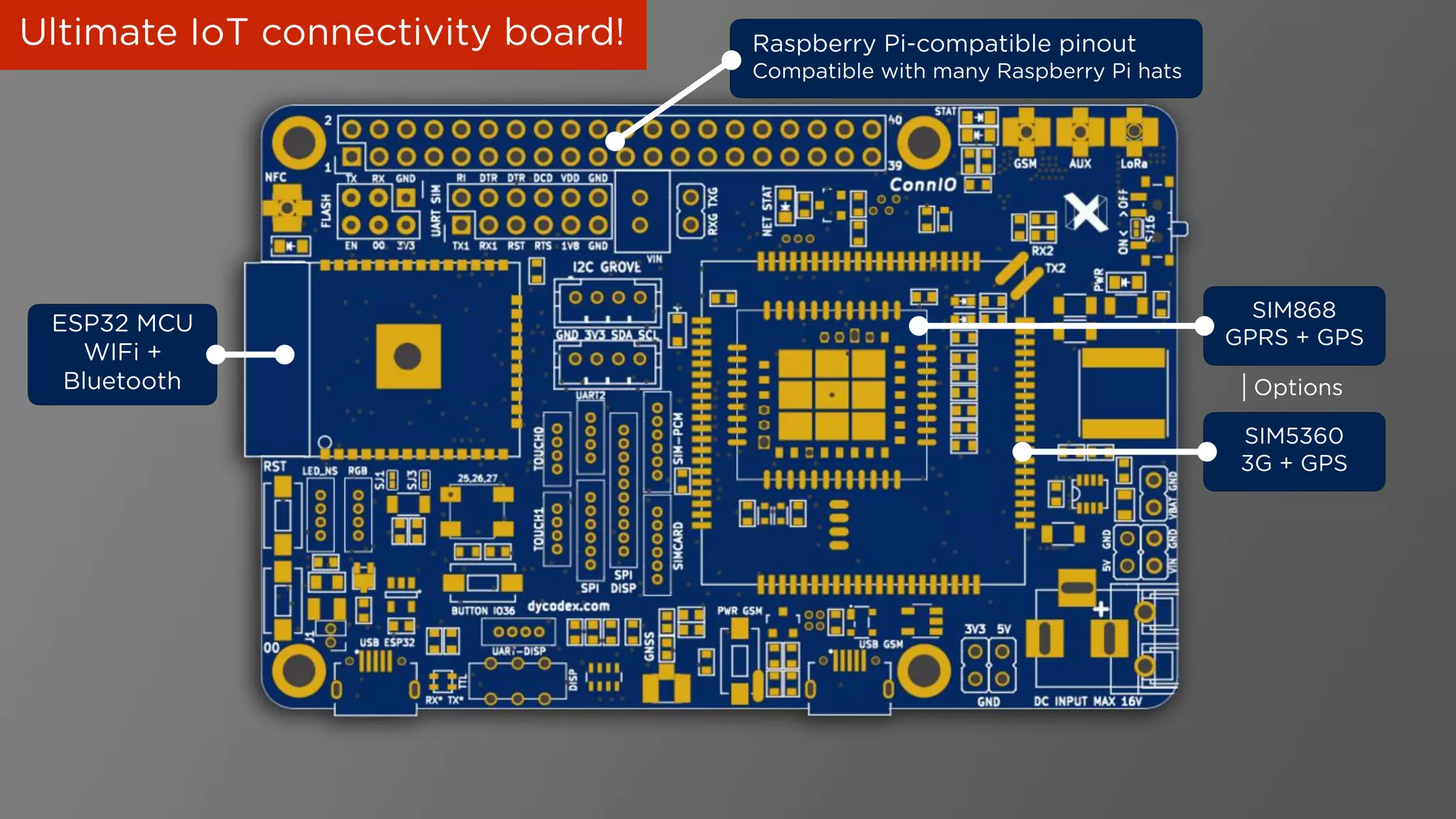
SIM868

GPRS + GPS
Ultimate IoT connectivity board!
ESP32 MCU

WIFi +
Bluetooth
SIM5360

3G + GPS
Options
Raspberry Pi-compatible pinout
Compatible with many Raspberry Pi hats
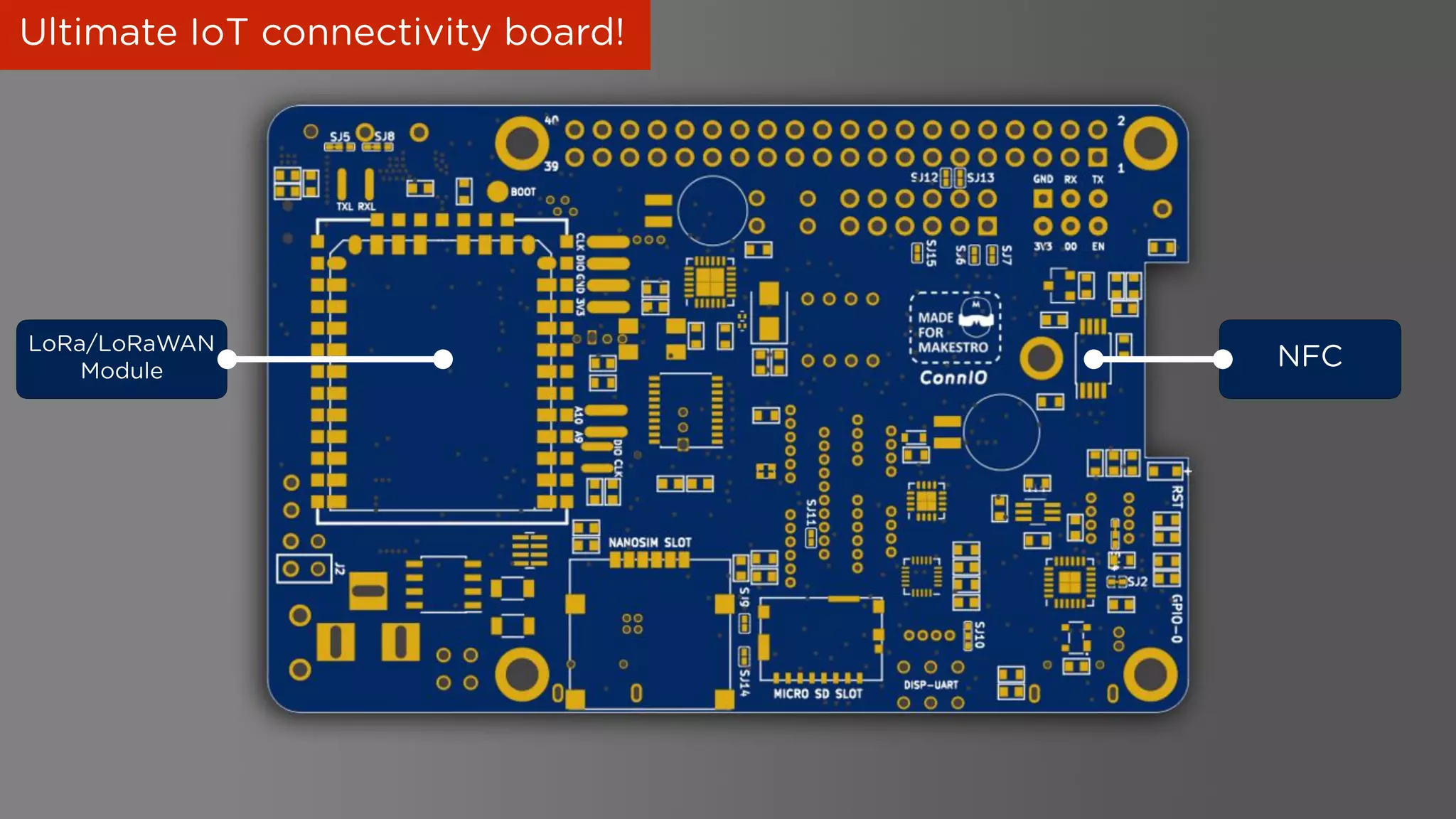
Ultimate IoT connectivity board!
LoRa/LoRaWAN
Module
NFC
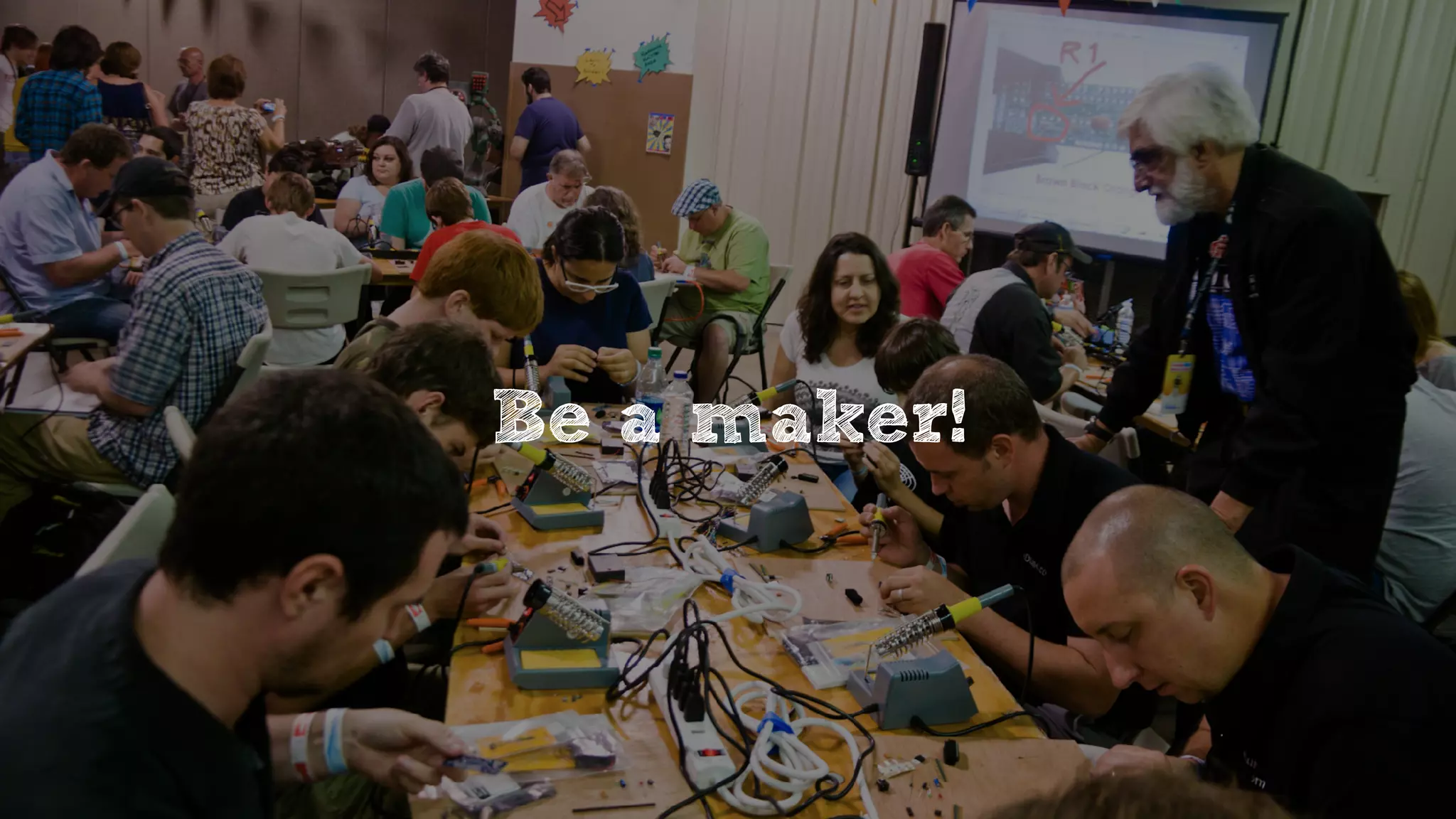
Be a maker!
A movement to “democratize”
knowledge, hardware kit, and software
to help makers to start making in
hardware.
Disclosure: it’s initiated and supported by DycodeX, but it’s Community!
ENABLING MAKER MOVEMENT
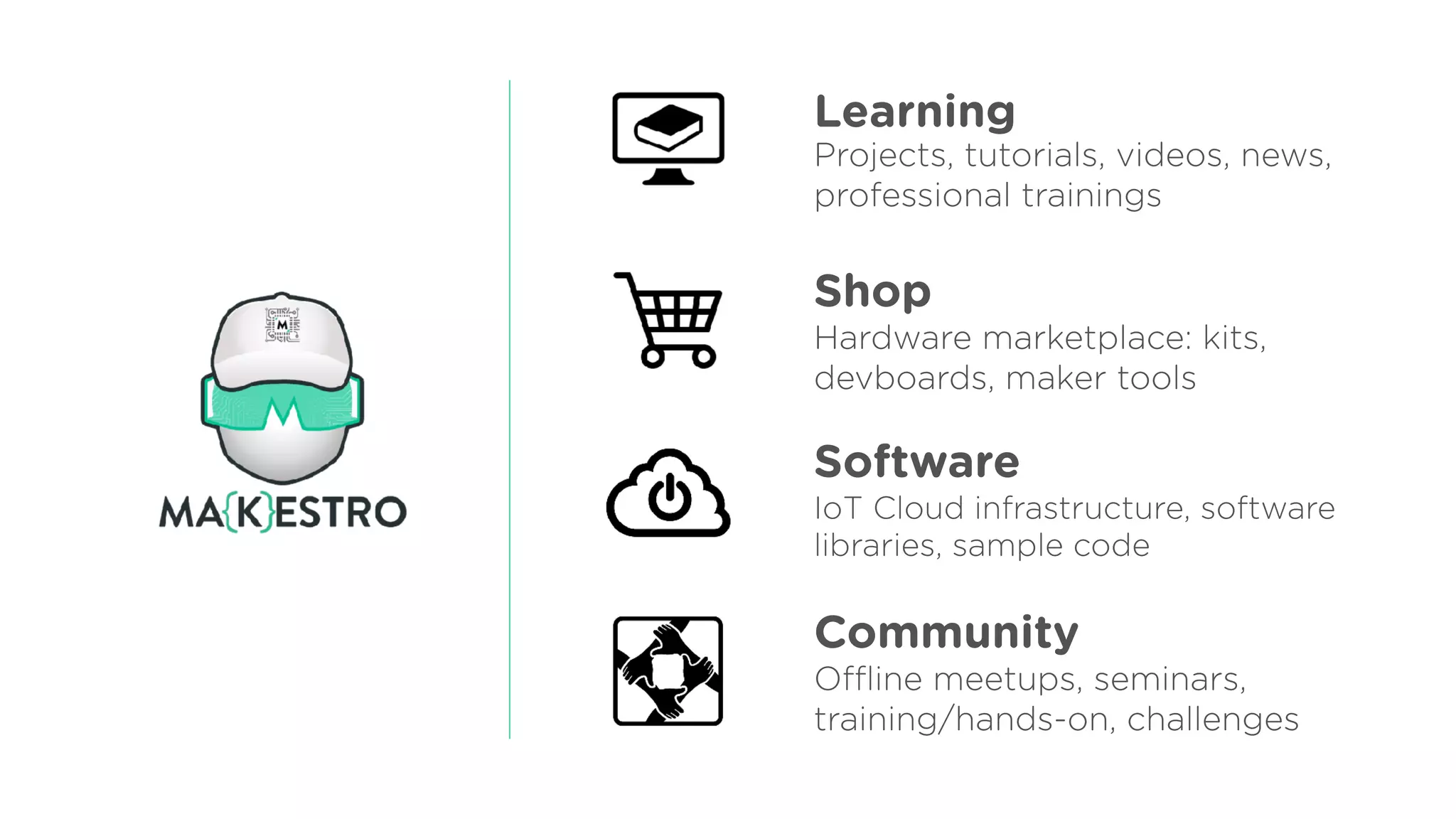
Learning
Shop
Community
Software
Projects, tutorials, videos, news,

professional trainings
Hardware marketplace: kits,
devboards, maker tools
IoT Cloud infrastructure, software 

libraries, sample code
Offline meetups, seminars,
training/hands-on, challenges
makestroid
makestroid
makestroid
How can we help?
for your next IoT endeavour
Andri

CEO

a@dycode.com
Helmi

CMO
helmi@dycode.com
Get in Touch
x@dycode.com | http://dycodex.com
IoT & maker movement enabler

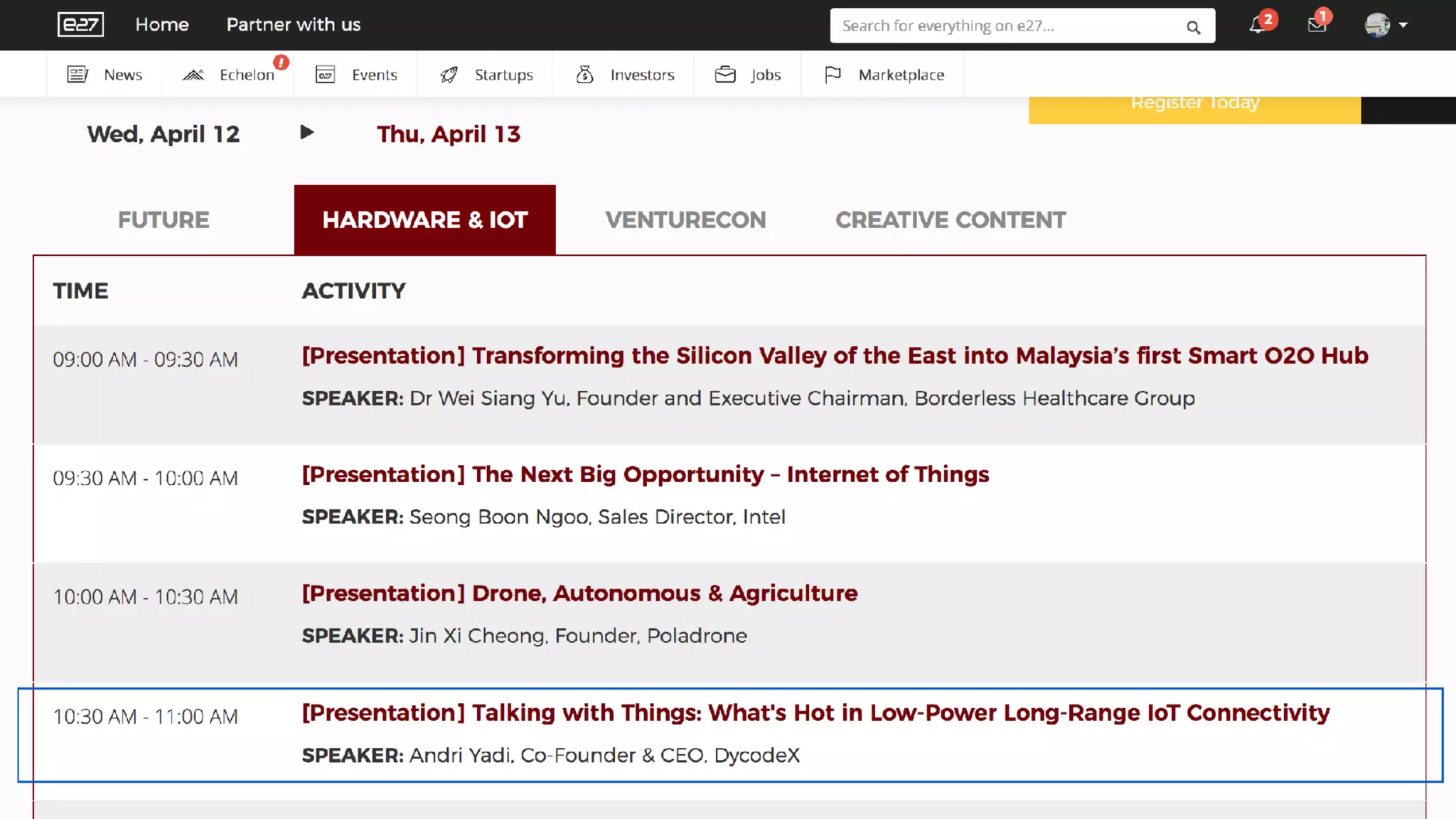
Talking with Things: What's Hot in Low-Power Long-Range IoT Connectivity

  • 1.
    Talking with Things ECHELON MALAYSIA- 2017, PENANG, APR 13 What's Hot in Low- Power Long-Range IoT Connectivity
  • 4.
    Disclaimer English is notmy mother tongue. bear with me
  • 5.
    What’s the heckan Indonesian doing here in Penang :) ? Well… I might have some stories/experiences to share with you
  • 6.
  • 7.
    First coined in2009 by Kevin Ashton, RFID pioneer and cofounder of the Auto-ID Center at the Massachusetts Institute of Technology (MIT) Internet of Things
  • 8.
    “Network of physicalobjects with embedded electronics, software, connectivity, and people to enable connectivity to exchange data, for intelligent applications and services„ Internet of Things
  • 9.
    Things Connectivity People& Processes Data Data Internet of Things
  • 10.
    A bit ofstory in 2003 around IoT connectivity
  • 11.
    My final yearproject in 2003 was kind of IoT Design and Implementation of Home Lighting Control System and Home Monitoring System using Mobile Phone over Internet
  • 12.
    Circa 2003, originalarchive Lamps Web Cam Modem for SMS & GPRS Home Server* GPRS GPRS My final project Architecture “The Thing” *Obviously it’s not based on single-board computer (SBC). SBC is non-existent commercially back then
  • 13.
    GPRS 2.5G, 40 -80 kbps in theory Mobile app Home Server app Achieved 12 secs/frame NOT 12 frame/secs (fps) :) My final project Video streaming feature Circa 2003, original archive J2ME app, on Nokia 3650 J2SE-based
  • 14.
    That’s what Ihad in 2003 for wide area IoT connectivity
  • 15.
    CONNECTIVITY is one ofthe biggest challenges to creating a true IoT …yet, it always fascinates me!
  • 16.
  • 17.
  • 18.
    Andri Yadi fb.com/andri.yadi |a at dycode dot com http://andriyadi.me | http://dycodex.com
  • 19.
  • 20.
    150+ Speakings 30+ talksabout IoT for the past 2 years
  • 21.
    Proudly coder for
 19 years ASM, QBasic, Pascal, c, C++, Java, PHP, Bash, C#, Visual Basic, HTML, JavaScript, Python, Objective-C, Swift .NET, Qt/QML, Java ME/EE/SE, Android SDK, iOS SDK, Node.js ARM MBED, ESP8266, ESP-IDF, Arduino
  • 22.
    Cellular IoT (CIoT) connectivitywe NOW have Fast, efficient 
 Up to 10 Mbps for 4G LTE Ubiquitous coverage Reliable & secure Not designed for IoT in mind High power consumption Relatively expensive: modules, data plan Provisioning, manageability Advantages Considerations
  • 23.
    Cellular IoT (CIoT) connectivitywe WILL have EC-GSM-IoT LTE-M / eMTC NB-IoT Low data throughput Low power Low device & deployment cost Extended coverage Technologies Common Traits
  • 24.
    3 Evolution of IoTConnectivity in 3GPP/GSMA 5 MHz200 kHz 1.4 MHz 5/10/15/20 MHz Other influences GSM LTE Cat-1+ Delay Tolerant Access Cat-0 Cat-M1 Cat-NB1EC-GSM UMTS GSM is the original wide-area M2M wireless connectivity technology. EC-GSM enhances it to keep it competitive. UMTS did not see any significant push towards a low-power variant. LTE-M (Cat-M1) is a concession to the low-power/low-throughput device within mainstream LTE. NB-IoT (Cat-NB1), a new RAN technology, is the official LPWAN contestant from the 3GPP/GSMA stable Evolution of IoT Connectivity in 3GPP/GSMA
  • 25.
  • 26.
    Communication Technologies -Overview Mbps Kbps bps 10 m 100 m 1 km 10 km Baud rate Range Wi-Fi / BT Short Range LPWAN ST Confidential Cellular -M -NB-IOT 5G 850/1900 MHz 900/1800 MHz Sub-GHz 2.4 GHz WIFI/BT Short Range LPWAN Cellular IoT Connectivity: Range vs Speed
  • 27.
    tend to beless complex than mesh networks as the endpoints can be connected directly to a gateway or base station, rather than relying on a relay system to transmit messages. cellular technologies and WiFi tend to offer high throughput rates, while new low power wide area (LPWA) technologies and Bluetooth are low energy technologies (see graphic). Low power wide area options Proprietary LPWA technologies in Cellular Range Battery Life LONG SHORT LONG Local network (WiFi, ZigBee, Z-Wave) Personal network (Bluetooth) Low-Power Wide-Area Network (LPWAN: Sigfox, LoRa, Dash7) Source: Alexander Vanwynsberghe, Blog article 'Long-range radios will change how the Internet of Things communicates' Source: Alexander Vanwynsberghe, Blog article 'Long-range radios will change how the Internet of Things communicates' IoT Connectivity: Range vs Power
  • 28.
    What is LPWA LowPower, Wide Area Networks Low data throughput = High sensitivity = Long range Relatively low cost Multiple Access = One-to-Many Architecture Using licensed or unlicensed spectrum
  • 29.
  • 30.
  • 31.
  • 32.
    Disclaimer Obviously, I cannot go deep into each technologies 30 minutes won’t be enough
  • 33.
    Cost Modules, deployment, operationalcost Usage Model / Licensing SIGFOX – Required to utilize their public network 
 LoRa – Proprietary physical layer but open MAC Regional Regulatory Allowed frequency for ISM band
 In Europe, duty-cycle is 1% for end-devices Upstream/Downstream SIGFOX – nearly entirely upstream 
 LoRaWAN – has 3 classes supporting different balances of upstream & downstream Hardware & Network Availability Is it available NOW? LPWA: Selection Factors
  • 34.
  • 35.
  • 36.
    Wireless modulation technology Physical(PHY) layer for long range communications Operates in the license-free ISM bands all around the world • 433, 868, 915 Mhz • Regulated (power, duty-cycle, bandwidth) E.g: EU: 0.1% or 1% per sub-band duty-cycle limitation (per hour) Sensitivity: -142 dBm Link budget (EU): 156 dB What is LoRa
  • 37.
    ISM Regulation ISMworldwide regulation 7 Output Power vs Duty Cycle Countries Frequency band review Max. output power EU 868 MHz 14 dBm USA 915 MHz 20 dBm Korea 900 MHz 14 dBm Japan 920 MHz Malaysia 862 to 875 MHz 20 dBm Philippines 868 MHz Vietnam 920 to 925 MHz India 865 to 867 MHz Singapore 922 MHz Thailand 920 to 925 MHz Indonesia 922 MHz ANZ 915 to 928 MHz Taiwan 920 to 925 MHz China 470 to 510 MHz 17 dBm 919 to 923MHz
  • 38.
    Communications protocol &architecture utilizing the LoRa physical layer Data rates are from 300bps to 5.5kbps 
 Has 2 high-speed channels at 11kbps and 50kbps (using FSK modulation) It supports • secure bi-directional communication, • mobility What is LoRaWAN
  • 39.
  • 40.
    ASSET TRACKING A real-worlduse case, that we did…
  • 41.
    (Planned) thousand ofassets to track Deployed in country-side: no cellular coverage, hard to reach once deployed Battery should last at least 3 years Trigger alert if asset is in-move and track its movement Requirement
  • 42.
    Low power MCU:Microchip/Atmel ATSAMD21 Sufficient clock, flash, RAM, peripherals
 Interrupt: RTC, external -> useful for wake-up Brain Sensor IMU sensor: gyroscope, accelerometer. 
 Will wake up MCU upon significant movement Obviously, need GPS module to track location Battery Lithium-thionyl chloride cells (Li-SoCl2) to reduce self-discharging rate 19Ah enough for 3+ years Solution: Hardware-side
  • 43.
    Most deployment areasare not covered by any cellular services Cellular Wi-Fi Nearby “civilization” is 5 km away. Not having clean LoS to use directional antenna Power consumption consideration LPWA Can be an option, but which one? Should be: Private network
 Easy and low-cost enough to implement NOW Options: Connectivity
  • 44.
    3 - 5kmLoRaWAN
 Gateway Network
 Server Application
 Server Cellular (3G/4G) Backend Tracker Node Solution: Architecture Makestro Cloud On-site
  • 45.
    System only wakeup upon: timer interrupt and external interrupt (significant motion & displacement) During sleeping:
 Turn off unneeded MCU peripherals
 Turn off/make sleep GPS and radio
 Keep IMU sensor alive with the lowest update frequency Only transmit data:
 By timer (depends on OTA configuration)
 Upon alert/interrupt Circuit design optimisation: reduce components, pull-ups, etc Low power technique
  • 46.
  • 47.
  • 48.
    Get One at:https://shop.makestro.com/product/tracker/
  • 49.
  • 50.
  • 51.
  • 52.
    (arguably) a moreaccessible option, NOW!
  • 53.
  • 54.
    Cytron’s Arduino & Shields:GPS, LoRa, LiPo battery Use development board + modules!
  • 55.
    Use development board+ modules! DycodeX’s ESPectro + LoRa + Alora Kit http://makestro.com/espectro
  • 56.
  • 57.
    SIM868
 GPRS + GPS UltimateIoT connectivity board! ESP32 MCU
 WIFi + Bluetooth SIM5360
 3G + GPS Options Raspberry Pi-compatible pinout Compatible with many Raspberry Pi hats
  • 58.
    Ultimate IoT connectivityboard! LoRa/LoRaWAN Module NFC
  • 59.
  • 60.
    A movement to“democratize” knowledge, hardware kit, and software to help makers to start making in hardware. Disclosure: it’s initiated and supported by DycodeX, but it’s Community!
  • 61.
  • 62.
    Learning Shop Community Software Projects, tutorials, videos,news,
 professional trainings Hardware marketplace: kits, devboards, maker tools IoT Cloud infrastructure, software 
 libraries, sample code Offline meetups, seminars, training/hands-on, challenges
  • 63.
  • 64.
    How can wehelp? for your next IoT endeavour
  • 65.
  • 66.
    x@dycode.com | http://dycodex.com IoT& maker movement enabler