International Research Journal of Engineering and Technology (IRJET) e-ISSN: 2395-0056
Volume: 07 Issue: 04 | Apr 2020 www.irjet.net p-ISSN: 2395-0072
© 2020, IRJET | Impact Factor value: 7.34 | ISO 9001:2008 Certified Journal | Page 1505
GARBAGE COLLECTING ROBOT USING IOT
Kavya.C1, Kokila.C2, Kowsalya.M3, Maha.A4,MUTHARASU.S5
1-4B.E.Student, Dept. of Electrical and Electronics Engineering, Vivekanandha College of Engineering for
Women[Autonomous], Namakkal, India.
5Assistant professor, Dept., of Electrical and Electronics Engineering, Vivekanandha College of Engineering for
Women[Autonomous], Namakkal, India.
-----------------------------------------------------------------------***--------------------------------------------------------------------
Abstract - Waste collection and management is a subject
undergoing extensive study, and solutions are being proposed
meticulously. Thanks to an exponential rise in population, there
is an increased production of waste, and also a significant
amount of litter consisting of plastic, paper, and other such
products carelessly thrown about and scattered in public. Thus,
the need for a more robust waste management strategy is
essential. Presently, waste management techniques either lack
efficiency, or incur high costs.. Collectionoftheunorganized and
scattered garbage is the preliminary and most vital step of
waste management, following proper segregation anddisposal.
This paper proposes, explains, and implements an original
concept of making a modular, scalable and cost effective system
for garbage collection.
Key Words: Embedded, IoT, LCD, Arduino
I. INTRODUCTION
To make the cities greener,safer,andmoreefficient,
Internet of Things (IoT) can play an important role. The
implementation of proper waste management system will
avoid the spreading of such disease.Inprojectweproposesa
smart mechanism for improving the management of wastes
in cities. Things that are connected to the Internet and those
devices controlled from the Internet is called Internet of
Things. In this system, the smart bin is connected with the
internet to display the exact information about the dustbin
level and to which area it belong. In present there was a
rapid growth in the population which leads to large quantity
of waste disposal in the cities. The overflow of dustbin will
create a unpleasant environment and it affect many people
by spreading the deadly disease.
II. EMBEDDED TECHNOLOGY
As the name signifies, an embedded system is
embedded or builds into something else.Embeddedsystems
encompass a variety of hardware and softwarecomponents,
which perform specific functions inhostsystem,for example
satellites, washing machine, handheld telephones and
automobiles. Embedded systems have become increasing
digital with a non-digital peripheral (analog power) and
therefore both Hardware and software coding signs are
relevant. Most embedded control product must special
requirement, cost effectiveness, low power, small-footprint
and a high level of system integration.
1. EMBEDDED SOFTWARE
Software in the embeddedsystemisimplanted witheither
assembly language or any high level language.Now-a-days C
and C++ has been the choice but language for the embedded
software for the following reasons.
 C and C++ are machine independent language, so the
programmer can concentrate only on the algorithms.
 C has the ability for direct hardware control and it
can be interfaced to run any mechanical machine.
Any source code written in C and C++ or assembly must be
converted into an executable image that can be loaded onto
an EEPROM chip. The process of converting the source code
representation of embedded software into an executable
image involves three distinct steps and the system or
computer on which these processes are executed is called
host computer. The Embedded system software compriseof
building program that will run on the host. These tools are
called Native tools. Some of them are:
2. CROSS-COMPILIERS
The compiler that runs on the host system and produces the
binary instructions that will be understood by the target
microprocessor is called Cross-Compiler.
3. CROSS-ASSEMBLER
A Cross assembler is the assembler that run on the host and
produces binary instructions appropriate for the target
system.
4. LINKER/LOCATOR
Linker/Locator links all the objectfilesproduced by
the cross compiler and assembler. The loader finds memory
into load the program from the disk into the memory and
may then do various other processing before starting the
program.
5. FEATURES OF EMBEDDED SYSTEM
 Higher performance
 Low power consumption
 Slimmer and more compact
 Mission-critical functions
International Research Journal of Engineering and Technology (IRJET) e-ISSN: 2395-0056
Volume: 07 Issue: 04 | Apr 2020 www.irjet.net p-ISSN: 2395-0072
© 2020, IRJET | Impact Factor value: 7.34 | ISO 9001:2008 Certified Journal | Page 1506
 Reduced design and development time
 Lower system cost
III. LITERATURE SURVEY
The primary objective of this research was to clean
up waste materials on coastline beaches. The mobile robot
system consists of a shovel to scoop up waste, a trash box to
deposit the waste In order to understand the need for a
compact, cost effective and scalable system, and before
diving in to provide our own solution, we need to first
understand the existing research and work done in the field.
In this section, we depict a concise review performed on
these existing pieces of work, encompassing mobile robots,
garbage collectors and IoT based systems for similar use
cases
Image recognition includes ground segmentation, contour
extraction, object tracking, and then classification. The
neural network used here is CNN. Once identified, the robot
will translate such that the image is kept in one particular
part of the image continually, and thearmwill thentakeover
and pick up the object at a certain distance ifitisclassifiedas
waste. Robot moves under PID algorithm. If out of range,
tries to come back in range. Good accuracy obtained, most
for bottles (91.87%), least for waste papers (77.7%).
IV. WORKING PROCESS
1. EXISITING SYSTEM
Too much land pollution/garbage and inconvenient
availability (unavailability) of sufficient workforce under all
circumstances. While manual labor to clean up garbage is a
good source of employment, there are several problemsthat
are associated with cleaning up of garbage manually.
This mechanism incurs high running cost and power
consumption.
All existing work includes only ideas and prototypes, and
there has been no actual product that has entered the
market. The main reason for this is the lack of versatilityand
extremely high cost of the prototypes.
2. DRAWBACKS
 Unavailability of manual labor in several remote
areas (such as railway tracks)
 Safety concerns of humans in hostile work
environments
 Lack of resources for hazard proof collection of
nuclear waste.
3. PROPOSED SYSTEM
An autonomous garbage collection system is proposed by
making the artificial robot system. The autonomous robot
can be controlled by the corporation office through internet
the website/app is used to navigate the robot the robot can
lift the filled bin and replace with the new bin using robotic
arm. Our aim is to substantially reduce the cost, so as to
make the implementation on a large scale feasible, including
implementation through government bodies.
4. ADVANTAGES
 It is flexibility to be utilized in a large number of
environments.
 In order to make the whole system fully autonomous.
 It is fully wireless technology using IOT
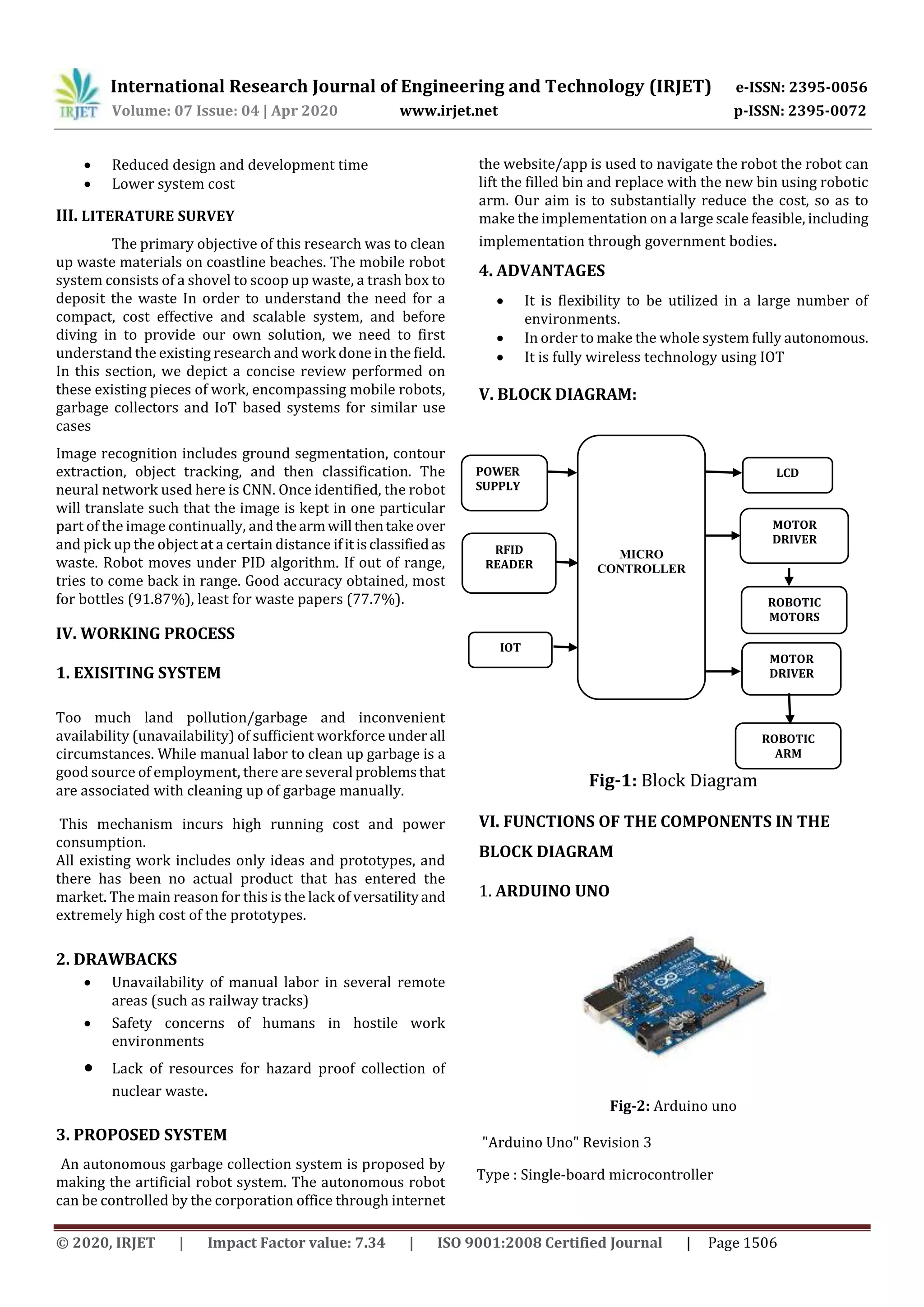
V. BLOCK DIAGRAM:
Fig-1: Block Diagram
VI. FUNCTIONS OF THE COMPONENTS IN THE
BLOCK DIAGRAM
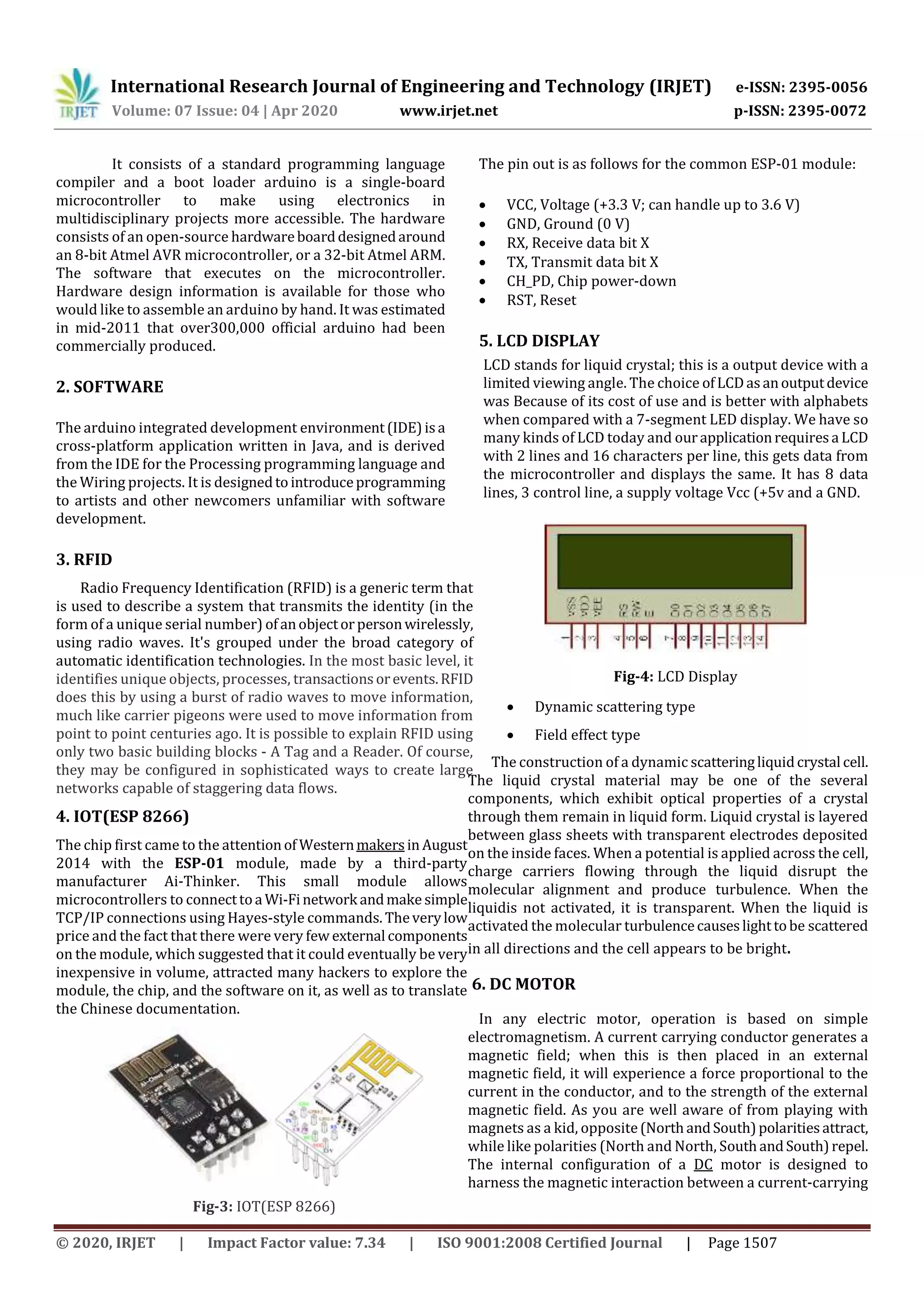
1. ARDUINO UNO
Fig-2: Arduino uno
"Arduino Uno" Revision 3
Type : Single-board microcontroller
ROBOTIC
ARM
ROBOTIC
ARM
ROBOTIC
ARM
ROBOTIC
ARM
LCD
MOTOR
DRIVER
ROBOTIC
MOTORS
MOTOR
DRIVER
POWER
SUPPLY
RFID
READER
IOT
MICRO
CONTROLLER
International Research Journal of Engineering and Technology (IRJET) e-ISSN: 2395-0056
Volume: 07 Issue: 04 | Apr 2020 www.irjet.net p-ISSN: 2395-0072
© 2020, IRJET | Impact Factor value: 7.34 | ISO 9001:2008 Certified Journal | Page 1507
It consists of a standard programming language
compiler and a boot loader arduino is a single-board
microcontroller to make using electronics in
multidisciplinary projects more accessible. The hardware
consists of an open-source hardwareboarddesignedaround
an 8-bit Atmel AVR microcontroller, or a 32-bit Atmel ARM.
The software that executes on the microcontroller.
Hardware design information is available for those who
would like to assemble an arduino by hand. It was estimated
in mid-2011 that over300,000 official arduino had been
commercially produced.
2. SOFTWARE
The arduino integrated development environment(IDE)isa
cross-platform application written in Java, and is derived
from the IDE for the Processing programming language and
the Wiring projects. It is designedtointroduceprogramming
to artists and other newcomers unfamiliar with software
development.
3. RFID
Radio Frequency Identification (RFID) is a generic term that
is used to describe a system that transmits the identity (in the
form of a unique serial number) ofanobjectorpersonwirelessly,
using radio waves. It's grouped under the broad category of
automatic identification technologies. In the most basic level, it
identifies unique objects, processes, transactionsorevents.RFID
does this by using a burst of radio waves to move information,
much like carrier pigeons were used to move information from
point to point centuries ago. It is possible to explain RFID using
only two basic building blocks - A Tag and a Reader. Of course,
they may be configured in sophisticated ways to create large
networks capable of staggering data flows.
4. IOT(ESP 8266)
The chip first came to the attentionof Westernmakersin August
2014 with the ESP-01 module, made by a third-party
manufacturer Ai-Thinker. This small module allows
microcontrollers to connecttoa Wi-Finetwork andmake simple
TCP/IP connections using Hayes-style commands.Theverylow
price and the fact that there were very few external components
on the module, which suggested that it could eventually be very
inexpensive in volume, attracted many hackers to explore the
module, the chip, and the software on it, as well as to translate
the Chinese documentation.
Fig-3: IOT(ESP 8266)
The pin out is as follows for the common ESP-01 module:
 VCC, Voltage (+3.3 V; can handle up to 3.6 V)
 GND, Ground (0 V)
 RX, Receive data bit X
 TX, Transmit data bit X
 CH_PD, Chip power-down
 RST, Reset
5. LCD DISPLAY
LCD stands for liquid crystal; this is a output device with a
limited viewing angle. The choice ofLCDasanoutputdevice
was Because of its cost of use and is better with alphabets
when compared with a 7-segment LED display. We have so
many kinds of LCD today and ourapplicationrequiresa LCD
with 2 lines and 16 characters per line, this gets data from
the microcontroller and displays the same. It has 8 data
lines, 3 control line, a supply voltage Vcc (+5v and a GND.
Fig-4: LCD Display
 Dynamic scattering type
 Field effect type
The construction of a dynamic scatteringliquidcrystal cell.
The liquid crystal material may be one of the several
components, which exhibit optical properties of a crystal
through them remain in liquid form. Liquid crystal is layered
between glass sheets with transparent electrodes deposited
on the inside faces. When a potential is applied across the cell,
charge carriers flowing through the liquid disrupt the
molecular alignment and produce turbulence. When the
liquidis not activated, it is transparent. When the liquid is
activated the molecular turbulencecauseslighttobe scattered
in all directions and the cell appears to be bright.
6. DC MOTOR
In any electric motor, operation is based on simple
electromagnetism. A current carrying conductor generates a
magnetic field; when this is then placed in an external
magnetic field, it will experience a force proportional to the
current in the conductor, and to the strength of the external
magnetic field. As you are well aware of from playing with
magnets as a kid, opposite(NorthandSouth)polaritiesattract,
while like polarities (North and North, SouthandSouth)repel.
The internal configuration of a DC motor is designed to
harness the magnetic interaction between a current-carrying
International Research Journal of Engineering and Technology (IRJET) e-ISSN: 2395-0056
Volume: 07 Issue: 04 | Apr 2020 www.irjet.net p-ISSN: 2395-0072
© 2020, IRJET | Impact Factor value: 7.34 | ISO 9001:2008 Certified Journal | Page 1508
conductor and an external magnetic field to generate
rotational motion.
Fig-4: DC motor
Every DC motor has six basic parts -- axle, rotor (a.k.a.,
armature), stator, commutator,fieldmagnet(s),andbrushes.
In most common DC motors the external magnetic field is
produced by high-strength permanent magnets1. The stator
is the stationary part of the motor this includes the motor
casing, as well as two or more permanent magnet pole
pieces. The rotors (together with the axle and attached
commutator) rotate with respect to the stator. The rotor
consists of windings (generally on a core), the windings
being electrically connected to the commutator.
7. POWER SUPPLY UNIT
Power supply is an integral partsa vital roleinevery
electronic system and hence their design constitutesa major
part in every application. In order to overcome mal-
operation which results due to fluctuations in the load and
discontinuity in the supply proper choice of power supply is
indeed a great need in this hour. Starting with an ac voltage,
a steady dc voltage is obtained by rectifying the ac voltage,
then filtering to a dc level, and finally, regulating to obtain a
desired fixed dc voltage.
VII. CONCLUSION
Hence theproposed prototypehassuccessfullybeen
implemented. The novelty of this paper lies in the conceptof
a cost-effective system that uses IoT to optimizethe working
of a network of garbage collectors. Furthermore, the
adoption and optimization of the best features from existing
technologies, into a single integrated system makes it very
efficient. It can particularly be used for nuclear-waste
collection, where human presence is unsafe.
REFERENCES
[1] Saravana Kannan G, Sasi Kumar S, Ragavan R,
Balakrishnan M,“Automatic GarbageSeparationRobotUsing
Image Processing Technique”, International Journal of
Scientific and Research Publications, Volume6,Issue4,April
2016.
[2] Hesham Alsahafi, Majed Almaleky, “Design and
Implementation of Metallic Waste Collection Robot”,
SEE2014 Zone I Conference, April 3-5, 2014, University of
Bridgeport, Bridgpeort, CT, USA.
[3] Osiany Nurlansa, Dewi Anisa Istiqomah, Mahendra Astu
Sanggha Pawitra, Member, IACSIT “AGATOR (Automatic
Garbage Collector) as Automatic Garbage Collector Robot
Model” International Journal of Future Computer and
Communication, Vol. 3, No. 5, October 2014.
[4] S. Vinoth Kumar, T. Senthil Kumaran, A. Krishna Kumar ,
“Smart Garbage [5] [5] [5 ] MonitoringandClearanceSystem
using Internet of Things”, in IEEE International Conference
on Smart Technologies & Management, August 2017.
[6] Pranjal Lokhande, M.D.Pawar, “Garbage Collection
Management System”, in International Journal of
Engineering and Computer Science, 2016.
[7] Gaikwad Prajakta1, Jadhav Kalyani, Machale Snehal ,
“Smart garbage collection system in residential area”, in
International Journal of Research in Engineering and
Technology , 2015.
[8] T. Takeshita, T. Tomizawa, “A house Cleaning Robot
System - path indication and Position estimation using
ceiling camera” presented at SICE-ICASE International Joint
Conference2006 in Bexco, Busan, Korea.
BIOGRAPHIES
Ms.C.KAVYA-,B.E.student,
Electrical and Electronics Engineering,
Vivekanandha College of Engineering
For Women,[Autonomouse],
Namakkal, India.
Ms.C.KOKILA-B.E. student,
Electrical and Electronics Engineering,
Vivekanandha College of Engineering
For Women,[Autonomouse],
Namakkal, India.
Ms.M.KOWSALYA-B.E. student,
Electrical and Electronics Engineering,
Vivekanandha College of Engineering
For Women,[Autonomouse],
Namakkal, India.
International Research Journal of Engineering and Technology (IRJET) e-ISSN: 2395-0056
Volume: 07 Issue: 04 | Apr 2020 www.irjet.net p-ISSN: 2395-0072
© 2020, IRJET | Impact Factor value: 7.34 | ISO 9001:2008 Certified Journal | Page 1509
Ms.A.MAHA-,B.E. student,
Electrical and Electronics Engineering,
Vivekanandha College of Engineering
For Women,[Autonomouse],
Namakkal, India.
Mr.S.MUTHARASU
Assistant professor,
Department of Electrical and
Electronics Engineering,
Vivekanandha College of Engineering
For Women, [Autonomouse],Namakkal, India.

IRJET - Garbage Collecting Robot using IoT

  • 1.
    International Research Journalof Engineering and Technology (IRJET) e-ISSN: 2395-0056 Volume: 07 Issue: 04 | Apr 2020 www.irjet.net p-ISSN: 2395-0072 © 2020, IRJET | Impact Factor value: 7.34 | ISO 9001:2008 Certified Journal | Page 1505 GARBAGE COLLECTING ROBOT USING IOT Kavya.C1, Kokila.C2, Kowsalya.M3, Maha.A4,MUTHARASU.S5 1-4B.E.Student, Dept. of Electrical and Electronics Engineering, Vivekanandha College of Engineering for Women[Autonomous], Namakkal, India. 5Assistant professor, Dept., of Electrical and Electronics Engineering, Vivekanandha College of Engineering for Women[Autonomous], Namakkal, India. -----------------------------------------------------------------------***-------------------------------------------------------------------- Abstract - Waste collection and management is a subject undergoing extensive study, and solutions are being proposed meticulously. Thanks to an exponential rise in population, there is an increased production of waste, and also a significant amount of litter consisting of plastic, paper, and other such products carelessly thrown about and scattered in public. Thus, the need for a more robust waste management strategy is essential. Presently, waste management techniques either lack efficiency, or incur high costs.. Collectionoftheunorganized and scattered garbage is the preliminary and most vital step of waste management, following proper segregation anddisposal. This paper proposes, explains, and implements an original concept of making a modular, scalable and cost effective system for garbage collection. Key Words: Embedded, IoT, LCD, Arduino I. INTRODUCTION To make the cities greener,safer,andmoreefficient, Internet of Things (IoT) can play an important role. The implementation of proper waste management system will avoid the spreading of such disease.Inprojectweproposesa smart mechanism for improving the management of wastes in cities. Things that are connected to the Internet and those devices controlled from the Internet is called Internet of Things. In this system, the smart bin is connected with the internet to display the exact information about the dustbin level and to which area it belong. In present there was a rapid growth in the population which leads to large quantity of waste disposal in the cities. The overflow of dustbin will create a unpleasant environment and it affect many people by spreading the deadly disease. II. EMBEDDED TECHNOLOGY As the name signifies, an embedded system is embedded or builds into something else.Embeddedsystems encompass a variety of hardware and softwarecomponents, which perform specific functions inhostsystem,for example satellites, washing machine, handheld telephones and automobiles. Embedded systems have become increasing digital with a non-digital peripheral (analog power) and therefore both Hardware and software coding signs are relevant. Most embedded control product must special requirement, cost effectiveness, low power, small-footprint and a high level of system integration. 1. EMBEDDED SOFTWARE Software in the embeddedsystemisimplanted witheither assembly language or any high level language.Now-a-days C and C++ has been the choice but language for the embedded software for the following reasons.  C and C++ are machine independent language, so the programmer can concentrate only on the algorithms.  C has the ability for direct hardware control and it can be interfaced to run any mechanical machine. Any source code written in C and C++ or assembly must be converted into an executable image that can be loaded onto an EEPROM chip. The process of converting the source code representation of embedded software into an executable image involves three distinct steps and the system or computer on which these processes are executed is called host computer. The Embedded system software compriseof building program that will run on the host. These tools are called Native tools. Some of them are: 2. CROSS-COMPILIERS The compiler that runs on the host system and produces the binary instructions that will be understood by the target microprocessor is called Cross-Compiler. 3. CROSS-ASSEMBLER A Cross assembler is the assembler that run on the host and produces binary instructions appropriate for the target system. 4. LINKER/LOCATOR Linker/Locator links all the objectfilesproduced by the cross compiler and assembler. The loader finds memory into load the program from the disk into the memory and may then do various other processing before starting the program. 5. FEATURES OF EMBEDDED SYSTEM  Higher performance  Low power consumption  Slimmer and more compact  Mission-critical functions
  • 2.
    International Research Journalof Engineering and Technology (IRJET) e-ISSN: 2395-0056 Volume: 07 Issue: 04 | Apr 2020 www.irjet.net p-ISSN: 2395-0072 © 2020, IRJET | Impact Factor value: 7.34 | ISO 9001:2008 Certified Journal | Page 1506  Reduced design and development time  Lower system cost III. LITERATURE SURVEY The primary objective of this research was to clean up waste materials on coastline beaches. The mobile robot system consists of a shovel to scoop up waste, a trash box to deposit the waste In order to understand the need for a compact, cost effective and scalable system, and before diving in to provide our own solution, we need to first understand the existing research and work done in the field. In this section, we depict a concise review performed on these existing pieces of work, encompassing mobile robots, garbage collectors and IoT based systems for similar use cases Image recognition includes ground segmentation, contour extraction, object tracking, and then classification. The neural network used here is CNN. Once identified, the robot will translate such that the image is kept in one particular part of the image continually, and thearmwill thentakeover and pick up the object at a certain distance ifitisclassifiedas waste. Robot moves under PID algorithm. If out of range, tries to come back in range. Good accuracy obtained, most for bottles (91.87%), least for waste papers (77.7%). IV. WORKING PROCESS 1. EXISITING SYSTEM Too much land pollution/garbage and inconvenient availability (unavailability) of sufficient workforce under all circumstances. While manual labor to clean up garbage is a good source of employment, there are several problemsthat are associated with cleaning up of garbage manually. This mechanism incurs high running cost and power consumption. All existing work includes only ideas and prototypes, and there has been no actual product that has entered the market. The main reason for this is the lack of versatilityand extremely high cost of the prototypes. 2. DRAWBACKS  Unavailability of manual labor in several remote areas (such as railway tracks)  Safety concerns of humans in hostile work environments  Lack of resources for hazard proof collection of nuclear waste. 3. PROPOSED SYSTEM An autonomous garbage collection system is proposed by making the artificial robot system. The autonomous robot can be controlled by the corporation office through internet the website/app is used to navigate the robot the robot can lift the filled bin and replace with the new bin using robotic arm. Our aim is to substantially reduce the cost, so as to make the implementation on a large scale feasible, including implementation through government bodies. 4. ADVANTAGES  It is flexibility to be utilized in a large number of environments.  In order to make the whole system fully autonomous.  It is fully wireless technology using IOT V. BLOCK DIAGRAM: Fig-1: Block Diagram VI. FUNCTIONS OF THE COMPONENTS IN THE BLOCK DIAGRAM 1. ARDUINO UNO Fig-2: Arduino uno "Arduino Uno" Revision 3 Type : Single-board microcontroller ROBOTIC ARM ROBOTIC ARM ROBOTIC ARM ROBOTIC ARM LCD MOTOR DRIVER ROBOTIC MOTORS MOTOR DRIVER POWER SUPPLY RFID READER IOT MICRO CONTROLLER
  • 3.
    International Research Journalof Engineering and Technology (IRJET) e-ISSN: 2395-0056 Volume: 07 Issue: 04 | Apr 2020 www.irjet.net p-ISSN: 2395-0072 © 2020, IRJET | Impact Factor value: 7.34 | ISO 9001:2008 Certified Journal | Page 1507 It consists of a standard programming language compiler and a boot loader arduino is a single-board microcontroller to make using electronics in multidisciplinary projects more accessible. The hardware consists of an open-source hardwareboarddesignedaround an 8-bit Atmel AVR microcontroller, or a 32-bit Atmel ARM. The software that executes on the microcontroller. Hardware design information is available for those who would like to assemble an arduino by hand. It was estimated in mid-2011 that over300,000 official arduino had been commercially produced. 2. SOFTWARE The arduino integrated development environment(IDE)isa cross-platform application written in Java, and is derived from the IDE for the Processing programming language and the Wiring projects. It is designedtointroduceprogramming to artists and other newcomers unfamiliar with software development. 3. RFID Radio Frequency Identification (RFID) is a generic term that is used to describe a system that transmits the identity (in the form of a unique serial number) ofanobjectorpersonwirelessly, using radio waves. It's grouped under the broad category of automatic identification technologies. In the most basic level, it identifies unique objects, processes, transactionsorevents.RFID does this by using a burst of radio waves to move information, much like carrier pigeons were used to move information from point to point centuries ago. It is possible to explain RFID using only two basic building blocks - A Tag and a Reader. Of course, they may be configured in sophisticated ways to create large networks capable of staggering data flows. 4. IOT(ESP 8266) The chip first came to the attentionof Westernmakersin August 2014 with the ESP-01 module, made by a third-party manufacturer Ai-Thinker. This small module allows microcontrollers to connecttoa Wi-Finetwork andmake simple TCP/IP connections using Hayes-style commands.Theverylow price and the fact that there were very few external components on the module, which suggested that it could eventually be very inexpensive in volume, attracted many hackers to explore the module, the chip, and the software on it, as well as to translate the Chinese documentation. Fig-3: IOT(ESP 8266) The pin out is as follows for the common ESP-01 module:  VCC, Voltage (+3.3 V; can handle up to 3.6 V)  GND, Ground (0 V)  RX, Receive data bit X  TX, Transmit data bit X  CH_PD, Chip power-down  RST, Reset 5. LCD DISPLAY LCD stands for liquid crystal; this is a output device with a limited viewing angle. The choice ofLCDasanoutputdevice was Because of its cost of use and is better with alphabets when compared with a 7-segment LED display. We have so many kinds of LCD today and ourapplicationrequiresa LCD with 2 lines and 16 characters per line, this gets data from the microcontroller and displays the same. It has 8 data lines, 3 control line, a supply voltage Vcc (+5v and a GND. Fig-4: LCD Display  Dynamic scattering type  Field effect type The construction of a dynamic scatteringliquidcrystal cell. The liquid crystal material may be one of the several components, which exhibit optical properties of a crystal through them remain in liquid form. Liquid crystal is layered between glass sheets with transparent electrodes deposited on the inside faces. When a potential is applied across the cell, charge carriers flowing through the liquid disrupt the molecular alignment and produce turbulence. When the liquidis not activated, it is transparent. When the liquid is activated the molecular turbulencecauseslighttobe scattered in all directions and the cell appears to be bright. 6. DC MOTOR In any electric motor, operation is based on simple electromagnetism. A current carrying conductor generates a magnetic field; when this is then placed in an external magnetic field, it will experience a force proportional to the current in the conductor, and to the strength of the external magnetic field. As you are well aware of from playing with magnets as a kid, opposite(NorthandSouth)polaritiesattract, while like polarities (North and North, SouthandSouth)repel. The internal configuration of a DC motor is designed to harness the magnetic interaction between a current-carrying
  • 4.
    International Research Journalof Engineering and Technology (IRJET) e-ISSN: 2395-0056 Volume: 07 Issue: 04 | Apr 2020 www.irjet.net p-ISSN: 2395-0072 © 2020, IRJET | Impact Factor value: 7.34 | ISO 9001:2008 Certified Journal | Page 1508 conductor and an external magnetic field to generate rotational motion. Fig-4: DC motor Every DC motor has six basic parts -- axle, rotor (a.k.a., armature), stator, commutator,fieldmagnet(s),andbrushes. In most common DC motors the external magnetic field is produced by high-strength permanent magnets1. The stator is the stationary part of the motor this includes the motor casing, as well as two or more permanent magnet pole pieces. The rotors (together with the axle and attached commutator) rotate with respect to the stator. The rotor consists of windings (generally on a core), the windings being electrically connected to the commutator. 7. POWER SUPPLY UNIT Power supply is an integral partsa vital roleinevery electronic system and hence their design constitutesa major part in every application. In order to overcome mal- operation which results due to fluctuations in the load and discontinuity in the supply proper choice of power supply is indeed a great need in this hour. Starting with an ac voltage, a steady dc voltage is obtained by rectifying the ac voltage, then filtering to a dc level, and finally, regulating to obtain a desired fixed dc voltage. VII. CONCLUSION Hence theproposed prototypehassuccessfullybeen implemented. The novelty of this paper lies in the conceptof a cost-effective system that uses IoT to optimizethe working of a network of garbage collectors. Furthermore, the adoption and optimization of the best features from existing technologies, into a single integrated system makes it very efficient. It can particularly be used for nuclear-waste collection, where human presence is unsafe. REFERENCES [1] Saravana Kannan G, Sasi Kumar S, Ragavan R, Balakrishnan M,“Automatic GarbageSeparationRobotUsing Image Processing Technique”, International Journal of Scientific and Research Publications, Volume6,Issue4,April 2016. [2] Hesham Alsahafi, Majed Almaleky, “Design and Implementation of Metallic Waste Collection Robot”, SEE2014 Zone I Conference, April 3-5, 2014, University of Bridgeport, Bridgpeort, CT, USA. [3] Osiany Nurlansa, Dewi Anisa Istiqomah, Mahendra Astu Sanggha Pawitra, Member, IACSIT “AGATOR (Automatic Garbage Collector) as Automatic Garbage Collector Robot Model” International Journal of Future Computer and Communication, Vol. 3, No. 5, October 2014. [4] S. Vinoth Kumar, T. Senthil Kumaran, A. Krishna Kumar , “Smart Garbage [5] [5] [5 ] MonitoringandClearanceSystem using Internet of Things”, in IEEE International Conference on Smart Technologies & Management, August 2017. [6] Pranjal Lokhande, M.D.Pawar, “Garbage Collection Management System”, in International Journal of Engineering and Computer Science, 2016. [7] Gaikwad Prajakta1, Jadhav Kalyani, Machale Snehal , “Smart garbage collection system in residential area”, in International Journal of Research in Engineering and Technology , 2015. [8] T. Takeshita, T. Tomizawa, “A house Cleaning Robot System - path indication and Position estimation using ceiling camera” presented at SICE-ICASE International Joint Conference2006 in Bexco, Busan, Korea. BIOGRAPHIES Ms.C.KAVYA-,B.E.student, Electrical and Electronics Engineering, Vivekanandha College of Engineering For Women,[Autonomouse], Namakkal, India. Ms.C.KOKILA-B.E. student, Electrical and Electronics Engineering, Vivekanandha College of Engineering For Women,[Autonomouse], Namakkal, India. Ms.M.KOWSALYA-B.E. student, Electrical and Electronics Engineering, Vivekanandha College of Engineering For Women,[Autonomouse], Namakkal, India.
  • 5.
    International Research Journalof Engineering and Technology (IRJET) e-ISSN: 2395-0056 Volume: 07 Issue: 04 | Apr 2020 www.irjet.net p-ISSN: 2395-0072 © 2020, IRJET | Impact Factor value: 7.34 | ISO 9001:2008 Certified Journal | Page 1509 Ms.A.MAHA-,B.E. student, Electrical and Electronics Engineering, Vivekanandha College of Engineering For Women,[Autonomouse], Namakkal, India. Mr.S.MUTHARASU Assistant professor, Department of Electrical and Electronics Engineering, Vivekanandha College of Engineering For Women, [Autonomouse],Namakkal, India.