Concrete international /JANUARY 2002 59
BY JOHN GAJDA AND MARTHA VANGEEM
pecifications generally limit temperatures in mass
concrete to prevent cracking and durability prob-
lems. Temperature limits are specified to seemingly
arbitrary values of 135 F (57 C) for the maximum
allowable concrete temperature and 35 F (19 C) for the
maximum allowable temperature difference between
the center and surface of the mass concrete section.
Typically, the contractor must meet all of the specification
requirements, but without a good understanding of mass
concrete, keeping concrete temperatures within limits
can be a difficult task.
Often, well-established temperature control measures
are sufficient to meet project specifications. However, if
these are overlooked or poorly understood, they could
result in concrete temperatures and temperature differ-
ences that greatly exceed specified limits, causing delays
to the construction schedule or damage to the concrete.
Additionally, recent trends, such as increasing the size of
concrete sections and requiring high minimum cement
contents or low water-cementitious materials ratios,
make temperature control even more difficult.
Understanding mass concrete is the key to controlling
temperatures and ultimately saving time, effort, and money.
Controlling
Temperatures
in Mass Concrete
Understanding mass concrete is the key to controlling temperatures
and ultimately saving time, effort, and money
What is mass concrete?
A question often arises as to exactly what is considered
to be mass concrete. According to ACI 116R,1
mass concrete
is defined as “any volume of concrete with dimensions
large enough to require that measures be taken to cope
with generation of heat from hydration of the cement and
attendant volume change, to minimize cracking.”
Because this definition doesn’t provide a specific
measure, many agencies have developed their own
definitions of mass concrete. For example, mass con-
crete is defined by some agencies as “any concrete
element having a least dimension greater than 3 ft
(0.9 m).” Under this definition, a large mat foundation
with a thickness of 3 ft (0.9 m) would not be considered
mass concrete, but a large mat foundation with a thick-
ness of 3.25 ft (1 m) would be considered mass concrete.
Other agencies use different minimum dimensions,
ranging from 1.5 to 6.5 ft (0.46 to 2.0 m), depending on
past experience. Note that none of these definitions
considers the cementitious material content of the
concrete. Temperatures within a concrete element will be
much different if high-performance or high-early-strength
concrete is used rather than typical structural concrete.
S
60 JANUARY 2002 / Concrete international
For lack of a standard definition, we consider mass
concrete to be any element with a minimum dimension
equal to or greater than 3 ft (0.9 m). Similar consider-
ations should be given to other concrete elements that
do not meet this definition but contain Type III cement or
cementitious materials in excess of 564 lb/yd3
(335 kg/m3
)
of concrete. In many cases, these non-mass elements will
also generate significant amounts of heat.
Maximum concrete temperature and
temperature difference
Maximum allowable concrete temperatures and
temperature differences are often specified to ensure
that proper planning occurs prior to concrete place-
ment. In many cases, the specified limits are seemingly
arbitrary and do not consider project specifics. As an
example of this, certain project specifications limit the
maximum concrete temperature to 135 F (57 C), and limit
the maximum concrete temperature difference to 35 F
(19 C). Other restrictions are often included, such as
limits on the maximum and minimum temperatures of
delivered concrete.
Maximum concrete temperature
The maximum concrete temperature is limited for a
variety of reasons. The primary reason is to prevent
damage to the concrete. Studies have shown that the
long-term durability of certain concretes can be compro-
mised if the maximum temperature after placement
exceeds the range of 155 to 165 F (68 to 74 C). The
primary damage mechanism is delayed ettringite forma-
tion (DEF). DEF can cause internal expansion and
cracking of concrete, which may not be evident for
several years after placement.
Other reasons to limit the maximum concrete
temperature include reducing cooling times and
associated delays, and minimizing the potential for
cracking due to thermal expansion and contraction.
Temperatures over 190 F (88 C) can also reduce
expected compressive strengths.
Maximum temperature difference
A maximum allowable concrete temperature difference
is often specified to minimize the potential for thermal
cracking. This temperature difference is the difference
between the temperature at the hottest portion of the
concrete and that at the surface. Thermal cracking will
occur when contraction due to cooling at the surface
causes tensile stresses that exceed the tensile strength
of the concrete.
A maximum allowable temperature difference of 35 F
(19 C) is often specified in contract documents. This
temperature difference is a general guideline based on
experience with unreinforced mass concrete placed in
Europe more than 50 years ago.
In many situations, limiting the temperature difference
to 35 F (19 C) is overly restrictive; thermal cracking may
not occur even at higher temperature differences. In other
cases, significant thermal cracking may still occur even
when the temperature difference is less than 35 F (19 C).
The maximum allowable temperature difference is a
function of concrete mechanical properties such as
thermal expansion, tensile strength, and elastic modulus,
as well as the size and restraints of the concrete element.
ACI 207.2R2
provides guidance on calculating the maxi-
mum allowable temperature difference to prevent
thermal cracking based on the properties of the concrete
and for a specific structure.
Figure 1 compares the typically specified 35 F (19 C)
maximum allowable temperature difference with that of
the calculated maximum allowable temperature differ-
ence for a specific mat foundation. As the concrete
reaches its design strength, the calculated maximum
allowable temperature difference is much greater than 35
F (19 C). Use of the calculated maximum allowable
temperature difference can significantly reduce the
amount of time that protective measures, such as surface
insulation, must be kept in place.
Predicting concrete temperatures
Specifications for mass concrete often require particular
cement types, minimum cement contents, and maximum
supplementary cementitious material contents. Once
this information is available, the process of predicting
maximum concrete temperatures and temperature
differences can begin. Several options are available to
predict maximum concrete temperatures.
Fig. 1: Comparison of maximum allowable temperature differences
Why is temperature control
necessary?
All concretes generate heat as the cementitious
materials hydrate. Most of this heat generation
occurs in the first days after placement.
For thin items such as pavements, heat dissipates
almost as quickly as it is generated. For thicker
concrete sections (mass concrete), heat dissipates
more slowly than it is generated. The net result is
that mass concrete can get hot.
Management of these temperatures is necessary
to prevent damage, minimize delays, and meet
project specifications.
Concrete international /JANUARY 2002 61
A simplistic method is briefly described in a PCA
document.3
This method is useful if the concrete contains
between 500 and 1000 lbs of cement per cubic yard of
concrete (297 and 594 kg/m3
) and the minimum dimension
is greater than 6 ft (1.8 m). For this approximation, every
100 lbs (45 kg) of cement increases the temperature of the
concrete by 12.8 F (7 C). Using this method, the maximum
concrete temperature of a concrete element that contains
900 lb of cement per cubic yard (534 kg/m3
) and is cast at
60 F (16 C) is approximately 175 F (79 C). This is above the
safe limit for controlling DEF formation. If such a concrete
was used, the initial concrete temperature would have to
be reduced to 45 F (7 C) to ensure that the maximum
concrete temperatures do not exceed 160 F (71 C). This
PCA method also does not consider surface temperatures
or supplementary cementitious materials.
A more precise method, known as Schmidt’s method
and described in ACI 207.1R,4
can be used to predict
maximum temperatures and temperature differences for
many concrete mix designs and a variety of conditions.
CTL staff developed and utilize software based on this
method, and have validated it using field calibrations
and 12 years of experience. The software can be used to
predict maximum concrete temperatures and tempera-
ture differences for any concrete mix proportion under
almost any placement condition with any commonly
utilized means of temperature control. The software is
capable of 1-, 2-, and 3-dimensional analyses, depending
on the geometry of the structure being analyzed.
Methods of temperature control
Methods of controlling mass concrete temperatures
range from relatively simple to complex, and from inexpen-
sive to costly. Depending on a particular situation, it may
be advantageous to use one or more methods over another.
Low-heat materials
Different types of cement (and cements within each
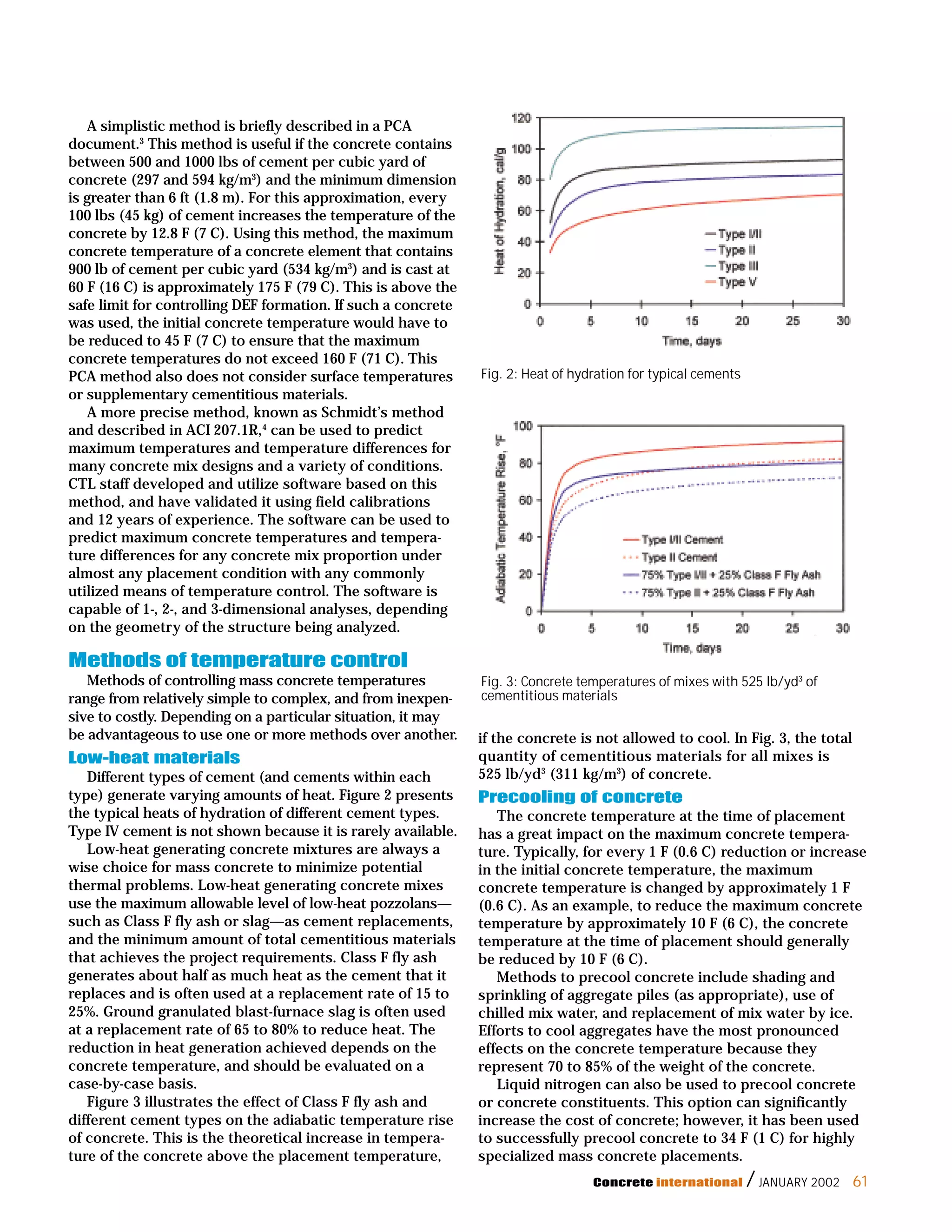
type) generate varying amounts of heat. Figure 2 presents
the typical heats of hydration of different cement types.
Type IV cement is not shown because it is rarely available.
Low-heat generating concrete mixtures are always a
wise choice for mass concrete to minimize potential
thermal problems. Low-heat generating concrete mixes
use the maximum allowable level of low-heat pozzolans—
such as Class F fly ash or slag—as cement replacements,
and the minimum amount of total cementitious materials
that achieves the project requirements. Class F fly ash
generates about half as much heat as the cement that it
replaces and is often used at a replacement rate of 15 to
25%. Ground granulated blast-furnace slag is often used
at a replacement rate of 65 to 80% to reduce heat. The
reduction in heat generation achieved depends on the
concrete temperature, and should be evaluated on a
case-by-case basis.
Figure 3 illustrates the effect of Class F fly ash and
different cement types on the adiabatic temperature rise
of concrete. This is the theoretical increase in tempera-
ture of the concrete above the placement temperature,
if the concrete is not allowed to cool. In Fig. 3, the total
quantity of cementitious materials for all mixes is
525 lb/yd3
(311 kg/m3
) of concrete.
Precooling of concrete
The concrete temperature at the time of placement
has a great impact on the maximum concrete tempera-
ture. Typically, for every 1 F (0.6 C) reduction or increase
in the initial concrete temperature, the maximum
concrete temperature is changed by approximately 1 F
(0.6 C). As an example, to reduce the maximum concrete
temperature by approximately 10 F (6 C), the concrete
temperature at the time of placement should generally
be reduced by 10 F (6 C).
Methods to precool concrete include shading and
sprinkling of aggregate piles (as appropriate), use of
chilled mix water, and replacement of mix water by ice.
Efforts to cool aggregates have the most pronounced
effects on the concrete temperature because they
represent 70 to 85% of the weight of the concrete.
Liquid nitrogen can also be used to precool concrete
or concrete constituents. This option can significantly
increase the cost of concrete; however, it has been used
to successfully precool concrete to 34 F (1 C) for highly
specialized mass concrete placements.
Fig. 2: Heat of hydration for typical cements
Fig. 3: Concrete temperatures of mixes with 525 lb/yd3
of
cementitious materials
62 JANUARY 2002 / Concrete international
ACI member John GJohn GJohn GJohn GJohn Gajdajdajdajdajdaaaaa is a licensed
professional engineer and senior engineer
for Construction Technology Laboratories
(CTL) in Skokie, Ill. He received his
master’s and bachelor’s degrees of
engineering from Iowa State University.
Gajda has been involved with more than
75 mass concrete projects throughout the
U.S. over the past nine years.
ACI member MMMMMarararararthththththaaaaa VVVVVanGeemanGeemanGeemanGeemanGeem is a licensed
professional engineer and principal engineer
for Construction Technology Laboratories
(CTL) in Skokie, Ill. She received her
bachelor’s degree of engineering from the
University of Illinois and her MBA from the
University of Chicago. In her 19 years at CTL,
VanGeem has worked in the areas of heat
transfer and thermal properties of concrete.
During the past 12 years, she has been
involved with most major mass concrete
bridge projects in the U.S.
Post-cooling of concrete
Cooling pipes in mass concrete are sometimes used to
reduce maximum concrete temperatures and to quickly
reduce interior temperatures. This method can have
high initial and operating costs, but benefits can often
outweigh these costs if cooling pipe size, spacing, and
temperatures are optimized properly.
Figure 4 illustrates the reduction in the average
temperature of a mass concrete pour with and without
internal cooling pipes. Note the reduction in the maxi-
mum concrete temperature and the increased rate of
cooling. It is important to emphasize again that signifi-
cant internal and surface thermal cracking can result if
post-cooling is improperly designed or performed.
However, if properly designed, a post-cooling system can
significantly reduce concrete temperatures and the
amount of time required for cooling.
Surface insulation
Insulation or insulated formwork is often used to
warm the concrete surface and reduce the temperature
difference, which in turn minimizes the potential for
thermal cracking. For most mass pours, surface insula-
tion does not appreciably increase the maximum concrete
temperature, but it can significantly decrease the rate of
cooling. Insulation is inexpensive, but resulting delays
from the reduced cooling rate can be costly. Insulation
often has to remain in place for several weeks or longer.
Removing it too soon can cause the surface to cool
quickly and crack.
Many types of insulation materials are available, and
insulation levels can be optimized to meet required
temperature differences and maximize the rate of cooling.
Aggregate
Thermal properties of the coarse aggregate can have a
significant effect on mass concrete. Concretes containing
low-thermal-expansion aggregates such as granite and
limestone generally permit higher maximum allowable
temperature differences than concretes made using high-
thermal-expansion aggregates, as shown in Fig. 5 (Fig. 5
is similar to Fig. 1, except a second calculated maximum
allowable temperature difference is added for concrete
with a high-thermal-expansion aggregate). This means
that selecting an aggregate with a low thermal expansion
will reduce the potential for thermal cracking.
References
1. ACI Committee 116, “Cement and Concrete Terminology (ACI
116R-00),” American Concrete Institute, Farmington Hills, Mich.,
2000, 73 pp.
2. ACI Committee 207, “Effect of Restraint, Volume Change, and
Reinforcement on Cracking of Mass Concrete (ACI 207.2R-95),”
American Concrete Institute, Farmington Hills, Mich., 2000, 26 pp.
3. Portland Cement Association, Design and Control of Concrete
Mixtures, 13th Edition, Skokie, Ill., 1988, 212 pp.
4. ACI Committee 207, “Mass Concrete (ACI 207.1R-96),” American
Concrete Institute, Farmington Hills, Mich., 1996, 42 pp.
Selected for reader interest by the editors after independent expert
evaluation and recommendation.
Fig. 5: Effect of aggregate on the maximum allowable temperature
difference
Fig. 4: Effects of internal cooling pipes

Controling temperature in mass concrete

  • 1.
    Concrete international /JANUARY2002 59 BY JOHN GAJDA AND MARTHA VANGEEM pecifications generally limit temperatures in mass concrete to prevent cracking and durability prob- lems. Temperature limits are specified to seemingly arbitrary values of 135 F (57 C) for the maximum allowable concrete temperature and 35 F (19 C) for the maximum allowable temperature difference between the center and surface of the mass concrete section. Typically, the contractor must meet all of the specification requirements, but without a good understanding of mass concrete, keeping concrete temperatures within limits can be a difficult task. Often, well-established temperature control measures are sufficient to meet project specifications. However, if these are overlooked or poorly understood, they could result in concrete temperatures and temperature differ- ences that greatly exceed specified limits, causing delays to the construction schedule or damage to the concrete. Additionally, recent trends, such as increasing the size of concrete sections and requiring high minimum cement contents or low water-cementitious materials ratios, make temperature control even more difficult. Understanding mass concrete is the key to controlling temperatures and ultimately saving time, effort, and money. Controlling Temperatures in Mass Concrete Understanding mass concrete is the key to controlling temperatures and ultimately saving time, effort, and money What is mass concrete? A question often arises as to exactly what is considered to be mass concrete. According to ACI 116R,1 mass concrete is defined as “any volume of concrete with dimensions large enough to require that measures be taken to cope with generation of heat from hydration of the cement and attendant volume change, to minimize cracking.” Because this definition doesn’t provide a specific measure, many agencies have developed their own definitions of mass concrete. For example, mass con- crete is defined by some agencies as “any concrete element having a least dimension greater than 3 ft (0.9 m).” Under this definition, a large mat foundation with a thickness of 3 ft (0.9 m) would not be considered mass concrete, but a large mat foundation with a thick- ness of 3.25 ft (1 m) would be considered mass concrete. Other agencies use different minimum dimensions, ranging from 1.5 to 6.5 ft (0.46 to 2.0 m), depending on past experience. Note that none of these definitions considers the cementitious material content of the concrete. Temperatures within a concrete element will be much different if high-performance or high-early-strength concrete is used rather than typical structural concrete. S
  • 2.
    60 JANUARY 2002/ Concrete international For lack of a standard definition, we consider mass concrete to be any element with a minimum dimension equal to or greater than 3 ft (0.9 m). Similar consider- ations should be given to other concrete elements that do not meet this definition but contain Type III cement or cementitious materials in excess of 564 lb/yd3 (335 kg/m3 ) of concrete. In many cases, these non-mass elements will also generate significant amounts of heat. Maximum concrete temperature and temperature difference Maximum allowable concrete temperatures and temperature differences are often specified to ensure that proper planning occurs prior to concrete place- ment. In many cases, the specified limits are seemingly arbitrary and do not consider project specifics. As an example of this, certain project specifications limit the maximum concrete temperature to 135 F (57 C), and limit the maximum concrete temperature difference to 35 F (19 C). Other restrictions are often included, such as limits on the maximum and minimum temperatures of delivered concrete. Maximum concrete temperature The maximum concrete temperature is limited for a variety of reasons. The primary reason is to prevent damage to the concrete. Studies have shown that the long-term durability of certain concretes can be compro- mised if the maximum temperature after placement exceeds the range of 155 to 165 F (68 to 74 C). The primary damage mechanism is delayed ettringite forma- tion (DEF). DEF can cause internal expansion and cracking of concrete, which may not be evident for several years after placement. Other reasons to limit the maximum concrete temperature include reducing cooling times and associated delays, and minimizing the potential for cracking due to thermal expansion and contraction. Temperatures over 190 F (88 C) can also reduce expected compressive strengths. Maximum temperature difference A maximum allowable concrete temperature difference is often specified to minimize the potential for thermal cracking. This temperature difference is the difference between the temperature at the hottest portion of the concrete and that at the surface. Thermal cracking will occur when contraction due to cooling at the surface causes tensile stresses that exceed the tensile strength of the concrete. A maximum allowable temperature difference of 35 F (19 C) is often specified in contract documents. This temperature difference is a general guideline based on experience with unreinforced mass concrete placed in Europe more than 50 years ago. In many situations, limiting the temperature difference to 35 F (19 C) is overly restrictive; thermal cracking may not occur even at higher temperature differences. In other cases, significant thermal cracking may still occur even when the temperature difference is less than 35 F (19 C). The maximum allowable temperature difference is a function of concrete mechanical properties such as thermal expansion, tensile strength, and elastic modulus, as well as the size and restraints of the concrete element. ACI 207.2R2 provides guidance on calculating the maxi- mum allowable temperature difference to prevent thermal cracking based on the properties of the concrete and for a specific structure. Figure 1 compares the typically specified 35 F (19 C) maximum allowable temperature difference with that of the calculated maximum allowable temperature differ- ence for a specific mat foundation. As the concrete reaches its design strength, the calculated maximum allowable temperature difference is much greater than 35 F (19 C). Use of the calculated maximum allowable temperature difference can significantly reduce the amount of time that protective measures, such as surface insulation, must be kept in place. Predicting concrete temperatures Specifications for mass concrete often require particular cement types, minimum cement contents, and maximum supplementary cementitious material contents. Once this information is available, the process of predicting maximum concrete temperatures and temperature differences can begin. Several options are available to predict maximum concrete temperatures. Fig. 1: Comparison of maximum allowable temperature differences Why is temperature control necessary? All concretes generate heat as the cementitious materials hydrate. Most of this heat generation occurs in the first days after placement. For thin items such as pavements, heat dissipates almost as quickly as it is generated. For thicker concrete sections (mass concrete), heat dissipates more slowly than it is generated. The net result is that mass concrete can get hot. Management of these temperatures is necessary to prevent damage, minimize delays, and meet project specifications.
  • 3.
    Concrete international /JANUARY2002 61 A simplistic method is briefly described in a PCA document.3 This method is useful if the concrete contains between 500 and 1000 lbs of cement per cubic yard of concrete (297 and 594 kg/m3 ) and the minimum dimension is greater than 6 ft (1.8 m). For this approximation, every 100 lbs (45 kg) of cement increases the temperature of the concrete by 12.8 F (7 C). Using this method, the maximum concrete temperature of a concrete element that contains 900 lb of cement per cubic yard (534 kg/m3 ) and is cast at 60 F (16 C) is approximately 175 F (79 C). This is above the safe limit for controlling DEF formation. If such a concrete was used, the initial concrete temperature would have to be reduced to 45 F (7 C) to ensure that the maximum concrete temperatures do not exceed 160 F (71 C). This PCA method also does not consider surface temperatures or supplementary cementitious materials. A more precise method, known as Schmidt’s method and described in ACI 207.1R,4 can be used to predict maximum temperatures and temperature differences for many concrete mix designs and a variety of conditions. CTL staff developed and utilize software based on this method, and have validated it using field calibrations and 12 years of experience. The software can be used to predict maximum concrete temperatures and tempera- ture differences for any concrete mix proportion under almost any placement condition with any commonly utilized means of temperature control. The software is capable of 1-, 2-, and 3-dimensional analyses, depending on the geometry of the structure being analyzed. Methods of temperature control Methods of controlling mass concrete temperatures range from relatively simple to complex, and from inexpen- sive to costly. Depending on a particular situation, it may be advantageous to use one or more methods over another. Low-heat materials Different types of cement (and cements within each type) generate varying amounts of heat. Figure 2 presents the typical heats of hydration of different cement types. Type IV cement is not shown because it is rarely available. Low-heat generating concrete mixtures are always a wise choice for mass concrete to minimize potential thermal problems. Low-heat generating concrete mixes use the maximum allowable level of low-heat pozzolans— such as Class F fly ash or slag—as cement replacements, and the minimum amount of total cementitious materials that achieves the project requirements. Class F fly ash generates about half as much heat as the cement that it replaces and is often used at a replacement rate of 15 to 25%. Ground granulated blast-furnace slag is often used at a replacement rate of 65 to 80% to reduce heat. The reduction in heat generation achieved depends on the concrete temperature, and should be evaluated on a case-by-case basis. Figure 3 illustrates the effect of Class F fly ash and different cement types on the adiabatic temperature rise of concrete. This is the theoretical increase in tempera- ture of the concrete above the placement temperature, if the concrete is not allowed to cool. In Fig. 3, the total quantity of cementitious materials for all mixes is 525 lb/yd3 (311 kg/m3 ) of concrete. Precooling of concrete The concrete temperature at the time of placement has a great impact on the maximum concrete tempera- ture. Typically, for every 1 F (0.6 C) reduction or increase in the initial concrete temperature, the maximum concrete temperature is changed by approximately 1 F (0.6 C). As an example, to reduce the maximum concrete temperature by approximately 10 F (6 C), the concrete temperature at the time of placement should generally be reduced by 10 F (6 C). Methods to precool concrete include shading and sprinkling of aggregate piles (as appropriate), use of chilled mix water, and replacement of mix water by ice. Efforts to cool aggregates have the most pronounced effects on the concrete temperature because they represent 70 to 85% of the weight of the concrete. Liquid nitrogen can also be used to precool concrete or concrete constituents. This option can significantly increase the cost of concrete; however, it has been used to successfully precool concrete to 34 F (1 C) for highly specialized mass concrete placements. Fig. 2: Heat of hydration for typical cements Fig. 3: Concrete temperatures of mixes with 525 lb/yd3 of cementitious materials
  • 4.
    62 JANUARY 2002/ Concrete international ACI member John GJohn GJohn GJohn GJohn Gajdajdajdajdajdaaaaa is a licensed professional engineer and senior engineer for Construction Technology Laboratories (CTL) in Skokie, Ill. He received his master’s and bachelor’s degrees of engineering from Iowa State University. Gajda has been involved with more than 75 mass concrete projects throughout the U.S. over the past nine years. ACI member MMMMMarararararthththththaaaaa VVVVVanGeemanGeemanGeemanGeemanGeem is a licensed professional engineer and principal engineer for Construction Technology Laboratories (CTL) in Skokie, Ill. She received her bachelor’s degree of engineering from the University of Illinois and her MBA from the University of Chicago. In her 19 years at CTL, VanGeem has worked in the areas of heat transfer and thermal properties of concrete. During the past 12 years, she has been involved with most major mass concrete bridge projects in the U.S. Post-cooling of concrete Cooling pipes in mass concrete are sometimes used to reduce maximum concrete temperatures and to quickly reduce interior temperatures. This method can have high initial and operating costs, but benefits can often outweigh these costs if cooling pipe size, spacing, and temperatures are optimized properly. Figure 4 illustrates the reduction in the average temperature of a mass concrete pour with and without internal cooling pipes. Note the reduction in the maxi- mum concrete temperature and the increased rate of cooling. It is important to emphasize again that signifi- cant internal and surface thermal cracking can result if post-cooling is improperly designed or performed. However, if properly designed, a post-cooling system can significantly reduce concrete temperatures and the amount of time required for cooling. Surface insulation Insulation or insulated formwork is often used to warm the concrete surface and reduce the temperature difference, which in turn minimizes the potential for thermal cracking. For most mass pours, surface insula- tion does not appreciably increase the maximum concrete temperature, but it can significantly decrease the rate of cooling. Insulation is inexpensive, but resulting delays from the reduced cooling rate can be costly. Insulation often has to remain in place for several weeks or longer. Removing it too soon can cause the surface to cool quickly and crack. Many types of insulation materials are available, and insulation levels can be optimized to meet required temperature differences and maximize the rate of cooling. Aggregate Thermal properties of the coarse aggregate can have a significant effect on mass concrete. Concretes containing low-thermal-expansion aggregates such as granite and limestone generally permit higher maximum allowable temperature differences than concretes made using high- thermal-expansion aggregates, as shown in Fig. 5 (Fig. 5 is similar to Fig. 1, except a second calculated maximum allowable temperature difference is added for concrete with a high-thermal-expansion aggregate). This means that selecting an aggregate with a low thermal expansion will reduce the potential for thermal cracking. References 1. ACI Committee 116, “Cement and Concrete Terminology (ACI 116R-00),” American Concrete Institute, Farmington Hills, Mich., 2000, 73 pp. 2. ACI Committee 207, “Effect of Restraint, Volume Change, and Reinforcement on Cracking of Mass Concrete (ACI 207.2R-95),” American Concrete Institute, Farmington Hills, Mich., 2000, 26 pp. 3. Portland Cement Association, Design and Control of Concrete Mixtures, 13th Edition, Skokie, Ill., 1988, 212 pp. 4. ACI Committee 207, “Mass Concrete (ACI 207.1R-96),” American Concrete Institute, Farmington Hills, Mich., 1996, 42 pp. Selected for reader interest by the editors after independent expert evaluation and recommendation. Fig. 5: Effect of aggregate on the maximum allowable temperature difference Fig. 4: Effects of internal cooling pipes