Dr . Nahid Sherbini
Consultant IM &Pulmonary
KFH ,Medina ,Saudi Arabia
Breathing is controlled by the central
neuronal network to meet the metabolic
demands of the body
– Neural
– Chemical
Keep arterial levels of O2 & CO2 constant.
Match perfusion by pulmonary blood
flow with ventilation of the lungs with
overall metabolic demand.
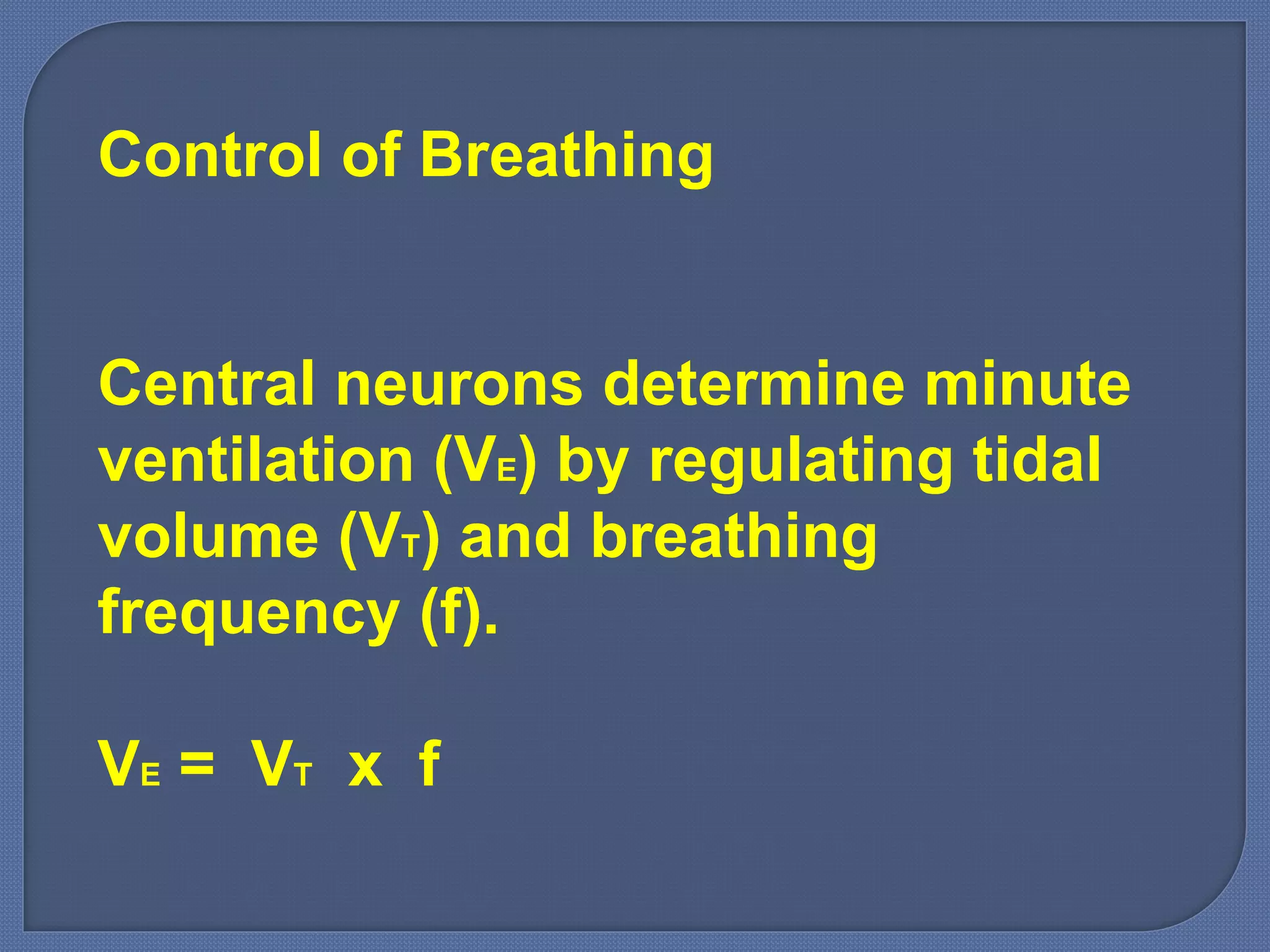
Control of Breathing
Central neurons determine minute
ventilation (VE) by regulating tidal
volume (VT) and breathing
frequency (f).
VE = VT x f
Definition:
A collection of functionally similar neurons
that help to regulate the respiratory
movement.
 Higher respiratory center: cortex,
hypothalamus & limbic system.
Medulla & Pons :
Basic respiratory center: produce and
control the respiration.
 Spinal cord: motor neurons.
Affect rate and depth of ventilation
Influenced by:
• higher brain centers
• peripheral mechanoreceptors
• peripheral & central chemoreceptors
Voluntary breathing center
Cerebral cortex.
Automatic (involuntary) breathing center
– Medulla
– Pons
CAN BYPASS LOWER CENTERS.
SPEECH,SINGING,COUGHING, BREATH
HOLDING .
 Voluntarily – speaking, blowing, whistling, pushing,
defecation.
 Voluntary control is bilateral – cannot contract half of
diaphragm or larynx.
 Descend via pyramidal tracts.
 Destroy voluntary control without losing involuntary
control can be.. i.e. stroke
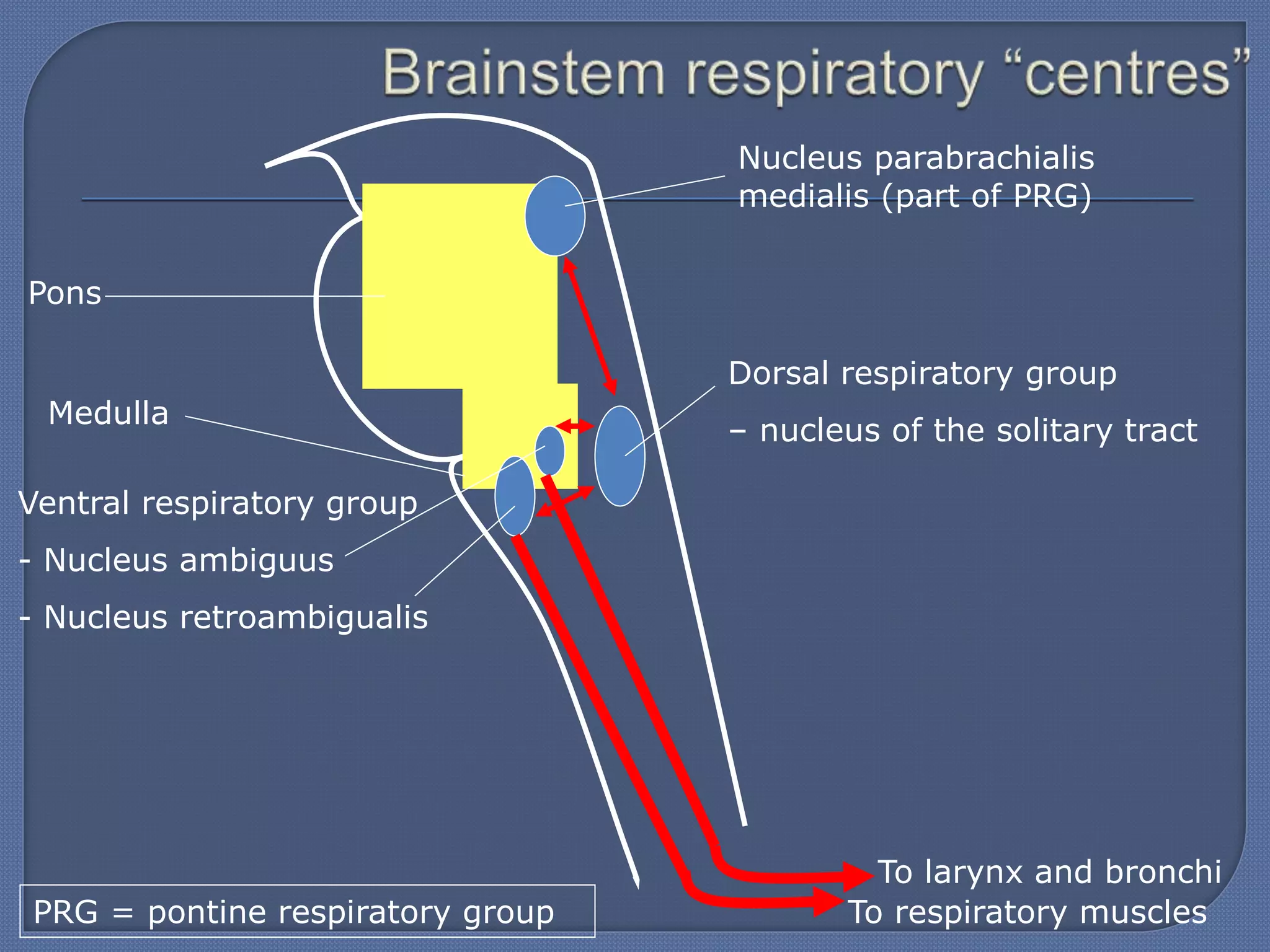
To larynx and bronchi
To respiratory muscles
Nucleus parabrachialis
medialis (part of PRG)
Dorsal respiratory group
– nucleus of the solitary tract
Pons
Medulla
Ventral respiratory group
- Nucleus ambiguus
- Nucleus retroambigualis
PRG = pontine respiratory group
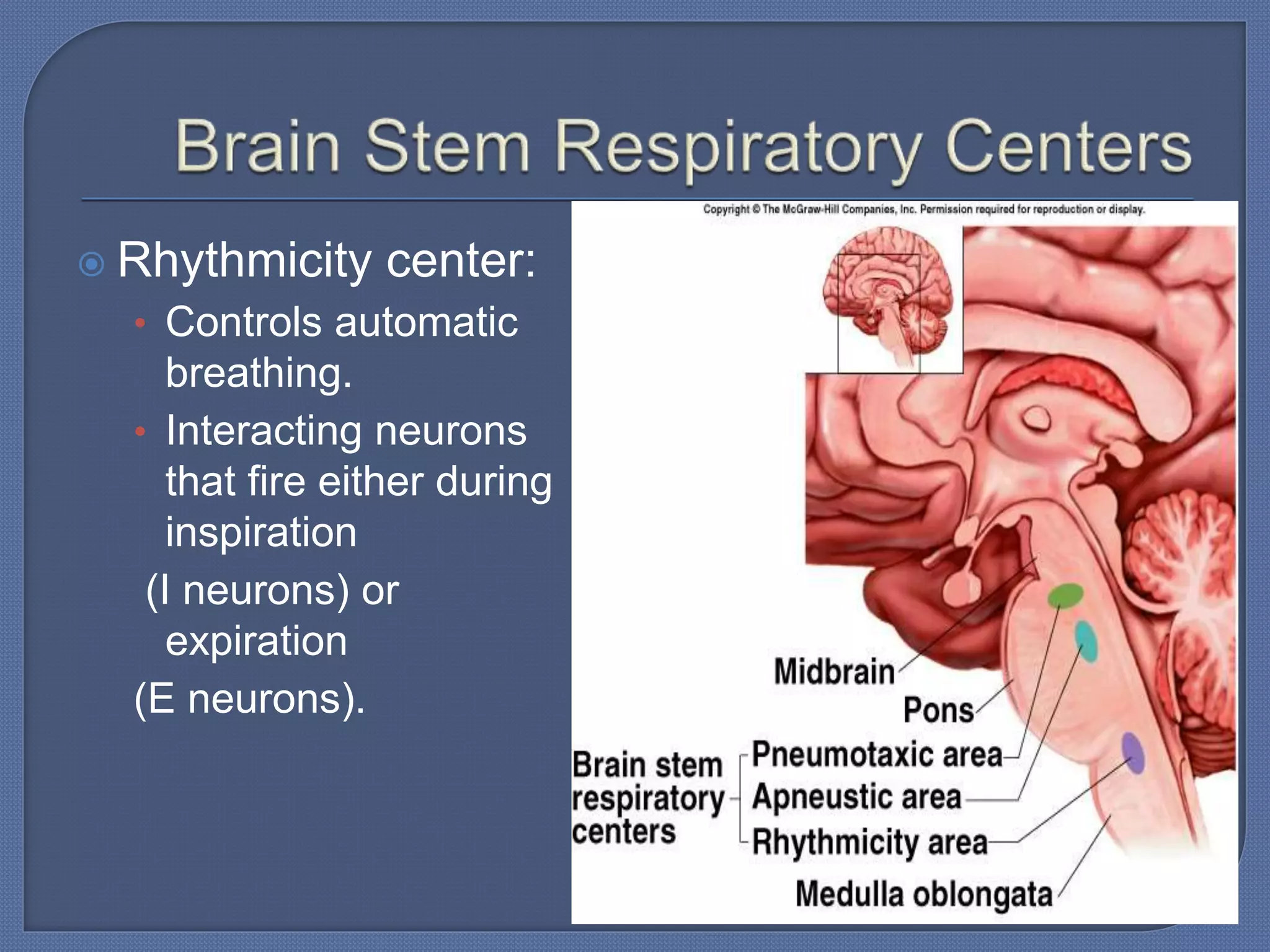
 Rhythmicity center:
• Controls automatic
breathing.
• Interacting neurons
that fire either during
inspiration
(I neurons) or
expiration
(E neurons).
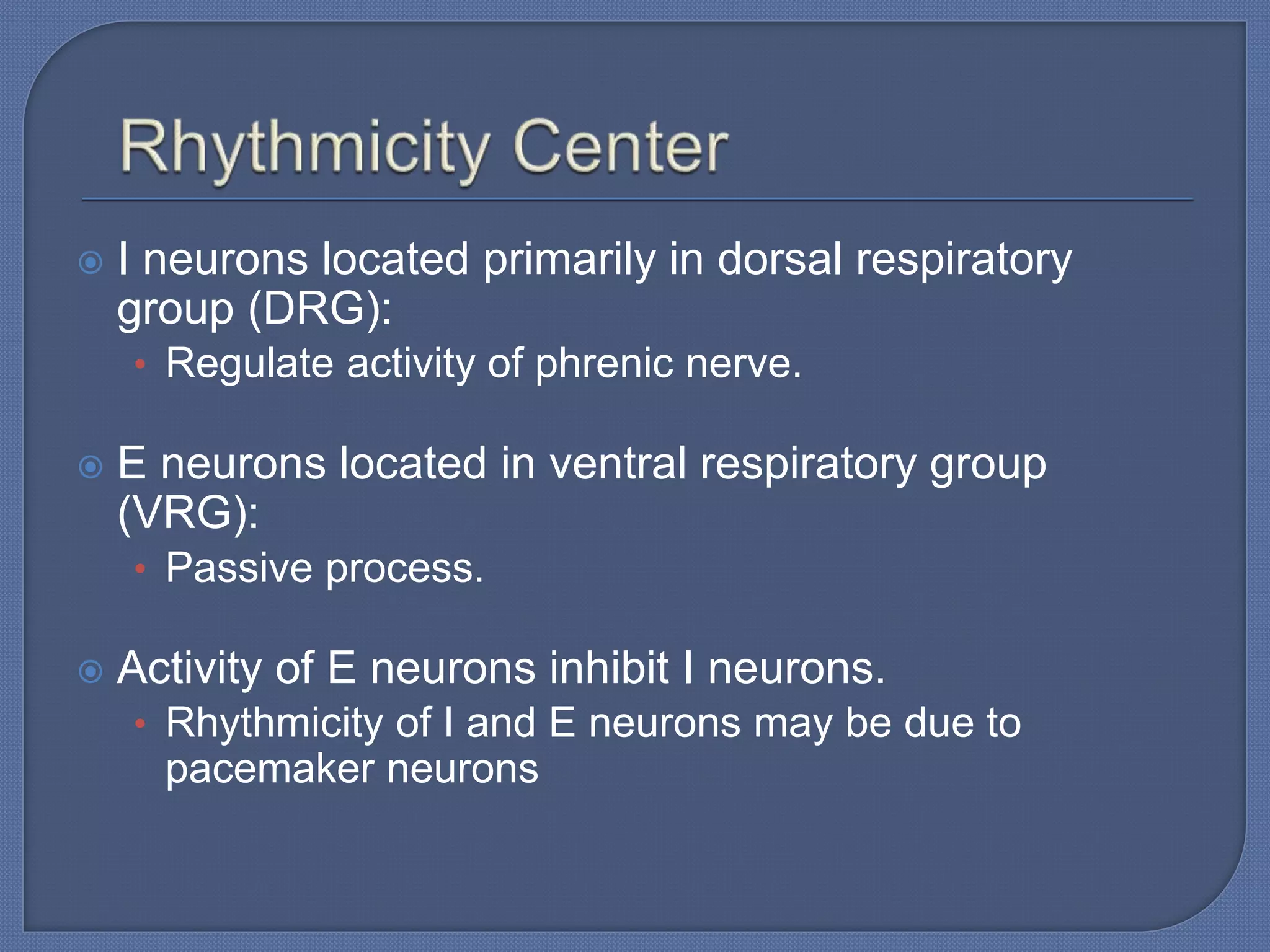
 I neurons located primarily in dorsal respiratory
group (DRG):
• Regulate activity of phrenic nerve.
 E neurons located in ventral respiratory group
(VRG):
• Passive process.
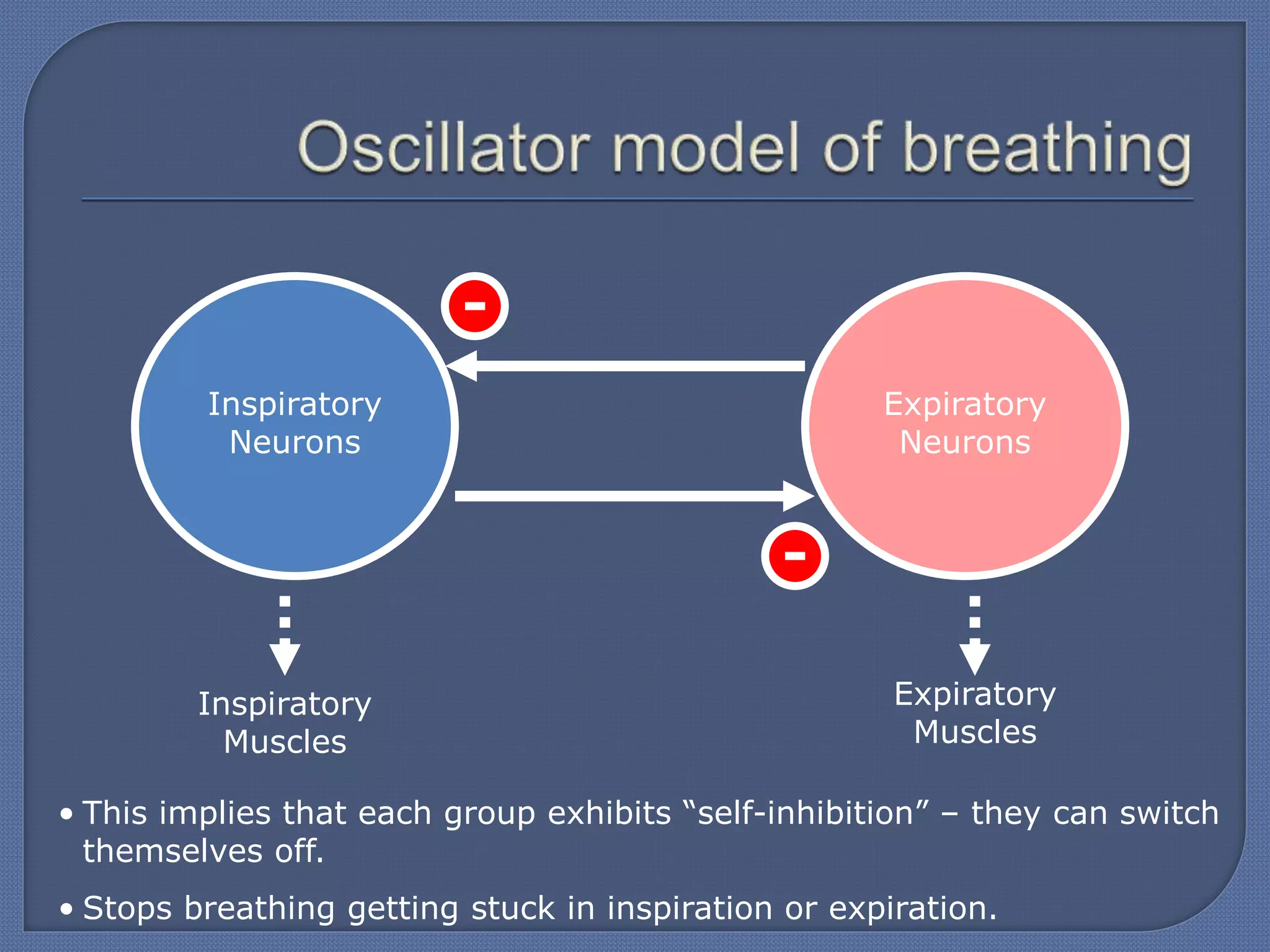
 Activity of E neurons inhibit I neurons.
• Rhythmicity of I and E neurons may be due to
pacemaker neurons
Inspiratory
Muscles
Expiratory
Muscles
Inspiratory
Neurons
Expiratory
Neurons
• This implies that each group exhibits “self-inhibition” – they can switch
themselves off.
• Stops breathing getting stuck in inspiration or expiration.
 Apneustic center (lower pons) – to
promote Inspiration.
Pneumotaxic center (upper pons)
– inhibits apneustic center & inhibits
inspiration
-helps control the rate and pattern of
breathing.
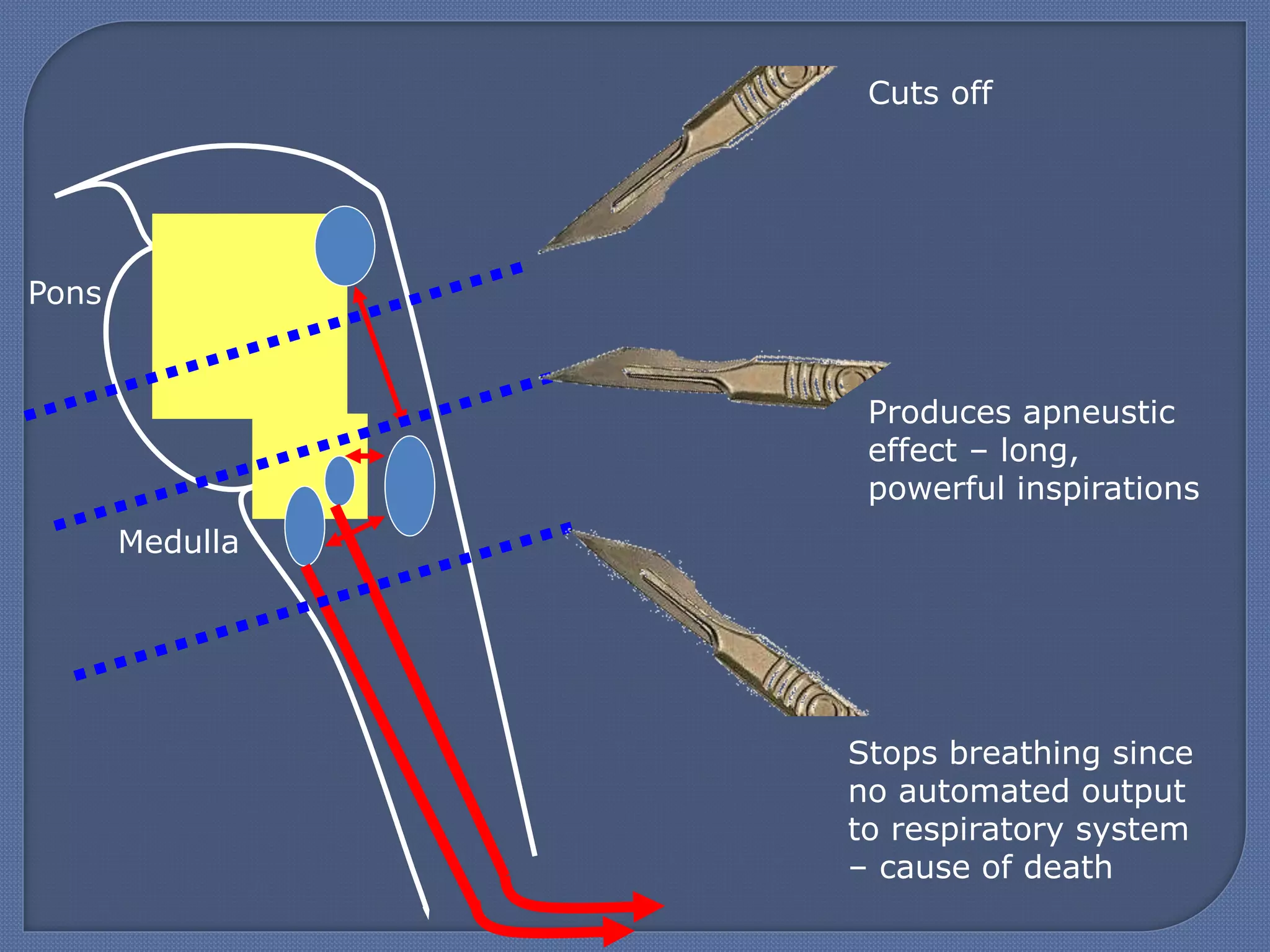
Pons
Medulla
Cuts off
Produces apneustic
effect – long,
powerful inspirations
Stops breathing since
no automated output
to respiratory system
– cause of death
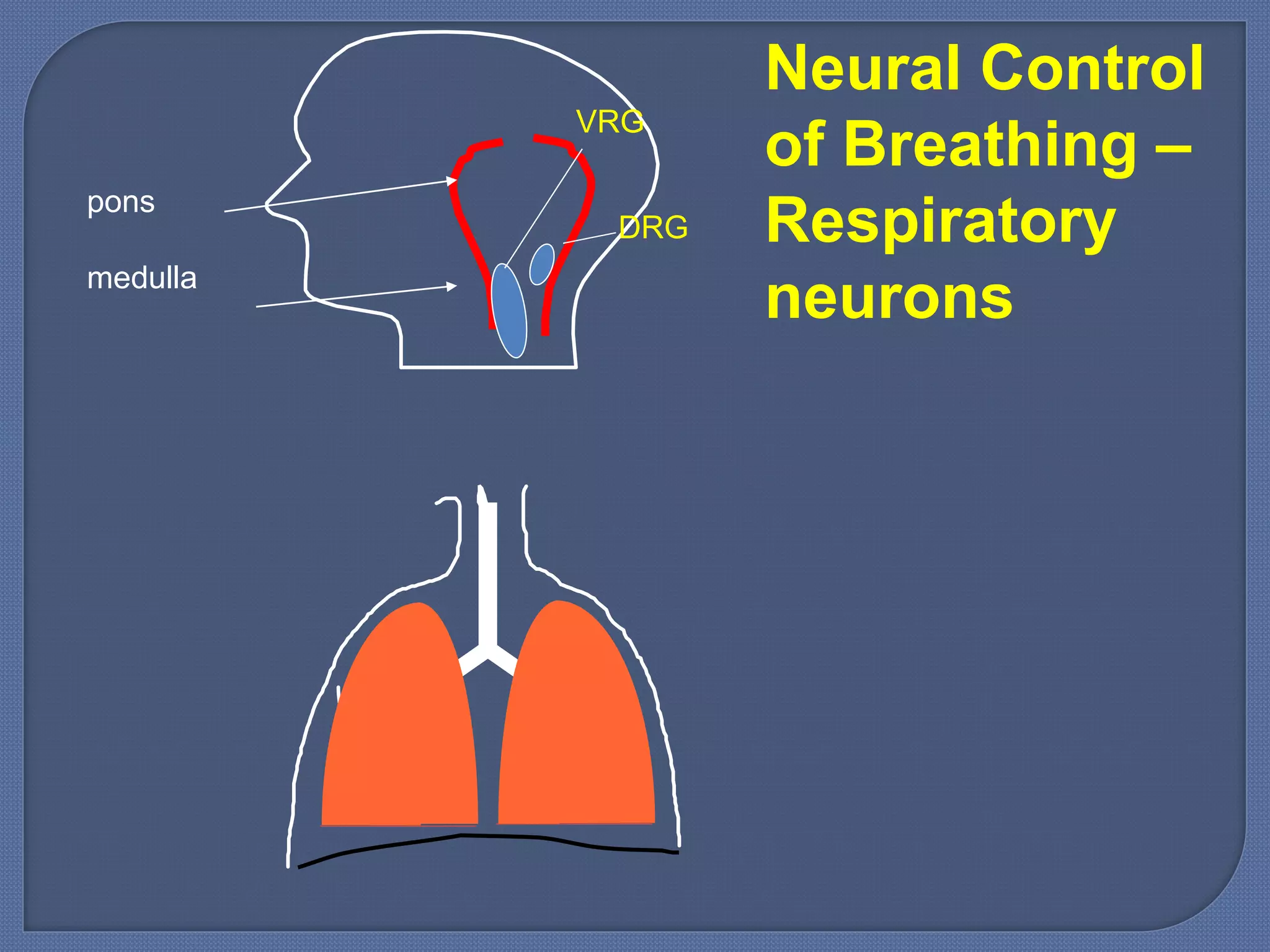
DRG
VRG
pons
medulla
Neural Control
of Breathing –
Respiratory
neurons
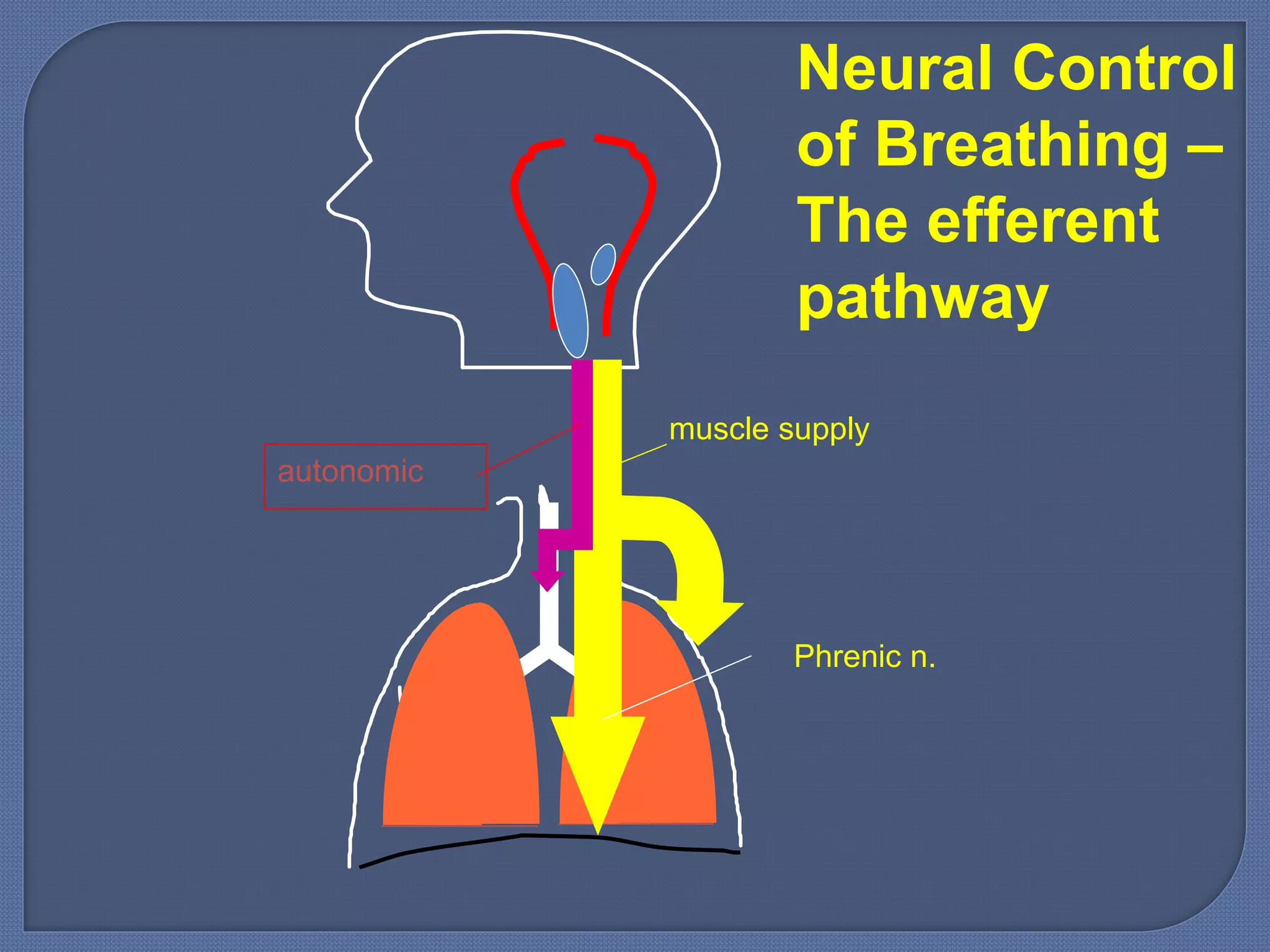
Neural Control
of Breathing –
The efferent
pathway
Phrenic n.
muscle supply
autonomic
DECENDING BULBOSPINAL FIBRES
ARE IN THE VENTRAL AND LATERAL
COLUMNS.
RESP NEURONS ARE IN VENTRAL Horn
EXP NEURONS -VENTROMEDIAL
INSP NEURONS- LATERAL
ASCENDING SPINORETICULAR FIBRES
CARRY PROPRIOCEPTIVE INPUTS TO
STIMULATE RESP CENTRE.
BILAT CERVICAL CORDOTOMY
LEADS TO RESPIRATORY
DYSFUNCTION (SLEEP APNEA).
 Diaphragm controlled directly by  motor
neurons – “C3,4 & 5 keeps the diaphragm alive”.
 Motor neurons take turns to stimulate different
groups of muscle fibres active to minimise
fatigue.
 Due to poor supply of muscle spindles , control
comes from DRG &VRG.
And this explains why rare to feel fatigue in
diaphragm.
 Larynx movements are synchronized with breathing.
 Superior and recurrent laryngeal nerves are branches of
vagus nerve.
Expiration – vocal cords together.
Inspiration – vocal cords apart.
 Automatic rhythm that we can override consciously.
 Opera singers try and maximise control of breathing
using these muscles.
 Control of breathing affected profoundly by
vagus nerves (Cranial Nerve X).
 Two of these run down either side of neck and
torso, near trachea.
 Regulate receptors which are most involved in
respiration:
• Slowly-adapting pulmonary stretch receptors (PSR’s)
• Rapidly-adapting (irritant) receptors (RAR’s)
• C-fibre receptors (J receptors)
Paintel et al (1970) :
Propose J receptors function TO LIMIT
EXERCISE WHEN INTERSTITIAL
PRESSURE INCREASES(J REFLEX)
MECHANISM:
INHIBITION OF RESP MOTOR
NEURONS.
•+ when pulmonary caps are
engorged or pulmonary edema.
create a feeling of dyspnea
 UNMYELINATED NERVE ENDINGS .
 RESPONSIBLE FOR BRONCHOSPASM
IN ASTHMA.
 INCREASED TRACHEOBRONCHIAL
SECRETIONS.
 MEDIATORS:
HISTAMINE, PROSTAGLANDINS ,
BRADYKININ.
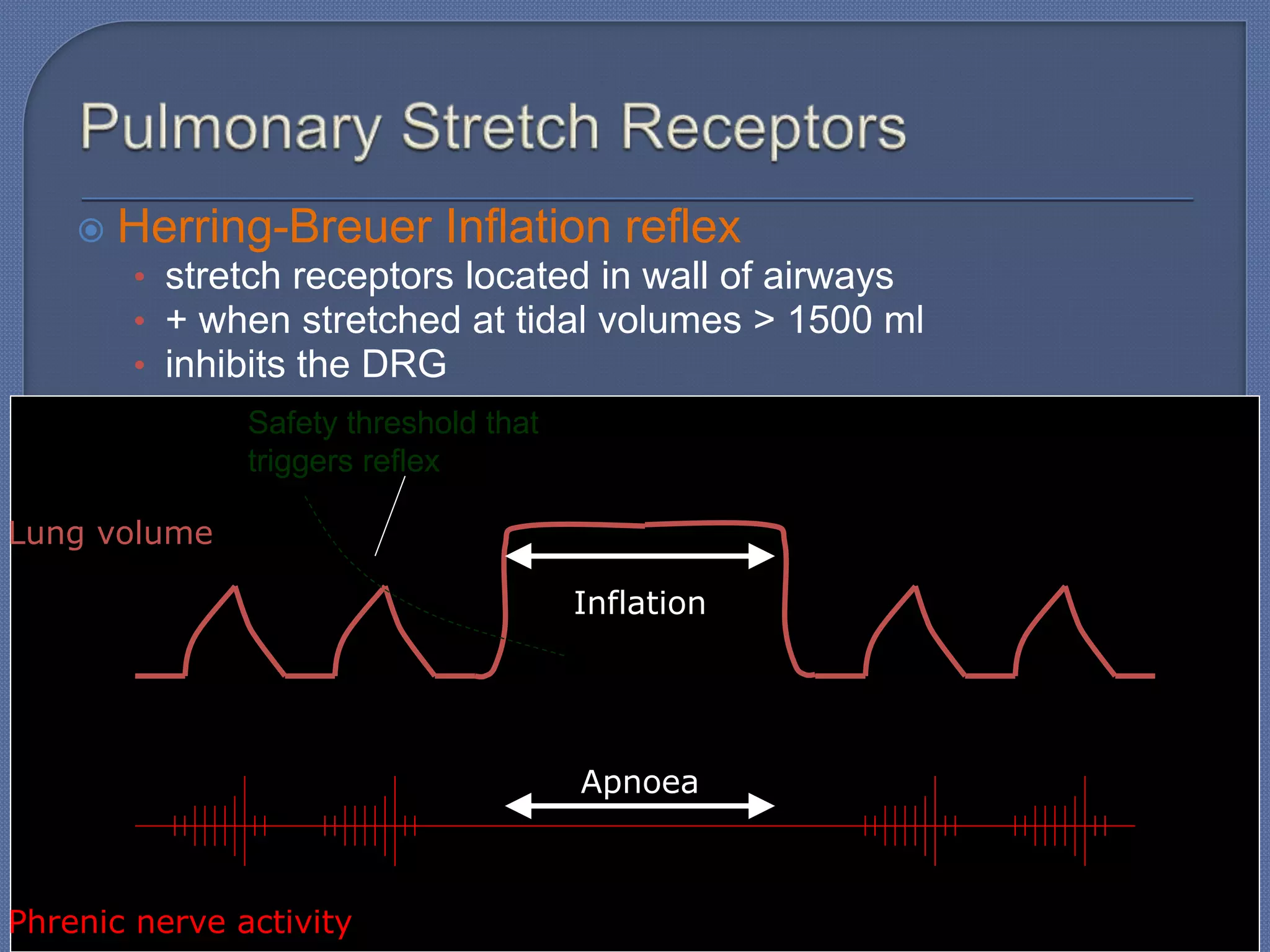
 Herring-Breuer Inflation reflex
• stretch receptors located in wall of airways
• + when stretched at tidal volumes > 1500 ml
• inhibits the DRG
Inflation
Apnoea
Phrenic nerve activity
Lung volume
Safety threshold that
triggers reflex
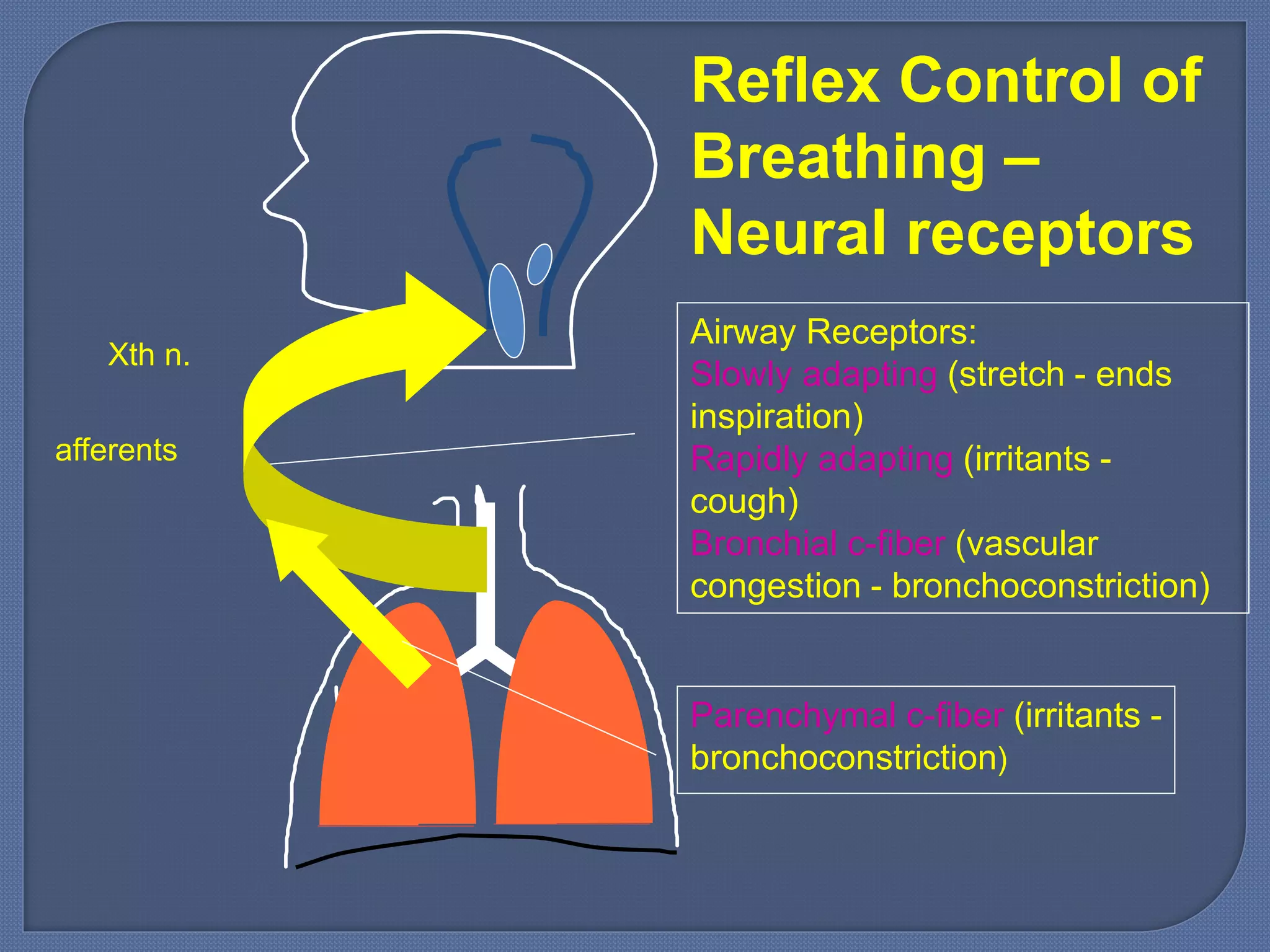
Airway Receptors:
Slowly adapting (stretch - ends
inspiration)
Rapidly adapting (irritants -
cough)
Bronchial c-fiber (vascular
congestion - bronchoconstriction)
Parenchymal c-fiber (irritants -
bronchoconstriction)
Xth n.
Reflex Control of
Breathing –
Neural receptors
afferents
EXPT ANIMAL STUDIES
Rapid shallow breathing pattern in
response to bronchospasm is mediated
through vagal afferents.
MECHANORECEPTORS - SENSE
CHANGES IN LENGTH ,TENSION AND
MOVEMENT.
ASCENDING TRACTS IN ANTERIOR
COLUMN OF SPINAL CORD TO RESP
CENTRE IN MEDULLA.
SENSE CHANGES IN MSL LENGTH.
INTERCOSTALS > DIAPHRAGM .
REFLEX CONTRACTION OF MUSCLE IN
RESPONSE TO STRETCH.
INCREASE VENTILATION IN EARLY
STAGES OF EXERCISE.
SENSE DEGREE OF CHEST WALL
MOVT.
INFLUENCE THE LEVEL & TIMING OF
RESP ACTIVITY.
 Neural control
 Beta receptors causing dilatation
 Parasympathetic-muscarinic receptors causing
constriction
 NANC nerves (non-adrenergic, non-cholinergic)
○ Inhibitory release VIP and NO  bronchodilitation
○ Stimulatory  bronchoconstriction, mucous
secretion, vascular hyperpermeability, cough,
vasodilation “neurogenic inflammation”.
Local factors
• histamine binds to H1 receptors-constriction
• histamine binds to H2 receptors-dilation
• slow reactive substance of anaphylaxsis-
constriction-allergic response to pollen
• Prostaglandins E series- dilation
• Prostaglandins F series- constriction
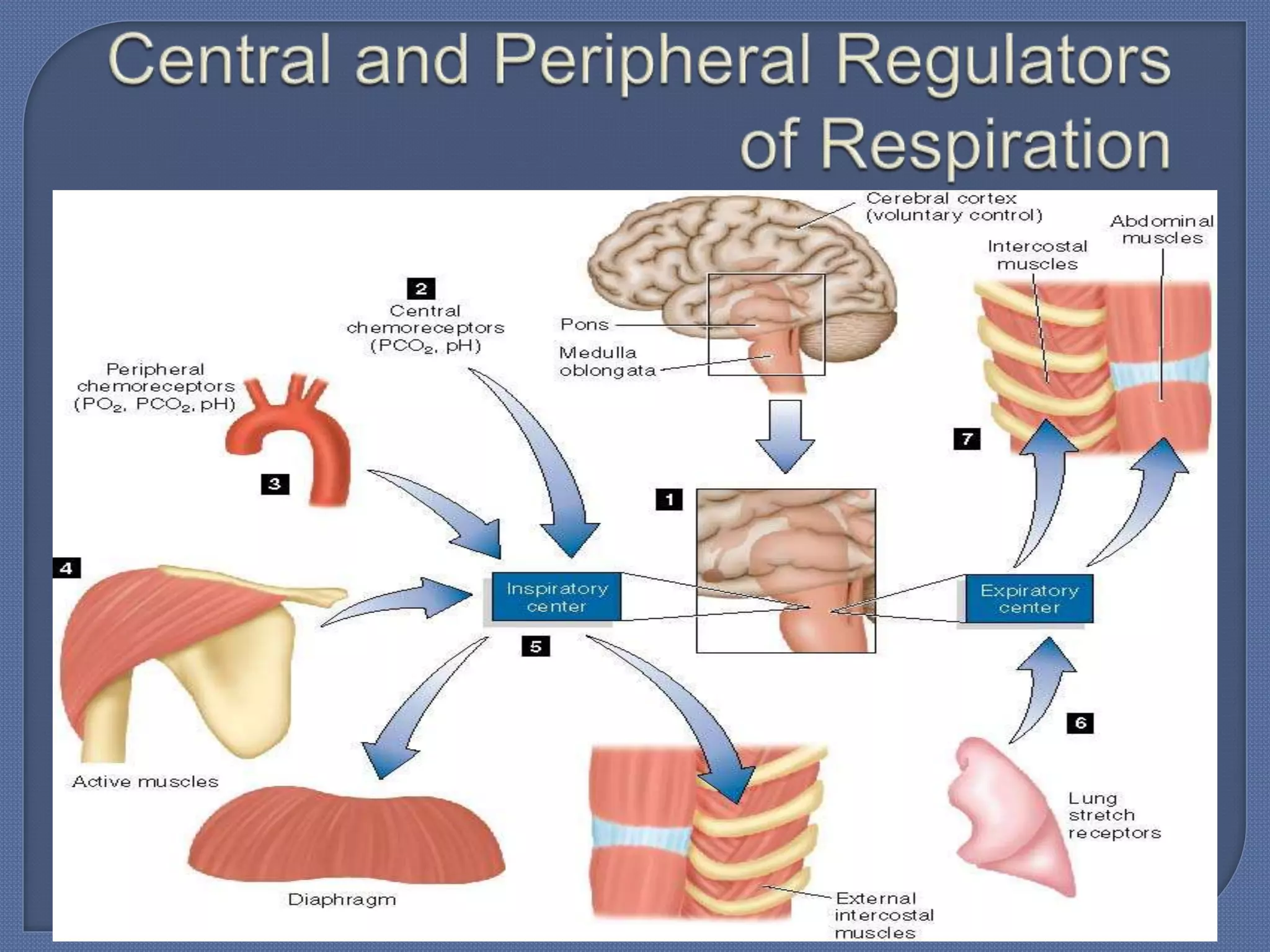
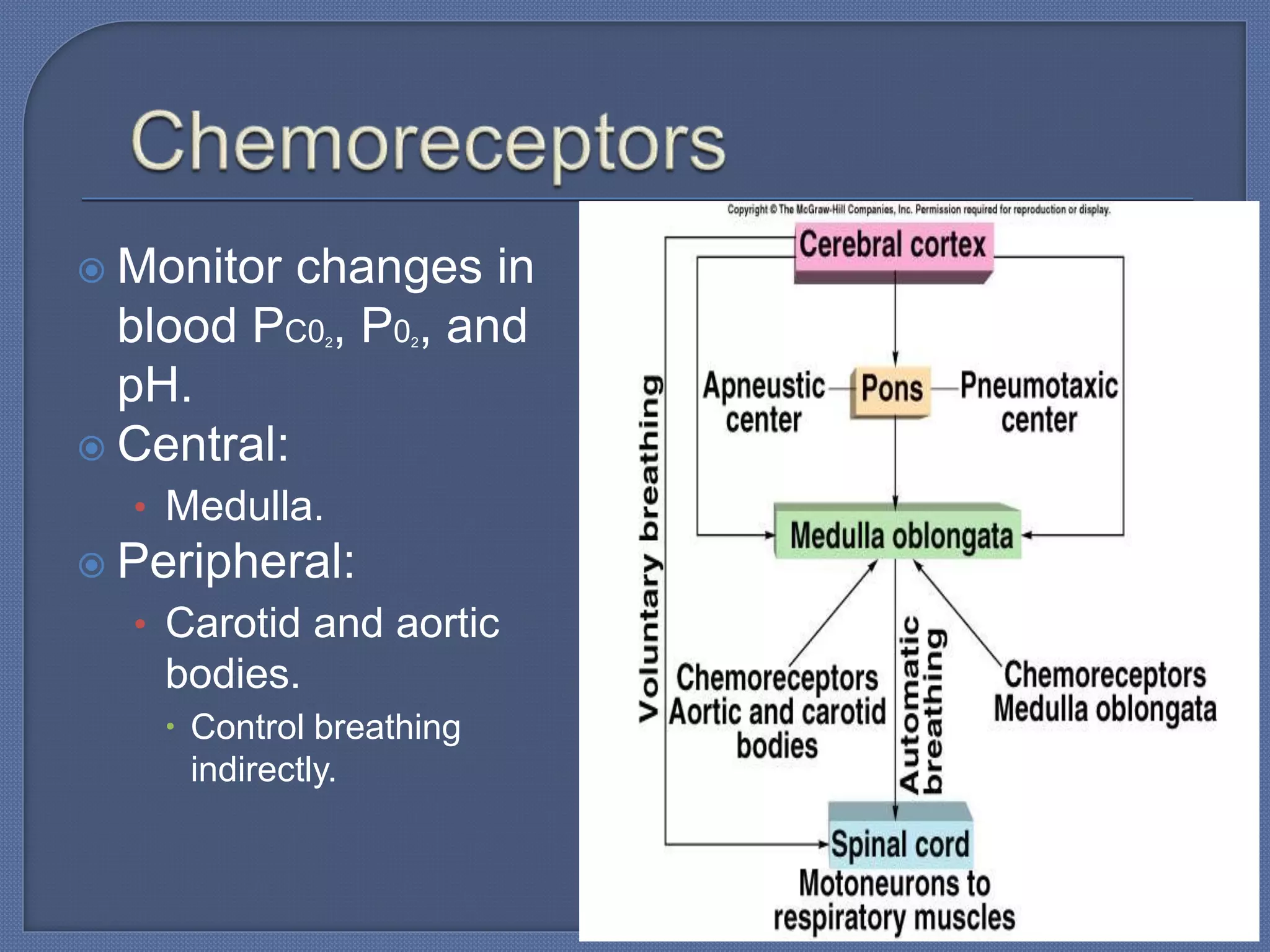
 Monitor changes in
blood PC02, P02, and
pH.
 Central:
• Medulla.
 Peripheral:
• Carotid and aortic
bodies.
 Control breathing
indirectly.
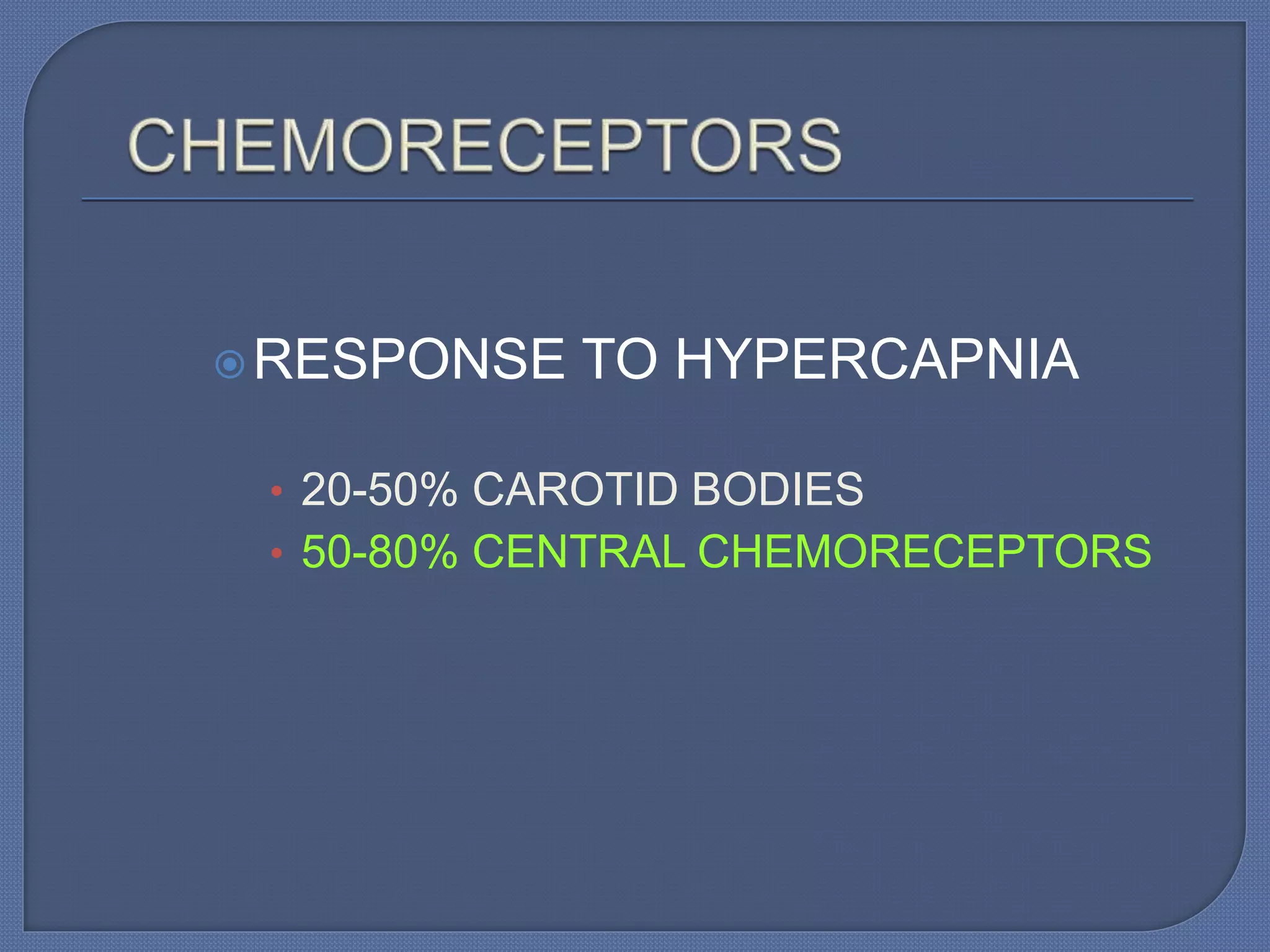
RESPONSE TO HYPERCAPNIA
• 20-50% CAROTID BODIES
• 50-80% CENTRAL CHEMORECEPTORS
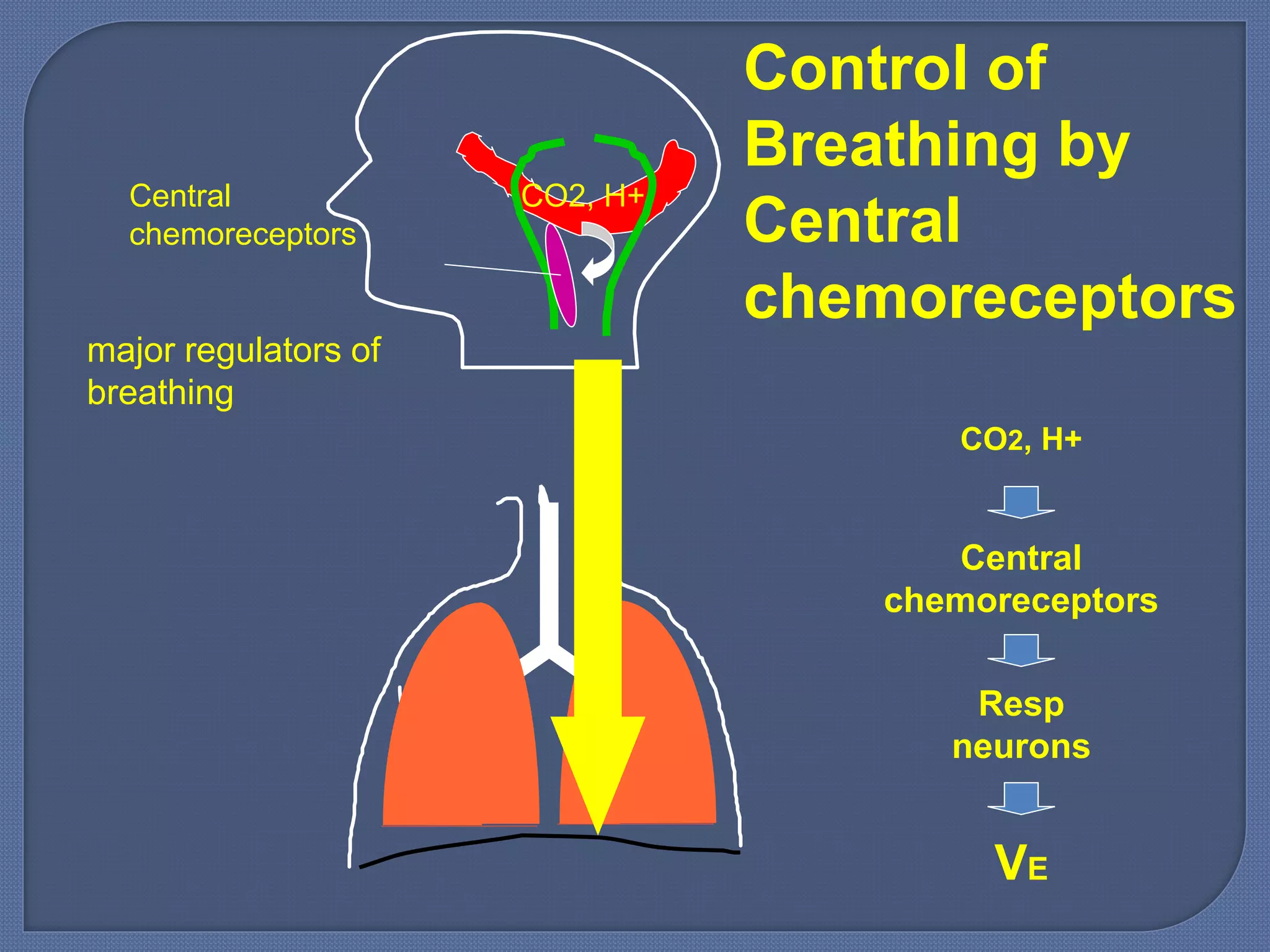
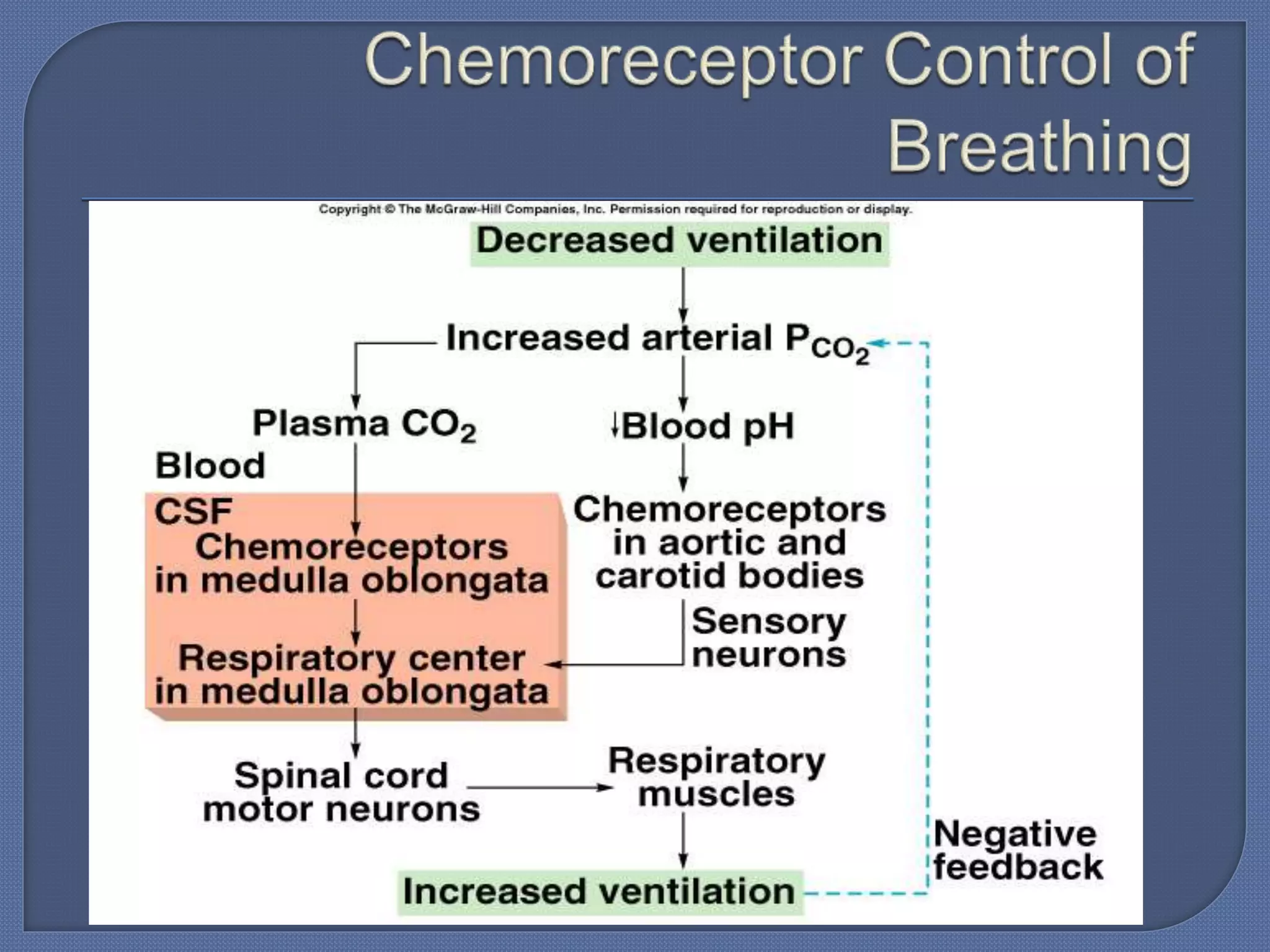
CO2, H+
Control of
Breathing by
Central
chemoreceptors
Central
chemoreceptors
major regulators of
breathing
CO2, H+
Central
chemoreceptors
Resp
neurons
VE
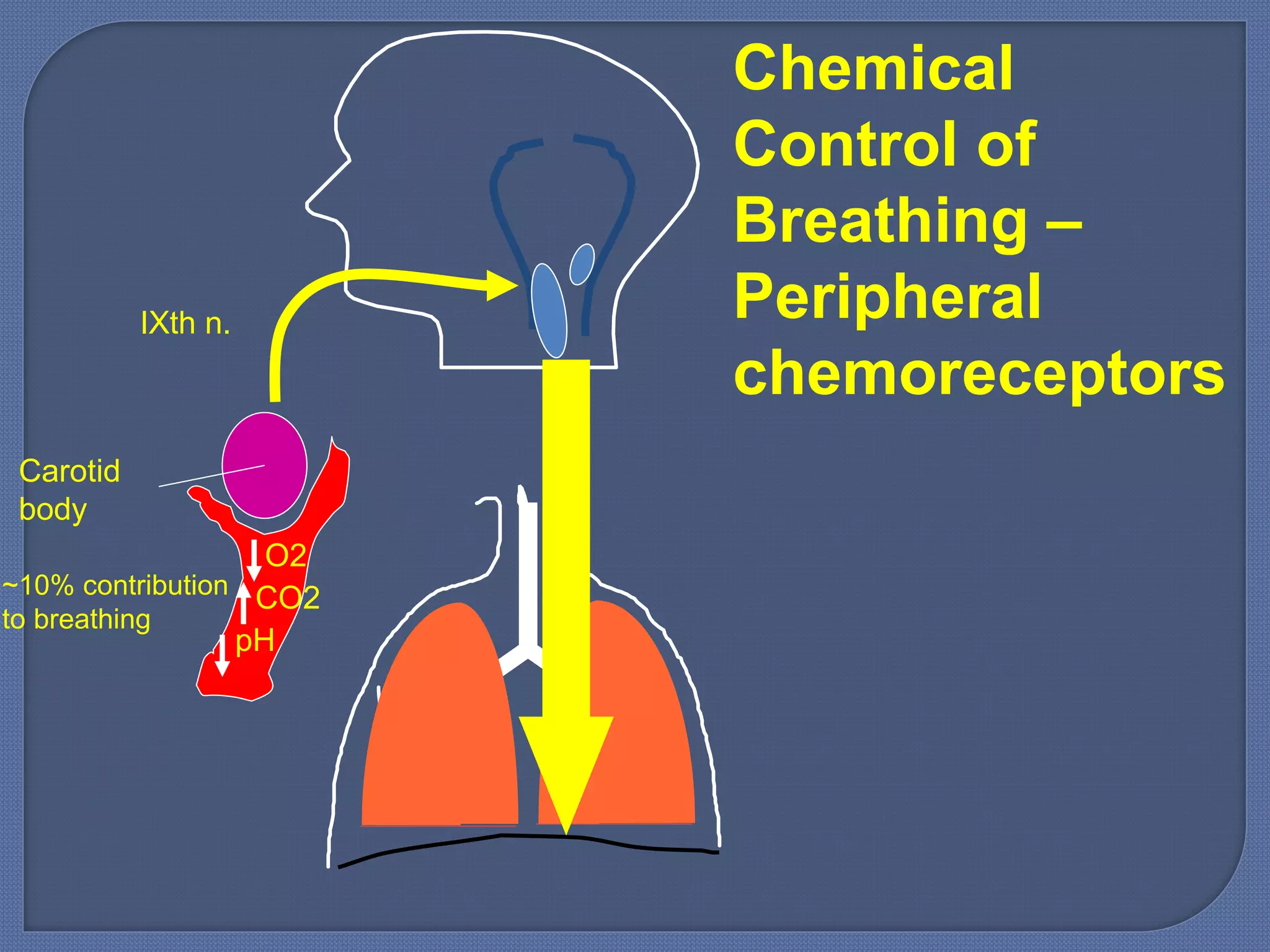
Carotid
body
O2
Chemical
Control of
Breathing –
Peripheral
chemoreceptors
IXth n.
CO2
pH
~10% contribution
to breathing
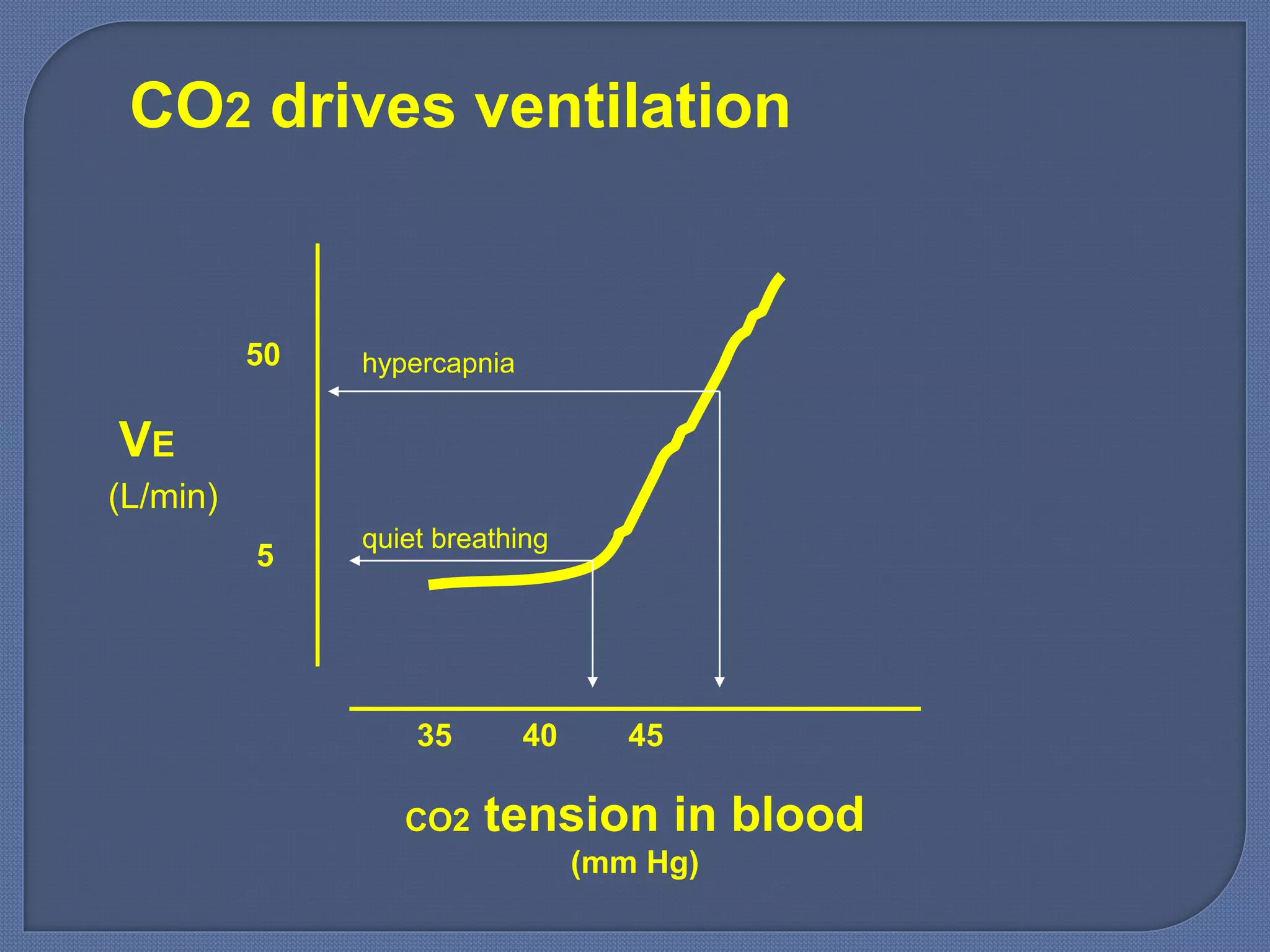
CO2 tension in blood
(mm Hg)
35 40 45
VE
5
50
(L/min)
quiet breathing
hypercapnia
CO2 drives ventilation
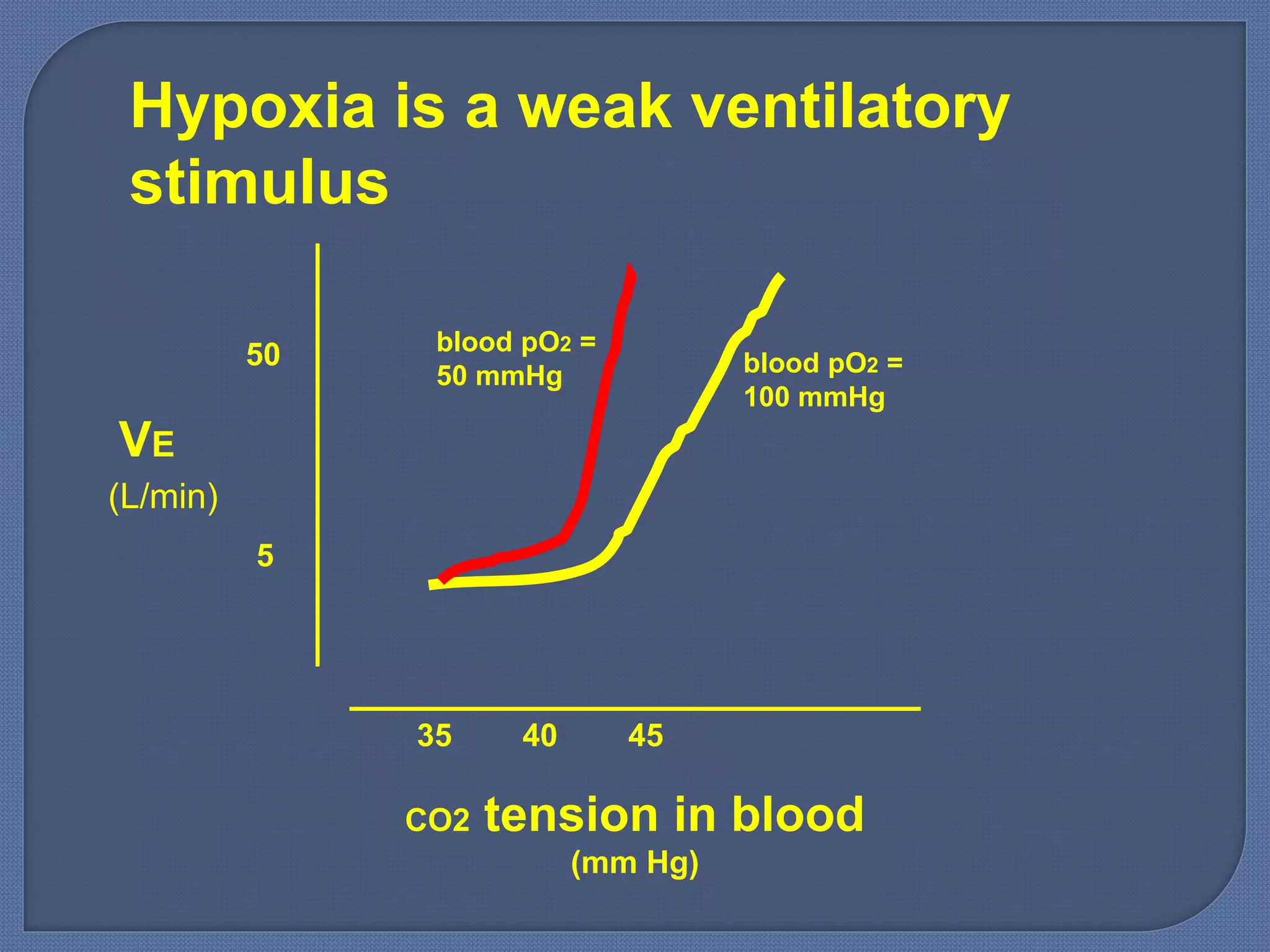
CO2 tension in blood
(mm Hg)
35 40 45
VE
5
50
(L/min)
Hypoxia is a weak ventilatory
stimulus
blood pO2 =
100 mmHg
blood pO2 =
50 mmHg
Are not stimulated directly by changes in
arterial PC02.
H20 + C02 H2C03 H+
Stimulated by rise in [H+] of arterial blood.
• Increased [H+] stimulates peripheral
chemoreceptors.
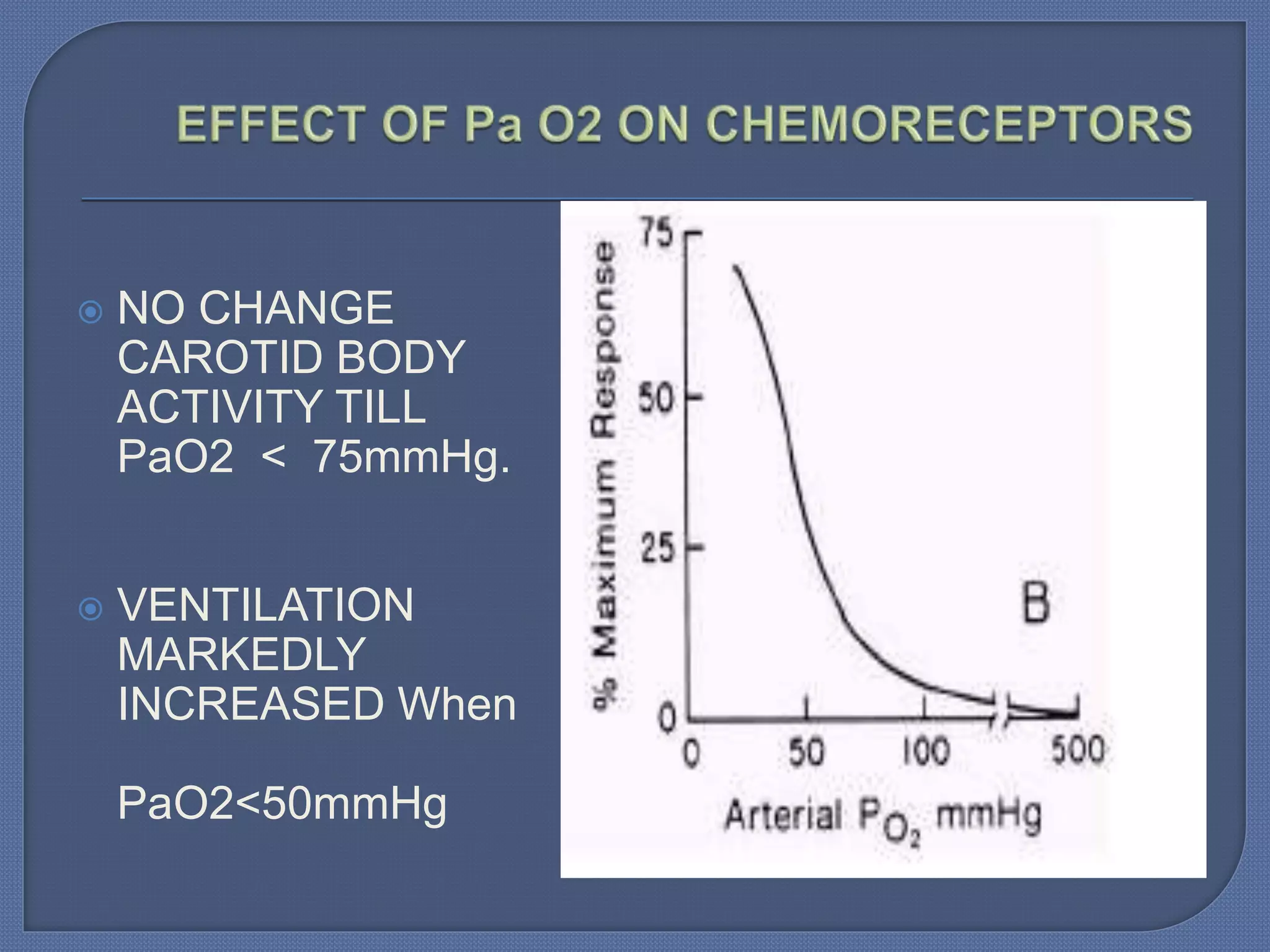
 NO CHANGE
CAROTID BODY
ACTIVITY TILL
PaO2 < 75mmHg.
 VENTILATION
MARKEDLY
INCREASED When
PaO2<50mmHg
RAPID PHASE- RAPID INCREASE IN VE
WITHIN SECONDS DUE TO
ACIDIFICATION OF CSF.
SLOWER PHASE- DUE TO BUILDUP OF
H+ IONS IN MEDULLARY
INTERSTITIUM.
CHRONIC HYPERCAPNIA- WEAKER
EFFECT DUE TO RENAL RETENTION
OF HCO3 WHICH REDUCES THE H+.
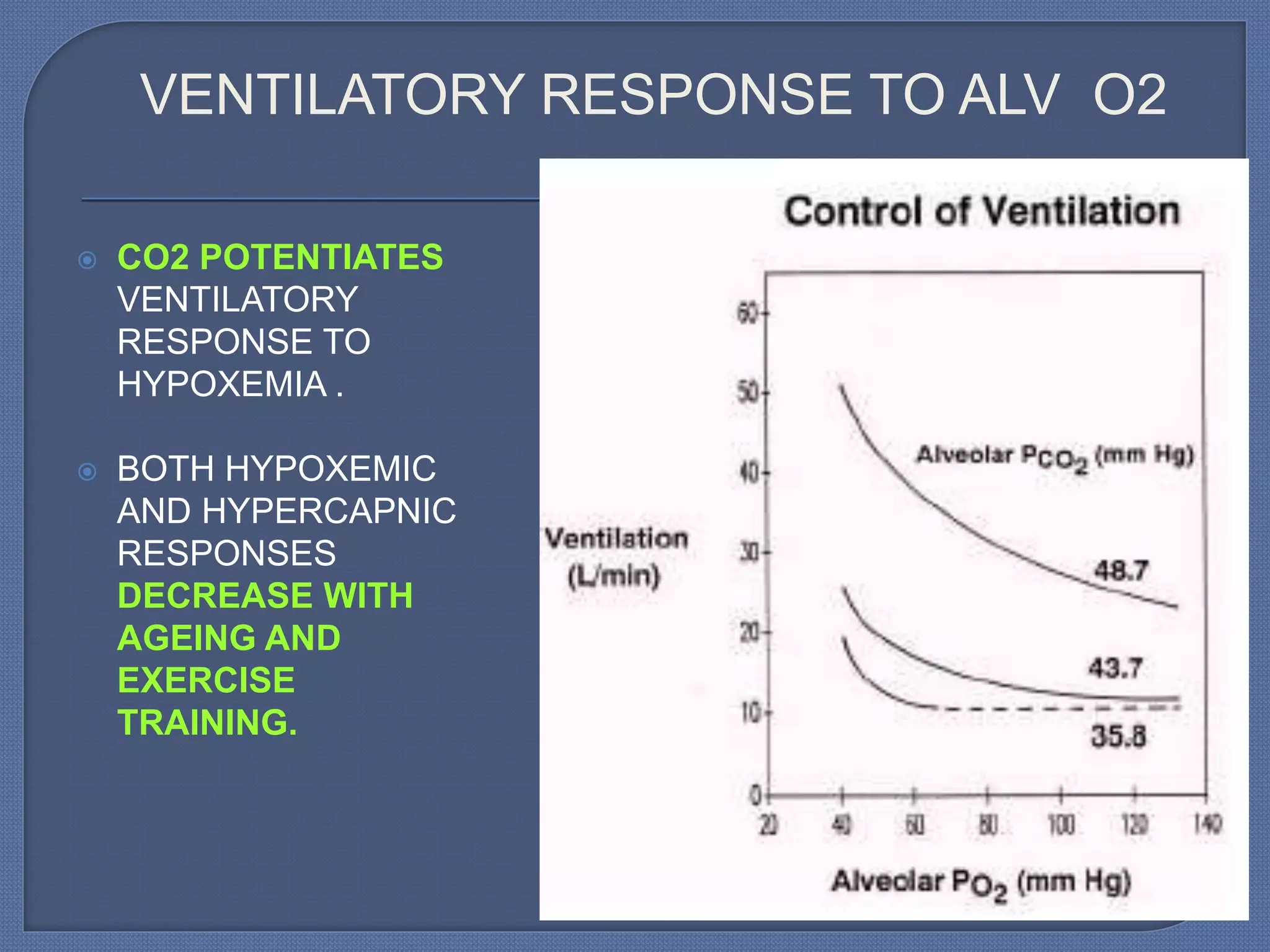
VENTILATORY RESPONSE TO ALV O2
 CO2 POTENTIATES
VENTILATORY
RESPONSE TO
HYPOXEMIA .
 BOTH HYPOXEMIC
AND HYPERCAPNIC
RESPONSES
DECREASE WITH
AGEING AND
EXERCISE
TRAINING.
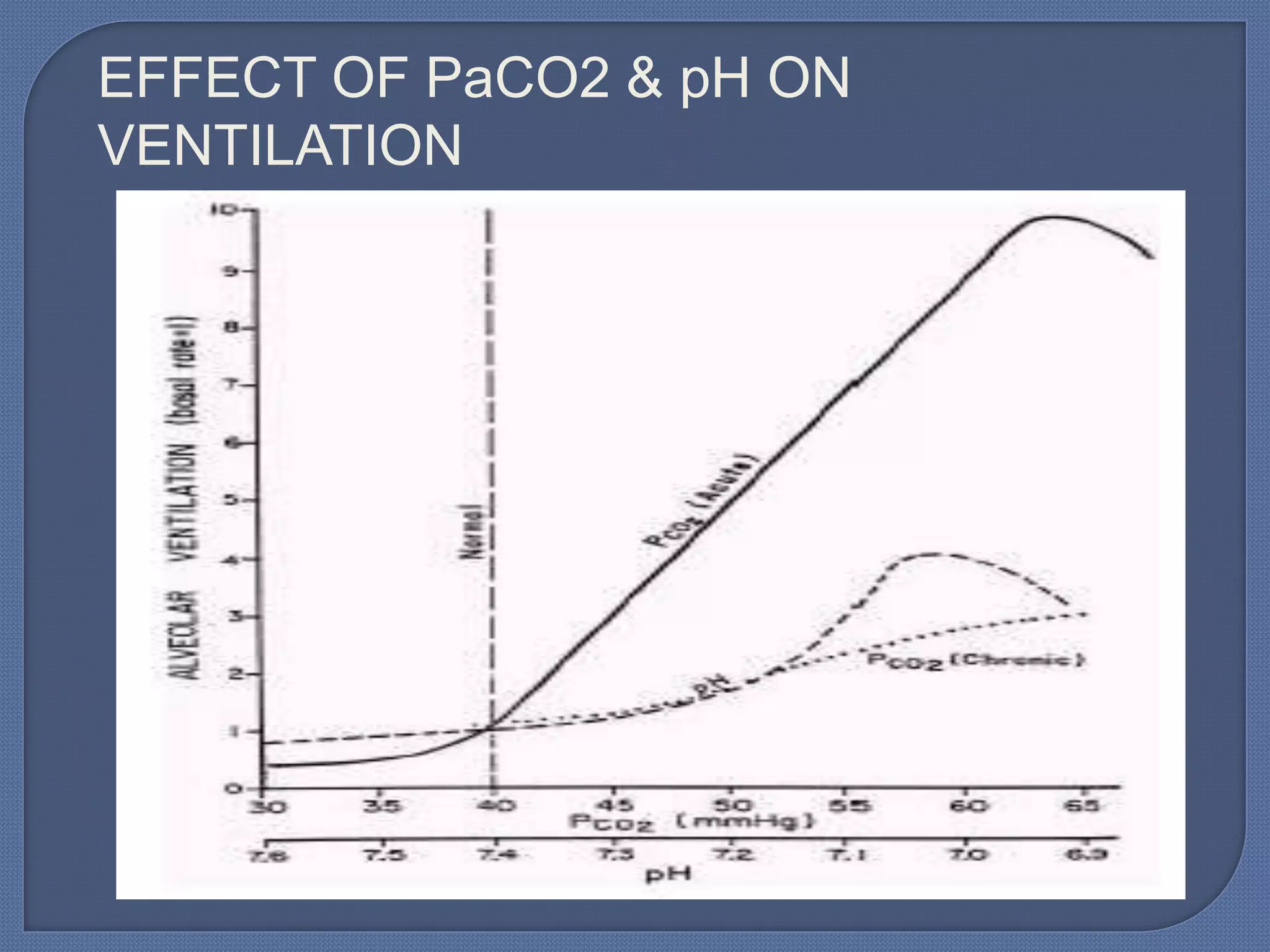
Normal level of HCO3- = 25 mEq/L
Metabolic acidosis (low HCO3-) will
stimulate ventilation (regardless of CO2
levels).
Metabolic alkalosis (high HCO3-) will
depress ventilation (regardless of CO2
levels) .
EFFECT OF PaCO2 & pH ON
VENTILATION
SENSATION OF DYSPNEA WHEN
INCREASED RESP EFFORT DUE TO
“LENGTH- TENSION
INAPPROPRTATENESS”
REMOVAL OF FLUID RESTORES THE
END EXP MSL FIBRE LENGTH
RESTORES THE LENTH TENSION
RELATIONSHIP RELIEF.
SV & CO decreased
Coronary blood flow decreased
Repolarization of heart impaired
Oxyhemoglobin affinity increased
Cerebral blood flow decreased
Skeletal muscle spasm & tetany
Serum potassium decreased
• (common thread in most of above is hypocapnic
alkalosis)
Effect of brain edema
• depression or inactivation of respiratory centers
Effect of Anesthesia/Narcotics
• respiratory depression
 sodium pentobarbital
 morphine
BILATERAL CAROTID BODY
RESECTION
CAROTID ENDARTERECTOMY
REDUCES VE.
30% DECREASE IN RESPONSE TO
HYPERCAPNIA.
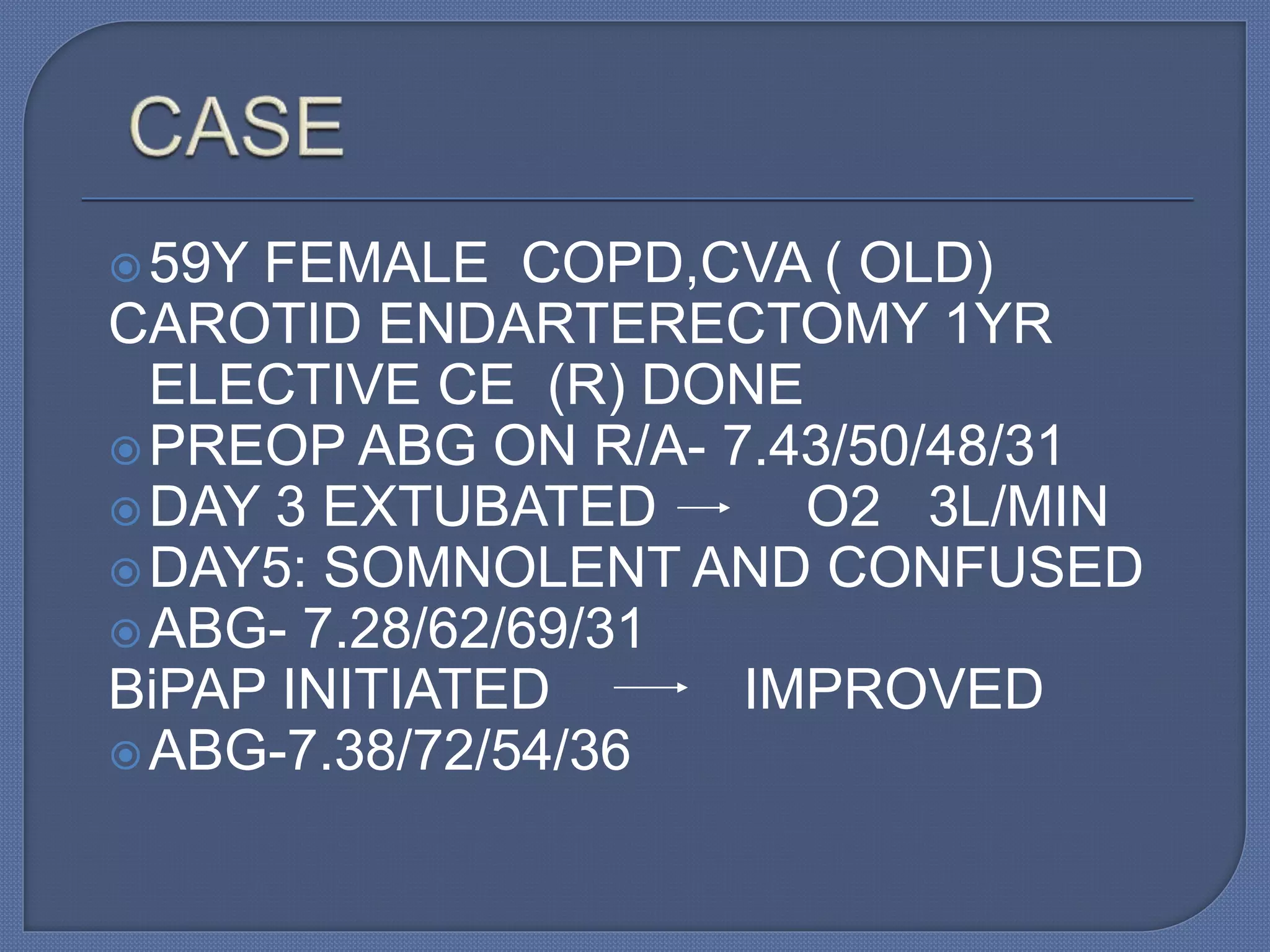
59Y FEMALE COPD,CVA ( OLD)
CAROTID ENDARTERECTOMY 1YR
ELECTIVE CE (R) DONE
PREOP ABG ON R/A- 7.43/50/48/31
DAY 3 EXTUBATED O2 3L/MIN
DAY5: SOMNOLENT AND CONFUSED
ABG- 7.28/62/69/31
BiPAP INITIATED IMPROVED
ABG-7.38/72/54/36
COPD WITH HYPERCAPNIA &
WORSENING RESP ACIDOSIS FULL
OXYGEN THERAPY
• LOSS OF HYPOXIC DRIVE
• WORSENING V/Q MISMATCH
PHYSIOLOGIC DEAD SPACE
• CO2 CARRYING CAPACITY AS
OXYGENATION OF Hb IMPROVES
( HALDANE EFFECT)
PERIODIC BREATHING PATTERN WITH
CENTRAL APNEAS.
Causes
1. BILATERAL SUPRAMEDULLARY
LESION
2. CARDIAC FAILURE
3. HIGH ALTITUDE
4. SLEEP
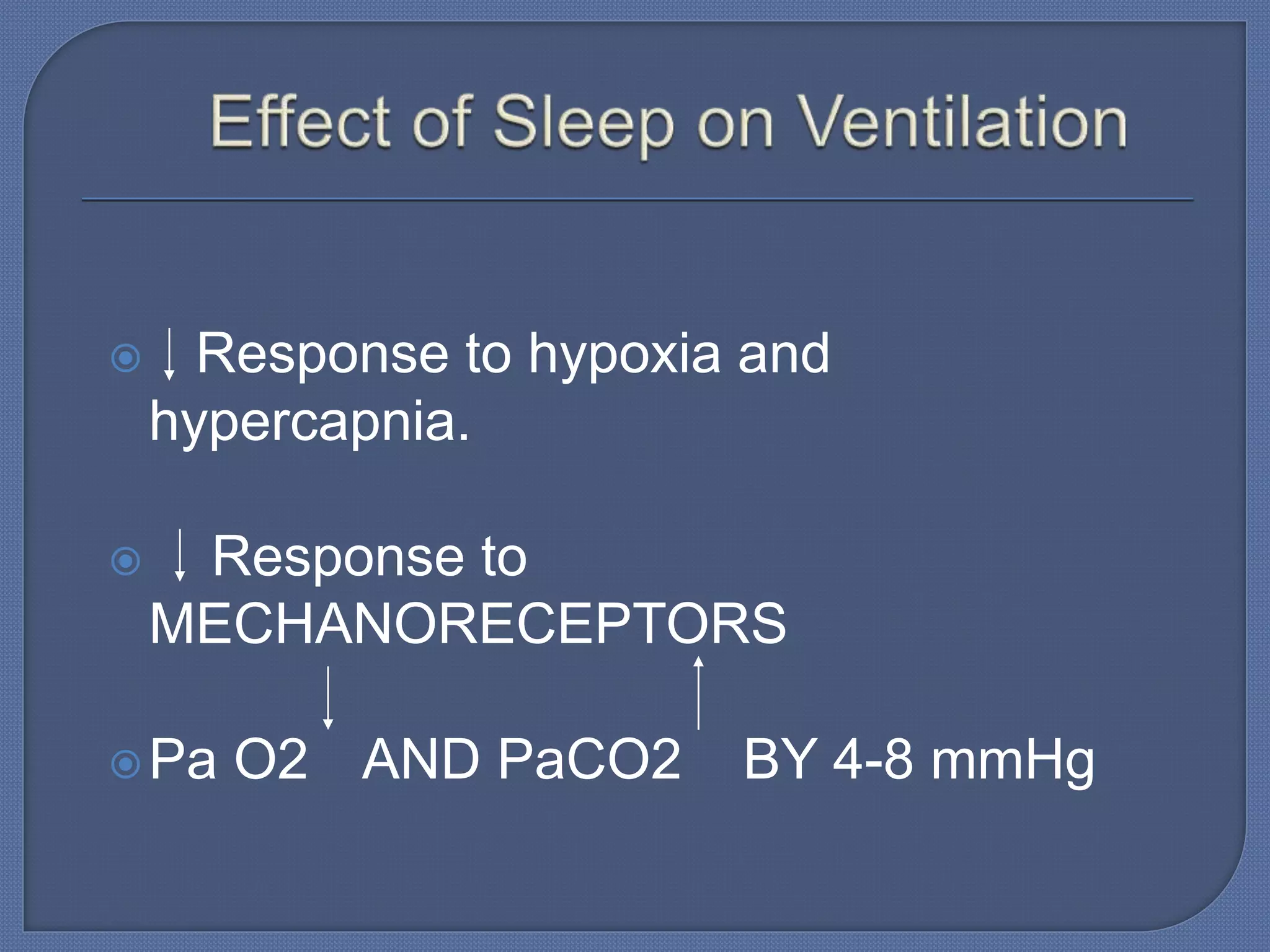
 Response to hypoxia and
hypercapnia.
 Response to
MECHANORECEPTORS
Pa O2 AND PaCO2 BY 4-8 mmHg
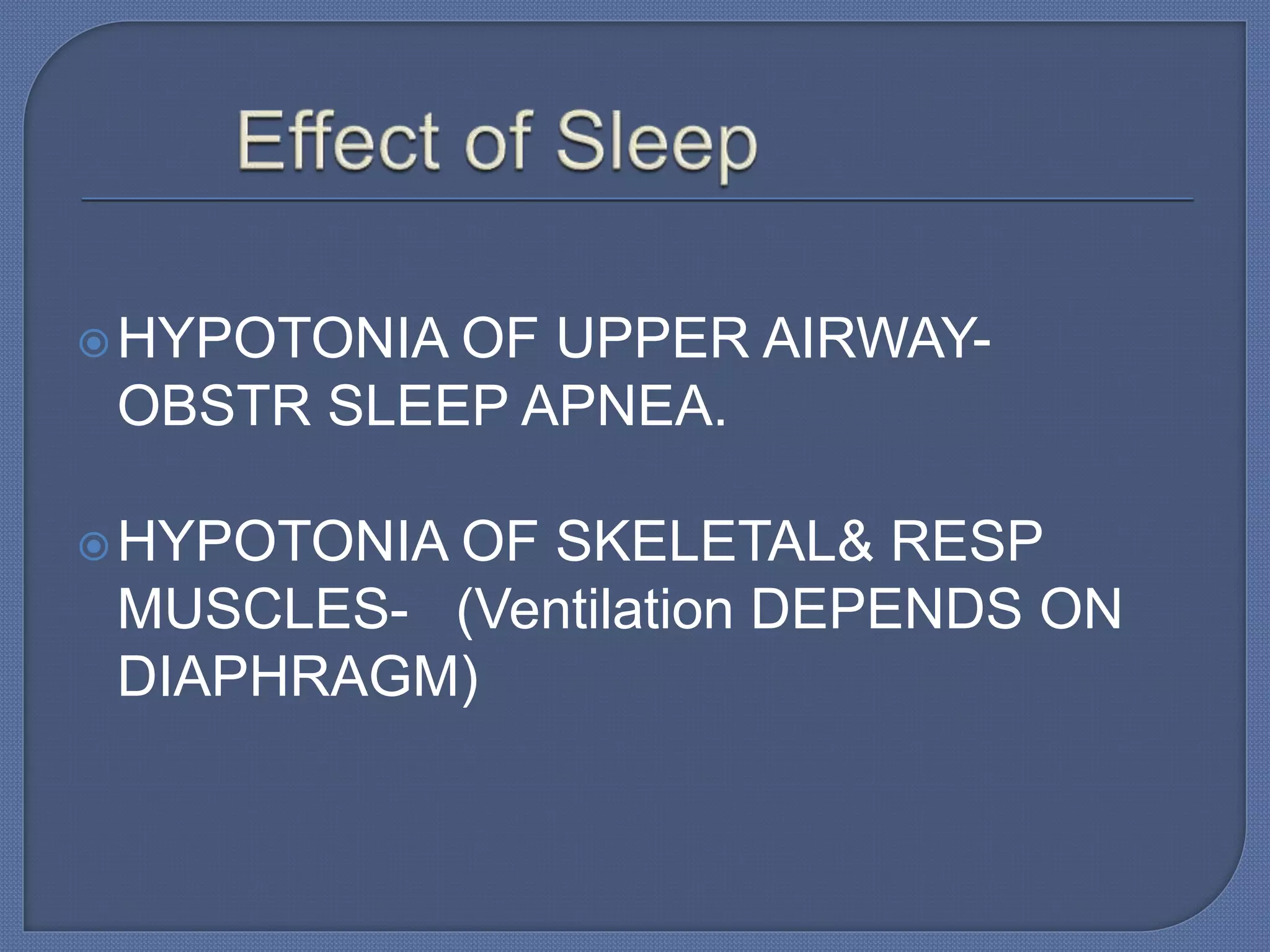
HYPOTONIA OF UPPER AIRWAY-
OBSTR SLEEP APNEA.
HYPOTONIA OF SKELETAL& RESP
MUSCLES- (Ventilation DEPENDS ON
DIAPHRAGM)
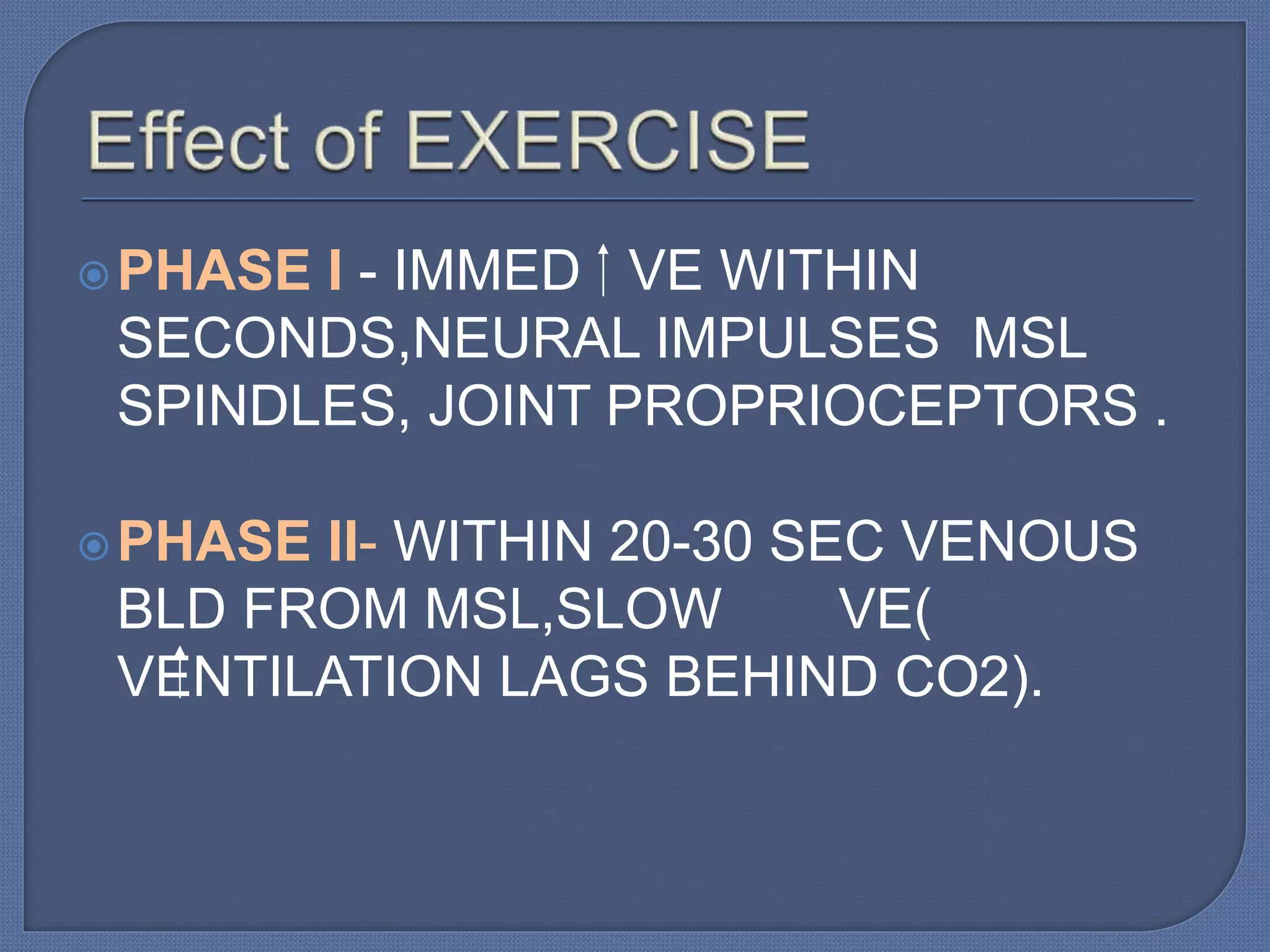
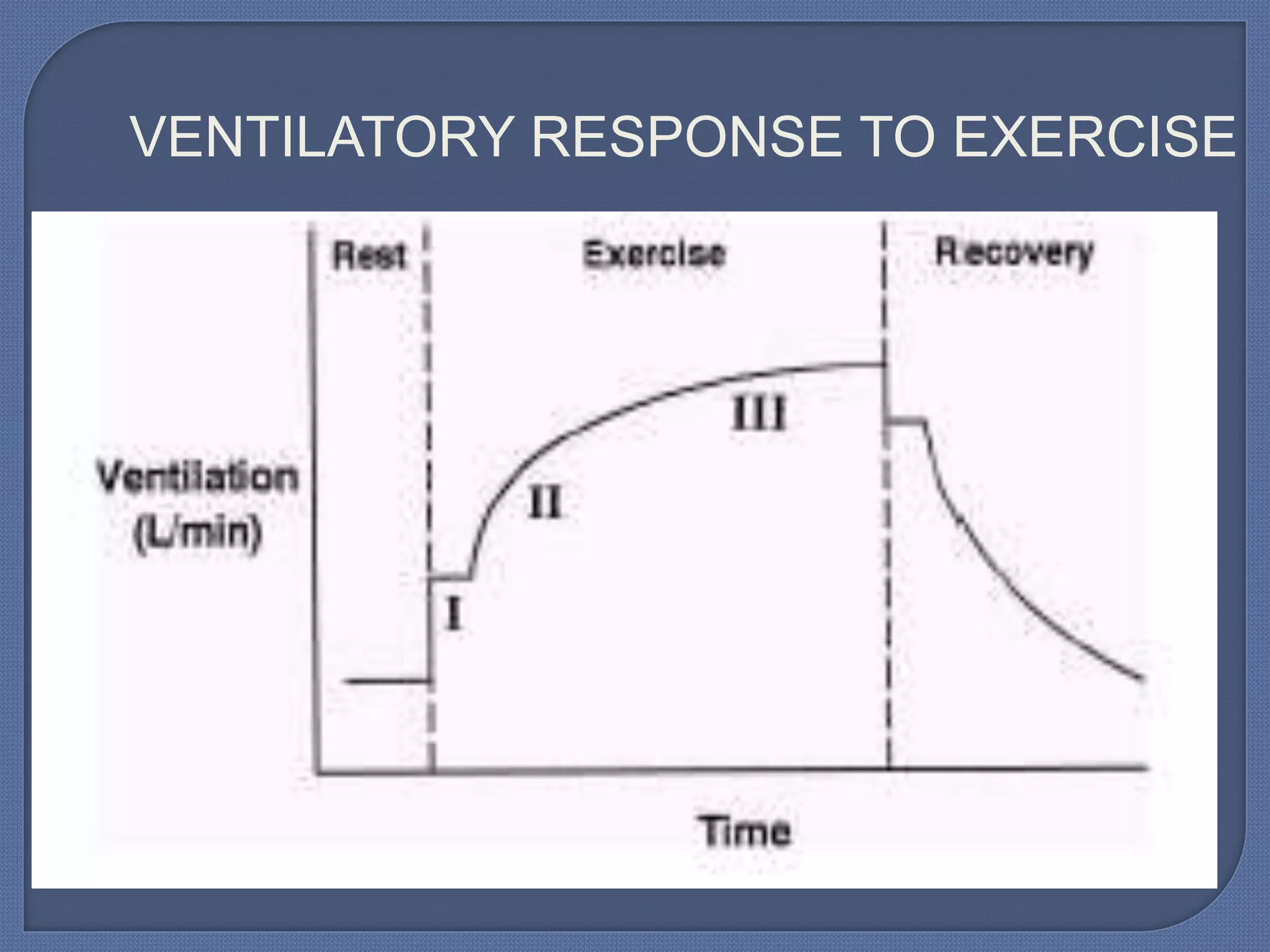
PHASE I - IMMED VE WITHIN
SECONDS,NEURAL IMPULSES MSL
SPINDLES, JOINT PROPRIOCEPTORS .
PHASE II- WITHIN 20-30 SEC VENOUS
BLD FROM MSL,SLOW VE(
VENTILATION LAGS BEHIND CO2).
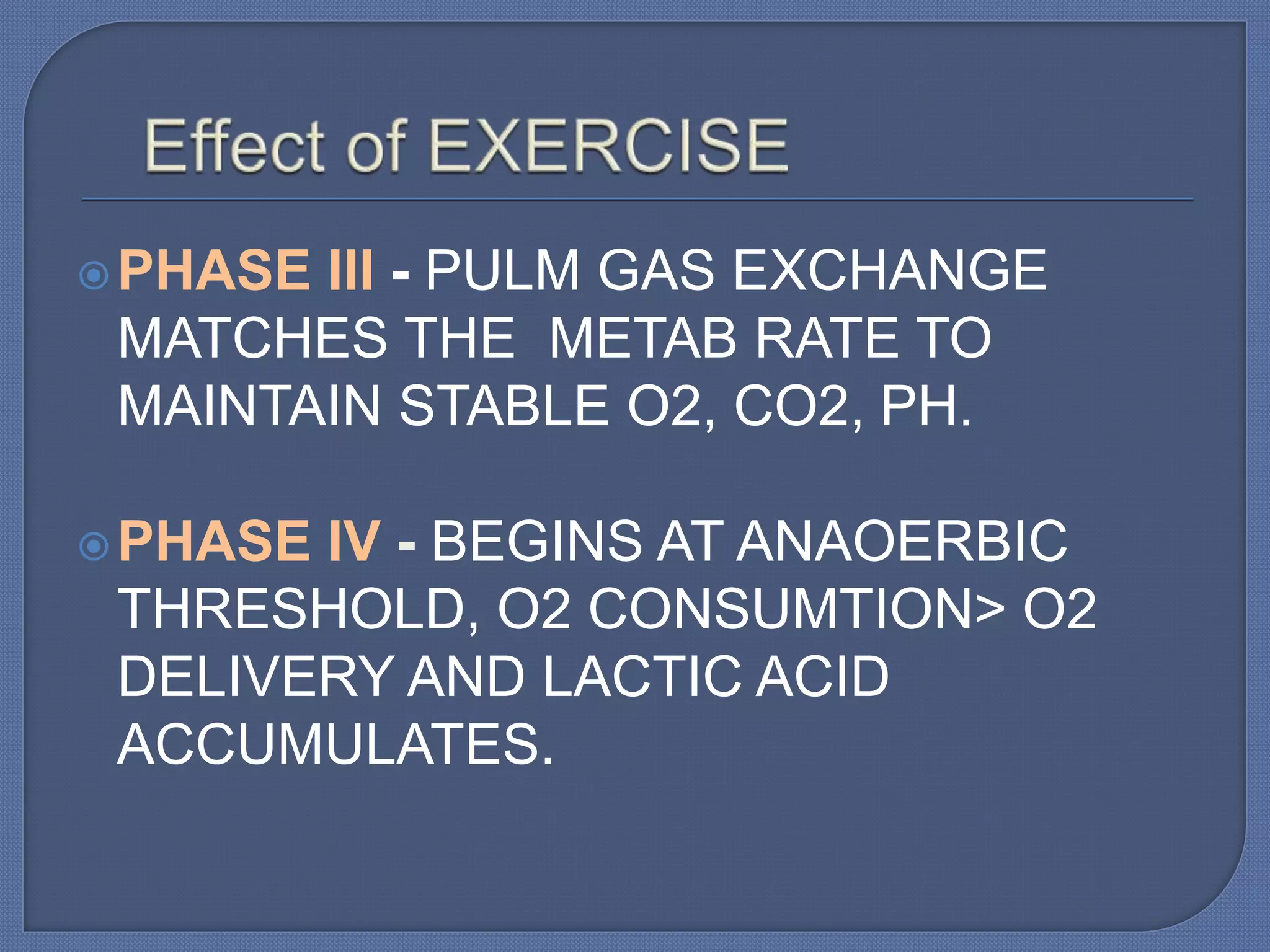
PHASE III - PULM GAS EXCHANGE
MATCHES THE METAB RATE TO
MAINTAIN STABLE O2, CO2, PH.
PHASE IV - BEGINS AT ANAOERBIC
THRESHOLD, O2 CONSUMTION> O2
DELIVERY AND LACTIC ACID
ACCUMULATES.
VENTILATORY RESPONSE TO EXERCISE
Control o

Control o

  • 1.
    Dr . NahidSherbini Consultant IM &Pulmonary KFH ,Medina ,Saudi Arabia
  • 2.
    Breathing is controlledby the central neuronal network to meet the metabolic demands of the body – Neural – Chemical
  • 3.
    Keep arterial levelsof O2 & CO2 constant. Match perfusion by pulmonary blood flow with ventilation of the lungs with overall metabolic demand.
  • 4.
    Control of Breathing Centralneurons determine minute ventilation (VE) by regulating tidal volume (VT) and breathing frequency (f). VE = VT x f
  • 5.
    Definition: A collection offunctionally similar neurons that help to regulate the respiratory movement.
  • 6.
     Higher respiratorycenter: cortex, hypothalamus & limbic system. Medulla & Pons : Basic respiratory center: produce and control the respiration.  Spinal cord: motor neurons.
  • 7.
    Affect rate anddepth of ventilation Influenced by: • higher brain centers • peripheral mechanoreceptors • peripheral & central chemoreceptors
  • 9.
    Voluntary breathing center Cerebralcortex. Automatic (involuntary) breathing center – Medulla – Pons
  • 10.
    CAN BYPASS LOWERCENTERS. SPEECH,SINGING,COUGHING, BREATH HOLDING .
  • 11.
     Voluntarily –speaking, blowing, whistling, pushing, defecation.  Voluntary control is bilateral – cannot contract half of diaphragm or larynx.  Descend via pyramidal tracts.  Destroy voluntary control without losing involuntary control can be.. i.e. stroke
  • 12.
    To larynx andbronchi To respiratory muscles Nucleus parabrachialis medialis (part of PRG) Dorsal respiratory group – nucleus of the solitary tract Pons Medulla Ventral respiratory group - Nucleus ambiguus - Nucleus retroambigualis PRG = pontine respiratory group
  • 13.
     Rhythmicity center: •Controls automatic breathing. • Interacting neurons that fire either during inspiration (I neurons) or expiration (E neurons).
  • 14.
     I neuronslocated primarily in dorsal respiratory group (DRG): • Regulate activity of phrenic nerve.  E neurons located in ventral respiratory group (VRG): • Passive process.  Activity of E neurons inhibit I neurons. • Rhythmicity of I and E neurons may be due to pacemaker neurons
  • 15.
    Inspiratory Muscles Expiratory Muscles Inspiratory Neurons Expiratory Neurons • This impliesthat each group exhibits “self-inhibition” – they can switch themselves off. • Stops breathing getting stuck in inspiration or expiration.
  • 16.
     Apneustic center(lower pons) – to promote Inspiration. Pneumotaxic center (upper pons) – inhibits apneustic center & inhibits inspiration -helps control the rate and pattern of breathing.
  • 17.
    Pons Medulla Cuts off Produces apneustic effect– long, powerful inspirations Stops breathing since no automated output to respiratory system – cause of death
  • 18.
  • 19.
    Neural Control of Breathing– The efferent pathway Phrenic n. muscle supply autonomic
  • 20.
    DECENDING BULBOSPINAL FIBRES AREIN THE VENTRAL AND LATERAL COLUMNS. RESP NEURONS ARE IN VENTRAL Horn EXP NEURONS -VENTROMEDIAL INSP NEURONS- LATERAL
  • 21.
    ASCENDING SPINORETICULAR FIBRES CARRYPROPRIOCEPTIVE INPUTS TO STIMULATE RESP CENTRE. BILAT CERVICAL CORDOTOMY LEADS TO RESPIRATORY DYSFUNCTION (SLEEP APNEA).
  • 22.
     Diaphragm controlleddirectly by  motor neurons – “C3,4 & 5 keeps the diaphragm alive”.  Motor neurons take turns to stimulate different groups of muscle fibres active to minimise fatigue.  Due to poor supply of muscle spindles , control comes from DRG &VRG. And this explains why rare to feel fatigue in diaphragm.
  • 23.
     Larynx movementsare synchronized with breathing.  Superior and recurrent laryngeal nerves are branches of vagus nerve. Expiration – vocal cords together. Inspiration – vocal cords apart.  Automatic rhythm that we can override consciously.  Opera singers try and maximise control of breathing using these muscles.
  • 24.
     Control ofbreathing affected profoundly by vagus nerves (Cranial Nerve X).  Two of these run down either side of neck and torso, near trachea.  Regulate receptors which are most involved in respiration: • Slowly-adapting pulmonary stretch receptors (PSR’s) • Rapidly-adapting (irritant) receptors (RAR’s) • C-fibre receptors (J receptors)
  • 25.
    Paintel et al(1970) : Propose J receptors function TO LIMIT EXERCISE WHEN INTERSTITIAL PRESSURE INCREASES(J REFLEX) MECHANISM: INHIBITION OF RESP MOTOR NEURONS.
  • 26.
    •+ when pulmonarycaps are engorged or pulmonary edema. create a feeling of dyspnea
  • 27.
     UNMYELINATED NERVEENDINGS .  RESPONSIBLE FOR BRONCHOSPASM IN ASTHMA.  INCREASED TRACHEOBRONCHIAL SECRETIONS.  MEDIATORS: HISTAMINE, PROSTAGLANDINS , BRADYKININ.
  • 28.
     Herring-Breuer Inflationreflex • stretch receptors located in wall of airways • + when stretched at tidal volumes > 1500 ml • inhibits the DRG Inflation Apnoea Phrenic nerve activity Lung volume Safety threshold that triggers reflex
  • 29.
    Airway Receptors: Slowly adapting(stretch - ends inspiration) Rapidly adapting (irritants - cough) Bronchial c-fiber (vascular congestion - bronchoconstriction) Parenchymal c-fiber (irritants - bronchoconstriction) Xth n. Reflex Control of Breathing – Neural receptors afferents
  • 30.
    EXPT ANIMAL STUDIES Rapidshallow breathing pattern in response to bronchospasm is mediated through vagal afferents.
  • 31.
    MECHANORECEPTORS - SENSE CHANGESIN LENGTH ,TENSION AND MOVEMENT. ASCENDING TRACTS IN ANTERIOR COLUMN OF SPINAL CORD TO RESP CENTRE IN MEDULLA.
  • 32.
    SENSE CHANGES INMSL LENGTH. INTERCOSTALS > DIAPHRAGM . REFLEX CONTRACTION OF MUSCLE IN RESPONSE TO STRETCH. INCREASE VENTILATION IN EARLY STAGES OF EXERCISE.
  • 33.
    SENSE DEGREE OFCHEST WALL MOVT. INFLUENCE THE LEVEL & TIMING OF RESP ACTIVITY.
  • 34.
     Neural control Beta receptors causing dilatation  Parasympathetic-muscarinic receptors causing constriction  NANC nerves (non-adrenergic, non-cholinergic) ○ Inhibitory release VIP and NO  bronchodilitation ○ Stimulatory  bronchoconstriction, mucous secretion, vascular hyperpermeability, cough, vasodilation “neurogenic inflammation”.
  • 35.
    Local factors • histaminebinds to H1 receptors-constriction • histamine binds to H2 receptors-dilation • slow reactive substance of anaphylaxsis- constriction-allergic response to pollen • Prostaglandins E series- dilation • Prostaglandins F series- constriction
  • 37.
     Monitor changesin blood PC02, P02, and pH.  Central: • Medulla.  Peripheral: • Carotid and aortic bodies.  Control breathing indirectly.
  • 39.
    RESPONSE TO HYPERCAPNIA •20-50% CAROTID BODIES • 50-80% CENTRAL CHEMORECEPTORS
  • 40.
    CO2, H+ Control of Breathingby Central chemoreceptors Central chemoreceptors major regulators of breathing CO2, H+ Central chemoreceptors Resp neurons VE
  • 41.
  • 42.
    CO2 tension inblood (mm Hg) 35 40 45 VE 5 50 (L/min) quiet breathing hypercapnia CO2 drives ventilation
  • 43.
    CO2 tension inblood (mm Hg) 35 40 45 VE 5 50 (L/min) Hypoxia is a weak ventilatory stimulus blood pO2 = 100 mmHg blood pO2 = 50 mmHg
  • 44.
    Are not stimulateddirectly by changes in arterial PC02. H20 + C02 H2C03 H+ Stimulated by rise in [H+] of arterial blood. • Increased [H+] stimulates peripheral chemoreceptors.
  • 45.
     NO CHANGE CAROTIDBODY ACTIVITY TILL PaO2 < 75mmHg.  VENTILATION MARKEDLY INCREASED When PaO2<50mmHg
  • 46.
    RAPID PHASE- RAPIDINCREASE IN VE WITHIN SECONDS DUE TO ACIDIFICATION OF CSF. SLOWER PHASE- DUE TO BUILDUP OF H+ IONS IN MEDULLARY INTERSTITIUM. CHRONIC HYPERCAPNIA- WEAKER EFFECT DUE TO RENAL RETENTION OF HCO3 WHICH REDUCES THE H+.
  • 47.
    VENTILATORY RESPONSE TOALV O2  CO2 POTENTIATES VENTILATORY RESPONSE TO HYPOXEMIA .  BOTH HYPOXEMIC AND HYPERCAPNIC RESPONSES DECREASE WITH AGEING AND EXERCISE TRAINING.
  • 48.
    Normal level ofHCO3- = 25 mEq/L Metabolic acidosis (low HCO3-) will stimulate ventilation (regardless of CO2 levels). Metabolic alkalosis (high HCO3-) will depress ventilation (regardless of CO2 levels) .
  • 49.
    EFFECT OF PaCO2& pH ON VENTILATION
  • 51.
    SENSATION OF DYSPNEAWHEN INCREASED RESP EFFORT DUE TO “LENGTH- TENSION INAPPROPRTATENESS” REMOVAL OF FLUID RESTORES THE END EXP MSL FIBRE LENGTH RESTORES THE LENTH TENSION RELATIONSHIP RELIEF.
  • 52.
    SV & COdecreased Coronary blood flow decreased Repolarization of heart impaired Oxyhemoglobin affinity increased Cerebral blood flow decreased Skeletal muscle spasm & tetany Serum potassium decreased • (common thread in most of above is hypocapnic alkalosis)
  • 53.
    Effect of brainedema • depression or inactivation of respiratory centers Effect of Anesthesia/Narcotics • respiratory depression  sodium pentobarbital  morphine
  • 54.
    BILATERAL CAROTID BODY RESECTION CAROTIDENDARTERECTOMY REDUCES VE. 30% DECREASE IN RESPONSE TO HYPERCAPNIA.
  • 55.
    59Y FEMALE COPD,CVA( OLD) CAROTID ENDARTERECTOMY 1YR ELECTIVE CE (R) DONE PREOP ABG ON R/A- 7.43/50/48/31 DAY 3 EXTUBATED O2 3L/MIN DAY5: SOMNOLENT AND CONFUSED ABG- 7.28/62/69/31 BiPAP INITIATED IMPROVED ABG-7.38/72/54/36
  • 56.
    COPD WITH HYPERCAPNIA& WORSENING RESP ACIDOSIS FULL OXYGEN THERAPY • LOSS OF HYPOXIC DRIVE • WORSENING V/Q MISMATCH PHYSIOLOGIC DEAD SPACE • CO2 CARRYING CAPACITY AS OXYGENATION OF Hb IMPROVES ( HALDANE EFFECT)
  • 57.
    PERIODIC BREATHING PATTERNWITH CENTRAL APNEAS. Causes 1. BILATERAL SUPRAMEDULLARY LESION 2. CARDIAC FAILURE 3. HIGH ALTITUDE 4. SLEEP
  • 58.
     Response tohypoxia and hypercapnia.  Response to MECHANORECEPTORS Pa O2 AND PaCO2 BY 4-8 mmHg
  • 59.
    HYPOTONIA OF UPPERAIRWAY- OBSTR SLEEP APNEA. HYPOTONIA OF SKELETAL& RESP MUSCLES- (Ventilation DEPENDS ON DIAPHRAGM)
  • 60.
    PHASE I -IMMED VE WITHIN SECONDS,NEURAL IMPULSES MSL SPINDLES, JOINT PROPRIOCEPTORS . PHASE II- WITHIN 20-30 SEC VENOUS BLD FROM MSL,SLOW VE( VENTILATION LAGS BEHIND CO2).
  • 61.
    PHASE III -PULM GAS EXCHANGE MATCHES THE METAB RATE TO MAINTAIN STABLE O2, CO2, PH. PHASE IV - BEGINS AT ANAOERBIC THRESHOLD, O2 CONSUMTION> O2 DELIVERY AND LACTIC ACID ACCUMULATES.
  • 62.