Best Practices in Contractor
Safety Management
Joy Inouye
Research Associate
Campbell Institute
Pat Cunningham
Director, Safety &
Auditing Services
BROWZ
BROWZ delivers assurance that
businesses are working with safe,
qualified, and socially responsible
contractors and suppliers.

Contractor Prequalification & Management
Save lives by preventing injuries and
deaths at work, in homesand
communities, and on the roads,
through leadership, research, education
and advocacy.
The Campbell Institute, at the
National Safety Council, is the
EHS center of excellence.
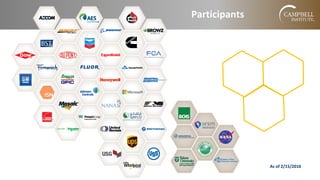
Participants
As of 2/15/2016
Featured Organizations
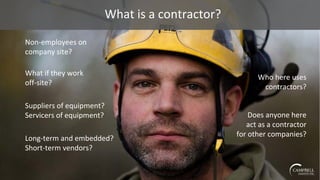
What is a contractor?
Non-employees on
company site?
What if they work
off-site?
Suppliers of equipment?
Servicers of equipment?
Long-term and embedded?
Short-term vendors?
Who here uses
contractors?
Does anyone here
act as a contractor
for other companies?
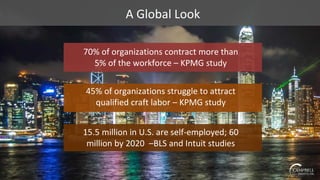
A Global Look
70% of organizations contract more than
5% of the workforce – KPMG study
45% of organizations struggle to attract
qualified craft labor – KPMG study
15.5 million in U.S. are self-employed; 60
million by 2020 –BLS and Intuit studies
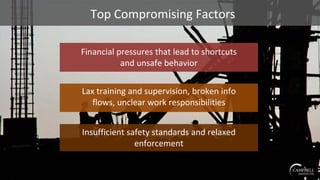
Top Compromising Factors
Financial pressures that lead to shortcuts
and unsafe behavior
Lax training and supervision, broken info
flows, unclear work responsibilities
Insufficient safety standards and relaxed
enforcement
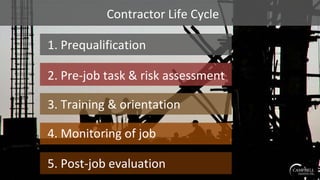
Contractor Life Cycle
1. Prequalification
2. Pre-job task & risk assessment
3. Training & orientation
4. Monitoring of job
5. Post-job evaluation
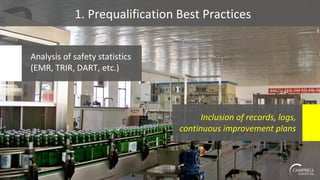
1. Prequalification Best Practices
Analysis of safety statistics
(EMR, TRIR, DART, etc.)
Inclusion of records, logs,
continuous improvement plans
1. Prequalification Best Practices
Use of third-party
verification services
Fill performance gaps, ensure
compliance for specific industries
1. Prequalification Best Practices
Use of internal scale,
checklist, or rating system
Grade or rating based on
policies, statistics, history
WC claims, injury logs,
environmental reports,
regulatory citations
Citation records, fatalities
Continuous improvement plans
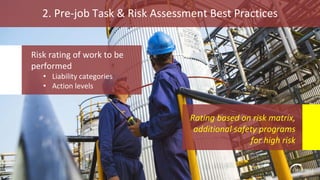
2. Pre-job Task & Risk Assessment Best Practices
Risk rating of work to be
performed
• Liability categories
• Action levels
Rating based on risk matrix,
additional safety programs
for high risk
Risk point values for
severity, frequency,
and probability
Risk assessed in terms
of insurance liability
Higher liability projects
vetted through third
party
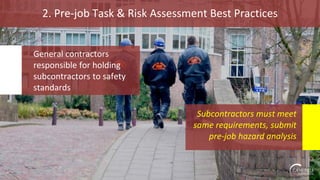
2. Pre-job Task & Risk Assessment Best Practices
General contractors
responsible for holding
subcontractors to safety
standards
Subcontractors must meet
same requirements, submit
pre-job hazard analysis
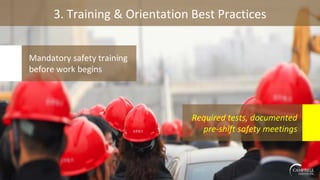
3. Training & Orientation Best Practices
Mandatory safety training
before work begins
Required tests, documented
pre-shift safety meetings
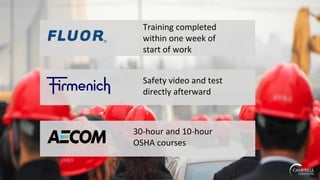
Training completed
within one week of
start of work
Safety video and test
directly afterward
30-hour and 10-hour
OSHA courses
3. Training & Orientation Best Practices
Specialized training offered
• Hazard identification
• PPE
• Fall prevention
Annual refresher courses,
badges to indicate
specialized training
Specialized area trainings
completed through
online program
Refresher courses held
annually for long-term
contractors
4. Job Monitoring Best Practices
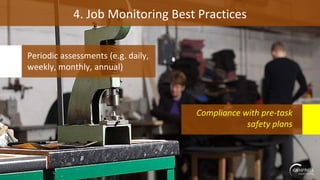
Periodic assessments (e.g. daily,
weekly, monthly, annual)
Compliance with pre-task
safety plans
4. Job Monitoring Best Practices
Safety observations
from contractors
Mobile apps to submit
observations, quota per month
Contractors submit minimum
of 2 observations per employee
per month
Uses mobile app (Lifeguard®)
to track reports of unsafe
conditions
4. Job Monitoring Best Practices
Maintenance of incident &
near miss report logs
Reports on incidents & corrective
actions to evaluate performance
Quarterly reports on lost-time
injuries and dollar losses for
Quality Assurance Plans
Contractors maintain incident
and near-miss report logs
Common Challenges
Lack of specific courses of
action for contractor
infractions
Action flow chart, levels of
discipline, strict policy for
serious infractions
Consequences outlined for 1st-3rd
infractions; termination of contract on 4th
Flow chart of actions for contractor
infractions ending in dismissal
IDLH infractions are grounds for
immediate termination of contract
Common Challenges
No integration of contractors into
an organization’s safety statistics
Contractor injuries still
tracked, even if not included
in company scorecard
Common Challenges
No formal post-work
evaluation of contractors
Guidelines for requalification,
evaluate if work was done
safely & well
Post-work evaluations considered
when bidding for future jobs
Safety & Operating Inspection
completed for every process change
Periodic performance reviews
capture contractor performance
Common Challenges
Lack of direct oversight of
subcontractor safety
Host employer liability gap
with prime contractors
vetting subs
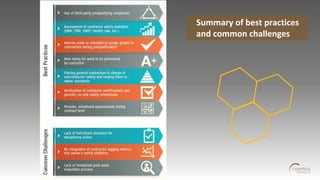
Summary of best practices
and common challenges
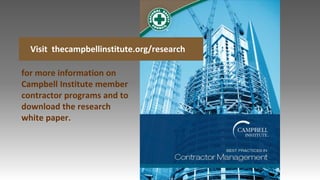
for more information on
Campbell Institute member
contractor programs and to
download the research
white paper.
Visit thecampbellinstitute.org/research
Contractor Management
What is the Return on Investment (ROI)?
browz.com/webinar
REGISTER >>>
Upcoming Webinar
“Campbell Institute” @RWCInstitute BROWZ.com/demo

Contractor Management Strategies in a Complex World

  • 1.
    Best Practices inContractor Safety Management
  • 2.
    Joy Inouye Research Associate CampbellInstitute Pat Cunningham Director, Safety & Auditing Services BROWZ
  • 3.
    BROWZ delivers assurancethat businesses are working with safe, qualified, and socially responsible contractors and suppliers. Contractor Prequalification & Management
  • 4.
    Save lives bypreventing injuries and deaths at work, in homesand communities, and on the roads, through leadership, research, education and advocacy.
  • 5.
    The Campbell Institute,at the National Safety Council, is the EHS center of excellence.
  • 6.
  • 7.
  • 8.
    What is acontractor? Non-employees on company site? What if they work off-site? Suppliers of equipment? Servicers of equipment? Long-term and embedded? Short-term vendors? Who here uses contractors? Does anyone here act as a contractor for other companies?
  • 9.
    A Global Look 70%of organizations contract more than 5% of the workforce – KPMG study 45% of organizations struggle to attract qualified craft labor – KPMG study 15.5 million in U.S. are self-employed; 60 million by 2020 –BLS and Intuit studies
  • 10.
    Top Compromising Factors Financialpressures that lead to shortcuts and unsafe behavior Lax training and supervision, broken info flows, unclear work responsibilities Insufficient safety standards and relaxed enforcement
  • 11.
    Contractor Life Cycle 1.Prequalification 2. Pre-job task & risk assessment 3. Training & orientation 4. Monitoring of job 5. Post-job evaluation
  • 12.
    1. Prequalification BestPractices Analysis of safety statistics (EMR, TRIR, DART, etc.) Inclusion of records, logs, continuous improvement plans
  • 13.
    1. Prequalification BestPractices Use of third-party verification services Fill performance gaps, ensure compliance for specific industries
  • 14.
    1. Prequalification BestPractices Use of internal scale, checklist, or rating system Grade or rating based on policies, statistics, history
  • 15.
    WC claims, injurylogs, environmental reports, regulatory citations Citation records, fatalities Continuous improvement plans
  • 16.
    2. Pre-job Task& Risk Assessment Best Practices Risk rating of work to be performed • Liability categories • Action levels Rating based on risk matrix, additional safety programs for high risk
  • 17.
    Risk point valuesfor severity, frequency, and probability Risk assessed in terms of insurance liability Higher liability projects vetted through third party
  • 18.
    2. Pre-job Task& Risk Assessment Best Practices General contractors responsible for holding subcontractors to safety standards Subcontractors must meet same requirements, submit pre-job hazard analysis
  • 19.
    3. Training &Orientation Best Practices Mandatory safety training before work begins Required tests, documented pre-shift safety meetings
  • 20.
    Training completed within oneweek of start of work Safety video and test directly afterward 30-hour and 10-hour OSHA courses
  • 21.
    3. Training &Orientation Best Practices Specialized training offered • Hazard identification • PPE • Fall prevention Annual refresher courses, badges to indicate specialized training
  • 22.
    Specialized area trainings completedthrough online program Refresher courses held annually for long-term contractors
  • 23.
    4. Job MonitoringBest Practices Periodic assessments (e.g. daily, weekly, monthly, annual) Compliance with pre-task safety plans
  • 24.
    4. Job MonitoringBest Practices Safety observations from contractors Mobile apps to submit observations, quota per month
  • 25.
    Contractors submit minimum of2 observations per employee per month Uses mobile app (Lifeguard®) to track reports of unsafe conditions
  • 26.
    4. Job MonitoringBest Practices Maintenance of incident & near miss report logs Reports on incidents & corrective actions to evaluate performance
  • 27.
    Quarterly reports onlost-time injuries and dollar losses for Quality Assurance Plans Contractors maintain incident and near-miss report logs
  • 28.
    Common Challenges Lack ofspecific courses of action for contractor infractions Action flow chart, levels of discipline, strict policy for serious infractions
  • 29.
    Consequences outlined for1st-3rd infractions; termination of contract on 4th Flow chart of actions for contractor infractions ending in dismissal IDLH infractions are grounds for immediate termination of contract
  • 30.
    Common Challenges No integrationof contractors into an organization’s safety statistics Contractor injuries still tracked, even if not included in company scorecard
  • 31.
    Common Challenges No formalpost-work evaluation of contractors Guidelines for requalification, evaluate if work was done safely & well
  • 32.
    Post-work evaluations considered whenbidding for future jobs Safety & Operating Inspection completed for every process change Periodic performance reviews capture contractor performance
  • 33.
    Common Challenges Lack ofdirect oversight of subcontractor safety Host employer liability gap with prime contractors vetting subs
  • 34.
    Summary of bestpractices and common challenges
  • 35.
    for more informationon Campbell Institute member contractor programs and to download the research white paper. Visit thecampbellinstitute.org/research
  • 36.
    Contractor Management What isthe Return on Investment (ROI)? browz.com/webinar REGISTER >>> Upcoming Webinar
  • 37.