Safety Standards & Procedures January 2008 Standards / Procedures Policy & Procedures Corporate Standards Communications Off-the-Job Safety Change Management
Review of What We Have Covered Various types of safety programs Looked at Scott Geller’s 10 Principles of Safety Management The role that management commitment and involvement plays in the process The role planning plays in the safety process
During Decembers Meeting The role that a Gap Analysis plays in the safety process How to conduct a Gap Analysis How effective safety processes do this annually to keep improving
Quote of the Session Opportunity is missed by most people because it is dressed in overalls and looks like work.   Thomas A. Edison (1847 - 1931)
Safety Rules and Procedures Developing safety rules and procedures is an opportunity to shape our safety process Provides guidance for the process Sets the checks and balances Determines the route for our education.
First Quest Speaker Stefanie Corbitt Former VaOSHA Compliance Officer Masters in Industrial Hygiene - West Virginia University Worked as a safety manager in Texas Owns her own consulting firm – SSIOSHA in Brunswick, Georgia - email - ssiosha@aol.com
The Rulemaking Process Federal  Three Kinds  6(a) Adoption of Consensus Standard 6(b) Permanent Standards 6(c) Emergency Temporary Standards
6(b) Standards Development 6(b)(1)-(4) Procedures for Rulemaking 6(b)(5)  Health Standards 6(b)(6)  Temporary Variances  6(b)(7)  Content of Standards  6(b)(8)  National Consensus Standards
Standards Development 29 C.F.R. 1911 Request for Information Advanced Notice of Proposal Rulemaking (ANPR) Notice of Proposed Rulemaking (NPRM) Public Comment
Standards Development Public Hearings Post-hearing Comment Analysis Final Rule
Components of a Proposed Rule Justification for Standard Significant Risk Material Impairment of Health Economic Impact Analysis Technical Feasibility Analysis Proposed Rule
Components of a Final Rule Findings  Significant risk Technical feasibility Economic Impact Final Rule Justification for Decision Implementation Schedule
Challenges to a Final Rule Administrative Appeal Judicial Review Standard for Review 60 days from date of publication Court of Appeals
Emergency Temporary Standards Imminent Danger Serious Effects Standard is necessary to prevent effects
Thanks Stef; Are there any questions before Stef goes to pick up Ike?
OR-OSHA Rule Making Process Anyone can have a bill introduced to state legislation If passed OR-OSHA will adopt the rule OR-OSHA has to adopt a new federal rule within 90 days Can make changes to enhance the application for Oregon
OR - OSHA Rule Making Process Can Develop rules they feel are necessary to promote safety within the state Must prove: Significant risk Technical feasibility Economic Impact Follows the same type of procedure as the federal process only on a state level
Standards That Require  Written Programs Emergency Response H2 & O2 HAZWOPER PPE Respiratory PRCS LOTO Fire Brigades Fire Extinguishers O2 Welding Vertical Standards Most of Subpart Z:  Asbestos, Pb, VC, Cd, Benzene, coke oven emissions, cotton dust, Acrylonitrile, Formaldehyde, MC* BBP Access to Medical Records HCS & Lab Standard *List not exhaustive
Additional OR-OSHA Requirements Safety Committee Written Health and Safety Plans
Things to Remember? All plant standards should be developed under the care and direction of a safety professional If the site does not have a safety professional then use insurance company Loss Control engineers, private consultants, or the OR-OSHA consultation service Care must be taken to understand the standard being adopted Must reflect the way the plant does the activity  Must be specific
What Should You Do Read the Standards Consult References OROSHA Guidebooks, OSHA CPL, LOI, STD Magazines and Trade Publications ASSE, AIHA Publication DOD/DOE Directives and Procedures Adapting "canned" programs to your facility
Who Should Develop  a Plant Standard? Standards should be developed by individuals who will be required to follow them: Safety Committee Members Supervisors Safety Managers (technical assistance only)
Our Second Speaker Bob Riley Former plant Safety Manager for Mars, Incorporated at the Burr Ridge and Chicago, IL plants (over 20 years experience in the plant) Bob is a Haz Mat Expert Bob has his own consulting firm – Riley Associates – email – bob@rileysafety.com
Standards and Procedures from  A Safety Manager’s Perspective Are they really necessary? Are they simple and concise? Are they enforceable and enforced? Must not demand unreasonable effort? Was employee input used? Are they consistent?
Manager’s Responsibility Development of proper and co-operative attitudes toward safety in employees.  Personal example:  The manager must set an example by his/her personal behavior. Enforcement Knowledge of safe work procedures and accident prevention techniques Standards, SOP’s, Policy documents
Types of Standards and Procedures Technical Engineering specifications Machine Specific Lock out procedures Confined space entry  Behavioral PPE compliance “How To” SOP’s Expectations
Safety Managers Role Provide technical input Ensure that the standard or Procedure follows current OSHA/OR-OSHA regulations Ensure that the procedure is feasible Ensure that the procedure is kept up to date Develop appropriate communication and training for the standard or procedure
The Managers’ Areas of Focus Do you reallyknow the Rules? Educate yourselves Educate your teams Take and delegate responsibility for safety standard development, implementation and enforcement  Share the knowledge and get input !  “Walk the Talk”
Thanks Bob; Are there any Questions for Bob?
Standard Development Process Obtain a copy of the OR-OSHA and or Federal OSHA standard Read and gain an understanding of the standard Determine the application to the plant Assemble a team of employees and managers to assist in the writing of the plant procedure Educate the team Draft the procedure Have management review the procedure Implement the procedure (communicate it to the plant and provide training)
Corporate – vs – OR-OSHA Procedures Many corporations require things that are not part of a OR-OSHA or Federal OSHA standard If this is the case, during an inspection the inspector will hold you accountable for compliance to your standard, not the OSHA standard
Things You Should  NOT  Do  Provide copies of plant standards or procedures to a compliance officer to which that the officer is not entitled Give entire company safety manual to the compliance officer Provide the compliance officer access to a network computer containing the safety procedures
Safety Procedures Format Develop a standard format for safety standards and procedures Common sections Scope/Purpose Responsibilities Technical Section Implementation Appendix Section with forms and support information Review and Update section
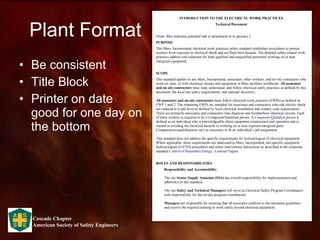
Plant Format Be consistent Title Block Printer on date good for one day on the bottom
Communication of Standards  and Procedures Establish a formal safety communication process Use: safety committee members Bulletin boards Emails Shift Meetings
Training Generic Training programs are good for communicating the basic standard information Each standard has specific training requirements
Change Management System Establish a formal Change Management system Document all updates and changes Provide information about changes to all affected employees
Policies & Procedures from a CSHO Perspective Is the document technically correct? Has it been reviewed/documented? Does it correlate to the process? Is it followed? Has communication & training been implemented on the floor?
Policies & Procedures from a CSHO Perspective  Corporate Standards exceed OSHA requirements Use of CPL and LOI Training CSHO (at your expense)
Next Month Checking the Safety Management System Self Assessments Corporate Audits Safety Work Order Systems Inspections & Audits Incident Investigation Performance Management Open Item Tracking / Info Mgmt
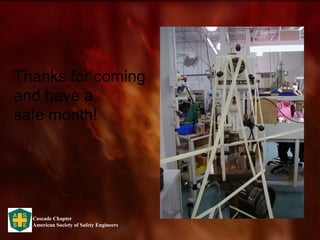
Thanks for coming  and have a  safe month!

Osha Manager Role

  • 1.
    Safety Standards &Procedures January 2008 Standards / Procedures Policy & Procedures Corporate Standards Communications Off-the-Job Safety Change Management
  • 2.
    Review of WhatWe Have Covered Various types of safety programs Looked at Scott Geller’s 10 Principles of Safety Management The role that management commitment and involvement plays in the process The role planning plays in the safety process
  • 3.
    During Decembers MeetingThe role that a Gap Analysis plays in the safety process How to conduct a Gap Analysis How effective safety processes do this annually to keep improving
  • 4.
    Quote of theSession Opportunity is missed by most people because it is dressed in overalls and looks like work. Thomas A. Edison (1847 - 1931)
  • 5.
    Safety Rules andProcedures Developing safety rules and procedures is an opportunity to shape our safety process Provides guidance for the process Sets the checks and balances Determines the route for our education.
  • 6.
    First Quest SpeakerStefanie Corbitt Former VaOSHA Compliance Officer Masters in Industrial Hygiene - West Virginia University Worked as a safety manager in Texas Owns her own consulting firm – SSIOSHA in Brunswick, Georgia - email - ssiosha@aol.com
  • 7.
    The Rulemaking ProcessFederal Three Kinds 6(a) Adoption of Consensus Standard 6(b) Permanent Standards 6(c) Emergency Temporary Standards
  • 8.
    6(b) Standards Development6(b)(1)-(4) Procedures for Rulemaking 6(b)(5) Health Standards 6(b)(6) Temporary Variances 6(b)(7) Content of Standards 6(b)(8) National Consensus Standards
  • 9.
    Standards Development 29C.F.R. 1911 Request for Information Advanced Notice of Proposal Rulemaking (ANPR) Notice of Proposed Rulemaking (NPRM) Public Comment
  • 10.
    Standards Development PublicHearings Post-hearing Comment Analysis Final Rule
  • 11.
    Components of aProposed Rule Justification for Standard Significant Risk Material Impairment of Health Economic Impact Analysis Technical Feasibility Analysis Proposed Rule
  • 12.
    Components of aFinal Rule Findings Significant risk Technical feasibility Economic Impact Final Rule Justification for Decision Implementation Schedule
  • 13.
    Challenges to aFinal Rule Administrative Appeal Judicial Review Standard for Review 60 days from date of publication Court of Appeals
  • 14.
    Emergency Temporary StandardsImminent Danger Serious Effects Standard is necessary to prevent effects
  • 15.
    Thanks Stef; Arethere any questions before Stef goes to pick up Ike?
  • 16.
    OR-OSHA Rule MakingProcess Anyone can have a bill introduced to state legislation If passed OR-OSHA will adopt the rule OR-OSHA has to adopt a new federal rule within 90 days Can make changes to enhance the application for Oregon
  • 17.
    OR - OSHARule Making Process Can Develop rules they feel are necessary to promote safety within the state Must prove: Significant risk Technical feasibility Economic Impact Follows the same type of procedure as the federal process only on a state level
  • 18.
    Standards That Require Written Programs Emergency Response H2 & O2 HAZWOPER PPE Respiratory PRCS LOTO Fire Brigades Fire Extinguishers O2 Welding Vertical Standards Most of Subpart Z: Asbestos, Pb, VC, Cd, Benzene, coke oven emissions, cotton dust, Acrylonitrile, Formaldehyde, MC* BBP Access to Medical Records HCS & Lab Standard *List not exhaustive
  • 19.
    Additional OR-OSHA RequirementsSafety Committee Written Health and Safety Plans
  • 20.
    Things to Remember?All plant standards should be developed under the care and direction of a safety professional If the site does not have a safety professional then use insurance company Loss Control engineers, private consultants, or the OR-OSHA consultation service Care must be taken to understand the standard being adopted Must reflect the way the plant does the activity Must be specific
  • 21.
    What Should YouDo Read the Standards Consult References OROSHA Guidebooks, OSHA CPL, LOI, STD Magazines and Trade Publications ASSE, AIHA Publication DOD/DOE Directives and Procedures Adapting "canned" programs to your facility
  • 22.
    Who Should Develop a Plant Standard? Standards should be developed by individuals who will be required to follow them: Safety Committee Members Supervisors Safety Managers (technical assistance only)
  • 23.
    Our Second SpeakerBob Riley Former plant Safety Manager for Mars, Incorporated at the Burr Ridge and Chicago, IL plants (over 20 years experience in the plant) Bob is a Haz Mat Expert Bob has his own consulting firm – Riley Associates – email – bob@rileysafety.com
  • 24.
    Standards and Proceduresfrom A Safety Manager’s Perspective Are they really necessary? Are they simple and concise? Are they enforceable and enforced? Must not demand unreasonable effort? Was employee input used? Are they consistent?
  • 25.
    Manager’s Responsibility Developmentof proper and co-operative attitudes toward safety in employees. Personal example: The manager must set an example by his/her personal behavior. Enforcement Knowledge of safe work procedures and accident prevention techniques Standards, SOP’s, Policy documents
  • 26.
    Types of Standardsand Procedures Technical Engineering specifications Machine Specific Lock out procedures Confined space entry Behavioral PPE compliance “How To” SOP’s Expectations
  • 27.
    Safety Managers RoleProvide technical input Ensure that the standard or Procedure follows current OSHA/OR-OSHA regulations Ensure that the procedure is feasible Ensure that the procedure is kept up to date Develop appropriate communication and training for the standard or procedure
  • 28.
    The Managers’ Areasof Focus Do you reallyknow the Rules? Educate yourselves Educate your teams Take and delegate responsibility for safety standard development, implementation and enforcement Share the knowledge and get input ! “Walk the Talk”
  • 29.
    Thanks Bob; Arethere any Questions for Bob?
  • 30.
    Standard Development ProcessObtain a copy of the OR-OSHA and or Federal OSHA standard Read and gain an understanding of the standard Determine the application to the plant Assemble a team of employees and managers to assist in the writing of the plant procedure Educate the team Draft the procedure Have management review the procedure Implement the procedure (communicate it to the plant and provide training)
  • 31.
    Corporate – vs– OR-OSHA Procedures Many corporations require things that are not part of a OR-OSHA or Federal OSHA standard If this is the case, during an inspection the inspector will hold you accountable for compliance to your standard, not the OSHA standard
  • 32.
    Things You Should NOT Do Provide copies of plant standards or procedures to a compliance officer to which that the officer is not entitled Give entire company safety manual to the compliance officer Provide the compliance officer access to a network computer containing the safety procedures
  • 33.
    Safety Procedures FormatDevelop a standard format for safety standards and procedures Common sections Scope/Purpose Responsibilities Technical Section Implementation Appendix Section with forms and support information Review and Update section
  • 34.
    Plant Format Beconsistent Title Block Printer on date good for one day on the bottom
  • 35.
    Communication of Standards and Procedures Establish a formal safety communication process Use: safety committee members Bulletin boards Emails Shift Meetings
  • 36.
    Training Generic Trainingprograms are good for communicating the basic standard information Each standard has specific training requirements
  • 37.
    Change Management SystemEstablish a formal Change Management system Document all updates and changes Provide information about changes to all affected employees
  • 38.
    Policies & Proceduresfrom a CSHO Perspective Is the document technically correct? Has it been reviewed/documented? Does it correlate to the process? Is it followed? Has communication & training been implemented on the floor?
  • 39.
    Policies & Proceduresfrom a CSHO Perspective Corporate Standards exceed OSHA requirements Use of CPL and LOI Training CSHO (at your expense)
  • 40.
    Next Month Checkingthe Safety Management System Self Assessments Corporate Audits Safety Work Order Systems Inspections & Audits Incident Investigation Performance Management Open Item Tracking / Info Mgmt
  • 41.
    Thanks for coming and have a safe month!

Editor's Notes

  • #39 Let’s focus on making your documents pass the first glance test. Prior to setting foot on the factory floor, the CSHO may ask to review certain key programs. Let’s use Hazard Communication for this example as it generally applies to all facilities. First, this standard requires a written program. Do you have one? If it’s canned, has it been made company specific? For example, on the title page does it have your company name and address, does the terminology match that of your organization? Does the policy meet the requirements of the standard? Does it discuss labeling, training, msds preparation and . Moving out to the plant floor, are containers labeled? Does your policy discuss immediate use container labeling? For instance if an employee siphons oil from a 55 gallon drum for lubrication, is that secondary (or immediate use) container labeled? As OSHA has an exception for immediate use, labeling might not be required unless your program specifies that ALL containers will be labeled. If your policy goes above and beyond OSHA requirements, you will be held to the more strict standard. Lastly if use of HMIS is employed as the labeling process, do all employees know how the process works? Can they explain the system? If you have effective and engaging training, your employees should be able to explain the system, describe or actually obtain an MSDS for a product on the floor and tell the CSHO how to where the written program is kept. Adults are only able to retain about 10% of new information, so having hands on demonstrations along with classroom instruction will help cement the learning. Additionally while not specifically required, having sign in sheets for the training session will assist in providing proof that employees have been trained.
  • #40 As with our example of the immediate use chemical, some corporations require all units to adhere to the same standards. As I mentioned if your policy goes above and beyond OSHA requirements, you will be held to the more strict standard. So how do you convince Corporate to settle for the OSHA standard? Unless you have some undue influence on Corporate, this situation is one you likely cannot change. Let’s use this to your advantage when dealing with a CSHO. Your company, for whatever reason, has decided to implement a more stringent policy. If the CSHO is evaluating one such program, you mention that the commitment of the business is to providing a safe and healthy work environment. For this reason, we have decided that all immediate use containers will be labeled. We realize that OSHA has an exception, however, we also recognize that mistakes can be made and the possibility of having an unattended, unlabeled container exists. For the health of our employees, we opt for the more stringent policy. During the walk around inspection, with this understanding, the CSHO may look more favorably on the facility and allow an immediate correction if an unlabeled container is found. If you are using a compliance instruction or relying on a letter of interpretation as the basis of your programs, have copies of these documents available. For example letters of interpretation are posted on the OSHA web page, however without warning or announcement, these documents call be pulled. If you do not have a saved or hard copy of the document, you may not be able to convince a CSHO that your program/policy was founded on sound OSHA information. Further, with differing administrations, interpretation can change drastically. Not all CSHO are technically competent. Take me for example, I was a health CSHO, my training and education is in industrial hygiene. On several of my first inspections, it is completely possible that I walked straight past LOTO violations. However after reading through a company policy, I was able to stop en-route to a complaint item and ask specific questions about a LOTO operation being conducted (incorrectly I might add) which resulted in a citation and penalty. In this case, because the company had a very good LOTO program and it’s procedures were outlined, I was able to determine that the training element was lacking as the operator did not understand the term exclusive control.