CONTRACEPTION
SHAMS ATRASH
Contraception is a mean used to prevent pregnancy.
It blocks the conception
It can work at different levels of the fertilization pathway:
 Keeps away the sperm from the egg
 Stops egg production
 Prevent the fertilized egg from attaching to the lining of the womb
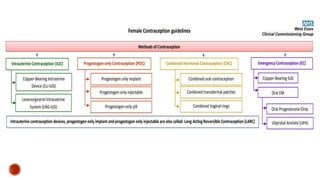
Condom
Diaphragm/cervical cap
Contraceptive sponge
spermicide
Both females and males condoms aims to prevent
sperm entry into the vagina
according to calculations done by Human Life
International based on data from the
authoritative Contraceptive Technology (21st Edition,
2018) and other sources.1
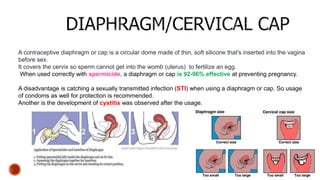
A contraceptive diaphragm or cap is a circular dome made of thin, soft silicone that's inserted into the vagina
before sex.
It covers the cervix so sperm cannot get into the womb (uterus) to fertilize an egg.
When used correctly with spermicide, a diaphragm or cap is 92-96% effective at preventing pregnancy.
A disadvantage is catching a sexually transmitted infection (STI) when using a diaphragm or cap. So usage
of condoms as well for protection is recommended.
Another is the development of cystitis was observed after the usage.
Estrogen
Development of internal/external genitalia breasts, female
fat distribution.
Growth of follicle, endometrial proliferation.
INCREASE myometrium excitability
Upregulation of estrogen, LH, and progesterone receptors;
feedback inhibition of FSH and LH, then LH surge
stimulation of prolactin secretion decrease prolactin effect
on the breast
Increase transport proteins
Increase HDL and decrease LDL.
Progesterone
Stimulation of endometrial glandular secretions and spiral artery development
 Production of thick cervical mucus  inhibit sperm entry into the uterus
Prevention of endometrial hyperplasia
Increase body temperature
Decrease estrogen receptor expression
Decrease LH/FSH secretion
Maintain pregnancy
Decrease myometrium contraction
Decrease prolactin action on breast
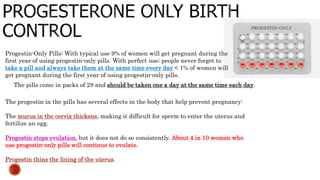
Progestin-Only Pills: With typical use 9% of women will get pregnant during the
first year of using progestin-only pills. With perfect use; people never forget to
take a pill and always take them at the same time every day < 1% of women will
get pregnant during the first year of using progestin-only pills.
The pills come in packs of 28 and should be taken one a day at the same time each day.
The progestin in the pills has several effects in the body that help prevent pregnancy:
The mucus in the cervix thickens, making it difficult for sperm to enter the uterus and
fertilize an egg.
Progestin stops ovulation, but it does not do so consistently. About 4 in 10 women who
use progestin-only pills will continue to ovulate.
Progestin thins the lining of the uterus.
women may have less bleeding or stop having periods altogether while taking these pills.
This can be helpful for women who have heavy or painful periods.
progestin-only pills can be used immediately after childbirth.
Does not affect the chances of getting pregnant after stopping the medication
BUT!!
this method does not protect from TSI and can cause irregular
bleeding and spotting.
patient at high risk for or have had breast cancer: some studies have shown an association with
progestin-only birth control and breast cancer.
liver disease: Some evidence has shown that progestin can potentially damage the liver.
anti-seizure medications: Some anti-seizure medications break down hormones in the body and may
reduce the effectiveness of a progestin-only pill.
bariatric surgery: Bariatric surgery may affect the way the body absorbs these medications and may
make them less effective.
Progestin-only birth control pills share common side effects, some of which will resolve over time. They
may include:
Headache
Nausea
Spotting or irregular vaginal bleeding
Amenorrhea
Breast tenderness
Weight gain
MEDROXYPROGESTERONE ACETATE
(DMPA)
The birth control injection contains the hormone depot medroxyprogesterone acetate (DMPA). This hormone
protects against pregnancy for 13 weeks. A total of four injections a year while using this form of birth control.
Injections are given by an ob-gyn or other health care professional.
first shot within the first 7 days after the start of the period, no additional birth control method is needed.
 first shot more than 7 days after the start of the period, a need to use an additional birth control method or
avoid sex for the next 7 days.
The injection is most effective when you get it every 13 weeks. Injections can be given up to 2 weeks late (15
weeks from the last injection).
DMPA has benefits that are not related to birth control, including
1. reducing the risk of cancer of the uterus if used long term
2. reducing pelvic pain caused by endometriosis
3. may relieve certain symptoms of sickle cell disease and seizure disorders. It may reduce the
bleeding associated with uterine fibroids. And it may protect against pelvic inflammatory disease
(PID).
The implant is more than 99% effective.
The implant can be taken out if you have side effects.
Some medicines can make the implant less effective,
such as:
medicines for HIV, epilepsy and tuberculosis
complementary remedies, such as St John's Wort
some antibiotics, such as rifabutin or rifampicin
https://youtu.be/opnXt3m2Nno
Pills that contain low doses of 2 hormones a progestin and an estrogen
Work primarily by preventing the release of eggs from the ovaries (ovulation)
Approximately 9% of women become pregnant in the first year of use with combined hormonal
contraceptives with typical use .
These methods are reversible and can be used by women of all ages.
are generally used for 21–24 consecutive days, followed by 4–7 hormone-free days (either no use or
placebo pills).
If combined hormonal contraceptives are started within the first 5 days since menstrual bleeding started, no
additional contraceptive protection is needed.
If combined hormonal contraceptives are started >5 days since menstrual bleeding started, the woman
needs to abstain from sexual intercourse or use additional contraceptive protection for the next 7 days.

Postpartum women who are breastfeeding should not use combined hormonal contraceptives
during the first 3 weeks after delivery due to concerns about increased risk for venous
thromboembolism ,concerns about potential effects on breastfeeding performance.

Postpartum breastfeeding women with other risk factors for venous thromboembolism
generally should not use combined hormonal contraceptives 4–6 weeks after delivery
Combined hormonal contraceptives can be started within the first 7 days after first or second
trimester abortion, including immediately post-abortion
Women with certain conditions such as current breast cancer, severe hypertension or vascular disease,
heart disease, migraine headaches with aura, and certain liver diseases, as well as women aged ≥35
years who smoke ≥15 cigarettes per day, should not use combined hormonal contraceptives
Women with thrombogenic mutations should not use combined hormonal contraceptives because of the
increased risk for venous thromboembolism
women with current breast cancer should not use combined hormonal contraceptives
Women with anemia, cervical intraepithelial neoplasia, cervical cancer, HIV infection, or other STDs can
use combined hormonal contraceptives; therefore, screening for these conditions is not necessary for the
safe initiation of combined hormonal contraceptives.
Taking BMI measures to keep a track of weight changes during medication usage is favorable
considered late when <24 hours have elapsed since the dose should have been taken. A dose is considered missed
if ≥24 hours have elapsed since the dose should have been taken.
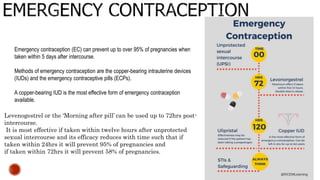
Emergency contraception (EC) can prevent up to over 95% of pregnancies when
taken within 5 days after intercourse.
Methods of emergency contraception are the copper-bearing intrauterine devices
(IUDs) and the emergency contraceptive pills (ECPs).
A copper-bearing IUD is the most effective form of emergency contraception
available.
Levenogestrel or the ‘Morning after pill’ can be used up to 72hrs post-
intercourse.
It is most effective if taken within twelve hours after unprotected
sexual intercourse and its efficacy reduces with time such that if
taken within 24hrs it will prevent 95% of pregnancies and
if taken within 72hrs it will prevent 58% of pregnancies.
ella (ulipristal acetate) is a synthetic progesterone agonist/antagonist.
When taken immediately before ovulation is to occur, Ella postpones follicular rupture.
alterations to the endometrium that may affect implantation may also contribute to efficacy.
Ella is supplied as a tablet for oral administration. The recommended dose is one tablet taken orally as soon as
possible, within 120 hours (5 days) after unprotected intercourse or a known or suspected contraceptive
failure.
acts as a potent, orally active anti-progestational agent.
Estrogen containing oral contraceptives
increase the plasma concentration of clotting
factors II, VII, X, XII, factor VIII, and
fibrinogen.
Estrogen, like many lipophilic hormones,
affects the gene transcription of various
proteins. Thus, estrogen increases plasma
concentrations of these clotting factors by
increasing gene transcription.
https://shcs.ucdavis.edu/health-topic/emergency-contraception-ec
https://www.rcemlearning.co.uk/foamed/emergency-contraception/
https://www.centerwatch.com/directories/1067-fda-approved-drugs/listing/3444-ella-ulipristal-acetate
https://www.cdc.gov/reproductivehealth/contraception/mmwr/spr/combined.html#Fig2
https://www.nhs.uk/conditions/contraception/what-is-contraception/
https://www.hli.org/resources/how-effective-are-condoms/
https://wellcaremedicalcentre.org.au/mirena/
https://www.mayoclinic.org/tests-procedures/minipill/about/pac-20388306
https://www.acog.org/womens-health/faqs/progestin-only-hormonal-birth-control-pill-and-injection
https://www.verywellhealth.com/common-depo-provera-side-effects-906709
https://www.shecares.com/menstruation/birth-control-implants
https://www.who.int/news-room/fact-sheets/detail/emergency-contraception
FIRST AID USMLE STEP1 BOOK 2021 EDITION & STEP UP TO USMLE STERP 2 CK 5
EDITION

contraception

  • 1.
  • 2.
    Contraception is amean used to prevent pregnancy. It blocks the conception
  • 3.
    It can workat different levels of the fertilization pathway:  Keeps away the sperm from the egg  Stops egg production  Prevent the fertilized egg from attaching to the lining of the womb
  • 5.
  • 6.
    Both females andmales condoms aims to prevent sperm entry into the vagina according to calculations done by Human Life International based on data from the authoritative Contraceptive Technology (21st Edition, 2018) and other sources.1
  • 7.
    A contraceptive diaphragmor cap is a circular dome made of thin, soft silicone that's inserted into the vagina before sex. It covers the cervix so sperm cannot get into the womb (uterus) to fertilize an egg. When used correctly with spermicide, a diaphragm or cap is 92-96% effective at preventing pregnancy. A disadvantage is catching a sexually transmitted infection (STI) when using a diaphragm or cap. So usage of condoms as well for protection is recommended. Another is the development of cystitis was observed after the usage.
  • 10.
    Estrogen Development of internal/externalgenitalia breasts, female fat distribution. Growth of follicle, endometrial proliferation. INCREASE myometrium excitability Upregulation of estrogen, LH, and progesterone receptors; feedback inhibition of FSH and LH, then LH surge stimulation of prolactin secretion decrease prolactin effect on the breast Increase transport proteins Increase HDL and decrease LDL.
  • 11.
    Progesterone Stimulation of endometrialglandular secretions and spiral artery development  Production of thick cervical mucus  inhibit sperm entry into the uterus Prevention of endometrial hyperplasia Increase body temperature Decrease estrogen receptor expression Decrease LH/FSH secretion Maintain pregnancy Decrease myometrium contraction Decrease prolactin action on breast
  • 12.
    Progestin-Only Pills: Withtypical use 9% of women will get pregnant during the first year of using progestin-only pills. With perfect use; people never forget to take a pill and always take them at the same time every day < 1% of women will get pregnant during the first year of using progestin-only pills. The pills come in packs of 28 and should be taken one a day at the same time each day. The progestin in the pills has several effects in the body that help prevent pregnancy: The mucus in the cervix thickens, making it difficult for sperm to enter the uterus and fertilize an egg. Progestin stops ovulation, but it does not do so consistently. About 4 in 10 women who use progestin-only pills will continue to ovulate. Progestin thins the lining of the uterus.
  • 13.
    women may haveless bleeding or stop having periods altogether while taking these pills. This can be helpful for women who have heavy or painful periods. progestin-only pills can be used immediately after childbirth. Does not affect the chances of getting pregnant after stopping the medication BUT!! this method does not protect from TSI and can cause irregular bleeding and spotting.
  • 14.
    patient at highrisk for or have had breast cancer: some studies have shown an association with progestin-only birth control and breast cancer. liver disease: Some evidence has shown that progestin can potentially damage the liver. anti-seizure medications: Some anti-seizure medications break down hormones in the body and may reduce the effectiveness of a progestin-only pill. bariatric surgery: Bariatric surgery may affect the way the body absorbs these medications and may make them less effective.
  • 15.
    Progestin-only birth controlpills share common side effects, some of which will resolve over time. They may include: Headache Nausea Spotting or irregular vaginal bleeding Amenorrhea Breast tenderness Weight gain
  • 17.
    MEDROXYPROGESTERONE ACETATE (DMPA) The birthcontrol injection contains the hormone depot medroxyprogesterone acetate (DMPA). This hormone protects against pregnancy for 13 weeks. A total of four injections a year while using this form of birth control. Injections are given by an ob-gyn or other health care professional. first shot within the first 7 days after the start of the period, no additional birth control method is needed.  first shot more than 7 days after the start of the period, a need to use an additional birth control method or avoid sex for the next 7 days. The injection is most effective when you get it every 13 weeks. Injections can be given up to 2 weeks late (15 weeks from the last injection). DMPA has benefits that are not related to birth control, including 1. reducing the risk of cancer of the uterus if used long term 2. reducing pelvic pain caused by endometriosis 3. may relieve certain symptoms of sickle cell disease and seizure disorders. It may reduce the bleeding associated with uterine fibroids. And it may protect against pelvic inflammatory disease (PID).
  • 19.
    The implant ismore than 99% effective. The implant can be taken out if you have side effects. Some medicines can make the implant less effective, such as: medicines for HIV, epilepsy and tuberculosis complementary remedies, such as St John's Wort some antibiotics, such as rifabutin or rifampicin https://youtu.be/opnXt3m2Nno
  • 20.
    Pills that containlow doses of 2 hormones a progestin and an estrogen Work primarily by preventing the release of eggs from the ovaries (ovulation) Approximately 9% of women become pregnant in the first year of use with combined hormonal contraceptives with typical use . These methods are reversible and can be used by women of all ages. are generally used for 21–24 consecutive days, followed by 4–7 hormone-free days (either no use or placebo pills). If combined hormonal contraceptives are started within the first 5 days since menstrual bleeding started, no additional contraceptive protection is needed. If combined hormonal contraceptives are started >5 days since menstrual bleeding started, the woman needs to abstain from sexual intercourse or use additional contraceptive protection for the next 7 days.
  • 21.
     Postpartum women whoare breastfeeding should not use combined hormonal contraceptives during the first 3 weeks after delivery due to concerns about increased risk for venous thromboembolism ,concerns about potential effects on breastfeeding performance.  Postpartum breastfeeding women with other risk factors for venous thromboembolism generally should not use combined hormonal contraceptives 4–6 weeks after delivery Combined hormonal contraceptives can be started within the first 7 days after first or second trimester abortion, including immediately post-abortion
  • 22.
    Women with certainconditions such as current breast cancer, severe hypertension or vascular disease, heart disease, migraine headaches with aura, and certain liver diseases, as well as women aged ≥35 years who smoke ≥15 cigarettes per day, should not use combined hormonal contraceptives Women with thrombogenic mutations should not use combined hormonal contraceptives because of the increased risk for venous thromboembolism women with current breast cancer should not use combined hormonal contraceptives Women with anemia, cervical intraepithelial neoplasia, cervical cancer, HIV infection, or other STDs can use combined hormonal contraceptives; therefore, screening for these conditions is not necessary for the safe initiation of combined hormonal contraceptives. Taking BMI measures to keep a track of weight changes during medication usage is favorable
  • 25.
    considered late when<24 hours have elapsed since the dose should have been taken. A dose is considered missed if ≥24 hours have elapsed since the dose should have been taken.
  • 28.
    Emergency contraception (EC)can prevent up to over 95% of pregnancies when taken within 5 days after intercourse. Methods of emergency contraception are the copper-bearing intrauterine devices (IUDs) and the emergency contraceptive pills (ECPs). A copper-bearing IUD is the most effective form of emergency contraception available. Levenogestrel or the ‘Morning after pill’ can be used up to 72hrs post- intercourse. It is most effective if taken within twelve hours after unprotected sexual intercourse and its efficacy reduces with time such that if taken within 24hrs it will prevent 95% of pregnancies and if taken within 72hrs it will prevent 58% of pregnancies.
  • 29.
    ella (ulipristal acetate)is a synthetic progesterone agonist/antagonist. When taken immediately before ovulation is to occur, Ella postpones follicular rupture. alterations to the endometrium that may affect implantation may also contribute to efficacy. Ella is supplied as a tablet for oral administration. The recommended dose is one tablet taken orally as soon as possible, within 120 hours (5 days) after unprotected intercourse or a known or suspected contraceptive failure. acts as a potent, orally active anti-progestational agent.
  • 32.
    Estrogen containing oralcontraceptives increase the plasma concentration of clotting factors II, VII, X, XII, factor VIII, and fibrinogen. Estrogen, like many lipophilic hormones, affects the gene transcription of various proteins. Thus, estrogen increases plasma concentrations of these clotting factors by increasing gene transcription.
  • 33.
    https://shcs.ucdavis.edu/health-topic/emergency-contraception-ec https://www.rcemlearning.co.uk/foamed/emergency-contraception/ https://www.centerwatch.com/directories/1067-fda-approved-drugs/listing/3444-ella-ulipristal-acetate https://www.cdc.gov/reproductivehealth/contraception/mmwr/spr/combined.html#Fig2 https://www.nhs.uk/conditions/contraception/what-is-contraception/ https://www.hli.org/resources/how-effective-are-condoms/ https://wellcaremedicalcentre.org.au/mirena/ https://www.mayoclinic.org/tests-procedures/minipill/about/pac-20388306 https://www.acog.org/womens-health/faqs/progestin-only-hormonal-birth-control-pill-and-injection https://www.verywellhealth.com/common-depo-provera-side-effects-906709 https://www.shecares.com/menstruation/birth-control-implants https://www.who.int/news-room/fact-sheets/detail/emergency-contraception FIRST AID USMLESTEP1 BOOK 2021 EDITION & STEP UP TO USMLE STERP 2 CK 5 EDITION