CONTRACEPTION
Presenter : Zamilatun hidayah binti MohdArifin
Mentor : Dr ikhwan
Supervisor : Dr Nuraini binti Muhammad
What is Contraception ?
• Birth control = methods or devices used to
prevent pregnancy
• WHO Definition :
• Methods used by individuals / couples to anticipate their
• Desired number of children
• The spacing between 1 child to another
• Timing of children’s birth
Characteristics of Ideal
Contraception ??
• Safe (without danger / serious side effects )
•Highly effective to protect against pregnancy (
at least by 60%)
• Reversible
• Acceptable from the user's personal , religion and cultural
point of view
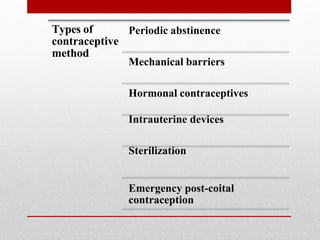
Types of
contraceptive
method
Periodic abstinence
Mechanical barriers
Hormonal contraceptives
Intrauterine devices
Sterilization
Emergency post-coital
contraception
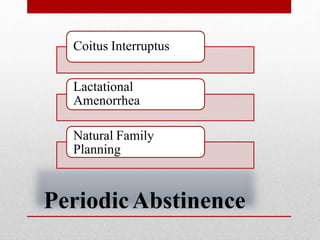
PeriodicAbstinence
Coitus Interruptus
Lactational
Amenorrhea
Natural Family
Planning
Coitus Interruptus
• DEFINITION :
• withdrawal of the entire penis from the vagina before
ejaculation
• EFFICACY :
• The failure rate : ~ 4% in the first year of perfect use.
• In typical use : ~ 22% during the first year of use.
• ADVANTAGES :
• No devices, no cost, no chemical involvement
• DISADVANTAGES :
• Probability of pregnancy is high with incorrect or
inconsistent use.
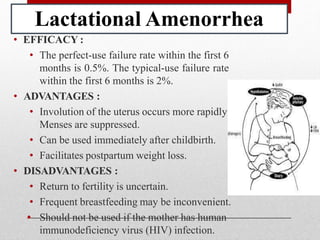
Lactational Amenorrhea
.
• EFFICACY :
• The perfect-use failure rate within the first 6
months is 0.5%. The typical-use failure rate
within the first 6 months is 2%.
• ADVANTAGES :
• Involution of the uterus occurs more rapidly
Menses are suppressed.
• Can be used immediately after childbirth.
• Facilitates postpartum weight loss.
• DISADVANTAGES :
• Return to fertility is uncertain.
• Frequent breastfeeding may be inconvenient.
• Should not be used if the mother has human
immunodeficiency virus (HIV) infection.
Natural Family Planning
• Avoid intercourse during a woman's fertile period(D10-D16)
• Calendar method : The menses is recorded for 6 cycles to
approximate the fertile period.
• Efficacy :
• The failure rate in typical use is estimated to be approximately
25%.
• Advantages :
• No adverse effects from hormones occur.
• Disadvantages :
• This is most suitable for women with regular and predictable
cycles.
• Requires discipline.
Mechanical Barriers
Male Condom
Female Condom
Diaphragm
Cervical Cap
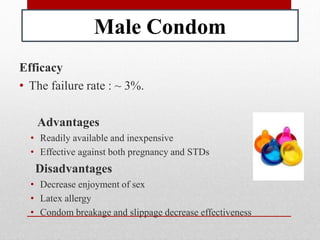
Male Condom
Efficacy
• The failure rate : ~ 3%.
Advantages
• Readily available and inexpensive
• Effective against both pregnancy and STDs
Disadvantages
• Decrease enjoyment of sex
• Latex allergy
• Condom breakage and slippage decrease effectiveness
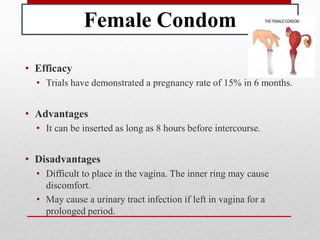
Female Condom
• Efficacy
• Trials have demonstrated a pregnancy rate of 15% in 6 months.
• Advantages
• It can be inserted as long as 8 hours before intercourse.
• Disadvantages
• Difficult to place in the vagina. The inner ring may cause
discomfort.
• May cause a urinary tract infection if left in vagina for a
prolonged period.
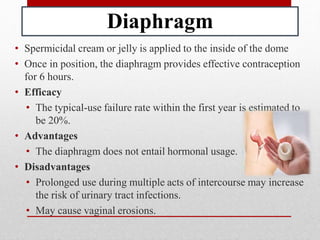
Diaphragm
• Spermicidal cream or jelly is applied to the inside of the dome
• Once in position, the diaphragm provides effective contraception
for 6 hours.
• Efficacy
• The typical-use failure rate within the first year is estimated to
be 20%.
• Advantages
• The diaphragm does not entail hormonal usage.
• Disadvantages
• Prolonged use during multiple acts of intercourse may increase
the risk of urinary tract infections.
• May cause vaginal erosions.
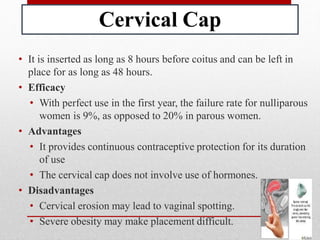
Cervical Cap
• It is inserted as long as 8 hours before coitus and can be left in
place for as long as 48 hours.
• Efficacy
• With perfect use in the first year, the failure rate for nulliparous
women is 9%, as opposed to 20% in parous women.
• Advantages
• It provides continuous contraceptive protection for its duration
of use
• The cervical cap does not involve use of hormones.
• Disadvantages
• Cervical erosion may lead to vaginal spotting.
• Severe obesity may make placement difficult.
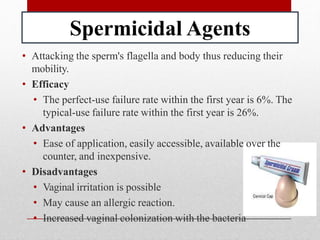
Spermicidal Agents
• Attacking the sperm's flagella and body thus reducing their
mobility.
• Efficacy
• The perfect-use failure rate within the first year is 6%. The
typical-use failure rate within the first year is 26%.
• Advantages
• Ease of application, easily accessible, available over the
counter, and inexpensive.
• Disadvantages
• Vaginal irritation is possible
• May cause an allergic reaction.
• Increased vaginal colonization with the bacteria
Hormonal
Contraceptives
Implants
Injectable
Depomedroxyprogesterone
Acetate
Progestin-Only Oral
Contraceptives
Combination Oral
Contraceptives
Implants
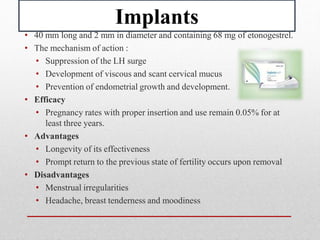
• 40 mm long and 2 mm in diameter and containing 68 mg of etonogestrel.
• The mechanism of action :
• Suppression of the LH surge
• Development of viscous and scant cervical mucus
• Prevention of endometrial growth and development.
• Efficacy
• Pregnancy rates with proper insertion and use remain 0.05% for at
least three years.
• Advantages
• Longevity of its effectiveness
• Prompt return to the previous state of fertility occurs upon removal
• Disadvantages
• Menstrual irregularities
• Headache, breast tenderness and moodiness
Timing of Insertion
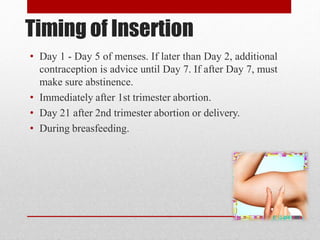
• Day 1 - Day 5 of menses. If later than Day 2, additional
contraception is advice until Day 7. If after Day 7, must
make sure abstinence.
• Immediately after 1st trimester abortion.
• Day 21 after 2nd trimester abortion or delivery.
• During breasfeeding.

Injectable Depomedroxyprogesterone
Acetate
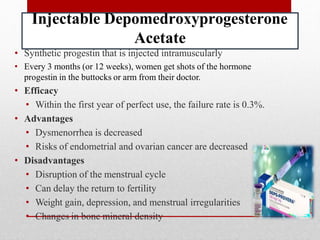
• Synthetic progestin that is injected intramuscularly
• Every 3 months (or 12 weeks), women get shots of the hormone
progestin in the buttocks or arm from their doctor.
• Efficacy
• Within the first year of perfect use, the failure rate is 0.3%.
• Advantages
• Dysmenorrhea is decreased
• Risks of endometrial and ovarian cancer are decreased
• Disadvantages
• Disruption of the menstrual cycle
• Can delay the return to fertility
• Weight gain, depression, and menstrual irregularities
• Changes in bone mineral density
• Suitable for women
who forget to take pills, particularly travellers,
due to frequent changes in time zones
In whom oestrogen is contraindicated:
○ mild to moderate hypertension
○ diabetes mellitus in the absence of vascular
disease
○ age >35yo & smoking
Progestin-Only Oral Contraceptives
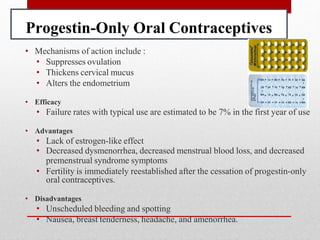
• Mechanisms of action include :
• Suppresses ovulation
• Thickens cervical mucus
• Alters the endometrium
• Efficacy
• Failure rates with typical use are estimated to be 7% in the first year of use
• Advantages
• Lack of estrogen-like effect
• Decreased dysmenorrhea, decreased menstrual blood loss, and decreased
premenstrual syndrome symptoms
• Fertility is immediately reestablished after the cessation of progestin-only
oral contraceptives.
• Disadvantages
• Unscheduled bleeding and spotting
• Nausea, breast tenderness, headache, and amenorrhea.
• Suitable for women with
Lactation , migraine, older women who smoke
Hpt, valvular heart disease ,Sickle cell disease,SLE
and other autoimmune disease
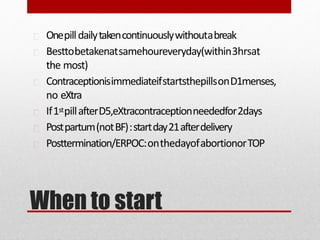
When to start
Onepilldailytakencontinuouslywithoutabreak
Besttobetakenatsamehoureveryday(within3hrsat
the most)
ContraceptionisimmediateifstartsthepillsonD1menses,
no eXtra
If1stpillafterD5,eXtracontraceptionneededfor2days
Postpartum(notBF):startday21afterdelivery
Posttermination/ERPOC:onthedayofabortionorTOP
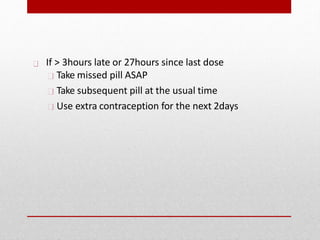
If ˃ 3hours late or 27hours since last dose
Take missed pill ASAP
Take subsequent pill at the usual time
Use extra contraception for the next 2days
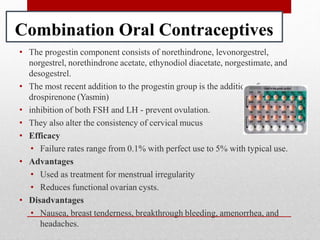
Combination Oral Contraceptives
• The progestin component consists of norethindrone, levonorgestrel,
norgestrel, norethindrone acetate, ethynodiol diacetate, norgestimate, and
desogestrel.
• The most recent addition to the progestin group is the addition of
drospirenone (Yasmin)
• inhibition of both FSH and LH - prevent ovulation.
• They also alter the consistency of cervical mucus
• Efficacy
• Failure rates range from 0.1% with perfect use to 5% with typical use.
• Advantages
• Used as treatment for menstrual irregularity
• Reduces functional ovarian cysts.
• Disadvantages
• Nausea, breast tenderness, breakthrough bleeding, amenorrhea, and
headaches.
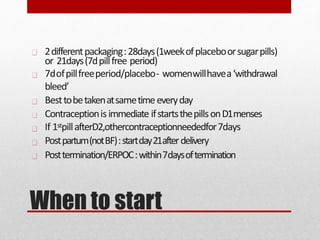
When to start
2differentpackaging:28days(1weekofplaceboorsugarpills)
or 21days(7dpillfree period)
7dofpillfreeperiod/placebo- womenwillhavea‘withdrawal
bleed’
Besttobetakenatsametimeeveryday
Contraceptionisimmediate ifstartsthepillsonD1menses
If 1stpillafterD2,othercontraceptionneededfor7days
Postpartum(notBF):startday21afterdelivery
Posttermination/ERPOC:within7daysoftermination
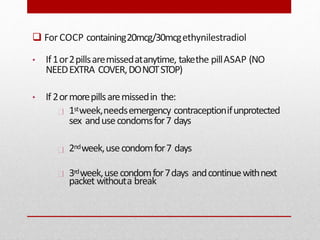
 ForCOCP containing20mcg/30mcgethynilestradiol
• If1or2pillsaremissedatanytime, takethe pillASAP (NO
NEEDEXTRA COVER,DONOTSTOP)
• If 2ormorepillsaremissedin the:
1stweek,needsemergency contraceptionifunprotected
sex andusecondomsfor7 days
2ndweek,usecondomfor7 days
3rdweek,usecondomfor7days andcontinuewithnext
packet withouta break
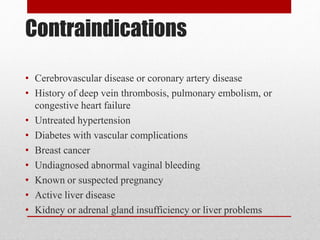
Contraindications
• Cerebrovascular disease or coronary artery disease
• History of deep vein thrombosis, pulmonary embolism, or
congestive heart failure
• Untreated hypertension
• Diabetes with vascular complications
• Breast cancer
• Undiagnosed abnormal vaginal bleeding
• Known or suspected pregnancy
• Active liver disease
• Kidney or adrenal gland insufficiency or liver problems
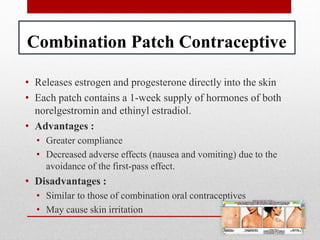
Combination Patch Contraceptive
• Releases estrogen and progesterone directly into the skin
• Each patch contains a 1-week supply of hormones of both
norelgestromin and ethinyl estradiol.
• Advantages :
• Greater compliance
• Decreased adverse effects (nausea and vomiting) due to the
avoidance of the first-pass effect.
• Disadvantages :
• Similar to those of combination oral contraceptives
• May cause skin irritation
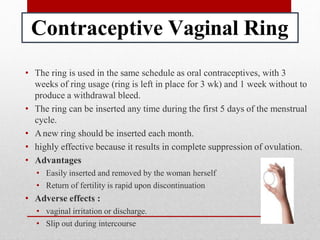
Contraceptive Vaginal Ring
• The ring is used in the same schedule as oral contraceptives, with 3
weeks of ring usage (ring is left in place for 3 wk) and 1 week without to
produce a withdrawal bleed.
• The ring can be inserted any time during the first 5 days of the menstrual
cycle.
• Anew ring should be inserted each month.
• highly effective because it results in complete suppression of ovulation.
• Advantages
• Easily inserted and removed by the woman herself
• Return of fertility is rapid upon discontinuation
• Adverse effects :
• vaginal irritation or discharge.
• Slip out during intercourse
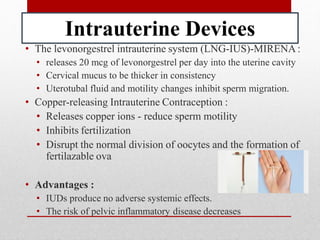
Intrauterine Devices
• The levonorgestrel intrauterine system (LNG-IUS)-MIRENA :
• releases 20 mcg of levonorgestrel per day into the uterine cavity
• Cervical mucus to be thicker in consistency
• Uterotubal fluid and motility changes inhibit sperm migration.
• Copper-releasing Intrauterine Contraception :
• Releases copper ions - reduce sperm motility
• Inhibits fertilization
• Disrupt the normal division of oocytes and the formation of
fertilazable ova
• Advantages :
• IUDs produce no adverse systemic effects.
• The risk of pelvic inflammatory disease decreases
• When to insert :
• Anytime during menses
• Any other time during cycles if she used appropriate contraception, was not
sexually active or not pregnant
• Any time after a pregnancy, a spontaneous abortion, a misscarriage, or and
induced abortion if a woman has not enggaged in unprotected intercourse
• Disadvantages :
• Risk of uterine perforation at the time of insertion (1%).
• Increased dysmenorrhea and blood loss may occur in the first few
cycles
• The intrauterine device does not protect against sexually transmitted
infections.
• Contraindications :
• Abnormal or distorted uterine cavity
• Undiagnosed genital bleeding, uterine or cervical malignancy
• Known or suspected pregnancy
• Active cervical or endometrial infections.
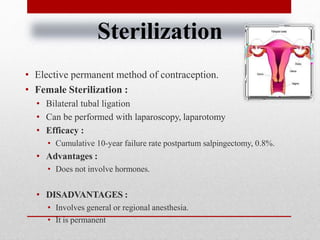
Sterilization
• Elective permanent method of contraception.
• Female Sterilization :
• Bilateral tubal ligation
• Can be performed with laparoscopy, laparotomy
• Efficacy :
• Cumulative 10-year failure rate postpartum salpingectomy, 0.8%.
• Advantages :
• Does not involve hormones.
• DISADVANTAGES :
• Involves general or regional anesthesia.
• It is permanent
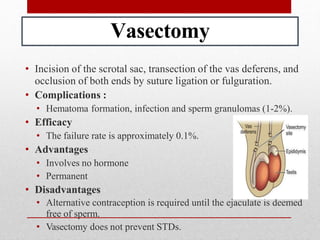
Vasectomy
• Incision of the scrotal sac, transection of the vas deferens, and
occlusion of both ends by suture ligation or fulguration.
• Complications :
• Hematoma formation, infection and sperm granulomas (1-2%).
• Efficacy
• The failure rate is approximately 0.1%.
• Advantages
• Involves no hormone
• Permanent
• Disadvantages
• Alternative contraception is required until the ejaculate is deemed
free of sperm.
• Vasectomy does not prevent STDs.
Emergency Postcoital
Contraception
⚫Also known as the “morning after pill”
⚫The pills are 75 to 89 percent effective at preventing pregnancy
⚫Can be taken up to 3-5daysAFTER unprotected sex
⚫No prescription needed over age of 15
⚫Effectiveness decreases after 24 hours
⚫Emergency contraception should only be used after no birth control
was used during sex, or if the birth control method failed, such as if
a condom broke
REFERENCES
• http://www.myhealth.gov.my/en/contraception/
• LAMAN WEB KEMENTERIAN KESIHATAN
MALAYSIA
• WORLD HEALTH ORGANISATION
• KEDAH PROTOCOL
THANK YOU

contraception1-220926125354-a2d3bafe.pptx

  • 1.
    CONTRACEPTION Presenter : Zamilatunhidayah binti MohdArifin Mentor : Dr ikhwan Supervisor : Dr Nuraini binti Muhammad
  • 2.
    What is Contraception? • Birth control = methods or devices used to prevent pregnancy • WHO Definition : • Methods used by individuals / couples to anticipate their • Desired number of children • The spacing between 1 child to another • Timing of children’s birth
  • 3.
    Characteristics of Ideal Contraception?? • Safe (without danger / serious side effects ) •Highly effective to protect against pregnancy ( at least by 60%) • Reversible • Acceptable from the user's personal , religion and cultural point of view
  • 4.
    Types of contraceptive method Periodic abstinence Mechanicalbarriers Hormonal contraceptives Intrauterine devices Sterilization Emergency post-coital contraception
  • 5.
  • 6.
    Coitus Interruptus • DEFINITION: • withdrawal of the entire penis from the vagina before ejaculation • EFFICACY : • The failure rate : ~ 4% in the first year of perfect use. • In typical use : ~ 22% during the first year of use. • ADVANTAGES : • No devices, no cost, no chemical involvement • DISADVANTAGES : • Probability of pregnancy is high with incorrect or inconsistent use.
  • 7.
    Lactational Amenorrhea . • EFFICACY: • The perfect-use failure rate within the first 6 months is 0.5%. The typical-use failure rate within the first 6 months is 2%. • ADVANTAGES : • Involution of the uterus occurs more rapidly Menses are suppressed. • Can be used immediately after childbirth. • Facilitates postpartum weight loss. • DISADVANTAGES : • Return to fertility is uncertain. • Frequent breastfeeding may be inconvenient. • Should not be used if the mother has human immunodeficiency virus (HIV) infection.
  • 8.
    Natural Family Planning •Avoid intercourse during a woman's fertile period(D10-D16) • Calendar method : The menses is recorded for 6 cycles to approximate the fertile period.
  • 9.
    • Efficacy : •The failure rate in typical use is estimated to be approximately 25%. • Advantages : • No adverse effects from hormones occur. • Disadvantages : • This is most suitable for women with regular and predictable cycles. • Requires discipline.
  • 10.
    Mechanical Barriers Male Condom FemaleCondom Diaphragm Cervical Cap
  • 11.
    Male Condom Efficacy • Thefailure rate : ~ 3%. Advantages • Readily available and inexpensive • Effective against both pregnancy and STDs Disadvantages • Decrease enjoyment of sex • Latex allergy • Condom breakage and slippage decrease effectiveness
  • 12.
    Female Condom • Efficacy •Trials have demonstrated a pregnancy rate of 15% in 6 months. • Advantages • It can be inserted as long as 8 hours before intercourse. • Disadvantages • Difficult to place in the vagina. The inner ring may cause discomfort. • May cause a urinary tract infection if left in vagina for a prolonged period.
  • 13.
    Diaphragm • Spermicidal creamor jelly is applied to the inside of the dome • Once in position, the diaphragm provides effective contraception for 6 hours. • Efficacy • The typical-use failure rate within the first year is estimated to be 20%. • Advantages • The diaphragm does not entail hormonal usage. • Disadvantages • Prolonged use during multiple acts of intercourse may increase the risk of urinary tract infections. • May cause vaginal erosions.
  • 14.
    Cervical Cap • Itis inserted as long as 8 hours before coitus and can be left in place for as long as 48 hours. • Efficacy • With perfect use in the first year, the failure rate for nulliparous women is 9%, as opposed to 20% in parous women. • Advantages • It provides continuous contraceptive protection for its duration of use • The cervical cap does not involve use of hormones. • Disadvantages • Cervical erosion may lead to vaginal spotting. • Severe obesity may make placement difficult.

  • 15.
    Spermicidal Agents • Attackingthe sperm's flagella and body thus reducing their mobility. • Efficacy • The perfect-use failure rate within the first year is 6%. The typical-use failure rate within the first year is 26%. • Advantages • Ease of application, easily accessible, available over the counter, and inexpensive. • Disadvantages • Vaginal irritation is possible • May cause an allergic reaction. • Increased vaginal colonization with the bacteria
  • 16.
  • 17.
    Implants • 40 mmlong and 2 mm in diameter and containing 68 mg of etonogestrel. • The mechanism of action : • Suppression of the LH surge • Development of viscous and scant cervical mucus • Prevention of endometrial growth and development. • Efficacy • Pregnancy rates with proper insertion and use remain 0.05% for at least three years. • Advantages • Longevity of its effectiveness • Prompt return to the previous state of fertility occurs upon removal • Disadvantages • Menstrual irregularities • Headache, breast tenderness and moodiness
  • 18.
    Timing of Insertion •Day 1 - Day 5 of menses. If later than Day 2, additional contraception is advice until Day 7. If after Day 7, must make sure abstinence. • Immediately after 1st trimester abortion. • Day 21 after 2nd trimester abortion or delivery. • During breasfeeding.
  • 19.
    Injectable Depomedroxyprogesterone Acetate • Syntheticprogestin that is injected intramuscularly • Every 3 months (or 12 weeks), women get shots of the hormone progestin in the buttocks or arm from their doctor. • Efficacy • Within the first year of perfect use, the failure rate is 0.3%. • Advantages • Dysmenorrhea is decreased • Risks of endometrial and ovarian cancer are decreased • Disadvantages • Disruption of the menstrual cycle • Can delay the return to fertility • Weight gain, depression, and menstrual irregularities • Changes in bone mineral density
  • 20.
    • Suitable forwomen who forget to take pills, particularly travellers, due to frequent changes in time zones In whom oestrogen is contraindicated: ○ mild to moderate hypertension ○ diabetes mellitus in the absence of vascular disease ○ age >35yo & smoking
  • 21.
    Progestin-Only Oral Contraceptives •Mechanisms of action include : • Suppresses ovulation • Thickens cervical mucus • Alters the endometrium • Efficacy • Failure rates with typical use are estimated to be 7% in the first year of use • Advantages • Lack of estrogen-like effect • Decreased dysmenorrhea, decreased menstrual blood loss, and decreased premenstrual syndrome symptoms • Fertility is immediately reestablished after the cessation of progestin-only oral contraceptives. • Disadvantages • Unscheduled bleeding and spotting • Nausea, breast tenderness, headache, and amenorrhea.
  • 22.
    • Suitable forwomen with Lactation , migraine, older women who smoke Hpt, valvular heart disease ,Sickle cell disease,SLE and other autoimmune disease
  • 23.
    When to start Onepilldailytakencontinuouslywithoutabreak Besttobetakenatsamehoureveryday(within3hrsat themost) ContraceptionisimmediateifstartsthepillsonD1menses, no eXtra If1stpillafterD5,eXtracontraceptionneededfor2days Postpartum(notBF):startday21afterdelivery Posttermination/ERPOC:onthedayofabortionorTOP
  • 24.
    If ˃ 3hourslate or 27hours since last dose Take missed pill ASAP Take subsequent pill at the usual time Use extra contraception for the next 2days
  • 25.
    Combination Oral Contraceptives •The progestin component consists of norethindrone, levonorgestrel, norgestrel, norethindrone acetate, ethynodiol diacetate, norgestimate, and desogestrel. • The most recent addition to the progestin group is the addition of drospirenone (Yasmin) • inhibition of both FSH and LH - prevent ovulation. • They also alter the consistency of cervical mucus • Efficacy • Failure rates range from 0.1% with perfect use to 5% with typical use. • Advantages • Used as treatment for menstrual irregularity • Reduces functional ovarian cysts. • Disadvantages • Nausea, breast tenderness, breakthrough bleeding, amenorrhea, and headaches.
  • 26.
    When to start 2differentpackaging:28days(1weekofplaceboorsugarpills) or21days(7dpillfree period) 7dofpillfreeperiod/placebo- womenwillhavea‘withdrawal bleed’ Besttobetakenatsametimeeveryday Contraceptionisimmediate ifstartsthepillsonD1menses If 1stpillafterD2,othercontraceptionneededfor7days Postpartum(notBF):startday21afterdelivery Posttermination/ERPOC:within7daysoftermination
  • 27.
     ForCOCP containing20mcg/30mcgethynilestradiol •If1or2pillsaremissedatanytime, takethe pillASAP (NO NEEDEXTRA COVER,DONOTSTOP) • If 2ormorepillsaremissedin the: 1stweek,needsemergency contraceptionifunprotected sex andusecondomsfor7 days 2ndweek,usecondomfor7 days 3rdweek,usecondomfor7days andcontinuewithnext packet withouta break
  • 28.
    Contraindications • Cerebrovascular diseaseor coronary artery disease • History of deep vein thrombosis, pulmonary embolism, or congestive heart failure • Untreated hypertension • Diabetes with vascular complications • Breast cancer • Undiagnosed abnormal vaginal bleeding • Known or suspected pregnancy • Active liver disease • Kidney or adrenal gland insufficiency or liver problems
  • 29.
    Combination Patch Contraceptive •Releases estrogen and progesterone directly into the skin • Each patch contains a 1-week supply of hormones of both norelgestromin and ethinyl estradiol. • Advantages : • Greater compliance • Decreased adverse effects (nausea and vomiting) due to the avoidance of the first-pass effect. • Disadvantages : • Similar to those of combination oral contraceptives • May cause skin irritation
  • 30.
    Contraceptive Vaginal Ring •The ring is used in the same schedule as oral contraceptives, with 3 weeks of ring usage (ring is left in place for 3 wk) and 1 week without to produce a withdrawal bleed. • The ring can be inserted any time during the first 5 days of the menstrual cycle. • Anew ring should be inserted each month. • highly effective because it results in complete suppression of ovulation. • Advantages • Easily inserted and removed by the woman herself • Return of fertility is rapid upon discontinuation • Adverse effects : • vaginal irritation or discharge. • Slip out during intercourse
  • 31.
    Intrauterine Devices • Thelevonorgestrel intrauterine system (LNG-IUS)-MIRENA : • releases 20 mcg of levonorgestrel per day into the uterine cavity • Cervical mucus to be thicker in consistency • Uterotubal fluid and motility changes inhibit sperm migration. • Copper-releasing Intrauterine Contraception : • Releases copper ions - reduce sperm motility • Inhibits fertilization • Disrupt the normal division of oocytes and the formation of fertilazable ova • Advantages : • IUDs produce no adverse systemic effects. • The risk of pelvic inflammatory disease decreases
  • 32.
    • When toinsert : • Anytime during menses • Any other time during cycles if she used appropriate contraception, was not sexually active or not pregnant • Any time after a pregnancy, a spontaneous abortion, a misscarriage, or and induced abortion if a woman has not enggaged in unprotected intercourse • Disadvantages : • Risk of uterine perforation at the time of insertion (1%). • Increased dysmenorrhea and blood loss may occur in the first few cycles • The intrauterine device does not protect against sexually transmitted infections. • Contraindications : • Abnormal or distorted uterine cavity • Undiagnosed genital bleeding, uterine or cervical malignancy • Known or suspected pregnancy • Active cervical or endometrial infections.
  • 33.
    Sterilization • Elective permanentmethod of contraception. • Female Sterilization : • Bilateral tubal ligation • Can be performed with laparoscopy, laparotomy • Efficacy : • Cumulative 10-year failure rate postpartum salpingectomy, 0.8%. • Advantages : • Does not involve hormones. • DISADVANTAGES : • Involves general or regional anesthesia. • It is permanent
  • 34.
    Vasectomy • Incision ofthe scrotal sac, transection of the vas deferens, and occlusion of both ends by suture ligation or fulguration. • Complications : • Hematoma formation, infection and sperm granulomas (1-2%). • Efficacy • The failure rate is approximately 0.1%. • Advantages • Involves no hormone • Permanent • Disadvantages • Alternative contraception is required until the ejaculate is deemed free of sperm. • Vasectomy does not prevent STDs.
  • 35.
    Emergency Postcoital Contraception ⚫Also knownas the “morning after pill” ⚫The pills are 75 to 89 percent effective at preventing pregnancy ⚫Can be taken up to 3-5daysAFTER unprotected sex ⚫No prescription needed over age of 15 ⚫Effectiveness decreases after 24 hours ⚫Emergency contraception should only be used after no birth control was used during sex, or if the birth control method failed, such as if a condom broke
  • 36.
    REFERENCES • http://www.myhealth.gov.my/en/contraception/ • LAMANWEB KEMENTERIAN KESIHATAN MALAYSIA • WORLD HEALTH ORGANISATION • KEDAH PROTOCOL
  • 37.