Continuous Delivery
5 years later
About me
Giovanni Toraldo
Open Source Enthusiast, Java
coder, writer of the OpenNebula
book, lead developer &
co-founder at Cloudesire.com,
shooting to 2 euro coin at 36
meters with medieval crossbow
2
Monetization & Brokering
Platform for immediate
SaaSification and automated
distribution of business
applications and services
3
4
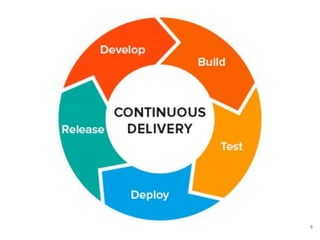
What is Continuous Delivery?
“Continuous delivery (CD) is a software engineering approach
in which teams produce software in short cycles, ensuring
that the software can be reliably released at any time. It
aims at building, testing, and releasing software faster and
more frequently. The approach helps reduce the cost, time,
and risk of delivering changes by allowing for more
incremental updates to applications in production.”
https://en.wikipedia.org/wiki/Continuous_delivery
5
6
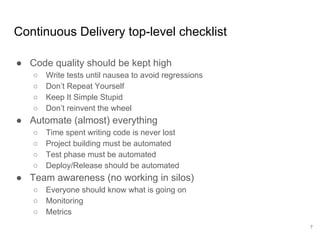
Continuous Delivery top-level checklist
● Code quality should be kept high
○ Write tests until nausea to avoid regressions
○ Don’t Repeat Yourself
○ Keep It Simple Stupid
○ Don’t reinvent the wheel
● Automate (almost) everything
○ Time spent writing code is never lost
○ Project building must be automated
○ Test phase must be automated
○ Deploy/Release should be automated
● Team awareness (no working in silos)
○ Everyone should know what is going on
○ Monitoring
○ Metrics
7
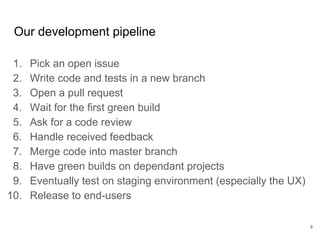
Our development pipeline
1. Pick an open issue
2. Write code and tests in a new branch
3. Open a pull request
4. Wait for the first green build
5. Ask for a code review
6. Handle received feedback
7. Merge code into master branch
8. Have green builds on dependant projects
9. Eventually test on staging environment (especially the UX)
10. Release to end-users
8
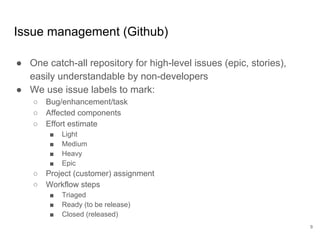
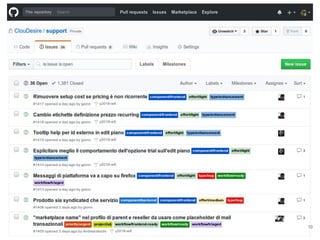
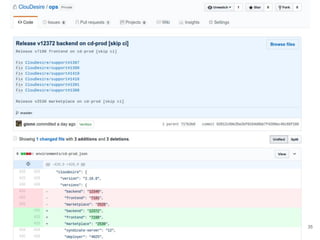
Issue management (Github)
● One catch-all repository for high-level issues (epic, stories),
easily understandable by non-developers
● We use issue labels to mark:
○ Bug/enhancement/task
○ Affected components
○ Effort estimate
■ Light
■ Medium
■ Heavy
■ Epic
○ Project (customer) assignment
○ Workflow steps
■ Triaged
■ Ready (to be release)
■ Closed (released)
9
10
Issue management
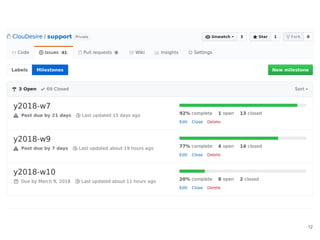
● We plan weekly sprints, where developers pick-up new issues
and treat them as priorities (github milestones)
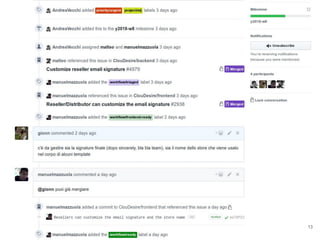
● Technical details are discussed on project repository
● Workflow labels:
○ Triaged: someone has looked to the issue and defined impact
○ Awaiting-feedback: more upstream information is required to proceed
○ Backend-ready: backend code is merged into master
○ Frontend-ready: frontend code is merged into master
○ Ready: issue will be into the next release
11
12
13
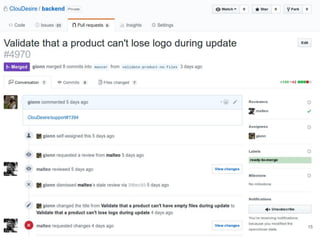
Pull request and code review
Code review is a revolution for code quality and team awareness
● Different eyes catch different bugs
● Push code laziness away
● Knowledge sharing
● Code changes awareness
● Asynchronous interaction between developers
14
15
Continuous Integration - Jenkins
Our previous experience with Jenkins:
● Build parallelization bound to number of nodes
○ More nodes to increase parallelization of a single project
● Isolation across projects fragile
○ Hack to use different ports for each project
● Failed builds may interferes with next builds
○ Hack to ensure everything get cleaned properly
● Toolchains needs to coexist together and maintained
○ Beefy node configuration recipes
○ Rbenv, nvm, pyenv and similar is a must
● Github PR plugin integration broke multiple times
○ Leaving us in panic
16
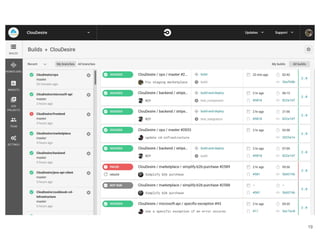
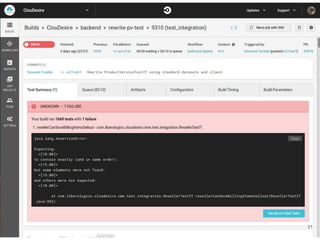
Continuous Integration - CircleCI
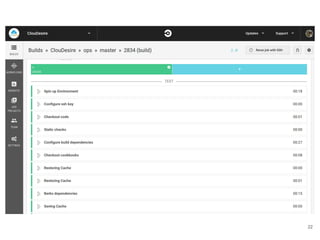
The day after all the jenkins github builds broke, we decided to
migrate CI to a paid service and keep headaches only for the code
we write
Enhancements of CircleCI over Jenkins:
● Build isolation guaranteed by the platform
● Parallelization bound to the bought plan
● No infrastructure to manage
● Project build configuration versioned into repository
● Finally a decent UI
17
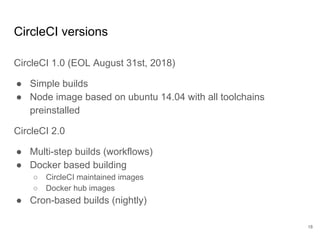
CircleCI versions
CircleCI 1.0 (EOL August 31st, 2018)
● Simple builds
● Node image based on ubuntu 14.04 with all toolchains
preinstalled
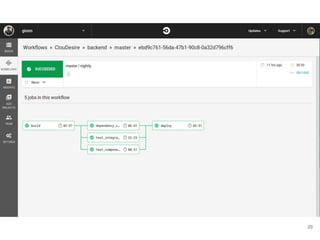
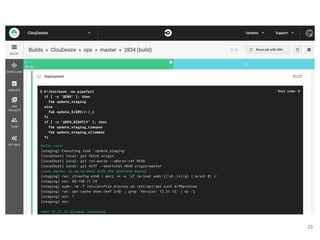
CircleCI 2.0
● Multi-step builds (workflows)
● Docker based building
○ CircleCI maintained images
○ Docker hub images
● Cron-based builds (nightly)
18
19
20
21
22
23
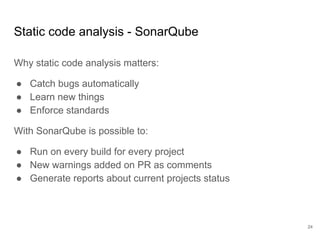
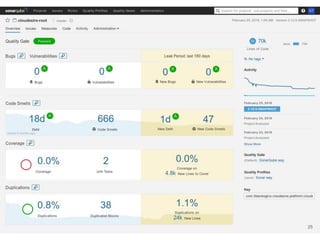
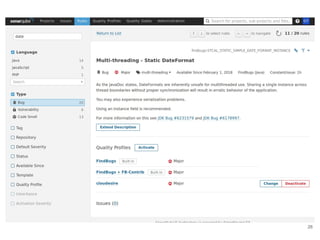
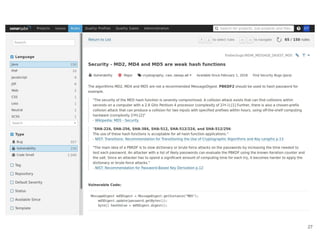
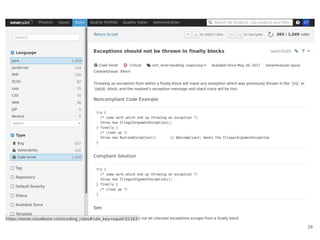
Static code analysis - SonarQube
Why static code analysis matters:
● Catch bugs automatically
● Learn new things
● Enforce standards
With SonarQube is possible to:
● Run on every build for every project
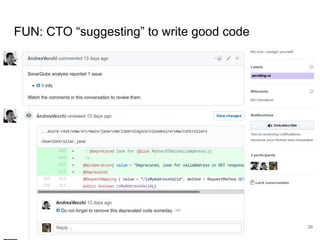
● New warnings added on PR as comments
● Generate reports about current projects status
24
25
26
27
28
FUN: CTO “suggesting” to write good code
29
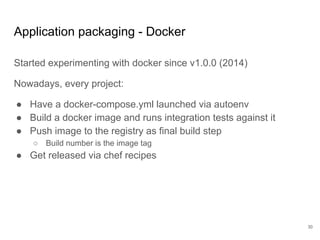
Application packaging - Docker
Started experimenting with docker since v1.0.0 (2014)
Nowadays, every project:
● Have a docker-compose.yml launched via autoenv
● Build a docker image and runs integration tests against it
● Push image to the registry as final build step
○ Build number is the image tag
● Get released via chef recipes
30
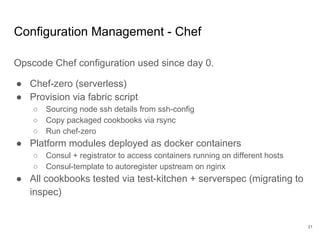
Configuration Management - Chef
Opscode Chef configuration used since day 0.
● Chef-zero (serverless)
● Provision via fabric script
○ Sourcing node ssh details from ssh-config
○ Copy packaged cookbooks via rsync
○ Run chef-zero
● Platform modules deployed as docker containers
○ Consul + registrator to access containers running on different hosts
○ Consul-template to autoregister upstream on nginx
● All cookbooks tested via test-kitchen + serverspec (migrating to
inspec)
31
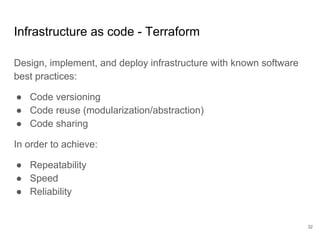
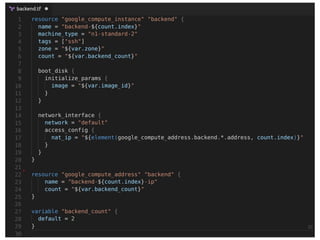
Infrastructure as code - Terraform
Design, implement, and deploy infrastructure with known software
best practices:
● Code versioning
● Code reuse (modularization/abstraction)
● Code sharing
In order to achieve:
● Repeatability
● Speed
● Reliability
32
33
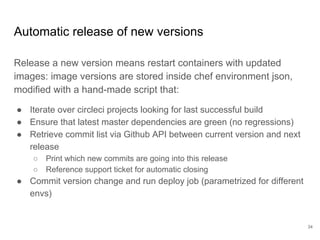
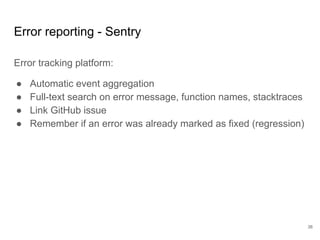
Automatic release of new versions
Release a new version means restart containers with updated
images: image versions are stored inside chef environment json,
modified with a hand-made script that:
● Iterate over circleci projects looking for last successful build
● Ensure that latest master dependencies are green (no regressions)
● Retrieve commit list via Github API between current version and next
release
○ Print which new commits are going into this release
○ Reference support ticket for automatic closing
● Commit version change and run deploy job (parametrized for different
envs)
34
35
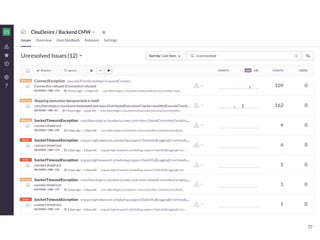
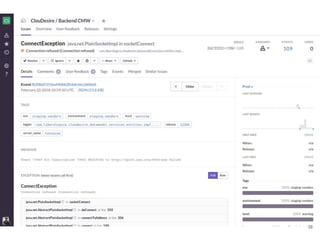
Error reporting - Sentry
Error tracking platform:
● Automatic event aggregation
● Full-text search on error message, function names, stacktraces
● Link GitHub issue
● Remember if an error was already marked as fixed (regression)
36
37
38
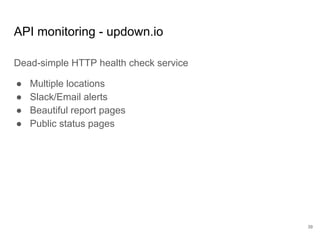
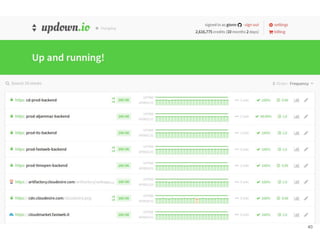
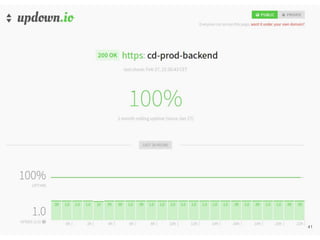
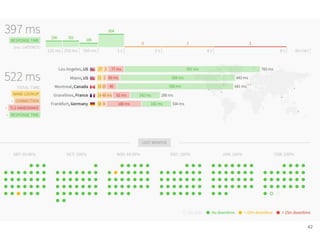
API monitoring - updown.io
Dead-simple HTTP health check service
● Multiple locations
● Slack/Email alerts
● Beautiful report pages
● Public status pages
39
40
41
42
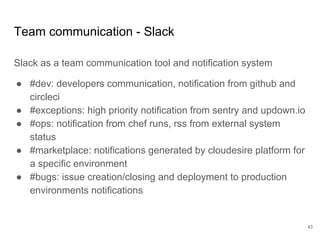
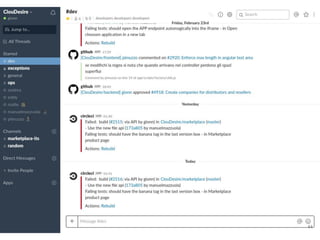
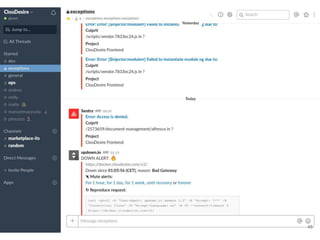
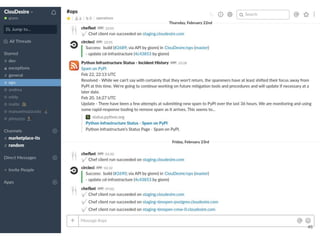
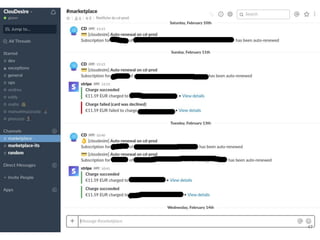
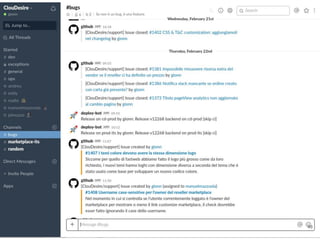
Team communication - Slack
Slack as a team communication tool and notification system
● #dev: developers communication, notification from github and
circleci
● #exceptions: high priority notification from sentry and updown.io
● #ops: notification from chef runs, rss from external system
status
● #marketplace: notifications generated by cloudesire platform for
a specific environment
● #bugs: issue creation/closing and deployment to production
environments notifications
43
44
45
46
47
48
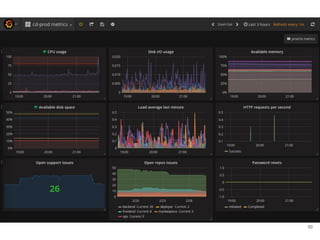
Metrics - Prometheus + Grafana
Prometheus is a monitoring system / time-series database
● Server scrape and store time series data
● Metrics exporter for nodes and applications (nginx, mysql, etc)
● Client libraries to instrument code
● Alert manager to send notifications
● Node autodiscovery via consul
49
50
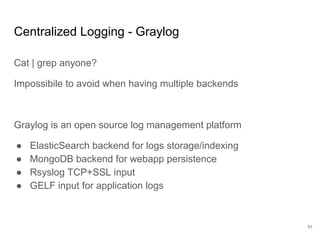
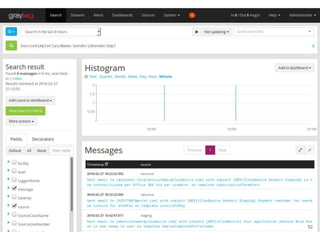
Centralized Logging - Graylog
Cat | grep anyone?
Impossibile to avoid when having multiple backends
Graylog is an open source log management platform
● ElasticSearch backend for logs storage/indexing
● MongoDB backend for webapp persistence
● Rsyslog TCP+SSL input
● GELF input for application logs
51
52
Future?
Things currently on our radar:
● Kubernetes/Mesos to replace chef orchestration
○ Avoid complexity in chef recipes
○ Scalable/fault-tolerant infrastructure
● Kotlin to replace Java for backend modules
○ Concise code
○ Backward-compatibility
● Full-remote developers
○ Currently working 2 days a week from home
53
Questions?
54

Continuous Delivery: 5 years later (Incontro DevOps 2018)

  • 1.
  • 2.
    About me Giovanni Toraldo OpenSource Enthusiast, Java coder, writer of the OpenNebula book, lead developer & co-founder at Cloudesire.com, shooting to 2 euro coin at 36 meters with medieval crossbow 2
  • 3.
    Monetization & Brokering Platformfor immediate SaaSification and automated distribution of business applications and services 3
  • 4.
  • 5.
    What is ContinuousDelivery? “Continuous delivery (CD) is a software engineering approach in which teams produce software in short cycles, ensuring that the software can be reliably released at any time. It aims at building, testing, and releasing software faster and more frequently. The approach helps reduce the cost, time, and risk of delivering changes by allowing for more incremental updates to applications in production.” https://en.wikipedia.org/wiki/Continuous_delivery 5
  • 6.
  • 7.
    Continuous Delivery top-levelchecklist ● Code quality should be kept high ○ Write tests until nausea to avoid regressions ○ Don’t Repeat Yourself ○ Keep It Simple Stupid ○ Don’t reinvent the wheel ● Automate (almost) everything ○ Time spent writing code is never lost ○ Project building must be automated ○ Test phase must be automated ○ Deploy/Release should be automated ● Team awareness (no working in silos) ○ Everyone should know what is going on ○ Monitoring ○ Metrics 7
  • 8.
    Our development pipeline 1.Pick an open issue 2. Write code and tests in a new branch 3. Open a pull request 4. Wait for the first green build 5. Ask for a code review 6. Handle received feedback 7. Merge code into master branch 8. Have green builds on dependant projects 9. Eventually test on staging environment (especially the UX) 10. Release to end-users 8
  • 9.
    Issue management (Github) ●One catch-all repository for high-level issues (epic, stories), easily understandable by non-developers ● We use issue labels to mark: ○ Bug/enhancement/task ○ Affected components ○ Effort estimate ■ Light ■ Medium ■ Heavy ■ Epic ○ Project (customer) assignment ○ Workflow steps ■ Triaged ■ Ready (to be release) ■ Closed (released) 9
  • 10.
  • 11.
    Issue management ● Weplan weekly sprints, where developers pick-up new issues and treat them as priorities (github milestones) ● Technical details are discussed on project repository ● Workflow labels: ○ Triaged: someone has looked to the issue and defined impact ○ Awaiting-feedback: more upstream information is required to proceed ○ Backend-ready: backend code is merged into master ○ Frontend-ready: frontend code is merged into master ○ Ready: issue will be into the next release 11
  • 12.
  • 13.
  • 14.
    Pull request andcode review Code review is a revolution for code quality and team awareness ● Different eyes catch different bugs ● Push code laziness away ● Knowledge sharing ● Code changes awareness ● Asynchronous interaction between developers 14
  • 15.
  • 16.
    Continuous Integration -Jenkins Our previous experience with Jenkins: ● Build parallelization bound to number of nodes ○ More nodes to increase parallelization of a single project ● Isolation across projects fragile ○ Hack to use different ports for each project ● Failed builds may interferes with next builds ○ Hack to ensure everything get cleaned properly ● Toolchains needs to coexist together and maintained ○ Beefy node configuration recipes ○ Rbenv, nvm, pyenv and similar is a must ● Github PR plugin integration broke multiple times ○ Leaving us in panic 16
  • 17.
    Continuous Integration -CircleCI The day after all the jenkins github builds broke, we decided to migrate CI to a paid service and keep headaches only for the code we write Enhancements of CircleCI over Jenkins: ● Build isolation guaranteed by the platform ● Parallelization bound to the bought plan ● No infrastructure to manage ● Project build configuration versioned into repository ● Finally a decent UI 17
  • 18.
    CircleCI versions CircleCI 1.0(EOL August 31st, 2018) ● Simple builds ● Node image based on ubuntu 14.04 with all toolchains preinstalled CircleCI 2.0 ● Multi-step builds (workflows) ● Docker based building ○ CircleCI maintained images ○ Docker hub images ● Cron-based builds (nightly) 18
  • 19.
  • 20.
  • 21.
  • 22.
  • 23.
  • 24.
    Static code analysis- SonarQube Why static code analysis matters: ● Catch bugs automatically ● Learn new things ● Enforce standards With SonarQube is possible to: ● Run on every build for every project ● New warnings added on PR as comments ● Generate reports about current projects status 24
  • 25.
  • 26.
  • 27.
  • 28.
  • 29.
    FUN: CTO “suggesting”to write good code 29
  • 30.
    Application packaging -Docker Started experimenting with docker since v1.0.0 (2014) Nowadays, every project: ● Have a docker-compose.yml launched via autoenv ● Build a docker image and runs integration tests against it ● Push image to the registry as final build step ○ Build number is the image tag ● Get released via chef recipes 30
  • 31.
    Configuration Management -Chef Opscode Chef configuration used since day 0. ● Chef-zero (serverless) ● Provision via fabric script ○ Sourcing node ssh details from ssh-config ○ Copy packaged cookbooks via rsync ○ Run chef-zero ● Platform modules deployed as docker containers ○ Consul + registrator to access containers running on different hosts ○ Consul-template to autoregister upstream on nginx ● All cookbooks tested via test-kitchen + serverspec (migrating to inspec) 31
  • 32.
    Infrastructure as code- Terraform Design, implement, and deploy infrastructure with known software best practices: ● Code versioning ● Code reuse (modularization/abstraction) ● Code sharing In order to achieve: ● Repeatability ● Speed ● Reliability 32
  • 33.
  • 34.
    Automatic release ofnew versions Release a new version means restart containers with updated images: image versions are stored inside chef environment json, modified with a hand-made script that: ● Iterate over circleci projects looking for last successful build ● Ensure that latest master dependencies are green (no regressions) ● Retrieve commit list via Github API between current version and next release ○ Print which new commits are going into this release ○ Reference support ticket for automatic closing ● Commit version change and run deploy job (parametrized for different envs) 34
  • 35.
  • 36.
    Error reporting -Sentry Error tracking platform: ● Automatic event aggregation ● Full-text search on error message, function names, stacktraces ● Link GitHub issue ● Remember if an error was already marked as fixed (regression) 36
  • 37.
  • 38.
  • 39.
    API monitoring -updown.io Dead-simple HTTP health check service ● Multiple locations ● Slack/Email alerts ● Beautiful report pages ● Public status pages 39
  • 40.
  • 41.
  • 42.
  • 43.
    Team communication -Slack Slack as a team communication tool and notification system ● #dev: developers communication, notification from github and circleci ● #exceptions: high priority notification from sentry and updown.io ● #ops: notification from chef runs, rss from external system status ● #marketplace: notifications generated by cloudesire platform for a specific environment ● #bugs: issue creation/closing and deployment to production environments notifications 43
  • 44.
  • 45.
  • 46.
  • 47.
  • 48.
  • 49.
    Metrics - Prometheus+ Grafana Prometheus is a monitoring system / time-series database ● Server scrape and store time series data ● Metrics exporter for nodes and applications (nginx, mysql, etc) ● Client libraries to instrument code ● Alert manager to send notifications ● Node autodiscovery via consul 49
  • 50.
  • 51.
    Centralized Logging -Graylog Cat | grep anyone? Impossibile to avoid when having multiple backends Graylog is an open source log management platform ● ElasticSearch backend for logs storage/indexing ● MongoDB backend for webapp persistence ● Rsyslog TCP+SSL input ● GELF input for application logs 51
  • 52.
  • 53.
    Future? Things currently onour radar: ● Kubernetes/Mesos to replace chef orchestration ○ Avoid complexity in chef recipes ○ Scalable/fault-tolerant infrastructure ● Kotlin to replace Java for backend modules ○ Concise code ○ Backward-compatibility ● Full-remote developers ○ Currently working 2 days a week from home 53
  • 54.