Zero to Hero

Pragmatic steps on the
path to continuous delivery

@geoffnettaglich
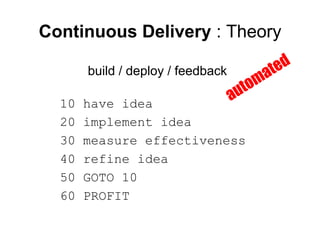
Continuous Delivery : Theory
ed
at

build / deploy / feedback
10
20
30
40
50
60

a

om
ut

have idea
implement idea
measure effectiveness
refine idea
GOTO 10
PROFIT
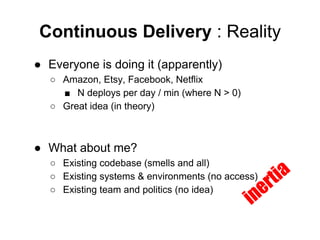
Continuous Delivery : Reality
● Everyone is doing it (apparently)
○ Amazon, Etsy, Facebook, Netflix
■ N deploys per day / min (where N > 0)
○ Great idea (in theory)

● What about me?
○ Existing codebase (smells and all)
○ Existing systems & environments (no access)
○ Existing team and politics (no idea)

e
in

ia
rt
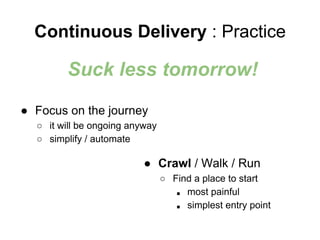
Continuous Delivery : Practice

Suck less tomorrow!
● Focus on the journey
○ it will be ongoing anyway
○ simplify / automate

● Crawl / Walk / Run
○ Find a place to start
■ most painful
■ simplest entry point
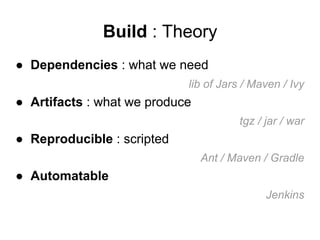
Build : Theory
● Dependencies : what we need
lib of Jars / Maven / Ivy

● Artifacts : what we produce
tgz / jar / war

● Reproducible : scripted
Ant / Maven / Gradle

● Automatable
Jenkins
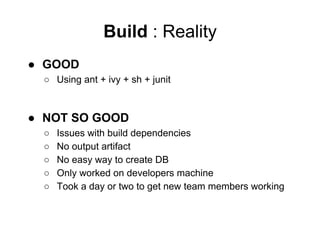
Build : Reality
● GOOD
○ Using ant + ivy + sh + junit

● NOT SO GOOD
○
○
○
○
○

Issues with build dependencies
No output artifact
No easy way to create DB
Only worked on developers machine
Took a day or two to get new team members working
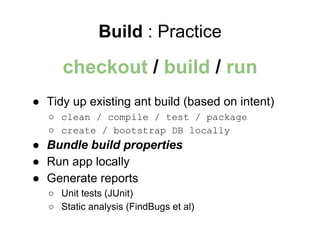
Build : Practice

checkout / build / run
● Tidy up existing ant build (based on intent)
○ clean / compile / test / package
○ create / bootstrap DB locally

● Bundle build properties
● Run app locally
● Generate reports
○ Unit tests (JUnit)
○ Static analysis (FindBugs et al)
Deploy : Theory
● Push button / Zero downtime
○ Not always easy: Java != rails != php/apache

● Deploy from developers machine is FAIL
○ Shared env or jump box
○ Then automate (via Jenkins)

● What version is running where
○ Build page
○ All servers up to date with latest version
Deploy : Reality
● GOOD
○ Scripted (somewhat)

● NOT SO GOOD
○
○
○
○
○

Only from developers machine [FAIL!]
Ignored errors (FULL STEAM AHEAD)
Rsync of build outcome
Manual stop / start
Customers may see errors during rollout
Deploy : Practice
● bash script (Capistrano or similar)
○ stop / upload / unpack / restart
○ similar structure to capistrano on filesystem

● Verify
○ Build page with stats (bundled in artifact)

● DB changes
○ Backwards compatible changes (process)
○ Liquibase is great
●

Automated (via Jenkins of course)
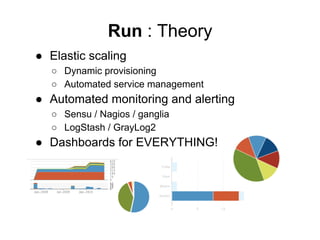
Run : Theory
● Elastic scaling
○ Dynamic provisioning
○ Automated service management

● Automated monitoring and alerting
○ Sensu / Nagios / ganglia
○ LogStash / GrayLog2

● Dashboards for EVERYTHING!
Run : Reality
● ssh to servers
○ to start stop services
○ monitor perf via top and ps
○ grep and tail -f of log files
● Only ‘qualified’ admins allowed
● No business metrics (manual reports)
● No visibility
● RESTART

!
G
N

I
N
R
A
W

Prone to human ERORS
Run : Practice
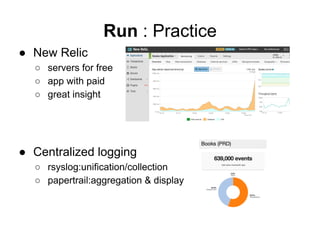
● New Relic
○ servers for free
○ app with paid
○ great insight

● Centralized logging
○ rsyslog:unification/collection
○ papertrail:aggregation & display
Run : Practice
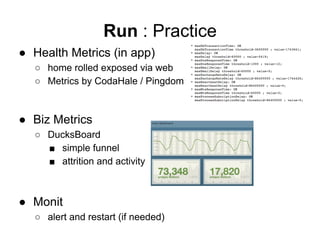
● Health Metrics (in app)
○ home rolled exposed via web
○ Metrics by CodaHale / Pingdom

● Biz Metrics
○ DucksBoard
■ simple funnel
■ attrition and activity

● Monit
○ alert and restart (if needed)
Environments : Theory

‘Works on my machine’
● Scale – vertically or horizontally
● automatable, reproducible
○ Green / Blue deploys FTW

● Chef / Puppet / Ansible ... just pick one
● If a server fails, can you rebuild it?
● If an environment fails, can you rebuild it?
Environments : Reality
You won’t always know what you inherit!
●
●
●
●
●

Private cloud hosting
Limited upgrade ability
Manual updates
Uncertain/misunderstood foundation
SSH and rsync to update and deploy
○ overwrote existing codebase
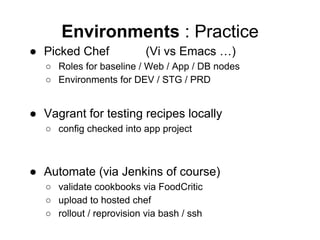
Environments : Practice
● Picked Chef

(Vi vs Emacs …)

○ Roles for baseline / Web / App / DB nodes
○ Environments for DEV / STG / PRD

● Vagrant for testing recipes locally
○ config checked into app project

● Automate (via Jenkins of course)
○ validate cookbooks via FoodCritic
○ upload to hosted chef
○ rollout / reprovision via bash / ssh
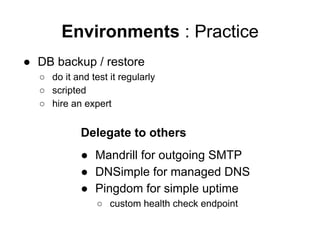
Environments : Practice
● DB backup / restore
○ do it and test it regularly
○ scripted
○ hire an expert

Delegate to others
● Mandrill for outgoing SMTP
● DNSimple for managed DNS
● Pingdom for simple uptime
○ custom health check endpoint
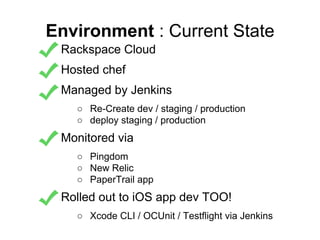
Environment : Current State
Rackspace Cloud
Hosted chef
Managed by Jenkins
○ Re-Create dev / staging / production
○ deploy staging / production

Monitored via
○ Pingdom
○ New Relic
○ PaperTrail app

Rolled out to iOS app dev TOO!
○ Xcode CLI / OCUnit / Testflight via Jenkins
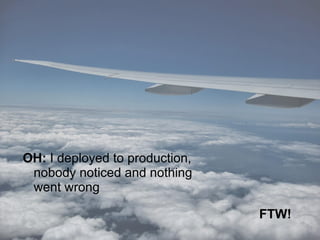
OH: I deployed to production,
nobody noticed and nothing
went wrong
FTW!

Zero to hero - Geoff Webb

  • 1.
    Zero to Hero Pragmaticsteps on the path to continuous delivery @geoffnettaglich
  • 2.
    Continuous Delivery :Theory ed at build / deploy / feedback 10 20 30 40 50 60 a om ut have idea implement idea measure effectiveness refine idea GOTO 10 PROFIT
  • 3.
    Continuous Delivery :Reality ● Everyone is doing it (apparently) ○ Amazon, Etsy, Facebook, Netflix ■ N deploys per day / min (where N > 0) ○ Great idea (in theory) ● What about me? ○ Existing codebase (smells and all) ○ Existing systems & environments (no access) ○ Existing team and politics (no idea) e in ia rt
  • 4.
    Continuous Delivery :Practice Suck less tomorrow! ● Focus on the journey ○ it will be ongoing anyway ○ simplify / automate ● Crawl / Walk / Run ○ Find a place to start ■ most painful ■ simplest entry point
  • 5.
    Build : Theory ●Dependencies : what we need lib of Jars / Maven / Ivy ● Artifacts : what we produce tgz / jar / war ● Reproducible : scripted Ant / Maven / Gradle ● Automatable Jenkins
  • 6.
    Build : Reality ●GOOD ○ Using ant + ivy + sh + junit ● NOT SO GOOD ○ ○ ○ ○ ○ Issues with build dependencies No output artifact No easy way to create DB Only worked on developers machine Took a day or two to get new team members working
  • 7.
    Build : Practice checkout/ build / run ● Tidy up existing ant build (based on intent) ○ clean / compile / test / package ○ create / bootstrap DB locally ● Bundle build properties ● Run app locally ● Generate reports ○ Unit tests (JUnit) ○ Static analysis (FindBugs et al)
  • 8.
    Deploy : Theory ●Push button / Zero downtime ○ Not always easy: Java != rails != php/apache ● Deploy from developers machine is FAIL ○ Shared env or jump box ○ Then automate (via Jenkins) ● What version is running where ○ Build page ○ All servers up to date with latest version
  • 9.
    Deploy : Reality ●GOOD ○ Scripted (somewhat) ● NOT SO GOOD ○ ○ ○ ○ ○ Only from developers machine [FAIL!] Ignored errors (FULL STEAM AHEAD) Rsync of build outcome Manual stop / start Customers may see errors during rollout
  • 10.
    Deploy : Practice ●bash script (Capistrano or similar) ○ stop / upload / unpack / restart ○ similar structure to capistrano on filesystem ● Verify ○ Build page with stats (bundled in artifact) ● DB changes ○ Backwards compatible changes (process) ○ Liquibase is great ● Automated (via Jenkins of course)
  • 11.
    Run : Theory ●Elastic scaling ○ Dynamic provisioning ○ Automated service management ● Automated monitoring and alerting ○ Sensu / Nagios / ganglia ○ LogStash / GrayLog2 ● Dashboards for EVERYTHING!
  • 12.
    Run : Reality ●ssh to servers ○ to start stop services ○ monitor perf via top and ps ○ grep and tail -f of log files ● Only ‘qualified’ admins allowed ● No business metrics (manual reports) ● No visibility ● RESTART ! G N I N R A W Prone to human ERORS
  • 13.
    Run : Practice ●New Relic ○ servers for free ○ app with paid ○ great insight ● Centralized logging ○ rsyslog:unification/collection ○ papertrail:aggregation & display
  • 14.
    Run : Practice ●Health Metrics (in app) ○ home rolled exposed via web ○ Metrics by CodaHale / Pingdom ● Biz Metrics ○ DucksBoard ■ simple funnel ■ attrition and activity ● Monit ○ alert and restart (if needed)
  • 15.
    Environments : Theory ‘Workson my machine’ ● Scale – vertically or horizontally ● automatable, reproducible ○ Green / Blue deploys FTW ● Chef / Puppet / Ansible ... just pick one ● If a server fails, can you rebuild it? ● If an environment fails, can you rebuild it?
  • 16.
    Environments : Reality Youwon’t always know what you inherit! ● ● ● ● ● Private cloud hosting Limited upgrade ability Manual updates Uncertain/misunderstood foundation SSH and rsync to update and deploy ○ overwrote existing codebase
  • 17.
    Environments : Practice ●Picked Chef (Vi vs Emacs …) ○ Roles for baseline / Web / App / DB nodes ○ Environments for DEV / STG / PRD ● Vagrant for testing recipes locally ○ config checked into app project ● Automate (via Jenkins of course) ○ validate cookbooks via FoodCritic ○ upload to hosted chef ○ rollout / reprovision via bash / ssh
  • 18.
    Environments : Practice ●DB backup / restore ○ do it and test it regularly ○ scripted ○ hire an expert Delegate to others ● Mandrill for outgoing SMTP ● DNSimple for managed DNS ● Pingdom for simple uptime ○ custom health check endpoint
  • 19.
    Environment : CurrentState Rackspace Cloud Hosted chef Managed by Jenkins ○ Re-Create dev / staging / production ○ deploy staging / production Monitored via ○ Pingdom ○ New Relic ○ PaperTrail app Rolled out to iOS app dev TOO! ○ Xcode CLI / OCUnit / Testflight via Jenkins
  • 20.
    OH: I deployedto production, nobody noticed and nothing went wrong FTW!