








Cloud native
Continuous Delivery
Christian Deger, christian@deger.eu, @cdeger
DevOpsCon Munich, 21.11.2017
Cloud native Continuous Delivery
• Cloud Native Computing Foundation
• Container packaged
• Dynamically managed
• Microservices oriented
• My opinion
• Serverless, FaaS
• Managed services
Cloud native Continuous Delivery
• Bring changes into production
• Fast
• Reliable
• Repeatable
• Traceable
• In order to
• Get fast feedback
• Lower risk
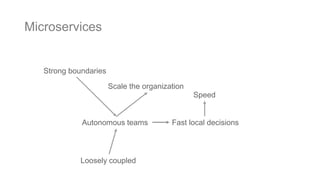
Microservices
Microservices
Speed
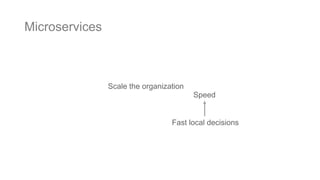
Microservices
Speed
Scale the organization
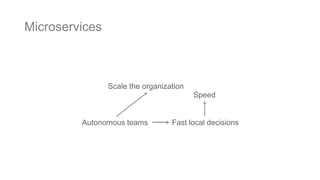
Microservices
Speed
Fast local decisions
Scale the organization
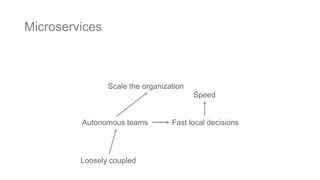
Microservices
Speed
Fast local decisionsAutonomous teams
Scale the organization
Microservices
Speed
Fast local decisionsAutonomous teams
Scale the organization
Loosely coupled
Microservices
Speed
Fast local decisionsAutonomous teams
Strong boundaries
Scale the organization
Loosely coupled
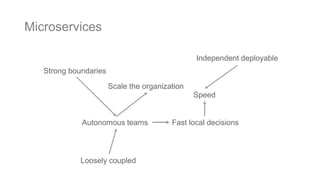
Microservices
Speed
Fast local decisionsAutonomous teams
Strong boundaries
Scale the organization
Independent deployable
Loosely coupled
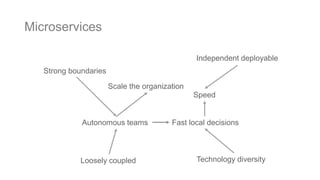
Microservices
Speed
Fast local decisionsAutonomous teams
Strong boundaries
Technology diversity
Scale the organization
Independent deployable
Loosely coupled
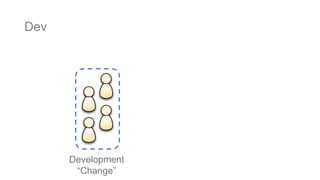
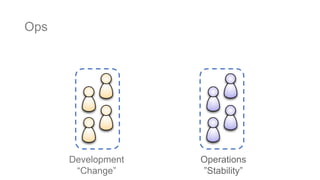
Development
“Change”
Dev
Development
“Change”
Operations
”Stability”
Ops
Development
“Change”
Operations
”Stability”
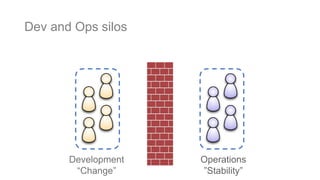
Dev and Ops silos
Development
“Change”
Operations
”Stability”
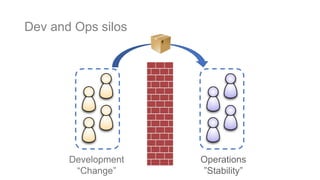
Dev and Ops silos
Cross-functional teams
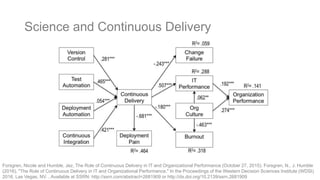
Science and Continuous Delivery
Forsgren, Nicole and Humble, Jez, The Role of Continuous Delivery in IT and Organizational Performance (October 27, 2015). Forsgren, N., J. Humble
(2016). "The Role of Continuous Delivery in IT and Organizational Performance." In the Proceedings of the Western Decision Sciences Institute (WDSI)
2016, Las Vegas, NV. . Available at SSRN: http://ssrn.com/abstract=2681909 or http://dx.doi.org/10.2139/ssrn.2681909
Deployment Pipeline
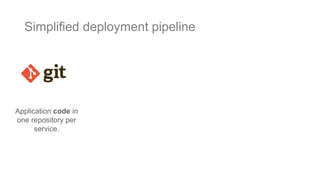
Simplified deployment pipeline
Application code in
one repository per
service.
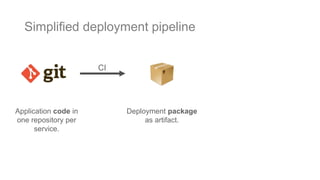
Simplified deployment pipeline
Application code in
one repository per
service.
CI
Deployment package
as artifact.
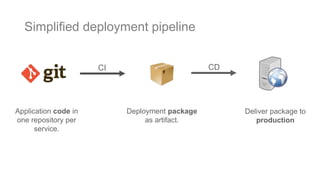
Simplified deployment pipeline
Application code in
one repository per
service.
CI
Deployment package
as artifact.
CD
Deliver package to
production
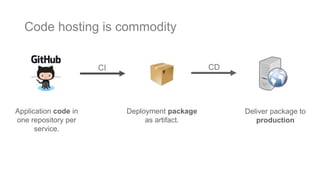
Code hosting is commodity
Application code in
one repository per
service.
CI
Deployment package
as artifact.
CD
Deliver package to
production
• GitHub, GitLab, Bitbucket, …
• Increased developer productivity
• Ecosystem: Apps and integrations
• Security
• Account Management, SSO, MFA
• git-secrets
• Backup using clone/fetch
Code hosting: Managed over self-hosted
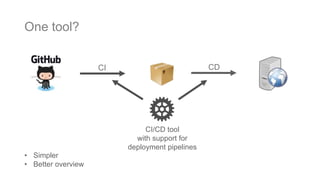
One tool?
CI
CI/CD tool
with support for
deployment pipelines
CD
• Simpler
• Better overview
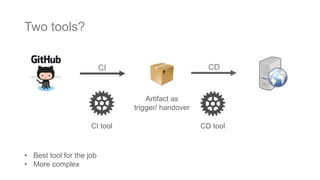
Two tools?
CI
CI tool
CD
CD tool
Artifact as
trigger/ handover
• Best tool for the job
• More complex
• Travis CI, CircleCI, GitLab CI, …
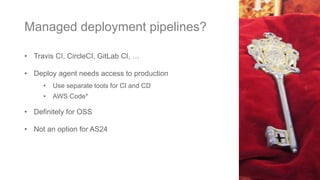
• Deploy agent needs access to production
• Use separate tools for CI and CD
• AWS Code*
• Definitely for OSS
• Not an option for AS24
Managed deployment pipelines?
• CD infrastructure should be the first task in a new project
• CD should not become a snowflake itself
• For disaster recovery you will need your CD infrastructure
• Aim for “CD as a service”
Automate CD infrastructure
• Containerized
• Isolated builds – bring your own agent
• Elastic agents
• Container as artifact
• Pipeline as code
• Declarative in service repository
• Fast and simple bootstrapping of new pipelines
• Avoid single, shared CI instance
New CI practices
• Everything that used to be good practices
• No CI theatre
• Embrace deployment pipelines
• No smarts in the CI tool
Old CI practices – Recap
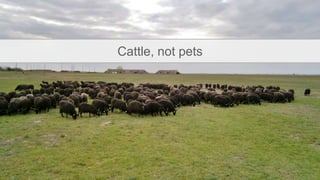
Pets?
Cattle, not pets
Burgers, not cattle
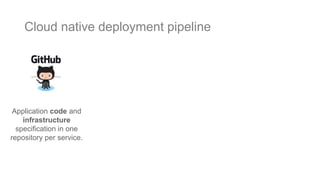
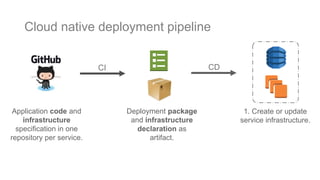
Cloud native deployment pipeline
Application code and
infrastructure
specification in one
repository per service.
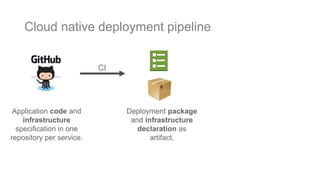
Cloud native deployment pipeline
Application code and
infrastructure
specification in one
repository per service.
CI
Deployment package
and infrastructure
declaration as
artifact.
Cloud native deployment pipeline
Application code and
infrastructure
specification in one
repository per service.
CI
Deployment package
and infrastructure
declaration as
artifact.
CD
1. Create or update
service infrastructure.
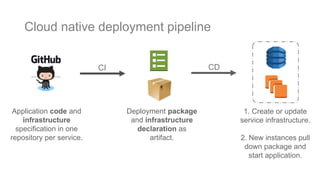
Cloud native deployment pipeline
Application code and
infrastructure
specification in one
repository per service.
CI
Deployment package
and infrastructure
declaration as
artifact.
CD
1. Create or update
service infrastructure.
2. New instances pull
down package and
start application.
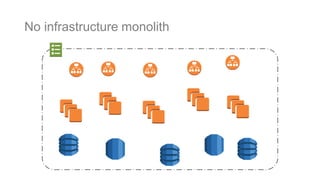
No infrastructure monolith
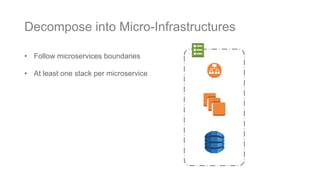
• Follow microservices boundaries
• At least one stack per microservice
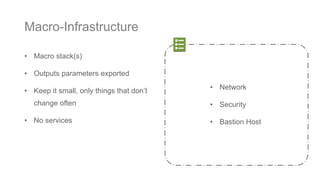
Decompose into Micro-Infrastructures
• Macro stack(s)
• Outputs parameters exported
• Keep it small, only things that don’t
change often
• No services
Macro-Infrastructure
• Network
• Security
• Bastion Host
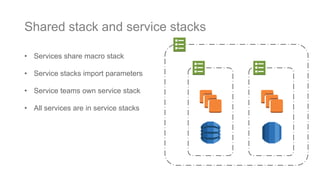
• Services share macro stack
• Service stacks import parameters
• Service teams own service stack
• All services are in service stacks
Shared stack and service stacks
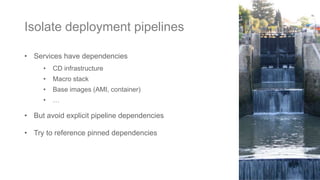
• Services have dependencies
• CD infrastructure
• Macro stack
• Base images (AMI, container)
• …
• But avoid explicit pipeline dependencies
• Try to reference pinned dependencies
Isolate deployment pipelines
Deployment
You build it,
you run it
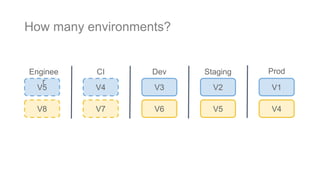
How many environments?
V2V3
V6 V5
V4
V7
V5
V8
Enginee
r
CI Dev Staging
V1
V4
Prod
• Integrate in production
• Consumer contracts or CDCs
• Reduce impact of failures
• MTTR over MTBF
• Monitoring
• Canary releases
• Rollbacks
• Semantic monitoring
No staging environment
• Separate code deployment from feature release
• Trunk-based development
• No long lived feature branches
Feature toggles
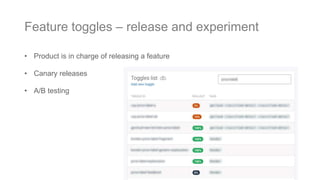
Feature toggles – release and experiment
• Product is in charge of releasing a feature
• Canary releases
• A/B testing
Immutable deployment patterns
Function as a Service - FaaS
Done 
Function as a Service - FaaS
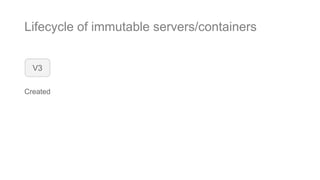
Lifecycle of immutable servers/containers
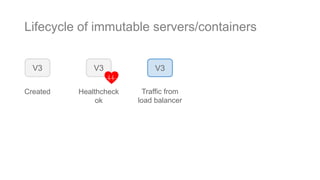
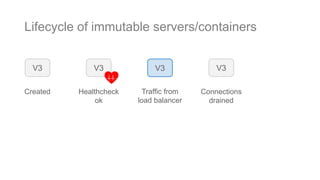
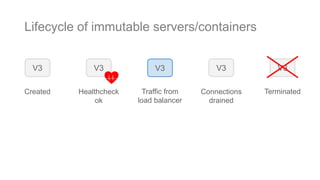
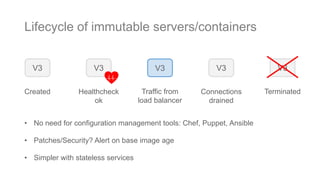
Created
V3
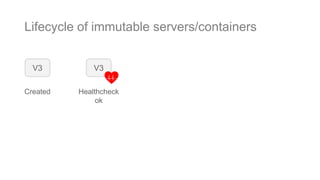
Lifecycle of immutable servers/containers
Created
V3
Healthcheck
ok
V3
Lifecycle of immutable servers/containers
Created
V3
Healthcheck
ok
V3
Traffic from
load balancer
V3
Lifecycle of immutable servers/containers
V3
Created
V3
Healthcheck
ok
V3
Traffic from
load balancer
V3
Connections
drained
Lifecycle of immutable servers/containers
V3
Created
V3
Healthcheck
ok
V3
Traffic from
load balancer
V3
Terminated
V3
Connections
drained
Lifecycle of immutable servers/containers
V3
Created
V3
Healthcheck
ok
V3
Traffic from
load balancer
V3
Terminated
V3
Connections
drained
• No need for configuration management tools: Chef, Puppet, Ansible
• Patches/Security? Alert on base image age
• Simpler with stateless services
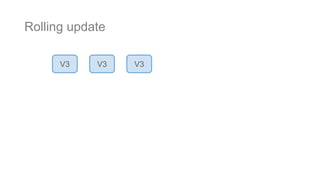
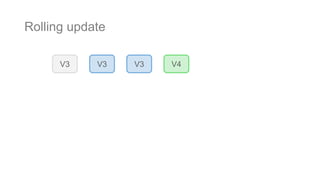
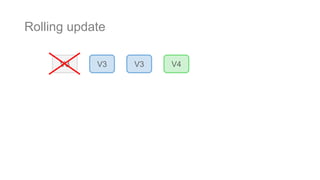
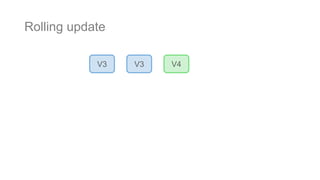
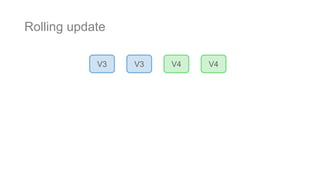
Rolling update
V3 V3 V3
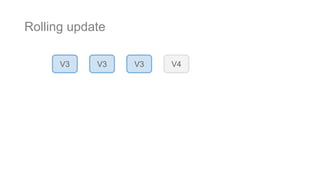
Rolling update
V3 V3 V3 V4
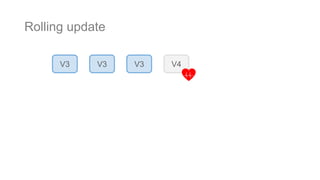
Rolling update
V3 V3 V3 V4
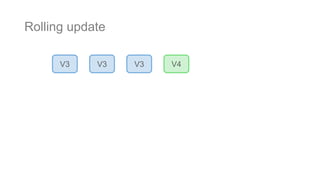
Rolling update
V3 V3 V3 V4
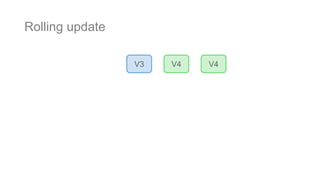
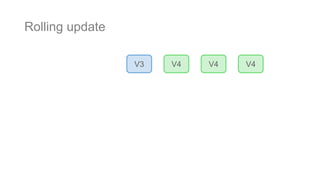
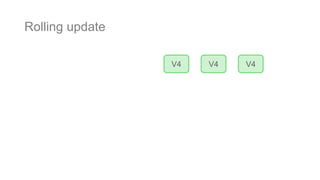
Rolling update
V3 V3 V4V3
Rolling update
V3 V3 V4V3
Rolling update
V3 V3 V4
Rolling update
V3 V3 V4 V4
Rolling update
V3 V4 V4
Rolling update
V3 V4 V4 V4
Rolling update
V4 V4 V4
Rolling update
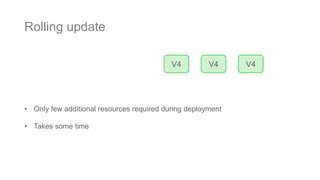
V4 V4 V4
• Only few additional resources required during deployment
• Takes some time
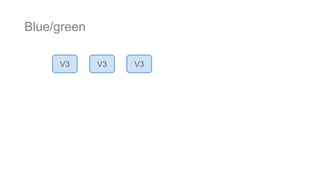
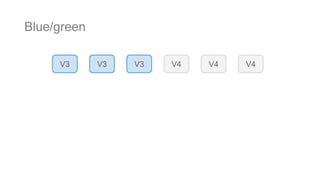
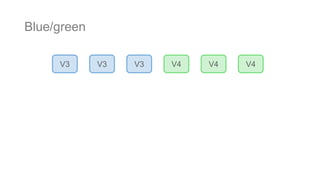
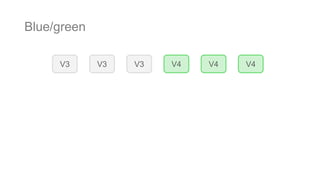
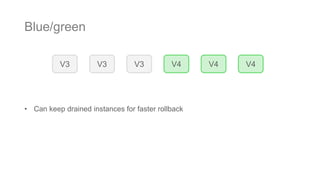
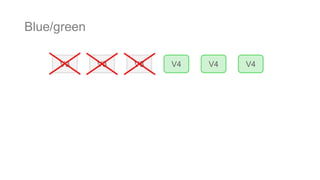
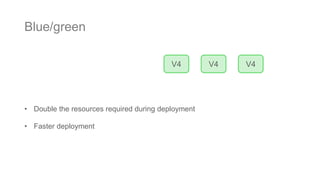
Blue/green
V3 V3 V3
Blue/green
V3 V3 V3 V4 V4 V4
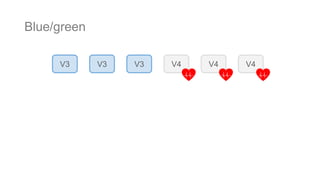
Blue/green
V3 V3 V3 V4 V4 V4
Blue/green
V4 V4 V4V3 V3 V3
Blue/green
V4 V4 V4V3V3V3
Blue/green
V4 V4 V4V3V3V3
• Can keep drained instances for faster rollback
Blue/green
V4 V4 V4V3V3V3
Blue/green
V4 V4 V4
• Double the resources required during deployment
• Faster deployment
Canary analysis
V3 V3 V3
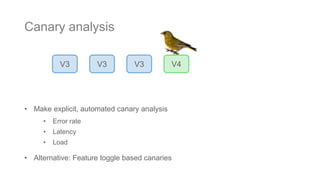
Canary analysis
V3 V3 V3 V4
• Make explicit, automated canary analysis
• Error rate
• Latency
• Load
• Alternative: Feature toggle based canaries
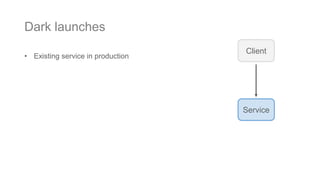
• Existing service in production
Dark launches
Service
Client
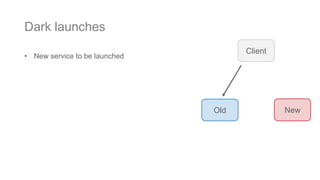
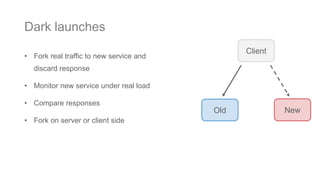
• New service to be launched
Dark launches
Old New
Client
• Fork real traffic to new service and
discard response
• Monitor new service under real load
• Compare responses
• Fork on server or client side
Dark launches
Old New
Client
Wrapping it up
• Build isolation
• Independent pipelines
• Elasticity
• Everything as code
• Pipelines owned by teams
Recommendations for deployment pipeline
• Time from commit to production – cycle time
• Time to bootstrap a new service including the deployment pipeline
Metrics
• “You build it, you deploy it, you run it”
• Embrace immutability
• Infrastructure follows microservices architecture
• Failures happen
• Reduce impact
• Fast detection
• Fast recovery
Important
Thank You!
• Regent's Rowing 8 by Jmf3333 [CC BY 3.0]
https://en.wikipedia.org/wiki/File:Regents_rowing.JPG
• Aquapark Aquacolors by Pantharei.2017 (Own work) [CC BY-SA 4.0]
https://commons.wikimedia.org/wiki/File:Aquapark_Aquacolors.jpg
• The Key of a Chamberlain by Niklitov [CC BY-SA 4.0]
https://commons.wikimedia.org/wiki/File:The_Key_of_a_Chamberlain_at_Kingdom_of_P
russia_Kalinigrad_Blindage_museum.JPG
• Beziers Fonseranes by Dedounet [CC BY-SA 1.0]
https://commons.wikimedia.org/wiki/File:Beziers_Fonseranes.jpg
Image attribution

Cloud native Continuous Delivery

Editor's Notes

  • #3 https://www.cncf.io/about/charter/ https://pivotal.io/de/cloud-native DevOps, Microservices, Containers, Continuous Delivery Attribution: CC0: https://pixabay.com/en/sky-cloud-blue-white-good-looking-254668/
  • #4 Bring changes into production, or into the hands of users, safely and quickly in a sustainable way.
  • #6 Speed -> Fast cycle time, Fast creation of new pipelines
  • #7 Being fast with a small team is one thing, but we want to not slow down, when the organization is larger.
  • #8 No committees, no waiting
  • #9 Autonomous teams -> Pipeline owned by teams
  • #12 Independent deployable -> Many pipelines
  • #16 They became silos, separated by a virtual wall. Tickets, Waiting, Blaming
  • #17 If you still have those silos: Get rid of them!
  • #18 True DevOps culture
  • #19 Jezz Humble: What We Learned from Three Years Sciencing the Crap out of Devops
  • #23 Now lets walk through the pipeline steps and see what happens when we put on the cloud native hat.
  • #25 Every engineer knows GitHub SSO: Depending on plan, additional tooling required. Backup: Scheduled clone/pull of all repos. Secure: Story of the committed GitHub key.
  • #26 Orchestration in one tool Better overview, Simpler
  • #27 CI: All the known tools CD: For example Spinnaker or Bosh, often platform specific
  • #28 We didn’t want to handover the golden key to a managed CI tool.
  • #29 If you cannot use a managed CD service…
  • #30 Isolated builds: Bring your own build environment, multi tenant services, like Travis, already work like this Also need to solve the problem of dependency caches. For example local Nexus. Elastic agents: Cost efficient, quickly spin up agents on demand. No job queue. Container as artifact: DinD or DooD Pipeline as code: Service templates includes pipeline declaration Single CI: Autonomous teams, CI patterns and guidelines are shared, not the infrastructure. https://www.thoughtworks.com/radar/techniques/pipelines-as-code
  • #31 CI theatre: Infrequent commit, long red, feature branches Embrace deployment pipelines: Beyond CI, eg. Jenkins, TC Smarts in the tool: Use the tool for coordination, smarts are in your automation, make like build scripts should run from shell https://www.thoughtworks.com/radar/techniques/ci-theatre
  • #32 Now we are done with CI, let’s talk about infrastructure. https://www.thoughtworks.com/talks/infrastructure-design-patterns-xconf-eu-2017
  • #33 No slowflakes Attribution: CC0, https://pxhere.com/en/photo/813531
  • #34 Immutable servers Phoenix servers Attribution: CC0, https://pixabay.com/en/hungary-puszta-sheep-herd-graze-734026/
  • #35 Ideally we are not even concerned with servers anymore: Serverless
  • #36 Instance can also be containers
  • #37 Instance can also be containers
  • #38 Instance can also be containers
  • #39 Instance can also be containers
  • #40 Infrastructure as code also implies good engineering practices. Not one template/stack for the complete infrastructure Resist layered slicing
  • #41 Stacks can be decomposed further. For example separate LB + Persistence stack from ASG for blue/green.
  • #42 VPC, Subnets, Security Groups, Internet Gateway Our macro stack is called global stack
  • #43 Cross-stack references, not nested stacks. "All services" include ops service like logging
  • #44 You are not triggering your builds, when a dependent OSS packages changes. Story of Base AMI
  • #45 Attribution: CC0 https://pixabay.com/en/cry-fear-funny-psyche-face-human-2192148/
  • #46 You build it, you deploy it, you run it
  • #47 Which versions on staging? Prod differs anyway: Load, data, patterns
  • #48 Still we want to release with confidence: Be bold, but not stupid. Mean time to detection
  • #49 Who is using feature branches and does CI? You are not doing CI, when you are branching. Short lived branches < 1 day are ok. Branch by abstraction https://trunkbaseddevelopment.com/ https://launchdarkly.com/
  • #50 Optional: Toggle forwarding to downstream services Toggle dependencies.
  • #51 Many of those patterns are viable without going cloud native, but are feasible then. Attribution: CC0, not attribution required, https://pixabay.com/en/ibiza-rock-sea-water-821719/
  • #53 Serverless frees you from this deployment details
  • #54 Let’s step back to where we actually deal with servers or containers.
  • #55 Verify health <> canary Attribution heartbeat CC0, no attribution required http://maxpixel.freegreatpicture.com/Heartbeat-Heart-Medical-Ecg-Electrocardiogram-2270728
  • #56 Instead of load balancer also batch or queue processing possible Or added to cluster.
  • #59 State should be pushed to client or down to managed state services form cloud provider. But this pattern also works with modern distributed data stores.
  • #61 Create
  • #62 Healthcheck
  • #63 Traffic
  • #64 Drain
  • #65 Terminate
  • #67 Repeat for all nodes
  • #81 You bring your canary to the coal mine and observe its behavior. Feature toggle canary: Staged rollout. Attribution: Canary: Public domain, https://commons.wikimedia.org/wiki/File:Carduelis_chloris_m.jpg Coal Mine: CC0, no attribution required, https://pixabay.com/en/coal-black-mineral-underground-1626368/
  • #84 Trade offs for client and server side forking: Server: Risk, timeout protection, additional load Client: Disclosure, bandwidth and load on client, less control
  • #85 Attribution: CC0, no attribution required, https://www.pexels.com/photo/close-up-of-christmas-decorations-257855/
  • #86 Build isolation: Decoupling, no coordination for a new Java SDK. Independent pipelines: Decoupling Elasticity: Do not waste resource or make teams wait for an agent Everything as code: Pipeline definition, deployment scripts, infrastructure Attribution: CC0, https://pixabay.com/en/thumbs-up-thumb-hand-positive-1006176/
  • #87 Improve over time, what is included in a newly bootstrapped service: Logging, Monitoring, Alerting, Dashboards Attribution: CC0, http://maxpixel.freegreatpicture.com/Measurement-Stopwatch-Timer-Clock-Symbol-Icon-2624277
  • #88 Autonomous, empowered teams. No silos Do not deal with DC constraints and mutate existing servers. Do not build an infrastructure monolith, decoupling
  • #89 Attribution: Raised hands, CC0, no attribution required, https://pixabay.com/en/hands-hand-raised-hands-raised-220163/