Software Delivery
in 2016
A Continuous Delivery approach.
Who am I?
Giovanni Toraldo (gionn)
Lead developer ClouDesire.
com
--
Lord of Jenkins
Protector of the build
Watcher of the stacktraces
What is ClouDesire?
Application Marketplace to help software vendors to sell and provision
applications
● Web Applications:
○ provision VM
○ on multiple cloud providers
○ deploy/upgrade docker containers
○ application logging
○ resource monitoring
● With multi-tenant applications/SaaS:
○ expose REST hooks and API for billing lifecycle
● manage subscriptions, billing, pay-per-use, invoicing, payments.
3
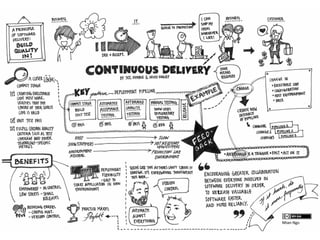
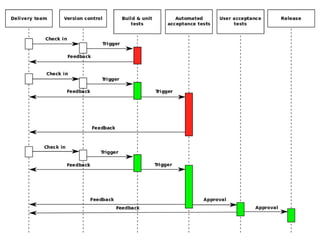
What is Continuous Delivery?
“Continuous delivery (CD) is a software engineering approach
in which teams produce software in short cycles, ensuring that
the software can be reliably released at any time. It aims at
building, testing, and releasing software faster and more
frequently. The approach helps reduce the cost, time, and risk
of delivering changes by allowing for more incremental
updates to applications in production.”
https://en.wikipedia.org/wiki/Continuous_delivery
The road to enlightenment
● Configuration Management
● Data management
● Continuous Integration
● Automated Deployment
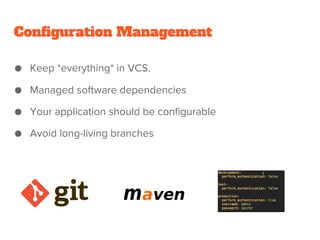
Configuration Management
● Keep *everything* in VCS.
● Managed software dependencies
● Your application should be configurable
● Avoid long-living branches
Data management
● Scripted schema migrations
● Dataset for development
● Be backward and forward compatible (when possible)
Continuous Integration
● Requirements:
○ Versioned sources
○ Build tool
○ Automated tests
● Features
○ Early feedback on how things are going
○ Feedback shared with all the team
○ Keep track on how things are going
○ Dashboard for automation
Jenkins for the CI
● Easy installation: Just run java -jar jenkins.war, or deploy it
in a servlet container, or system packages.
● Easy configuration: via friendly web GUI with on-the-fly
error checks and inline help.
● Extensibility: Most parts of Jenkins can be extended and
modified, and there plugins for every needs.
● Distributed builds: Jenkins can distribute build/test loads
to multiple computers with different operating systems.
What is a pipeline?
“is an automated manifestation of your process for getting
software from version control into the hands of your users.”
Jez Humble and David Farley - Continuous Delivery
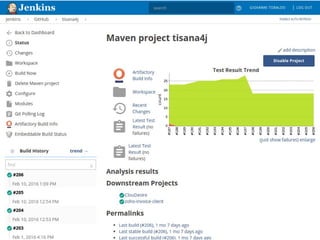
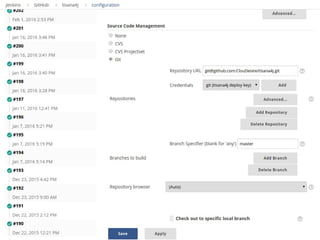
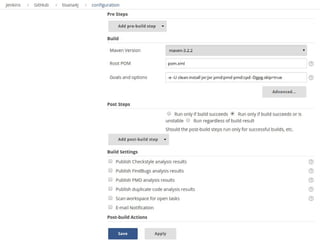
One job “pipeline” for simple java app
Prerequisites:
● Version Control System (GIT, Mercurial, SVN..)
● Dependency management (NPM, Gem, Composer, …)
● Build system (Maven, Gradle, ...)
Jenkins will:
1. Grab the latest code
2. Execute commands you want
3. Report status
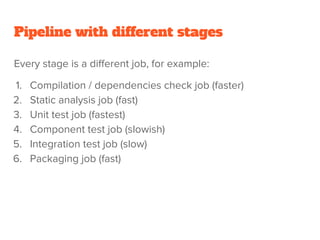
Pipeline with different stages
Every stage is a different job, for example:
1. Compilation / dependencies check job (faster)
2. Static analysis job (fast)
3. Unit test job (fastest)
4. Component test job (slowish)
5. Integration test job (slow)
6. Packaging job (fast)
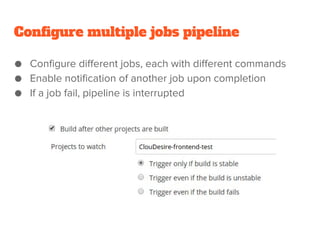
Configure multiple jobs pipeline
● Configure different jobs, each with different commands
● Enable notification of another job upon completion
● If a job fail, pipeline is interrupted
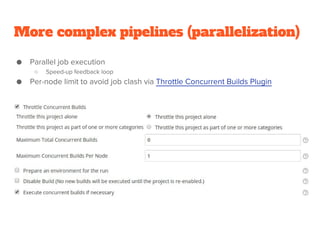
More complex pipelines (parallelization)
● Parallel job execution
○ Speed-up feedback loop
● Per-node limit to avoid job clash via Throttle Concurrent Builds Plugin
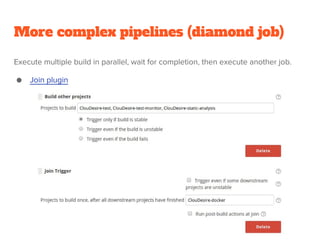
More complex pipelines (diamond job)
Execute multiple build in parallel, wait for completion, then execute another job.
● Join plugin
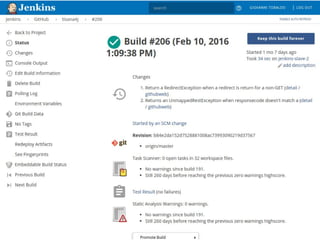
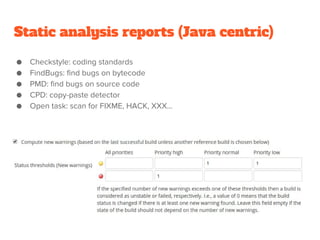
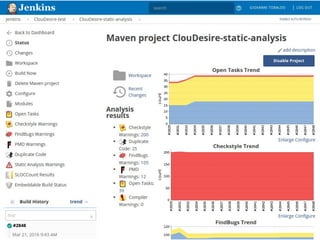
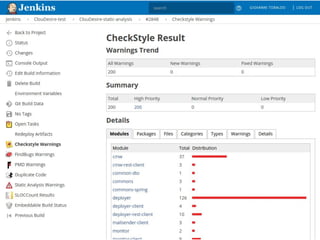
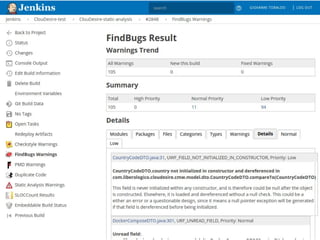
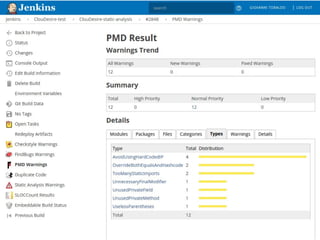
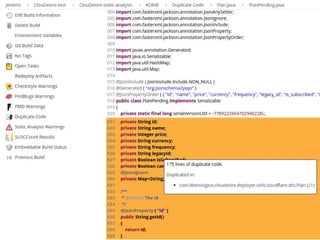
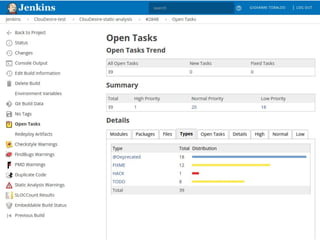
Static analysis reports (Java centric)
● Checkstyle: coding standards
● FindBugs: find bugs on bytecode
● PMD: find bugs on source code
● CPD: copy-paste detector
● Open task: scan for FIXME, HACK, XXX...
GitHub
● GIT repository hosting
● Simple issue management
● Pull requests workflow
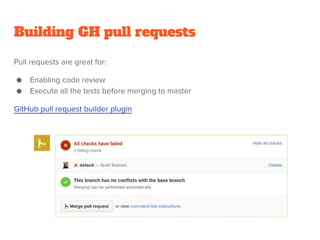
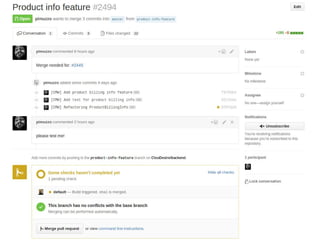
Building GH pull requests
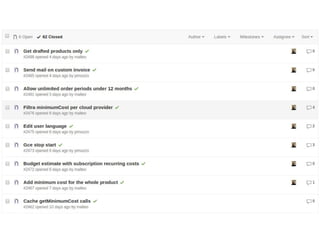
Pull requests are great for:
● Enabling code review
● Execute all the tests before merging to master
GitHub pull request builder plugin
Code review
Pros:
● Ensure use-cases are respected
● Catch bugs early
● Catch distraction errors
● Enforce coding quality
● Rise the bar among developers
Automated Deployment
● Requirements:
○ Versioned sources
○ Build tool
○ Automated tests
● Features
○ Automated deploy procedure
○ Easy roll-back when things go wrong
○ Easy management of multiple environments
Chef-zero (ex Chef-Solo)
● Ruby DSL
● Recipes organized in
cookbooks
● Everything is versioned in
a git repository
● Environment
management
● Single node
management
● Data in JSON
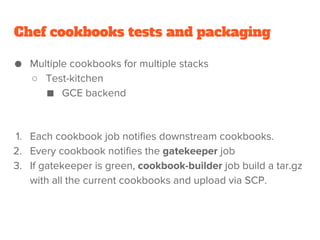
Chef cookbooks tests and packaging
● Multiple cookbooks for multiple stacks
○ Test-kitchen
■ GCE backend
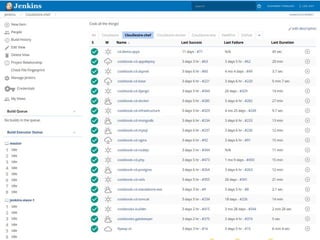
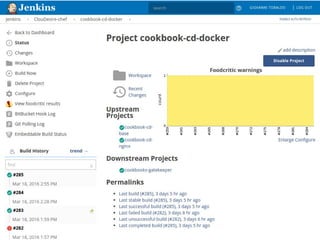
1. Each cookbook job notifies downstream cookbooks.
2. Every cookbook notifies the gatekeeper job
3. If gatekeeper is green, cookbook-builder job build a tar.gz
with all the current cookbooks and upload via SCP.
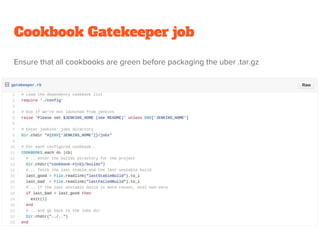
Cookbook Gatekeeper job
Ensure that all cookbooks are green before packaging the uber .tar.gz
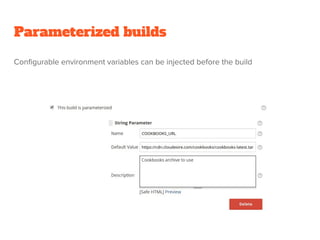
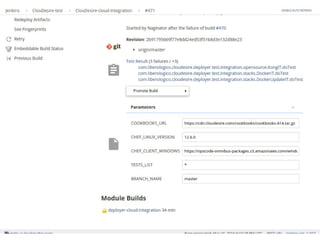
Parameterized builds
Configurable environment variables can be injected before the build
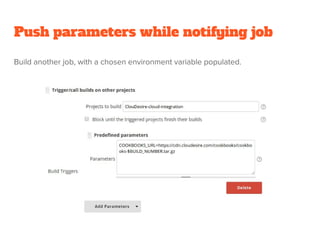
Push parameters while notifying job
Build another job, with a chosen environment variable populated.
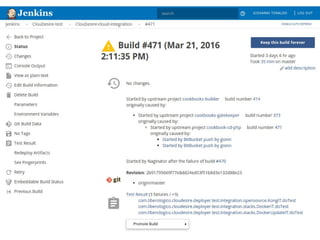
Multi-cloud integration tests
50+ parallels tests:
● of different applications with different stacks
○ Wordpress php+mysql
○ ...
○ Docker applications
● on multiple cloud providers
○ Empty VM
○ Sample applications
Questions?
Don’t be shy!
We are hiring!
https://cloudesire.cloud/jobs/
jobs@cloudesire.com
Thanks!

Software Delivery in 2016 - A Continuous Delivery Approach

  • 1.
    Software Delivery in 2016 AContinuous Delivery approach.
  • 2.
    Who am I? GiovanniToraldo (gionn) Lead developer ClouDesire. com -- Lord of Jenkins Protector of the build Watcher of the stacktraces
  • 3.
    What is ClouDesire? ApplicationMarketplace to help software vendors to sell and provision applications ● Web Applications: ○ provision VM ○ on multiple cloud providers ○ deploy/upgrade docker containers ○ application logging ○ resource monitoring ● With multi-tenant applications/SaaS: ○ expose REST hooks and API for billing lifecycle ● manage subscriptions, billing, pay-per-use, invoicing, payments. 3
  • 4.
    What is ContinuousDelivery? “Continuous delivery (CD) is a software engineering approach in which teams produce software in short cycles, ensuring that the software can be reliably released at any time. It aims at building, testing, and releasing software faster and more frequently. The approach helps reduce the cost, time, and risk of delivering changes by allowing for more incremental updates to applications in production.” https://en.wikipedia.org/wiki/Continuous_delivery
  • 6.
    The road toenlightenment ● Configuration Management ● Data management ● Continuous Integration ● Automated Deployment
  • 7.
    Configuration Management ● Keep*everything* in VCS. ● Managed software dependencies ● Your application should be configurable ● Avoid long-living branches
  • 8.
    Data management ● Scriptedschema migrations ● Dataset for development ● Be backward and forward compatible (when possible)
  • 9.
    Continuous Integration ● Requirements: ○Versioned sources ○ Build tool ○ Automated tests ● Features ○ Early feedback on how things are going ○ Feedback shared with all the team ○ Keep track on how things are going ○ Dashboard for automation
  • 10.
    Jenkins for theCI ● Easy installation: Just run java -jar jenkins.war, or deploy it in a servlet container, or system packages. ● Easy configuration: via friendly web GUI with on-the-fly error checks and inline help. ● Extensibility: Most parts of Jenkins can be extended and modified, and there plugins for every needs. ● Distributed builds: Jenkins can distribute build/test loads to multiple computers with different operating systems.
  • 11.
    What is apipeline? “is an automated manifestation of your process for getting software from version control into the hands of your users.” Jez Humble and David Farley - Continuous Delivery
  • 13.
    One job “pipeline”for simple java app Prerequisites: ● Version Control System (GIT, Mercurial, SVN..) ● Dependency management (NPM, Gem, Composer, …) ● Build system (Maven, Gradle, ...) Jenkins will: 1. Grab the latest code 2. Execute commands you want 3. Report status
  • 18.
    Pipeline with differentstages Every stage is a different job, for example: 1. Compilation / dependencies check job (faster) 2. Static analysis job (fast) 3. Unit test job (fastest) 4. Component test job (slowish) 5. Integration test job (slow) 6. Packaging job (fast)
  • 19.
    Configure multiple jobspipeline ● Configure different jobs, each with different commands ● Enable notification of another job upon completion ● If a job fail, pipeline is interrupted
  • 20.
    More complex pipelines(parallelization) ● Parallel job execution ○ Speed-up feedback loop ● Per-node limit to avoid job clash via Throttle Concurrent Builds Plugin
  • 21.
    More complex pipelines(diamond job) Execute multiple build in parallel, wait for completion, then execute another job. ● Join plugin
  • 22.
    Static analysis reports(Java centric) ● Checkstyle: coding standards ● FindBugs: find bugs on bytecode ● PMD: find bugs on source code ● CPD: copy-paste detector ● Open task: scan for FIXME, HACK, XXX...
  • 29.
    GitHub ● GIT repositoryhosting ● Simple issue management ● Pull requests workflow
  • 30.
    Building GH pullrequests Pull requests are great for: ● Enabling code review ● Execute all the tests before merging to master GitHub pull request builder plugin
  • 32.
    Code review Pros: ● Ensureuse-cases are respected ● Catch bugs early ● Catch distraction errors ● Enforce coding quality ● Rise the bar among developers
  • 34.
    Automated Deployment ● Requirements: ○Versioned sources ○ Build tool ○ Automated tests ● Features ○ Automated deploy procedure ○ Easy roll-back when things go wrong ○ Easy management of multiple environments
  • 35.
    Chef-zero (ex Chef-Solo) ●Ruby DSL ● Recipes organized in cookbooks ● Everything is versioned in a git repository ● Environment management ● Single node management ● Data in JSON
  • 36.
    Chef cookbooks testsand packaging ● Multiple cookbooks for multiple stacks ○ Test-kitchen ■ GCE backend 1. Each cookbook job notifies downstream cookbooks. 2. Every cookbook notifies the gatekeeper job 3. If gatekeeper is green, cookbook-builder job build a tar.gz with all the current cookbooks and upload via SCP.
  • 39.
    Cookbook Gatekeeper job Ensurethat all cookbooks are green before packaging the uber .tar.gz
  • 40.
    Parameterized builds Configurable environmentvariables can be injected before the build
  • 41.
    Push parameters whilenotifying job Build another job, with a chosen environment variable populated.
  • 42.
    Multi-cloud integration tests 50+parallels tests: ● of different applications with different stacks ○ Wordpress php+mysql ○ ... ○ Docker applications ● on multiple cloud providers ○ Empty VM ○ Sample applications
  • 45.
  • 46.
  • 47.