CONDUCTOR - AUTOMATING CI AND CD
2
 Introduction
 Continuous Integration Overview
 Reforming Continuous Integration at Conductor
 Common Issues and Mitigations
 Deployment Overview
 Microservices at Conductor
 Q and A
AGENDA
3
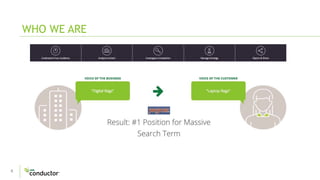
WHO WE ARE
4
WHO WE ARE
5
“The practice of integrating and testing source code continuously
in an automated fashion”
WHAT IS CONTINUOUS INTEGRATION?
6
 Minimize the duration and effort required by each integration
episode
 Be able to deliver a product version suitable for release at any
moment
OBJECTIVES
7
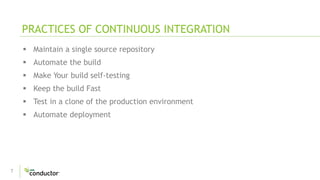
 Maintain a single source repository
 Automate the build
 Make Your build self-testing
 Keep the build Fast
 Test in a clone of the production environment
 Automate deployment
PRACTICES OF CONTINUOUS INTEGRATION
8
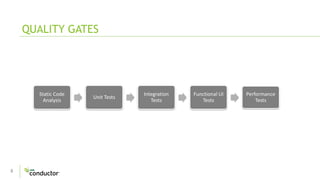
QUALITY GATES
Static Code
Analysis
Unit Tests
Integration
Tests
Functional UI
Tests
Performance
Tests
9
REFORMING CI AT CONDUCTOR
10
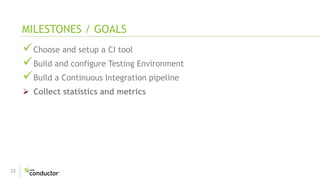
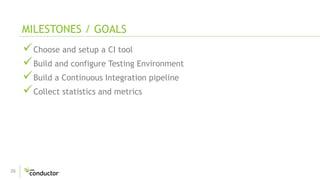
· Choose and setup a CI tool
· Build and configure Testing Environment
· Build a Continuous Integration pipeline
· Collect statistics and metrics
MILESTONES / GOALS
11
 Choose and setup a CI tool
· Build and configure Testing Environment
· Build a Continuous Integration pipeline
· Collect statistics and metrics
MILESTONES / GOALS
12
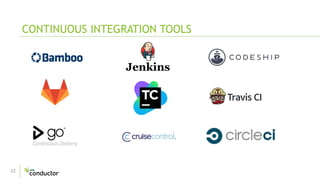
CONTINUOUS INTEGRATION TOOLS
13
CONTINUOUS INTEGRATION TOOLS
14
Choose and setup a CI tool
 Build and configure Testing Environment
· Build a Continuous Integration pipeline
· Collect statistics and metrics
MILESTONES / GOALS
15
 Easy to spin up and maintain
 Immutable and disposable Infrastructure
 Production-like
 Cost effective
 Environment agnostic
TEST ENVIRONMENT REQUIREMENTS
16
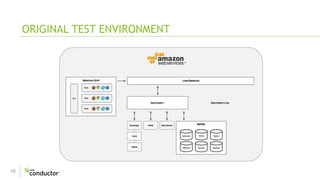
ORIGINAL TEST ENVIRONMENT
17
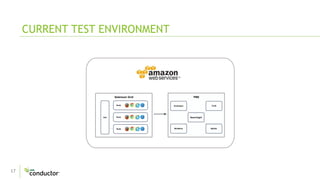
CURRENT TEST ENVIRONMENT
PBE
Searchlight
ZooKeeper
WireMock MySQL
Thrift
Selenium Grid
Node
Node
NodeHub
18
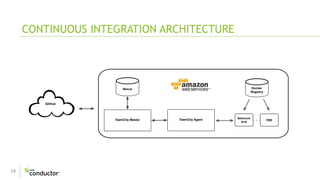
CONTINUOUS INTEGRATION ARCHITECTURE
GitHub
Docker
Registry
TeamCity Master
Nexus
TeamCity Agent Selenium
Grid
PBE
19
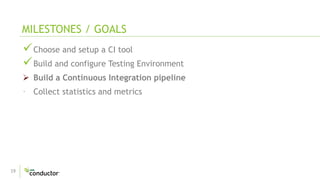
Choose and setup a CI tool
Build and configure Testing Environment
 Build a Continuous Integration pipeline
· Collect statistics and metrics
MILESTONES / GOALS
20
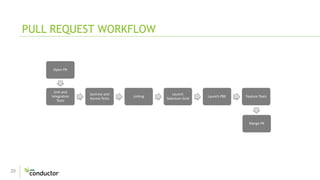
PULL REQUEST WORKFLOW
Open PR
Unit and
Integration
Tests
Jasmine and
Karma Tests
Linting
Launch
Selenium Grid
Launch PBE Feature Tests
Merge PR
21
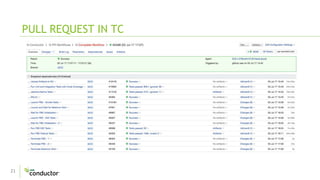
PULL REQUEST IN TC
22
Choose and setup a CI tool
Build and configure Testing Environment
Build a Continuous Integration pipeline
 Collect statistics and metrics
MILESTONES / GOALS
23
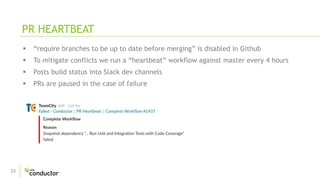
 “require branches to be up to date before merging” is disabled in Github
 To mitigate conflicts we run a “heartbeat” workflow against master every 4 hours
 Posts build status into Slack dev channels
 PRs are paused in the case of failure
PR HEARTBEAT
24
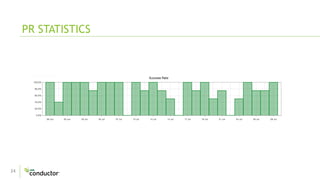
PR STATISTICS
25
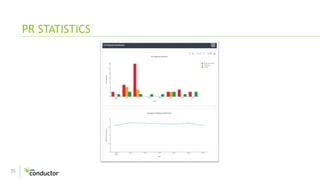
PR STATISTICS
26
Choose and setup a CI tool
Build and configure Testing Environment
Build a Continuous Integration pipeline
Collect statistics and metrics
MILESTONES / GOALS
27
COMMON ISSUES AND MITIGATIONS
28
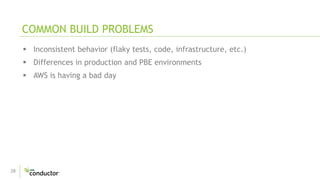
 Inconsistent behavior (flaky tests, code, infrastructure, etc.)
 Differences in production and PBE environments
 AWS is having a bad day
COMMON BUILD PROBLEMS
29
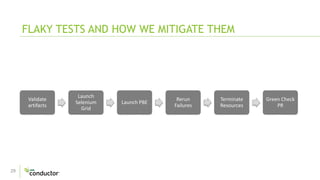
FLAKY TESTS AND HOW WE MITIGATE THEM
Validate
artifacts
Launch
Selenium
Grid
Launch PBE
Rerun
Failures
Terminate
Resources
Green Check
PR
30
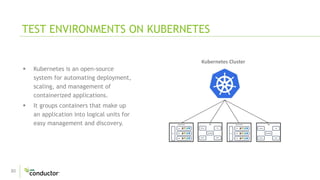
 Kubernetes is an open-source
system for automating deployment,
scaling, and management of
containerized applications.
 It groups containers that make up
an application into logical units for
easy management and discovery.
TEST ENVIRONMENTS ON KUBERNETES
Kubernetes Cluster
Selenium Grid
Hub
Node
Node
Node
Searchlight
ZooKeeper
WireMock MySQL
Thrift
PBE Selenium Grid
Hub
Node
Node
Node
Searchlight
ZooKeeper
WireMock MySQL
Thrift
PBE
31
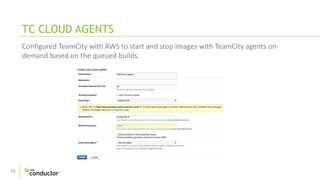
TC CLOUD AGENTS
Configured TeamCity with AWS to start and stop images with TeamCity agents on-
demand based on the queued builds.
32
DEPLOYMENT OVERVIEW
33
 Tests similar to those run for PRs are used
 Runs on a production-like beta environment
 Test results are reviewed
 Jenkins job deploys in rolling fashion with zero downtime
DEPLOY TESTING
34
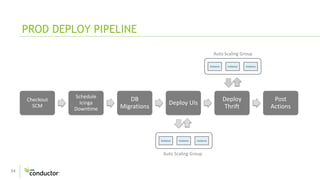
PROD DEPLOY PIPELINE
Checkout
SCM
Schedule
Icinga
Downtime
DB
Migrations
Deploy UIs
Deploy
Thrift
Post
Actions
Instance
Auto Scaling Group
Auto Scaling Group
Instance InstanceInstance
35
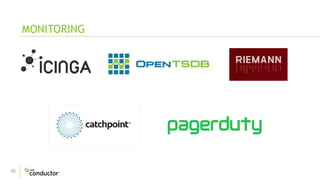
MONITORING
36
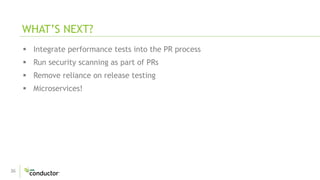
 Integrate performance tests into the PR process
 Run security scanning as part of PRs
 Remove reliance on release testing
 Microservices!
WHAT’S NEXT?
37
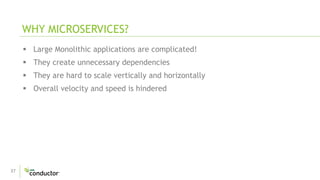
 Large Monolithic applications are complicated!
 They create unnecessary dependencies
 They are hard to scale vertically and horizontally
 Overall velocity and speed is hindered
WHY MICROSERVICES?
38
 Define organizational standards for designing, developing, testing and
deploying microservices
 Use out of the box solutions as much as possible
 Build new features as microservices alongside the monolith
 Migrate existing features to microservices when necessary
GREAT, NOW WHAT?
39
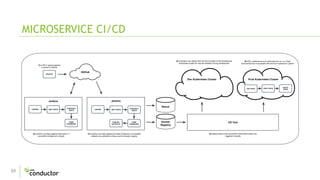
MICROSERVICE CI/CD
Jenkins
Dev Kubernetes Cluster
(1) a PR is opened against
a branch in GitHub
(2) Jenkins runs tests against that branch, if
successful changes are merged
(3) Jenkins runs tests against the head of features, if successful
artifacts are published to Nexus and the Docker registry
(4) Engineers can deploy their service manually to the development
Kubernetes cluster for manual validation during development
Prod Kubernetes Cluster
(5) Deployments to the production Kubernetes cluster are
triggered manually
E2E TESTS PERF TESTS
SCALE
TESTS
(6) E2E, performance and scale tests are run in a "blue"
environment and if successful the service is switched to "green"
Nexus
Docker
Registry
CD Tool
LINTING UNIT TESTS
CONTRACT
TESTS
CODE
COVERAGE
PUBLISH
ARTIFACTS
GitHub
Jenkins
LINTING UNIT TESTS
CONTRACT
TESTS
CODE
COVERAGE
OPEN PR
40
· Daily monolith deploys
· Frequent microservice deploys
· Deliver bug fixes and new features faster
· Fewer bugs in production
· Continued adoption of microservices
WHERE WE ARE TODAY
41
QUESTIONS?

Continuous Integration and Delivery using TeamCity and Jenkins

  • 1.
  • 2.
    2  Introduction  ContinuousIntegration Overview  Reforming Continuous Integration at Conductor  Common Issues and Mitigations  Deployment Overview  Microservices at Conductor  Q and A AGENDA
  • 3.
  • 4.
  • 5.
    5 “The practice ofintegrating and testing source code continuously in an automated fashion” WHAT IS CONTINUOUS INTEGRATION?
  • 6.
    6  Minimize theduration and effort required by each integration episode  Be able to deliver a product version suitable for release at any moment OBJECTIVES
  • 7.
    7  Maintain asingle source repository  Automate the build  Make Your build self-testing  Keep the build Fast  Test in a clone of the production environment  Automate deployment PRACTICES OF CONTINUOUS INTEGRATION
  • 8.
    8 QUALITY GATES Static Code Analysis UnitTests Integration Tests Functional UI Tests Performance Tests
  • 9.
  • 10.
    10 · Choose andsetup a CI tool · Build and configure Testing Environment · Build a Continuous Integration pipeline · Collect statistics and metrics MILESTONES / GOALS
  • 11.
    11  Choose andsetup a CI tool · Build and configure Testing Environment · Build a Continuous Integration pipeline · Collect statistics and metrics MILESTONES / GOALS
  • 12.
  • 13.
  • 14.
    14 Choose and setupa CI tool  Build and configure Testing Environment · Build a Continuous Integration pipeline · Collect statistics and metrics MILESTONES / GOALS
  • 15.
    15  Easy tospin up and maintain  Immutable and disposable Infrastructure  Production-like  Cost effective  Environment agnostic TEST ENVIRONMENT REQUIREMENTS
  • 16.
  • 17.
    17 CURRENT TEST ENVIRONMENT PBE Searchlight ZooKeeper WireMockMySQL Thrift Selenium Grid Node Node NodeHub
  • 18.
  • 19.
    19 Choose and setupa CI tool Build and configure Testing Environment  Build a Continuous Integration pipeline · Collect statistics and metrics MILESTONES / GOALS
  • 20.
    20 PULL REQUEST WORKFLOW OpenPR Unit and Integration Tests Jasmine and Karma Tests Linting Launch Selenium Grid Launch PBE Feature Tests Merge PR
  • 21.
  • 22.
    22 Choose and setupa CI tool Build and configure Testing Environment Build a Continuous Integration pipeline  Collect statistics and metrics MILESTONES / GOALS
  • 23.
    23  “require branchesto be up to date before merging” is disabled in Github  To mitigate conflicts we run a “heartbeat” workflow against master every 4 hours  Posts build status into Slack dev channels  PRs are paused in the case of failure PR HEARTBEAT
  • 24.
  • 25.
  • 26.
    26 Choose and setupa CI tool Build and configure Testing Environment Build a Continuous Integration pipeline Collect statistics and metrics MILESTONES / GOALS
  • 27.
  • 28.
    28  Inconsistent behavior(flaky tests, code, infrastructure, etc.)  Differences in production and PBE environments  AWS is having a bad day COMMON BUILD PROBLEMS
  • 29.
    29 FLAKY TESTS ANDHOW WE MITIGATE THEM Validate artifacts Launch Selenium Grid Launch PBE Rerun Failures Terminate Resources Green Check PR
  • 30.
    30  Kubernetes isan open-source system for automating deployment, scaling, and management of containerized applications.  It groups containers that make up an application into logical units for easy management and discovery. TEST ENVIRONMENTS ON KUBERNETES Kubernetes Cluster Selenium Grid Hub Node Node Node Searchlight ZooKeeper WireMock MySQL Thrift PBE Selenium Grid Hub Node Node Node Searchlight ZooKeeper WireMock MySQL Thrift PBE
  • 31.
    31 TC CLOUD AGENTS ConfiguredTeamCity with AWS to start and stop images with TeamCity agents on- demand based on the queued builds.
  • 32.
  • 33.
    33  Tests similarto those run for PRs are used  Runs on a production-like beta environment  Test results are reviewed  Jenkins job deploys in rolling fashion with zero downtime DEPLOY TESTING
  • 34.
    34 PROD DEPLOY PIPELINE Checkout SCM Schedule Icinga Downtime DB Migrations DeployUIs Deploy Thrift Post Actions Instance Auto Scaling Group Auto Scaling Group Instance InstanceInstance Instance InstanceInstance
  • 35.
  • 36.
    36  Integrate performancetests into the PR process  Run security scanning as part of PRs  Remove reliance on release testing  Microservices! WHAT’S NEXT?
  • 37.
    37  Large Monolithicapplications are complicated!  They create unnecessary dependencies  They are hard to scale vertically and horizontally  Overall velocity and speed is hindered WHY MICROSERVICES?
  • 38.
    38  Define organizationalstandards for designing, developing, testing and deploying microservices  Use out of the box solutions as much as possible  Build new features as microservices alongside the monolith  Migrate existing features to microservices when necessary GREAT, NOW WHAT?
  • 39.
    39 MICROSERVICE CI/CD Jenkins Dev KubernetesCluster (1) a PR is opened against a branch in GitHub (2) Jenkins runs tests against that branch, if successful changes are merged (3) Jenkins runs tests against the head of features, if successful artifacts are published to Nexus and the Docker registry (4) Engineers can deploy their service manually to the development Kubernetes cluster for manual validation during development Prod Kubernetes Cluster (5) Deployments to the production Kubernetes cluster are triggered manually E2E TESTS PERF TESTS SCALE TESTS (6) E2E, performance and scale tests are run in a "blue" environment and if successful the service is switched to "green" Nexus Docker Registry CD Tool LINTING UNIT TESTS CONTRACT TESTS CODE COVERAGE PUBLISH ARTIFACTS GitHub Jenkins LINTING UNIT TESTS CONTRACT TESTS CODE COVERAGE OPEN PR
  • 40.
    40 · Daily monolithdeploys · Frequent microservice deploys · Deliver bug fixes and new features faster · Fewer bugs in production · Continued adoption of microservices WHERE WE ARE TODAY
  • 41.