CONTINOUS PERIPHERAL
NERVE BLOCKS
PRESENTED BY :
DR.ANKITA MADAN
INTRODUCTION
• Preference for continous peripheral nerve blocks
(CPNBs)
To avoid breakthrough pain that follows after
resolution of the single shot peripheral nerve
block(SPNB)
Opioid sparing effect
Adjustment of analgesia and motor function in post
operative period.
Can be given in hospital settings or in ambulatory set
up.
Easiest , simplest and cheapest available modality to
provide pain relief.
HISTORY
• Concept of CPNB evolved from the year 1946 by
Ansari when he suggested a continuous infusion of
local anaesthetic to prolong the supraclavicular block.
• New frontiers opened up with the development of
needles and catheter with special features, possibility
of inserting perineural catheter with assistance of
nerve stimulators and ultrasound.
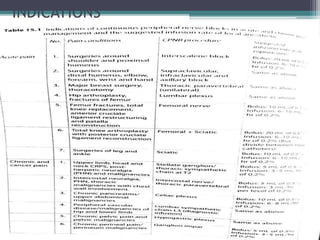
INDICATIONS
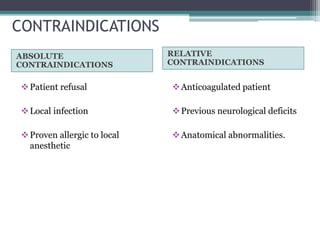
CONTRAINDICATIONS
ABSOLUTE
CONTRAINDICATIONS
RELATIVE
CONTRAINDICATIONS
Patient refusal
Local infection
Proven allergic to local
anesthetic
Anticoagulated patient
Previous neurological deficits
Anatomical abnormalities.
TECHNIQUE OF CPNB
• All standard precautions and steps as are being used
in SPNB.
• Using USG and fluoroscopy depends on their
availability and convenience of the pain physcian.
• For acute pain management technique utilize nerve
stimulator with or without the assistance of USG.
• For chronic pain interventions often utilize fluoroscopy
assistance more than USG.
• All procedures to be done under aseptic precautions.
• Explain the Proposed steps of the procedure , its
benefits and side effects to the patients while taking
informed consent.
NERVE STIMULATOR
• Introduced in 1962
• Principle is using an electrical current via needle
placed close to nerve to stimulate it for localization.
• The local anesthetic then injected or catheter is
advanced for CPNBs.
• Modern nerve stimulator produces a square wave
pulse of current.
• Variable pulse duration also known as sequential
electrical nerve stimulation helps in better nerve
localization.
• Nonconducting injectates like dextrose 5% in water
(D5W) preserve the twich response to nerve
stimulation , and increase current density at the needle
tip.
• Injection of ionized solutions like normal saline (NS)
or local anesthetics (LA) disperse the current leading
to loss of twich.
• Nerve stimulator settings :
 Amplitude width: 0.1ms
Frequency : 2Hz
Impulse : 0.3-0.4 mA
Adjusted to get a faint motor response
• Right nerve to be selected as per requirement of
surgery.
• Length of multiorifice catheter should not be more
than 5 cm as catheter can coil.
• Best length: between 3-4cm beyond the tip of
needle.
ULTRASOUND
• Offers the advantage of watching the needle
navigation , identify the vascular structures and
finally the nerves.
• Provides a guide to note approximate distance of
nerves.
• The vascular injections can be picked as bubble
cloud in local vasculature.
MEDICATIONS AND DELIVERY OPTIONS
• Once the catheter is in place, the next step to
follow is bolus adminstritaion of medications
followed by infusion of local anesthetics with or
without the addition of adjuvant agents with a
lock out period.
• Ropivacine (0.2%) and bupivacaine (0.125%)are
commonly used.
• Ropivacine have more motor sparing effect and is
less cardiogenic agent.
• The local anesthetic systemic toxicity (LAST) WITH
LARGE SINGLE bolus single injection of local
anesthetic rather than prolonged infusion.
• Avoid local anesthetic toxicity by using minimum
local anesthetic concentration (MLAC) and by using
imaging technology to place the catheter close to
nerve.
• Addition of adjuvent agents like opiods, alpha -2-
agonists , adrenaline and others also reduces the use
of local anesthetic.
• Alpha- 2 agonists like clonidine have dual
property of vasoconstriction thereby delaying
the absorption of local anesthetic and
prolongation of repolarization current.
• Adrenaline is commonly added to local
anesthetic to detect the accidental intravascular
placement of the catheter during the initial
placement.
ANTICOAGULATION AND CPNBs
• Guidelines published by American Society For
Regional Anesthesia (ASRA) in 2015 with respect to
thrombolytic and thromboprophylaxis in Regional
anesthesia.
• During inadvertent vascular puncture , the patients on
anticoagulant therapy pose a risk of hematoma
formation.
• The problem lies with CPNB in patients on
thromboprophylaxis when compared to thrombolytic
therapy wherein the anticoagulants are used in higher
dosages.
• Anticoagulants for thromboprophylaxis is identifed
and depending on duration of action the perineural
catheter insertion or removal is planned.
• When enoxaparin is used for thromboprophylaxis then
perineural catheter is inserted 12-16hrs after
administration of enoxaparin.
• The removal of catheter is timed 12-16hrs after
administration of enoxaparin.
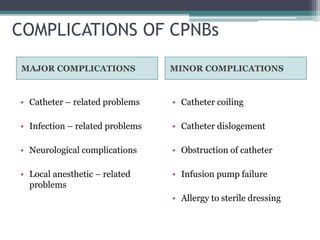
COMPLICATIONS OF CPNBs
MAJOR COMPLICATIONS MINOR COMPLICATIONS
• Catheter – related problems
• Infection – related problems
• Neurological complications
• Local anesthetic – related
problems
• Catheter coiling
• Catheter dislogement
• Obstruction of catheter
• Infusion pump failure
• Allergy to sterile dressing
CATHETER –RELATED PROBLEMS
• Especially with beginners , the perineural catheter may
be placed bit away from target leading to inadequate
analgesia.
• Catheter migration from its original location could lead
to loss of analgesia.
• Reports of intravascular , intrapleural , intraepidural
migration of catheter after correct placement of
catheter.
INFECTION- RELATED PROBLEMS
• Incidence : higher in hospital inpatients (0-3.2%) than
outpatients (below 1%)
• Commonly happen at axillary or femral level but some
have reported in interscalene catheter also.
• Use of aseptic preacautions at each step.
• Risk factors :
Local inflammation
Patients in intensive care
Absence of prophylactic antibiotics
Diabetes mellitus
Patients with axillary or femoral catheter
Duration of infusion beyond 48hrs.
NEUROLOGICAL COMPLICATIONS
• Due to needling of nerve
• Perineural catheter related problem
• Local pressure due to local anesthetic solution
• Toxicity of local anesthetic solution
 Incidence :0.3% to 2%
Transient and resolve within 4-6 weeks
Neurological deficts which persist after 4-6 weeks
resolve over next 3-6 months.
• Serious plexus injuries with paravertebral blocks at
cervical , thoracic and lumbar levels.
• Precautions to be taken in patients with CPNB about
total motor block and insensate extremities.
• There is always Risk of Fall in individuals with
insensate extremities.
• Risk of fall in oupatients given CPNB for femoral
nerve is 1.7%
LOCAL ANESTHETIC –RELATED
PROBLEMS
• Local anesthetic are used in diluted form for
postoperative pain relief @infusion rate 5-10ml/hr.
• At this rate of infusion, risk of toxicity is unlikely but
events have been recorded.
• Risk of toxicity arises if perineural catheter has
migrated intravascularly when bolus dose is given.
• Pump malfunction leads to bolus delivery of drug.
THANK YOU 

Continous peripheral nerve blocks

  • 1.
  • 2.
    INTRODUCTION • Preference forcontinous peripheral nerve blocks (CPNBs) To avoid breakthrough pain that follows after resolution of the single shot peripheral nerve block(SPNB) Opioid sparing effect
  • 3.
    Adjustment of analgesiaand motor function in post operative period. Can be given in hospital settings or in ambulatory set up. Easiest , simplest and cheapest available modality to provide pain relief.
  • 4.
    HISTORY • Concept ofCPNB evolved from the year 1946 by Ansari when he suggested a continuous infusion of local anaesthetic to prolong the supraclavicular block. • New frontiers opened up with the development of needles and catheter with special features, possibility of inserting perineural catheter with assistance of nerve stimulators and ultrasound.
  • 5.
  • 6.
    CONTRAINDICATIONS ABSOLUTE CONTRAINDICATIONS RELATIVE CONTRAINDICATIONS Patient refusal Local infection Provenallergic to local anesthetic Anticoagulated patient Previous neurological deficits Anatomical abnormalities.
  • 7.
    TECHNIQUE OF CPNB •All standard precautions and steps as are being used in SPNB. • Using USG and fluoroscopy depends on their availability and convenience of the pain physcian.
  • 8.
    • For acutepain management technique utilize nerve stimulator with or without the assistance of USG. • For chronic pain interventions often utilize fluoroscopy assistance more than USG. • All procedures to be done under aseptic precautions. • Explain the Proposed steps of the procedure , its benefits and side effects to the patients while taking informed consent.
  • 9.
    NERVE STIMULATOR • Introducedin 1962 • Principle is using an electrical current via needle placed close to nerve to stimulate it for localization. • The local anesthetic then injected or catheter is advanced for CPNBs. • Modern nerve stimulator produces a square wave pulse of current.
  • 10.
    • Variable pulseduration also known as sequential electrical nerve stimulation helps in better nerve localization. • Nonconducting injectates like dextrose 5% in water (D5W) preserve the twich response to nerve stimulation , and increase current density at the needle tip. • Injection of ionized solutions like normal saline (NS) or local anesthetics (LA) disperse the current leading to loss of twich.
  • 11.
    • Nerve stimulatorsettings :  Amplitude width: 0.1ms Frequency : 2Hz Impulse : 0.3-0.4 mA Adjusted to get a faint motor response • Right nerve to be selected as per requirement of surgery. • Length of multiorifice catheter should not be more than 5 cm as catheter can coil. • Best length: between 3-4cm beyond the tip of needle.
  • 12.
    ULTRASOUND • Offers theadvantage of watching the needle navigation , identify the vascular structures and finally the nerves. • Provides a guide to note approximate distance of nerves. • The vascular injections can be picked as bubble cloud in local vasculature.
  • 13.
    MEDICATIONS AND DELIVERYOPTIONS • Once the catheter is in place, the next step to follow is bolus adminstritaion of medications followed by infusion of local anesthetics with or without the addition of adjuvant agents with a lock out period. • Ropivacine (0.2%) and bupivacaine (0.125%)are commonly used. • Ropivacine have more motor sparing effect and is less cardiogenic agent.
  • 14.
    • The localanesthetic systemic toxicity (LAST) WITH LARGE SINGLE bolus single injection of local anesthetic rather than prolonged infusion. • Avoid local anesthetic toxicity by using minimum local anesthetic concentration (MLAC) and by using imaging technology to place the catheter close to nerve. • Addition of adjuvent agents like opiods, alpha -2- agonists , adrenaline and others also reduces the use of local anesthetic.
  • 15.
    • Alpha- 2agonists like clonidine have dual property of vasoconstriction thereby delaying the absorption of local anesthetic and prolongation of repolarization current. • Adrenaline is commonly added to local anesthetic to detect the accidental intravascular placement of the catheter during the initial placement.
  • 16.
    ANTICOAGULATION AND CPNBs •Guidelines published by American Society For Regional Anesthesia (ASRA) in 2015 with respect to thrombolytic and thromboprophylaxis in Regional anesthesia. • During inadvertent vascular puncture , the patients on anticoagulant therapy pose a risk of hematoma formation. • The problem lies with CPNB in patients on thromboprophylaxis when compared to thrombolytic therapy wherein the anticoagulants are used in higher dosages.
  • 17.
    • Anticoagulants forthromboprophylaxis is identifed and depending on duration of action the perineural catheter insertion or removal is planned. • When enoxaparin is used for thromboprophylaxis then perineural catheter is inserted 12-16hrs after administration of enoxaparin. • The removal of catheter is timed 12-16hrs after administration of enoxaparin.
  • 18.
    COMPLICATIONS OF CPNBs MAJORCOMPLICATIONS MINOR COMPLICATIONS • Catheter – related problems • Infection – related problems • Neurological complications • Local anesthetic – related problems • Catheter coiling • Catheter dislogement • Obstruction of catheter • Infusion pump failure • Allergy to sterile dressing
  • 19.
    CATHETER –RELATED PROBLEMS •Especially with beginners , the perineural catheter may be placed bit away from target leading to inadequate analgesia. • Catheter migration from its original location could lead to loss of analgesia. • Reports of intravascular , intrapleural , intraepidural migration of catheter after correct placement of catheter.
  • 20.
    INFECTION- RELATED PROBLEMS •Incidence : higher in hospital inpatients (0-3.2%) than outpatients (below 1%) • Commonly happen at axillary or femral level but some have reported in interscalene catheter also. • Use of aseptic preacautions at each step.
  • 21.
    • Risk factors: Local inflammation Patients in intensive care Absence of prophylactic antibiotics Diabetes mellitus Patients with axillary or femoral catheter Duration of infusion beyond 48hrs.
  • 22.
    NEUROLOGICAL COMPLICATIONS • Dueto needling of nerve • Perineural catheter related problem • Local pressure due to local anesthetic solution • Toxicity of local anesthetic solution  Incidence :0.3% to 2% Transient and resolve within 4-6 weeks Neurological deficts which persist after 4-6 weeks resolve over next 3-6 months.
  • 23.
    • Serious plexusinjuries with paravertebral blocks at cervical , thoracic and lumbar levels. • Precautions to be taken in patients with CPNB about total motor block and insensate extremities. • There is always Risk of Fall in individuals with insensate extremities. • Risk of fall in oupatients given CPNB for femoral nerve is 1.7%
  • 24.
    LOCAL ANESTHETIC –RELATED PROBLEMS •Local anesthetic are used in diluted form for postoperative pain relief @infusion rate 5-10ml/hr. • At this rate of infusion, risk of toxicity is unlikely but events have been recorded. • Risk of toxicity arises if perineural catheter has migrated intravascularly when bolus dose is given. • Pump malfunction leads to bolus delivery of drug.
  • 26.