CITIZENSHIP
 Legally: conferred by birth (jus soli) or by inheritance (jus sanguinus).
 Theoretically: appears to be a simple concept.
 In Practice: becomes a complicated system.
What is citizenship? What does it mean to be a citizen?
 Inequalities exist within citizenship due to:
Formal and informal dimensions of citizenship
Social factors
Misconceptions and stereotyping
The ‘widening gap’ between classes
Citizenship: Wealth and Poverty
“The state ultimately
guarantees citizenship rights,
but it is the way in which
citizenship identities and
entitlements are settled
between the civil sphere and
the state that creates different
historical forms of
citizenship”.
(Nash, 2010)
Is Citizenship a Privilege?
 Formal rights of the citizen are granted by
the state.
 Informal expectations of the citizen develop
within the civil sphere.
 Informal dimension of citizenship determines
one’s entitlement to the status of being a
citizen.
 Division occurs: Active Citizen vs Inactive
Citizen.
“Social movements challenge informal
criteria that define some individuals as
“other,” as belonging to a group that
makes them unworthy of equal rights in
the civil sphere”.
(Nash, 2010)
Consumer Citizens
 Capitalism: Freedom > Equality
 Citizens seen as consumers.
 Socioeconomic status informally defining citizenship.
 Underclass seen as responsible for their condition:
The “flawed consumers” (Bauman, 1998)
 Leads to social isolation:
Poverty as shameful
The Widening Gap
 Widening gap between socioeconomic classes.
 Increases inequality.
 Economic, social and political factors contribute to
disparity.
 Poor people unable to exercise their rights as
citizens
Example: ELISABETH WYNHAUSEN
Tried life as a low-wage worker packing eggs in poor
conditions. Three weeks in, the millionaire manger
announced the company was selling its egg division.
Wynhausen claims she was “struck by the fact that
none of the workers challenged the manager”, as if
they were “stripped of all defences” (Leigh, 2013).
Pursuit for Change
 Underclass have limited access
to services and therefore,
limited access to exercise their
rights as citizens.
 Citizenship is influenced by
social factors and movements.
 Poverty and wealth pose on
example of the many
inequalities existing in
citizenship.
“William Julius Wilson tried
to produce a different
understanding of the
“underclass”, arguing that
it should be seen as an
economic and social
phenomenon rather than
the result of rational
individual choices”.
(Nash, 2010)
“The recently launched
Development Research
Centre on Citizenship,
Participation and
Accountability is based
on the premise that a
critical challenge for the
twenty-first century is to
construct new concepts
and forms of citizenship
which will help to make
rights real for poor
people”.
(Gaventa, 2002)

Continous analytical reflection: Citizenship, Wealth and Poverty.

  • 1.
    CITIZENSHIP  Legally: conferredby birth (jus soli) or by inheritance (jus sanguinus).  Theoretically: appears to be a simple concept.  In Practice: becomes a complicated system. What is citizenship? What does it mean to be a citizen?  Inequalities exist within citizenship due to: Formal and informal dimensions of citizenship Social factors Misconceptions and stereotyping The ‘widening gap’ between classes Citizenship: Wealth and Poverty “The state ultimately guarantees citizenship rights, but it is the way in which citizenship identities and entitlements are settled between the civil sphere and the state that creates different historical forms of citizenship”. (Nash, 2010)
  • 2.
    Is Citizenship aPrivilege?  Formal rights of the citizen are granted by the state.  Informal expectations of the citizen develop within the civil sphere.  Informal dimension of citizenship determines one’s entitlement to the status of being a citizen.  Division occurs: Active Citizen vs Inactive Citizen. “Social movements challenge informal criteria that define some individuals as “other,” as belonging to a group that makes them unworthy of equal rights in the civil sphere”. (Nash, 2010)
  • 3.
    Consumer Citizens  Capitalism:Freedom > Equality  Citizens seen as consumers.  Socioeconomic status informally defining citizenship.  Underclass seen as responsible for their condition: The “flawed consumers” (Bauman, 1998)  Leads to social isolation: Poverty as shameful
  • 4.
    The Widening Gap Widening gap between socioeconomic classes.  Increases inequality.  Economic, social and political factors contribute to disparity.  Poor people unable to exercise their rights as citizens Example: ELISABETH WYNHAUSEN Tried life as a low-wage worker packing eggs in poor conditions. Three weeks in, the millionaire manger announced the company was selling its egg division. Wynhausen claims she was “struck by the fact that none of the workers challenged the manager”, as if they were “stripped of all defences” (Leigh, 2013).
  • 5.
    Pursuit for Change Underclass have limited access to services and therefore, limited access to exercise their rights as citizens.  Citizenship is influenced by social factors and movements.  Poverty and wealth pose on example of the many inequalities existing in citizenship. “William Julius Wilson tried to produce a different understanding of the “underclass”, arguing that it should be seen as an economic and social phenomenon rather than the result of rational individual choices”. (Nash, 2010) “The recently launched Development Research Centre on Citizenship, Participation and Accountability is based on the premise that a critical challenge for the twenty-first century is to construct new concepts and forms of citizenship which will help to make rights real for poor people”. (Gaventa, 2002)

Editor's Notes

  • #2 Theoretically, citizenship may appear to be a relatively simple concept. However, in practice, citizenship proves to be an extensively complicated system. Several questions are raised regarding the social definition of citizenship and the social responsibilities held by the citizen. Additionally, the rights associated with citizenship become problematic. Some citizens lack the ability to sufficiently exercise the full extent of their given rights due to withstanding social factors. The ‘underclass’ is one example of the inequalities of citizenship.
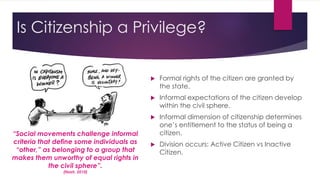
  • #3 The categorisation of “Others” implements the idea of an ‘us’ against ‘them’ mentality. Existing stereotypes regarding those in poverty reside around the perception of them being “inherently different”, and commonly seen as “diseased and criminal” (Lister, 2004). This capitalist view of the underclass suggests that they are responsible for their own condition. Thus, the remainder of society believe them to be underserving of the status of citizen (Nash, 2010). People contributing to the economy and therefore, the government, see themselves as active citizens. Those who cannot contribute in the same way (ie. the unemployed), are then seen as inactive citizens. Image: http://pub209healthcultureandsociety.wikispaces.com/Capitalism,+Consumerism+and+The+Bogan. (Date accessed: 18/5/14).
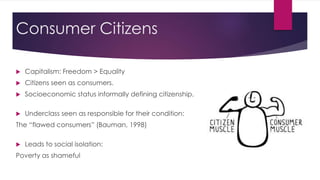
  • #4 Capitalism places great emphasis upon the freedom of choice. In a consumerist society, equality then becomes an issue. As citizens are turned into consumers, the poor become regarded as “flawed consumers” (Bauman, 1998). Furthermore, the underclass is not only isolated from society, but they are blamed for maintaining behaviour that keeps them in poverty. Social isolation causes more problems, as admitting one is in poverty is seen as shameful, especially when the poor are considered to be responsible for their condition (Lister, 2004). Image: http://www.cruxcatalyst.com/2012/07/18/the-story-of-change-flexing-the-citizen-muscle/muscle/ (Date accessed: 18/5/14).
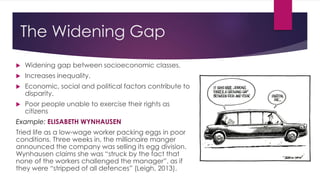
  • #5 In Australia, it appears that poverty has increased since the 1980s: “Just as the top is accelerating away from the middle, so too has the bottom fallen away from the middle” (Leigh, 2013). This has led to a widening gap between socioeconomic classes within society. However, the inequality of citizenship should be understood to encompass more than just economic factors. Rather, it is the joint result of economic, social and political factors combined (Piketty, 2014). Additionally, many poor people do not know how to exercise their rights as citizens. The question of power and material resources is strongly connected to this issue (Gaventa, 2002). Image: http://fbheron.org/2014/04/26/in-case-you-missed-it-a-whole-new-world/ (Date accessed: 19/5/14).
  • #6 Therefore, citizenship becomes a complex system that is constantly shaped and influenced by social movements. Those in poverty receive treatment based upon their income, their contribution to the economy and their skills as a consumer. Their access to citizenship rights become restricted due to financial implications, resulting in the reproach of those who only have access to inferior services (Nash, 2010). But for the most part, what it presents to us is one of the many inequalities associated with citizenship. Reference List: Gaventa, J. (2002). Introduction: Exploring Citizenship, Participation and Accountability. IDS Bulletin. p. 1-18. Leigh, A. (2013, July 16). Mind the Gap. The Sydney Morning Herald. Nash, K. (2010). Cotemporary Political Sociology: Globalization, Politics and Power, ‘Citizenship’ (pp. 130-191). Wiley-Blackwell. Piketty, T. (2014). Capital in the Twenty-first Century. United States of America: Harvard College.