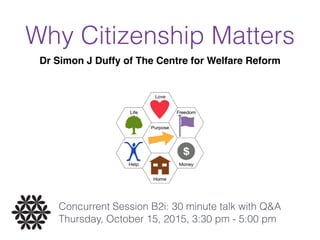
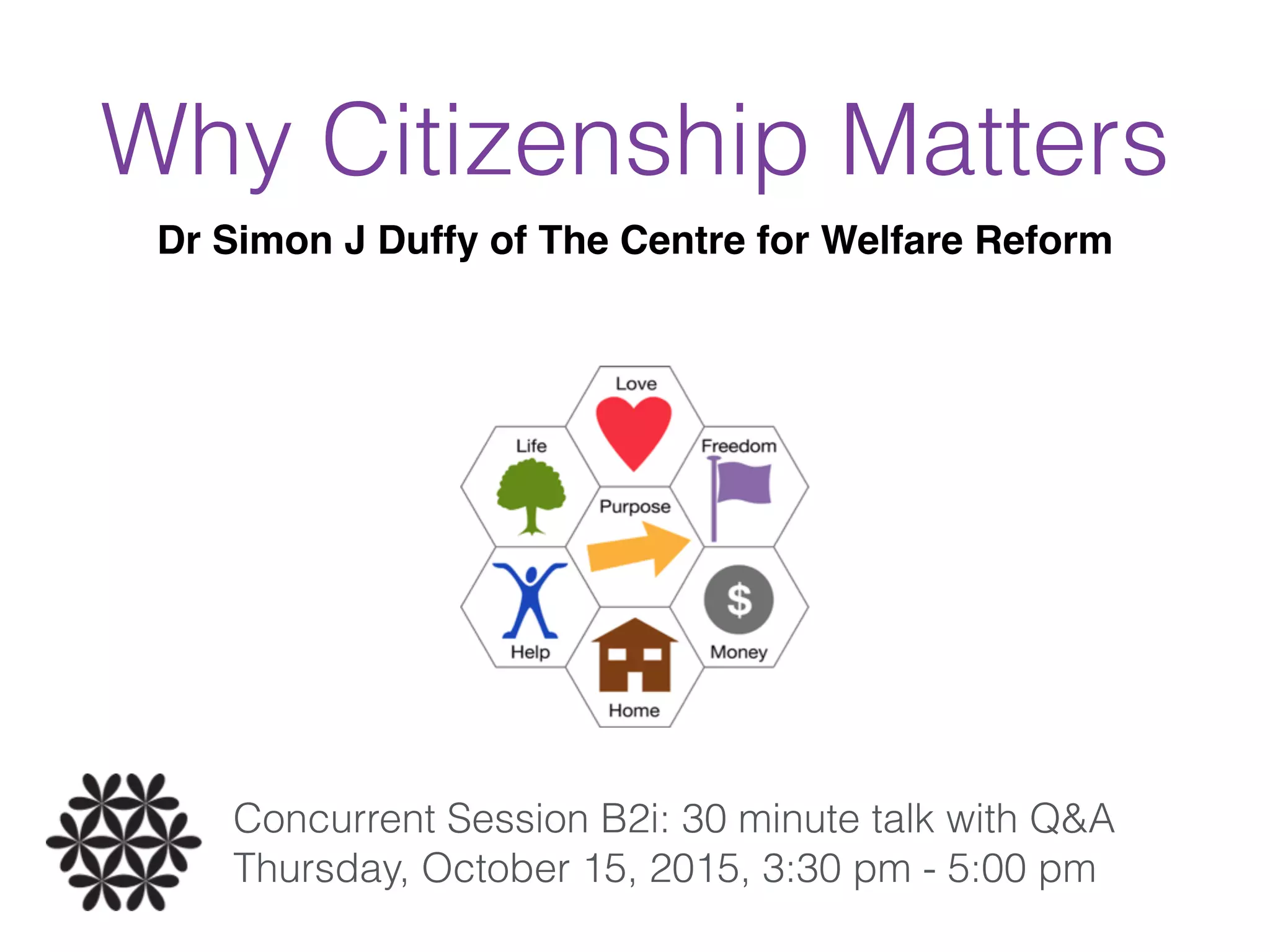
Why Citizenship Matters
Concurrent Session B2i: 30 minute talk with Q&A

Thursday, October 15, 2015, 3:30 pm - 5:00 pm
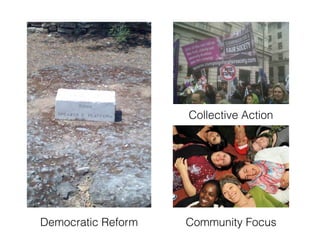
Dr Simon J Duffy of The Centre for Welfare Reform
1. Citizenship is the most important goal for our work
together.
2. True citizenship welcomes difference, creates equality
and is inclusive of all.
3. Citizens work together to understand how citizenship
can be opened up to everyone.
4. Our recent work has, to some degree, helped more
people to achieve citizenship.
5. But if we take citizenship seriously then this may
change how we carry out our work.
What are we doing
?
What is our goal
?
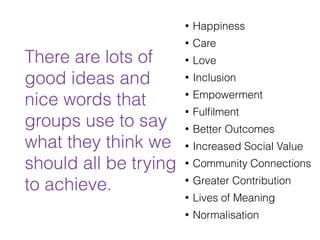
• Happiness
• Care
• Love
• Inclusion
• Empowerment
• Fulfilment
• Better Outcomes
• Increased Social Value
• Community Connections
• Greater Contribution
• Lives of Meaning
• Normalisation
There are lots of
good ideas and
nice words that
groups use to say
what they think we
should all be trying
to achieve.
But the most important
goal is citizenship
Why
?
Because to be a citizen means
you are part of the community
that decides what its goals are.
If you are not a citizen you are
outside and any goals that are set
are not your goals (although they
may still be set for you).
What kind of citizenship
?
The idea of citizenship has a long
history and it has been used and
abused by many different
societies.
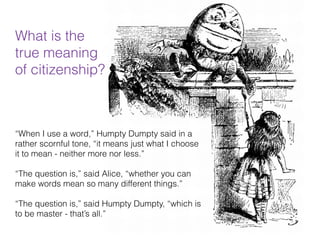
Lewis Carroll
“When I use a word,” Humpty Dumpty said in a
rather scornful tone, “it means just what I choose
it to mean - neither more nor less.”
“The question is,” said Alice, “whether you can
make words mean so many different things.”
“The question is,” said Humpty Dumpty, “which is
to be master - that’s all.”
What is the 

true meaning 

of citizenship?
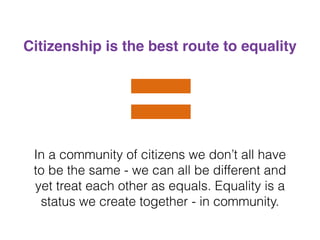
In a community of citizens we don’t all have
to be the same - we can all be different and
yet treat each other as equals. Equality is a
status we create together - in community.
Citizenship is the best route to equality
=
“Aristotle explains that a
community is not made out of
equals, but on the contrary of
people who are different and
unequal. The community
comes into being through
equalising, isathenai.” 

[Nichomean Ethics 1133a 14]
Hannah Arendt, 

The Promise of Politics
“Citizenship grows when people who
are different recognise they are equal
and start to work together in that spirit.”
“Citizenship dies when people
abandon those who are different to
injustice and retreat into passivity.”
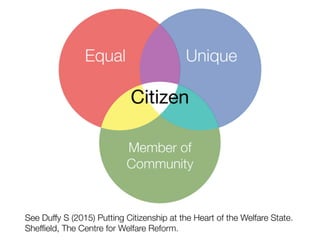
Understood correctly, citizenship enables us to be
equal - and different - unique. Citizenship frees us
from the idea that we must conform to a standard.
Instead we can learn to live together with respect:

as free and contributing members of the community.
How can we be citizens
?
Citizenship is valuable.
But it has a price. It is
not enough to just call
people ‘citizens’, rather
we must work to make
sure that everyone can
be valued as an equal.
Citizenship is ‘Universalised’
Social Role Valorisation (SRV)
• Both pay attention to how our status is ‘constructed’
by society and both seek to increase status of
people with intellectual disabilities. But
• Citizenship demands we reject social devaluation
for everyone, rather than just avoiding placing
people in devalued roles.
• Citizenship demands that we all have a duty to act
as a citizen and to welcome others as citizens.
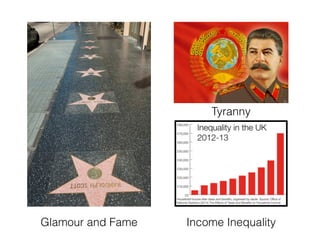
Some things are bad for
citizenship.
Glamour and Fame Income Inequality
Tyranny
Some things are good for
citizenship.
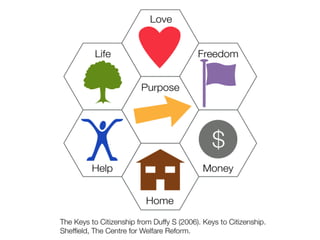
We make citizenship real by
1. Finding our sense of purpose
2. Having the freedom to pursue it
3. Having enough money to be free
4. Having a home where we belong
5. Getting help from other people
6. Making life in community
7. Finding love
This protects our status
1. Our life is seen to have meaning
2. We are not on someone else’s control
3. We can pay our way - we’re not unduly dependent
4. We have a stake in the community
5. We give others the chance to give
6. We contribute to the community
7. We are building the relationships that sustain community
This kind of citizenship is entirely
practical and sustainable. 

It is possible to achieve the keys
to citizenship for everyone. 

Not only does it not rely on the
exclusion of others it benefits
from the inclusion of all.
What about 

self-directed support
?
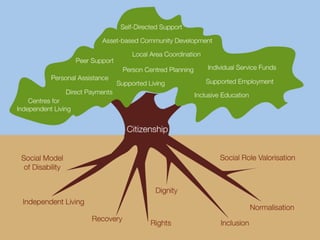
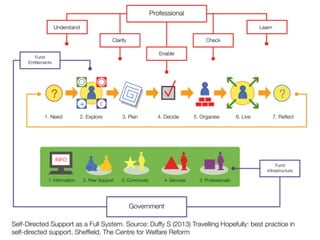
For many of us self-directed
support has always been about
helping people achieve
citizenship.
This often influences the
design of different systems
of self-directed support
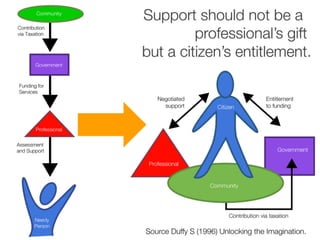
• Purpose - enabling people to set their own goals
• Freedom - overcoming problem of mental capacity
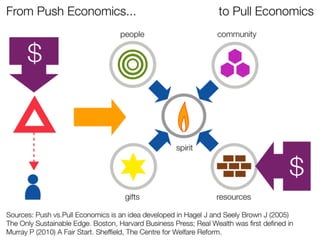
• Money - moving resources from systems to citizens
• Home - enabling people to live where they choose
• Help - people directing their own support
• Life - increasing participation and contribution
• Love - strengthening families, friendships & relationships
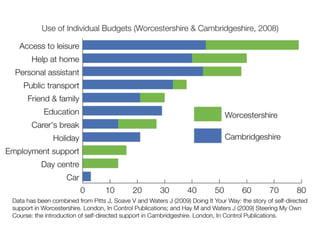
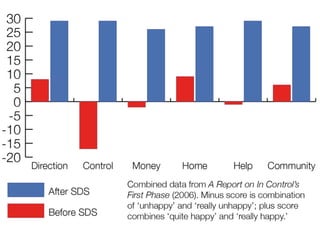
Often research on self-
directed support suggest
some improvements in
‘signs of citizenship’.
What next
?
Systems cannot be tricked into
treating people as citizens. Self-
directed support will need strong
foundations if it is be truly effective.
This means, for example
1. We must be able to define and measure how
effective we are being in achieving citizenship.
2. We must recognise that this is about equipping
people to act as citizens.
3. We must connect our efforts to wider social and
democratic reforms.
Democratic Reform Community Focus
Collective Action
People with disabilities, like many others, have had to
fight for citizenship; and there is still much to be
achieved. In fact people with disabilities can show
people the true meaning of citizenship, and this
raises important challenges for all societies in the
decades ahead. It is time to challenge the priorities of
modern society and to develop ideas that are more
inclusive, empowering and creative. Citizenship is an
ideal whose time has come.
But we must begin by
acting as citizens
ourselves.
Q & A
For more information:
• www.centreforwelfarereform.org
• @simonjduffy and @CforWR
• simon@centreforwelfarereform.org
• www.facebook.com/centreforwelfarereform
Learning objectives
• Understand the meaning of citizenship
• Evaluate different policies with regard to their
impact on citizenship
• Develop innovations that promote citizenship for all
References
Arendt H (2005) The Promise of Politics. New York, Schocken Books.
Duffy, S. (1996) Unlocking the Imagination, Choice Press, London.
Duffy S (2006) Keys to Citizenship: a guide to getting good support services for people with learning disabilities. Sheffield,
The Centre for Welfare Reform.
Duffy S (2010) "Citizenship Theory of Social Justice - exploring the meaning of personalisation for social workers", Journal of
Social Work Practice Vol. 24 No. 3 pp. 253-267
Duffy S (2013) The Unmaking of Man: Disability and the Holocaust. Sheffield, The Centre for Welfare Reform.
Duffy S (2013) Travelling Hopefully: Best practice in self-directed support. Sheffield, The Centre for Welfare Reform.
Duffy S (2013) 21st Century Vision. Sheffield, The Centre for Welfare Reform.
Duffy S (2015) Putting Citizenship at the Heart of the Welfare State. Sheffield, The Centre for Welfare Reform.
Hay M and Waters J (2009, Steering My Own Course. London, In Control Publications.
Murray P (2010) A Fair Start. Sheffield, The Centre for Welfare Reform.
Poll. C. Duffy, S. Hatton, C. Sanderson, H. and Routledge, M. (2006) A Report on In Control's First Phase 2003-2005. London,
In Control Publications.
Hagel J. and Seely Brown J (2005) The Only Sustainable Edge, Boston, Harvard Business Press,
Lane M (2014) Greek and Roman Political Ideas. London, Pelican.
Pitts J Soave V and Waters J (2009) Doing It Your Way: the story of self-directed support in Worcestershire. London, In Control
Publications.

Why Citizenship Matters - Lessons for Self-Directed Support

  • 1.
    Why Citizenship Matters ConcurrentSession B2i: 30 minute talk with Q&A
 Thursday, October 15, 2015, 3:30 pm - 5:00 pm Dr Simon J Duffy of The Centre for Welfare Reform
  • 2.
    1. Citizenship isthe most important goal for our work together. 2. True citizenship welcomes difference, creates equality and is inclusive of all. 3. Citizens work together to understand how citizenship can be opened up to everyone. 4. Our recent work has, to some degree, helped more people to achieve citizenship. 5. But if we take citizenship seriously then this may change how we carry out our work.
  • 3.
    What are wedoing ?
  • 4.
  • 5.
    • Happiness • Care •Love • Inclusion • Empowerment • Fulfilment • Better Outcomes • Increased Social Value • Community Connections • Greater Contribution • Lives of Meaning • Normalisation There are lots of good ideas and nice words that groups use to say what they think we should all be trying to achieve.
  • 6.
    But the mostimportant goal is citizenship
  • 7.
  • 8.
    Because to bea citizen means you are part of the community that decides what its goals are.
  • 9.
    If you arenot a citizen you are outside and any goals that are set are not your goals (although they may still be set for you).
  • 10.
    What kind ofcitizenship ?
  • 11.
    The idea ofcitizenship has a long history and it has been used and abused by many different societies.
  • 14.
    Lewis Carroll “When Iuse a word,” Humpty Dumpty said in a rather scornful tone, “it means just what I choose it to mean - neither more nor less.” “The question is,” said Alice, “whether you can make words mean so many different things.” “The question is,” said Humpty Dumpty, “which is to be master - that’s all.” What is the 
 true meaning 
 of citizenship?
  • 15.
    In a communityof citizens we don’t all have to be the same - we can all be different and yet treat each other as equals. Equality is a status we create together - in community. Citizenship is the best route to equality =
  • 16.
    “Aristotle explains thata community is not made out of equals, but on the contrary of people who are different and unequal. The community comes into being through equalising, isathenai.” 
 [Nichomean Ethics 1133a 14] Hannah Arendt, 
 The Promise of Politics
  • 18.
    “Citizenship grows whenpeople who are different recognise they are equal and start to work together in that spirit.” “Citizenship dies when people abandon those who are different to injustice and retreat into passivity.”
  • 19.
    Understood correctly, citizenshipenables us to be equal - and different - unique. Citizenship frees us from the idea that we must conform to a standard. Instead we can learn to live together with respect:
 as free and contributing members of the community.
  • 20.
    How can webe citizens ?
  • 21.
    Citizenship is valuable. Butit has a price. It is not enough to just call people ‘citizens’, rather we must work to make sure that everyone can be valued as an equal.
  • 22.
    Citizenship is ‘Universalised’ SocialRole Valorisation (SRV) • Both pay attention to how our status is ‘constructed’ by society and both seek to increase status of people with intellectual disabilities. But • Citizenship demands we reject social devaluation for everyone, rather than just avoiding placing people in devalued roles. • Citizenship demands that we all have a duty to act as a citizen and to welcome others as citizens.
  • 23.
    Some things arebad for citizenship.
  • 24.
    Glamour and FameIncome Inequality Tyranny
  • 25.
    Some things aregood for citizenship.
  • 27.
    We make citizenshipreal by 1. Finding our sense of purpose 2. Having the freedom to pursue it 3. Having enough money to be free 4. Having a home where we belong 5. Getting help from other people 6. Making life in community 7. Finding love
  • 28.
    This protects ourstatus 1. Our life is seen to have meaning 2. We are not on someone else’s control 3. We can pay our way - we’re not unduly dependent 4. We have a stake in the community 5. We give others the chance to give 6. We contribute to the community 7. We are building the relationships that sustain community
  • 29.
    This kind ofcitizenship is entirely practical and sustainable. 
 It is possible to achieve the keys to citizenship for everyone. 
 Not only does it not rely on the exclusion of others it benefits from the inclusion of all.
  • 31.
  • 32.
    For many ofus self-directed support has always been about helping people achieve citizenship.
  • 34.
    This often influencesthe design of different systems of self-directed support
  • 36.
    • Purpose -enabling people to set their own goals • Freedom - overcoming problem of mental capacity • Money - moving resources from systems to citizens • Home - enabling people to live where they choose • Help - people directing their own support • Life - increasing participation and contribution • Love - strengthening families, friendships & relationships
  • 37.
    Often research onself- directed support suggest some improvements in ‘signs of citizenship’.
  • 39.
  • 40.
    Systems cannot betricked into treating people as citizens. Self- directed support will need strong foundations if it is be truly effective.
  • 41.
    This means, forexample 1. We must be able to define and measure how effective we are being in achieving citizenship. 2. We must recognise that this is about equipping people to act as citizens. 3. We must connect our efforts to wider social and democratic reforms.
  • 44.
    Democratic Reform CommunityFocus Collective Action
  • 45.
    People with disabilities,like many others, have had to fight for citizenship; and there is still much to be achieved. In fact people with disabilities can show people the true meaning of citizenship, and this raises important challenges for all societies in the decades ahead. It is time to challenge the priorities of modern society and to develop ideas that are more inclusive, empowering and creative. Citizenship is an ideal whose time has come.
  • 46.
    But we mustbegin by acting as citizens ourselves.
  • 47.
  • 48.
    For more information: •www.centreforwelfarereform.org • @simonjduffy and @CforWR • simon@centreforwelfarereform.org • www.facebook.com/centreforwelfarereform
  • 49.
    Learning objectives • Understandthe meaning of citizenship • Evaluate different policies with regard to their impact on citizenship • Develop innovations that promote citizenship for all
  • 50.
    References Arendt H (2005)The Promise of Politics. New York, Schocken Books. Duffy, S. (1996) Unlocking the Imagination, Choice Press, London. Duffy S (2006) Keys to Citizenship: a guide to getting good support services for people with learning disabilities. Sheffield, The Centre for Welfare Reform. Duffy S (2010) "Citizenship Theory of Social Justice - exploring the meaning of personalisation for social workers", Journal of Social Work Practice Vol. 24 No. 3 pp. 253-267 Duffy S (2013) The Unmaking of Man: Disability and the Holocaust. Sheffield, The Centre for Welfare Reform. Duffy S (2013) Travelling Hopefully: Best practice in self-directed support. Sheffield, The Centre for Welfare Reform. Duffy S (2013) 21st Century Vision. Sheffield, The Centre for Welfare Reform. Duffy S (2015) Putting Citizenship at the Heart of the Welfare State. Sheffield, The Centre for Welfare Reform. Hay M and Waters J (2009, Steering My Own Course. London, In Control Publications. Murray P (2010) A Fair Start. Sheffield, The Centre for Welfare Reform. Poll. C. Duffy, S. Hatton, C. Sanderson, H. and Routledge, M. (2006) A Report on In Control's First Phase 2003-2005. London, In Control Publications. Hagel J. and Seely Brown J (2005) The Only Sustainable Edge, Boston, Harvard Business Press, Lane M (2014) Greek and Roman Political Ideas. London, Pelican. Pitts J Soave V and Waters J (2009) Doing It Your Way: the story of self-directed support in Worcestershire. London, In Control Publications.