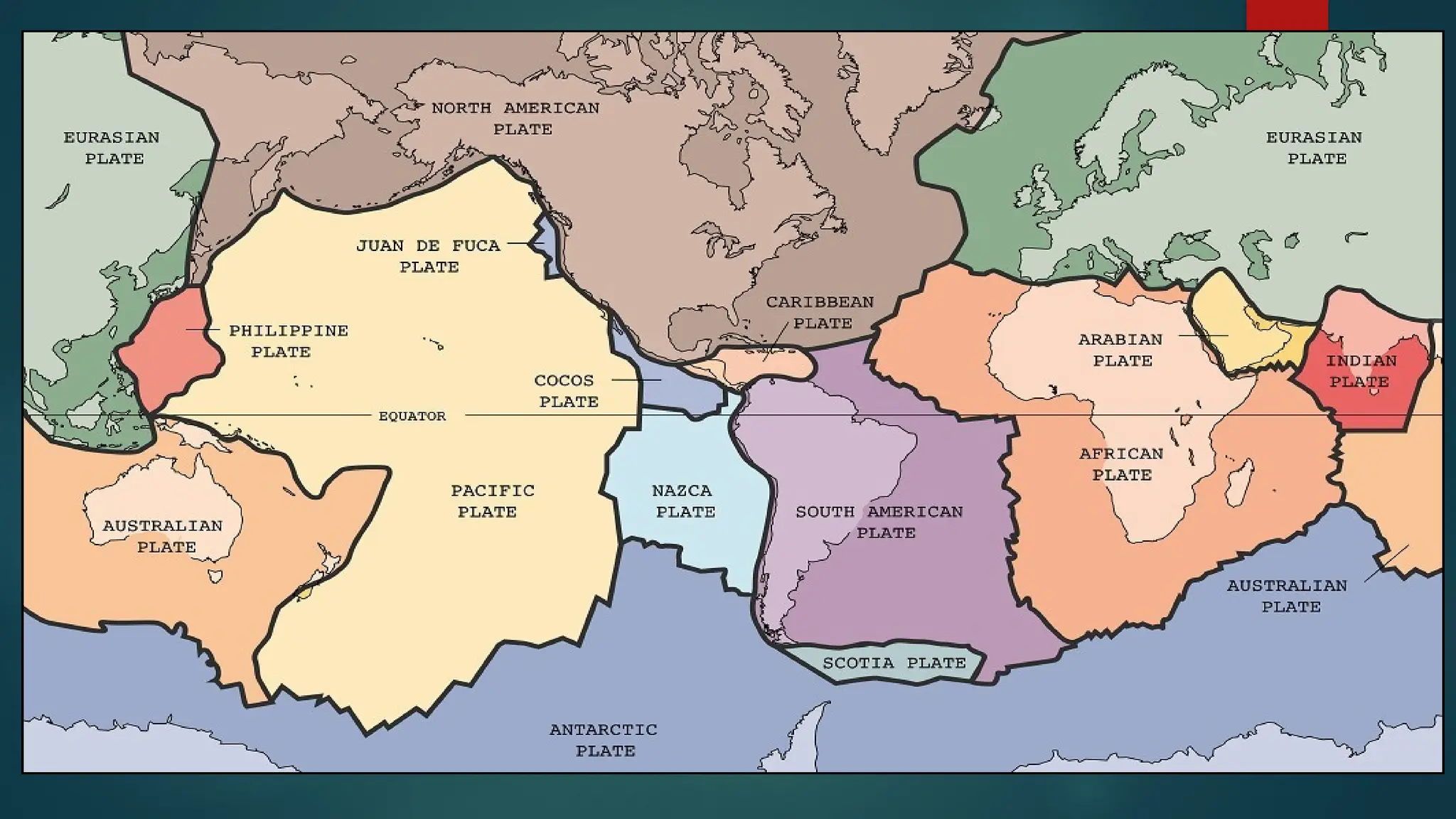
Looking at the picture,
can you see patterns or
places where pieces
can fit?
GEOLOGY
 Literally, it is the study of the Earth. to understand
the structure of the Earth and its surface features,
 what causes earthquakes and tsunamis, and why
volcanoes form and erupt.
 Learn about minerals, which form the building
blocks of rocks, and how rocks are made and
destroyed.
 Learn about Earth’s fascinating history, the variety
of life forms which have roamed the surface over
the millennia, and the dramatic changes that have
happened over Earth’s long history.
What is Plate tectonics?
From the Greek adjective tektonikos, meaning “built”
theory dealing with the dynamics of Earth’s outer shell, the
lithosphere, that revolutionized Earth sciences by providing
a uniform context for understanding
mountain-building processes, volcanoes, and earthquakes,
as well as understanding the evolution of Earth’s surface
and reconstructing its past continental and oceanic
configurations.
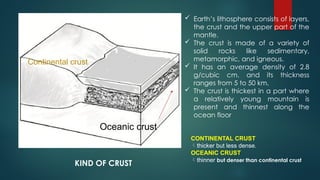
Continental crust
Oceanic crust
 Earth’s lithosphere consists of layers,
the crust and the upper part of the
mantle.
 The crust is made of a variety of
solid rocks like sedimentary,
metamorphic, and igneous.
 It has an average density of 2.8
g/cubic cm. and its thickness
ranges from 5 to 50 km.
 The crust is thickest in a part where
a relatively young mountain is
present and thinnest along the
ocean floor
KIND OF CRUST
CONTINENTAL CRUST
thicker but less dense.
OCEANIC CRUST
thinner but denser than continental crust
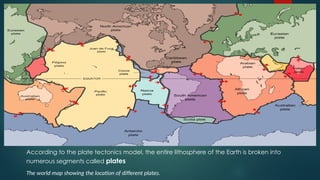
According to the plate tectonics model, the entire lithosphere of the Earth is broken into
numerous segments called plates
The world map showing the location of different plates.
ELABORATION FROM THE MAP
1. The Idea, of plate tectonics says that Earth’s outer layer
is made up of large, moving pieces called plates. there
are seven relatively large plates and a number of
smaller ones, including the Philippine plate.
2. All of Earth’s land and water sit on these plates.
ELABORATION FROM THE MAP
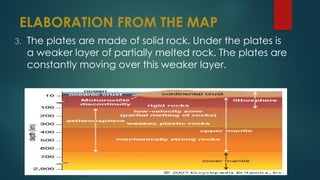
3. The plates are made of solid rock. Under the plates is
a weaker layer of partially melted rock. The plates are
constantly moving over this weaker layer.
ELABORATION FROM THE MAP
4. The plates move very slowly but constantly, and this movement is
called TECTONICS
5. thus the theory of moving lithospheric plates is called PLATE
TECTONICS.
6. every city, mountain and ocean on top of a particular plate
moves with the plate
7. Large-scale geological activity such as earthquakes and
volcanoes occur on or near plate bounders.
8. Areas farther from plate boundaries are less prone to earthquakes.
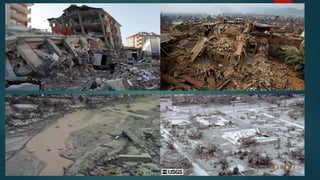
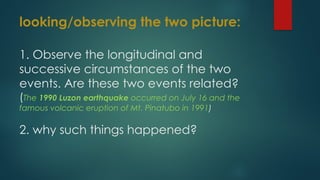
looking/observing the two picture:
1. Observe the longitudinal and
successive circumstances of the two
events. Are these two events related?
(The 1990 Luzon earthquake occurred on July 16 and the
famous volcanic eruption of Mt. Pinatubo in 1991)
2. why such things happened?
HISTORY AND DEVELOPMENT OF THE PLATE
Catastrophism
Until the 1700s, most Europeans thought that
a Biblical Flood played a major role in shaping
the Earth's surface
This way of thinking was based on the belief
that all earthly changes were sudden and
caused by a series of catastrophes such as
volcanic eruption, floods, and earthquakes.
HISTORY AND DEVELOPMENT OF THE PLATE
Uniformitarianism
proposed in 1785 by James Hutton, a Scottish geologist.
a new way of thinking centered around the
"Uniformitarian Principle“
This principle is commonly stated as follows: The present
is the key to the past. Those holding this viewpoint assume
that the geologic forces and processes -- gradual as well
as catastrophic -- acting on the Earth today are the
same as those that have acted in the geologic past.
HISTORY AND DEVELOPMENT OF THE PLATE
1596
Dutch map maker Abraham Ortelius in his
work Thesaurus Geographicus.
Ortelius suggested that the Americas were "torn
away from Europe and Africa . . . by earthquakes
and floods" and went on to say: "The vestiges of
the rupture reveal themselves, if someone brings
forward a map of the world and considers
carefully the coasts of the three [continents].
HISTORY AND DEVELOPMENT OF THE PLATE
1792
Benjamin Franklin hypothesized that the
earth’s crust is floating on the fluid interior; thus
earths surface would be capable of being
broken and disordered
HISTORY AND DEVELOPMENT OF THE PLATE
1912
Alfred Lothar Wegener a 32-year-old
German meteorologist, the idea of moving
continents was seriously considered as a full-
blown scientific theory -- called Continental
Drift -- introduced in two articles.
He contended that, around 200 million years
ago, the supercontinent Pangaea began to
split apart.
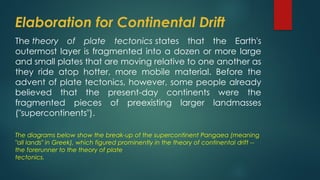
Elaboration for Continental Drift
The theory of plate tectonics states that the Earth's
outermost layer is fragmented into a dozen or more large
and small plates that are moving relative to one another as
they ride atop hotter, more mobile material. Before the
advent of plate tectonics, however, some people already
believed that the present-day continents were the
fragmented pieces of preexisting larger landmasses
("supercontinents").
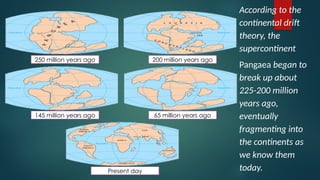
The diagrams below show the break-up of the supercontinent Pangaea (meaning
"all lands" in Greek), which figured prominently in the theory of continental drift --
the forerunner to the theory of plate
tectonics.
According to the
continental drift
theory, the
supercontinent
Pangaea began to
break up about
225-200 million
years ago,
eventually
fragmenting into
the continents as
we know them
today.
250 million years ago
65 million years ago
200 million years ago
145 million years ago
Present day
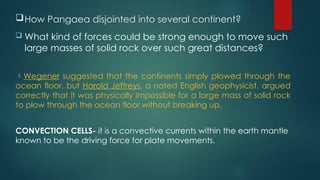
How Pangaea disjointed into several continent?
 What kind of forces could be strong enough to move such
large masses of solid rock over such great distances?
Wegener suggested that the continents simply plowed through the
ocean floor, but Harold Jeffreys, a noted English geophysicist, argued
correctly that it was physically impossible for a large mass of solid rock
to plow through the ocean floor without breaking up.
CONVECTION CELLS- it is a convective currents within the earth mantle
known to be the driving force for plate movements.
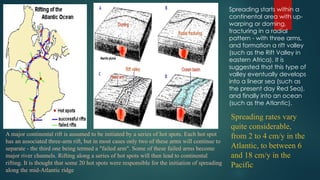
Spreading starts within a
continental area with up-
warping or doming,
fracturing in a radial
pattern - with three arms,
and formation a rift valley
(such as the Rift Valley in
eastern Africa). It is
suggested that this type of
valley eventually develops
into a linear sea (such as
the present day Red Sea),
and finally into an ocean
(such as the Atlantic).
Spreading rates vary
quite considerable,
from 2 to 4 cm/y in the
Atlantic, to between 6
and 18 cm/y in the
Pacific
A major continental rift is assumed to be initiated by a series of hot spots. Each hot spot
has an associated three-arm rift, but in most cases only two of these arms will continue to
separate - the third one being termed a "failed arm". Some of these failed arms become
major river channels. Rifting along a series of hot spots will then lead to continental
rifting. It is thought that some 20 hot spots were responsible for the initiation of spreading
along the mid-Atlantic ridge
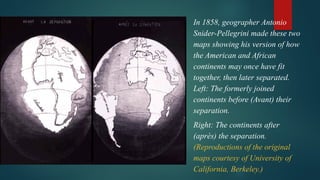
In 1858, geographer Antonio
Snider-Pellegrini made these two
maps showing his version of how
the American and African
continents may once have fit
together, then later separated.
Left: The formerly joined
continents before (Avant) their
separation.
Right: The continents after
(après) the separation.
(Reproductions of the original
maps courtesy of University of
California, Berkeley.)
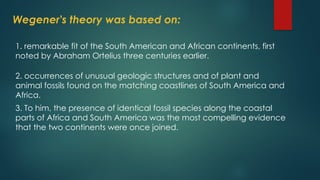
Wegener's theory was based on:
1. remarkable fit of the South American and African continents, first
noted by Abraham Ortelius three centuries earlier.
2. occurrences of unusual geologic structures and of plant and
animal fossils found on the matching coastlines of South America and
Africa.
3. To him, the presence of identical fossil species along the coastal
parts of Africa and South America was the most compelling evidence
that the two continents were once joined.
Activity: WRITE AND TELL
QUESTION:
MY
RESPONSE
BEFORE
DISCUSSION
MY
RESPONSE
AFTER
DISCUSSIO
N
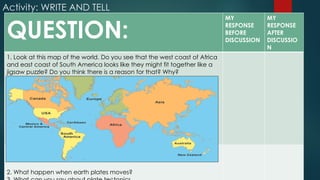
1. Look at this map of the world. Do you see that the west coast of Africa
and east coast of South America looks like they might fit together like a
jigsaw puzzle? Do you think there is a reason for that? Why?
2. What happen when earth plates moves?

SCIENCE 10 - CONTINENTAL DRIFT THEORIES-

  • 2.
    Looking at thepicture, can you see patterns or places where pieces can fit?
  • 4.
    GEOLOGY  Literally, itis the study of the Earth. to understand the structure of the Earth and its surface features,  what causes earthquakes and tsunamis, and why volcanoes form and erupt.  Learn about minerals, which form the building blocks of rocks, and how rocks are made and destroyed.  Learn about Earth’s fascinating history, the variety of life forms which have roamed the surface over the millennia, and the dramatic changes that have happened over Earth’s long history.
  • 5.
    What is Platetectonics? From the Greek adjective tektonikos, meaning “built” theory dealing with the dynamics of Earth’s outer shell, the lithosphere, that revolutionized Earth sciences by providing a uniform context for understanding mountain-building processes, volcanoes, and earthquakes, as well as understanding the evolution of Earth’s surface and reconstructing its past continental and oceanic configurations.
  • 6.
    Continental crust Oceanic crust Earth’s lithosphere consists of layers, the crust and the upper part of the mantle.  The crust is made of a variety of solid rocks like sedimentary, metamorphic, and igneous.  It has an average density of 2.8 g/cubic cm. and its thickness ranges from 5 to 50 km.  The crust is thickest in a part where a relatively young mountain is present and thinnest along the ocean floor KIND OF CRUST CONTINENTAL CRUST thicker but less dense. OCEANIC CRUST thinner but denser than continental crust
  • 7.
    According to theplate tectonics model, the entire lithosphere of the Earth is broken into numerous segments called plates The world map showing the location of different plates.
  • 8.
    ELABORATION FROM THEMAP 1. The Idea, of plate tectonics says that Earth’s outer layer is made up of large, moving pieces called plates. there are seven relatively large plates and a number of smaller ones, including the Philippine plate. 2. All of Earth’s land and water sit on these plates.
  • 9.
    ELABORATION FROM THEMAP 3. The plates are made of solid rock. Under the plates is a weaker layer of partially melted rock. The plates are constantly moving over this weaker layer.
  • 10.
    ELABORATION FROM THEMAP 4. The plates move very slowly but constantly, and this movement is called TECTONICS 5. thus the theory of moving lithospheric plates is called PLATE TECTONICS. 6. every city, mountain and ocean on top of a particular plate moves with the plate 7. Large-scale geological activity such as earthquakes and volcanoes occur on or near plate bounders. 8. Areas farther from plate boundaries are less prone to earthquakes.
  • 12.
    looking/observing the twopicture: 1. Observe the longitudinal and successive circumstances of the two events. Are these two events related? (The 1990 Luzon earthquake occurred on July 16 and the famous volcanic eruption of Mt. Pinatubo in 1991) 2. why such things happened?
  • 13.
    HISTORY AND DEVELOPMENTOF THE PLATE Catastrophism Until the 1700s, most Europeans thought that a Biblical Flood played a major role in shaping the Earth's surface This way of thinking was based on the belief that all earthly changes were sudden and caused by a series of catastrophes such as volcanic eruption, floods, and earthquakes.
  • 14.
    HISTORY AND DEVELOPMENTOF THE PLATE Uniformitarianism proposed in 1785 by James Hutton, a Scottish geologist. a new way of thinking centered around the "Uniformitarian Principle“ This principle is commonly stated as follows: The present is the key to the past. Those holding this viewpoint assume that the geologic forces and processes -- gradual as well as catastrophic -- acting on the Earth today are the same as those that have acted in the geologic past.
  • 15.
    HISTORY AND DEVELOPMENTOF THE PLATE 1596 Dutch map maker Abraham Ortelius in his work Thesaurus Geographicus. Ortelius suggested that the Americas were "torn away from Europe and Africa . . . by earthquakes and floods" and went on to say: "The vestiges of the rupture reveal themselves, if someone brings forward a map of the world and considers carefully the coasts of the three [continents].
  • 16.
    HISTORY AND DEVELOPMENTOF THE PLATE 1792 Benjamin Franklin hypothesized that the earth’s crust is floating on the fluid interior; thus earths surface would be capable of being broken and disordered
  • 17.
    HISTORY AND DEVELOPMENTOF THE PLATE 1912 Alfred Lothar Wegener a 32-year-old German meteorologist, the idea of moving continents was seriously considered as a full- blown scientific theory -- called Continental Drift -- introduced in two articles. He contended that, around 200 million years ago, the supercontinent Pangaea began to split apart.
  • 18.
    Elaboration for ContinentalDrift The theory of plate tectonics states that the Earth's outermost layer is fragmented into a dozen or more large and small plates that are moving relative to one another as they ride atop hotter, more mobile material. Before the advent of plate tectonics, however, some people already believed that the present-day continents were the fragmented pieces of preexisting larger landmasses ("supercontinents"). The diagrams below show the break-up of the supercontinent Pangaea (meaning "all lands" in Greek), which figured prominently in the theory of continental drift -- the forerunner to the theory of plate tectonics.
  • 19.
    According to the continentaldrift theory, the supercontinent Pangaea began to break up about 225-200 million years ago, eventually fragmenting into the continents as we know them today. 250 million years ago 65 million years ago 200 million years ago 145 million years ago Present day
  • 20.
    How Pangaea disjointedinto several continent?  What kind of forces could be strong enough to move such large masses of solid rock over such great distances? Wegener suggested that the continents simply plowed through the ocean floor, but Harold Jeffreys, a noted English geophysicist, argued correctly that it was physically impossible for a large mass of solid rock to plow through the ocean floor without breaking up. CONVECTION CELLS- it is a convective currents within the earth mantle known to be the driving force for plate movements.
  • 21.
    Spreading starts withina continental area with up- warping or doming, fracturing in a radial pattern - with three arms, and formation a rift valley (such as the Rift Valley in eastern Africa). It is suggested that this type of valley eventually develops into a linear sea (such as the present day Red Sea), and finally into an ocean (such as the Atlantic). Spreading rates vary quite considerable, from 2 to 4 cm/y in the Atlantic, to between 6 and 18 cm/y in the Pacific A major continental rift is assumed to be initiated by a series of hot spots. Each hot spot has an associated three-arm rift, but in most cases only two of these arms will continue to separate - the third one being termed a "failed arm". Some of these failed arms become major river channels. Rifting along a series of hot spots will then lead to continental rifting. It is thought that some 20 hot spots were responsible for the initiation of spreading along the mid-Atlantic ridge
  • 22.
    In 1858, geographerAntonio Snider-Pellegrini made these two maps showing his version of how the American and African continents may once have fit together, then later separated. Left: The formerly joined continents before (Avant) their separation. Right: The continents after (après) the separation. (Reproductions of the original maps courtesy of University of California, Berkeley.)
  • 23.
    Wegener's theory wasbased on: 1. remarkable fit of the South American and African continents, first noted by Abraham Ortelius three centuries earlier. 2. occurrences of unusual geologic structures and of plant and animal fossils found on the matching coastlines of South America and Africa. 3. To him, the presence of identical fossil species along the coastal parts of Africa and South America was the most compelling evidence that the two continents were once joined.
  • 24.
    Activity: WRITE ANDTELL QUESTION: MY RESPONSE BEFORE DISCUSSION MY RESPONSE AFTER DISCUSSIO N 1. Look at this map of the world. Do you see that the west coast of Africa and east coast of South America looks like they might fit together like a jigsaw puzzle? Do you think there is a reason for that? Why? 2. What happen when earth plates moves?