DDD Strategic Design
Introduction to Context Maps
Paulo Clavijo - April 2018DDD Guild - GSAD Dell-EMC
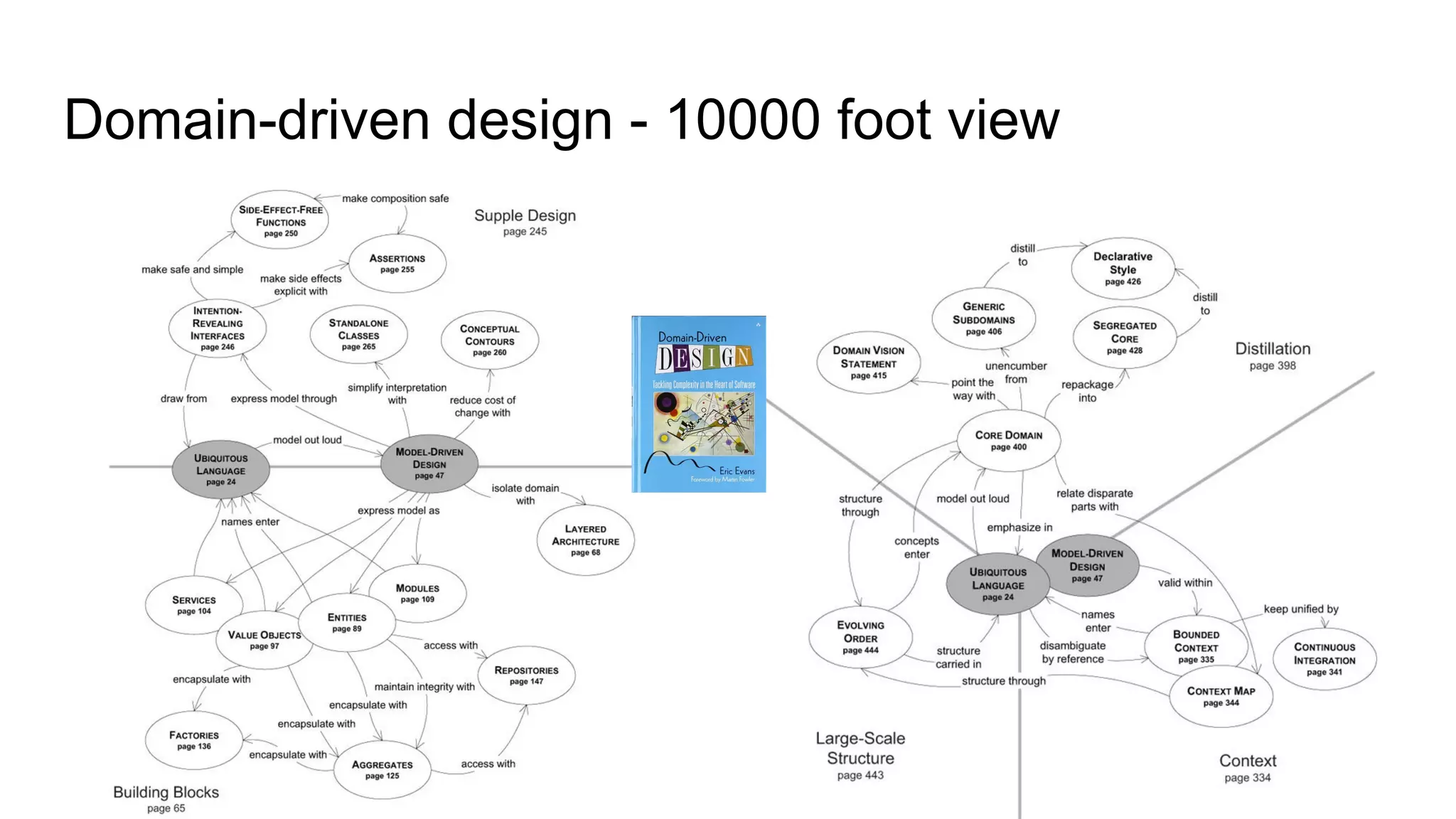
Domain-driven design - 10000 foot view
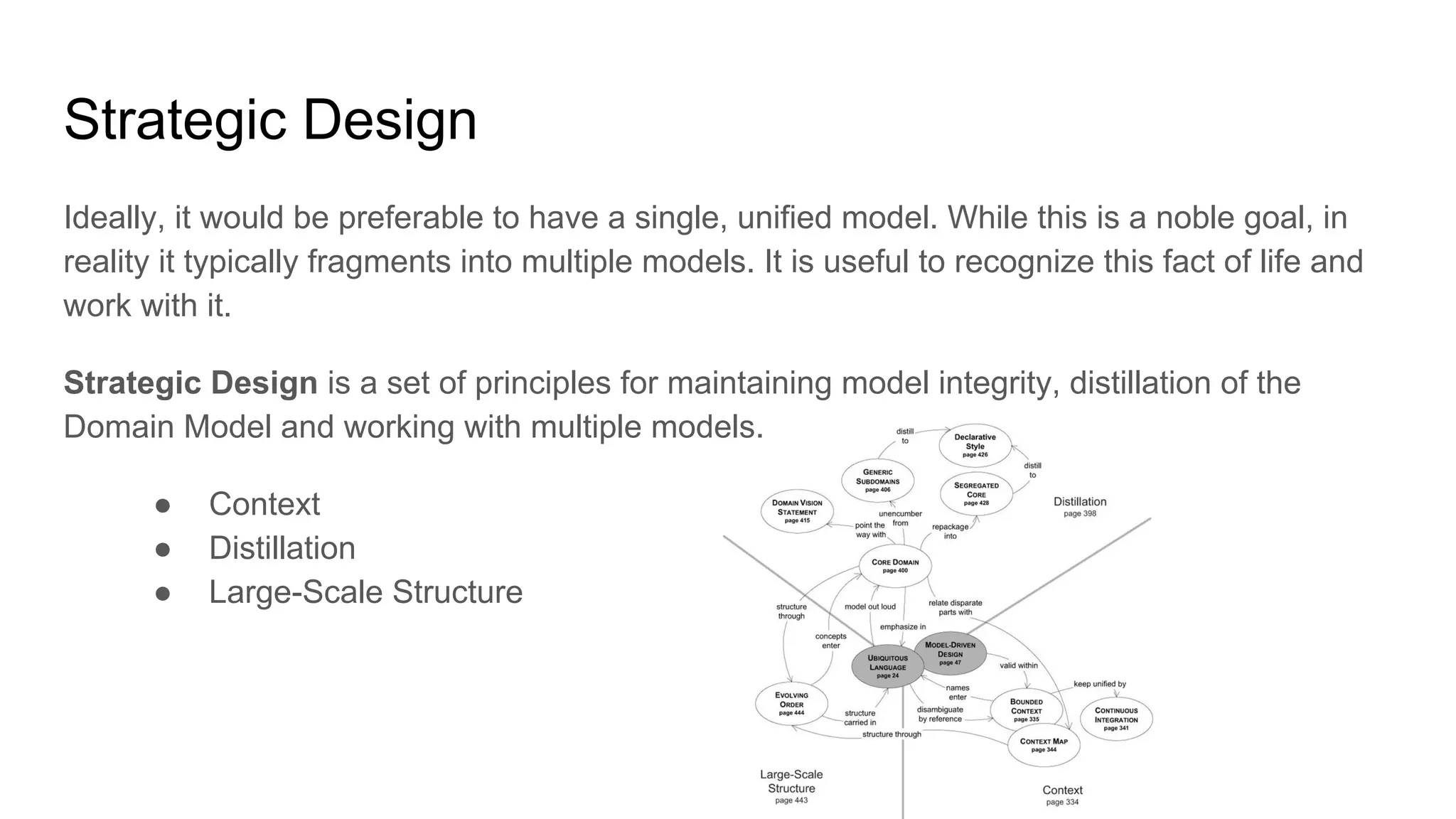
Strategic Design
Ideally, it would be preferable to have a single, unified model. While this is a noble goal, in
reality it typically fragments into multiple models. It is useful to recognize this fact of life and
work with it.
Strategic Design is a set of principles for maintaining model integrity, distillation of the
Domain Model and working with multiple models.
● Context
● Distillation
● Large-Scale Structure
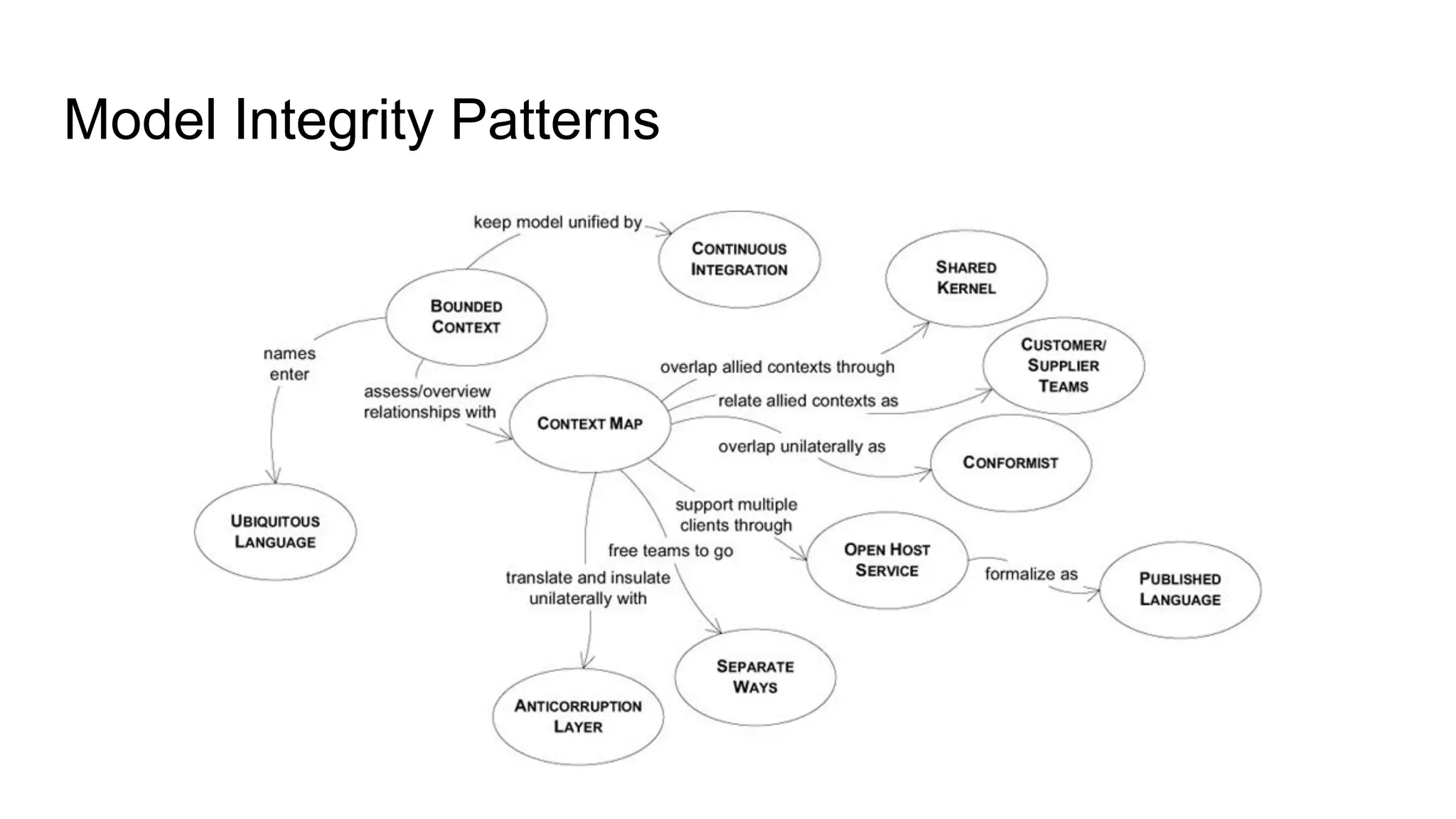
Model Integrity Patterns
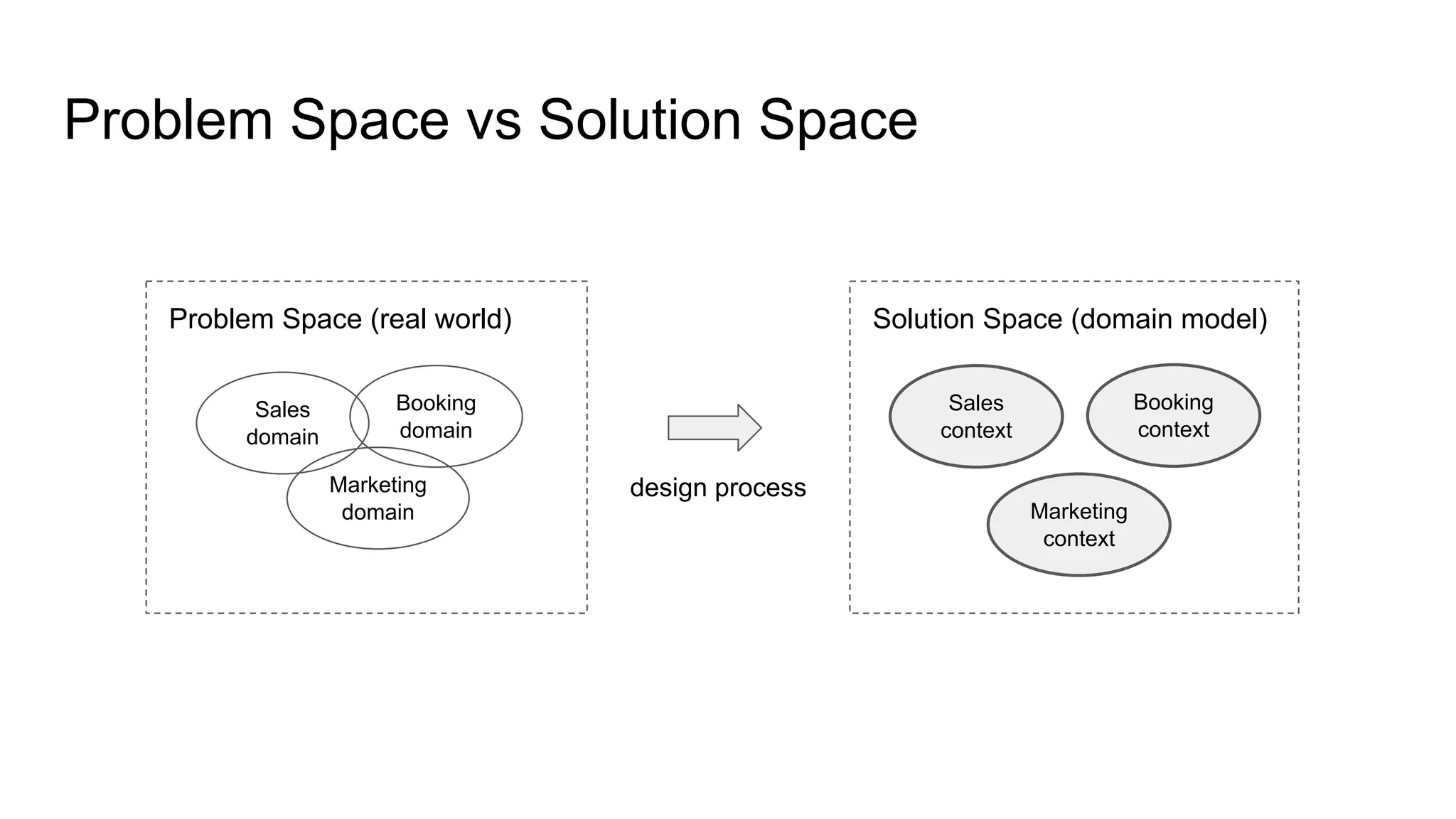
Problem Space vs Solution Space
Sales
domain
Booking
domain
Marketing
domain
Problem Space (real world) Solution Space (domain model)
design process
Booking
context
Sales
context
Marketing
context
Dom
Ap ic o
Ser s
AP
/In
ef
In
as
c
e
Dat e
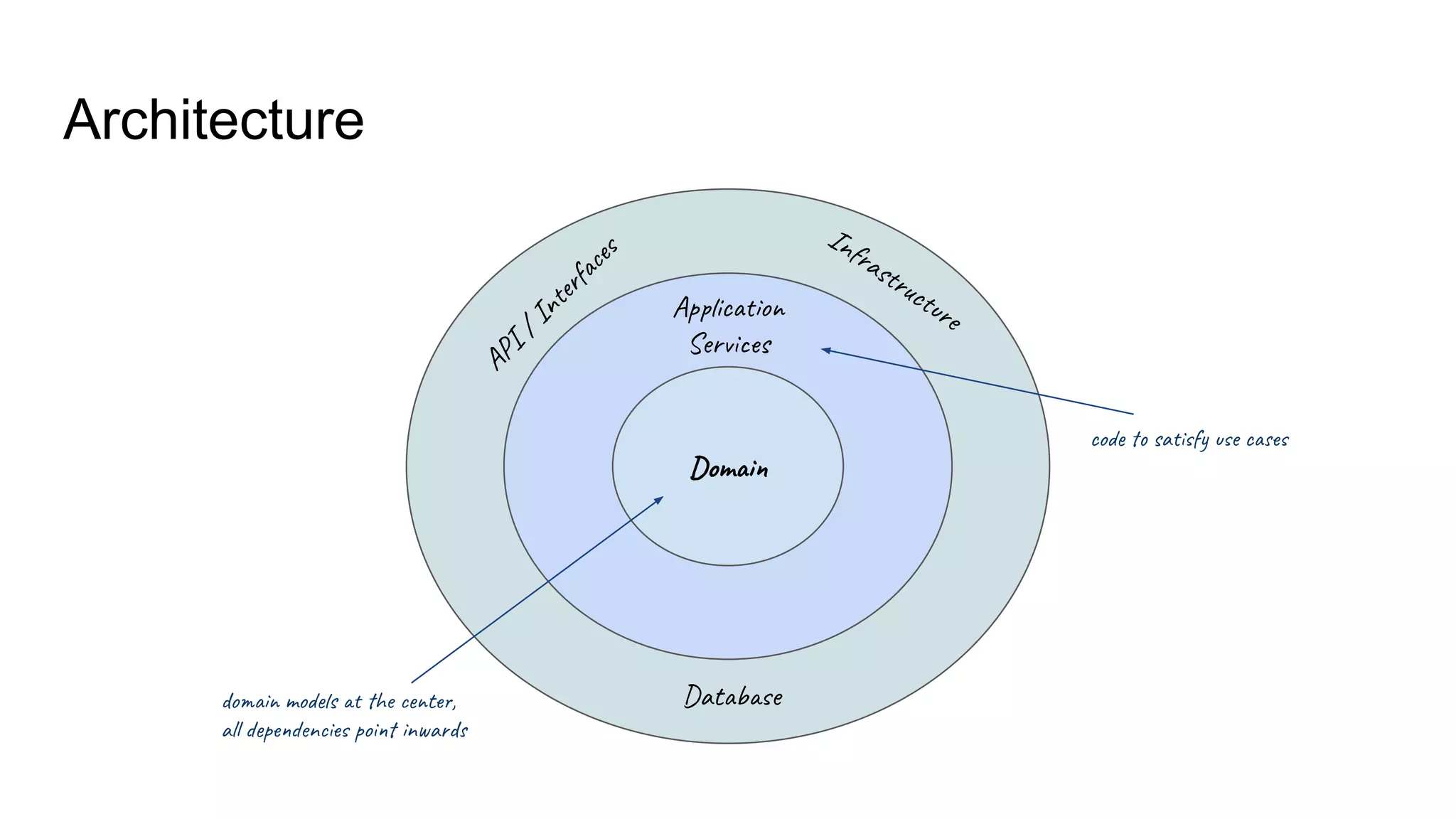
Architecture
do mo s he t ,
al p en po n a d
co sa f e c
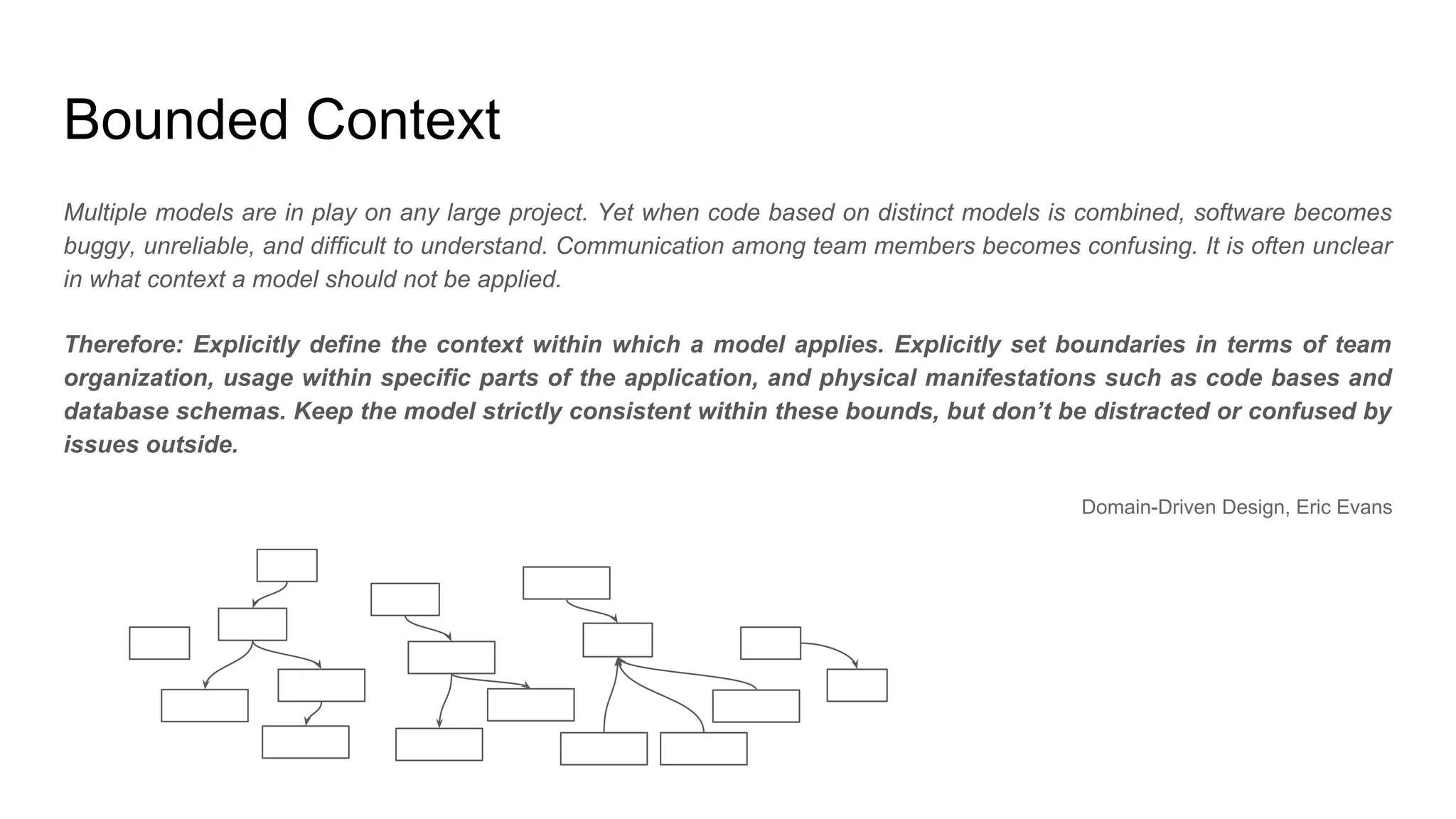
Bounded Context
Multiple models are in play on any large project. Yet when code based on distinct models is combined, software becomes
buggy, unreliable, and difficult to understand. Communication among team members becomes confusing. It is often unclear
in what context a model should not be applied.
Therefore: Explicitly define the context within which a model applies. Explicitly set boundaries in terms of team
organization, usage within specific parts of the application, and physical manifestations such as code bases and
database schemas. Keep the model strictly consistent within these bounds, but don’t be distracted or confused by
issues outside.
Domain-Driven Design, Eric Evans
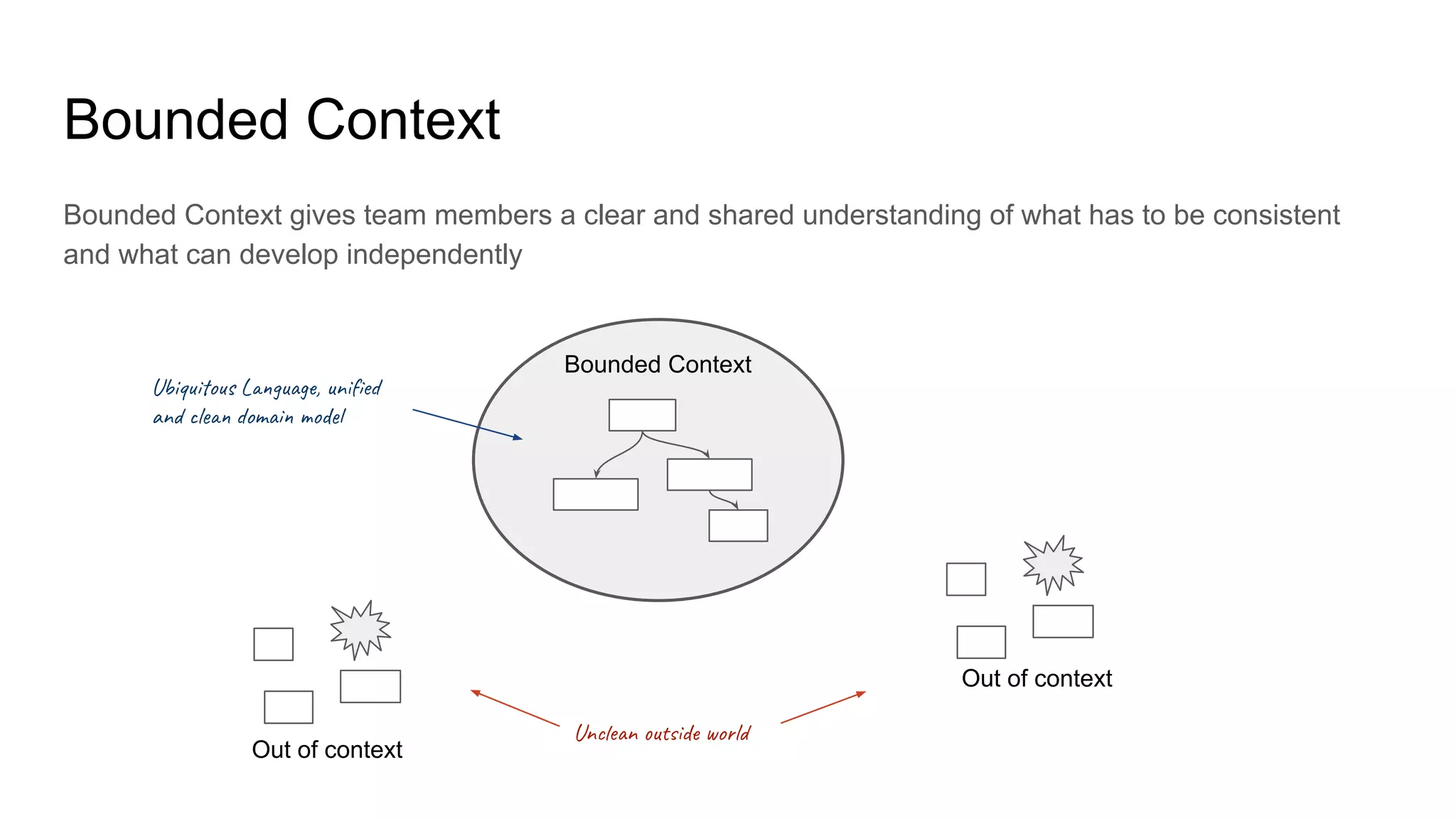
Bounded Context
Bounded Context gives team members a clear and shared understanding of what has to be consistent
and what can develop independently
Bounded Context
Out of context
Out of context
Ubi o s L u g , un e
an l om od
Un e n u d o l
Bounded Context
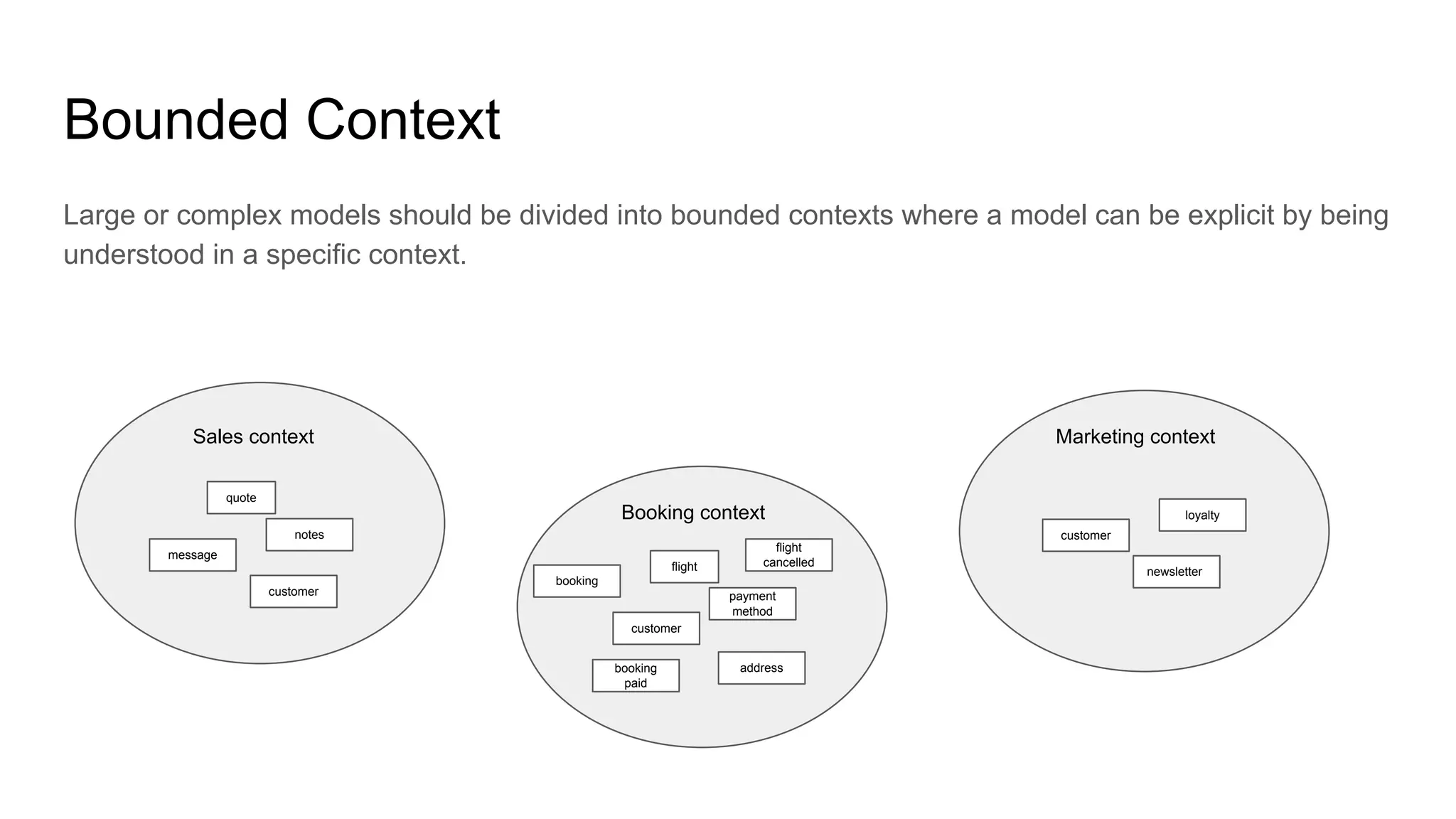
Large or complex models should be divided into bounded contexts where a model can be explicit by being
understood in a specific context.
customer
message
quote
quote
Sales context
Booking context
Marketing context
notes
customer
address
flight
payment
method
newsletter
customer
loyalty
booking
paid
flight
cancelled
booking
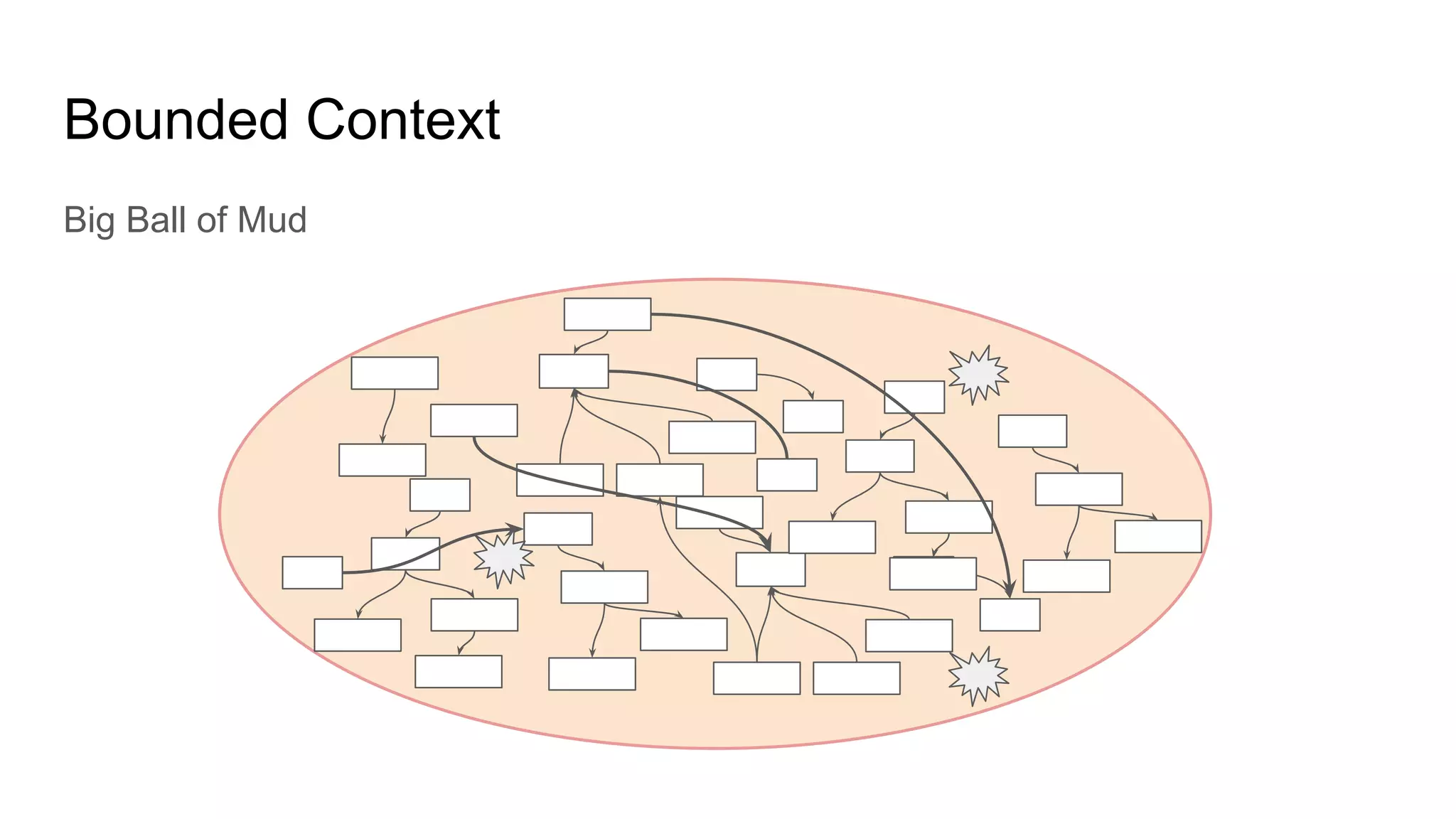
Big Ball of Mud
Bounded Context
There is no direct one to one correlation between
● Domain - Context
● Context - Module
● Context - Micro-service
Bounded Context
Context Map
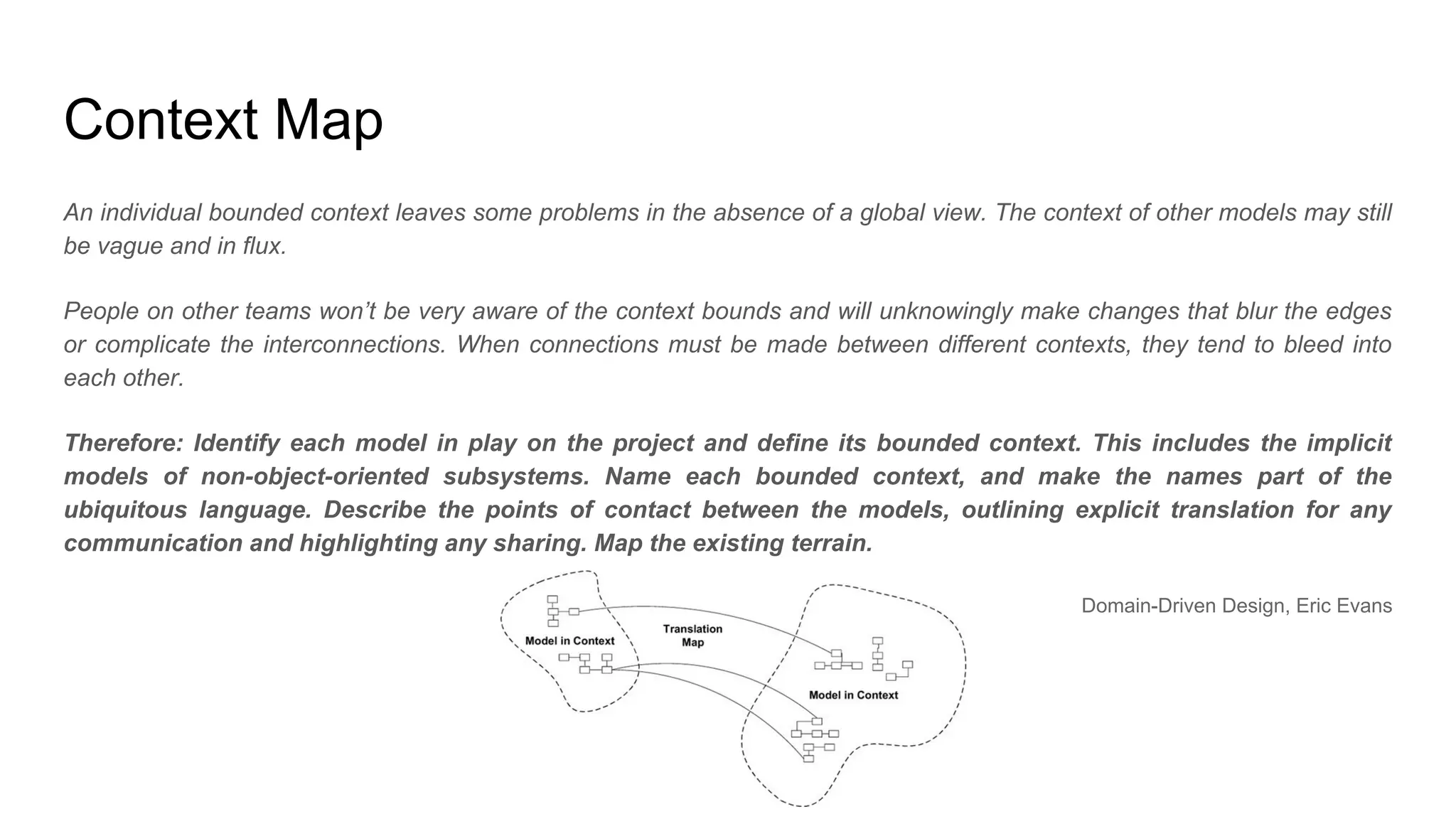
An individual bounded context leaves some problems in the absence of a global view. The context of other models may still
be vague and in flux.
People on other teams won’t be very aware of the context bounds and will unknowingly make changes that blur the edges
or complicate the interconnections. When connections must be made between different contexts, they tend to bleed into
each other.
Therefore: Identify each model in play on the project and define its bounded context. This includes the implicit
models of non-object-oriented subsystems. Name each bounded context, and make the names part of the
ubiquitous language. Describe the points of contact between the models, outlining explicit translation for any
communication and highlighting any sharing. Map the existing terrain.
Domain-Driven Design, Eric Evans
Context Map
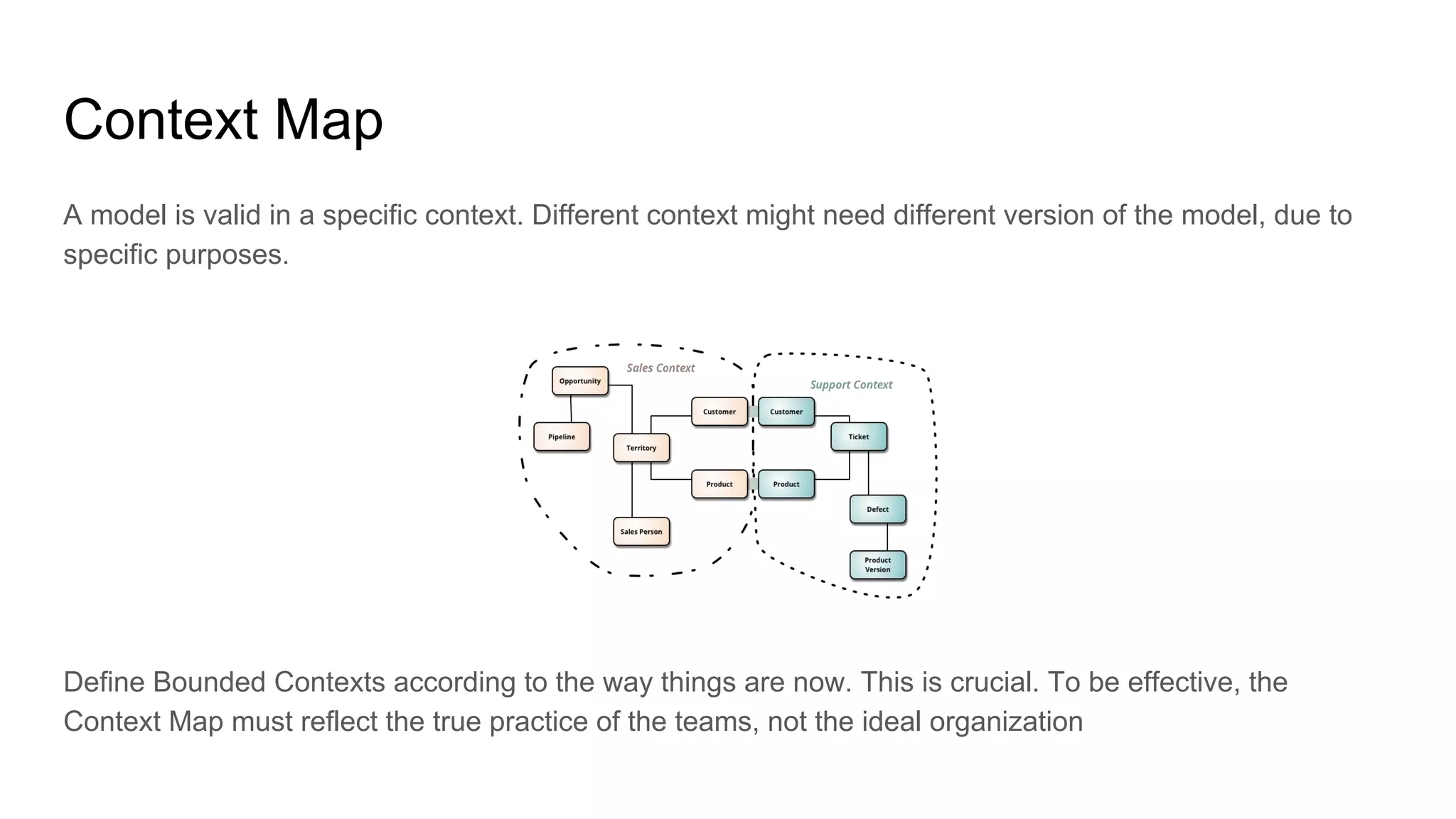
A model is valid in a specific context. Different context might need different version of the model, due to
specific purposes.
Define Bounded Contexts according to the way things are now. This is crucial. To be effective, the
Context Map must reflect the true practice of the teams, not the ideal organization
Types of Bounded Context Relationships
● Shared Kernel
● Customer / Supplier
● Conformist
● Anticorruption Layer
● Separate Ways
● Open Host Service
● Published Language
Shared Kernel
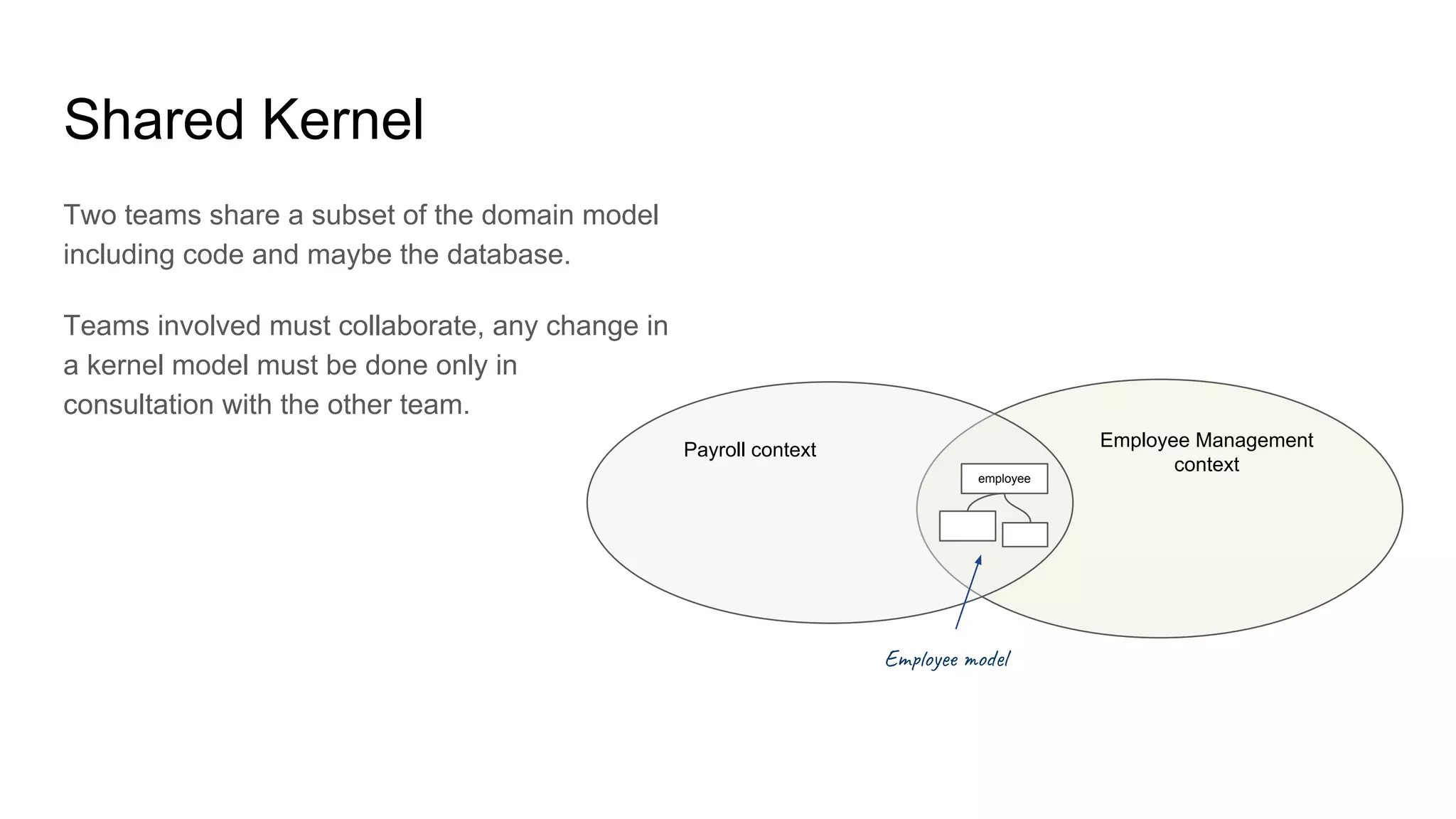
Two teams share a subset of the domain model
including code and maybe the database.
Teams involved must collaborate, any change in
a kernel model must be done only in
consultation with the other team.
Payroll context
employee
Employee Management
context
Em oy o l
Customer / Supplier
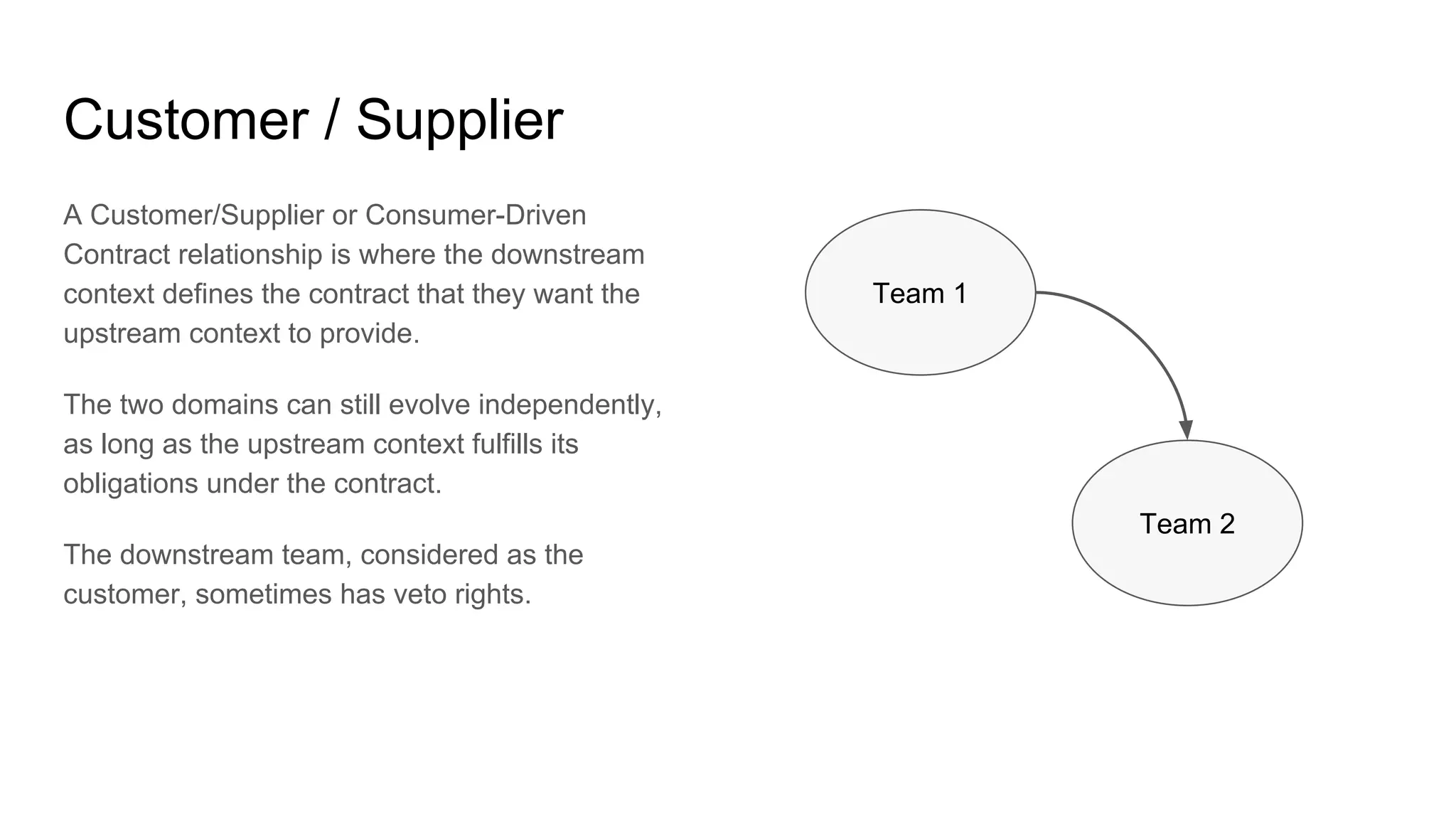
A Customer/Supplier or Consumer-Driven
Contract relationship is where the downstream
context defines the contract that they want the
upstream context to provide.
The two domains can still evolve independently,
as long as the upstream context fulfills its
obligations under the contract.
The downstream team, considered as the
customer, sometimes has veto rights.
Team 1
Team 2
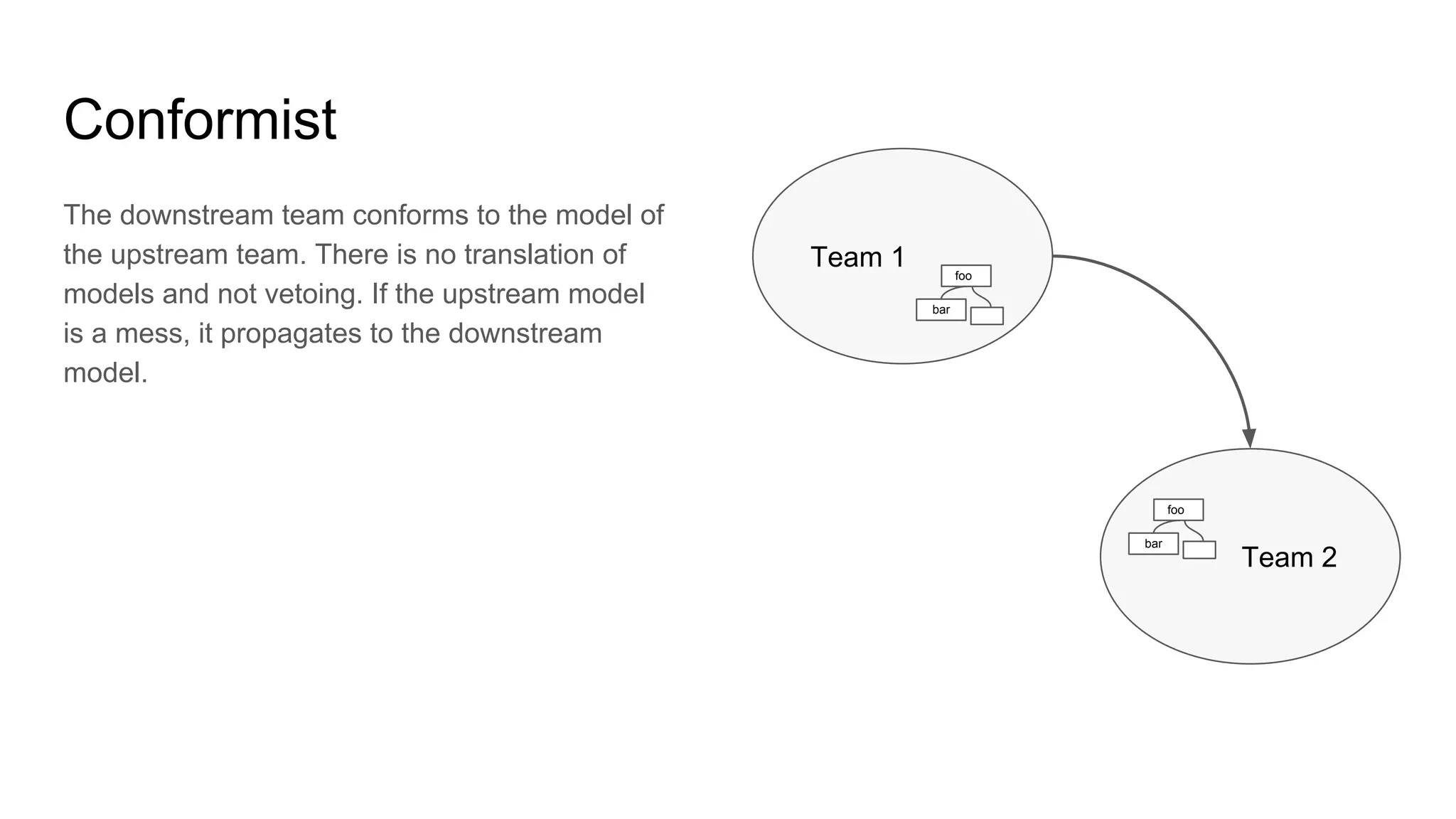
Conformist
The downstream team conforms to the model of
the upstream team. There is no translation of
models and not vetoing. If the upstream model
is a mess, it propagates to the downstream
model.
Team 1
Team 2
bar
foo
bar
foo
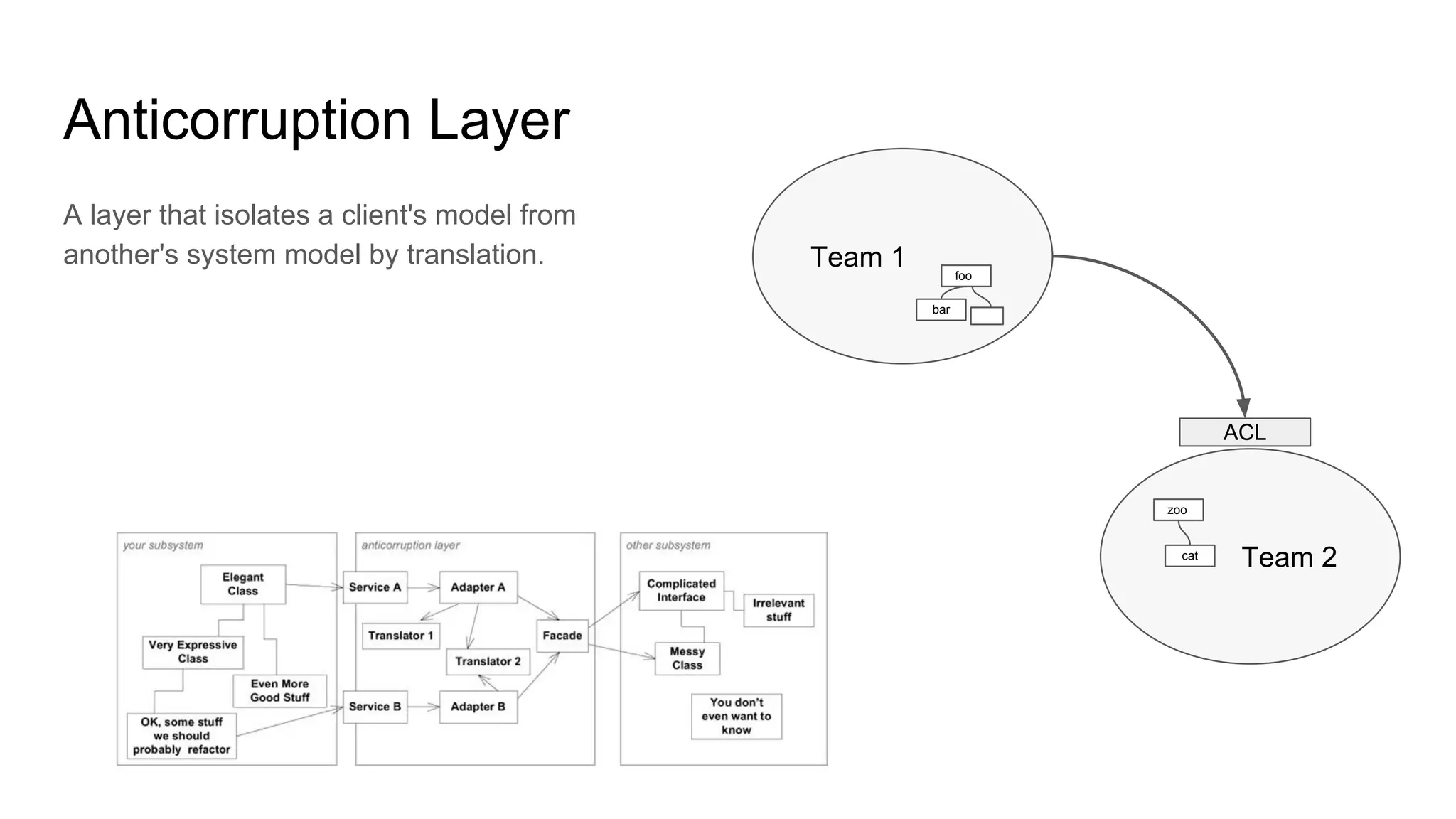
Anticorruption Layer
A layer that isolates a client's model from
another's system model by translation. Team 1
Team 2
bar
foo
cat
zoo
ACL
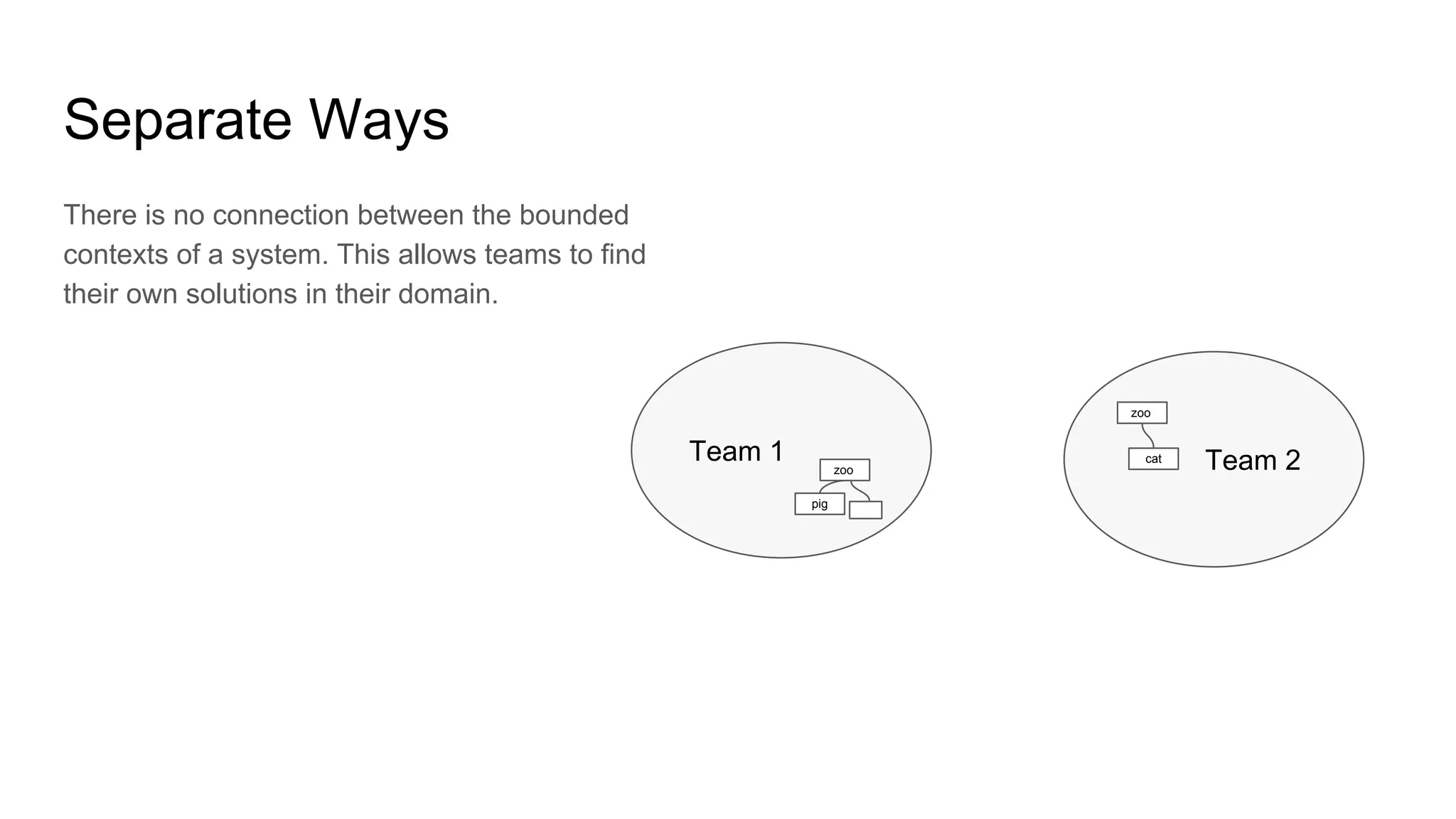
Separate Ways
There is no connection between the bounded
contexts of a system. This allows teams to find
their own solutions in their domain.
Team 1 Team 2
pig
zoo
cat
zoo
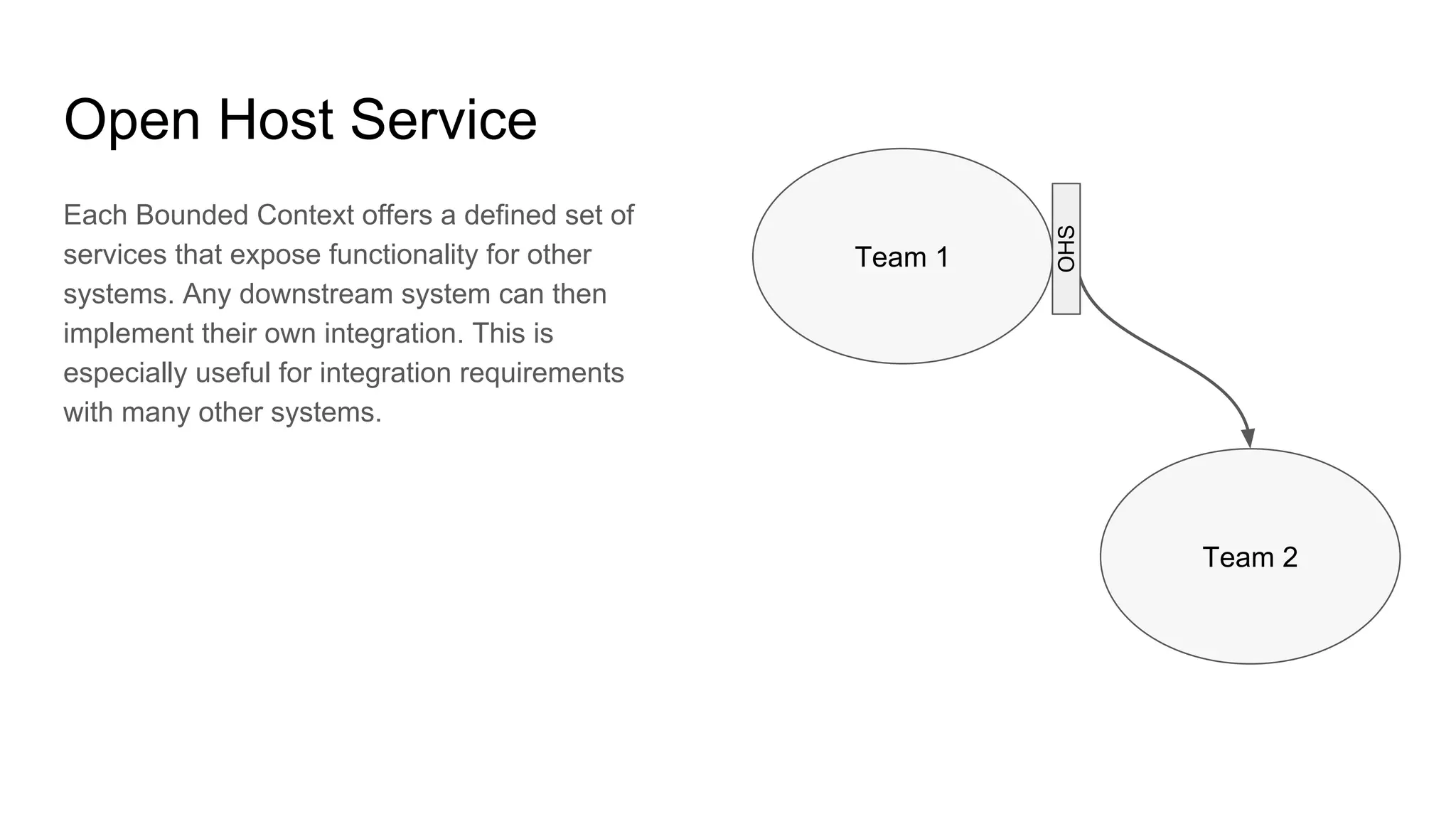
Open Host Service
Each Bounded Context offers a defined set of
services that expose functionality for other
systems. Any downstream system can then
implement their own integration. This is
especially useful for integration requirements
with many other systems.
Team 1
Team 2
OHS
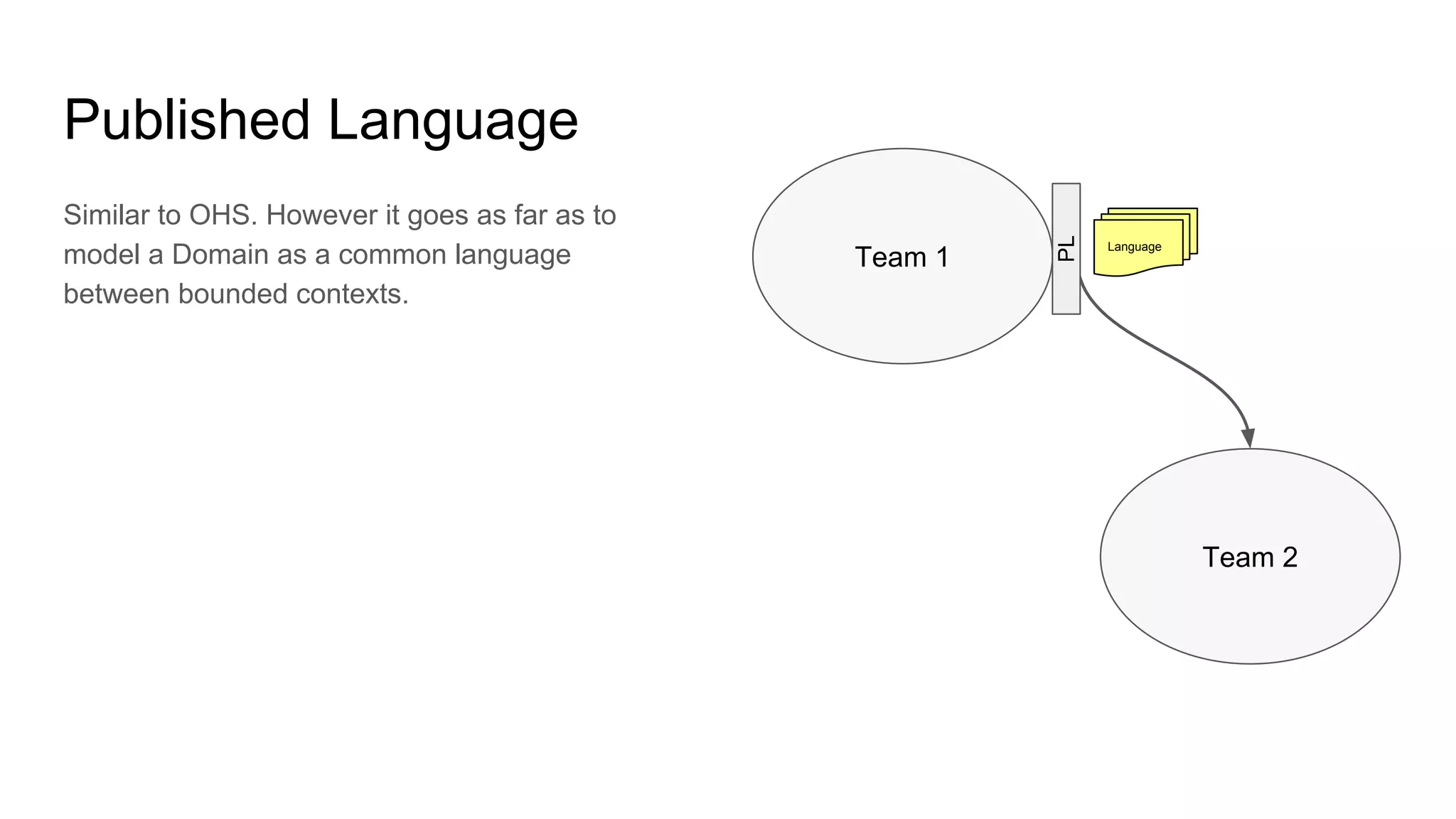
Published Language
Similar to OHS. However it goes as far as to
model a Domain as a common language
between bounded contexts.
Team 1
Team 2
PL
Language
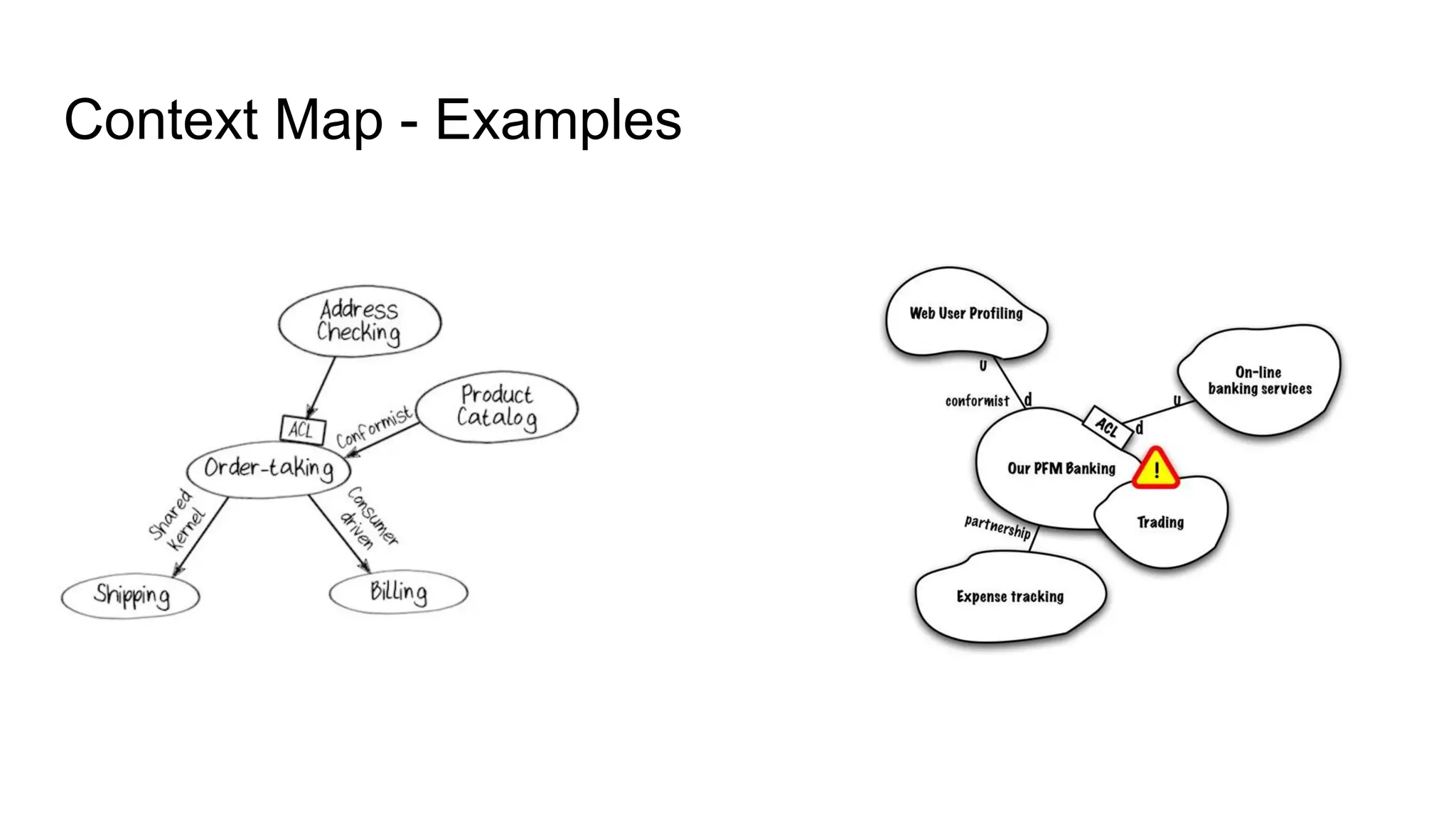
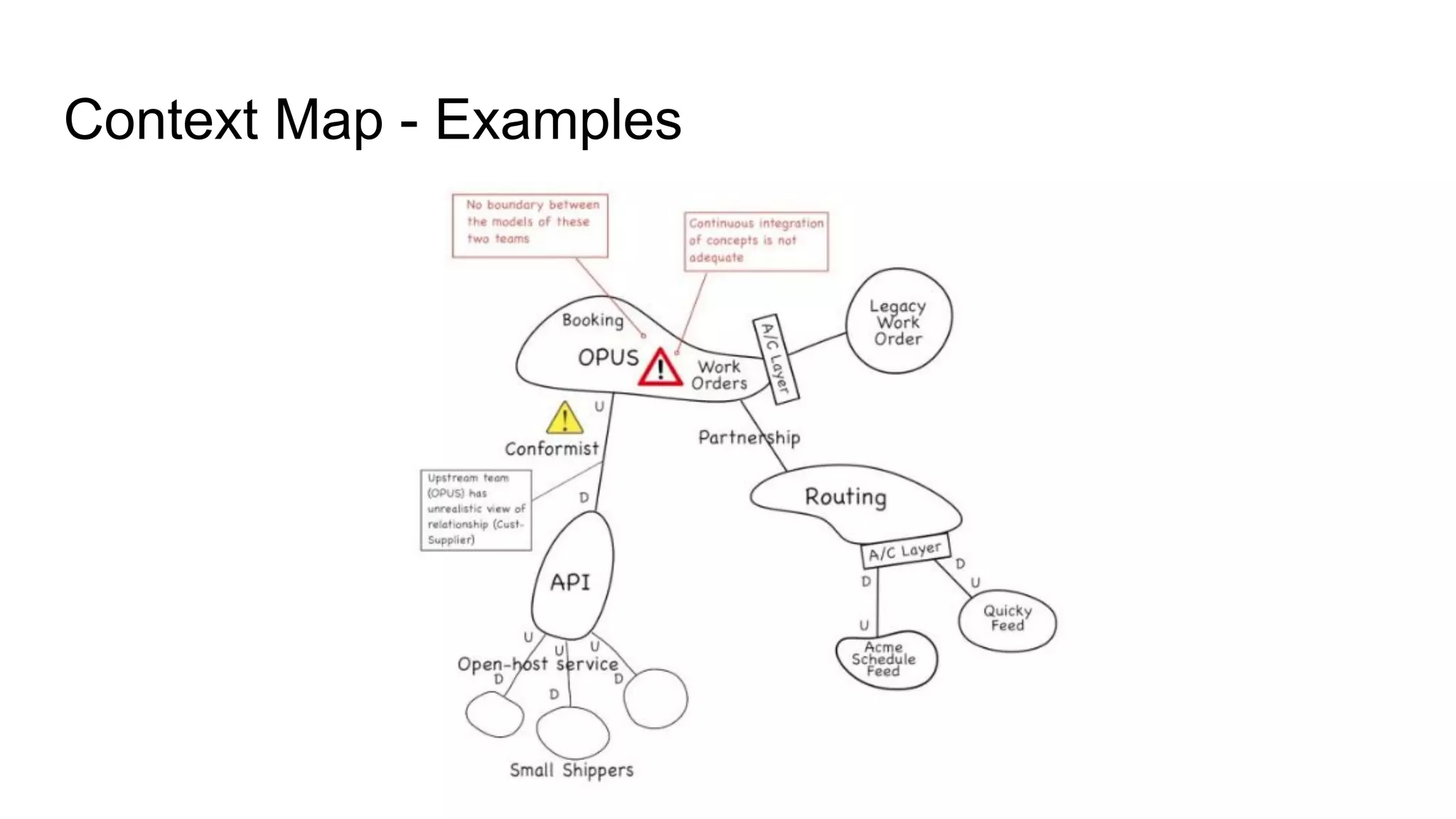
Context Map - Examples
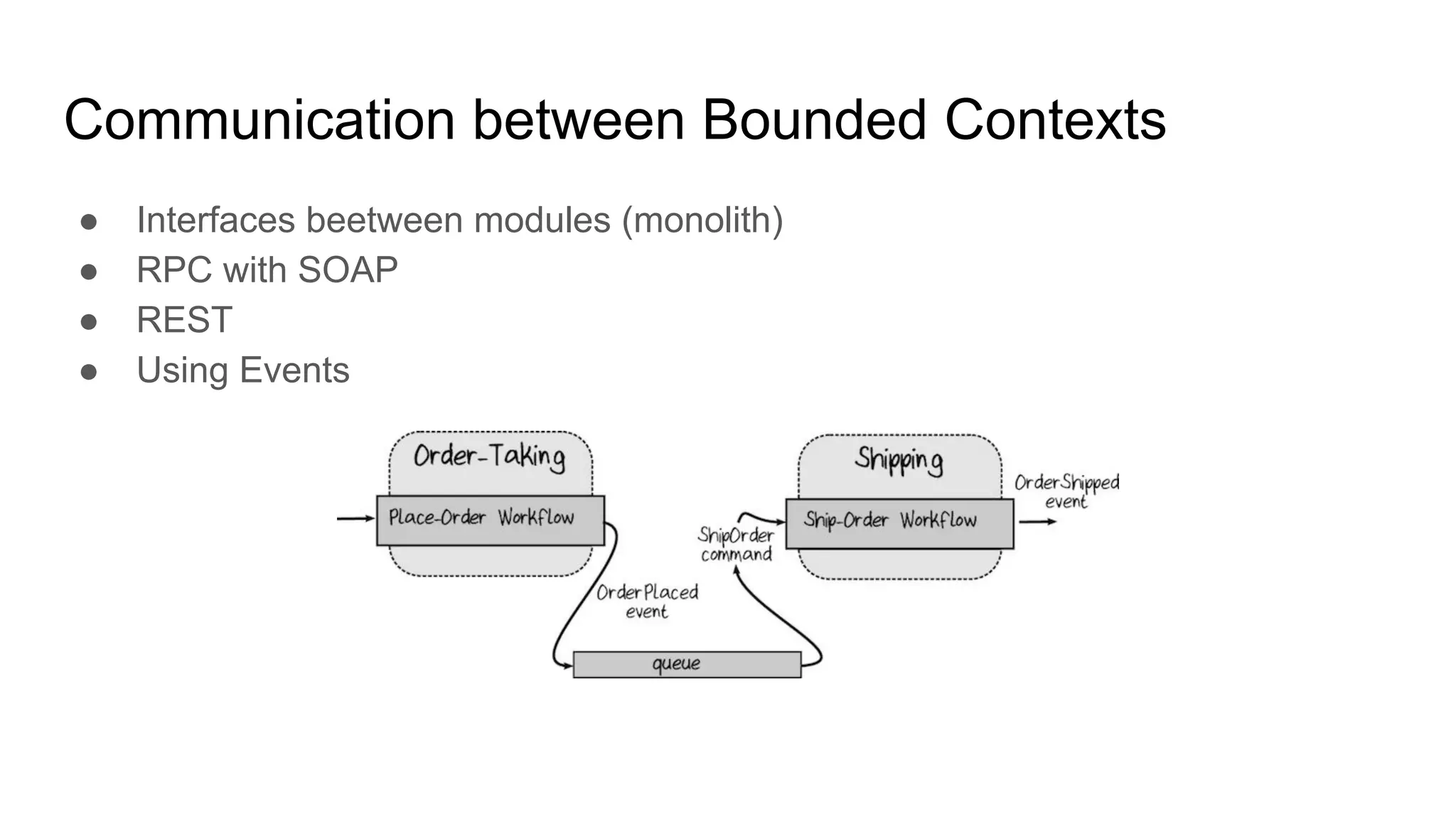
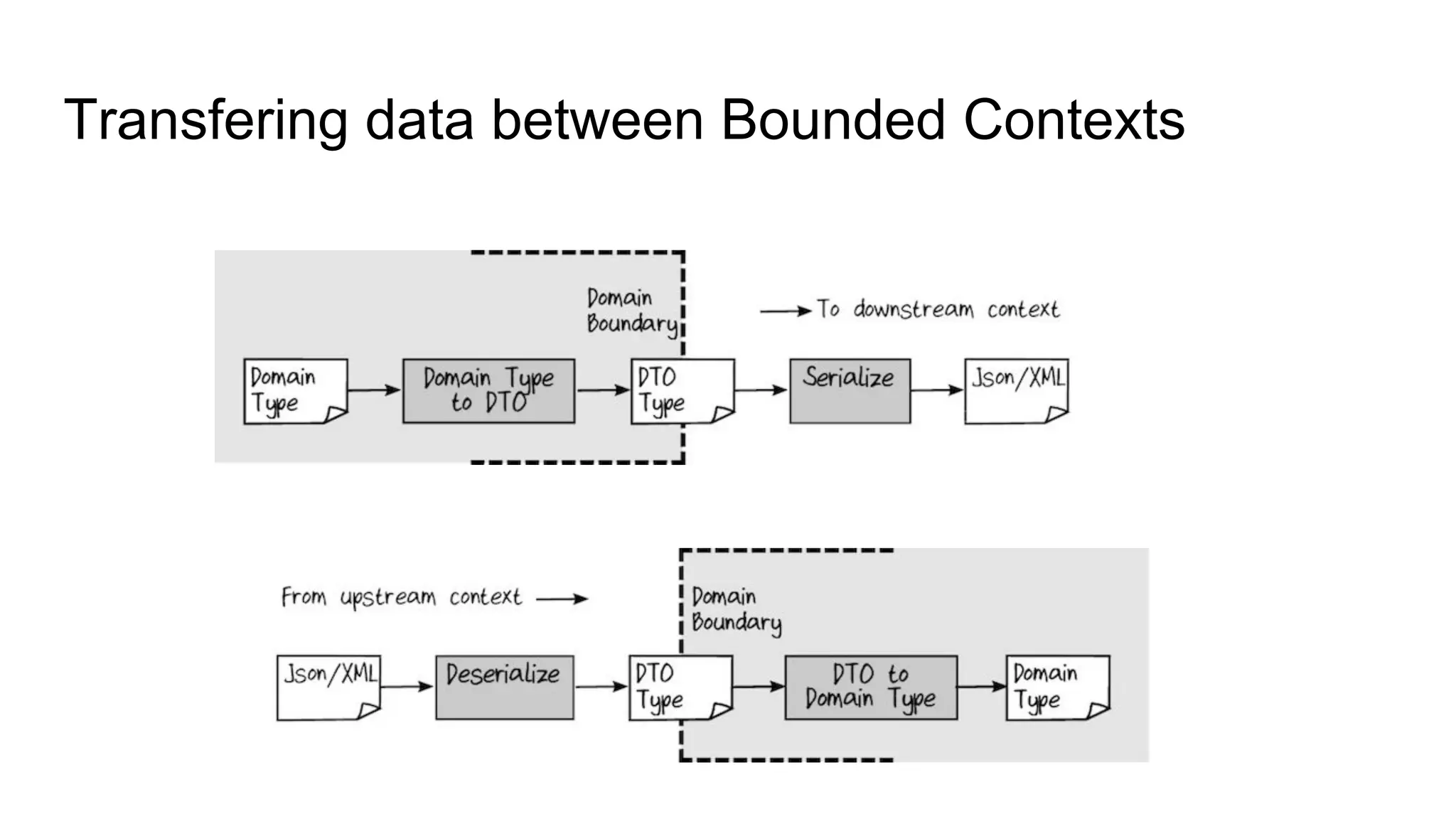
Communication between Bounded Contexts
● Interfaces beetween modules (monolith)
● RPC with SOAP
● REST
● Using Events
Transfering data between Bounded Contexts
References
● Domain-Driven Design. Eric Evans (2003).
● Domain-Driven Design Distilled. Vaughn Vernon (2016).
● Implementing Domain Driven Design. Vaughn Vernon (2013).
● The Anatomy Of Domain-Driven Design. Scott Millett and Samuel Knight.
● Domain Modeling Made Functional. Scott Wlashchin (2018).

DDD Strategic Design - Context Maps - Paulo Clavijo - April 2018

  • 1.
    DDD Strategic Design Introductionto Context Maps Paulo Clavijo - April 2018DDD Guild - GSAD Dell-EMC
  • 2.
    Domain-driven design -10000 foot view
  • 3.
    Strategic Design Ideally, itwould be preferable to have a single, unified model. While this is a noble goal, in reality it typically fragments into multiple models. It is useful to recognize this fact of life and work with it. Strategic Design is a set of principles for maintaining model integrity, distillation of the Domain Model and working with multiple models. ● Context ● Distillation ● Large-Scale Structure
  • 4.
  • 6.
    Problem Space vsSolution Space Sales domain Booking domain Marketing domain Problem Space (real world) Solution Space (domain model) design process Booking context Sales context Marketing context
  • 7.
    Dom Ap ic o Sers AP /In ef In as c e Dat e Architecture do mo s he t , al p en po n a d co sa f e c
  • 8.
    Bounded Context Multiple modelsare in play on any large project. Yet when code based on distinct models is combined, software becomes buggy, unreliable, and difficult to understand. Communication among team members becomes confusing. It is often unclear in what context a model should not be applied. Therefore: Explicitly define the context within which a model applies. Explicitly set boundaries in terms of team organization, usage within specific parts of the application, and physical manifestations such as code bases and database schemas. Keep the model strictly consistent within these bounds, but don’t be distracted or confused by issues outside. Domain-Driven Design, Eric Evans
  • 9.
    Bounded Context Bounded Contextgives team members a clear and shared understanding of what has to be consistent and what can develop independently Bounded Context Out of context Out of context Ubi o s L u g , un e an l om od Un e n u d o l
  • 10.
    Bounded Context Large orcomplex models should be divided into bounded contexts where a model can be explicit by being understood in a specific context. customer message quote quote Sales context Booking context Marketing context notes customer address flight payment method newsletter customer loyalty booking paid flight cancelled booking
  • 11.
    Big Ball ofMud Bounded Context
  • 12.
    There is nodirect one to one correlation between ● Domain - Context ● Context - Module ● Context - Micro-service Bounded Context
  • 13.
    Context Map An individualbounded context leaves some problems in the absence of a global view. The context of other models may still be vague and in flux. People on other teams won’t be very aware of the context bounds and will unknowingly make changes that blur the edges or complicate the interconnections. When connections must be made between different contexts, they tend to bleed into each other. Therefore: Identify each model in play on the project and define its bounded context. This includes the implicit models of non-object-oriented subsystems. Name each bounded context, and make the names part of the ubiquitous language. Describe the points of contact between the models, outlining explicit translation for any communication and highlighting any sharing. Map the existing terrain. Domain-Driven Design, Eric Evans
  • 14.
    Context Map A modelis valid in a specific context. Different context might need different version of the model, due to specific purposes. Define Bounded Contexts according to the way things are now. This is crucial. To be effective, the Context Map must reflect the true practice of the teams, not the ideal organization
  • 15.
    Types of BoundedContext Relationships ● Shared Kernel ● Customer / Supplier ● Conformist ● Anticorruption Layer ● Separate Ways ● Open Host Service ● Published Language
  • 16.
    Shared Kernel Two teamsshare a subset of the domain model including code and maybe the database. Teams involved must collaborate, any change in a kernel model must be done only in consultation with the other team. Payroll context employee Employee Management context Em oy o l
  • 17.
    Customer / Supplier ACustomer/Supplier or Consumer-Driven Contract relationship is where the downstream context defines the contract that they want the upstream context to provide. The two domains can still evolve independently, as long as the upstream context fulfills its obligations under the contract. The downstream team, considered as the customer, sometimes has veto rights. Team 1 Team 2
  • 18.
    Conformist The downstream teamconforms to the model of the upstream team. There is no translation of models and not vetoing. If the upstream model is a mess, it propagates to the downstream model. Team 1 Team 2 bar foo bar foo
  • 19.
    Anticorruption Layer A layerthat isolates a client's model from another's system model by translation. Team 1 Team 2 bar foo cat zoo ACL
  • 20.
    Separate Ways There isno connection between the bounded contexts of a system. This allows teams to find their own solutions in their domain. Team 1 Team 2 pig zoo cat zoo
  • 21.
    Open Host Service EachBounded Context offers a defined set of services that expose functionality for other systems. Any downstream system can then implement their own integration. This is especially useful for integration requirements with many other systems. Team 1 Team 2 OHS
  • 22.
    Published Language Similar toOHS. However it goes as far as to model a Domain as a common language between bounded contexts. Team 1 Team 2 PL Language
  • 23.
    Context Map -Examples
  • 24.
    Context Map -Examples
  • 25.
    Communication between BoundedContexts ● Interfaces beetween modules (monolith) ● RPC with SOAP ● REST ● Using Events
  • 26.
    Transfering data betweenBounded Contexts
  • 27.
    References ● Domain-Driven Design.Eric Evans (2003). ● Domain-Driven Design Distilled. Vaughn Vernon (2016). ● Implementing Domain Driven Design. Vaughn Vernon (2013). ● The Anatomy Of Domain-Driven Design. Scott Millett and Samuel Knight. ● Domain Modeling Made Functional. Scott Wlashchin (2018).