DDD Domain Relationship
Radars
Philippe Bourgau
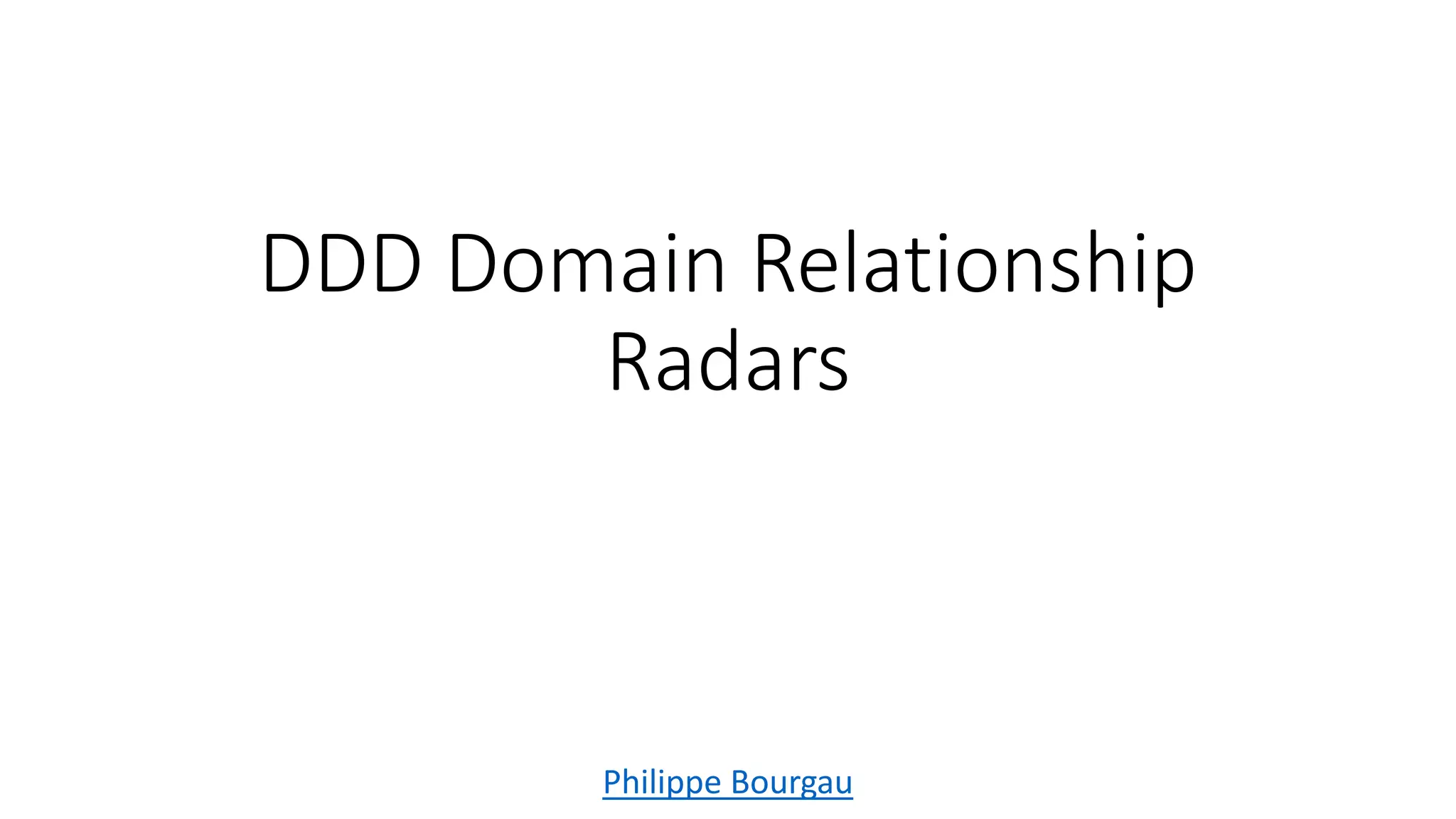
Ex : Imagine a startup building a system. It
can become large without any thought for
architecture. That’s when you get a big
ball of mud.
When you have to deal with big,
monolithic (legacy) system
• Often with large intermixed models
Big Ball of Mud
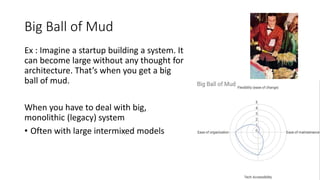
Ex : Visual Studio and Office teams and
products contain similar features, but
they are coded twice to let the 2 products
evolve independently.
Used to cut loose systems
• Integration is always expensive
• When there is little to zero interest /
benefit in integration
Separate Ways
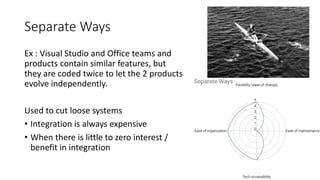
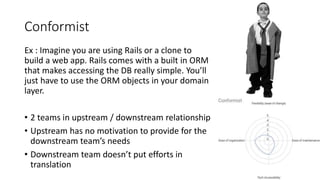
Ex : Imagine you are using Rails or a clone to
build a web app. Rails comes with a built in ORM
that makes accessing the DB really simple. You’ll
just have to use the ORM objects in your domain
layer.
• 2 teams in upstream / downstream relationship
• Upstream has no motivation to provide for the
downstream team’s needs
• Downstream team doesn’t put efforts in
translation
Conformist
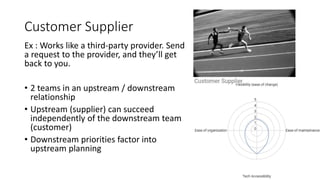
Ex : Works like a third-party provider. Send
a request to the provider, and they’ll get
back to you.
• 2 teams in an upstream / downstream
relationship
• Upstream (supplier) can succeed
independently of the downstream team
(customer)
• Downstream priorities factor into
upstream planning
Customer Supplier
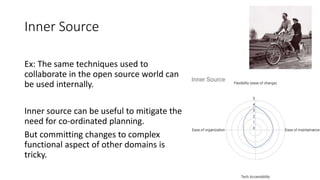
Inner Source
Ex: The same techniques used to
collaborate in the open source world can
be used internally.
Inner source can be useful to mitigate the
need for co-ordinated planning.
But committing changes to complex
functional aspect of other domains is
tricky.
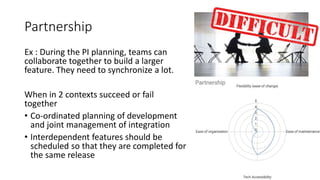
Ex : During the PI planning, teams can
collaborate together to build a larger
feature. They need to synchronize a lot.
When in 2 contexts succeed or fail
together
• Co-ordinated planning of development
and joint management of integration
• Interdependent features should be
scheduled so that they are completed for
the same release
Partnership
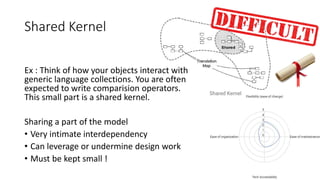
Ex : Think of how your objects interact with
generic language collections. You are often
expected to write comparision operators.
This small part is a shared kernel.
Sharing a part of the model
• Very intimate interdependency
• Can leverage or undermine design work
• Must be kept small !
Shared Kernel
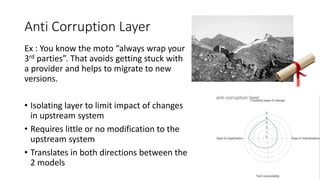
Ex : You know the moto “always wrap your
3rd parties”. That avoids getting stuck with
a provider and helps to migrate to new
versions.
• Isolating layer to limit impact of changes
in upstream system
• Requires little or no modification to the
upstream system
• Translates in both directions between the
2 models
Anti Corruption Layer
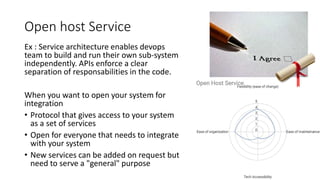
Ex : Service architecture enables devops
team to build and run their own sub-system
independently. APIs enforce a clear
separation of responsabilities in the code.
When you want to open your system for
integration
• Protocol that gives access to your system
as a set of services
• Open for everyone that needs to integrate
with your system
• New services can be added on request but
need to serve a "general" purpose
Open host Service
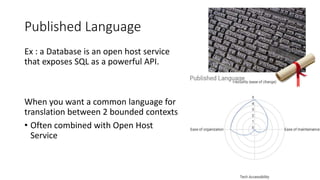
Ex : a Database is an open host service
that exposes SQL as a powerful API.
When you want a common language for
translation between 2 bounded contexts
• Often combined with Open Host
Service
Published Language
Credits, Thanks and Acknowledgments
• This was greatly inspired from Alberto Brandolini's presentation
Context Mapping in Action
• Most of the illustrations come directly from Eric Evans' Domain Driven
Design, Tackling Complexity in the Heart of Software book
• Missing illustration came from pixabay.com and from the classic Big
Ball of Mud article
• Descriptions where inspired from Stijn Volders' presentation DDD
Basics – Context Mapping
• Finally, thanks to my colleagues at Murex

DDD Domain Relationships Radars

  • 1.
  • 2.
    Ex : Imaginea startup building a system. It can become large without any thought for architecture. That’s when you get a big ball of mud. When you have to deal with big, monolithic (legacy) system • Often with large intermixed models Big Ball of Mud
  • 3.
    Ex : VisualStudio and Office teams and products contain similar features, but they are coded twice to let the 2 products evolve independently. Used to cut loose systems • Integration is always expensive • When there is little to zero interest / benefit in integration Separate Ways
  • 4.
    Ex : Imagineyou are using Rails or a clone to build a web app. Rails comes with a built in ORM that makes accessing the DB really simple. You’ll just have to use the ORM objects in your domain layer. • 2 teams in upstream / downstream relationship • Upstream has no motivation to provide for the downstream team’s needs • Downstream team doesn’t put efforts in translation Conformist
  • 5.
    Ex : Workslike a third-party provider. Send a request to the provider, and they’ll get back to you. • 2 teams in an upstream / downstream relationship • Upstream (supplier) can succeed independently of the downstream team (customer) • Downstream priorities factor into upstream planning Customer Supplier
  • 6.
    Inner Source Ex: Thesame techniques used to collaborate in the open source world can be used internally. Inner source can be useful to mitigate the need for co-ordinated planning. But committing changes to complex functional aspect of other domains is tricky.
  • 7.
    Ex : Duringthe PI planning, teams can collaborate together to build a larger feature. They need to synchronize a lot. When in 2 contexts succeed or fail together • Co-ordinated planning of development and joint management of integration • Interdependent features should be scheduled so that they are completed for the same release Partnership
  • 8.
    Ex : Thinkof how your objects interact with generic language collections. You are often expected to write comparision operators. This small part is a shared kernel. Sharing a part of the model • Very intimate interdependency • Can leverage or undermine design work • Must be kept small ! Shared Kernel
  • 9.
    Ex : Youknow the moto “always wrap your 3rd parties”. That avoids getting stuck with a provider and helps to migrate to new versions. • Isolating layer to limit impact of changes in upstream system • Requires little or no modification to the upstream system • Translates in both directions between the 2 models Anti Corruption Layer
  • 10.
    Ex : Servicearchitecture enables devops team to build and run their own sub-system independently. APIs enforce a clear separation of responsabilities in the code. When you want to open your system for integration • Protocol that gives access to your system as a set of services • Open for everyone that needs to integrate with your system • New services can be added on request but need to serve a "general" purpose Open host Service
  • 11.
    Ex : aDatabase is an open host service that exposes SQL as a powerful API. When you want a common language for translation between 2 bounded contexts • Often combined with Open Host Service Published Language
  • 12.
    Credits, Thanks andAcknowledgments • This was greatly inspired from Alberto Brandolini's presentation Context Mapping in Action • Most of the illustrations come directly from Eric Evans' Domain Driven Design, Tackling Complexity in the Heart of Software book • Missing illustration came from pixabay.com and from the classic Big Ball of Mud article • Descriptions where inspired from Stijn Volders' presentation DDD Basics – Context Mapping • Finally, thanks to my colleagues at Murex