i


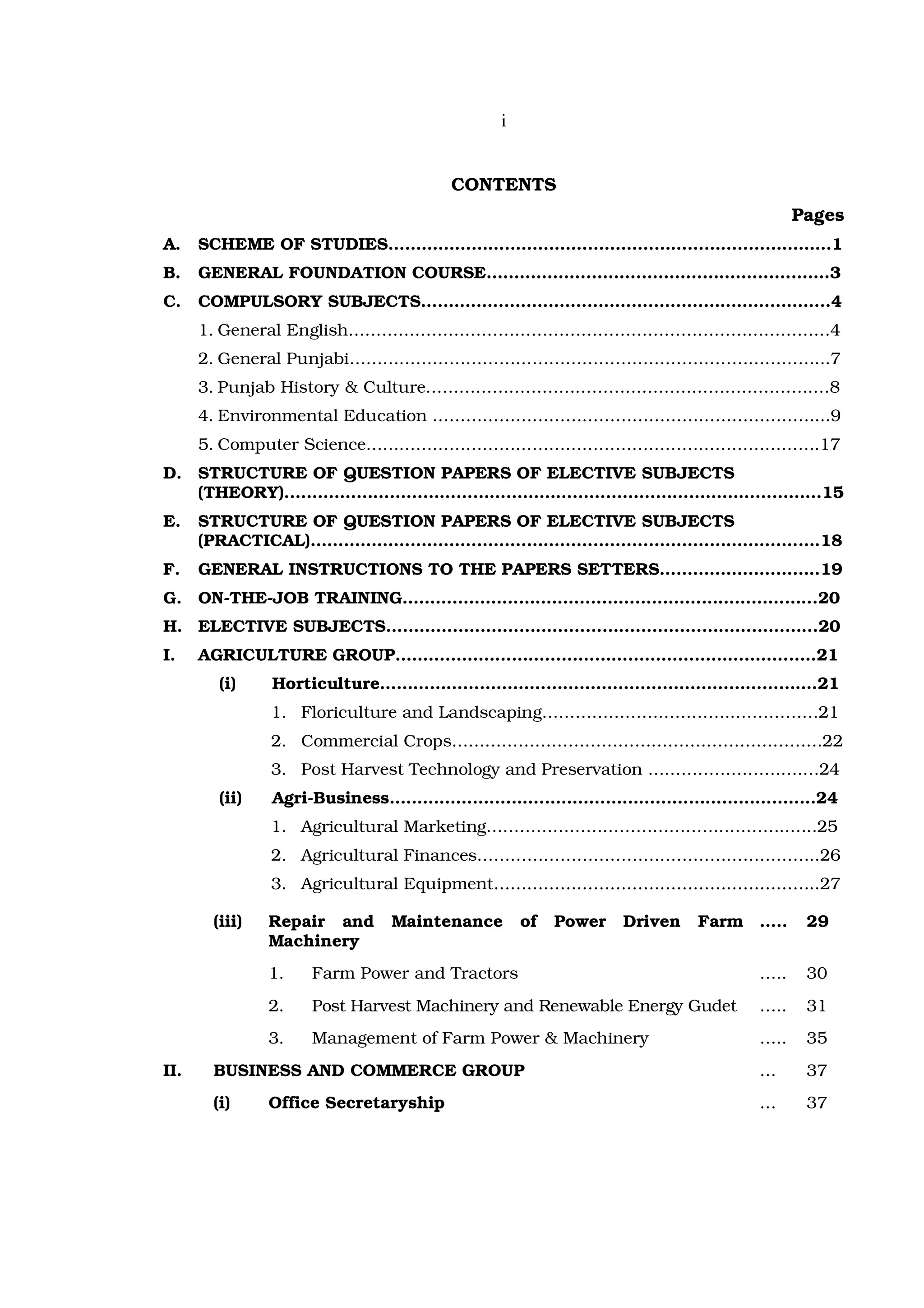
                                      CONTENTS
                                                                               Pages
A.    SCHEME OF STUDIES……………………………………………………..………………1
B.    GENERAL FOUNDATION COURSE……………………………………………….…….3
C.    COMPULSORY SUBJECTS………………………………………………………………..4
      1. General English……………………………………………………………………………4
      2. General Punjabi…………………………………………………………………………...7
      3. Punjab History & Culture…………………………………………………………….…8
      4. Environmental Education ……………………………………………………………...9
      5. Computer Science……………………………………………………………………….17
D. STRUCTURE OF QUESTION PAPERS OF ELECTIVE SUBJECTS
   (THEORY).…………………………………………………………………………………...15
E.    STRUCTURE OF QUESTION PAPERS OF ELECTIVE SUBJECTS
      (PRACTICAL)…………………………………………………………………………….….18
F.    GENERAL INSTRUCTIONS TO THE PAPERS SETTERS………………………..19
G. ON-THE-JOB TRAINING………………………………………………………………...20
H. ELECTIVE SUBJECTS…………………………………………………………………...20
I.    AGRICULTURE GROUP……………………………………………………………..…..21
        (i)    Horticulture…………………………………………………………………….21
               1. Floriculture and Landscaping……………………………..……………21
               2. Commercial Crops……………………………………….…………………22
               3. Post Harvest Technology and Preservation ……………………….…24
        (ii)   Agri-Business…………………………………………………………………..24
               1. Agricultural Marketing……………………………………..………..…..25
               2. Agricultural Finances……………………………………………………..26
               3. Agricultural Equipment…………………………………………………..27

       (iii)   Repair and    Maintenance      of   Power   Driven   Farm …..    29
               Machinery
               1.   Farm Power and Tractors                              …..    30
               2.   Post Harvest Machinery and Renewable Energy Gudet    …..    31
               3.   Management of Farm Power & Machinery                 …..    35
II.    BUSINESS AND COMMERCE GROUP                                       …      37
       (i)     Office Secretaryship                                      …      37
ii


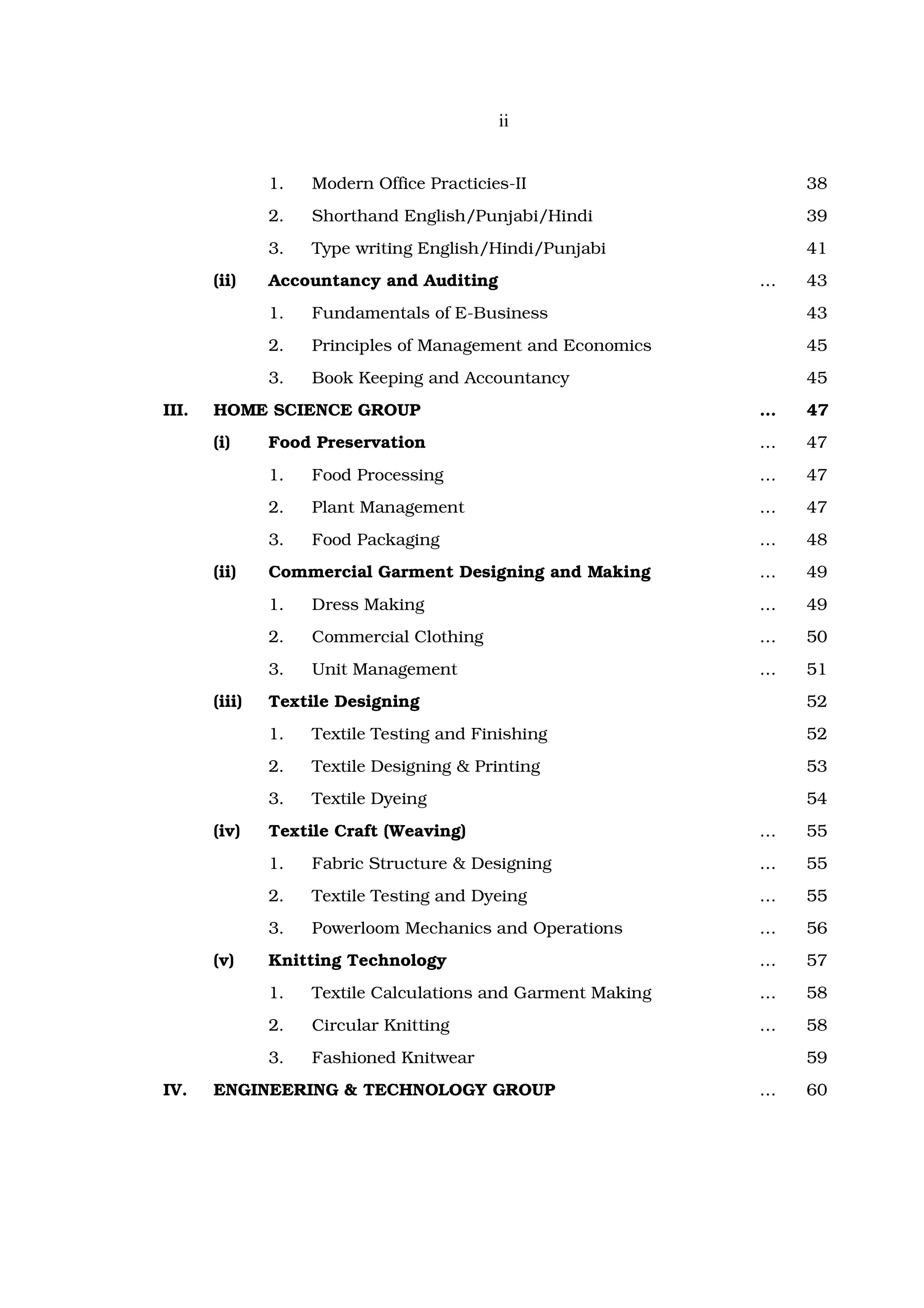
               1.   Modern Office Practicies-II                   38
               2.   Shorthand English/Punjabi/Hindi               39
               3.   Type writing English/Hindi/Punjabi            41
       (ii)    Accountancy and Auditing                       …   43
               1.   Fundamentals of E-Business                    43
               2.   Principles of Management and Economics        45
               3.   Book Keeping and Accountancy                  45
III.   HOME SCIENCE GROUP                                     …   47
       (i)     Food Preservation                              …   47
               1.   Food Processing                           …   47
               2.   Plant Management                          …   47
               3.   Food Packaging                            …   48
       (ii)    Commercial Garment Designing and Making        …   49
               1.   Dress Making                              …   49
               2.   Commercial Clothing                       …   50
               3.   Unit Management                           …   51
       (iii)   Textile Designing                                  52
               1.   Textile Testing and Finishing                 52
               2.   Textile Designing & Printing                  53
               3.   Textile Dyeing                                54
       (iv)    Textile Craft (Weaving)                        …   55
               1.   Fabric Structure & Designing              …   55
               2.   Textile Testing and Dyeing                …   55
               3.   Powerloom Mechanics and Operations        …   56
       (v)     Knitting Technology                            …   57
               1.   Textile Calculations and Garment Making   …   58
               2.   Circular Knitting                         …   58
               3.   Fashioned Knitwear                            59
IV.    ENGINEERING & TECHNOLOGY GROUP                         …   60
iii


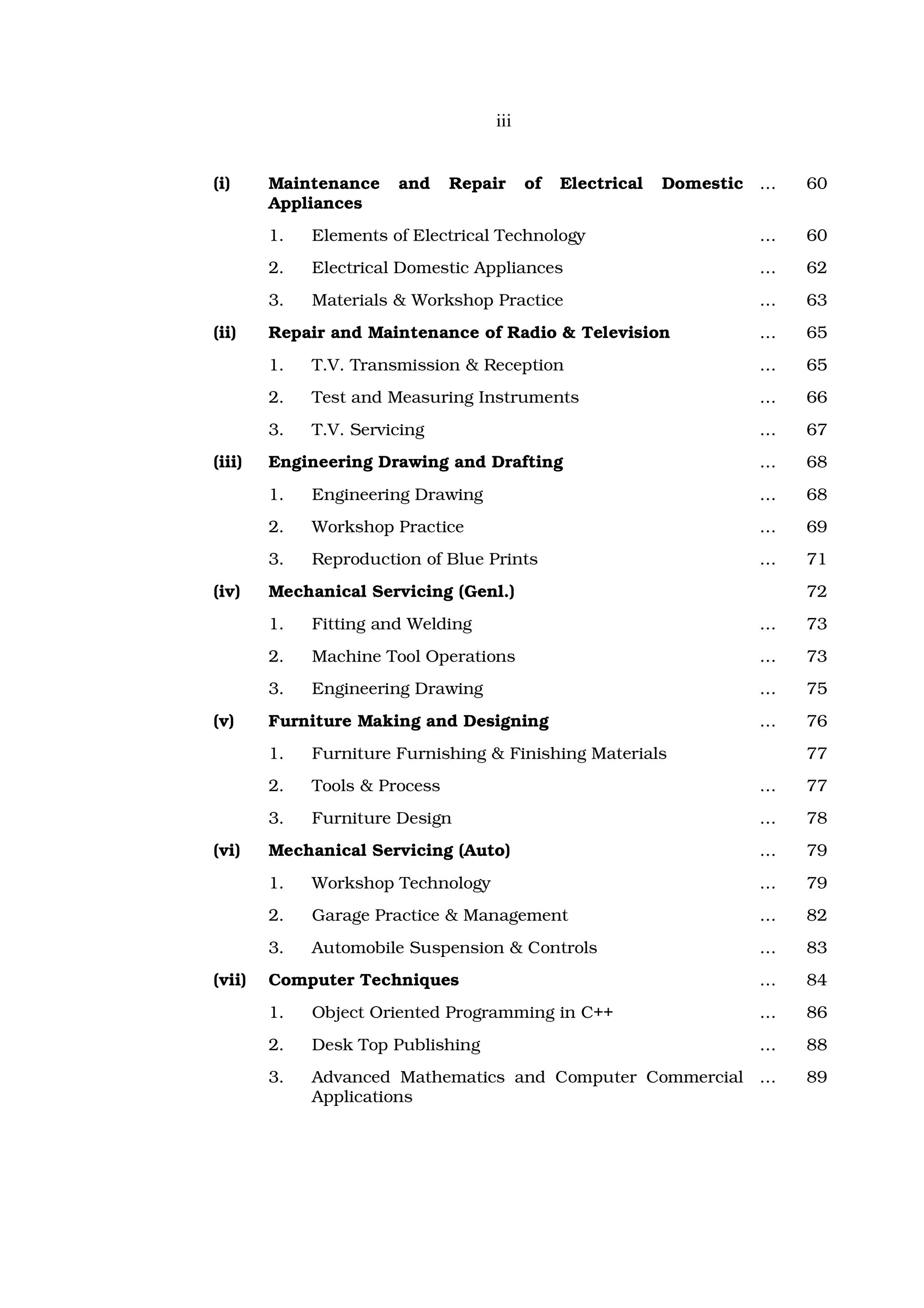
(i)     Maintenance    and     Repair    of   Electrical   Domestic …   60
        Appliances
        1.   Elements of Electrical Technology                     …    60
        2.   Electrical Domestic Appliances                        …    62
        3.   Materials & Workshop Practice                         …    63
(ii)    Repair and Maintenance of Radio & Television               …    65
        1.   T.V. Transmission & Reception                         …    65
        2.   Test and Measuring Instruments                        …    66
        3.   T.V. Servicing                                        …    67
(iii)   Engineering Drawing and Drafting                           …    68
        1.   Engineering Drawing                                   …    68
        2.   Workshop Practice                                     …    69
        3.   Reproduction of Blue Prints                           …    71
(iv)    Mechanical Servicing (Genl.)                                    72
        1.   Fitting and Welding                                   …    73
        2.   Machine Tool Operations                               …    73
        3.   Engineering Drawing                                   …    75
(v)     Furniture Making and Designing                             …    76
        1.   Furniture Furnishing & Finishing Materials                 77
        2.   Tools & Process                                       …    77
        3.   Furniture Design                                      …    78
(vi)    Mechanical Servicing (Auto)                                …    79
        1.   Workshop Technology                                   …    79
        2.   Garage Practice & Management                          …    82
        3.   Automobile Suspension & Controls                      …    83
(vii)   Computer Techniques                                        …    84
        1.   Object Oriented Programming in C++                    …    86
        2.   Desk Top Publishing                                   …    88
        3.   Advanced Mathematics and Computer Commercial …             89
             Applications
iv


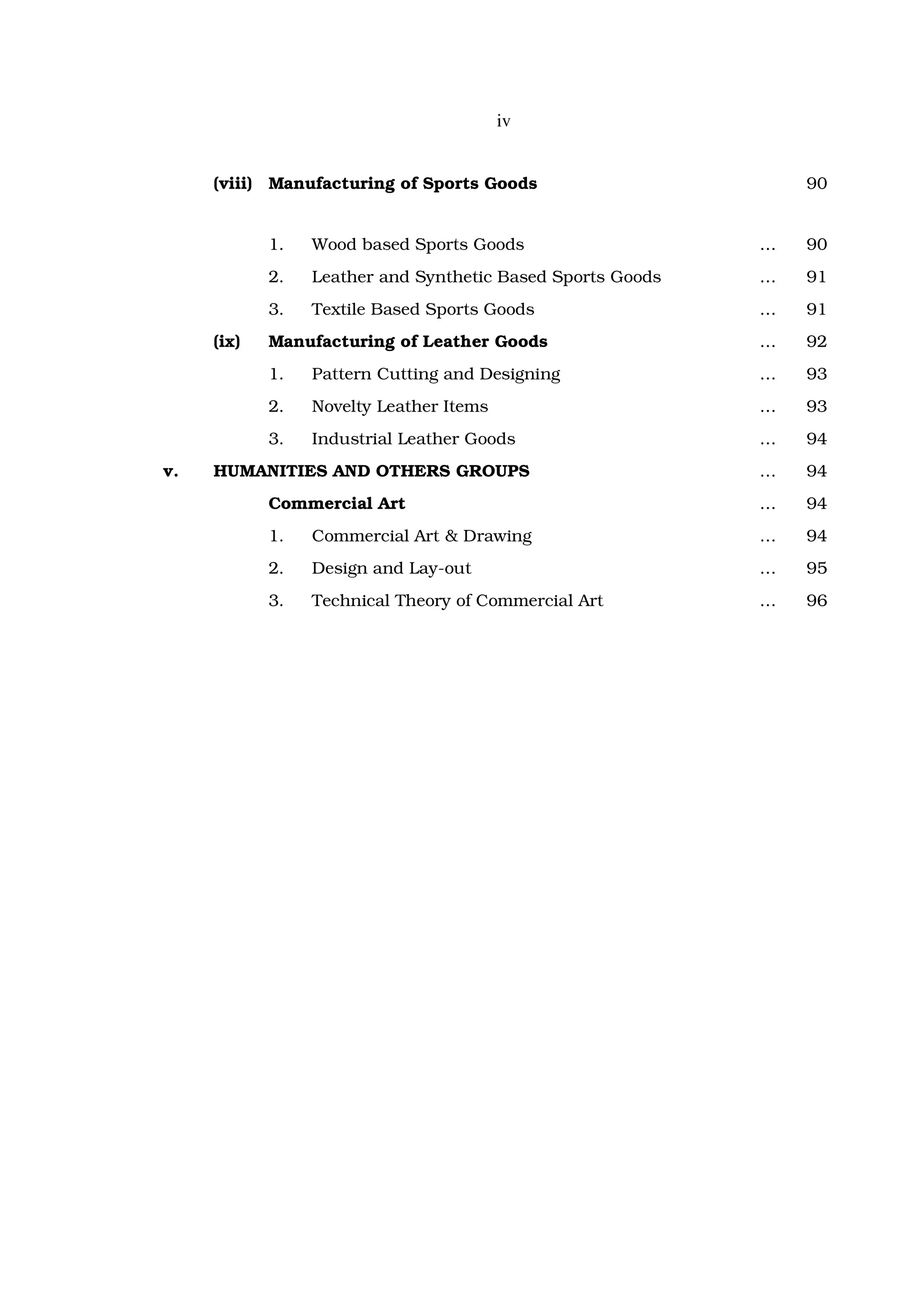
     (viii) Manufacturing of Sports Goods                       90


            1.   Wood based Sports Goods                    …   90
            2.   Leather and Synthetic Based Sports Goods   …   91
            3.   Textile Based Sports Goods                 …   91
     (ix)   Manufacturing of Leather Goods                  …   92
            1.   Pattern Cutting and Designing              …   93
            2.   Novelty Leather Items                      …   93
            3.   Industrial Leather Goods                   …   94
v.   HUMANITIES AND OTHERS GROUPS                           …   94
            Commercial Art                                  …   94
            1.   Commercial Art & Drawing                   …   94
            2.   Design and Lay-out                         …   95
            3.   Technical Theory of Commercial Art         …   96
1


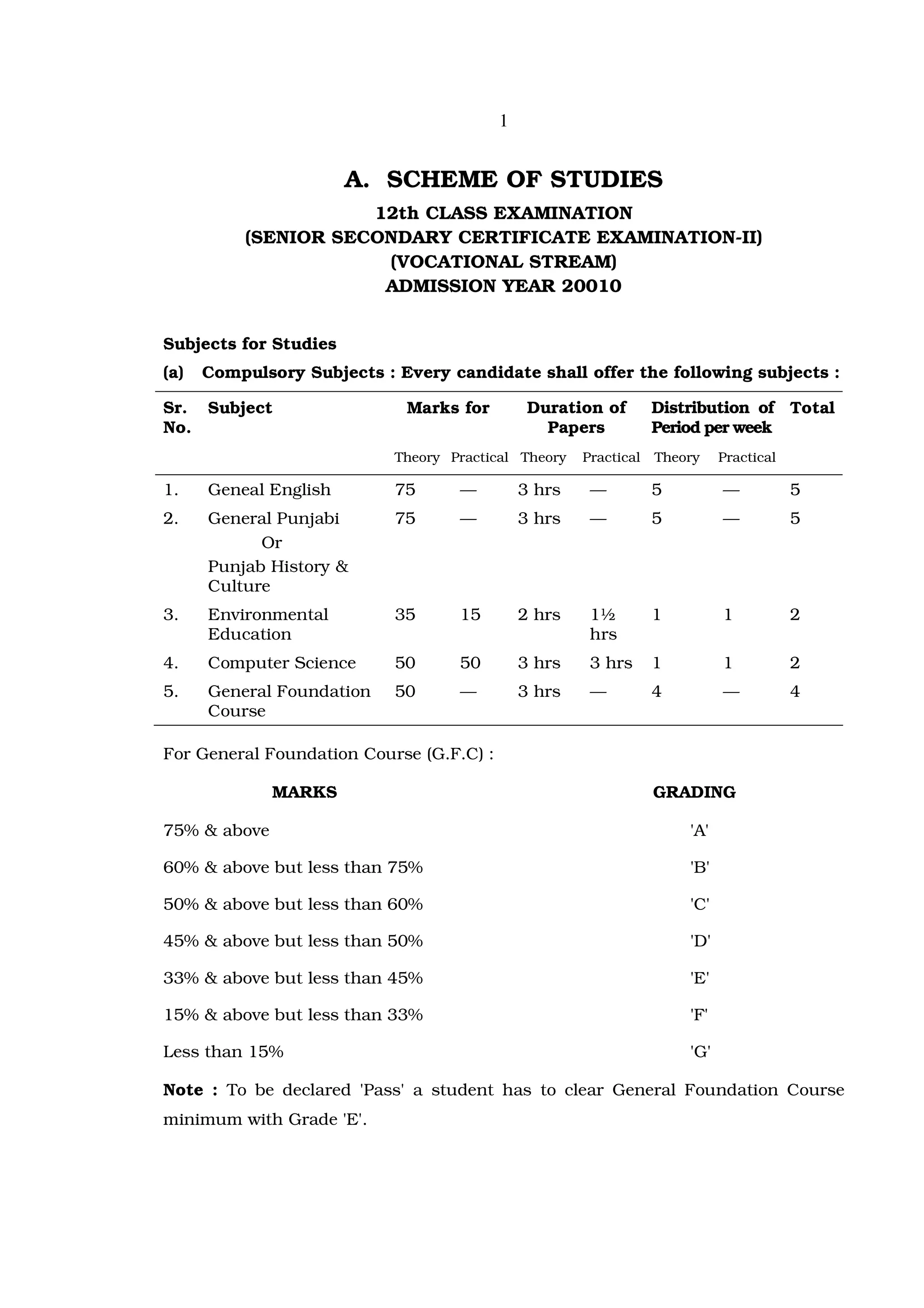
                       A. SCHEME OF STUDIES
                      12th CLASS EXAMINATION
           (SENIOR SECONDARY CERTIFICATE EXAMINATION-II)
                       (VOCATIONAL STREAM)
                       ADMISSION YEAR 20010


Subjects for Studies
(a)   Compulsory Subjects : Every candidate shall offer the following subjects :

Sr. Subject                  Marks for         Duration of        Distribution of Total
No.                                              Papers           Period per week
                            Theory Practical Theory   Practical   Theory    Practical

1.    Geneal English        75      —         3 hrs    —          5         —           5
2.    General Punjabi       75      —         3 hrs    —          5         —           5
            Or
      Punjab History &
      Culture
3.    Environmental         35      15        2 hrs    1½         1         1           2
      Education                                        hrs
4.    Computer Science      50      50        3 hrs    3 hrs      1         1           2
5.    General Foundation    50      —         3 hrs    —          4         —           4
      Course

For General Foundation Course (G.F.C) :

              MARKS                                               GRADING

75% & above                                                           'A'

60% & above but less than 75%                                         'B'

50% & above but less than 60%                                         'C'

45% & above but less than 50%                                         'D'

33% & above but less than 45%                                         'E'

15% & above but less than 33%                                         'F'

Less than 15%                                                         'G'

Note : To be declared 'Pass' a student has to clear General Foundation Course
minimum with Grade 'E'.
2

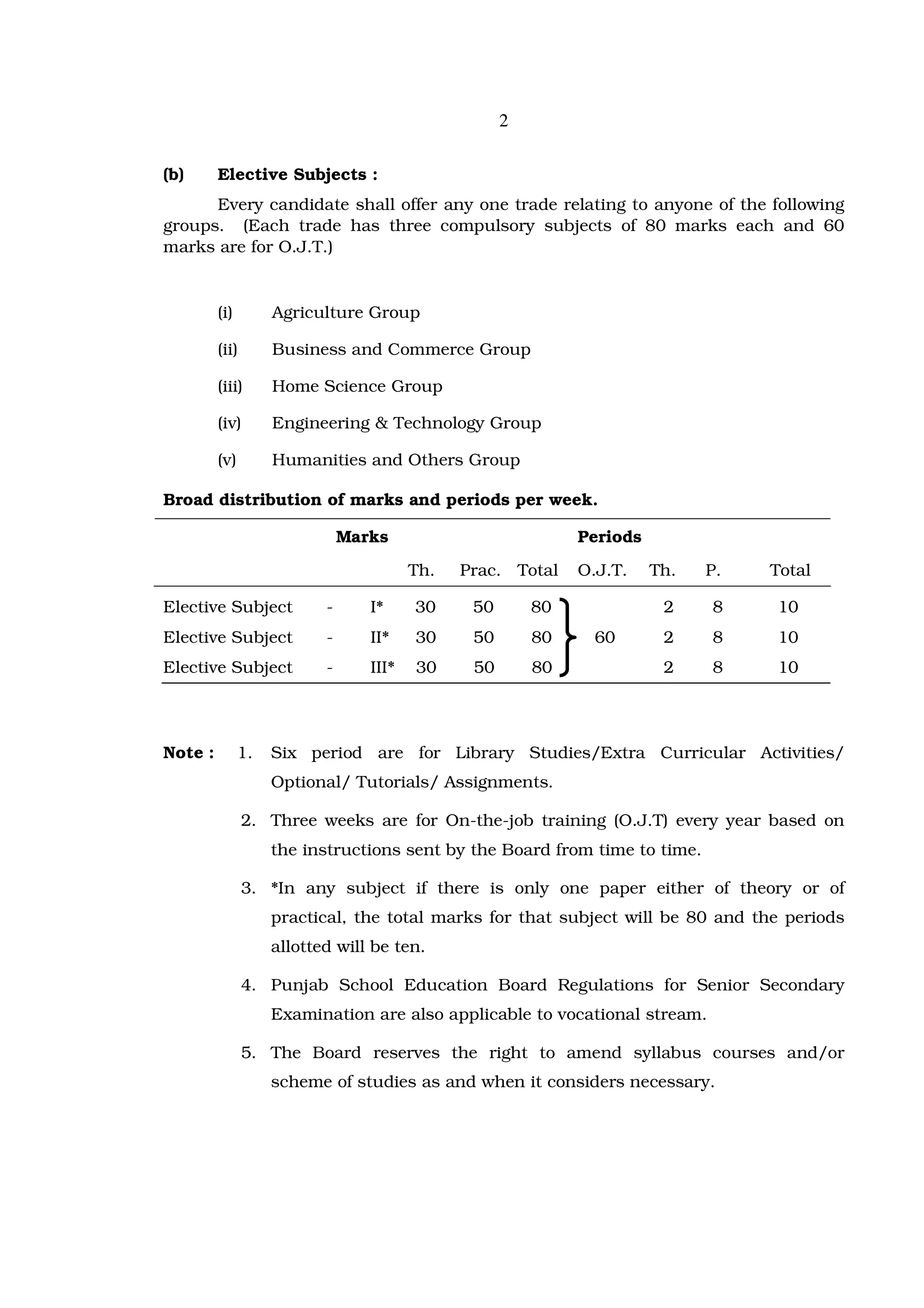
(b)      Elective Subjects :
      Every candidate shall offer any one trade relating to anyone of the following
groups. (Each trade has three compulsory subjects of 80 marks each and 60
marks are for O.J.T.)


         (i)        Agriculture Group

         (ii)       Business and Commerce Group

         (iii)      Home Science Group

         (iv)       Engineering & Technology Group

         (v)        Humanities and Others Group

Broad distribution of marks and periods per week.

                               Marks                          Periods
                                         Th.   Prac. Total    O.J.T.    Th.   P.   Total

Elective Subject           -      I*     30     50       80              2    8    10
Elective Subject           -      II*    30     50       80     60       2    8    10
Elective Subject           -      III*   30     50       80              2    8    10


Note :         1.   Six period are for Library Studies/Extra Curricular Activities/
                    Optional/ Tutorials/ Assignments.

                2. Three weeks are for On-the-job training (O.J.T) every year based on
                    the instructions sent by the Board from time to time.

                3. *In any subject if there is only one paper either of theory or of
                    practical, the total marks for that subject will be 80 and the periods
                    allotted will be ten.

                4. Punjab School Education Board Regulations for Senior Secondary
                    Examination are also applicable to vocational stream.

                5. The Board reserves the right to amend syllabus courses and/or
                    scheme of studies as and when it considers necessary.
3


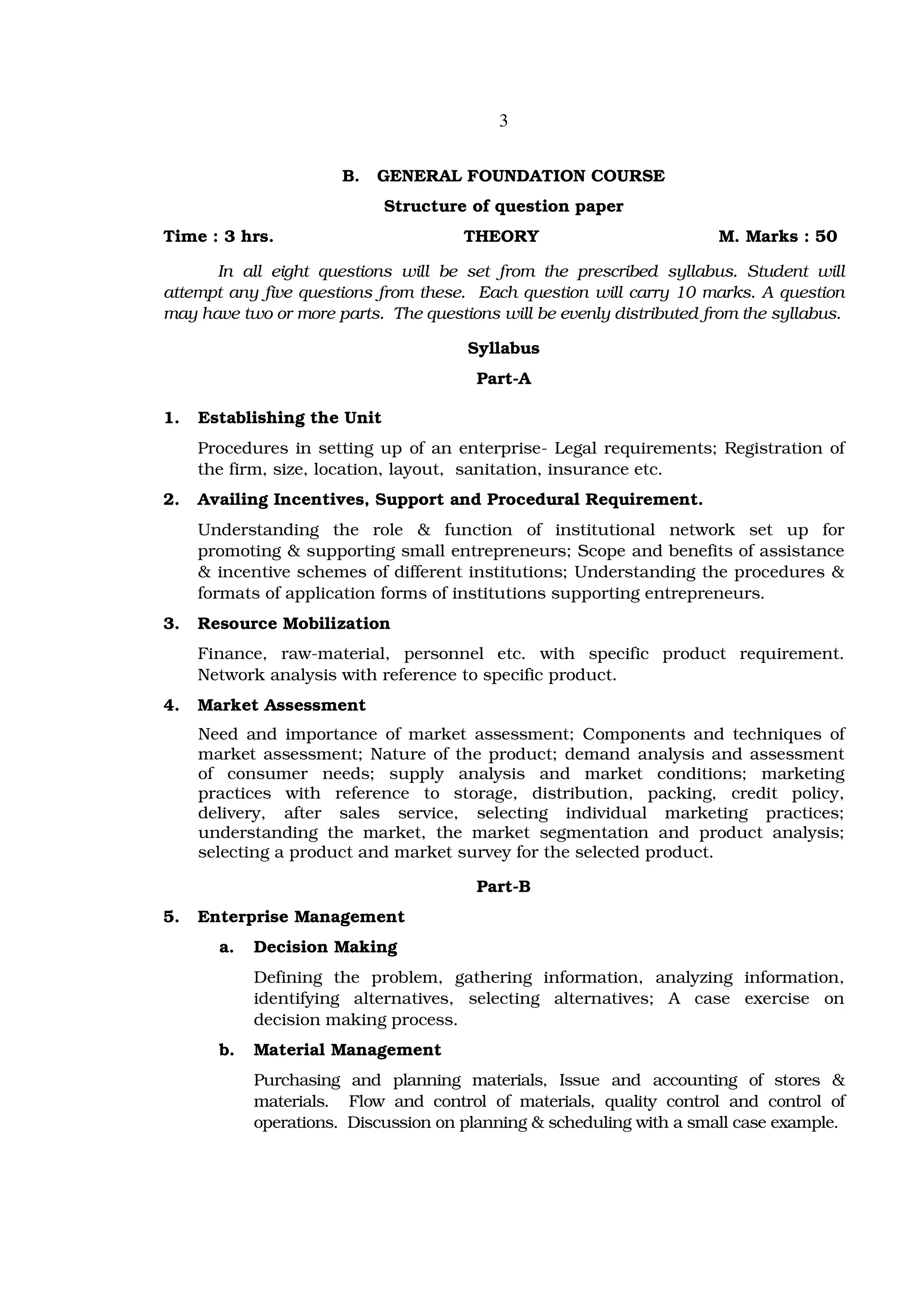
                       B.   GENERAL FOUNDATION COURSE
                             Structure of question paper
Time : 3 hrs.                         THEORY                          M. Marks : 50

      In all eight questions will be set from the prescribed syllabus. Student will
attempt any five questions from these. Each question will carry 10 marks. A question
may have two or more parts. The questions will be evenly distributed from the syllabus.

                                      Syllabus
                                        Part-A

1.   Establishing the Unit
     Procedures in setting up of an enterprise- Legal requirements; Registration of
     the firm, size, location, layout, sanitation, insurance etc.
2.   Availing Incentives, Support and Procedural Requirement.
     Understanding the role & function of institutional network set up for
     promoting & supporting small entrepreneurs; Scope and benefits of assistance
     & incentive schemes of different institutions; Understanding the procedures &
     formats of application forms of institutions supporting entrepreneurs.
3.   Resource Mobilization
     Finance, raw-material, personnel etc. with specific product requirement.
     Network analysis with reference to specific product.
4.   Market Assessment
     Need and importance of market assessment; Components and techniques of
     market assessment; Nature of the product; demand analysis and assessment
     of consumer needs; supply analysis and market conditions; marketing
     practices with reference to storage, distribution, packing, credit policy,
     delivery, after sales service, selecting individual marketing practices;
     understanding the market, the market segmentation and product analysis;
     selecting a product and market survey for the selected product.

                                        Part-B
5.   Enterprise Management
       a.   Decision Making
            Defining the problem, gathering information, analyzing information,
            identifying alternatives, selecting alternatives; A case exercise on
            decision making process.
       b.   Material Management
            Purchasing and planning materials, Issue and accounting of stores &
            materials. Flow and control of materials, quality control and control of
            operations. Discussion on planning & scheduling with a small case example.
4


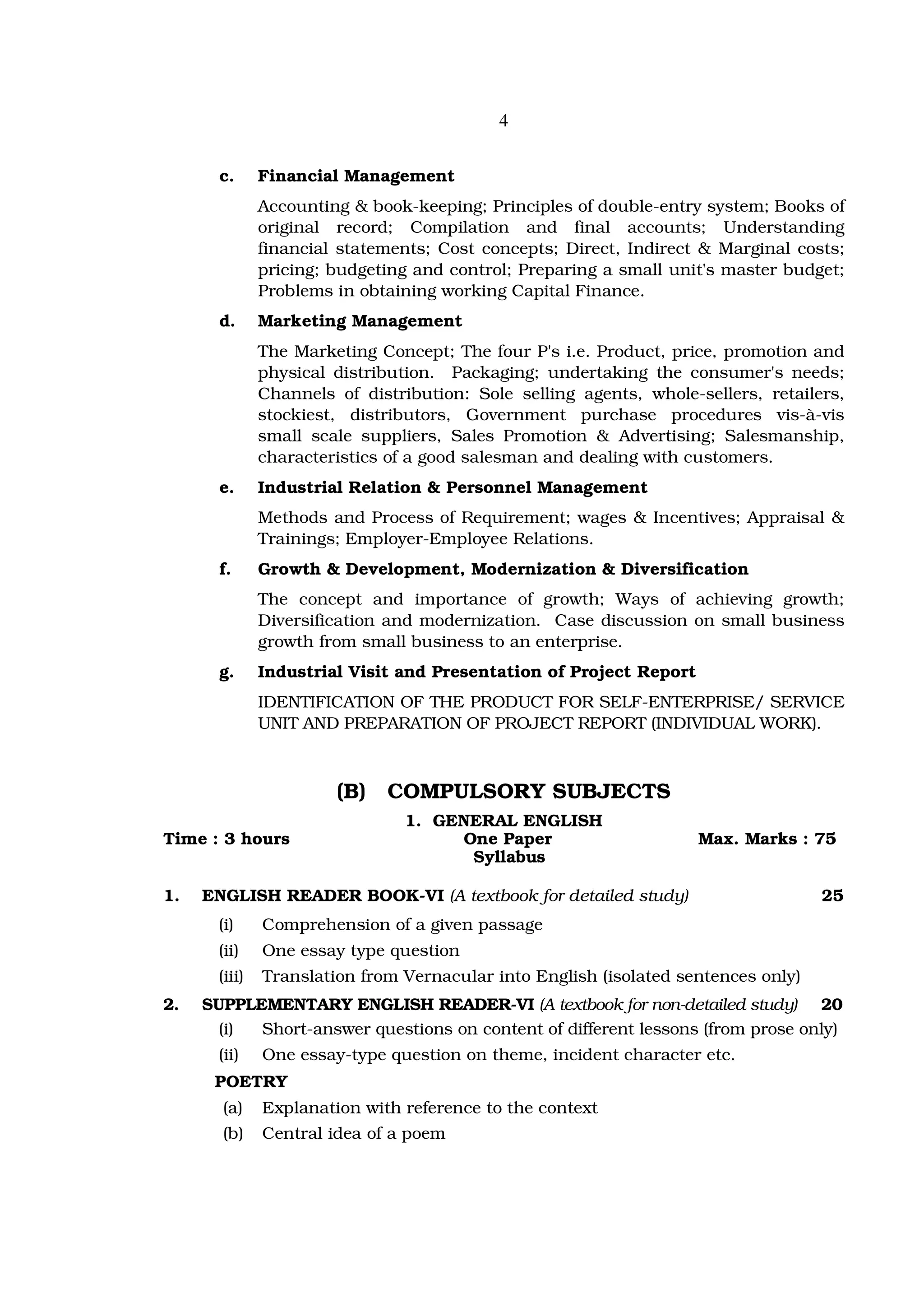
       c.      Financial Management
               Accounting & book-keeping; Principles of double-entry system; Books of
               original record; Compilation and final accounts; Understanding
               financial statements; Cost concepts; Direct, Indirect & Marginal costs;
               pricing; budgeting and control; Preparing a small unit's master budget;
               Problems in obtaining working Capital Finance.
       d.      Marketing Management
               The Marketing Concept; The four P's i.e. Product, price, promotion and
               physical distribution. Packaging; undertaking the consumer's needs;
               Channels of distribution: Sole selling agents, whole-sellers, retailers,
               stockiest, distributors, Government purchase procedures vis-à-vis
               small scale suppliers, Sales Promotion & Advertising; Salesmanship,
               characteristics of a good salesman and dealing with customers.
       e.      Industrial Relation & Personnel Management
               Methods and Process of Requirement; wages & Incentives; Appraisal &
               Trainings; Employer-Employee Relations.
       f.      Growth & Development, Modernization & Diversification
               The concept and importance of growth; Ways of achieving growth;
               Diversification and modernization. Case discussion on small business
               growth from small business to an enterprise.
       g.      Industrial Visit and Presentation of Project Report
               IDENTIFICATION OF THE PRODUCT FOR SELF-ENTERPRISE/ SERVICE
               UNIT AND PREPARATION OF PROJECT REPORT (INDIVIDUAL WORK).


                        (B)   COMPULSORY SUBJECTS
                                 1. GENERAL ENGLISH
Time : 3 hours                        One Paper                      Max. Marks : 75
                                       Syllabus

1.   ENGLISH READER BOOK-VI (A textbook for detailed study)                         25
       (i)     Comprehension of a given passage
       (ii)    One essay type question
       (iii)   Translation from Vernacular into English (isolated sentences only)
2.   SUPPLEMENTARY ENGLISH READER-VI (A textbook for non-detailed study) 20
       (i) Short-answer questions on content of different lessons (from prose only)
       (ii)    One essay-type question on theme, incident character etc.
      POETRY
       (a)     Explanation with reference to the context
       (b)     Central idea of a poem
5


3.         USAGE AND COMPOSITION                                                              30
           (i)      Question on change, sequence and use of tenses; reported speech,
                    change of voice etc. based on language material contained in the
                    prescribed textbooks
           (ii)     Precis writing
           (iii)    Letter-writing/Paragraph writing
Note : In case of students who are not familiar with any of the Modern Indian
       Languages, a question in lieu of translation will be as follows :
             Paraphrase of a piece of verse
                            Structure of Question Paper and Guidelines
Time : 3 hours                             One Paper                   Max. Marks : 75

Note : All the questions of Part-A, Part-B and Part-C shall be based on the exercises
       of the textbooks prescribed by the Board

                                                PART-A
ENGLISH READER BOOK VI (Text for detailed study)                                    (25 Marks)
1.   (a)      A passage from the above text-book to test comprehension through the
             following techniques :
                    (i)    Name of the author and lesson from which the passage has been
                           taken                                                      (2)
                    (ii)   Short answer type questions
                           (2 questions to be answers in one sentence each)                  (2)
                    (iii) Matching exercise
                           (2 words to be attached out of 3 words)                           (2)
                    (iv) Fill in the blanks (two sentences)                                  (2)
                    (v)    Meaning of difficult words/phrases in simple English (2 out of 3) (2)
     (b)         One essay type question to be answered in about 100 words on theme
                 and understanding of details with internal choice.                 (10)
2.    Translation from Vernacular into English
      5 isolated sentences from 5 different lessons of English Reader Book VI                 (5)
Note : A special question in lieu of translation for foreign students only Paraphrase
       of a piece of verse.
6


                                              PART-B
                            SUPPLEMENTARY ENGLISH READER-VI
                                (Text for non-detailed study)                       (20 Marks)
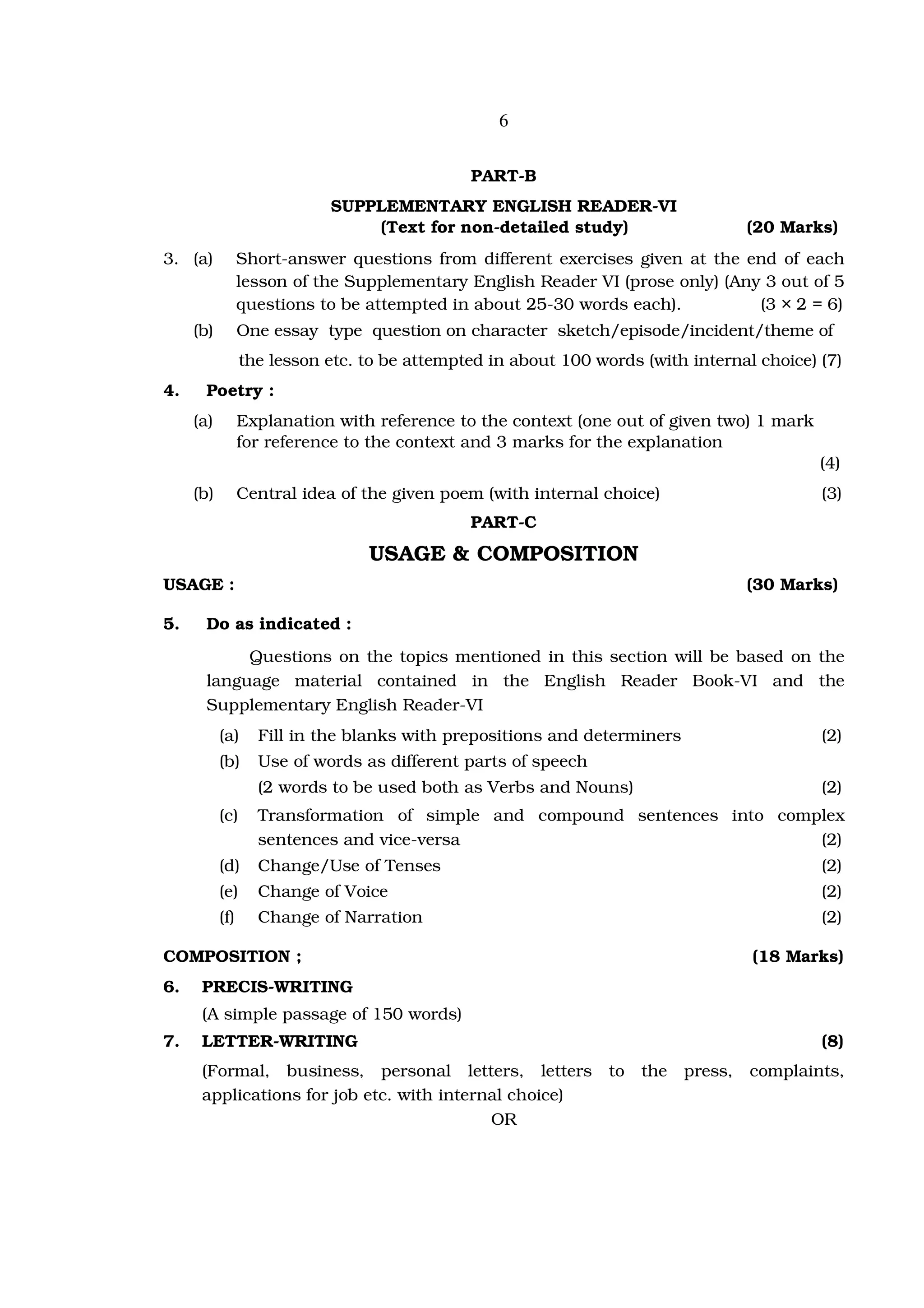
3. (a)           Short-answer questions from different exercises given at the end of each
                 lesson of the Supplementary English Reader VI (prose only) (Any 3 out of 5
                 questions to be attempted in about 25-30 words each).          (3 × 2 = 6)
     (b)         One essay type question on character sketch/episode/incident/theme of
                 the lesson etc. to be attempted in about 100 words (with internal choice) (7)
4.     Poetry :
     (a)         Explanation with reference to the context (one out of given two) 1 mark
                 for reference to the context and 3 marks for the explanation
                                                                                            (4)
     (b)         Central idea of the given poem (with internal choice)                      (3)
                                              PART-C
                                 USAGE & COMPOSITION
USAGE :                                                                             (30 Marks)

5.     Do as indicated :
            Questions on the topics mentioned in this section will be based on the
       language material contained in the English Reader Book-VI and the
       Supplementary English Reader-VI
           (a)     Fill in the blanks with prepositions and determiners                     (2)
           (b)     Use of words as different parts of speech
                   (2 words to be used both as Verbs and Nouns)                             (2)
           (c)     Transformation of simple and compound sentences into complex
                   sentences and vice-versa                                 (2)
           (d)     Change/Use of Tenses                                                     (2)
           (e)     Change of Voice                                                          (2)
           (f)     Change of Narration                                                      (2)

COMPOSITION ;                                                                       (18 Marks)
6.    PRECIS-WRITING
      (A simple passage of 150 words)
7.    LETTER-WRITING                                                                        (8)
      (Formal, business, personal letters, letters              to   the   press,   complaints,
      applications for job etc. with internal choice)
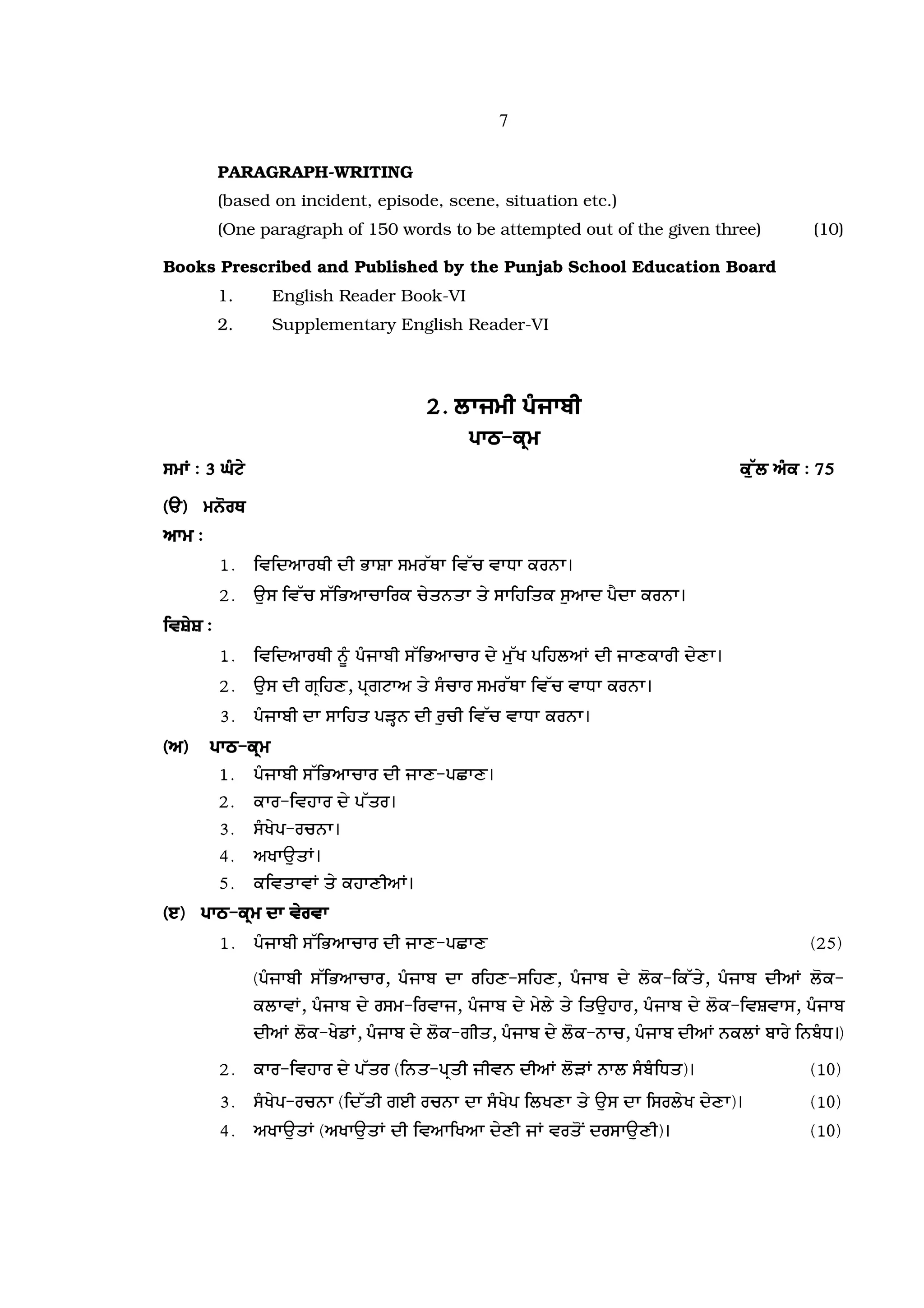
                                           OR
)01(                           .)hD[Tk;od A'sot Ki hD/d knyfkntf hd Ks[Tkyn( Ks[Tkyn       a4
)01(                 .)kD/d y/bo;f kd ;[T /s kDybf g/yz; kd kBuo hJr hsZdf( kBuo-g/yz;     a3
)01(                        .)sXfzpz; bkB KV'b Knhd Bthi hsqg-sBf( osZg /d okjtf-oke       a2
).XzpBf /okp KbeB Knhd pkizg ,ukB-e'b /d pkizg ,shr-e'b /d pkizg ,Kv/y-e'b Knhd
pkizg ,;ktÙtf-e'b /d pkizg ,okj[Tsf /s /b/w /d pkizg ,iktof-w;o /d pkizg ,Ktkbe
-e'b Knhd pkizg ,/sZef-e'b /d pkizg ,Djf;-Djfo kd pkizg ,okuknGfZ; hpkizg(
)52(                                                     DkSg-Dki hd okuknGfZ; hpkizg      a1
                                                                             kto/t kd wqe-mkg )J(
                                                                  .KnhDkje /s Ktkstfe       a5
                                                                              .Ks[Tkyn      a4
                                                                           .kBuo-g/yz;      a3
                                                                    .osZg /d okjtf-oke      a2
                                                         .DkSg-Dki hd okuknGfZ; hpkizg      a1
                                                                                     wqqe-mkg
                                                                                     we-mkg
                                                                                     wqqe-mkg
                                                                                     we-mkg           )n(
                                                                                                      )n(
                                                                                                      )n(
                                                                                                      )n(
                                          .kBoe kXkt uZtf hu[o hd BQVg sjfk; kd hpkizg     a3
                                  .kBoe kXkt uZtf kEZow; okuz; /s nkNrqg ,Djfqr hd ;[T     a2
                         .kD/d hokeDki hd Knbjfg y[Zw /d okuknGfZ; hpkizg {zB hEokndftf    a1
                                                                                                    ÙÙtf
                                                                                                 LL ÙÙtf
                                                                                                 LL Ù////Ùtf
                                                                                                    ÙÙtf
                             .kBoe kd?g dkn[; esfjfk; /s ksBs/u eofkuknGfZ; uZtf ;[T       a2
                                            .kBoe kXkt uZtf kEZow; kÙkG hd hEokndftf       a1
                                                                                                   wkn
                                                                                                LL wkn
                                                                                                LL wkn
                                                                                                   wkn
                                                                                          EoBw )T(
                                                                                          Eo''Bw )T(
                                                                                          Eo''Bw )T(
                                                                                          EoBw )T(
 57 LL ezzn b[[ZZ[[ZZe
 57 LL en b e
 57 en b e
 57 ezzn b e                                                                              //Nzzx 3 LL Kw;
                                                                                            Nx 3 LL Kw;
                                                                                            //Nzzx 3 Kw;
                                                                                              Nx 3 Kw;
                                                 gkm-eqw
                                                 gkm-
                                           2a bkiwh gzikph
                                               Supplementary English Reader-VI              2.
                                                            English Reader Book-VI          1.
              Books Prescribed and Published by the Punjab School Education Board
(10)             (One paragraph of 150 words to be attempted out of the given three)
                                      (based on incident, episode, scene, situation etc.)
                                                                  PARAGRAPH-WRITING
                                                     7
should be in about 80-85 words.
3. Questions from 11 to 15 will carry 5 marks each Answer to each question
                                      should be in about 20-25 words.
Answer to each question            2. Questions from 1 to 10 will carry 2 marks each.
      1. There will be eighteen questions in all. All the questions will be compulsory.
 Max. Marks : 75                        Time : 3 Hours                                 One Paper
                                  Structure of Question Paper
                         PUNJAB HISTORY AND CULTURE                        3.
)01(                                        .kr/tki kjef hJb Dybf ok; kd eZJf /;ef
/e /d KnhDkje 'd A'uZtf KnhDkje izg KnhsZdf uZtf es;[g-mkg ,21-hpkizg hw˜kb              6azB BÙqg
)01(                            .kr/tki kjef hJb Dybf tkG- hodA/e kd eZJf /;ef /e /d
Ktkstfe Bzsf A'uZtf Ktkstfe Kodzg KnhsZdf uZtf es;[g-mkg ,21-hpkizg hw˜kb                5azB BÙqg
+2+2+2+2=(10)            2
                 .kr/tki kjef hJb D;Zd KnhsEf; Knhd A'sot hd KBj[T Ki Dsot uZtf
Kekt {zB izg A'uZtf KBj[T /e /d Ks[Tkyn mZn A'uZtf es;[g-mkg ,21-hpkizg hw˜kb            4azB BÙqg
+2=(10)      8                                                 .kr/tki kjef ht hJb
D/d y/bo;f kd kBuo g/yz;        .hr/t'j hJkjsf eZJf rg-rb kd kBuo b{w 'i     .kr/oe
kBuo-g/yz; hd /o?g ;Jf hEoknyfhqg      .kr/tki ksZdf ko?g eZJf hJb Boe kBuo-g/yz;        3azB BÙqg
+6+2=(10)         2                                                         .kr/tki
kjef hJb Dybf osZg /okp /d eZJf /;ef /e /d /Ùtf 'd hJb osZg /d okjtf-oke                 2azB BÙqg
+5+5+5+5=(25)            5
.kr/tki kjef hJb Dybf osZ[T kd izg A'uZtf KBj[T /e S[Zg BÙqg mZn /bkt KosZ[T /N'S
A'uZtf K;knGfn-mkg /d rkG okuknGfZ; hpkizg /d es;[g-mkg ,21-hpkizg hw˜kb                 1azB BÙqg
 57 LL ezzn b[[ZZ[[ZZe
 57 LL en b e
 57 en b e
 57 ezzn b e                                                                           //Nzzx 3 LL Kw;
                                                                                         Nx 3 LL Kw;
                                                                                         //Nzzx 3 Kw;
                                                                                           Nx 3 Kw;
                 KsJfkdjf Ù/Ùtf hJb Kenyfhqg /sn KoNA?; og/g ,KnhEokndftf ,KegknXfn
                                           bkiwh gzikph
                                  sÙfkeqg A'bZt vo'p knyfZ;f b{e; pkizg 21 - hpkizg hwikb
                                                                                       es;g-mkg
                                                                                       es;[[g-mkg
                                                                                       es;g-mkg
                                                                                       es;[[g-mkg
                                                            ).Ktkstfe Kodzg Knhd Knhte
izg /sn KnhDkje izg Knhd KokehDkje izg /J'j /dyZo uZtf BknXf {zB hu[o hd hEokndftf(
)01(                                                         KnhDkje /sn Ktkstfe        a5
                                                  8
9

4. Questions from 16 to 18 will carry 10 marks each. Answer to each question should
   be in about 250-300 words. There will be 100% internal choice in these questions.
   The paper setter should not set more than one such question from one chapter.
5. The language of paper should be straight.
6. No question will be based on quotation.
7. The question paper will cover the whole syllabus.

                                      SYLLABUS
   1. The Great Mughals and their legacy to the Punjab.
   2. Guru Nanak Dev Ji.
   3. Successors of Guru Nanak Dev Ji.
   4. Banda Bahadur and his Martyrdom.
   5. Sikhs became Masters of the Punjab.
   6. The Punjab under Maharaja Ranjit Singh.
   7. The British occupation of the Punjab.
   8. Some famous Legends of the Punjab.
       (i)     Puran Bhagat
       (ii)    Heer Ranjha
       (iii)   Sohni Mahiwal
   9. Classical Literature of the Medieval period.


                    4.   ENVIRONMENTAL EDUCATION
Theory Paper                       Time : 2 Hours                 Max. Marks : 35
Project Work                       Time : 1½ hrs.                      Marks : 15
                                                                 Total Marks : 50
                                       THEORY
                              Structure of Question Paper
1. There will be one theory paper comprising of 16 questions. All questions will be
   compulsory.
2. Question Nos. 1-5 are very short answer type questions carrying 1 mark each.
   Answer to each question will be in one line or few words only.
3. Question Nos. 6-10 are short answer type questions carrying 2 marks each.
   Answer to each question will be in 20-30 words.
4. Question Nos. 11-15 are short answer type questions carrying 3 marks each.
   Answer to each question will be in 40-50 words.
10


5. Question Nos. 16 is long answer type questions carrying 5 marks. Answer to
   this question will be in 80-100 words.
6. In question No. 16, there will be 100% internal choice.
7. There will be no objective type questions such as yes/no. tick/cross, fill in the
   blanks, multiple choice, true/false etc.
8. The question paper should be strictly from the prescribed syllabus based on
   above mentioned guidelines.
9. Unitwise distibution of marks will be as follows
   Unit I                Biodiversity                         7 marks
   Unit II               Environmental Management             7 marks
   Unit III              Sustainable Development              7 marks
   Unit IV               Sustainable Agriculture              7 marks
   Unit V                Environmental Actions                7 marks

                                         SYLLABUS
   1.     Biodiversity
   2.     Concept and value of biodiversity.
   3.     Levels of biodiversity-species, eco and genetic.
   4.     Balance in nature.
   5.     Biodiversity for sustenance of mankind.
   6.     Resource limitations.
   7.     Ecological role of biodiversity.
   8.     Interdependence between different species.
   9.     India as a mega diversity nation.
   10. Economic potential of biodiversity.
   11. Loss of biodiversity-threatened, endangered and extinct species.
   12. Strategies for conservation of biodiversity-in situ and ex-situ.
   13. Mitigating the people-wildlife conflict.

Unit II      Environmental Management
        •    Need for environmental management vis-à-vis development.
        •    Aspects of environmental management-ethical, economic, technological
             and social.
        •    Legal provisions for environmental management.
        •    Approaches for environmental management-economic policies, environmental
             indicators, setting of standards, information exchange and surveillance.
11


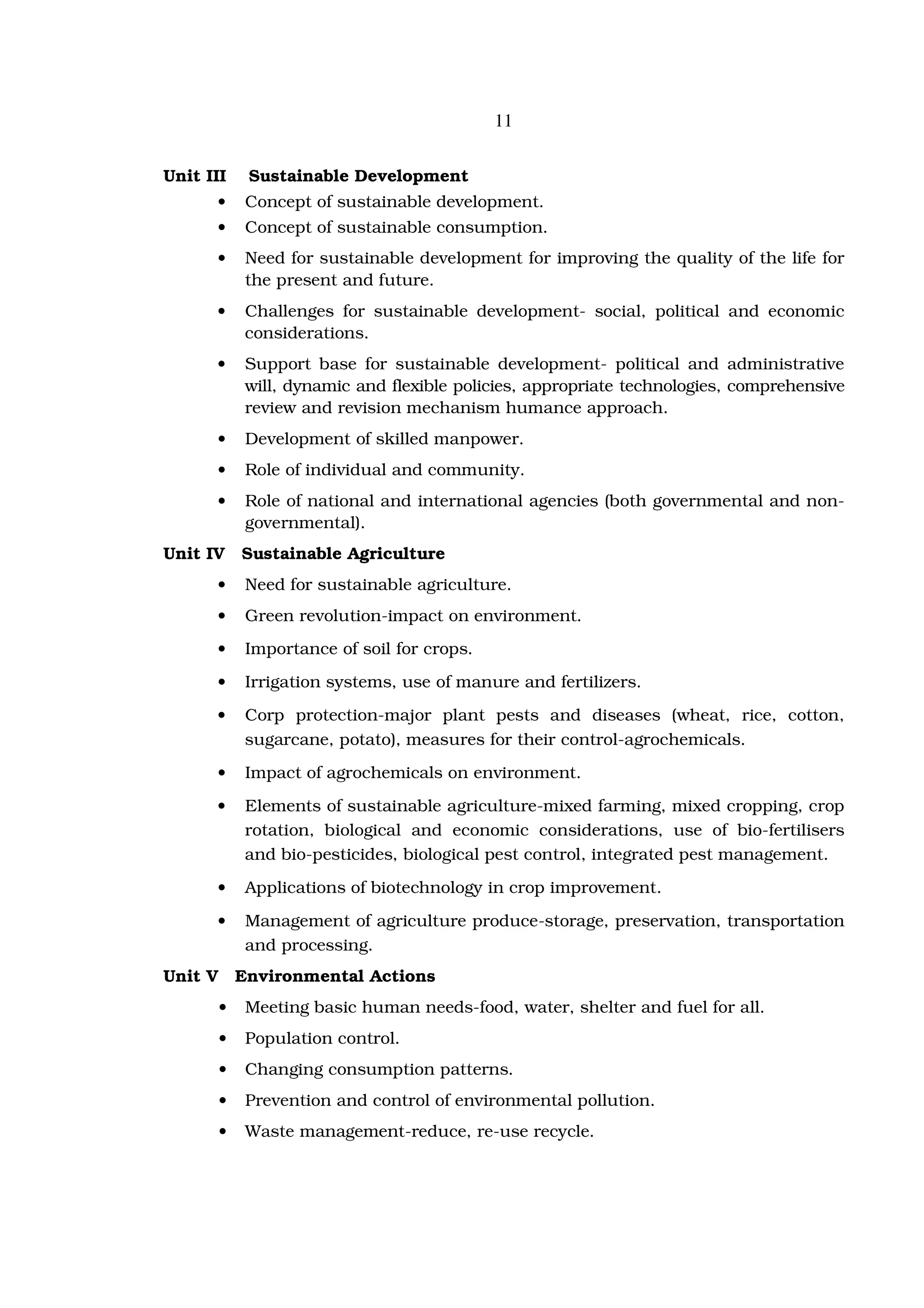
Unit III      Sustainable Development
      •       Concept of sustainable development.
      •       Concept of sustainable consumption.
      •       Need for sustainable development for improving the quality of the life for
              the present and future.
      •       Challenges for sustainable development- social, political and economic
              considerations.
      •       Support base for sustainable development- political and administrative
              will, dynamic and flexible policies, appropriate technologies, comprehensive
              review and revision mechanism humance approach.
      •       Development of skilled manpower.
      •       Role of individual and community.
      •       Role of national and international agencies (both governmental and non-
              governmental).
Unit IV      Sustainable Agriculture
      •       Need for sustainable agriculture.
      •       Green revolution-impact on environment.
      •       Importance of soil for crops.
      •       Irrigation systems, use of manure and fertilizers.
      •       Corp protection-major plant pests and diseases (wheat, rice, cotton,
              sugarcane, potato), measures for their control-agrochemicals.
      •       Impact of agrochemicals on environment.
      •       Elements of sustainable agriculture-mixed farming, mixed cropping, crop
              rotation, biological and economic considerations, use of bio-fertilisers
              and bio-pesticides, biological pest control, integrated pest management.
      •       Applications of biotechnology in crop improvement.
      •       Management of agriculture produce-storage, preservation, transportation
              and processing.
Unit V       Environmental Actions
         •    Meeting basic human needs-food, water, shelter and fuel for all.
         •    Population control.
         •    Changing consumption patterns.
         •    Prevention and control of environmental pollution.
         •    Waste management-reduce, re-use recycle.
12


       •   Community movements for ecological restoration and conservation of
           environment like Van Mahotsava, Chipko, Silent Valley, Project Tiger,
           Ganga Action Plan, Joint Forestry Management (JEM), students
           participation in tree rearing, social and agroforestry.


                                PROJECT WORK
Time : 1½ hrs.                                                              Marks : 15
Two Projects 5 marks each                                                   10 marks
Viva                                                                          5 marks

Exemplar Projects and Activities

       It is expected that students will undertake two projects or activities, one of
which should be undertaken individually, and they will prepare a report in each
case. Teachers may plan and design projects and activities depending upon the
local situation, available resources and environmental issues of concern. The
projects and activities given below are only suggestive and not prescriptive.
   •   To study the impact of changes in agricultural practices or animal husbandry
       including poulty, piggery, fishery and apiculture over a period of time on the
       local environment of a given locality or village. The components for analysis
       may include, types of crops, land area under cultivation mechanization, use of
       electricity, mode of irrigation and agrochemicals, agro-wastes and their
       disposal, types of animal breed and their feed, types of shelter and health
       care, methods of preservation and processing of products and animal wastes
       and their disposal. To suggest an action plan for modifying the prevailing
       practices so as to make them environment friendly and sustainable.
   •   To study the practices followed in the region for storage, preservation,
       transportation and processing of perishable or non-perishable farm products
       and to assess the extent of their wastage due to faulty practices.
   •   To study the status of an endangered species listed for region by collecting
       information through different sources and observation, if possible and to
       assess the reasons for its diminishing number. Suggest ways and means to
       protect the species.
   •   To conduct a survey of plants and trees in the locality and collect information
       about their cultural, economic and medicinal values from the local people and
       the available literature. To prepare and action plan for the propagation of trees
       that is most valuable in terms of their cultural, economic and medicinal use.
   •   To make a list of raw materials used by the family for preparing different
       types of dishes. To identify the plants and animals and their parts from
       which each food material is obtained. Also to make a list of plants on which
oo'bg;e?n N?BoNzJf
                             kD[Tkvzt k;Zjf bkB KoN{Tgfze hJe kd oNqzgf uZtf eotN?B
                                                                              LL hibkBos oku; sn kBu;
                                                                              LL hi''''bkBos okuzzzz; //sn kBu{{;
                                                                                 hibkBos oku; //sn kBu{{;
                                                                                 hibkBos oku; sn kBu;                       a4
                                                                                                                            a4
                                                                                                                            a4
                                                                                                                            a4
                                                                                         kBoe dzp {zB oN{Tgfze
                                                                                        kBoe {bku {zB oN{Tgfze
                                                       kBV'i uZtf ;gkn {zB KwN;;f p; oN{Tgfze
                                                                                  kDTkbu B oNTgfe kvkjs
                                                                                  kD[[Tkbu {{{{zzB oN{{Tgfzze kvkj[[[[s
                                                                                  kDTkbu B oNTgfe kvkjs
                                                                                  kD[[Tkbu zzB oN{{Tgfzze kvkjs             a3
                                                                                                                            a3
                                                                                                                            a3
                                                                                                                            a3
                   wN;;f rzNf/ogU ,˜ov'b ,ioezbf ,edkt[Bn kÙkG L wN;;f on/tNck;
                                                             osDp o;?;'qg ,o;?;'qg
                                                                              how?w
                                                                 N[ZgN{Tkn$N[ZgBJf
                                  Boehrot kd on/tNck; L on/tNck; /sn on/tvokj
                                                      wN;;f oN{Tgfze tszw BokX;
                                                                           LL wN;;f oNTgfe tsw BokX;
                                                                           LL wN;;f oN{{Tgfzze tszzw BokX;
                                                                              wN;;f oN{{Tgfzze tszzw BokX;
                                                                              wN;;f oNTgfe tsw BokX;                        a2
                                                                                                                            a2
                                                                                                                            a2
                                                                                                                            a2
                                                        W kdoe wze A/tef wN;;f oN{Tgfze
                                                                 W wN;;f eZJf oN{Tgfze
                                        kBb[s bkB Ky[ZBw hd;Jf DkSg-Dki /okp oN{Tgfze
                                                                                       LL sKX;f bw d oNTgfe
                                                                                       LL sKX;f b{{{{w //d oN{{Tgfzzzze
                                                                                          sKX;f bw //d oN{{Tgfe
                                                                                          sKX;f bw d oNTgfe                 a1
                                                                                                                            a1
                                                                                                                            a1
                                                                                                                            a1
                                                                                                                 hts ; skwi
                                                                                                                 hts ; skwi
                                                                                                             AAAAhtsZZZZ; skwi
                                                                                                                 hts ; skwi
                                                                                                                   hwG-m gf
                                                                                                                   hwG-m gf
                                                                                                                   hw{{{G-mZZZgf
                             hJb KnhDÙ htokp s htm n
                             hJb KnhDqq//qq//Ù AAAAhtQQokp AAAA''s AAAAhtmZZZZn
                             hJb KnhDÙ htQQokp ''s htm n
                             hJb KnhDÙ htokp s htm n
                                             wqe-mkg-
                                    ezfgT{No ;kfJz;
biodiversity in providing food to human population.
by diagrams/photographs/ pictures/ graphs to focus on the importance of
and animals which are found in the locality. To prepare a report supported
in which action of microorganisms is made use of. To identify those plants
the animals in the list depend for their food. To name the processes, if any,
                                                   13
DkSg Dki bkB eif"b N/N; 'd
                                                                     wqe kbutf BhÙw
                                                                       esotofg kÙkG
                                                                     KtkÙkG oN{Tgfze
                                                              odzn /d NB/p?e a{:ahgah;
                                                           'bc kd kBu{; utf oN{Tgfze
                                                             ontN¯k; sn ontvokj
                                                             on//tN¯k; //sn on//tvokj         a2
                                                              oN{Tgfze /d Kw;ef o'j
                                                          ˜BÙ/oB?i Knhd KoN{Tgfze
                                                                ;ketf kd KoN{Tgfze
                    skn{o[Ù hd kBhÙw Knhbkt Boe rzNf{Tgfze /sn D[Tkb pk;jf ,BDrf
                                                            ;     kd KBhÙw oNTgfe
                                                            ;ketf kd KBhÙw oN{{Tgfzze         a1
                                                                            iwks nZmthA
                                            ˜tNfwfqgf hd 'r'b ,skn{o[Ù hd 'r'b ,kewf{G
                                                                                   L rb
                                                                                   L ''r''b
                                                                                   L rb
                                                                                   L ''r''b   a8
                                                                                              a8
                                                                                              a8
                                                                                              a8
                                                                       /uKY /d Noku'bc
                                                             QBzuf /d ;Jf /sn Noku'bc
                                                                            wEofkrb?n
                                                                kDTkMb; kd kn;fZw;
                                                                kD[[TkMb[[; kd kn;fZw;
                                                                kDTkMb; kd kn;fZw;
                                                                kD[[TkMb[[; kd kn;fZw;        a7
                                                                                              a7
                                                                                              a7
                                                                                              a7
                                                                         bvkw kN/v
                                                DkSg-Dki bkB wN;;f NA?wi/B?w ;/pkN/v
                                                                       NA?wi/B?w ;/pkN/v      a6
                                            A'sot hd KQB[T /sn ˜BÙ/ehbg?n /d ;ecfkqr
                                                                     ecfkqr /sn kN/v
                                                              L kDvy bkB ecfkr kNv
                                                              L kDv//y bkB ecfkqqr kN////v
                                                              L kDvy bkB ecfkr kNv
                                                              L kDv//y bkB ecfkqqr kNv        a5
                                                                                              a5
                                                                                              a5
                                                                                              a5
               hD[Tkg skM /s KBu{; A'utf BXk; kN/v vot ,kD[Tkbwf ekv ,hBok; ,Boehw;
,QBzuf ,kBoG hB[X kd{i"w utf ˜/tks;d vot ,ezbfoghJkj ,hob?r gbfe L o;?;'qg vot
                                           14
;N/bgA?N BJfk˜vf
                    kD[TkXt KvJfkb; o'j
                            hs[s;qg AhtB
                 sZs Bhoe; NJfKn'gotkg
                             DkSg-Dki
                            ˜if/e?g hs[s;qg   a5
                        kBoks[T on/tN¯k;
                            rzNf?u B?boNzJf
                                rz;f?ocBke
                                g[or˜{TBf
                                ;N?nqehN?B
                                    b/w-hJ
                             Doeg[T okuz;
                                   kseogz;
         KnhXtf Knhd kseogz; /sn okuz;
                           hi'b'g'N eotN?B
     BXk; /dAhV'b hJb KoN{Tgfze rzefotN?B
                                bB?u okuz;
                                 okuz; kNkv
                               DkSg-Dki
                  hehBes okuz; /sn kBu{;      a4
     wN;;f rzNf/ogkn hJb kseokjtf kBu{;
                                  rzbf{g;
                                   ;ocZp
                               oi/B?w sq';
                         kewf{G hd ;?n$'n
                               DkSg Dki
                 );?n$'n( wN;;f rzNf/ogkn     a3
15
kDNkS bp/N ;/pkNkv
                                  /Dbdp vokeof /d bp/N ;/pkNkv
kD[Tkg vokeof utf bJfkc ;/pkNkv hQb'y /D[j A'utf bJfkc hoyt /;ef
                                kDGb vokeof A'utf bp/N ;/pkNkv
                                kDy/d vokeof A'utf bp/N ;/pkNkv
                                         kDbeBf A'utf n'qg;ekc
                            kBoe Kwi vokeof uZtf bp/N ;/pkNkv
                                 kDbdp osDp hd bp/N ;/pkNkv
                            kBoe dzp /sn kDQb'y KbJfkc ;/pkNkv
                                                kD[TkDp ;/pkNkv
                                kBoe wze Ahjko ;/pkNkv n'qg;ekc
                                 Xzpqg /sn bkGz; GK; hd ;/pkNkv
                           wN;;f Xzpqg ;/pkNkv-Xzpqg kd ;/pkNkv
                                                   Xzpqg ;/p kNkv   a6
                               kBoe t/; hs[s;qg /s o's /d i/g p?t
                              /D[TkXt tkGqg /d ˜ktkn /sn shrz;
                                                    knhvhwhNbw
                                      Knhs[s;qg KnhJkDp KnhDp
                              /Boe bykd i/tks;d utf KvJfkb;
                           kDsot Noku utf KvJfkb; KnhDgkn
                                                          ibp/N
                                             ˜BÙ˜fKoN vJfkb;
                                                       BÙ/whB?n
                                               kBoe Nzqgf hs[s;qg
                                   Ùqdf BzGtf utf NJfKn'g otkg
                                               kBoe t/; hs[s;qg
                                             kDQb'y hs[s;qg d{i"w
                                kDyo KB kd bJfkc NJfKn'g otkg
                      16
M. Marks : 80                                                           Time : 3 hours
                 FOR QUESTION PAPER CARRYING 80 MARKS (THEORY) EACH
evenly distributed from the syllabus.
marks. A question may have two or more parts. The questions will be
will attempt any five questions out of these. Every question will carry six
In all eight questions will be set from the prescribed syllabus. Candidates
M. Marks : 30                                                           Time : 2 hours
THOSE SPECIFIED AT*)
FOR QUESTION PAPERS CARRYING 30 MARKS (THEORY) EACH (EXCEPT
                                     (THEORY)
D. STRUCTURE OF QUESTION PAPERS OF ELECTIVE SUBJECTS
                  .hr/tki hi/G /s o"s /oyZt vzt ˜JfktoN;?w; wqe-mkg /d bBÙ/e't-hqg     L N'B
  .krtj rkb we-mkg kn;fZd ogT hJb KnhEokndftf d Kbe; KBT ,W knrf kshe rkb kÙtf
     / ' {    q              [                 / { Q [                {
jJf okt hbjfg uZtf Kbe; KBjif .krjo bku we-mkg hj jT ET W kjof ki knJfkVg Ait
                      {            / {     q         [ / [              Q '
Ùtf hwikb jJf hj kbjfg AbZt ;Negf utf be; KBif W knrf kshe hwikb kBVg hJb hDÙ
/                         '             { Q                         Q        q/
Ahtokp As htS kÙtf kd ;Jfk; oNTgfe As 9002 bk; kbykd ,ok;Bn KsJfkdj Knhd okeo;
    Q ' /               z      { z '                     [                             L NB
                                                                                       L NB '
                                                                                       L N''B
                                                           bwn /s[T i/o?n /sn i/o?n
                                                         kBi': hd i/tks;d /sn b{N
                                                            oeZu Bthi ;ketf Xzpqg
                                                                        ;ketf Xzpqg
                                                                        gbez; Xzpqg
                                                                    gbez; rzwfkor'qg     a8
                                                                        MS-Excel
                                                             NhÙv?og; eBf'oNe?bJf
                                                                       DkSg-Dki
                                                                          NhÙvog;
                                                                          NhÙvog;
                                                                          NhÙv??og;
                                                                          NhÙv??og;      a7
                                                                                         a7
                                                                                         a7
                                                                                         a7
                                     kBoe ssf/ez;kDn$kBoe bkjp {zB Kvokeof /JkNj
                                                 kD[TkNj vokeof A'utf bp/N ;/pkNkv
                                          17
18


       The structure of question paper having 80 marks theory precedes the
       syllabus of that particular subject.

*SUBJECTS HAVING 80 MARKS THEORY ARE :

              GROUP                     TRADE                      SUBJECT
Business & Commernce           Accountancy and Auditing    a. Principles of
                               -do-                           Management and
                                                              Economics
                                                           b. Book Keeping and
                                                              Accountancy
Engineering & Technology       Computer Techniques         Advanced Mathematics &
                                                           Computer Commercial
                                                           Applications
Humanities & Others            Commercial Art              Technical Theory of
                                                           Commercial Art


E. STRUCTURE OF QUESTION PAPER OF ELECTIVE SUBJECTS
                         (PRACTICAL)
FOR QUESTION PAPERS CARRYING 50 MARKS (PRACTICAL) EACH (EXCEP
THOSE SPECIFIED AT*)
Time : 3 hours                                                          M. Marks : 50

Distribution of marks will be as follows :
       (i)     Practical note book/sessional work/visits/project work       10 marks
       (ii)    Viva Voce                                                     5 marks
       (iii) Actual performance                                             35 marks
No.1 MAJOR PRACTICAL                                                      (20 Marks)
       In all three practicals will be asked from the prescribed syllabus. Candidate
will be asked to choose any two out of these. The Practical examiner will ask the
candidate to perform any one practical out of the two chosen by him.
No.2 MINOR PRACTICAL                                                      (15 Marks)
       In all three practicals will be asked from the prescribed syllabus. Candidate
will be asked to choose any two out of these. The examiner will ask the candidate
to perform any one practical out of the two chosen by him.
FOR QUESTION PAPERS CARRYING 80 MARKS (PRACTICAL) EACH :
19


       The Structure of question paper having 80 marks practical precedes the
syllabus of that particular subject.


*SUBJECTS HAVING 80 MARKS PRACTICAL ARE :

        GROUP                       TRADE                      SUBJECT

Engineering and           Engg. Drawing and Drafting   a. Engineering Drawing
Technology
                          Mechanical servicing (Genl.) b. Engineering Drawing

Humanities & Others       Commercial Art               a. Commercial Art & Drawing
                                                       b. Design and Lay-out


   F.     GENERAL INSTRUCTIONS TO THE PAPER SETTERS
                                      (THEORY)

   1. The paper should be strictly from the prescribed syllabus or according to
        guidelines given under the structure of question paper.

   2. The language should be simple and to the mental level of the students.

   3. The standardized form of the technical terminology should be used.

   4. The questions in the paper should be evenly distributed throughout the syllabus.

   5. There will not be any objective type question like Yes or No, tick or cross, fill
        in the blanks, multiple choice etc.

   6. Due weightage should be given to numerical problems wherever required.

   7. Marks for every part/sub-part should be shown on the question paper itself.

                                     PRACTICAL

   1. The question paper will be set on the spot by the practical examiner himself.

   2. The practical examiner will set the question paper on the spot based upon
        the instructions & prescribed syllabus. The examiner must send one copy of
        the question paper for Board's record.     The second copy of the question
        paper must be kept by the examiner.
20


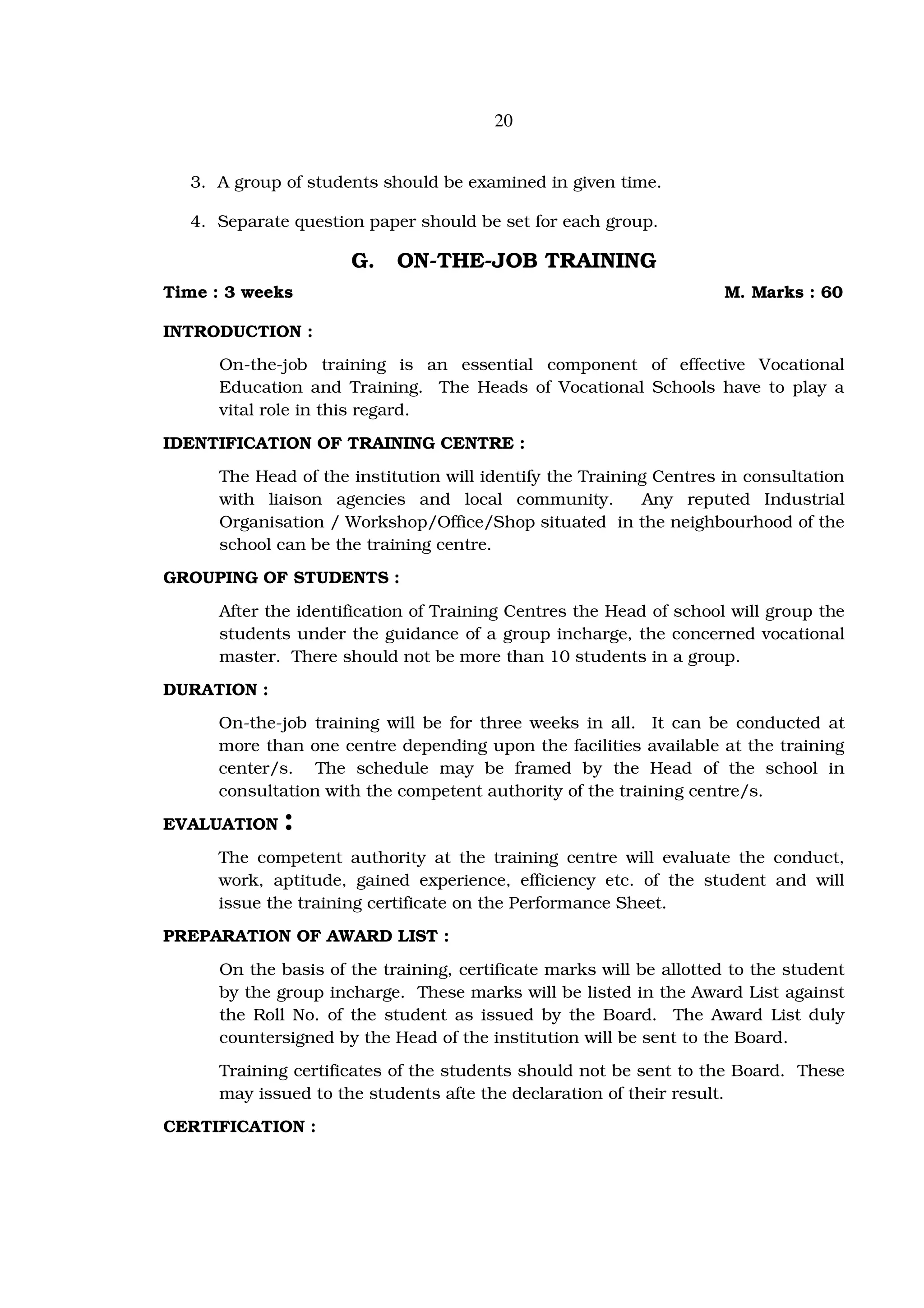
  3. A group of students should be examined in given time.

  4. Separate question paper should be set for each group.

                      G.    ON-THE-JOB TRAINING
Time : 3 weeks                                                       M. Marks : 60

INTRODUCTION :
      On-the-job training is an essential component of effective Vocational
      Education and Training. The Heads of Vocational Schools have to play a
      vital role in this regard.
IDENTIFICATION OF TRAINING CENTRE :
      The Head of the institution will identify the Training Centres in consultation
      with liaison agencies and local community.           Any reputed Industrial
      Organisation / Workshop/Office/Shop situated in the neighbourhood of the
      school can be the training centre.
GROUPING OF STUDENTS :

      After the identification of Training Centres the Head of school will group the
      students under the guidance of a group incharge, the concerned vocational
      master. There should not be more than 10 students in a group.
DURATION :
     On-the-job training will be for three weeks in all. It can be conducted at
     more than one centre depending upon the facilities available at the training
     center/s. The schedule may be framed by the Head of the school in
     consultation with the competent authority of the training centre/s.
EVALUATION    :
     The competent authority at the training centre will evaluate the conduct,
     work, aptitude, gained experience, efficiency etc. of the student and will
     issue the training certificate on the Performance Sheet.
PREPARATION OF AWARD LIST :
      On the basis of the training, certificate marks will be allotted to the student
      by the group incharge. These marks will be listed in the Award List against
      the Roll No. of the student as issued by the Board. The Award List duly
      countersigned by the Head of the institution will be sent to the Board.
      Training certificates of the students should not be sent to the Board. These
      may issued to the students afte the declaration of their result.
CERTIFICATION :
21


       The marks obtained by the student will be reflected in the Detail marks card
       issued by the Board. On-the-job training will be counted as a subject and it
       will be compulsory to pass this subject to pass the examination as a whole.

                         I   AGRICULTURE GROUP
                              (i) Horticultural
PAPER-I                LANDSCAPING AND FLORICULTURE
Time : 2 hrs.                     THEORY                              M.MARKS : 30

   •   Importance, definition, status and scope of landscaping and floriculture.
   •   History and types of gardens.
   •   Principles of landscaping.
   •   Design and layout of gardens for home, school, college, public buildings,
       modern parks.
   •   Essential and decorative components and features of gardens-gate, lawn,
       shrubbery, flower beds, borders, paths, hedges, edges, steps, statues,
       fountains, bird baths, streams, pools, waterfalls, terraces, rockeries, pergolas,
       arches and topiary.
   •   Study of Indoor gardening, Rock gardening.
   •   Important Omamental trees, shrubs, climbers and groundcovers, their
       selection based on landscape value and use, their planting and maintenance.
   •   Establishment and maintenance of lawns.
   •   Cultivation of bedding plants, bulbs and pot plants.
   •   Cultivation of the following flower crops with respect to soil, climate,
       varieties, propagation, method and time of planting irrigation, weeding, pest
       control, Time of flowering, harvesting packing and marketing: Rose,
       chrysanthemum, gladiolus, marigold, camation, tuberose, jasmine.
   •   Study of the flower arrangements, flower shows and exhibition, packing and
       storage of cut flowers, Study of cacti and succulents.
   •   Seed production of important seasonal flowers.
   •   Marketing of indoor plants and cut flower.
   •   Gardening operation like staking, disbudding and pinching.


PAPER-I          LANDSCAPING AND FLORICULTURE
Time : 3 hours                                                         M.MARKS : 50
                                     PRACTICAL
   •   Identification of Seasonal flowers.
22


   •   Preparation of nursery; beds and sowing of seeds of seasonal flowers.
   •   Planting and maintenance of lawn.
   •   Identification of landscape trees, shrubs/climbers and ground covers.
   •   Propagation of rose, chrysanthemum, and marigold.
   •   Planting shrubbery, hedges and edges.
   •   Potting and repotting.
   •   Garden operations- staking, training, pruning, desukering, pinching,
       disbudding, topiary.
   •   Harvesting, cleaning, grading and packaging of cut flowers.
   •   Preparation of garlands and bouquets.
   •   Arranging pots and materials for special decorations.
   •   Visits to flower growers fields, gardens and flower shows and markets.
   •   Landscap plan (i) modern bunglow (ii) Public place (iii) park.


PAPER-II                    COMMERCIAL CROPS
Time : 2 hrs.                        THEORY                        Max. Marks : 30

   •   Indroduction, present status and future prospects of plantation, spice,
       medicinal and aromatic crops.

   •   Commercial cultivation of the following with respect to soil, climate, improved
       varieties, propagation and nursery techniques, lay out and planting, cultural
       practices, water management, weed control, plant protection, harvesting,
       processing, products, storage and marketing of the following.

       SPICE CROPS : Cinnamon, ginger, turmeric, fennel, comin and coriander.

       MEDICINAL CROPS : Dioscorea, periwinkle, sarpagandha, ashwagandha, steroid
       bearing solanum, isabgol, senna and liquorice, alowera, glow, tulsi, sativia.

       AROMATIC CROPS : Lemon grass, citronella, palmarosa, vetiver (khus),
       geranium, patchaouli, davana, mints and rosemary.

       BEE KEEPING : Importance and scope, bee species and honey bee colony; bee
       keeping procedures; social behaviour, bee hives and their equipments; apiary
       management practices; products of bee hive; diseases and enemies of honey
       bees, pesticidal enemies of bees and economics and marketing of honey.
23


       MUSHROOMS : Their types, environmental requirements, containers, media
       and its preparation, disinfection, seeding, look after and care, harvesting,
       dehydration and packing. Preparation and maintenance of culture.

       VERMICULTURE : Introduction, Role of Earthworms, Organic Wastes,
       Advantages of vermiculture, vermicompasting, application of vermicomposing.


PAPER-II                     COMMERCIAL CROPS                      M. Marks : 50
Time : 3 hrs.                      PRACTICAL

Spice Crops
   •   Processing and curing of ginger and turmeric
Medicinal and Aromatic Crops
   •   Study of important spice, medicinal and aromatic crops.
   •   Extraction of essential oils in plants such as Mertha.
   •   Preparation of plants of geranium and patchouli through cuttings.
   •   Study of propagation in aromatic grasses.
Beekeeping
   •   Study of honey bees and their products.
   •   Study of bee pasturage.
   •   Site selection and arrangement of apiary.
   •   Setting up be hive.
   •   Seasonal management of bee colonies.
   •   Management of pest and diseases of bee.
   •   Extraction of honey, processing and marketing.
Mushrooms
   •   Study of common cultivated mushrooms and their food value.
   •   Compost preparation for button mushroom.
   •   Filling of tays/shalves/bage with compost for button mushroom.
   •   Spawning in butoon mushroom.
   •   Casing in button mushroom.
   •   Cropping and harvesting of button mushroom.
   •   Substrate preparation for paddy straw mushroom.
   •   Bed preparation and spawning in paddy straw mushroom.
   •   Cropping in paddy straw mushroom.
24


  •   Post harvest management.
  •   Management of insect-pests and diseases.
VERMICULTURE
  •   Identification of Important species of earthworms.
  •   Selection of suitable species.
  •   Vermicomposting materials and feed for earthworms.
  •   Diferent schemes for Vermicomposting.
  •   Preparation and maintenance of Vermicomposting beds.
  •   Products of cocoons and its survival.
  •   Application of vermicompost.
  •   Preparation of vermiwash and its applications.


  PAPER-III    POST HARVEST TECHNOLOGY AND PRESERVATION
  Time : 2 hrs.                        THEORY                        M. Marks : 30

  •   Maturity standards for fruits and vegetables.
  •   Methods of harvesting, handling, grading and transportation.
  •   Techniques of storage including cold storage of fruits & vegetables.
  •   Use of growth regulators and wax, emulsions for extending the storage life.
  •   Importance, scope and present position of preservation industry in India
      with special reference to Punjab.
  •   Principles and methods of preservation by low temperature, chemical,
      additives, salt, sugar, heat and drying.
  •   Factors affecting spoilage of fruits-role of enzymes and bacteria. Bacterial
      food poisoning, sulphuring and sulphitation.
  •   Establishment of processing factory ; consideration, machinery, labour,
      containers, finance.
  •   Canning of fruits and vegetables ; Important materials used, Suitable
      varieties of fruits and vegetables, selecion of material, preparation of
      materials, syruping, exhausting, sealing, sterilization and cooling.
  •   Preparation and preservation of fruit juice, squashes, cordial syrup, jam,
      jelly, marmalade and preserve, chutneys, pickles and sauces.
  •   Drying and dehydation of important fruits and vegetables.
  •   Evaluation of quality of preserved/ processed products.
25


       POST HARVEST TECHNOLOGY AND PRESERVATION
Time : 3 hrs.                         PRACTICAL                       M. Marks : 50

   •   Determination of maturity standards for fruits and vegetables.
   •   Methods of harvesting, handling, grading and transportation.
   •   Storage life of fruits and vegetables.
   •   Preservation of fruits and vegetables by low temperature, chemical additives,
       salt, sugar, heat and drying.
   •   Study of spoilage of fruits.
   •   Visit to a processing factory.
   •   Preparation and preservation of fruit juices, squashes, cordial syrup, jam,
       jelly, marmalade and preserve, chutneys, pickles and sauces.
   •   Drying and dehydration of important fruits and vegetables.
   •   Canning of fruits and vegetables.


                              (ii)    AGRIBUSINESS
PAPER-I                     AGRICULTURAL MARKETING
Time : 2 hrs.                           THEORY                      M. Marks : 30

   •   Basic concepts.

   •   Definition of market-Marketing.

   •   Differences between market and marketing.

   •   Differences between trade, commerce, merchandising and marketing.

   •   Importance of marketing.

   •   Classification of markets, on the basis of area, on the basis of time, on the
       basis of goods/commodities.

   •   Approaches to Study of Marketing-the functional approach, the institutional
       approach, the commodity approach and behaviour system or decision
       making approach.

   •   Marketing functions-Principal marketing functions, assembling, processing
       and disperson. Secondary services: grading, packing, transporting, storing,
       financing, assuming risk and selling.
26


   •   Agricultural Marketing systems in India. Defects in the present system of
       agricultural marketing in India and remedial measures.

   •   Marketing institutions - Regulated markets, co-operative marketing, state
       trading, commodity boards, warehousing.

   •   Agricultral prices-Factors influencing price.

   •   Management of distribution channels, Market segmentation and marketing
       mix, Sales promotion tools.

PAPER-I                AGRICULTURAL MARKETING
Time : 3 hrs.                        PRACTICAL                           M. Marks : 50

   •   Visit to farm holdings to appraise the selling behaviours of farmers.
   •   Visit to village market to analyse its importance, nature of participants and
       different transactions.
   •   Commodity market survey to study diffeent market channels (important five
       commodities in the locality).
   •   Study of regulated market, its functions and benefits to accrued farmers.
   •   Visit to co-operative marketing society to study the genesis, structure,
       functions and benefits accrued to members.
   •   Visit to any one commodity board to study its functions.
   •   Visit to warehousing co-operation to study its functions and services,
       methods of storage, storage pest control measures.
   •   Visit to agricultural input distributor to study about his business activities.
   •   Visit to agricultural input retailer shop to study the business activity.
   •   Visit to Assistant Director of Agriculture office to know about Fertiliser
       control order, Pesticide control order.
   •   Visit to Seed Certificate Office to know about seed act.
   •   Visit to any one agricultural input firm to study the sales promotion activities.


PAPER-II                    AGRICULTURAL FINANCE
Time : 2 hrs.                              THEORY                         M. Marks : 30

Agricultural Finance
   •   Concept of Agricultural       finance,   nature,   scope    and   importance        of
       agricultural finance.
27

   •   Financial needs of farmers and firms.
Financial Institutes
   •   Commercial banks, agricultural development branches, history, organization,
       sources of capital, functions.
   •   Reserve bank of India-history, organization, functions.
   •   National Bank for Agricultural and Rural Development (NABARD)- history,
       organization, functions.
   •   The Punjab schedule caste Land Development & Finance Corporation.
   •   The Punjab State Agri. Co-operative Land Development Bank.
   •   The Punjab State Industrial Development Corporation.
   •   The Punjab Financial Corporation.
   •   The Punjab Agro Industry Corporation.
   •   The Department of Agriculture (Pb.)
   •   The Department of Horticulture (Pb).


PAPER-II               AGRICULTURAL FINANCE
Time : 3 hrs.                     PRACTICAL                         M. Marks : 50

   •   Study of basic concepts used in Agricultral Finance-(Capital Finance, credit,
       debt, indebtedness, asset, liability, overdues outstanding shares, dividend).
   •   Study and analysis of forms of repayment.
   •   Visit to selected commercial banks to study organizational, procedure for
       financing and repayment schedule.
   •   Visit to rural banks to study the organizational, procedure for financing and
       repayment schedule.
   •   Visits to the Head office/ branch of Punjab Schedule caste Land
       Development & Finance Corporation to study the organization and
       procedure for financing.
   •   Visit to the head office/branch of Punjab State Agri co-operation Land
       Development Bank to study the organisaional and procedure for financing.
   •   Visit to the head office/branch of Punjab State Industrial Development
       Corporation to study the organizational & procedure for financing.
   •   Visit to the head office/branch of Punjab Financial Corporation to study the
       organization & procedure for financing.
   •   Visit to the head office/branch of Punjab Agro. Industries Corporation to
       study the agricultural & procedure for financing.
28


PAPER-III           AGRICULTURAL EQUIPMENT
Time : 2 hrs.                    THEORY                              M. Marks : 30

A   Farm Power :             1    Types of Engines : single and multicylinder diesel
                                  engines, brief operations of different systems i.e.
                                  fuel systems, lubrication systems, cooling systems.
                             2    Tractors of various models and brands.
                                  Operations of transmission and hydraulic
                                  systems of tractors.

                             3    Types of electric motors and their uses.

B   Tillage Implements:      1    Primary tillage implements : proper use of
                                  hitching of mould board plough and disc plough.

                             2    Secondary tillage : Uses of levelers, harrows,
                                  cultivators.

C   Seeding Machinery :      1    Seed drills, types of drills- plain drills and seed-
                                  cum-fertiliser drills.

                             2    Planters : types & uses of planters

D   Crop Production and      1    Irrigation, types of pumps i.e. centrifugal,
    Protection Equipment :        submersible pumps and their suitability to
                                  different conditions.

                             2    Sprayers and dusters; types and their uses,
                                  different parts of sprayers and dusters.

                             3    Safety precautions in handling of chemicals and
                                  operative techniques.

E   Harvesting:                   Introduction to Reapers, Threshers             and
                                  Combines and their operational use.


                      AGRICULTURAL FINANCE
Time : 3 hrs.                    PRACTICAL                            M. Marks : 50
1. Collection of data regarding various engines available in the market for
   irrigation purposes.
29


2. Collection of data regarding various tractor makers, their models and brand names.
3. A study of fuel, cooling and lubrication systems of a given engine.
4. Demonstration of transmission and hydraulic systems of tractors at a site.
5. Collection of data regarding various electric motor makers, their models and
   brand names available in the local market.
6. Demonstration of hitching practices of various tillage implements at site.
7. Identification of different parts of sprayers.
8. Identification of different parts of dusters.
9. Demonstration of working of sprayers and dusters.
10. Demonstration of working of planters.
11. Collection of data regarding various makers of sprayers and dusters, their
    models and brand names.
12. Demonstration of working of various special equipments i.e. sugarcane crusher,
    maize sheller, chaff cutter, groundnut decorticator and rice sheller at the locally
    available site.


(iii)    REPAIR AND MAINTENANCE OF POWER DRIVEN FARM
                        MACHINERY
PAPER-I                     FARM POWER AND TRACTORS
Time : 2 hrs.                          THEORY                             M. Marks : 30

General:
   •    Availability of indigenous tractors, makes and models and horsepowers.
   •    Role of tractors in form mechanization.
   •    Familiarisation with the main components, various gauges, instruments and
        controls of tractors.
   •    Safety in driving of tractors nad road signals.
Engine :
   •    Constructional features of I.C. engines and familiarization with principal parts.
   •    Principles of operation and salient features of four stroke and two stroke engines.
   •    Multicylinder engines, firing orders and valve arrangements.
   •    Fuel system : major parts of a fuel system, system of fuel injection, different
        parts of injection pumps and injectors and their functions.

   •    Governing system : function of a Governor, Principles of operation and
        classification.
30


   •   Lubrication system, necessity of lubrication, functions of lubricating oils,
       properties and grades, different lubricating systems; crankcase ventilation.

   •   Cooling system, its necessity, requirement of an efficient cooling system,
       types and different parts of a cooling system and their functions.

   •   Intake and exhaust systems & their necessity, different components of an air intake
       system and exhaust system & their functions. Supercharger and its functions.
   •   Electrical system, different components of an electrical system and their functions.
   •   Engine trouble shooting; familiarisation with possible causes of troubles and
       their remedies.

Power Transmission
   •   Clutch function, types of clutches, various components and working of
       single and dual clutch systems; clutch adjustment.
   •   Gear box; Principles of gearing, types of gear boxes, different components;
       speed ratio.
   •   Differential & final drive, principles of operation, functions of a differential lock.
   •   P.T.O drive, its position and operational control.
Other Systems :
   •   Steering system and front axle ; different components of the system, types of
       steering gear box on different makes of tractors.
   •   Brakes; function of a brake system; classification of brakes their working
       with emphasis on hydraulic brake system.
   •   Tyres, tubes and wheel ballasting, constructional features of pneumatic
       tyres, size and ply rating, air inflation techniques; size of rims retreading of
       tyres, need of ballasting.
Hydraulic & Hitch System :
   •   Hydraulic & hitch system, their necessity, different components, assemblies
       & controls of hydraulic system & hitch system and functions, Mertis of
       hydraulic system over mechanical system. Brief description of matching
       tools & machines.


                      FARM POWER AND TRACTORS
Time : 3 hrs.                        PRACTICAL                              M. Marks : 50

   1. Familiarisation with various matching tools and machines used in
      maintenance & repair of tractors.
   2. Familiarisation with different components, gauges & controls of tractors.
31


   3. General cleaning, oiling & greasing of tractors.
   4. Checking & tightening of nuts & bolts, checking: fuel, oil, cooling systems &
      battery checking and inflating tyres.
   5. Identification of different parts of an engine.
   6. General precautions and observations while starting running & stoping of engines.
   7. Observation of different gauges & controls for proper functioning.
   8. Driving practice in forward & reverse.
   9. Engine trouble shootings causes & their remedies.
  10. Common defects & remedies of different systems of a tractor.
  11. Repairing tyre puncture & practice in liquid tyre blasting.
  12. Hitching the implements.
  13. Practice in trolley reversing.
  14. Familiarisation with road signals and driving practice on road.
  15. To develop competency in reading part and service catalogue and
      maintenance of log books & history sheets.
  16. Visit to repair & servicing workship to familiarize with the techniques of
      crank-stet grinding, honing, pump calibration etc.


POST HARVEST MACHINERY AND RENEWABLE ENERGY GADGET
Paper-II                          THEORY                              Time : 3 Hours
Time : 2 hrs.                                                          M. Marks : 30

Post Harvest Machinery
   •   Introduction to post-harvest technology and its importance.
   •   Definition of different terms like clearning, grading, sorting, drying and
       dehydration, storage, milling, handling, packaging & transportation, proximate
       composition, engineering properties etc. used in unit operation in post-harvest.
Cleaning and grading machinery
   •   Definition of cleaning, grading, dockage, foreign matter, size, shape, specific
       gravity, terminal velocity, coefficient of friction and angle of repose.
   •   Types of commonly used cleaners and grader like air screen cleaners, rotary
       cleaners, vibratory screen cleaners, disc separator, indentend cylinder
       separator, spiral separator, specific gravity separator, magnetic separator,
       cyclone separator, their uses and suitability to different farm produce.
   •   Components of cleaners and graders like hopper, sieves, blower,
       oscillating mechanism etc., their functions, materials of construction and
       functional requirements.
32


  •   Installation of cleaning and grading machinery.
  •   Adjustment and alignment of feed rate, sieve selection (mesh number of
      screen), slope of sieves, air flow rate, frequency and amplitude of oscillations
      for optimum efficiency.
  •   Common faults and corrective measures.
  •   Safety and precaution in use of cleaners and graders.
Drying Equipment/Machinery
  •   Definition of drying and related terms like moisture content, bound
      moisture, unbound moisture, free moisture, thin layer drying, dry bulb
      temperature, wet bulb temperature, relative humidity etc. Advantages of
      drying form produce and safe moisture contents for storage.
  •   Drying methods-convection drying, conduction drying, vacuum drying and
      their uses. Commonly used dryers like flat bed type batch dryer, Louisiana
      State Univeersity (LSU) dryer, rotary dryer, tray dryer, spray dryer, their
      uses and suitability to different form produce.
  •   Parts of drives like drying chamber, air distribution system, direct or indirect heating
      system-their functions, material of construction and functional requirements.
  •   Installation of drives.
  •   Adjustment of drying air temperature, air flow rate, grain flow rate etc. for
      efficient use of dryers.
  •   Common faults and their rectification.
  •   Safety and precaution in use of dryers.
Milling Machinery
  •   Definition of milling and terms like cleaning, mixing, pearling, hulling, polishing,
      dehusking, sorting, size reduction, size, average particle size, screen analysis.
  •   Types uses and commonly used flour mills, spice mills like burr/
      plate/attrition mill, hammer mill, ball mill, dal mills like abrasive roller mill
      and roller mill and rice mills/hullers like engleberg huller, rubber roll sheller,
      under runner disc huller, centrifugal dehusker and vertical cone whitener.
  •   Introduction to flour mills like burr mill and roller flour mill, spice mills, dal
      mills, and rice mills/hullers like traditional rice hullers and modern rice mills.
  •   Installation of milling machinery.
  •   Adjustment/alignment of spacing between plates, rpm, screen size, gap
      between rubber rolls, and spacing between emery rollers/cane and screen etc.,
      for efficient use of mills.Common faults and corrective measures in the mills.
  •   Safety nd precaution in use of miling machinery.
  •   Components of flour mills, dal mills and rice mills/hullers; their functions,
      material of construction and functional requirements.
33


   Sugarcane Crushers
   •   Introduction to different types of commonly used cane crushers like smooth
       roll crusher and serrated or toothed roll crusher.
   •   Main parts of cane crushers like rollers, gear assembly, feeding assembly,
       feeding mechanism etc., and their functions and operation of crushers.
   •   Installation of sugarcane crushers.
   •   Adjustment/alignment of gap between rollers, spring load and rpm for
       optimum use of crushers.'
   •   Common faults and corrective measures.
   •   Safety and precaution in use of cane crushers.
Chaff Cutters
   •   Introduction to different types of commonly used hard and power operated
       chaff cutters.
   •   Main parts of chaff cutter like feeding rollers, fly wheel, cutting blades and
       feeding mechanism and their functions.
   •   Installation of chaff cutters.
   •   Adjustment/alignment of feeding rollers, cutting gap; and other systems for
       their efficient uses.
   •   Common faults and corrective measures.
   •   Safety and precautions in use of chaff cutters.
Maize Shellers and Groundnut Decorticators
   •   Introduction to commonly used manual and power operated maize shellers
       and groundnut decorticators.
   •   Main parts of maize shellers and groundnut decorticators and their
       functions and operation.
   •   Adjustment/alignment of various components of maize shellers and
       groundnut decorticators for their efficient uses.
   •   Common faults and their rectification.
   •   Safety and precaution in use of maize shellers and groundnut decorticators.
Renewable Energy Gadgets
   •   Introduction to renewable energy and its importance.
   •   Different types of renewable energy gadgets - such as solar, biogas, wind
       mills and chulhas.
Solar Gadgets
   •   Working principles of solar gadgets.
34


   •   Introduction to different solar gadgets such as solar cookers, solar water
       heaters, solar photovoltaid panels and solar dryers, etc.
   •   Types of commonly used solar cookers, solar water heaters, solar dryers and
       photovoltaic panels.
   •   Components of solar cookers (such as reflector, boxes, insulation etc.), solar
       water heaters, solar photovoltaics and solar dryers their functions.
   •   Adjustment/orientation/alignment of solar gadgets for their efficient uses.
   •   Common faults and corrective measures.
   •   Safety and precautions in use of solar gadgets.
   •   Repair and routine maintenance of solar gadgets.
Biogas Plants and Appliances
   •   Working principles of biogas plants and commonly used substance for
       biogas production.
   •   Introduction to different types of biogas plants such as KVIC, fixed dome
       type and appliances viz. burners, lantern, engines and uses.
   •   Main components of biogas plants (digester, inlet, outlet, gas holder/dome,
       etc.) and their functions.
   •   Gas conveyance pipe lines and water draining devices.
   •   Installation and commissioning of biogas plants and appliances.
   •   Common faults and corrective measures.

   •   Repair and routine maintenance of biogas plants.

Wind mills and Matching Devices

   •   Working principles of Wind mills and advantage of wind energy utilization.

   •   Introduction to different types of wind mills (horizontal axis, vertical axis) and
       matching devices (such as pump, aerator, aero-generator) and their suitability.

   •   Main components of wind mills blades, transmission mechanism, rudder
       etc. and their matching devices and their functions.

   •   Adjustment/orientation/alignment different types of wind mills and their
       efficient workability.

   •   Common faults and corrective measures.
   •   Safety and precaution in use of wind mills.
   •   Installation of wind mills and matching devices.

Smokeless chulhas/improved stoves
35


   •   Advantages of using improved chulhas.
   •   Types of improved chulhas (fixed, portable, single mouth, two mouth, three mouth).
   •   Main parts of improved chulhas (combustion chamber, chimney, cobble, air
       supply system) and their functions.
   •   Adjustment of different components of improved chulhas for their efficient use.
   •   Common faults and remedial measures.
   •   Safety and precaution in use of improved chulhas.
   •   Repair and maintenance of improved chulhas.

POST HARVEST MACHINERY AND RENEWABLE ENERGY GADGET
Paper-II                           PRACTICAL
Time : 3 hrs.                                                             M. Marks : 50

   •   Identification of different parts and components of commonly used cleaners
       and graders, their adjustments, operation and functions.
   •   Identification of different parts and components of drying equipments/
       machinery, their adjustment, operation and functions.
   •   Familiarisation and identification of different parts and components of
       commonly used flour mills, spice mills, dal mills and rice mills/hullers,
       function of different parts and their adjustment for efficient use and operation.
   •   Familiarisation and identification of different parts of components of
       commonly used sugarcane crushers, function of different parts and their
       adjustment for efficient operation.
   •   Familiarisation and identification of different components of commonly used
       chaff cutters, function of different parts and their adjustment for efficient use.
   •   Familarisation and identification of different components of commonly used
       maize shellers, function of different parts and adjustment for efficient use.
   •   Familarisation and identification of different parts of components of
       commonly available solar cooker, solar water heater, solar photovoltaics and
       solar dryers, function of different parts and adjustment for their efficient use.
   •   Familarisation and identification of different components of biogas plants
       and appliances, function of different parts, routine repair and maintenance
       of biogas appliances.
   •   Familarisation and identification of different parts and components of
       commonly available wind mills and matching devices, their function
       adjustment for harnessing of wind energy.
   •   Familarisation and identification of different parts and components of smokeless
       chulhas, function of different parts and adjustment for their efficient use.
36


       MANAGEMENT OF FARM POWER AND MACHINERY
Paper-III                           THEORY
Time : 2 hrs.                                                           M. Marks : 30

Factors in Analysis of Cost of Operation:
   •   Fixed cost: initial cost, salvage value, useful life, depreciation, interest, taxes
       and insurance, housing.
   •   Variable cost: repair and maintenance, fuel and oil consumption, wages.
   •   Theoretical and actual field capacities, field efficiency.
   •   Methods of improving field efficiencies.

Purchase and Disposal

   •   Methods of purchase : Quotation,tender, spot purchase.

   •   Comparative statement: Technical specifications, costs and charge, terms
       and conditions of payment and delivery.

   •   Placement of purchase order: description of stores, part number if any,
       quantity required, price per unit, insurance, mode of shipment.

   •   Receipt of stores, verification and inspection: receipt with all documents,
       verification of quantity and inspection of quality, entry in records, preparing
       inspection notes, rejection/shorting note.

Storage of Materials, Machines and Supplies

   •   Criteria for location of stores, layout for stores & racks, types of racks,
       preservation of stores from white ants, rats, rusting, fire & mechanicl
       damage, care in stacking, types of fire fighting equipment, importance of
       lighting & verification.

Record Keeping

   •   Importance of maintaining record, various records such as stock register,
       issue register, register of unserviceable items, issue vouchers, bin card,
       identification tag, history sheet of machines, job card.

Accounts Keeping

   •   Terms such as profit, debit, credit, asset, liability, capital, familiarisation with
       cash balance, profit and loss account, balance sheet, voucher, proforma invoice.

Marketing, Sales, and Custom Hiring
37


   •   Assessing of the customer need, displaying of merchandise, packaging and
       billing, after Sales services, securing interviews, conducting demonstration.

Publicity and Advertising

   •   Importance of Publicity and advertising, media of advertising and
       comparative cost and advantages and disadvantages, advantages of Publicity
       and display in fairs, field days, exhibitions and demonstrations.

Consultancy

   •   Consultancy services and training organizations, essential information in a
       project report for securing loan and establishing an enterprise.

         MANAGEMENT OF FARM POWER & MACHINERY
Paper-III                          PRACTICAL
Time : 3 hrs.                                                          M. Marks : 50

   •   Calculating cost per hour/per hectare of tractors, power tillers, engine, and
       various agricultural implements and machines.
   •   Filling up quotation and tender forms, preparing comparative statement,
       filling up of a specimen. Purchase order, familiarization with inspection note,
       identification tag, rejection shorting note filing up a bin card, visit to a store.
   •   Laying out a store, fabricating racks; practice in applying rust compounds,
       familiarization with fire extinguishers, visit to a store.
   •   Familiarisation with different records, visit to a store.
   •   Preparing a profit and loss account (refer Appendix on sample project
       report), Visit to a manufacturer's account section.
   •   Preparing a demonstration of an implement or machine, preparing a list of
       after sale service, familiarize with methods of packaging and billing, visit to a
       show room and a Farmers' Fair.
   •   Visit to an advertising agency, visit to fairs, field days, exhibition and
       demonstration, preparation of a poster for publicity.
   •   Visit to a consultancy services and a training organization, familiarization
       with forms and procedures for securing loans.


                II BUSINESS AND COMMERCE GROUP
                            (i) OFFICE SECRETARYSHIP
                             Modern Office Practices - II
38


Paper-I                                 Theory
Time : 2 hrs.                                                        M. Marks : 30
                                         Part I
Unit-I     Office Communication
   •     Meaning and Importance of Effective Communication.
   •     Ways of Communication. Verbal (Written, spoken) and non-verbal
         communication, internal and external communication-Their importance in
         different setting and their disadvantages.
   •     Tools of Communication: Letter, Telephone, Extension PBX, Intercom,
         facsimile, e-mail, video conferencing, etc.,
   •     Postal Services: Different modes of sending letters, parcels, telegrams, and
         packets, courier, speed post.
   •     Introduction to Internet : Concept of Internet, Use of Internet, Browsing
         the Internet, Procedure of opening e-mail account on Internet,
         communicating with e-mail.
Unit-II     Office Manuals and Procedures
   •     Meaning of office manual.
   •     Manual in use.
   •     Information to be included in the manual.
   •     Meaning of office procedure.
   •     Developing a procedure.
   •     Knowledge of various standard symbols used in office procedure.
                                        Part-II
Unit-III    Training in Human Relations
   •     Relations with the public
   •     Relations with the superiors/subordinates
   •     Relations with the fellow employees.
Unit-IV     Secretarial work in relation to Meeting and Conferences
   •     Committee procedure for conducting meetings.
   •     Notice, Agenda, Quorum, Minutes and Adjustment.
   •     Noting.
   •     Resolutions.
39


Paper-I                 MODERN OFFICE PRACTICE-II
                                    Practical
Time : 3 hrs.                                                     M. Marks : 50

1. Communications skills-Resume writing and application for jobs.

2. Log into Internet.

3. Navigation for seeking information.

4. Sending and receiving e-mail; Creating e-mail accounts, creating a message,
   creating new address book, attaching file(s)/ photo(es) with e-mail, reading and
   replying e-mail, deleting a message.


                            SHORTHAND-ENGLISH
Paper-II
Time : 2 hrs.                       Theory                        M. Marks : 30
Revision of shorthand studied in 11th class.
                                          Part-I
1. Prefixes and Suffixes.
2. Terminations and special contractions.
3. Shorthand Materials-pen, pencil and copy.
4. Dictation-method of taking dictation.
5. General mistakes and their rectification.
                                         Part-II
6. Transcription.
7. Phraseography.
8. Evaluation of paper. Functions of a steno.
9. General knowledge of shorthand in other languages (Hindi/Punjabi).


                            SHORTHAND-ENGLISH
                                    Practical
Paper-II
Time : 3 hrs                                                        M. Marks : 50

   1. Students are to pick up a speed of 80 W.P.M. A passage of 200 words in
      English will be dictated in 2.30 minutes.
   2. After an interval of one minute, another passage of 200 words will be
      dictated in 2:30 minutes. Students will be required to transcribe both paras
      within 20 minutes on T/W.
vf/dre vad % 30                                                                         le; % 2 ?kaVs
                                                                                          isij&II
                                             fyf[kr ijh{kk
                                         'kkVZgSaM (fgUnh)
                                                                                ./tki hshe oknsf
bhJkc hd KnBfzg 001 NZx A's NZx hd ioke /she Bko"d bk; A'bt hEokndftf Bko"d hJkby;f                     a3
                                              .kr/tki kj ef hJb Boe X';-hgZbf /s BhÙw ghJkN
uZtf KNzwf 02 /sn kr/tki knJfktybf bkB oksco hd Nzwf hsqg dpÙ 08 ko?g kd KdpÙ 002                       a2
                          .kr/tki kjef hJb Boe X[ZÙ-hgZbf /s BhÙw ghJkN uZtf KNzwf 02 /sn
kr/tki knJfktybf uZtf KNzwf hJkY bkB oksco hd Nzwf hsqg dpÙ 08 ko?g kd KdpÙ 002                         a1
              05 L ezn b[Ze                                                             /Nzx 3 L Kw;
                                          knyfhg hr:g
                                          knyfhqqqqg hr'':qqqqg
                                          knyfhg hr'':g
                                          knyfhg hr:g
                                                                                            II-ogg
                                                                                              -ogg
                                                                                              -og//g
                                                                                              -og//g
                                       ÙkoNj?Av-gzikph
                               .hcekt wkn hXzpz; vA?jNokÙ hd )hdzjf$h˜/qrzn( KtkÙkG Knho;{d        a9
                                                            .ioke /d 'B?N; ,hXZtf Dezb[w hd /uog   a8
                                                           .ÙKekt$g{o g/yz; /d KdpÙ sbfZuqg wkn    a7
                                                                              .hXZtf oszn hgZbf    a6
                                                 II   -rkG
                                                      -rkG
                                                      -rkG
                                                      -rkG
                                                                   .hXZtf okX[; hd Knhsbr wkn      a5
                                                                       .hXZtf hd Dybf BÙ/Nevf      a4
                                            .hgke ,b;fA?g ,BA?g -horZw; hJb Dybf vA?jNokÙ          a3
                                                                                   .hXZtf AhtNke   a2
                                                                                .os/Sgf-os/rn      a1
                              .hJkoj[d hd Kw:Bf /QVg hJb hJkby;f hd vA?jNojkÙ uZtf hD/qÙ Ahtoknrf
                                                  I-rkG
  03 LL ezzn b[[[[ZZZZe
  03 LL en b e
  03 en b e
  03 ezzn b e                                         hsybf
                                                      hsybf
                                                      hsybf
                                                      hsybf                                 //Nzzx 2 LL Kw;
                                                                                              Nx 2 LL Kw;
                                                                                              //Nzzx 2 Kw;
                                                                                                Nx 2 Kw;
                                                                                                 II   -og/g
                                         ÙkoNj?Av-gzikph
   during the session.
3. Sessional work: A file of at least 100 pages will be prepared by students
                                                      40
41


(uksV % fx;kjoha d{kk esa 'kkVZgSaM dh fl[kykbZ ds i<+s gq, fu;eksa dh nksgjkbZA)
                                                    Hkkx&I
1-      milxZ&izU;;A
2-      dkVoha fof/A
3-      'kkVZgSaM fy[kus ds fy, lkeku&iSUu] iSafUly] dkihA
4-      Jqrys[k fy[kus dh fof/A
5-      xyfr;k¡ ,o mUgsa lq/kjus dh fof/A
                                                    Hkkx&II
6-      fyfi&varj fof/ (Transciption)
7-      vke izpfyr 'kCnksa dk la{ksi :Ik@okD;ka'k (Pharasecgraphy)
8-      ipsZ dk eqY;kadu] LVSuksa ds dk;ZA
9-      nwljh Hkk"kkvksa (vaxzsth@iatkch) esa 'kkVZgSaM lEcU/h tkudkjhA
                                             'kkVZgSaM (fgUnh)
                                                iz;ksfxd ijh{kk
isij&II
le; % 3 ?kaVs                                                                           vf/dre vad % 50
1-    200 'kCnksa dk iSjk] 80 'kCn izfr feUV dh xfr ls <kbZ (2½) feUV esa fy[kk;k tk,xk vkSj bls 20
      feUVksa esa VkbZi e'khu ij fyfi&'kq¼ djus dks Hkh dgk tk,xkA
2-    200 'kCnksa dk ,d vkSj iSjk] 80 'kCn izfr feUV dh xfr ls <kbZ (2½) feUV esa fy[kk;k tk,xk vkSj
      bls 20 feUVksa esa VkbZi e'khu ij fyfi&'kq¼ djus dks Hkh dgk tk,xkA
       (uksV % fn, x, nksuksa iSjksa esa ,d feUV dk fojke fn;k tk,xkA)
3-    lS'ku ds nkSjku fo|kfFkZ;ksa }kjk iwjs o"kZ esa fd;s x, dk;Z dh de ls de 100 i`"Bksa dh QkbZy rS;kj dh tk,xhA


                                  TYPEWRITING-ENGLISH
Paper-III
Time : 2 hours                                      Theory                                    M. Marks : 30
                                                    Part-I
     1. Correspondence-Memorandum, D.O., U.O., Circular letter.
     2. Typing systematically, Typing heading, Typing addresses on envelopes,
        Typing in margins, typing sub-headings.
     3. Tabulation-Importance, methods.
     4. Use and types of carbon paper, making duplicate copies, making corrections
        on carbon copies, care of carbon papers.
                                                    Part-II
     5. Stencil paper-Importance, use, method of cutting, methods of making
        corrections, use of fluid, stylus pen, stencil plate.
.kr/tki ksZ df hJb Boe ghJkN uZtf KNzwf 03 ko?g kd KdpÙ 003          a1
  05 LL ezzn XZZZZt AAAA''''s XZZZZt
  05 LL en X t s X t
  05 en X t s X t
  05 ezzn X t s X t                                                                             //Nzzx 3 LL Kw;
                                                                                                  Nx 3 LL Kw;
                                                                                                  //Nzzx 3 Kw;
                                                                                                    Nx 3 Kw;
                                                     behNeg
                                                     behNeqqqq??g
                                                     behNe??g
                                                     behNeg
                                           NkfJg okfJfNzr-gzikph
                                                            .rzvfof c{og ,hXZtf Dezb[w hd /uog gJfkN        a8
                                           .kBoe ghJkN bkB rzY /iZu[; {zB KnVfoy hB{zBke /s esjfk;          a7
                                                                    .oN/ehbg[v hoN'o ,BhÙw rzNf?ehbg[v      a6
                                             A'sot hd N/bg b;A?N; /sn BZ?g ;?bhJkN; ,r':qg kd bos
hs;[od ,/ehos /d BokX[; KnhX[ZÙn ,hXZtf hd DNZe ,r':qg ,kssZjw hd ;Jf-og/g b;A?N;                           a5
                                                      II   -rkG
                                                                                 .bkGz; hd og/g Bpoke
,X'; hd Knhsbr /s Knhgke Bpoke ,kBoe oknsf beB ,r':qg ,Kw;ef Knhd og/g Bpoke                                a4
                                                                             .hXZtf ,kssZjw-BoehBok;        a3
      .kBoe g hJkN KtkBo;f /s Kncfkcbf ,kBoe gJfkN y/bo;f-kBoe ghJkN bkB rzY /iZu[;                         a2
                 .hokeDki dfkn osZg hokeo; o?r ,osZg hokeo; Xon ,osZg-dk:-okjtf-osZg                        a1
                                                       -rkG
                                                       -rkG
                                                       -rkG
                                                       -rkG
                                                       I
   03 L ezn b[Ze                                     knyfhqg hsybf                              /Nzx 2 L Kw;
                                                                                                   III-ogg
                                                                                                      -ogg
                                                                                                      -og//g
                                                                                                      -og//g
                                           NkfJg okfJfNzr-gzikph
   during the session.
4. Sessional work. A file of at least 100 pages will be prepared by students
                                                 3. Typing 4-column statement in 30 minutes.
                                  2. Typing an office letter on stencil paper within 20 minutes.
   will be given to be typed in 10 minutes (In English).
1. Students are expected to pick up speed of 30 W.P.M. A para of 300 words
M. Marks : 50                                                                                Time : 3 hrs
                                                     Practical
                                        TYPEWRITING-ENGLISH
                                           8. Evaluation methods of type paper, proof reading.
                                           7. Typing-legal and literary documents.
                                           6. Duplicating machine, rotary duplicator.
                                                           42
43


a2   .kDNZe b;A?N; uZtf Nzwf 02 kd osZg hoscd

a3   .kBoe ghJkN uZtf KNzwf 03 {zB NA?wN/N; hd Kwbke 4

a4   hd KnBfzg 001 NZx-'NZx hd wze /Jr /she Bko"d bk; A'bZt KnhEokndftf Bko"d hJkby;f

     ./tki hshe oknsf bhJkc


                                     VkbZi&jkbfVax (fgUnh)
                                             fyf[kr ijh{kk
isij&III
Le; % 2 ?kaVs                                                                      vf/dre vad % 30
                                                 Hkkx&I
1-   i=kkpkj&eSeksjSaMe] v/Z&ljdkjh i=k (D.O. Letters), xLrh i=k (U.O.)] xSj&ljdkjh i=k
     (Circular Letters) vkfn ds ckjs esa KkuA
2-   lgh <ax ls VkbZi djuk&'khZ"kd VkbZi djuk fyQkQksa ij irk VkbZi djukA
3-   lkj.khdj.k&egRo ,ao fof/A
4-   dkcZu isij dh fdLesa] iz;ksx] MqIyhdsV dkih rS;kj djuk] dkcZu dkfi;ksa dh 'kks/] dkcZu isij dh laHkkyA
                                                Hkkx&II
5-    LVSaly isij&bldk egRo] iz;ksx] dkVus dh fof/] v'kqf¼;k¡ lq/kjus ds <ax] dqjSd'ku Qy;wM
      (Correction Fluid) dk iz;ksx] LVkbZySl (Stylus) iSUu] LVSaly IysV dk iz;ksxA
6-    MqIyhdsV e'khu] jksVjh MqIyhdsVjA
7-    lkfgrd ,ao dkuwuh nLrkostksa dks lgh <ax ls VkbZi djukA
8-    VkbZi isij dh eqY;kadu fof/] i:Q jhfMaxA


                                       VkbZi&jkbfVax (fgUnh)
                                              iz;ksxh ijh{kk
le; % 3 ?kaVs                                                                      vf/dre vad % 50
1-   300 'kCnksa dk iSjk (Paragraph) 30 feUVksa esa VkbZi djus ds fy, fn;k tk,xkA
2-   nÝrjh i=k dk 20 feUVksa esa LVSaly dkVukA
3-   pkj dkye dh LVsVeSaV dks 30 feUVksa esa VkbZi djukA
4-   lS'ku nkSjku fo|kfFkZ;ksa }kjk iwjs o"kZ esa fd;s x, dk;Z dh de ls de 100 iUuksa dh QkbZy rS;kj dh tk,A
                        (ii) ACCOUNTANCY & AUDITING
                                  Fundamentals of E-Business
Paper-I
Time : 2 hrs.                                  Theory                                 M. Marks : 30
                                                Part-I
44

Unit-I Fundamentals of Information Technology
   • Concept and Scope of IT
   • Elements of computer system : Computer hardware and software
   • Computer Organization, CPU, memory, input devices, output devices,
       storage devices, communication devices, multimedia devices.
   • Introduction to operating system.
   • Indroduction to the internet : Concept of internet, use of internet,
       requirement of internet, internet domain, internet server, establishing
       connectivity on the internet, types of internet providers, constitute of
       internet protocol, browsing the internet, tools and service of internet,
       procedure of opening e-mail account on internet.

                                     Part-II
                  CONCEPTUAL FRAMEWORK OF E-BUSINESS

Unit-2Introduction to Electronic Commerce
      Meaning, features, functions and benefits of e-commerce, e-commerce
      practices vs. traditional practices, scope and basic models of e-commerce,
      limitations of e-commerce, precautions for secure e-commerce, proxy
      services, types of e-commerce, meaning of B2C, B2B, C2C, P2P,
Unit-3E-Payment
      Transaction through internet, requirements of e-payments system, post paid
      payment system-credit card solutions, cyber cash, internet cheques, instant
      paid payment system debit card, pre-paid payment system-electronic cash,
      dig cash, net cash, cyber cash, smart cards.
Unit-4E-Securty
      Areas of internet security, security threats, security breach avoidance,
      defection and recovery. Confidentiality and integrity, electronic signature,
      access control, authentication, precautions for secure e-commerce
Unit-5E-Banking
      Meaning importance and types of e-banking services, traditional vs. e-
      banking, process of e-banking, advantages and disadvantages of e-banking,
      status of e-banking in India.
Unit-6E-Marketing
      Concept of e-marketing, 4Ps of e-marketing, traditional marketing vs. e-
      marketing, advantages of e-marketing.


                  FUNDAMENTALS OF E-BUSINESS
                                  PRACTICAL
45


Time : 3 hrs                                                           M. Marks : 50
Internet and its applications
                                            PART-I
1.      Log into internet.
2.      Navigation for seeking information.
3.      Downloading information from internet.
                                            PART-II
4.      Sending and receiving e-mail.
          (a)    Create e-mail account
          (b)    Creating a message
          (c)    Creating an address book
          (d)    Attaching a file with e-mail
          (e)    Receiving a message
          (f)    Deleting a message
5.      Purchasing through the net.
                PRINCIPLES OF MANAGEMENT AND ECONOMICS
Paper II
Time : 3 hrs                               Theory                       M. Marks : 80
                                            Part A
                                                                           Marks : 40
                                  Principle of Management
(i)      Management; meaning; importance and principles of management.
(ii)     Planning : maning, features and types.
(iii)    Organization : meaning and importance.
(iv)     Staffing : (a) Recruitment meaning and sources ; (b) Selection : meaning and
         process; (c) Training : meaning and need.
(v)      Directing : meaning and importance.
(vi)     Controlling : meaning and importance; Steps in the process of control.
                                                Part B
                                          Economics                        Marks : 40
 (i)     Introduction : Micro Economics - Meaning and Scope, Macro Economics-
         Meaning and Scope, Difference between Micro and Macro Economics.
(ii)     Money : meaning and function of money.
(iii)    Banking : Central Bank and Types of Banks; Functions of commercial Banks.
(iv)     Public Finance : meaning of public finance, sources of govt, revenue,meaning
         of direct and indirect taxes and difference between indirect and direct taxes.
46


                   BOOK KEEPING AND ACCOUNTANCY
PAPER-III
Time : 3 hrs.                            Theory                    Max. Marks : 80

                                        PART-A
Unit I     Accounting for Partnership.
         Nature of Partnership : Partnership Deed (meaning, importance).
         Final Account of Partnership : Fixed v/s Fluctuating Capital. Division of
         Profit among partners (excluding guarantee and past adjustments), and
         Profit and Loss Appropriation Account.
Unit II    Reconstitution of Partnership.
         Changes in Profit Sharing Ratio among the existing partners-Sacrificing
         Ratio and Gaining Ratio.
         Accounting for Revaluation of Assets and Liabilities and distribution of
         reserves and accumulated profits.
         Goodwill: Nature, Factors affecting and methods of valuation: Average profit,
         Super profit and Capitalization methods.
         Admission of a Partner; Effect of Admission of Partner, Change in Profit
         Sharing Ratio, Accounting Treatment for Goodwill (as per accounting
         standard 10), Revaluation of Assets and liabilities, Reserve (accumulated
         Profits) and Adjustment of Capitals.
         Retirement/Death of a Partner: Change in Profit Sharing ratio, accounting
         treatment of Goodwill, Revaluation of Assets and Liabilities, Adjustment of
         Accumulated Profits (Reserves), Payment to retiree/deceased partners.
Unit III    Dissolution of Partnership Firm.
         Meaning, Settlement of Accounts : Preparation of Realization account and
         related accounts (excluding piecemeal distribution, sale to a company and
         insolvency of a partner)
                                        PART-B
Unit IV     Accounting Not-For-Profit Organisation.
         Not for profit organization : Meaning and examples.
         Receipts and payments: Meaning and concept of fund based and non-fund
         based accounting.
         Preparation of Income and Expenditure Account and Balance Sheet from
         Receipts and payment Account with additional information.
Unit V      Accounting for Share and Debenture Capital
47

      Share Capital : Meaning, Nature and Types
      Accounting for Share Capital : Issue and Allotment of Equity and Preference
      Shares; Over subscription and under subscription; Issue at par, premium
      and at discount; Calls in advance, Calls in arrears, Issue of Shares for
      consideration other than cash.
      Forfeiture of Shares : Accounting Treatment, Re-issue of Forfeited Shares.
      Presentation of Share and Debenture Capital in company's Balance Sheet.
      Issue of debenture : Meaning, issue at par premium and discount; issue of
      debenture for consideration other than cash.
      Redemption of debentures out of capital; redemption methods; lump sum
      payment, draw by lots, purchase in open market and conversion (excluding
      cum-interest and ex-interest).
Unit VI Classification of Audit
      Genral and Specific Audit; Commercial and Non-commercial Audit.
      Private Audit : (Accounts of Sale-Trades, Partnership Firm, Individual) and
      Govt. Audit.
      Independent Audit (External and Internal).
      Statutory and Non-Statutory Audit, Continuous and periodical Audit.
      Completed/Annual Audit.

                       III     HOME SCIENCE GROUP
                             (i)   FOOD PRESERVATION
Paper-I                            FOOD PROCESSING
Time : 2 hrs.                          THEORY                          M.Marks : 30

   1. Food Processing - Definition of terms, unit operation, types of unit operation,
      small & large scale processing.
   2. Processing by heat- Pasteurization and sterilization, processing of vegetable
      and fruit by heat.
   3. Canning-General outlines of canning unit operations, i.e. receiving,
      selecting, weighing, sorting, preparing, blanching, filling, exhausting,
      seaming, sterilizing, cooling, packing, labeling, warehousing & dispatching.
   4. Processing and canning of various seasonal fruits such as apples, pears, mangoes,
      papaya and vegetables like beans, tomatoes, carrots, potatoes, and peas.
   5. Spoilage of canned fruits and vegetables, causes and their control.
   6. By-products-utilization of fruit and vegetable waste like lemon, orange,
      guava, mangoes, banana, grapes, tomatoes, peas and spinach.


                               FOOD PROCESSING
                                      PRACTICAL
Time : 3 hrs                                                           M. Marks : 50
48


1.    Washing, Sterilizing, disinfecting bottles and cans.
2.    Pasteurization and sterilization of fruit and vegetable juices in bottles.
3.    Visit to Canning/Bottling unit to observe application of seam checking gauge,
      micrometer, pressure gauge, vacuum gauge, cut out analysis of can etc.
4.    Canning of mango, pineapple, citrus fruits, papaya, peas, tomato & spinach/saag.
5.    Utilization of by products in preparation of lemon peel pickle, orange peel
      marmalade and citrus peel candy.
All practicals to be recorded in file along with procedures, analysis and samples.


                             PLANT MANAGEMENT
                                         THEORY
Paper-II
Time : 2 hrs.                                                              M. Marks : 30

1. Selection of site, factory layout plan, water supply, drainage, labour,
   equipments forward and backward linkage.
2. Water types, significance of chemical and bacteriological qualities and
   management of water.        Impact of hard water on equipment, food and
   containers, chlorination of water and its importance in food processing.
3. Detergents and cleaning agents-types and selection of clearing agents for food industry.
4. Hygiene and sanitation-Hygienic standards for plant and staff, disinfection in a
   food processing unit an Waste disposal of plant.
5. Control of pests and rodents in a food factory.
6. Study of equipments & their maintenance.
7. Book keeping, balance sheet and profit-loos analysis.
8. Project report writing.


                             PLANT MANAGEMENT
                                       PRACTICAL
Time : 3 hrs.                                                              M. Marks : 50

     1. Visit to food factories and report writing on plant lay-out.
     2. A project report on setting up of a food factory.
     3. A report on sanitary standards of a food factory.
     4. Planning lay out of factory, making charts for lay-out for a cannery.
     5. Determination of hardness of water.
     6. Practical training to carryout measures for pest control.
     7. Cleaning and maintenance of equipments.
     8. Procedure and filling-up of required documents i.e. loan forms, licenses,
        electric connections, FPO returns, sales tax returns etc.
49


All practicals to be recorded in file along with procedures, analysis and samples.


                             FOOD PACKAGING
                                      THEORY
Paper-III
Time : 2 hrs.                                                        M. Marks : 30
1. Need and functions of packaging. Modes and economics in packaging of foods.
2. Types of traditional and modern packaging materials such as O.T.S. cans,
   bottles, P.V.C. L.D.P.E., H.D.P.E., laminators, retort pouch, PET Bottles, Tetra
   packs and permeability for oxygen and moisture.
3. Paper packing-paper as a container butter paper, wax paper, cellophane paper.
4. Skin packs, blister packs-their utility in food packing, importance and selection.
5. Crushing material for packing food, wood shearing, paper shearing, aerosils,
   thermocols and others.
6. Corrugated boards-importance, criteria for selection.
7. Wooden containers, their replacements with changing situations.
8. Use of strips, seals and similar material (veils) for sealing boxes for local and
   export markets.

                             FOOD PACKAGING
                                    PRACTICAL
Paper-III
Time : 3 hrs.                                                         M. Marks : 50
1. Observing the packing of foods in food industry.
2. Market survey for availability of packing materials.
3. Preparation of a scrap book with samples of different packing materials.
4. Suitability of butter paper, wax paper, cellophane and other papers.
5. Measurements of closure caps, wad and their identifications.
6. Exhibition of food products at production centers.
All practicals to be recorded in file along with procedures, analysis and samples.


    (ii)   COMMERCIAL GARMENT DESIGNING AND MAKING
                                  DRESS MAKING
Paper-I                            THEORY
Time : 2 hrs.                                                         M. Marks : 30
1. Fashion
   a) Origin-costumes from medieval to modern period (Sultanate period, Mughal
      period, Pre-British & British period).
50


      b) Fashion-Definition and related terminology-style, hi-style, classic, fads, chic etc.
      c) Factors favouring and retarding fashion.
      d) Fashion cycle.
      e) Role of fashion and fashion designer in the garment industry.
2.    Silhouette-Types knowledge of current silhouttes.
3.    Special dress designs for children and adults with special emphasis on (a)
      sleeves and cuffs (b) collars (c) pockets (d) yokes.
4.    Fitting-Method of taking trial, finding out the defects in fitting and suggesting
      remedies for the defects.
5.    Study of traditional embroideries-Phulkari, Kashida, Chicken-kari, Kantha and Dasuti.


                                     DRESS MAKING
                                           PRACTICAL
Time : 3 hrs.                                                                    M. Marks : 50

1.      Designing, drafting, layout, cutting, stitching and finishing of the following garments:
(a)     Bush Shirt              (d) Shirt
(b)     Kurta                   (e) Shirt top
(c)     Pyjama                  (f) Nighty
2.      Fitting - Fitting trials, finding defects and rectifying the same.
3.      Ironing folding and packing of finished garments.

4.      Using innovative traditional embroidery stitches and techniques on the
        garments designed and stitched.

        Design file - Stepwise illustration exploring the design plan, drafting, layout,
        paper patterns and other embellishments.

        Embroidery file showing samples of different embroideries and other
        embellishments prevelant.

All practicals to be recorded in file along with procedures, analysis and samples.


                              COMMERCIAL CLOTHING
Paper-II
Time : 2 hrs.                               THEORY                               M. Marks : 30
51


1. Calculation of standard body measurements from chest/bust and height
   measurement.

2. Grading its importance and method.

3. Knowledge and use of special equipments for button hole making, buttoning,
   overlocking, embroidery, picoh, eyelet, embroidery stitches and button covering.

4. Estimation of (a) fabric (b) length of lay (c) raw material and asessories
   according to design, sizes, order size and other criteria.

5. Study of processes and stages of commercial(bulk) production (laying, marking,
   cutting, ticketing, assembling and distribution of components, stitching,
   assembling of garments, finishing of raw edges, checking, laundering, ironing,
   folding and packing).

6. Finishing and quality control (checking at various stages).

7. Sale promotion techniques like exhibitions, displays (window and interior),
   advertisements, fashion shows, discount sales, sample portfolio.

8. Readymade garments-their importance, selection and evaluation for (a)
   Appearance (b) Workmanship (c) Fabric (d) Cost.

                           COMMERCIAL CLOTHING
                                      PRACTICAL
Paper-II
Time : 3 hrs.                                                         M. Marks : 50

1. Drafting of Men's shirt & Trouser.
2. Drafting of Formal ladies suit.
3. Drafting of Formal Baby Frock.
4. Designing of Home textiles products-Quilt cover, Pillow cover, cushion cover,
   Bag, Tray mat, Dinning tale mat, Table Runner etc.
5. Adjustment of pattern according to various body shapes e.g. full bust, flat bust,
   steeping shoulders etc.
6. Computerised/manual grading of pattern one size up and one size below (for
   children, women and men).
7. Costing of the finished garment.
8. Taking orders from the market for two garments each for men, women or
   children, and one from home textile products.
52


9. Exercises in estimation of (a) fabric (b) length of lay (c) raw material and
   accessories according to design, size, order size and other criteria.
10. Planning & organization of exhibitions, display, fashion shows, etc.
11. Visit to commercial Unit to observe stages of commercial production of garments.
All practicals to be recorded in file along with procedures, analysis and samples.


                              UNIT MANAGEMENT
                                       THEORY
Paper-III
Time : 2 hrs.                                                         M. Marks : 30

1. Unit establishment selection of site for factory building/shop personnel
   requirement, equipment requirements, raw materials procurement and
   complete budgetary requirements.
2. Lay-out plans for efficient and smooth working of units.
     (a)   Effective and maximum utilization of space available.
     (b)   Emphasis on safety measures.
     (c)   Care and maintenance of equipment and machines.
     (d)   Effective storage of raw material.
     (e)   Knowledge regarding the working of a garment manufacturer/export industry
           and the job responsibility of the persons employed at different levels.
     (f)   Knowledge and management of records prevalent in the garment industry.

                              UNIT MANAGEMENT
Paper-III                          PRACTICAL
Time : 3 hrs.                                                         M. Marks : 50

Making a file with the following information.
1. Lay-out plans for factory/shops etc.
2. Lay-out plans for interior for the same.
3. Using various cleaning agents and techniques for maintenance of various types
   of equipments in the unit.
4. Visit to different related industries and reporting regarding lay-out, equipments,
   safety, storage and personnel etc.
All practicals to be recorded in file along with procedures, analysis and samples.


                          (iii)   TEXTILE DESIGNING
                         TEXTILE TESTING AND FINISHING
53


Paper-I
Time : 2 hrs.                        THEORY                            M. Marks : 30

1. Study of hard and soft water methods of removing of hardness of water.
2. Study of various kinds of advanced finishing processes used in textiles -
   Shearing, Raising, Sinzeing, Decatizing, Sanforization. Mercerisation, Sizing,
   Starching, Crease, Resistance, Calendaring, Anti-static Water Resist and Water
   proof finish. Fire Resist and Fire proof finish. Mildew proofing and Moth
   proofing their importance and uses.
3. Indtroduction to dry and wet cleaning their importance and uses.
4. Detailed study of various types of machines used for dry cleaning and washing
   of different textiles.
5. Dry cleaning of different textiles.
6. Cleaning of carpets, galicha, sofa sets and wall hangings.
7. Folding and packing of the finished articles.


                   TEXTILE TESTING AND FINISHING
                                     PRACTICAL
Paper-I
Time : 3 hrs.                                                           M. Marks : 50
1. Detailed study of textiles fibres (by Physical and Chemicals Methods) to identify
   the dye applicable to the given fibre.
2. Qualitative and quantitative analysis of different blends-terry-cot, terry-wool,
   terry-viscose, cots-wool, cotton-cashmilon.
3. Practice of dry cleaning woolen garments.
4. Practice of wet cleaning.
5. Practice of testing shrinkage of cotton.
6. Colour fastness testing with grey scale.
All practicals to be recorded in file along with procedures, analysis and samples.


                  TEXTILE DESIGNING AND PRINTING
                                         THEORY
Paper-II
Time : 2 hrs.                                                          M. Marks : 30

1. Classification of Printing styles - Direct, Discharge and Resist styles.
   Direct Style-Block and Screen Printing.
54


   Discharge Style-Oxidation and Reduction Printing
   Resist Style-Batik, Tie & Dye and Chemical dsResist Printing.
2. Printing of cotton fabric using Direct Dyes, Rapid Fast Dyes, Reactive Dyes,
   Azoic and Indigo-sol Dyes with Direct Style.
3. Printing of synthetic and blended fabrics with Pigment Colours, Disperse and
   Reactive dyes.
4. Different types of printing machinery-Flat Bed, Rotary and Roller Printing
   Machine-their operations, techniques, advantages and disadvantages.
5. Making of screens by direct and photographic method and printing with screen
   on various textiles.
6. After treatment given to printed textile-Drying, steaming, ageing & washing.
7. Introduction to computer aided designing.


                 TEXTILE DESIGNING AND PRINTING
                                     PRACTICAL
Paper-II
Time : 3 hrs.                                                          M. Marks : 50
1) Practice of printing cotton fabric with Batik style and Chemicals Resists Printing.
2) Practice of printing cotton fabric with various Tie and Dye Techniques.
3) Practice of printing cotton fabric with Direct, Rapid Fast, Indigosol and Reactive
   Dyes with Block, Screen and Spray Printing methods.
4) Practice of Screen Making.
5) Practice of printing a blended fabric-blended, terry-cot, cots-wool, with pigment
   colours with screen printing using different colours.
6) One article each to be worked out with a combination of two or more techniques e.g.
   Tie and Dye & Block-printing; Batik and fabric printing; Spray and Screen Printing.
7) Introduction to computer aided designing.
All practicals to be recorded in file along with procedures, analysis and samples.


                                TEXTILE DYEING
                                      THEORY
Paper-III
Time : 2 hrs.                                                          M. Marks : 30
55


1) Scouring and bleaching of viscose, acelate rayon, nylon, terrylene and acrylic (cashmilon).
2) Dyeing of polyester with disperse dyes using conventional carrier and high
   temperature/High pressure method.
3) Properties and applications of basic dyes on cashmilon.
4) Dyeing of nylon with acid dyes and direct dyes.
5) Application of direct dyes on viscose.
6) Study of machinery used in textile dyeing-Winch machine, Jigger machine,
   Beam dyeing machine, Jet dyeing machine, Soft flow machines, cone dyeing
   machine and Cabinet dyeing machine.


                                  TEXTILE DYEING
                                        PRACTICAL
Paper-I
Time : 3 hrs.                                                                 M. Marks : 50

1) Practice of scouring and bleaching of Acrylic, viscose and terrycot.
2) Practice of dyeing of polyester with Disperse dyes using carrier method.
3) Practice of dyeing cashmilon with Basic dyes.
4) Practice of dyeing nylon with Acid and Direct dyes.
5) Practice of dyeing Terry-cot.
6) Practice of matching shades with direct dyes.
All practicals to be recorded in file along with procedures, analysis and samples.

                      (iv)   TEXTILE CRAFT (WEAVING)
                        FABRIC STRUCTURE AND DESIGNING
                                    THEORY
Paper-I
Time : 2 hrs.                                                                M. Marks : 30
1) An introduction to compound and complex weaves-Broken twill, Mixed twill,
   Transposed twill, Fancy twill, Satin and Sateen, Mockleno, Bedford-cord.
   Corduroy and Huck-a-back, Swivel, Double, cloths.
2) Weaving defects and their remedies.
3) Cloth analysis-Recognition of warp and weft, Picks/inch, ends/inc. Pattern of
   colour scheme, weight of warp, weight of weft and quality of cloth.
4) Introduction to Computer Aided Designing.
5) Colour-Theory of colour, Qualities of colours, Colour wheel, Colour schemes,
   Psychological impact of colours and factors affecting choice of colours.
56


                  FABRIC STRUCTURE AND DESIGNING
                                        PRACTICAL
Paper-I
Time : 3 hrs.                                                                 M. Marks : 50
1) Preparation of warp, drafting, denting and drawing for plain, twill, mockleno,
   Bedford-cord and huck-a-back weaves on the powerloom.
2) Analysis of cotton, silk and worsted cloth samples with different weaves and patterns.
3) Removal of cloth defects on the loom.
4) Introduction to computer aided designing.
5) Colour-Wheel, tins and tones, combinations and schemes.
6) Sketching of floral and geometrical motifs.
All practicals to be recorded in file along with procedures, analysis and samples.
Visit to Museums, Art galleries, Craft Meals and report writing of the craft apprised.


                      TEXTILE TESTING AND DYEING
                                          THEORY
Paper-II
Time : 2 hrs.                                                                M. Marks : 30

1) Physical testing for Count of yarn, twist of yarn, yarn ply, types of yarn, tensile strength
   of yarn, shrinkage of cloth, crease resistance, strength of cloth and abrasion test.
2) Chemical testing for damage to cellulose and animal fibres, colour fastness to
   washing, Sunlight, rubbing, bleaching and Crocking.
3) Quantitative and qualitative analysis of blends - Terricot, terrywool, viscot and cotswool.
4) Preparation of material before dyeing i.e. scouring, boiling, washing, bleaching.
5) Dyeing process on cotton, wool, silk and synthetic (Polyster) fibres using Direct
   dyes, Acid dyes, Basic dyes, Reactive dyes, Vat dyes, Indigosol dyes, Mordant
   dyes, Azoic dyes and Disperse dyes according to their dyeing suitabilities.
6) Dyeing of silk and wool by Chrome and Procion dyes. Dyeing of polyester by
   disperse dyes.


                      TEXTILE TESTING AND DYEING
                                        PRACTICAL
Time : 3 hrs.                                                                 M. Marks : 50

1) To find the yarn count of given piece of cloth by Besseley balance and by
   physical balance.
57


2) To find the crease resistance angle of a given sample
3) To find the shrinkage percentage of a given sample
4) To find percentage of different fibres from a given sample
5) Preliminary treatment to cotton & woolen cloth or yarn before dyeing.
6) Practice of sample dyeing on cotton yarn/fabric with direct, vat, Azoic and
   reactive dyes.
7) Practice of sample dyeing on woolen yarns/Fabric with acid and reactive dyes.
8) Practice of sample dyeing on silk and wool with chrome and Procion dyes.
9) Practice of sample dyeing on polyester with disperse dyes
All practicals to be recorded in file along with procedures, analysis and samples.


             POWERLOOM MECHANICS & OPERATIONS
                                      THEORY
Paper-III
Time : 2 hrs.                                                        M. Marks : 30

1) Types of powerlooms-Air jet,water jet, Dornier, Automatic, Shuttleless and
   Computerized looms.
2) Parts of power loom and their functioning.
3) a) Introduction to different types of dobbies - Knowles' positive dobby, Negative
      dobby, Single chain, Double chain and Hetter sley.
     b) Introduction to different types of Jacquards-Single Cylinder, Single Lift
        Jacquard, Double Cylinder, Double lift Jacquard.
4) Different motions of the powerlooms
        a) Primary - shedding, pickling & beating up.
        b) Secondary - taking up and letting off
        c) Auxillary - warp stop motion, weft fork motion, loose reed motion, fast
           reed motion.
5) Checking of powerlooms before operation and general precautions.
6) Maintenance of powerlooms.
7) Making of lattice and pegging according to the design of the cloth to be woven
   on a dobby powerloom.
8)   a) Sketching of design on graph paper, card punching and lacing to make a
        chain for the jacquard.
     b) Introduction to Piano Cards Cutting Machine.
58


               POWERLOOM MECHANICS & OPERATIONS
                                      PRACTICAL
Paper-III
Time : 3 hrs.                                                           M. Marks : 50

1) Identification of different parts of powerloom.
2) To prepare lattice as per given design or sample.
3) To prepare chain for the jacquard as peer given design.
4) Practice of weaving of cloth on plain, dobby and jacquard loom.
All practicals to be recorded in file along with procedures, analysis and samples. Visit
to reputed power loom industry, on the job experience and report writing for the same.


                        (v)   KNITTING TECHNOLOGY
                 TEXTILE CALCULATIONS AND GARMENT MAKING
                                  THEORY
Paper-I
Time : 2 hrs.                                                           M. Marks : 30

1) Definition of count.
2) Method of finding count in Indirect System.
3) Method of finding weight in Indirect System.
4) Method of finding length in Indirect System.
5) Method of finding the count in Direct System.
6) Method of finding length in Direct System.
7) Method of finding weight in Direct System.
8) Conversion from
       (i)    Indirect to Direct system.
       (ii)   Direct to Indirect system.
9) Brief explanation of machines used for sewing knitted garments.          (Over lock,
   Flat lock, Sewing machine etc.)
10) Different types of garments made from knitted fabrics.
11) Different sizes charts of Garments.


        TEXTILE CALCULATIONS AND GARMENT MAKING
                                      PRACTICAL
59


Paper-I
Time : 3 hrs.                                                           M. Marks : 50

1) Adjustment of the knives of the over lock machine.
2) Identification & functioning of different parts of over lock machine.
3) Adjustment of the needle of over lock machine.
4) Adjustment of the loops of the over lock machine.
5) Method of calculation cost per piece in knitting industry.
6) Drafting of Pull-over, Slipover, Cardigan and undergarments (Vests and Under-wears).
7) Cutting and making of V-neck slip-over.
8) Cutting and making of pull-over.
9) Cutting and making of half-sleeve vest.
10) Board pressing of knitted garments.
11) Mending, pressing, labeling, folding and packing of finished product.
All practicals are to be included in file along with procedures.


                               CIRCULAR KNITTING
                                       THEORY
Paper-II
Time : 2 hrs.                                                           M. Marks : 30

1) Different types of welts.
2) Effects of good winding in knitting.
3) Different types of knots used in Knitting Industry.
4) Different types of sinkers and their different parts with diagram.
5) Knitting movements of Latch Needle with holding down sinker.
6) Knitting movements of Latch Neele with Loop forming sinker.
7) Cam set of simple circular Knitting Machine.
8) Explain Jacquard in knitting.
9) Explanation Pattern Wheel Mechanism with diagram.


                               CIRCULAR KNITTING
                                     PRACTICAL
Paper-II
Time : 3 hrs.                                                           M. Marks : 50

(1)   Identification of cams from a cam-system of a circular knitting machine.
60


(2)   Formation of welt on a circular knitting machine.
(3)   Dissembling & assembling of cam set/system.
(4)   Jobbing-on & Running on operations.
(5)   Setting of stitch-length for stitch/loop setting.
(6)   Transferring of loop stitch from one needle to another needle.
(7)   Adjustment of center and timing of dial and cylinder.
(8)   Threading of yarn from bobbin stand/creel to yarn feeder and guide.
(9)   Calculation of the designing area of two/four pattern wheel circular machine.
(10) Drafting of design on graph paper.
(11) Filling of Bits in pattern wheels according to design.
(12) Setting of pattern wheels with cylinder and knitting a designed fabric.
All practicals are to be recorded in file along with procedures.


                            FASHIONED KNITWEAR
                                         THEORY
Paper-III
Time : 2 hrs.                                                               M. Marks : 30

1. Identification and functions of different parts of hand flat jackquard knitting machine.
2. Explaining starting sequence of hand flat jacquard knitting machine.
3. Producing a plain knitted fabric on hand flat jacquard knitting machine.
4. Producting a 1×1 & 2×2 rib on hand flat jacquard knitting machine.
5. Explaining with diagram the loop-formation of Latch-Needle on hand flat
   jacquard knitting machine.
6. Explaining with diagram the tuck formation of Latch-Needle on hand flat
   jacquard knitting machine.
7. Explaining with diagram the cam set of Hand Flat Jacquard Knitting Machine.
8. Types of knitted fabric produced on a Hand Flat Jacquard Knitting Machine.
       (i)    Knitting of fashion garments
       (ii)   Narrowing
       (iii) Widening
9. Basic knowledge regarding electronic machines.


                            FASHIONED KNITWEAR
61


                                        PRACTICAL
Paper-III
Time : 3 hrs.                                                            M. Marks : 50

1. Identification & functions of different parts of Hand Flat Jacquard Knitting Machine.
2. Dissembling and assembling of the parts of Hand Flat Jacquard Knitting Machine.
3. Jobbing-on operation, Running-on operation and winding off operation.
4. Starting sequence of the machine.
5. Plain Knitting 1x 1 rib and 2 x 2 rib on hand flat machine.
6. Adjustment of Stitch-cam for stitch setting.
7. Adjustment of Brushes & Yarn Guides.
8. Producing (i) Deeca-Design (ii) Rack-Design. (iii) Jacquard-Design, (iv) Tuck-Design.
9. Knitting-(i) Half cardigan (ribs) (ii) Full cardigant (ribs).
10. Knitting-(i) Pull-over (ii) Slip-over.
All practicals to be recorded in file along with procedures, analysis and samples.


              IV ENGINEERING & TECHNOLOGY GROUP
  (i) MAINTENANCE AND REPAIR OF ELECTRICAL DOMESTIC APPLIANCES
Paper I.      ELEMENTS OF ELECTRICAL TECHNOLOGY
Time : 2 hrs.                          THEORY                           M. Marks : 30

1. D.C. Motors; Types of motors - series, shunt and compound. Constructions, working
   principles and applications of different types of motors (fractional horse power).
   Starting and starters for D.C. Motors, Speed Control and Speed revers method of
   D.C. Motor, Common faults, their causes, testing and repair (no derivation).
2. Diodes : Types of Diodes, working principles and characteristics of Diodes,
   specifications and ratings, Diode as rectifier.
3. Transformer : Types of Transformer-step up and step down transformer, voltage
   and current transformer, autotransformer: Constructions, working principles,
   rating and applications of different types of transformer.        Rewinding of
   transformers. Indroduction to a welding transformer. Study of star connection
   and delta connection simple derivation related to above contents.
4. Single phase A.C. Motor : Types of A.C. Motors-Induction Motor (Split phase and
   repulsion start), Capacitor Motor, Shaded Pole Motor, Universal Motor,
   Constructions, working principles, special characteristics, and applications of
   different types of fractional horse power motors. Starting and starters for different
   motors. Rotation, reversal and speed control of A.C. Motors. Installation of A.C.
   Motors and testing. Common faults-their causes, testing and repairs.
62


              ELEMENTS OF ELECTRICAL TECHNOLOGY
Time : 3 hrs.                       PRACTICAL                            M. Marks : 50

1. To test and repair a defective cycle dynamo.
2. Measurement of resistance of series, shunt field and armature and identification
   of terminals by multimeter.
3. Measurement of insulation resistance of armature and field.
4. Testing, fault finding and repair of a D.C. motor.
5. Overhauling of a D.C. motor.
6. Dismantling, study and reassembling of a D.C. motor starters.
7. To study D.C. series motor, its running, speed control, reversing rotation,
   measurement of current, voltage and speed.
8. To study D.C. shunt motor, its running, speed control and reversing rotation
   and measurement of current, voltage and speed.
9. To study D.C. compound motor, its running, speed control and reversing
   rotation and measurement of current, voltage and speed.
10. To study D.C. universal motor, its running, speed control, and reversing
    rotation, measurement of current, voltage and speed.
11. Identification of semi conductor diodes.
12. Characteristics of diode.
13. Study of a half-wave rectifier circuit with and without filter. Using CRO
14. Study of a full-wave rectifier circuit with centre tap transformer with and
    without filter. Using CRO
15. Study of a bridge rectifier circuit with and without filter. Using CRO
16. Study of (i) Voltage transformer (ii) Current transformer and (iii) Auto-transformer.
17. Dismantling, study and reassembling of an A.C. motor.
18. Overhauling of an A.C. Motor.
19. Dismantling, study and reassembling of an A.C. motor starters.
20. Testing, fault finding and repair of an A.C. motor starters.
21. Connecting, starting, running and reversing of an induction motor.
22. Connecting, starting, running and reversing of an capacitor motor.
23. Connecting, starting, running and reversing of a shaded pole motor.
24. Connecting, starting, running and reversing of an A.C. universal motor.
25. Installation of three phase A.C. motor.
63


Paper-II             ELECTRICAL DOMESTIC APPLIANCES
Time : 2 hrs.                         THEORY                               M. Marks : 30

1.   Electric Room Heater :
     Construction and working principle of Blower type room heater, common
     defects, their causes, testing and repair.
2.   Electric Fans :
     Types of fans - Ceiling fan, Pedestal fan, Fresh-air fan, Table fan, Bracket fan,
     Exhaust fan, Constructions, working principles, special characteristics and
     applications of electric fans. Common faults, their causes, testing and repairs;
     Installation of Bracket fan and Exhaust fan.
3.   Electric Mixer :
     Constructions, working principles, special characteristics and applications of
     Electric Mixer, Common faults, their causes, testing and repairs, Repair,
     servicing, maintenance and overhauling of Electric Mixer.
4.   Electric Washing Machines :
     Constructions, working principles, special features and applications of different
     types of washing machines. Common faults, their causes, testing and repairs.
     Repair, servicing, maintenance and overhauling of washing machines.
5.   Hair Dryer :
     Construction and working principles of Hair Dryer, Common faults their
     causes, testing and repair.
6.   Room Cooler :
     Construction and working details of Room Cooler, Common faults their
     causes, testing and repair. Installation of Room Cooler.
7.   Vacuum Cleaner :
     Construction and working principles of Vacuum Cleaner, Common faults,
     causes, testing and repair.
8.   A.C. Voltage Stabilizer (manual):
     Construction, working principles of Stabilizer, Common faults, causes, testing
     and repair.
9.   Electric Hand Drill :
     Construction and working principles of electic Hand Drill, Common faults,
     causes, testing and repair.
10. Battery Charger.
     Construction, working, common               faults,   causes,   testing   and   repair,
     specifications of a battery charger.
64


                          DOMESTIC APPLIANCES
Paper-II
Time : 3 hrs.                     PRACTICAL                              M. Marks : 50

1. Testing, fault finding, repair and overhauling Blower type, Room Heater and its
   maintenance.
2. Testing, fault finding, repair and overhauling Electric Fans.
3. Testing, fault finding, repair and overhauling Electric Mixer.
4. Testing, fault finding, repair and overhauling Washing Machine.
5. Testing, fault finding, repair and overhauling Hair Dryer.
6. Testing, fault finding, repair and overhauling Room Cooler.
7. Testing, fault finding, repair and overhauling Vaccum Cleaner.
8. Testing, fault finding, repair and overhauling Voltage Stabilizer. (Manual)
9. Testing, fault finding, repair and overhauling Electric Hand Drill.


Paper-III       MATERIALS & WORKSHOP PRACTICE
Time : 2 hrs.                      THEORY                                M. Marks : 30

1. Assembly shop :
   Tools, machines, equipment and instruments required for assembly shop-their
   working and use. Planning layout and setting of an assembly shop. Rules and
   methods of sequential assembly of appliances. Safety precautions and measures
   in assembly shop. Up keeping of assembly shop.
2. Testing Laboratory :
   Tools and instruments required for testing laboratory-their working and use.
   Planning, layout and setting of a testing laboratory. Methods of testing
   continuity, open circuit, short circuit, earth fault in open winding and closed
   winding. Methods of measuring resistance, insulation resistance, voltage,
   current, power consumption, temperature and speed. Safety precautions and
   measures in testing laboratory. Upkeeping of testing laboratory.
3. Repair-Shop :
   Tools, machines, equipment and instruments required for repair-ship - their
   working and use. Planning, layout and setting of repair-shop. Rules and
   methods of repair, servicing and overhauling domestic appliances. Safety
   precautions and measures in repair-shop. Unkeeping of repair shop.
4. Winding Shop :
65


   Tools, machines, equipment and instruments required for winding shop, their
   working and use. Planning, layout and setting of a winding shop. Rules and
   methods of winding of armature, stator, rotor and fields coils. Safety
   precautions and measures in winding shop. Upkeeping of winding shop.
5. Estimating, Costing and Billing :
   Elements of estimation ; Quantity and specifications of required materials,
   knowledge of waste and extra material requirement, proforma for estimation.
   Elements of costing. Market value of materials, labour cost, production cost,
   overhead cost, profit and total cost. Method of costing, costing proforma.
   Billing methods and terms of payments.
6. Load, estimation and test report :
   Specifications of various electrical accessories and appliances.           Load
   calculations of an electrical installation and preparation of test report as per
   norms. Estimation of a bimonthly electricity bill.

                  MATERIALS & WORKSHOP PRACTICE
Paper-III
Time : 3 hrs.                         PRACTICAL                              M. Marks : 50

1. Drawing layout of (i) Assembly shop (ii) Testing Laboratory (iii) Repair shop and
   (iv) Winding shop.
2. Drawing (i) lap-winding and (ii) Wave winding for armature-winding.
3. Formation of field coil winding.
4. Formation of stator coil winding.
5. Practice for making a card-board bobbin/former.
6. Practice for assembly of domestic appliances.
7. Rotor winding of motor used in electric mixer.
8. Drawing stator winding of A.C. motor. (Single & three phase motor).
9. Estimating repair, service and overhauling of domestic appliances, its costing and billing.
10. Study of a given project report.
11. Preparation of a test report.
12. Study of an electricity bill issued by electricity deptt.
13. Estimating electricity bill of a given electrical installation.


  (ii) REPAIR AND MAINTENANCE OF RADIO & TELEVISION
Paper-I               T.V. TRANSMISSION AND RECEPTION
66


Time : 2 hrs.                              THEORY                          M. Marks : 30

1. TV Transmission and Pulse circuits.
   * Camera scanning standards and synchronization. Composite video signals.
   * Transmitters : Principle, Characteristic, block diagram (sound and picture),
      Channel band width, Principle of amplitude and frequency modulation,
      advantages and disadvantages.
      *      Pulse circuits- multivibrators, blocking oscillators, differentiating and
             integrating circuits.
2.         TV Reception
      *      Block diagram of Monochorme TV Receiver, working Principles of different
             sections like Tuner, video section, sound section, Sync Section, Deflection
             circuits, AGC, AFC, EHT and Picture Tube. Power supply and their types
             like SCR and SMPS.
      *      Block diagram of colour TV Like PAL/SECAM/NTSC system.               Coloured
             picture tubes and their types.
3.         TV Antenna
      *      Principle, folded dipole, director and reflector, feeder cables, balun, booster
             amplifier, Installation and testing UHF and VHF converters.
4.           Comparison of a TV Receiver with Visual Display unit.


                      T.V. TRANSMISSION AND RECEPTION
Time : 3 hrs.                           PRACTICAL                           M. Marks : 50

1.         Study and demonstration of integrator and differentiator circuits on CRO.
2.         Study and demonstration of limiter circuit on CRO.
3.         Study, demonstration and use of multivibrators on a CRO.
4.         Study, use and demonstration of a saw tooth generator on a CRO.
5.         Checking of SCR Power supply.
6.         Checking of SMPS Power supply.
7.         Study of T.V. Receiver-Monochrome and colour.
8.(a) Familiarization of consumer and technician controls with safety precautions.
     (b) Identification of different sections and components there in.
     (c) Tracing of various stages.
     (d) Demonstration of circuit diagrams in stages.
     (e) Voltage measurement in various stages.
     (f)    Study of input and output wave forms of various stages on a CRO.
67


     (g) EHT voltage testing.
     (h) Alignment of RF, IF and SIF sections.


Paper-II              TEST & MEASURING INSTRUMENTS
Time : 2 hrs.                             THEORY                          M. Marks : 30

1. Test Signal Generators :

      Specifications, Operator Controls, use and applications of the following instruments :

      -    Tone generator

      -    AM and FM, RF signal generator

      -    Colour bar Generator.

      -    Pattern Generator.

      -    Signal injectors, sweep generators, Wobbuloscopes

2. Test and Alignment :

          Power supply adjustments, channel selection and turning.          Adjustment for
          geometric distortion like centering, height, width, linearity, pincushion,
          convergence etc. Alignment of video IF, Tuner, AGC and AFC. Adjustments,
          colour senstivity.     Deflection circuits, focus adjustments.         Delay line
          adjustments for colour. Other adjustments as necessary.

3. FM Receiver Section :

      Various alignment and adjustment of sound IF section.

                    TEST AND MEASUREING INSTRUMENTS
Time : 3 hrs.                          PRACTICAL                            M. Marks : 50

1.        Demonstration of composit video-signal on a CRO.
2.        Demonstration and use of Monocrome/colour pattern generator.
3.        Familiarization and use of Sweep generator.
4.        Demonstration of sound Section of TV Receiver.
(a)       Identification of parts and sections.
(b)       Tracing of various stages.
68


(c)       Preparation of circuit diagrams in stages.
(d)       Voltage and waveform measurement of various stages.


Paper-III                            TV SERVICING
Time : 2 hrs.                               THEORY                          M. Marks : 30

1.        Fault Analysis Techniques :

      •       Signal injection method : Signal levels and wave shapes at the input and
              output of different stages

      •       Systematic approach to fault finding

      •       Tools and equipments required

      •       Replacement guidelines using data books service manuals etc.

2.        Case Studies

          Different types of faults, their causes, impact on reception and rectification.
          Faults in following stages : Tunes, video IF and Sound IF CKTS, AGC, AFC,
          Deflection Ckts. EHT circuits. Chroma section and power supply section.

3.        Composite Fault Finding and Repair :

          -    Discrete and IC oriented circuits of different stages. Exercises on simple
               and complex fault condition.

4.        Repair Organisations

          -    Job cards, service cards, History sheets, stock keeping, Test benches, Field
               servicing, Job Scheduling.

                                       T.V. SERVICING
Time : 3 hrs.                                PRACTICAL                       M. Marks : 50

1.        Fault analysis and rectification : Colour TV receiver.
      (a)      Simulation of faults and their rectification in various stages.
               (i)    Individual Sections
               (ii)   Composite Sections
      (b)      Simulation of fault for geometrical distortions and rectification.
      (c)      Grey scale tracking adjustments
      (d)      Adjustment of colour killer
69


      (e)      Adjustment of focus.
      (f)      Adjustment of chroma AGC
      (g)      Testing of degaussing coil.
2.         Assembly, installaion and testing of TV antenna and Boosters.


                    (iii)   ENGINEERING DRAWING AND DRAFTING
                                 Paper-I   ENGINEERING DRAWING
Time : 3 hrs.                              PRACTICAL                        M. Marks : 80

                                    Structure of Question Paper
The question paper will consist of five parts.
1.         Drawing instruments & their uses                                      10 marks
2.         Line lettering & dimensions                                           15 marks
3.         Projection of planes & solids                                         25 marks
4.         Sessional work : Student will show at least 15 articles (5 from each 15 marks
           topic) which have been designed by him during the whole year.
5.         Project work                                                          15 marks

                                             SYLLABUS
1.         Pictorial Drawing :
     (a)     Limitation of orthographic projections. Difference between :
             (i)     Axonometric and oblique drawing.
             (ii)    Isometric and diametric projection.
     (b)     Procedure for drawing isometric drawing/projection of square, rectangle, circle,
             arc and irregular curves and simple solid objects like cube, prism, pyramid,
             cylinder, cone and frustum of cone and pyramid.
     (c)     Procedure for drawing isometric drawing/projection from the orthographic
             projections of simple blocks.
     (d)     Procedure for drawing perspective drawing of cube and prism.
2.         Symbols and Conventions :
           Symbolic representation of surface roughness, machining, production method,
           roughness grade, sampling length, direction of layout etc. Symbolic
           representation of pipe fittings and valves. Welding symbols.
3.         Tolerances :
70


     Need of fits, limits and tolerances.          Basic size, deviations, tolerances,
     allowances, deviation fit, interference fit and transition fit, hole basis and shaft
     basis system. Procedure for indicating above fits on drawing.
4.   Production Drawing :
     (i)    Explanation of information provided in drawing such as scale, finish,
            tolerance, processes, material list etc.
     (ii)   Information needed for carpenting, metal fitting, electrical and diesel
            engine shops.
     (iii) Layout of following shops
            (a)   Carpenting
            (b)   Metal fitting
            (c)   Electrical (Household wiring)
            (d)   Diesel engine.
5.   Brick Masonry :
     Bricks, Types and uses of bricks, Characteristics of goval bricks. Important
     technical terms regarding bond-English and Flemish, Stecher, Header and
     Diagonal bond. Classification of brick masonry.
6.   Project work
      Layout of building, working out material quantity calculation.
Note : Minimum 25 sheets must be prepared based on above concept.


Paper-II                       WORKSHOP PRACTICE
Time : 2 hrs.                           THEORY                            M. Marks : 30

1.   Surveying-Division of surveying, instruments used for taking measurements,
     Units of measured, Basic principles of surveying precision of surveying.
2.   Chain Survey - Chain, arrows, tapes Ranging Rods, offset rods, Pegs, methods of
     chaining, Errorsum chaining. Chaining on sloping ground, numericals related to
     chaining, obstacles in chaining, recording of field book.
3.   Leveling - Introduction, Principles of leveling, level & its different types, leveling
     staff, Terms used in leveling, adjustments of the level, finding the difference of
     level of two points level book and reduction of levels, errors in leveling and their
     prevention. Rise and fall method and height of collimation method.
4.   Plane Table Surveying - Introduction, advantages, disadvantages of plane
     table surveying, Drawing Sheet paper, setting up of plane table, General
71

      Instructions while plane table surveying. Two point & Three point problem,
      Errors in plane Tabling, Testing & adjusting the plane table, alidade.
5.    Contouring - Contour & Contouring, contour Intervals, Horizontal Equivalent,
      characteristics of contour, methods of contouring, Examples of contouring,
      Drawing & Contour lines, Tracing the Contour Gradient for alignment of
      (Roads, Railways, canals etc.) use of contour maps.

                              WORKSHOP PRACTICE
Time : 3 hrs.                       PRACTICAL                         M. Marks : 50
1.   Folding and unfolding of chain.
2.   Ranging a line
3.   Chaining a line
4.   Setting of Dumpy level
5.   To find the difference in elevation between far points.
6.   Setting of plane Table
7.   Solution of two and three Point problem.
8.   Drawing of contour sheets.
Mimimum 25 sheets to be prepared related to above concepts.

Paper-III              REPRODUCTION OF BLUE PRINTS
Time : 2 hrs.                      THEORY                            M. Marks : 30
1.   Graphs and charts :
     Advangates of graphical representation.      General rules to be followed while
     preparing a graph. Procedure for preparing the charts : Bar chart, percentage
     bar chart, pie chart and pictograph.       Procedure for preparing recti-linear
     graph and identification of semi logarithmic and logarithmic graphs.
2.   Tracing :
     Usage of making instruments. Tracing paper/Tracing cloth usage and quality
     graph per set.
3.   Blue-Printing :
     Description and working of blue printing machine and materials.
4.   Ammonia-Printing :
     Chemicals used in ammonia printing. Description of ammonia printing machine.
5.   Zeroxing/Photostating :
72

      Description of zeroxing machine. Materials and chemicals used in zeroxing.
      Procedure of zeroxing, enlargement and reduction.
6.    Pentagraph :
      Description and its application.
7.    Planimeter :
      Use of planimeter for calculating areas of irregular plane figures.
8.    House wiring :
9.    Building Estimates : Types of estimate, standard method of taking out
      quanlity, labour and material detailed and abstract estimate. Analysis of rates
      for simple items of works, Schedules of rates, specifications.


                     REPRODUCTION OF BLUE PRINTS
Time : 3 hrs.                            PRACTICAL                          M. Marks : 50
                                      (Minimum 10 sheets)
                                Drawing of charts (1 sheet)
     Tracing         of         Sheet         No. 1         of       M/c       Drawing
        "            "            "           No. 2         "         "             "
        "            "            "           No. 3         "         "             "
        "            "            "           No. 4         "         "             "
        "            "            "           No. 5         "         "             "
        "            "            "           No. 6         "         "             "
        "            "            "           No. 7         "         "             "
        "            "            "           No. 8         "         "             "
        "            "            "           No. 9         "         "             "
        "            "            "          No. 10         "         "             "
        "            "            "          No. 11         "         "             "
        Ammonia      printing    of     at   least    100   sheets   from   above   tracings
enlargement/reduction of at least 25% of tracing on zerox machine of at least 500
sheets. Drawing of nomographs (minimum 5 sheets).

                  (iv) MECHANICAL SERVICING (GENL.)
                                      Fitting and Welding
Paper-I
73

Time : 2 hrs.                             THEORY                              M. Marks : 30
FITTING :
(i)    HAND TOOLS
       Hammers, pliers, Spanners, torque & other wrenches, Punches, Files, tapes
       and dies, screw drivers.         hacksaw, try squares, marking tools, V-Block,
       Surface plate, scriber, steel scale, marking gauge etc.
(ii)   MECHANICAL MEASUREMENTS
       Linear Measuring instruments, callipers, Vernior calliper, Micrometer, depth and
       height gauge, Angular Measuring instruments, level protector, Combination Set
       gauge, Field gauge, wire gauge, thread gauge, radius gauge, dial gauge.
(iii) LIMITS, FITS AND TOLRENCES
       Need for limit systems, types of fits, viz. clearance fits, transition fits, interference
       fits elaborating the above with examples, Limit gauges and their applications,
       Limits and tolerances, and correlation of allownce with the type of fit.
                                             Part-B
WELDING :
(i)    PRINCIPLES AND APPLICATION :
       Principles and applications of welding, brazing and soldering, classification of welding.
(ii) OXY-ACETYLENE WELDING :
       Principle of gas welding, gas welding equipment.             Low pressure and High
       pressure gas welding. Flame, parts of flame, Different types of flames and
       their uses, gas cutling, Fluxes their composition and application.
(iii) ELECTRIC ARC WELDING :
       Introduction, Principle of arc welding, Arc welding equipment.                 Types of
       welding joints.     Edge preparation, types of electrodes and their uses Flux
       properties and uses. Arc welding methods using AC and DC supply.


(iv) SPECIAL WELDING TECHNIQUES :
       Electric resistance welding principle, description and working of spot welding
       machine.
(v)    Simple introduction Mig-Tig.

                              FITTING AND WELDING
Time : 3 hrs.                          PRACTICAL                               M. Marks : 50
74

1.    To practice on cutting, chipping, Filling and use of measuring instruments.
2.    To prepare on M.S. rectangular flat with use of file.
3.    To do Fitting on male and Female pieces.
4.    To make Cube/rectangular solids from round bar/stock
5.    To make hexagonal nut & bolt.
6.    To carry out drilling, reaming, tapping and disc operations.
7.    To familiarisewith oxy acetylene welding equipment and accessories and
      practice on producing different flames for welding & cutting.
8.    To make a lap joint by arc welding.
9.    To make a butt joint by arc welding.
10.   To make a T. Joint by arc welding.
11.   To make a sheet metal funnel and soldering of joints with a soldering iron.
12.   Repair of sheet metal stool by gas welding
                                            Or
      Repair of Bench by arc welding.
13.   Repair of any commodity by gas as well as arc welding.

Paper-II              MACHINE TOOL OPERATION
Time : 2 hrs.                        THEORY                             M. Marks : 30
1.    DRILLING MACHINE :
      Classification, specification and general description of drilling machines-Types
      of operations such as spot facing, counter boring, counter sinking, tapping
      and reaming-types of drills, tap and reamers.
2.    MILLING MACHINES :
      Types, construction and specifications of milling machines-Types of milling
      cutters and their profile-job and tool holding devices-methods of indexing
      such   as simple,    compound, differential     and     angular   indexing-milling
      operations viz. face milling, gang milling, spiral milling, gear milling-cutting
      speed and feed for milling-selection of milling cutters.
3.    SHAPING MACHINE
      Working principle - essential features - mechanisms to control stroke length -
      automatic feed mechanism - specifications, capability and working range.
4.    POWER HACKSAW MACHINE :
75

      Description and working of machine - selection of blades for cutting different
      materials.
 5.   GRINDING MACHINES :
      Types of grinding operations like cylindrical, internal and external surface
      grinding, magnetic and self centering chucks- types, shape and selection of
      grinding wheels- grinding wheels balancing and dressing - use of universal
      tool and cutter grinder.
 6.   LUBRICANTS :
      Necessity of lubrication - types of lubricants, solid, semi-solid and liquid
      lubricants - properties of a good lubricant - designation of lubricating oils
      according to BIS - Application of different grades of lubricating oils wih
      examples - coolants and cutting fluids.
 7.   TRANSMISSION OF POWER
      Concept of power transmission - types of drives - belt and gear drives - types
      of belt drives - classification of gear trains, simple and compound gear trains -
      velocity ratio - calculation of driver and driven speeds - gear ratio - angular
      and peripheral speed - power.
 8.   SIMPLE MACHINES :
      Definition of terms such as load, effort, velocity ratio (V.R.), mechanical
      advantage (M.A.), mechanical efficiency - types of levers, pulleys, fixed and
      movable pulleys - simple machines like simple wheel and axle, simple screw
      jack, worm and worm wheel, single purchase crab-industrial applications of
      the above machines.
 9.   MACHINESHOP LAYOUT & MAINTENANCE OF MACHINES
      Layout of Machineshop & Maintenance of different types machines, General
      Instructions for machine-shop, purpose and importance of maintenance.
      Reconditioning and overhaling of machines.

                       MACHINE TOOL OPERATION
 Time : 3 hrs.                     PRACTICAL                           M. Marks : 50
 I. Drilling countersinking on drilling Machine.
II. To perform saw milling.
III. To perform Face Milling.
IV. To perform form Milling.
76

  V. Preparing a square piece on a shaper
 VI. Cutting a V-groove in square thick iron sheet piece on the shaper
VII. Grinding of twist drills
VIII. Drilling boring and reaming on Drilling Machine.
 IX. Prepare a metal sheet according to given drawing.

                            ENGINEERING DRAWING
  Paper-III
  Time : 3 hrs.                       PRACTICAL                          M. Marks : 80
                                Structure of Question Paper.
  The question paper will consists of four parts.
  1.   Drawing instruments & their uses.
       Line lettering and dimensions, Free hand isometric view from given diagram of
       Screw threads.                                                          15 marks.
  2.   Projections of planes and solids                                        25 marks
  3.   Development of surfaces and interpenetration of solids.
                                            Or
       Assembly Drawing                                                        25 marks
  4.   Sessional work : Student will show at least 15 articles which have been
       designed by him during the whole year.                                  15 marks
                                        SYLLABUS
  1.   ISOMETRIC DRAWINGS                                                      15 marks
       Concept of true length and isometric length - conversion of arthographic views into
       isometric view of simple elements such as V-block, stepped block, hexagonal, bolt
       and nut- freehand isometric sketches of simple mechanical element.
  2.   SECTIONING
       Concept of sectioning, cutting plane lines - simple example of sectioning such as
       a hollow shaft pulley and shaft, flange roaping, simple journal bearing bracket.
  3.   SCREW THREADS
       Introduction of various screw elements such as pitch load, depth, nominal
       diameter, care diameter. Single and multi start - left and right - internal and
       external threads with suitable examples - convention representation of thread
       portions. General thread profiles such as vee, including pipes and coupling,
       square, knuckle.
77

4.      DEVELOPMENT OF SURFACES AND INTERPENETRATION OF SOLIDS
        Concept of solids such as cylinder, prism and pyramid-development of
        surfaces of these solids. Interpenetration of cylinders of equal and different
        diameters with their axis intersecting at right angle.
5.      ASSEMBLY DRAWING
        Concept of assembly and dissembling - Assembly drawing of simple elements
        such as pulley and shaft, flange coupling, knuckle joint, screw & Cotter joint.
6.      RIVTS AND RIVTS JOINTS
        Lap joint, Butt joint (single rivts, Double rivts).

                 (V) FURNITURE MAKING AND DESIGINING
                     Furniture Furnishing & Finishing Materials


Paper-I
Time : 2 hrs.                         THEORY                               M. Marks : 30
(a)    Fixing and Fastening :
        Different types of nails, dowels, screws, nut-bolts, washers, catches, locks,
        latches and hinges : their characteristics, uses, cost, selection and care in
        furniture making.
(b)    Ancillary Materials :
       Decorative laminates, glass, aluminium alloy structures, plastics, cast iron
       and mild steel items and uses, cost, selection and care in furniture making.
(c)    Adhesives :
       Animal glue, casein-glue, synthetic resin, putties, natural latex adhesives,
       their characteristics and uses and industrial adhesives.
(d)    Upholstry :
      (i)    Various types of tapestries involving cotton, silk, synthetic,        woolen,
             rexine, leather : their uses, cost, selection and care in furniture making.
      (ii)   Cushioning materials : springs, jute, cotton, foams, rubber, polyfill fibre,
             their uses, cost, selection, care in furniture making.

       FURNITURE FURNISHING AND FINISHING MATERIALS
Time : 3 hrs.                         PRACTICAL                          M. Marks : 50
1.     Exercises in jointing with the help of nails and screws.
       Exercises in jointing with the help of adhesives.
78

3.     Exercises of fixing decorative laminates on plain, curved surfaces and on edges.
4.     Practice in cushioning and fixing tapestries on the furniture items already prepared.
5.     Exercises of upholstery - prepare a file with latest samples and their cost.

Paper-II                             TOOLS & PROCESSES
Time : 2 hrs.                             THEORY                           M. Marks : 30
      (a) Power drills : working of a power drill, different types of bits and their
             selection, care and maintenance, drilling techniques and precautions
             involved in drilling.
      (b) Circular Saw : Different types of blades, their selection, adjusting and
             setting.   Working details, sawing techniques and precautions involved,
             special purpose saw used in cutting rotates, tapers and moulding.
      (c) Band Saw : Constructional details, saw blades & their specifications.
      (d) Planers : Working principles & constructional details, and uses.
      (e) Sanding machine : Types, functioning, selection, use, care and maintenance.
      (f) Wood turning Lathe-details, basic tools used in turning, working principle,
             care and maintenance, precautions while handling.
      (g) Introduction & working of five in one compact Machine.

                                     TOOLS & PROCESSES
Time : 3 hrs.                            PRACTICAL                          M. Marks : 50
(a)    Practice on wood working lathe for preparing cylindrical objects of different
       diameter, recessing and contouring.
(b)    (i)     Preparation of Dovetail joint and glued joint.
       (ii)    Preparation of Exposed wedge joint.
(c)    Preparation & polishing of the following :
       1.      Chair without arms
       2.      Table with drawers
       3.      Box type settee
       4.      Black Board
       5.      Notice Board with glass panels.
(d)    Preparation of following wooden furniture item using alumimium alloy and
       mild steel structures :
       (i)     Chair with/without arms.
       (ii)    Study table.
79

        (iii) Bench
        (iv) Desk.
        (e)          Repair of old furniture/school furniture, replacement of parts and polishing.


Paper-III                               FURNITURE DESIGN
Time : 2 hrs.                                  THEORY                            M. Marks : 30
(a)         Designing and detailing of the following type of furniture :
            (i)       Movable furniture
            (ii)      Upholstered furniture
            (iii)     Built in furniture and fixtures
            (iv)      Ornamental furniture
            (v)       Mirrors & pedestal lamps
(b)         Estimating :
      (i)           Principles of estimating for all types of furniture items, direct/indirect
                    costs, overheads.
      (ii)          Preparing materials estimates for different types of furniture.
      (iii)         Working out labour required for a given job.
      (iv)          Preparation of cost estimates for new and old work.

                                        FURNITURE DESIGN
Time : 3 hrs.                                  PRACTICAL                           M. Marks : 50
(a)         At least 15 sheets regarding furniture design should be prepared.
(b)         Preparation of furniture album with the help of sales literature, newspaper
            cuttings and allied materials.
(c)         Local visits to local carpenter workshops/showroom. (at least 4 visits).


                            (VI)   MECHNICAL SERVICING (AUTO)
Paper-I                                 WORKSHOP TECHNOLOGY
Time : 2 hrs.                                  THEORY                             M. Marks : 30
LATHE :                 Introduction to Lathe and its classification and Constructional
                        features of centre lathe.        Attachments and accessories of lathe.
                        Introduction to CNC (Computer Numerically Control.) Lathe machine.
80

WELDING : Basic principle of gas and arc welding. Difference between gas and arc
               welding, arc welding transformer set, arc and gas welding equipments,
               Introduction to electrodes, flux, welding joints, soldering and brazing.
GRINDING : Constructional features of grinder, bench and its working.

                            WORKSHOP TECHNOLOGY
Time : 3 hrs.                          PRACTICAL                            M. Marks : 50
1.    Use of tools, equipments used in a welding shop.
2.    To learn the various safety measures used in welding shop.
3.    To learn the current setting of the transformer according to the thickness of
      the job and selection of welding rod accordingly, electric arc welding practice.
4.    To learn starting and stopping of flames of gas welding.
5.    To learn to get the correct character of flames and to form the bead with gas welding.
6.    To exercise centering of given job on central Lathe machine.
7.    To do two exercise each in plain turning, taper turning, thread cutting, drilling,
      boring, knurling, chamfering and parting off.


Paper-II        GARAGE PRACTICE AND MANAGEMENT
Time : 2 hrs.                          THEORY                               M. Marks : 30
AUTO SERVICING
•    Study of Vehicle maintenance and repair.
•    Study of vehicle maintenance and maintenance schedule.
•    General service procedure for four wheelers.           Servicing of engine, clutches
     gearbox, propeller shaft, final drive and wheels.
•    Study of faults of -
            Engine-does not turn over, does not start, runs but misses, locks power,
            over heats, noisy operation, stalls and back-fires.
            Excess fuel consumption, smoky exhaust, excess oil consumption, etc.
            Clutch-slips while engaged, grabs or chatters, drags, noisy, incorrect pedal play.
            Gear Box- noisy, hard gear shifting, slip in gears.
            Universal Joint-worm-out cross, less bearing life.
            Propeller shaft defects.
            Differential - continuous noise growing while rounding a curve.
            Wheels-Tyre ware types, tyre cracks etc.
81

               Chassis & Body - Hard & rough ride, vehicle' sway, sagging spring,
               distortions in frame and body.
     •     Steering & front suspension - Hard steering, wheel wandering, wheel
           pulling, front wheel shimmy, wheel tramp, excess steering play etc.
     •     Brake-hard brake, padel goes to floor, dragging and noisy brake.
•    Road Testing Procedure.
•    Check wheel balancing, toe-in, toe-out, camber angle adjustment, Brake/Clutch
     adjustment.
                                          Management
1.       Garage location & layout. Types, scope, selection of site for garage, layout of
         building and machinery.
2.       Maintenance of shop, safety and first aid facilities.
         (a)   Safety ensured by building aspects.
         (b)   Safety ensured by machinery and equipments.
         (c)   Safety ensured based on the human attitude.
3.       Book Keeping
         (a)   Registers to be maintained.
         (b)   Method of accounting transactions.
         (c)   Profit and loss account.
4.       Elements of costing.
         (a)   Direct labour cost.
         (b)   Material cost.
         (c)   Overhead cost.
5.       Basic inventory control and store keeping.
         (a)   Concept of maximum stock, safety stock, lead time and economic
               recorder quantity, ABC analysis.
         (b)   Duties of store keeper.
         (c)   Method of keeping store.
6.       Elements of shop act regarding working hours, holidays; definition of worker.
7.       Insurance : Purpose and provision of third party insurance.
8.       Salesmanship
         (a)   Duties of Salesman
         (b)   Personal qualities of salesman
82

      (c)         Advertising and publicity.
      (d)         As per new motor vehicle act.
9.    Motor Vehicle rules As per New Motor Vehicle Act.
      (a)         Light duty vehicle.
      (b)         Heavy duty vehicle.
      (c)         Stage carriage.
      (d)         Public carrier.
      (e)         Private carrier.
      (f)         Invalid carriage.
10. Rules Relating to :
      (a)         Size of letters and background colour of number plates of different types
                  of vehicles.
      (b)         Location of lights and masking.
      (c)         Minimum space required for passenger, gang way, floor to ceiling, front
                  and overhang.
      (d)         Safety aspect in terms of condition of tyre, brakes, steering, exhaust.
      (e)         Traffic signs signs found installed on the road.
      (f)         Signalling by driver and what it communicates to other road users.
      (g)         Prescribed forms for driving licence, registration, permit, fitness certificate.
      (h)         Offences and penalities of driving vehicle without
            (i)      Driving Licence.
            (ii)     Registration.
            (iii)    Permit.
            (iv)     Fitness Certificate.
            (i)      Euro/Bharat pollution control norms.


                      GARAGE PRACTICE AND MANAGEMENT
Time : 3 hrs.                               PRACTICAL                             M. Marks : 50
1.   Servicing of the fuel filter.
2.   Servicing of fuel injection pump.
3.   Servicing of fuel injector.
4.   Air Bleeding from fuel supply system.
83

5.   To study and sketch the pneumatically operated governor mechanism of fuel
     injection pump of a multi cylinder pump.
6.   To study and sketch the mechanical governor mechanism of a multi cylinder
     fuel injection pump.
7.   Checking & adjusting of ignition timing.
8.   To study and carryout the fuel injection pump timing.
9.   To dismantle a single cylinder diesel engine, clean components, inspect report on
     the condition of parts, suggest remedial measures, repair, reassemble and test.
10. To dismantle a multi cylinder diesel engine of a 4 wheeler, clean components,
     inspect report on the condition of parts, suggest remedial measures, repair,
     reassemble and test.
11. Checking of cylinder bore.
12. Fitting of bearings, bushes and shells.
13. Engine Tuning.
14. To obtain all the prescribed forms by Directorate of Transport and fill up
     details for obtaining.
      (a) Driving licence.
      (b) Fitness certificate.
      (c) Permit etc.
15. To study and draw neat sketches of different road signals and signs.
16. To inflate tyres with specified pressure and tighten all wheel nuts.
17. To prepare a costing and estimate statement for a repair.
18. Visit to nearby auto mobile services.
19. To carry out road test and check exhaust for emission of carbon monoxide.


Paper-III       AUTOMOBILE SUSPENSION & CONTROLS
Time : 2 hrs.                      THEORY                              M. Marks : 30
I.   Frames and Body work : Function of frames. Types of frames for 2, 3 and 4
     wheelers. Forces acting on the frames. Frames alignment. Types of body and
     their repair procedures, body denting, painting and polishing.               Body
     accessories and fittings. Trouble shooting of frame and its maintenance.
84

II.   Suspension : Function of suspension system.             Desirable characteristics of
      suspension system.      Types of springs & shock absorbers used and their
      details.    Spring mountings, Torsien bar, Rear axies. Suspension and their
      types. Independent suspension system used on front wheels.                  Trouble
      shooting of suspension system and its adjustments.
III. Front Axle and Steering :Constructional features of front axle,                Front
      assembly. Steering wheel and column. Steering geometry. Ackerman linkage,
      Camber, castor, king pin inclination, Toe-in, Toe-out on corners.
      Trouble shooting of steering and front axle units and their adjustments.
IV. Brakes : Functions of brakes, Layout of brake system, stopping, stopping
      distance.     Types of brakes-mechanical and hydraulic, parking brake.
      Constructional details of mechanical and hdraulic brake system. Brake drum,
      brake shoe and lining material, Simple master cylinder and wheel cylinder.
      Trouble shooting of brakes and their adjustments, bleeding of brakes.
V.    Wheels and Tyres : Types of wheel discs and rims and their constructional
      features, tyre pressure, spoked wheels, and casted wheels. Types of tyres and
      their constructional features. Tyre specifications, tyre rotation, causes of tyre
      wear, tyre retreating, trouble shooting of tyres and their maintenance.
VI. Electrical System : Obectives, lighting circuits, layout and its function, lamps,
      functions Head Light, Tail Light, and colour coding of cables, connectors,
      switches, wind screen wiper, horn, gauges (fuel level and temperature).

                 AUTOMOBILE SUSPENSION & CONTROLS
Time : 3 hrs.                       PRACTICAL                             M. Marks : 50
1.    To dismantle the front wheel, handle bar assembly of a two wheeler, clean inspect
      report on the condition of components, repair, reassemble, adjust and lubricate.
2.    To dismantle the components of rigid front axle beam of a four wheeler, clean
      inspect report on the condition, repair, reassemble and lubricate the parts.
3.    To dismount the steering gear and column assembly from a four wheeler, dismantle,
      clean, inspect report on the condition, repair, reassemble, refit and adjust.
4.    To dismount the independent front suspension of a four wheeler, dismantle,
      clean, inspect report on the condition, repair, refit, adjust.
5.    To dismount the leaf spring suspension of rear axle, dismantle, clean inspect
      report on the condition, repair, refit and lubricate.
85

6.   To dismount the telescopic shock absorber of front wheel of two wheeler,
     clean, inspect report on the condition and repair and refit.
7.   To dismount the wheel assembly from a two wheeler, dismantle, clean, inspect report
     on the condition of wheel, rims, tyre, tube, rectify defects of tube, refit and remount.
8.   To dismount the wheel assembly from a four wheeler, dismantle, clean, inspect report
     on the condition of wheel, rims, tyre, tube, rectify defects of tube, refit and remount.
9.   To dismantle the disc type brakes, clean inspect and assemble and remount.
10. Bleeding of brakes.
11. Trouble shooting of lighting system.
12. Headlight, beam alignment & focusing.
13. Driving practice and road testing.

                       (VII) COMPUTER TECHNIQUES
Paper-I.             OBJECT ORIENTED PROGRAMMING IN C++
Time : 2 hrs.                             THEORY                               M. Marks : 30
OOPS : Software Quality factors (Robustness, correctness, portability etc.), External and
Internal quality factor, Modularity, Reusability, Genericity and Overloading, Object,
Oriented philosophy, Top down design method, Object Oriented design.
C++ Language Features : History, Structure of a C++ program, function
prototyping, C++ operators, Variable declaration.            Default argument functions,
inline functions, inline v/s macros; const declaration, const v/s #define, Variable
references; Function overloading, Default argument functions; external "C"
declaration, Reference v/s pointer, Memory allocation and deallocation using new
and delete operators; IO streams, cout, cin and cerr object; Comparision of cout
and cin with print() and scan().
C++ Class concept : Data members and member functions (manager, accessory and
setter functions). Access specifier : public, private and protected; Reference, static,
const and pointer variables as data member, Magic pointer (this), Operator
overloading; Default member functions : constructor, destructor, assignment operator
and copy constructor; Constant and static member functions, Interface and
implementation; Object the instances of the classes, Object creation, accessing data
members using objects; Classes v/s objects; Array of objects and constant objects;
Class objects as members of other classes, initialization v/s assignment; User defined
constructor, Friend functions and friend classes; Empty class, Overloading of new and
86

delete operators etc.; Account, complex, string example etc. would be discussed; Type
conversion; Primitive to primitive, typecasting operators, Primitive to user defined :
constructor, User defined to primitive consversion operator; User defined to user
defined : constructor and conversion operators.
Inheritance : Base and derived classes; What goes into derived class, Types of
derivation : public, private and protected; Function overriding, Overriding v/s
overloading; Inheritance v/s containment ('is a' and 'has a relationship'); Types of
inheritance : single, multilevel, multiple, repeated ; Standard conversion betweens
base and derived, Virtual derivations.
Polymorphism : Virtual functions, virtual table (Shape class etc.); Polymorphism, Static
and dynamic binding, runtime overheads; Pure virtual functions, Abstract Base Class,
Interface, Virtual destructor; Multiple and Repeated inheritance, Role of virtual base
class, int. Vector, protected int vector, range in vector etc.
C++ File I/O : ios stream input - istreasm class, stream output - ostream class;
Built-in mainpulator functions: endl, deehex, oct, ws, ends, flush, setw, setfill; User
defined manipulator, File input if stream class, file output of stream class; opening
and closing files; open() and close(); Reading and writing to and from the file read()
and write(); eofi), file pointers and their         manipulator; seekg(), seekp(), tellg();
Streambuf class and filebuf class.
Templates : Function Templates, Template functions; Class Templates and
Template classes, Overloading v/s Templates; Stack, Vector Templates etc.
Exception Handling : Exception handling v/s traditional error handling;
Exception classes; try, throw, catch keyboards.
Namespaces : Namespace concept, Declaring and using them in applications,
Namespace alias etc.
Cast Operators : const cast, static cast, dynamic cast and reinterpret cast.


              OBJECT ORIENTED PROGRAMMING IN C++
Time : 3 hrs.                         PRACTICAL                            M. Marks : 50
Each student may perform at least 5 to 10 programs based on the following topic :
1.    Simple programs based on C++ variable, constant.
2.    Programs using built in (library) functions, user, defined functions, operators,
      if, nested-if, switch and various loops.
87

3.    Programs on Inline functions and prototypes, overloading of functions,
      classes, nesting of functions.
4.    Programs on constructor.
5.    Programs with C++ Class.
6.    Programs using arrays and arrays of objects.
7.    Programs on operator overloading.
8.    Programs on string manipulation using operators.
9.    Programs on inheritance.
10.   Programs on pointers, vitual function and polymorphism.
11.   Programs on point (setting a pointer) to objects, classes and functions.
12.   Operations of file pointers for input and output.
13.   Programs on file operation in C++.


Paper-II                  DESK TOP PUBLISHING
Time : 2 hrs.                      THEORY                             M. Marks : 30
DTP FUNDAMENTALS AND BASICS OF PAGEMAKER
Introduction to DTP : What is Desk Top Publishing; Introduction to different DTP
software; Uses of DTP and Print documents; Advantages and disadvantages of DTP
over word processing; Hardware and software requirements for DTP; Installation of
DTP software and fonts.
Basics of Pagemaker : Document Planning, Page Layout, Margin, Tabs, Rulers,
Header, Footer, Fonts, Styling, Frames, Master Page concept, WYS/WYG etc; Use of
file, edit, page, frame, font, graphics and option menu.
Corel Draw : Installation of Corel Draw and minimum configuration requirements;
Managing files, Using the drawing tools; Manipulating the objects; Moving the
objects, Reshaping objects; Previewing your drawing, filling and outfitting the
objects, shaping objects, changing object position; Surfing through opening interface
for all tools and menu. Working with text, editing text, modifying special effects,
fonts and choosing artistic and paragraph text, Color, modeling system, creating
custom colors; customizing color palettes; Using the Corel Clip board - Working with
objects, Zooming, Dragging and other features.       Creating special effects - Object
perspective, Envelopes, Blending objects, Extrusion; Corel Photo Point; Corel chart;
Corel movie; Use of contour and lens effects; Cropping and bitmaps.
88

POWER POINT AND PHOTOSHOP
Ms-Power Point : Introduction working with Power Point; Creating a new
presentation; Saving and closing a presentation. Opening and existing presentation;
Inserting and deleting text, Moving and copying text, Formatting text, changing text
attribute styles; Changing bullet characteristics, Aligning, Line setting, Paragraph
setting; Changing slide color scheme; Using masters; Slide, Title, Handout, Notes,
Editing text-viewing a presentation in different view, Adding and deleting slide,
Selecting text, More about presentation; Drawing objects like lines, arcs, rectangles,
ellipses; Drawing freeform shapes; Using auto shape feature in Power Point; Rotating
objects, Modifying colors and lines; Adding headers and footers; Inserting Ms-Excel
worksheet, Printing presentation components.
Abode Photoshop : Installation of Photoshop, configuration and requirements,
Managing files, forms, line, space, texture, color, typography, layouts etc. Still life
layouts, color layouts, poster design, Image scanning, Resolution, size file and formats
of images, gray scale and color option, file conversion reducing the memory space.
MS ACCESS :
Database Management : Database examples, Records, Field, Field types.
Getting Started : Starting Acess, Creating a database, Creating a table, Using a
table, Viewing records Record numbers. Displaying all records. Closing the database.
Creating A Database : Planning the structure, Creating the structure, Modifying
the structure, Delete Insert and rearrange fields in a table.
Entering & Deleting Data : Appending records, Saving the database.               Editing
records, Moving to the ends, Deleting records. Using Datasheet.
Form : Creating a form, View the rcords in a form. Add and save the records with a
form, Print, Save and close a form. Customizing a form. Working with controls.
Querying A Database : Creating a Query, Modifying a Query, Joining Tables,
Creating relationship between tables using criteria, Sorting records.
Reports : Creating, printing and saving reports.
Index : Viewing and editing Indexes, Creating Multiple Field Indexes.
Database Structure : Fields, Records, Records data types, Relational database,
management systems, Field structures and relations.
Relational Database Management : Input masks, Query structures, Reports structures.
89

Creating Relational Databases : Table structure modification, Relationship types,
Setting Relationships between Tables, Viewing and Editing existing Relationships,
One to many relationship, Data entry Referential Integrity.
SQL : Using SQL in Microsoft Access, Using SQL to View and Modify Queries, Creating
Table with Access SQL.        Writing Select Queries in SQL, Using the SQL Aggregate
Function: SELECT, FROM, WHERE, ORDER BY, AS, GROUP BY, HAVING clause.
Relational Queries : Creating query, sub query, Adding to query view,
Mathematical expressions, Field captions.
Relational Reports : Creating, Linking tables.

                             DESK TOP PUBLISHING
Time : 3 hrs.                        PRACTICAL                              M. Marks : 50
1.    PAGEMAKER
      1. Create a document using table and graphic using MS-WORD.
      2. Installation of Pagemaker.
      3. Create style sheets.
      4. Preparation of one page/two columns.
      5. Generate the same page layout of today's Newspaper on your computer screen.
      6. Generate at least four page brochure of a company with its logo on each page.
      7. Use of header, footer, foot notes in designing of page layout.
      8. Development of multi chapter publication with contents, index, graphics and tables.
      9. Designing of corporate logos and image rendering.
II. CORELDRAW
      1.   Learning and Practicing CorelDraw.
      2.   Creating an artistic sketch in CorelDraw.
      3.   Linking and integrating the CorelDraw files in Web Pages.


III. POWERPOINT
      1.   Design simple presentation using colors and fonts.
      2.   Design presentation advance features using animation and 3-D features.
IV.    PHOTOSHOP
      1.   Installation practice of Photoshop.
      2.   Learning and Practicing Abode Photoshop.
      3.   Creating and optimizing pictures and images in Photoshop.
      4.   Saving the pictures in various file formats.
90

   5. File conversion and reducing the memory space.
   6. Pasting photographs and Images using Photoshop.
   7. Linking and Integrating the Photoshop files in Web Pages.
V. MS ACCESS
   1. Starting and Quiting.
   2. Practicing using the Microsoft Access help facilities.
   3. Practicing opening viewing and closing the various objects in the Database.
   4. Creating, naming and saving a new blank Database.
   5. Create, naming and saving tables in the Database.
VI. SQL
      1.   Using the select Query window, select tables Practice joining and deleting
           the join lines between different tables.
      2.   Create relationshop between different tables.
      3.   Create and run the different Queries on tables.
      4.   Practice sorting the records in your tables into specific orders.
      5.   Create Queries to retrieve the Data as required.

Paper-III        ADVANCED MATHEMATICS AND COMPUTER
                          COMMERCIAL APPLICATIONS
Time : 2 hrs.                         THEORY                             M. Marks : 80
PART-A
      1.   Matrices and Determinants, Simultaneous linear Equations.
      2.   Differentiation.
      3.   Integration.
      4.   Differential Equation.
PART-B
1.     INTRODUCION TO DATA PROCESSING
      Introduction to DBMS and RDBMS : Limitation of the file processing system.
      Advantages and Disadvantages of DBMS, Introduction to Data Models-Physical
      Data Models, Object based Data Model.
      (i) ERD (Entity Relationship diagram) (ii) Normalisation (1NF, 2NF, 3NF) Record
      Based Data Models.        Relational HDB (Hierarchical Database Model), NDB
      (Network Database Model), E.F. Codd's Rules, Different types of Key attributes.
II.    SYSTEM ANALYSIS AND DESIGN
       Introduction, Need for system analysis and design, Steps and techniques of
       system analysis, Role of system analyst; System development life cycle, Data
       flow diagram, Documentation.
91

III. FINANCIAL ACCOUNTING PACKAGE
     Introduction to accounting, Objectives, Use of TALLY package and its
     operations. Security measures, Company creation, Accounting heads, Voucher
     entry; Balance Sheet; Display, Trial Balance.

               (VIII)   MANUFACTURING OF SPORTS GOODS
                        Paper I.   WOOD BASED SPORTS GOODS
Time : 2 hrs.                           THEORY                         M. Marks : 30
1.   Raw Materials used for Carrom Board, Cricket Bat, Shuttle Cock, Wickets and
     Bails (For Semi-goods).
2.   Various types of finishing materials used in sports goods industry.
3.   Economy measures to be taken in wood based sports industry.
4.   Procedure for calculating the cost-price of a finished product.
5.   Export and Import of sports goods, detail study of specialities related to the
     Sports Industry (wood).
6.   Drawing, designing & standard specifications of the following.
           1. Carrom Board
           2. Wickets and Bails
           3. Cricket Bat
           4. Shuttle Cock

                           WOOD BASED SPROTS GOODS
Time : 3 hrs.                       PRACTICAL                          M. Marks : 50
1.   Identification & usage of tools.
2.   Practice in finishing the semi-finished product.
3.   Practice in making joints and application of adhesives.
4.   Making and calculating the cost of the following sports items.
      1.     Carrom Board
      2.     Shuttle Cock
      3.     Cricket Bat

Paper-II       LEATHER AND SYNTHETIC BASED SPORTS GOODS
Time : 2 hrs.                       THEORY                             M. Marks : 30
1.   Raw Materials used for making Basket Ball, Rugby Ball, Cricket Ball/Hockey Ball.
2.   Various types of finishing materials used in sports goods industry.
92

3.   Economy measures to be observed in leather and synthetic based sports industry.
4.   Procedure for calculating the cost-price of a finished product.
5.   Reasons of making things in sports good industry from synthetic leather than leather.
6.   Why we take precautions to make best goods from Leather.
7.   Export and Import of leather sports goods and detail study specially related to
     these goods.8
8.   Drawing, designing & standard specifications of the following :
     1.    Basket ball                     32 panels
     2.    Rugby ball                      4 panels
     3.    Cricket/Hockey ball             4/2 panels

          LEATHER AND SYNTHETIC BASED SPORTS GOODS
Time : 3 hrs.                       PRACTICAL                             M. Marks : 50
1.   Identification and usage of tools.
2.   Practice in finishing the semi-finished product.
3.   Making and calculating the cost of the following sports items :
     1.   Basket ball
     2.   Rugby ball
     3.   Cricket/Hockey ball
     4.   Reparing of football, volleyball, basketball and rugby ball.

Paper-III               TEXTILE BASED SPORTS GOODS
Time : 2 hrs.                          THEORY                             M. Marks : 30
1.   Identificaion and introduction to various types of threads & padding material
     used in sports goods industry.
2.   Raw Material used in Textile Based Sports Industry for all types of Guards,
     Nets, Sports Cap; Leather Grips.
3.   Economy measures to be observed in textile based sports goods industry.
4.   Procedure for calculating the cost price of finished product.
5.   Scope, Production and Modernisation of sports industry in India with special
     reference to Punjab.
6.   Export and Import of sports goods, Detailed study of specialy related to Textile
     Based Sports Goods.
7.   Drawing, designing and standard specifications of the following :
93

      (i)    All types of leg guards, shin guard, arm guard, chest guard, face mask, elbow
             guards, head guards, abdominal guard, boxing head guard, punching kit.
      (ii) All types of nets.
      (iii) Sports cap.
      (iv) Leather grips.

                       TEXTILE BASED SPORTS GOODS
Time : 3 hrs.                         PRACTICAL                         M. Marks : 50
1.   Practice in cutting patterns.
2.   Practice in cutting components.
3.   Making and calculating the cost of the following sports items :
     (i)    Cricket leg guards.
     (ii) Hockey leg guards.
     (iii) Abdominal guards.
     (iv) Badminton net.
     (v) Volleyball net.

              (IX)   MANUFACTURING OF LEATHER GOODS
                     Paper-I.     PATTERN CUTTING AND DESIGNING
Time : 2 hrs.                         THEORY                             M. Marks : 30
1.   Drawing and designing of patterns e.g. portfolio brief cases, hand bags, hand
     gloves, watch straps, apron.
2.   Various materials required for pattern cutting in cottage industry & small
     industry, thir utility and importance.
3.   Various types of machinery used in pattern cutting i.e. Pattern Shears, Pattern
     Vice, Grading Pantograph, its care and maintenance.
4.   Various types of packing material for finished product.
5.   Wastage-its proportion, limit and utilization.
6.   Computer based Drawing and Designing pattern.

                     PATTERN CUTTING AND DESIGNING
Time : 3 hrs.                         PRACTICAL                         M. Marks : 50
1.   Practice in cutting components.
2.   Making and calculating the cost of the following : portfolio, hand bags, hand
     gloves, watch straps.
94

3.   Preparation and practice of ladies purse, chess board, seat cover, hand bags,
     watch straps and key cases from waste material.
4.   Computer based Drawing and Designing of pattern.

                   Paper-II.   NOVELTY LEATHER ITEMS
Time : 2 hrs.                        THEORY                             M. Marks : 30
1.   Introduction and scope of leather industry with special reference to leather
     footwear, leather-wears and leather based sports goods.
2.   Synthetic raw materials used in leather goods trade, their availibity, suitability,
     characteristics and comparison with leather.
3.   Various types of auxiliaries and grinderies used in leather goods industry.
4.   Proper care, maintenance nad precautions regarding raw material, finished
     leather product in the workshop.
5.   Sequence of operations while making the following : portfolio, hand bags, hand
     gloves, watch straps, apron.
6.   Finishing of leather goods, its processes, defects and remedies.

                         NOVELTY LEATHER ITEMS
Time : 3 hrs.                       PRACTICAL                           M. Marks : 50
1.   Identification of various types of auxiliaries.
2.   Identification of various types of threads and adhesives.
3.   Identification of various types of synthetic raw materials.
4.   Preparation and practice of leather laces.
5.   Preparation and practice of portfolios.
6.   Preparation and practice of dak pad.
7.   Preparation and practice of dressing case.
8.   Preparation and practice of novelty watch strap.


                Paper-III   INDUSTRIAL LEATHER GOODS
Time : 2 hrs.                        THEORY                             M. Marks : 30
1.   Introduction and importance of industrial leather goods.
2.   Various types of raw material required for the manufacturing of industrial
     leather goods.
95

3.   Various auxiliaries and grinderies used in industrial leather goods.
4.   Sequence of operations involved while making the following : cycle saddle top,
     industrial gloves, leather belting, leather aprons, safety mines shoes.
5.   Cost calculations of the above finished goods.

                       INDUSTRIAL LEATHER GOODS
Time : 3 hrs.                        PRACTICAL                          M. Marks : 50
1.   Identification and selection of raw material used in industrial leather goods.
2.   Preparation and practice of various types of laces.
3.   Pattern cutting and practice of cycle, scooter, moped, motor cycle seat covers,
     leather aprons, industrial gloves.
4.   Preparation and practice of cycle, scooter, moped, motorcycle seat covers
     leather aprons, industrial gloves.

                V.     HUMANITIES AND OTHERS GROUP
                                    COMMERCIAL ART
                     Paper-I.    COMMERCIAL ART AND DRAWING
Time : 5 hrs.                          PRACTICAL                        M. Marks : 80
                                Structure of Question Paper
The question paper will consist of 3 parts.
No. 1                                                                       (30 marks)
        This part will be based upon unit I of the syllabus. Two questions will be asked
and the student will do any one of these. The distribution of marks will be as follows :
Composition                     10 marks
Expression                      10 marks
Finishing                       10 marks
No. 2                                                                       (30 marks)
        This part will be based upon unit II of the syllabus. Two questions will be
asked and the student will do any one of these.
Distribution of marks will be as follows :
Composition                     10 marks
Expression                      10 marks
Finishing                       10 marks
No. 3                                                                     (20 marks)
96

         This part relates to sessional work. Student will show at least 15 articles relating to
Drawing any lay-out which have been designed by him during the whole academic year.
                                          SYLLABUS
Unit I                                                                             Marks : 30
1.   Drawing from life full figure Monochrome/Colours.
                                               Or
2.   Drawing from Nature/Memory Land Scape, Monochrome/Colours
Unit II                                                                            Marks : 30
3.   Book illustration for specific purpose in pen and ink or half tone work.
                                               Or
4.   Designs of letter heads with black and while ink/colours.
Unit III Sessional Work                                                            Marks : 20
         Atleast fifteen articles should be prepared by the candidates.
         The Practical Examiner will award the marks.


                         Paper-II.    DSSIGN AND LAY-OUT
Time : 5 hrs.                          PRACTICAL                              M. Marks : 80
                               Structure of Question Paper
The question paper will consist of 3 parts.
No. 1                                                                             (30 marks)
         This part will be based upon unit I of the syllabus. Two questions will be asked
and the student will do any one of these. The distribution of marks will be as follows :
Composition                    10 marks
Expression                     10 marks
Finishing                      10 marks
Unit 2                                                                             Marks : 30
         This part will be based upon Unit II of the syllabus. Two questions will be
asked and the student will attempt any one. Distribution of marks will be as follows :
Composition                    10 marks
Expression                     10 marks
Finishing                      10 marks
No. 3                                                                             (20 marks)
97

       This part relates to sessional work. Student will show at least 15 articles relating to
Drawing and lay-out which have been designed by him during the whole academic year.
                                        SYLLABUS
Unit I                                                                      Marks : 30
1. Preparation of Textile designing such as Sari-Border, Curtain and All over
     pattern etc.
                                           Or
2. Preparation of various types of posters.
Unit II                                                                     Marks : 30
3. Preparation of lay-out with given component such as Insignia and Trade mark designs.
                                           Or
4. Book illustration, Story illustration.
Unit III Sessional Work                                                     Marks : 20
       Atleast fifteen articles should be prepared by the candidates.
       The Practical Examiner will award the marks.
      Paper-III. TECHNICAL THEORY OF COMMERCIAL ART
Time : 3 hrs.                          THEORY                               M. Marks : 80
                             Structure of Question Paper
       In all eight questions will be set from the prescribed syllabus. Student will
attempt any five questions from these. Each question will carry 16 marks. A
question may have two or more parts. The questions will be evenly distributed
from the syllabus.
                                      SYLLABUS
1. Early Indian cave paintings, their techniques and style of illustrations.
2. Ajanta paintings and their techniques Subject Matter and characteristics of
    illustrations.
3. Designs of Indus Valley Seals and their artistic value.
4. Jain Manuscripts illustrations.
5. Pala Manuscripts illustrations.
6. Mughal Manuscripts illustrations and their techniques, subject matter and
    characteristics.
7. Pahari Manuscripts illustration and their techniques, subject matter and
    characteristics.
8. Theory of colours and various types of colours.
9. Principles of designs and various types of designs.
10. Mauryan period animal designs on pillars.

CONTENTS Pages

  • 1.
    i CONTENTS Pages A. SCHEME OF STUDIES……………………………………………………..………………1 B. GENERAL FOUNDATION COURSE……………………………………………….…….3 C. COMPULSORY SUBJECTS………………………………………………………………..4 1. General English……………………………………………………………………………4 2. General Punjabi…………………………………………………………………………...7 3. Punjab History & Culture…………………………………………………………….…8 4. Environmental Education ……………………………………………………………...9 5. Computer Science……………………………………………………………………….17 D. STRUCTURE OF QUESTION PAPERS OF ELECTIVE SUBJECTS (THEORY).…………………………………………………………………………………...15 E. STRUCTURE OF QUESTION PAPERS OF ELECTIVE SUBJECTS (PRACTICAL)…………………………………………………………………………….….18 F. GENERAL INSTRUCTIONS TO THE PAPERS SETTERS………………………..19 G. ON-THE-JOB TRAINING………………………………………………………………...20 H. ELECTIVE SUBJECTS…………………………………………………………………...20 I. AGRICULTURE GROUP……………………………………………………………..…..21 (i) Horticulture…………………………………………………………………….21 1. Floriculture and Landscaping……………………………..……………21 2. Commercial Crops……………………………………….…………………22 3. Post Harvest Technology and Preservation ……………………….…24 (ii) Agri-Business…………………………………………………………………..24 1. Agricultural Marketing……………………………………..………..…..25 2. Agricultural Finances……………………………………………………..26 3. Agricultural Equipment…………………………………………………..27 (iii) Repair and Maintenance of Power Driven Farm ….. 29 Machinery 1. Farm Power and Tractors ….. 30 2. Post Harvest Machinery and Renewable Energy Gudet ….. 31 3. Management of Farm Power & Machinery ….. 35 II. BUSINESS AND COMMERCE GROUP … 37 (i) Office Secretaryship … 37
  • 2.
    ii 1. Modern Office Practicies-II 38 2. Shorthand English/Punjabi/Hindi 39 3. Type writing English/Hindi/Punjabi 41 (ii) Accountancy and Auditing … 43 1. Fundamentals of E-Business 43 2. Principles of Management and Economics 45 3. Book Keeping and Accountancy 45 III. HOME SCIENCE GROUP … 47 (i) Food Preservation … 47 1. Food Processing … 47 2. Plant Management … 47 3. Food Packaging … 48 (ii) Commercial Garment Designing and Making … 49 1. Dress Making … 49 2. Commercial Clothing … 50 3. Unit Management … 51 (iii) Textile Designing 52 1. Textile Testing and Finishing 52 2. Textile Designing & Printing 53 3. Textile Dyeing 54 (iv) Textile Craft (Weaving) … 55 1. Fabric Structure & Designing … 55 2. Textile Testing and Dyeing … 55 3. Powerloom Mechanics and Operations … 56 (v) Knitting Technology … 57 1. Textile Calculations and Garment Making … 58 2. Circular Knitting … 58 3. Fashioned Knitwear 59 IV. ENGINEERING & TECHNOLOGY GROUP … 60
  • 3.
    iii (i) Maintenance and Repair of Electrical Domestic … 60 Appliances 1. Elements of Electrical Technology … 60 2. Electrical Domestic Appliances … 62 3. Materials & Workshop Practice … 63 (ii) Repair and Maintenance of Radio & Television … 65 1. T.V. Transmission & Reception … 65 2. Test and Measuring Instruments … 66 3. T.V. Servicing … 67 (iii) Engineering Drawing and Drafting … 68 1. Engineering Drawing … 68 2. Workshop Practice … 69 3. Reproduction of Blue Prints … 71 (iv) Mechanical Servicing (Genl.) 72 1. Fitting and Welding … 73 2. Machine Tool Operations … 73 3. Engineering Drawing … 75 (v) Furniture Making and Designing … 76 1. Furniture Furnishing & Finishing Materials 77 2. Tools & Process … 77 3. Furniture Design … 78 (vi) Mechanical Servicing (Auto) … 79 1. Workshop Technology … 79 2. Garage Practice & Management … 82 3. Automobile Suspension & Controls … 83 (vii) Computer Techniques … 84 1. Object Oriented Programming in C++ … 86 2. Desk Top Publishing … 88 3. Advanced Mathematics and Computer Commercial … 89 Applications
  • 4.
    iv (viii) Manufacturing of Sports Goods 90 1. Wood based Sports Goods … 90 2. Leather and Synthetic Based Sports Goods … 91 3. Textile Based Sports Goods … 91 (ix) Manufacturing of Leather Goods … 92 1. Pattern Cutting and Designing … 93 2. Novelty Leather Items … 93 3. Industrial Leather Goods … 94 v. HUMANITIES AND OTHERS GROUPS … 94 Commercial Art … 94 1. Commercial Art & Drawing … 94 2. Design and Lay-out … 95 3. Technical Theory of Commercial Art … 96
  • 5.
    1 A. SCHEME OF STUDIES 12th CLASS EXAMINATION (SENIOR SECONDARY CERTIFICATE EXAMINATION-II) (VOCATIONAL STREAM) ADMISSION YEAR 20010 Subjects for Studies (a) Compulsory Subjects : Every candidate shall offer the following subjects : Sr. Subject Marks for Duration of Distribution of Total No. Papers Period per week Theory Practical Theory Practical Theory Practical 1. Geneal English 75 — 3 hrs — 5 — 5 2. General Punjabi 75 — 3 hrs — 5 — 5 Or Punjab History & Culture 3. Environmental 35 15 2 hrs 1½ 1 1 2 Education hrs 4. Computer Science 50 50 3 hrs 3 hrs 1 1 2 5. General Foundation 50 — 3 hrs — 4 — 4 Course For General Foundation Course (G.F.C) : MARKS GRADING 75% & above 'A' 60% & above but less than 75% 'B' 50% & above but less than 60% 'C' 45% & above but less than 50% 'D' 33% & above but less than 45% 'E' 15% & above but less than 33% 'F' Less than 15% 'G' Note : To be declared 'Pass' a student has to clear General Foundation Course minimum with Grade 'E'.
  • 6.
    2 (b) Elective Subjects : Every candidate shall offer any one trade relating to anyone of the following groups. (Each trade has three compulsory subjects of 80 marks each and 60 marks are for O.J.T.) (i) Agriculture Group (ii) Business and Commerce Group (iii) Home Science Group (iv) Engineering & Technology Group (v) Humanities and Others Group Broad distribution of marks and periods per week. Marks Periods Th. Prac. Total O.J.T. Th. P. Total Elective Subject - I* 30 50 80 2 8 10 Elective Subject - II* 30 50 80 60 2 8 10 Elective Subject - III* 30 50 80 2 8 10 Note : 1. Six period are for Library Studies/Extra Curricular Activities/ Optional/ Tutorials/ Assignments. 2. Three weeks are for On-the-job training (O.J.T) every year based on the instructions sent by the Board from time to time. 3. *In any subject if there is only one paper either of theory or of practical, the total marks for that subject will be 80 and the periods allotted will be ten. 4. Punjab School Education Board Regulations for Senior Secondary Examination are also applicable to vocational stream. 5. The Board reserves the right to amend syllabus courses and/or scheme of studies as and when it considers necessary.
  • 7.
    3 B. GENERAL FOUNDATION COURSE Structure of question paper Time : 3 hrs. THEORY M. Marks : 50 In all eight questions will be set from the prescribed syllabus. Student will attempt any five questions from these. Each question will carry 10 marks. A question may have two or more parts. The questions will be evenly distributed from the syllabus. Syllabus Part-A 1. Establishing the Unit Procedures in setting up of an enterprise- Legal requirements; Registration of the firm, size, location, layout, sanitation, insurance etc. 2. Availing Incentives, Support and Procedural Requirement. Understanding the role & function of institutional network set up for promoting & supporting small entrepreneurs; Scope and benefits of assistance & incentive schemes of different institutions; Understanding the procedures & formats of application forms of institutions supporting entrepreneurs. 3. Resource Mobilization Finance, raw-material, personnel etc. with specific product requirement. Network analysis with reference to specific product. 4. Market Assessment Need and importance of market assessment; Components and techniques of market assessment; Nature of the product; demand analysis and assessment of consumer needs; supply analysis and market conditions; marketing practices with reference to storage, distribution, packing, credit policy, delivery, after sales service, selecting individual marketing practices; understanding the market, the market segmentation and product analysis; selecting a product and market survey for the selected product. Part-B 5. Enterprise Management a. Decision Making Defining the problem, gathering information, analyzing information, identifying alternatives, selecting alternatives; A case exercise on decision making process. b. Material Management Purchasing and planning materials, Issue and accounting of stores & materials. Flow and control of materials, quality control and control of operations. Discussion on planning & scheduling with a small case example.
  • 8.
    4 c. Financial Management Accounting & book-keeping; Principles of double-entry system; Books of original record; Compilation and final accounts; Understanding financial statements; Cost concepts; Direct, Indirect & Marginal costs; pricing; budgeting and control; Preparing a small unit's master budget; Problems in obtaining working Capital Finance. d. Marketing Management The Marketing Concept; The four P's i.e. Product, price, promotion and physical distribution. Packaging; undertaking the consumer's needs; Channels of distribution: Sole selling agents, whole-sellers, retailers, stockiest, distributors, Government purchase procedures vis-à-vis small scale suppliers, Sales Promotion & Advertising; Salesmanship, characteristics of a good salesman and dealing with customers. e. Industrial Relation & Personnel Management Methods and Process of Requirement; wages & Incentives; Appraisal & Trainings; Employer-Employee Relations. f. Growth & Development, Modernization & Diversification The concept and importance of growth; Ways of achieving growth; Diversification and modernization. Case discussion on small business growth from small business to an enterprise. g. Industrial Visit and Presentation of Project Report IDENTIFICATION OF THE PRODUCT FOR SELF-ENTERPRISE/ SERVICE UNIT AND PREPARATION OF PROJECT REPORT (INDIVIDUAL WORK). (B) COMPULSORY SUBJECTS 1. GENERAL ENGLISH Time : 3 hours One Paper Max. Marks : 75 Syllabus 1. ENGLISH READER BOOK-VI (A textbook for detailed study) 25 (i) Comprehension of a given passage (ii) One essay type question (iii) Translation from Vernacular into English (isolated sentences only) 2. SUPPLEMENTARY ENGLISH READER-VI (A textbook for non-detailed study) 20 (i) Short-answer questions on content of different lessons (from prose only) (ii) One essay-type question on theme, incident character etc. POETRY (a) Explanation with reference to the context (b) Central idea of a poem
  • 9.
    5 3. USAGE AND COMPOSITION 30 (i) Question on change, sequence and use of tenses; reported speech, change of voice etc. based on language material contained in the prescribed textbooks (ii) Precis writing (iii) Letter-writing/Paragraph writing Note : In case of students who are not familiar with any of the Modern Indian Languages, a question in lieu of translation will be as follows : Paraphrase of a piece of verse Structure of Question Paper and Guidelines Time : 3 hours One Paper Max. Marks : 75 Note : All the questions of Part-A, Part-B and Part-C shall be based on the exercises of the textbooks prescribed by the Board PART-A ENGLISH READER BOOK VI (Text for detailed study) (25 Marks) 1. (a) A passage from the above text-book to test comprehension through the following techniques : (i) Name of the author and lesson from which the passage has been taken (2) (ii) Short answer type questions (2 questions to be answers in one sentence each) (2) (iii) Matching exercise (2 words to be attached out of 3 words) (2) (iv) Fill in the blanks (two sentences) (2) (v) Meaning of difficult words/phrases in simple English (2 out of 3) (2) (b) One essay type question to be answered in about 100 words on theme and understanding of details with internal choice. (10) 2. Translation from Vernacular into English 5 isolated sentences from 5 different lessons of English Reader Book VI (5) Note : A special question in lieu of translation for foreign students only Paraphrase of a piece of verse.
  • 10.
    6 PART-B SUPPLEMENTARY ENGLISH READER-VI (Text for non-detailed study) (20 Marks) 3. (a) Short-answer questions from different exercises given at the end of each lesson of the Supplementary English Reader VI (prose only) (Any 3 out of 5 questions to be attempted in about 25-30 words each). (3 × 2 = 6) (b) One essay type question on character sketch/episode/incident/theme of the lesson etc. to be attempted in about 100 words (with internal choice) (7) 4. Poetry : (a) Explanation with reference to the context (one out of given two) 1 mark for reference to the context and 3 marks for the explanation (4) (b) Central idea of the given poem (with internal choice) (3) PART-C USAGE & COMPOSITION USAGE : (30 Marks) 5. Do as indicated : Questions on the topics mentioned in this section will be based on the language material contained in the English Reader Book-VI and the Supplementary English Reader-VI (a) Fill in the blanks with prepositions and determiners (2) (b) Use of words as different parts of speech (2 words to be used both as Verbs and Nouns) (2) (c) Transformation of simple and compound sentences into complex sentences and vice-versa (2) (d) Change/Use of Tenses (2) (e) Change of Voice (2) (f) Change of Narration (2) COMPOSITION ; (18 Marks) 6. PRECIS-WRITING (A simple passage of 150 words) 7. LETTER-WRITING (8) (Formal, business, personal letters, letters to the press, complaints, applications for job etc. with internal choice) OR
  • 11.
    )01( .)hD[Tk;od A'sot Ki hD/d knyfkntf hd Ks[Tkyn( Ks[Tkyn a4 )01( .)kD/d y/bo;f kd ;[T /s kDybf g/yz; kd kBuo hJr hsZdf( kBuo-g/yz; a3 )01( .)sXfzpz; bkB KV'b Knhd Bthi hsqg-sBf( osZg /d okjtf-oke a2 ).XzpBf /okp KbeB Knhd pkizg ,ukB-e'b /d pkizg ,shr-e'b /d pkizg ,Kv/y-e'b Knhd pkizg ,;ktÙtf-e'b /d pkizg ,okj[Tsf /s /b/w /d pkizg ,iktof-w;o /d pkizg ,Ktkbe -e'b Knhd pkizg ,/sZef-e'b /d pkizg ,Djf;-Djfo kd pkizg ,okuknGfZ; hpkizg( )52( DkSg-Dki hd okuknGfZ; hpkizg a1 kto/t kd wqe-mkg )J( .KnhDkje /s Ktkstfe a5 .Ks[Tkyn a4 .kBuo-g/yz; a3 .osZg /d okjtf-oke a2 .DkSg-Dki hd okuknGfZ; hpkizg a1 wqqe-mkg we-mkg wqqe-mkg we-mkg )n( )n( )n( )n( .kBoe kXkt uZtf hu[o hd BQVg sjfk; kd hpkizg a3 .kBoe kXkt uZtf kEZow; okuz; /s nkNrqg ,Djfqr hd ;[T a2 .kD/d hokeDki hd Knbjfg y[Zw /d okuknGfZ; hpkizg {zB hEokndftf a1 ÙÙtf LL ÙÙtf LL Ù////Ùtf ÙÙtf .kBoe kd?g dkn[; esfjfk; /s ksBs/u eofkuknGfZ; uZtf ;[T a2 .kBoe kXkt uZtf kEZow; kÙkG hd hEokndftf a1 wkn LL wkn LL wkn wkn EoBw )T( Eo''Bw )T( Eo''Bw )T( EoBw )T( 57 LL ezzn b[[ZZ[[ZZe 57 LL en b e 57 en b e 57 ezzn b e //Nzzx 3 LL Kw; Nx 3 LL Kw; //Nzzx 3 Kw; Nx 3 Kw; gkm-eqw gkm- 2a bkiwh gzikph Supplementary English Reader-VI 2. English Reader Book-VI 1. Books Prescribed and Published by the Punjab School Education Board (10) (One paragraph of 150 words to be attempted out of the given three) (based on incident, episode, scene, situation etc.) PARAGRAPH-WRITING 7
  • 12.
    should be inabout 80-85 words. 3. Questions from 11 to 15 will carry 5 marks each Answer to each question should be in about 20-25 words. Answer to each question 2. Questions from 1 to 10 will carry 2 marks each. 1. There will be eighteen questions in all. All the questions will be compulsory. Max. Marks : 75 Time : 3 Hours One Paper Structure of Question Paper PUNJAB HISTORY AND CULTURE 3. )01( .kr/tki kjef hJb Dybf ok; kd eZJf /;ef /e /d KnhDkje 'd A'uZtf KnhDkje izg KnhsZdf uZtf es;[g-mkg ,21-hpkizg hw˜kb 6azB BÙqg )01( .kr/tki kjef hJb Dybf tkG- hodA/e kd eZJf /;ef /e /d Ktkstfe Bzsf A'uZtf Ktkstfe Kodzg KnhsZdf uZtf es;[g-mkg ,21-hpkizg hw˜kb 5azB BÙqg +2+2+2+2=(10) 2 .kr/tki kjef hJb D;Zd KnhsEf; Knhd A'sot hd KBj[T Ki Dsot uZtf Kekt {zB izg A'uZtf KBj[T /e /d Ks[Tkyn mZn A'uZtf es;[g-mkg ,21-hpkizg hw˜kb 4azB BÙqg +2=(10) 8 .kr/tki kjef ht hJb D/d y/bo;f kd kBuo g/yz; .hr/t'j hJkjsf eZJf rg-rb kd kBuo b{w 'i .kr/oe kBuo-g/yz; hd /o?g ;Jf hEoknyfhqg .kr/tki ksZdf ko?g eZJf hJb Boe kBuo-g/yz; 3azB BÙqg +6+2=(10) 2 .kr/tki kjef hJb Dybf osZg /okp /d eZJf /;ef /e /d /Ùtf 'd hJb osZg /d okjtf-oke 2azB BÙqg +5+5+5+5=(25) 5 .kr/tki kjef hJb Dybf osZ[T kd izg A'uZtf KBj[T /e S[Zg BÙqg mZn /bkt KosZ[T /N'S A'uZtf K;knGfn-mkg /d rkG okuknGfZ; hpkizg /d es;[g-mkg ,21-hpkizg hw˜kb 1azB BÙqg 57 LL ezzn b[[ZZ[[ZZe 57 LL en b e 57 en b e 57 ezzn b e //Nzzx 3 LL Kw; Nx 3 LL Kw; //Nzzx 3 Kw; Nx 3 Kw; KsJfkdjf Ù/Ùtf hJb Kenyfhqg /sn KoNA?; og/g ,KnhEokndftf ,KegknXfn bkiwh gzikph sÙfkeqg A'bZt vo'p knyfZ;f b{e; pkizg 21 - hpkizg hwikb es;g-mkg es;[[g-mkg es;g-mkg es;[[g-mkg ).Ktkstfe Kodzg Knhd Knhte izg /sn KnhDkje izg Knhd KokehDkje izg /J'j /dyZo uZtf BknXf {zB hu[o hd hEokndftf( )01( KnhDkje /sn Ktkstfe a5 8
  • 13.
    9 4. Questions from16 to 18 will carry 10 marks each. Answer to each question should be in about 250-300 words. There will be 100% internal choice in these questions. The paper setter should not set more than one such question from one chapter. 5. The language of paper should be straight. 6. No question will be based on quotation. 7. The question paper will cover the whole syllabus. SYLLABUS 1. The Great Mughals and their legacy to the Punjab. 2. Guru Nanak Dev Ji. 3. Successors of Guru Nanak Dev Ji. 4. Banda Bahadur and his Martyrdom. 5. Sikhs became Masters of the Punjab. 6. The Punjab under Maharaja Ranjit Singh. 7. The British occupation of the Punjab. 8. Some famous Legends of the Punjab. (i) Puran Bhagat (ii) Heer Ranjha (iii) Sohni Mahiwal 9. Classical Literature of the Medieval period. 4. ENVIRONMENTAL EDUCATION Theory Paper Time : 2 Hours Max. Marks : 35 Project Work Time : 1½ hrs. Marks : 15 Total Marks : 50 THEORY Structure of Question Paper 1. There will be one theory paper comprising of 16 questions. All questions will be compulsory. 2. Question Nos. 1-5 are very short answer type questions carrying 1 mark each. Answer to each question will be in one line or few words only. 3. Question Nos. 6-10 are short answer type questions carrying 2 marks each. Answer to each question will be in 20-30 words. 4. Question Nos. 11-15 are short answer type questions carrying 3 marks each. Answer to each question will be in 40-50 words.
  • 14.
    10 5. Question Nos.16 is long answer type questions carrying 5 marks. Answer to this question will be in 80-100 words. 6. In question No. 16, there will be 100% internal choice. 7. There will be no objective type questions such as yes/no. tick/cross, fill in the blanks, multiple choice, true/false etc. 8. The question paper should be strictly from the prescribed syllabus based on above mentioned guidelines. 9. Unitwise distibution of marks will be as follows Unit I Biodiversity 7 marks Unit II Environmental Management 7 marks Unit III Sustainable Development 7 marks Unit IV Sustainable Agriculture 7 marks Unit V Environmental Actions 7 marks SYLLABUS 1. Biodiversity 2. Concept and value of biodiversity. 3. Levels of biodiversity-species, eco and genetic. 4. Balance in nature. 5. Biodiversity for sustenance of mankind. 6. Resource limitations. 7. Ecological role of biodiversity. 8. Interdependence between different species. 9. India as a mega diversity nation. 10. Economic potential of biodiversity. 11. Loss of biodiversity-threatened, endangered and extinct species. 12. Strategies for conservation of biodiversity-in situ and ex-situ. 13. Mitigating the people-wildlife conflict. Unit II Environmental Management • Need for environmental management vis-à-vis development. • Aspects of environmental management-ethical, economic, technological and social. • Legal provisions for environmental management. • Approaches for environmental management-economic policies, environmental indicators, setting of standards, information exchange and surveillance.
  • 15.
    11 Unit III Sustainable Development • Concept of sustainable development. • Concept of sustainable consumption. • Need for sustainable development for improving the quality of the life for the present and future. • Challenges for sustainable development- social, political and economic considerations. • Support base for sustainable development- political and administrative will, dynamic and flexible policies, appropriate technologies, comprehensive review and revision mechanism humance approach. • Development of skilled manpower. • Role of individual and community. • Role of national and international agencies (both governmental and non- governmental). Unit IV Sustainable Agriculture • Need for sustainable agriculture. • Green revolution-impact on environment. • Importance of soil for crops. • Irrigation systems, use of manure and fertilizers. • Corp protection-major plant pests and diseases (wheat, rice, cotton, sugarcane, potato), measures for their control-agrochemicals. • Impact of agrochemicals on environment. • Elements of sustainable agriculture-mixed farming, mixed cropping, crop rotation, biological and economic considerations, use of bio-fertilisers and bio-pesticides, biological pest control, integrated pest management. • Applications of biotechnology in crop improvement. • Management of agriculture produce-storage, preservation, transportation and processing. Unit V Environmental Actions • Meeting basic human needs-food, water, shelter and fuel for all. • Population control. • Changing consumption patterns. • Prevention and control of environmental pollution. • Waste management-reduce, re-use recycle.
  • 16.
    12 • Community movements for ecological restoration and conservation of environment like Van Mahotsava, Chipko, Silent Valley, Project Tiger, Ganga Action Plan, Joint Forestry Management (JEM), students participation in tree rearing, social and agroforestry. PROJECT WORK Time : 1½ hrs. Marks : 15 Two Projects 5 marks each 10 marks Viva 5 marks Exemplar Projects and Activities It is expected that students will undertake two projects or activities, one of which should be undertaken individually, and they will prepare a report in each case. Teachers may plan and design projects and activities depending upon the local situation, available resources and environmental issues of concern. The projects and activities given below are only suggestive and not prescriptive. • To study the impact of changes in agricultural practices or animal husbandry including poulty, piggery, fishery and apiculture over a period of time on the local environment of a given locality or village. The components for analysis may include, types of crops, land area under cultivation mechanization, use of electricity, mode of irrigation and agrochemicals, agro-wastes and their disposal, types of animal breed and their feed, types of shelter and health care, methods of preservation and processing of products and animal wastes and their disposal. To suggest an action plan for modifying the prevailing practices so as to make them environment friendly and sustainable. • To study the practices followed in the region for storage, preservation, transportation and processing of perishable or non-perishable farm products and to assess the extent of their wastage due to faulty practices. • To study the status of an endangered species listed for region by collecting information through different sources and observation, if possible and to assess the reasons for its diminishing number. Suggest ways and means to protect the species. • To conduct a survey of plants and trees in the locality and collect information about their cultural, economic and medicinal values from the local people and the available literature. To prepare and action plan for the propagation of trees that is most valuable in terms of their cultural, economic and medicinal use. • To make a list of raw materials used by the family for preparing different types of dishes. To identify the plants and animals and their parts from which each food material is obtained. Also to make a list of plants on which
  • 17.
    oo'bg;e?n N?BoNzJf kD[Tkvzt k;Zjf bkB KoN{Tgfze hJe kd oNqzgf uZtf eotN?B LL hibkBos oku; sn kBu; LL hi''''bkBos okuzzzz; //sn kBu{{; hibkBos oku; //sn kBu{{; hibkBos oku; sn kBu; a4 a4 a4 a4 kBoe dzp {zB oN{Tgfze kBoe {bku {zB oN{Tgfze kBV'i uZtf ;gkn {zB KwN;;f p; oN{Tgfze kDTkbu B oNTgfe kvkjs kD[[Tkbu {{{{zzB oN{{Tgfzze kvkj[[[[s kDTkbu B oNTgfe kvkjs kD[[Tkbu zzB oN{{Tgfzze kvkjs a3 a3 a3 a3 wN;;f rzNf/ogU ,˜ov'b ,ioezbf ,edkt[Bn kÙkG L wN;;f on/tNck; osDp o;?;'qg ,o;?;'qg how?w N[ZgN{Tkn$N[ZgBJf Boehrot kd on/tNck; L on/tNck; /sn on/tvokj wN;;f oN{Tgfze tszw BokX; LL wN;;f oNTgfe tsw BokX; LL wN;;f oN{{Tgfzze tszzw BokX; wN;;f oN{{Tgfzze tszzw BokX; wN;;f oNTgfe tsw BokX; a2 a2 a2 a2 W kdoe wze A/tef wN;;f oN{Tgfze W wN;;f eZJf oN{Tgfze kBb[s bkB Ky[ZBw hd;Jf DkSg-Dki /okp oN{Tgfze LL sKX;f bw d oNTgfe LL sKX;f b{{{{w //d oN{{Tgfzzzze sKX;f bw //d oN{{Tgfe sKX;f bw d oNTgfe a1 a1 a1 a1 hts ; skwi hts ; skwi AAAAhtsZZZZ; skwi hts ; skwi hwG-m gf hwG-m gf hw{{{G-mZZZgf hJb KnhDÙ htokp s htm n hJb KnhDqq//qq//Ù AAAAhtQQokp AAAA''s AAAAhtmZZZZn hJb KnhDÙ htQQokp ''s htm n hJb KnhDÙ htokp s htm n wqe-mkg- ezfgT{No ;kfJz; biodiversity in providing food to human population. by diagrams/photographs/ pictures/ graphs to focus on the importance of and animals which are found in the locality. To prepare a report supported in which action of microorganisms is made use of. To identify those plants the animals in the list depend for their food. To name the processes, if any, 13
  • 18.
    DkSg Dki bkBeif"b N/N; 'd wqe kbutf BhÙw esotofg kÙkG KtkÙkG oN{Tgfze odzn /d NB/p?e a{:ahgah; 'bc kd kBu{; utf oN{Tgfze ontN¯k; sn ontvokj on//tN¯k; //sn on//tvokj a2 oN{Tgfze /d Kw;ef o'j ˜BÙ/oB?i Knhd KoN{Tgfze ;ketf kd KoN{Tgfze skn{o[Ù hd kBhÙw Knhbkt Boe rzNf{Tgfze /sn D[Tkb pk;jf ,BDrf ; kd KBhÙw oNTgfe ;ketf kd KBhÙw oN{{Tgfzze a1 iwks nZmthA ˜tNfwfqgf hd 'r'b ,skn{o[Ù hd 'r'b ,kewf{G L rb L ''r''b L rb L ''r''b a8 a8 a8 a8 /uKY /d Noku'bc QBzuf /d ;Jf /sn Noku'bc wEofkrb?n kDTkMb; kd kn;fZw; kD[[TkMb[[; kd kn;fZw; kDTkMb; kd kn;fZw; kD[[TkMb[[; kd kn;fZw; a7 a7 a7 a7 bvkw kN/v DkSg-Dki bkB wN;;f NA?wi/B?w ;/pkN/v NA?wi/B?w ;/pkN/v a6 A'sot hd KQB[T /sn ˜BÙ/ehbg?n /d ;ecfkqr ecfkqr /sn kN/v L kDvy bkB ecfkr kNv L kDv//y bkB ecfkqqr kN////v L kDvy bkB ecfkr kNv L kDv//y bkB ecfkqqr kNv a5 a5 a5 a5 hD[Tkg skM /s KBu{; A'utf BXk; kN/v vot ,kD[Tkbwf ekv ,hBok; ,Boehw; ,QBzuf ,kBoG hB[X kd{i"w utf ˜/tks;d vot ,ezbfoghJkj ,hob?r gbfe L o;?;'qg vot 14
  • 19.
    ;N/bgA?N BJfk˜vf kD[TkXt KvJfkb; o'j hs[s;qg AhtB sZs Bhoe; NJfKn'gotkg DkSg-Dki ˜if/e?g hs[s;qg a5 kBoks[T on/tN¯k; rzNf?u B?boNzJf rz;f?ocBke g[or˜{TBf ;N?nqehN?B b/w-hJ Doeg[T okuz; kseogz; KnhXtf Knhd kseogz; /sn okuz; hi'b'g'N eotN?B BXk; /dAhV'b hJb KoN{Tgfze rzefotN?B bB?u okuz; okuz; kNkv DkSg-Dki hehBes okuz; /sn kBu{; a4 wN;;f rzNf/ogkn hJb kseokjtf kBu{; rzbf{g; ;ocZp oi/B?w sq'; kewf{G hd ;?n$'n DkSg Dki );?n$'n( wN;;f rzNf/ogkn a3 15
  • 20.
    kDNkS bp/N ;/pkNkv /Dbdp vokeof /d bp/N ;/pkNkv kD[Tkg vokeof utf bJfkc ;/pkNkv hQb'y /D[j A'utf bJfkc hoyt /;ef kDGb vokeof A'utf bp/N ;/pkNkv kDy/d vokeof A'utf bp/N ;/pkNkv kDbeBf A'utf n'qg;ekc kBoe Kwi vokeof uZtf bp/N ;/pkNkv kDbdp osDp hd bp/N ;/pkNkv kBoe dzp /sn kDQb'y KbJfkc ;/pkNkv kD[TkDp ;/pkNkv kBoe wze Ahjko ;/pkNkv n'qg;ekc Xzpqg /sn bkGz; GK; hd ;/pkNkv wN;;f Xzpqg ;/pkNkv-Xzpqg kd ;/pkNkv Xzpqg ;/p kNkv a6 kBoe t/; hs[s;qg /s o's /d i/g p?t /D[TkXt tkGqg /d ˜ktkn /sn shrz; knhvhwhNbw Knhs[s;qg KnhJkDp KnhDp /Boe bykd i/tks;d utf KvJfkb; kDsot Noku utf KvJfkb; KnhDgkn ibp/N ˜BÙ˜fKoN vJfkb; BÙ/whB?n kBoe Nzqgf hs[s;qg Ùqdf BzGtf utf NJfKn'g otkg kBoe t/; hs[s;qg kDQb'y hs[s;qg d{i"w kDyo KB kd bJfkc NJfKn'g otkg 16
  • 21.
    M. Marks :80 Time : 3 hours FOR QUESTION PAPER CARRYING 80 MARKS (THEORY) EACH evenly distributed from the syllabus. marks. A question may have two or more parts. The questions will be will attempt any five questions out of these. Every question will carry six In all eight questions will be set from the prescribed syllabus. Candidates M. Marks : 30 Time : 2 hours THOSE SPECIFIED AT*) FOR QUESTION PAPERS CARRYING 30 MARKS (THEORY) EACH (EXCEPT (THEORY) D. STRUCTURE OF QUESTION PAPERS OF ELECTIVE SUBJECTS .hr/tki hi/G /s o"s /oyZt vzt ˜JfktoN;?w; wqe-mkg /d bBÙ/e't-hqg L N'B .krtj rkb we-mkg kn;fZd ogT hJb KnhEokndftf d Kbe; KBT ,W knrf kshe rkb kÙtf / ' { q [ / { Q [ { jJf okt hbjfg uZtf Kbe; KBjif .krjo bku we-mkg hj jT ET W kjof ki knJfkVg Ait { / { q [ / [ Q ' Ùtf hwikb jJf hj kbjfg AbZt ;Negf utf be; KBif W knrf kshe hwikb kBVg hJb hDÙ / ' { Q Q q/ Ahtokp As htS kÙtf kd ;Jfk; oNTgfe As 9002 bk; kbykd ,ok;Bn KsJfkdj Knhd okeo; Q ' / z { z ' [ L NB L NB ' L N''B bwn /s[T i/o?n /sn i/o?n kBi': hd i/tks;d /sn b{N oeZu Bthi ;ketf Xzpqg ;ketf Xzpqg gbez; Xzpqg gbez; rzwfkor'qg a8 MS-Excel NhÙv?og; eBf'oNe?bJf DkSg-Dki NhÙvog; NhÙvog; NhÙv??og; NhÙv??og; a7 a7 a7 a7 kBoe ssf/ez;kDn$kBoe bkjp {zB Kvokeof /JkNj kD[TkNj vokeof A'utf bp/N ;/pkNkv 17
  • 22.
    18 The structure of question paper having 80 marks theory precedes the syllabus of that particular subject. *SUBJECTS HAVING 80 MARKS THEORY ARE : GROUP TRADE SUBJECT Business & Commernce Accountancy and Auditing a. Principles of -do- Management and Economics b. Book Keeping and Accountancy Engineering & Technology Computer Techniques Advanced Mathematics & Computer Commercial Applications Humanities & Others Commercial Art Technical Theory of Commercial Art E. STRUCTURE OF QUESTION PAPER OF ELECTIVE SUBJECTS (PRACTICAL) FOR QUESTION PAPERS CARRYING 50 MARKS (PRACTICAL) EACH (EXCEP THOSE SPECIFIED AT*) Time : 3 hours M. Marks : 50 Distribution of marks will be as follows : (i) Practical note book/sessional work/visits/project work 10 marks (ii) Viva Voce 5 marks (iii) Actual performance 35 marks No.1 MAJOR PRACTICAL (20 Marks) In all three practicals will be asked from the prescribed syllabus. Candidate will be asked to choose any two out of these. The Practical examiner will ask the candidate to perform any one practical out of the two chosen by him. No.2 MINOR PRACTICAL (15 Marks) In all three practicals will be asked from the prescribed syllabus. Candidate will be asked to choose any two out of these. The examiner will ask the candidate to perform any one practical out of the two chosen by him. FOR QUESTION PAPERS CARRYING 80 MARKS (PRACTICAL) EACH :
  • 23.
    19 The Structure of question paper having 80 marks practical precedes the syllabus of that particular subject. *SUBJECTS HAVING 80 MARKS PRACTICAL ARE : GROUP TRADE SUBJECT Engineering and Engg. Drawing and Drafting a. Engineering Drawing Technology Mechanical servicing (Genl.) b. Engineering Drawing Humanities & Others Commercial Art a. Commercial Art & Drawing b. Design and Lay-out F. GENERAL INSTRUCTIONS TO THE PAPER SETTERS (THEORY) 1. The paper should be strictly from the prescribed syllabus or according to guidelines given under the structure of question paper. 2. The language should be simple and to the mental level of the students. 3. The standardized form of the technical terminology should be used. 4. The questions in the paper should be evenly distributed throughout the syllabus. 5. There will not be any objective type question like Yes or No, tick or cross, fill in the blanks, multiple choice etc. 6. Due weightage should be given to numerical problems wherever required. 7. Marks for every part/sub-part should be shown on the question paper itself. PRACTICAL 1. The question paper will be set on the spot by the practical examiner himself. 2. The practical examiner will set the question paper on the spot based upon the instructions & prescribed syllabus. The examiner must send one copy of the question paper for Board's record. The second copy of the question paper must be kept by the examiner.
  • 24.
    20 3.A group of students should be examined in given time. 4. Separate question paper should be set for each group. G. ON-THE-JOB TRAINING Time : 3 weeks M. Marks : 60 INTRODUCTION : On-the-job training is an essential component of effective Vocational Education and Training. The Heads of Vocational Schools have to play a vital role in this regard. IDENTIFICATION OF TRAINING CENTRE : The Head of the institution will identify the Training Centres in consultation with liaison agencies and local community. Any reputed Industrial Organisation / Workshop/Office/Shop situated in the neighbourhood of the school can be the training centre. GROUPING OF STUDENTS : After the identification of Training Centres the Head of school will group the students under the guidance of a group incharge, the concerned vocational master. There should not be more than 10 students in a group. DURATION : On-the-job training will be for three weeks in all. It can be conducted at more than one centre depending upon the facilities available at the training center/s. The schedule may be framed by the Head of the school in consultation with the competent authority of the training centre/s. EVALUATION : The competent authority at the training centre will evaluate the conduct, work, aptitude, gained experience, efficiency etc. of the student and will issue the training certificate on the Performance Sheet. PREPARATION OF AWARD LIST : On the basis of the training, certificate marks will be allotted to the student by the group incharge. These marks will be listed in the Award List against the Roll No. of the student as issued by the Board. The Award List duly countersigned by the Head of the institution will be sent to the Board. Training certificates of the students should not be sent to the Board. These may issued to the students afte the declaration of their result. CERTIFICATION :
  • 25.
    21 The marks obtained by the student will be reflected in the Detail marks card issued by the Board. On-the-job training will be counted as a subject and it will be compulsory to pass this subject to pass the examination as a whole. I AGRICULTURE GROUP (i) Horticultural PAPER-I LANDSCAPING AND FLORICULTURE Time : 2 hrs. THEORY M.MARKS : 30 • Importance, definition, status and scope of landscaping and floriculture. • History and types of gardens. • Principles of landscaping. • Design and layout of gardens for home, school, college, public buildings, modern parks. • Essential and decorative components and features of gardens-gate, lawn, shrubbery, flower beds, borders, paths, hedges, edges, steps, statues, fountains, bird baths, streams, pools, waterfalls, terraces, rockeries, pergolas, arches and topiary. • Study of Indoor gardening, Rock gardening. • Important Omamental trees, shrubs, climbers and groundcovers, their selection based on landscape value and use, their planting and maintenance. • Establishment and maintenance of lawns. • Cultivation of bedding plants, bulbs and pot plants. • Cultivation of the following flower crops with respect to soil, climate, varieties, propagation, method and time of planting irrigation, weeding, pest control, Time of flowering, harvesting packing and marketing: Rose, chrysanthemum, gladiolus, marigold, camation, tuberose, jasmine. • Study of the flower arrangements, flower shows and exhibition, packing and storage of cut flowers, Study of cacti and succulents. • Seed production of important seasonal flowers. • Marketing of indoor plants and cut flower. • Gardening operation like staking, disbudding and pinching. PAPER-I LANDSCAPING AND FLORICULTURE Time : 3 hours M.MARKS : 50 PRACTICAL • Identification of Seasonal flowers.
  • 26.
    22 • Preparation of nursery; beds and sowing of seeds of seasonal flowers. • Planting and maintenance of lawn. • Identification of landscape trees, shrubs/climbers and ground covers. • Propagation of rose, chrysanthemum, and marigold. • Planting shrubbery, hedges and edges. • Potting and repotting. • Garden operations- staking, training, pruning, desukering, pinching, disbudding, topiary. • Harvesting, cleaning, grading and packaging of cut flowers. • Preparation of garlands and bouquets. • Arranging pots and materials for special decorations. • Visits to flower growers fields, gardens and flower shows and markets. • Landscap plan (i) modern bunglow (ii) Public place (iii) park. PAPER-II COMMERCIAL CROPS Time : 2 hrs. THEORY Max. Marks : 30 • Indroduction, present status and future prospects of plantation, spice, medicinal and aromatic crops. • Commercial cultivation of the following with respect to soil, climate, improved varieties, propagation and nursery techniques, lay out and planting, cultural practices, water management, weed control, plant protection, harvesting, processing, products, storage and marketing of the following. SPICE CROPS : Cinnamon, ginger, turmeric, fennel, comin and coriander. MEDICINAL CROPS : Dioscorea, periwinkle, sarpagandha, ashwagandha, steroid bearing solanum, isabgol, senna and liquorice, alowera, glow, tulsi, sativia. AROMATIC CROPS : Lemon grass, citronella, palmarosa, vetiver (khus), geranium, patchaouli, davana, mints and rosemary. BEE KEEPING : Importance and scope, bee species and honey bee colony; bee keeping procedures; social behaviour, bee hives and their equipments; apiary management practices; products of bee hive; diseases and enemies of honey bees, pesticidal enemies of bees and economics and marketing of honey.
  • 27.
    23 MUSHROOMS : Their types, environmental requirements, containers, media and its preparation, disinfection, seeding, look after and care, harvesting, dehydration and packing. Preparation and maintenance of culture. VERMICULTURE : Introduction, Role of Earthworms, Organic Wastes, Advantages of vermiculture, vermicompasting, application of vermicomposing. PAPER-II COMMERCIAL CROPS M. Marks : 50 Time : 3 hrs. PRACTICAL Spice Crops • Processing and curing of ginger and turmeric Medicinal and Aromatic Crops • Study of important spice, medicinal and aromatic crops. • Extraction of essential oils in plants such as Mertha. • Preparation of plants of geranium and patchouli through cuttings. • Study of propagation in aromatic grasses. Beekeeping • Study of honey bees and their products. • Study of bee pasturage. • Site selection and arrangement of apiary. • Setting up be hive. • Seasonal management of bee colonies. • Management of pest and diseases of bee. • Extraction of honey, processing and marketing. Mushrooms • Study of common cultivated mushrooms and their food value. • Compost preparation for button mushroom. • Filling of tays/shalves/bage with compost for button mushroom. • Spawning in butoon mushroom. • Casing in button mushroom. • Cropping and harvesting of button mushroom. • Substrate preparation for paddy straw mushroom. • Bed preparation and spawning in paddy straw mushroom. • Cropping in paddy straw mushroom.
  • 28.
    24 • Post harvest management. • Management of insect-pests and diseases. VERMICULTURE • Identification of Important species of earthworms. • Selection of suitable species. • Vermicomposting materials and feed for earthworms. • Diferent schemes for Vermicomposting. • Preparation and maintenance of Vermicomposting beds. • Products of cocoons and its survival. • Application of vermicompost. • Preparation of vermiwash and its applications. PAPER-III POST HARVEST TECHNOLOGY AND PRESERVATION Time : 2 hrs. THEORY M. Marks : 30 • Maturity standards for fruits and vegetables. • Methods of harvesting, handling, grading and transportation. • Techniques of storage including cold storage of fruits & vegetables. • Use of growth regulators and wax, emulsions for extending the storage life. • Importance, scope and present position of preservation industry in India with special reference to Punjab. • Principles and methods of preservation by low temperature, chemical, additives, salt, sugar, heat and drying. • Factors affecting spoilage of fruits-role of enzymes and bacteria. Bacterial food poisoning, sulphuring and sulphitation. • Establishment of processing factory ; consideration, machinery, labour, containers, finance. • Canning of fruits and vegetables ; Important materials used, Suitable varieties of fruits and vegetables, selecion of material, preparation of materials, syruping, exhausting, sealing, sterilization and cooling. • Preparation and preservation of fruit juice, squashes, cordial syrup, jam, jelly, marmalade and preserve, chutneys, pickles and sauces. • Drying and dehydation of important fruits and vegetables. • Evaluation of quality of preserved/ processed products.
  • 29.
    25 POST HARVEST TECHNOLOGY AND PRESERVATION Time : 3 hrs. PRACTICAL M. Marks : 50 • Determination of maturity standards for fruits and vegetables. • Methods of harvesting, handling, grading and transportation. • Storage life of fruits and vegetables. • Preservation of fruits and vegetables by low temperature, chemical additives, salt, sugar, heat and drying. • Study of spoilage of fruits. • Visit to a processing factory. • Preparation and preservation of fruit juices, squashes, cordial syrup, jam, jelly, marmalade and preserve, chutneys, pickles and sauces. • Drying and dehydration of important fruits and vegetables. • Canning of fruits and vegetables. (ii) AGRIBUSINESS PAPER-I AGRICULTURAL MARKETING Time : 2 hrs. THEORY M. Marks : 30 • Basic concepts. • Definition of market-Marketing. • Differences between market and marketing. • Differences between trade, commerce, merchandising and marketing. • Importance of marketing. • Classification of markets, on the basis of area, on the basis of time, on the basis of goods/commodities. • Approaches to Study of Marketing-the functional approach, the institutional approach, the commodity approach and behaviour system or decision making approach. • Marketing functions-Principal marketing functions, assembling, processing and disperson. Secondary services: grading, packing, transporting, storing, financing, assuming risk and selling.
  • 30.
    26 • Agricultural Marketing systems in India. Defects in the present system of agricultural marketing in India and remedial measures. • Marketing institutions - Regulated markets, co-operative marketing, state trading, commodity boards, warehousing. • Agricultral prices-Factors influencing price. • Management of distribution channels, Market segmentation and marketing mix, Sales promotion tools. PAPER-I AGRICULTURAL MARKETING Time : 3 hrs. PRACTICAL M. Marks : 50 • Visit to farm holdings to appraise the selling behaviours of farmers. • Visit to village market to analyse its importance, nature of participants and different transactions. • Commodity market survey to study diffeent market channels (important five commodities in the locality). • Study of regulated market, its functions and benefits to accrued farmers. • Visit to co-operative marketing society to study the genesis, structure, functions and benefits accrued to members. • Visit to any one commodity board to study its functions. • Visit to warehousing co-operation to study its functions and services, methods of storage, storage pest control measures. • Visit to agricultural input distributor to study about his business activities. • Visit to agricultural input retailer shop to study the business activity. • Visit to Assistant Director of Agriculture office to know about Fertiliser control order, Pesticide control order. • Visit to Seed Certificate Office to know about seed act. • Visit to any one agricultural input firm to study the sales promotion activities. PAPER-II AGRICULTURAL FINANCE Time : 2 hrs. THEORY M. Marks : 30 Agricultural Finance • Concept of Agricultural finance, nature, scope and importance of agricultural finance.
  • 31.
    27 • Financial needs of farmers and firms. Financial Institutes • Commercial banks, agricultural development branches, history, organization, sources of capital, functions. • Reserve bank of India-history, organization, functions. • National Bank for Agricultural and Rural Development (NABARD)- history, organization, functions. • The Punjab schedule caste Land Development & Finance Corporation. • The Punjab State Agri. Co-operative Land Development Bank. • The Punjab State Industrial Development Corporation. • The Punjab Financial Corporation. • The Punjab Agro Industry Corporation. • The Department of Agriculture (Pb.) • The Department of Horticulture (Pb). PAPER-II AGRICULTURAL FINANCE Time : 3 hrs. PRACTICAL M. Marks : 50 • Study of basic concepts used in Agricultral Finance-(Capital Finance, credit, debt, indebtedness, asset, liability, overdues outstanding shares, dividend). • Study and analysis of forms of repayment. • Visit to selected commercial banks to study organizational, procedure for financing and repayment schedule. • Visit to rural banks to study the organizational, procedure for financing and repayment schedule. • Visits to the Head office/ branch of Punjab Schedule caste Land Development & Finance Corporation to study the organization and procedure for financing. • Visit to the head office/branch of Punjab State Agri co-operation Land Development Bank to study the organisaional and procedure for financing. • Visit to the head office/branch of Punjab State Industrial Development Corporation to study the organizational & procedure for financing. • Visit to the head office/branch of Punjab Financial Corporation to study the organization & procedure for financing. • Visit to the head office/branch of Punjab Agro. Industries Corporation to study the agricultural & procedure for financing.
  • 32.
    28 PAPER-III AGRICULTURAL EQUIPMENT Time : 2 hrs. THEORY M. Marks : 30 A Farm Power : 1 Types of Engines : single and multicylinder diesel engines, brief operations of different systems i.e. fuel systems, lubrication systems, cooling systems. 2 Tractors of various models and brands. Operations of transmission and hydraulic systems of tractors. 3 Types of electric motors and their uses. B Tillage Implements: 1 Primary tillage implements : proper use of hitching of mould board plough and disc plough. 2 Secondary tillage : Uses of levelers, harrows, cultivators. C Seeding Machinery : 1 Seed drills, types of drills- plain drills and seed- cum-fertiliser drills. 2 Planters : types & uses of planters D Crop Production and 1 Irrigation, types of pumps i.e. centrifugal, Protection Equipment : submersible pumps and their suitability to different conditions. 2 Sprayers and dusters; types and their uses, different parts of sprayers and dusters. 3 Safety precautions in handling of chemicals and operative techniques. E Harvesting: Introduction to Reapers, Threshers and Combines and their operational use. AGRICULTURAL FINANCE Time : 3 hrs. PRACTICAL M. Marks : 50 1. Collection of data regarding various engines available in the market for irrigation purposes.
  • 33.
    29 2. Collection ofdata regarding various tractor makers, their models and brand names. 3. A study of fuel, cooling and lubrication systems of a given engine. 4. Demonstration of transmission and hydraulic systems of tractors at a site. 5. Collection of data regarding various electric motor makers, their models and brand names available in the local market. 6. Demonstration of hitching practices of various tillage implements at site. 7. Identification of different parts of sprayers. 8. Identification of different parts of dusters. 9. Demonstration of working of sprayers and dusters. 10. Demonstration of working of planters. 11. Collection of data regarding various makers of sprayers and dusters, their models and brand names. 12. Demonstration of working of various special equipments i.e. sugarcane crusher, maize sheller, chaff cutter, groundnut decorticator and rice sheller at the locally available site. (iii) REPAIR AND MAINTENANCE OF POWER DRIVEN FARM MACHINERY PAPER-I FARM POWER AND TRACTORS Time : 2 hrs. THEORY M. Marks : 30 General: • Availability of indigenous tractors, makes and models and horsepowers. • Role of tractors in form mechanization. • Familiarisation with the main components, various gauges, instruments and controls of tractors. • Safety in driving of tractors nad road signals. Engine : • Constructional features of I.C. engines and familiarization with principal parts. • Principles of operation and salient features of four stroke and two stroke engines. • Multicylinder engines, firing orders and valve arrangements. • Fuel system : major parts of a fuel system, system of fuel injection, different parts of injection pumps and injectors and their functions. • Governing system : function of a Governor, Principles of operation and classification.
  • 34.
    30 • Lubrication system, necessity of lubrication, functions of lubricating oils, properties and grades, different lubricating systems; crankcase ventilation. • Cooling system, its necessity, requirement of an efficient cooling system, types and different parts of a cooling system and their functions. • Intake and exhaust systems & their necessity, different components of an air intake system and exhaust system & their functions. Supercharger and its functions. • Electrical system, different components of an electrical system and their functions. • Engine trouble shooting; familiarisation with possible causes of troubles and their remedies. Power Transmission • Clutch function, types of clutches, various components and working of single and dual clutch systems; clutch adjustment. • Gear box; Principles of gearing, types of gear boxes, different components; speed ratio. • Differential & final drive, principles of operation, functions of a differential lock. • P.T.O drive, its position and operational control. Other Systems : • Steering system and front axle ; different components of the system, types of steering gear box on different makes of tractors. • Brakes; function of a brake system; classification of brakes their working with emphasis on hydraulic brake system. • Tyres, tubes and wheel ballasting, constructional features of pneumatic tyres, size and ply rating, air inflation techniques; size of rims retreading of tyres, need of ballasting. Hydraulic & Hitch System : • Hydraulic & hitch system, their necessity, different components, assemblies & controls of hydraulic system & hitch system and functions, Mertis of hydraulic system over mechanical system. Brief description of matching tools & machines. FARM POWER AND TRACTORS Time : 3 hrs. PRACTICAL M. Marks : 50 1. Familiarisation with various matching tools and machines used in maintenance & repair of tractors. 2. Familiarisation with different components, gauges & controls of tractors.
  • 35.
    31 3. General cleaning, oiling & greasing of tractors. 4. Checking & tightening of nuts & bolts, checking: fuel, oil, cooling systems & battery checking and inflating tyres. 5. Identification of different parts of an engine. 6. General precautions and observations while starting running & stoping of engines. 7. Observation of different gauges & controls for proper functioning. 8. Driving practice in forward & reverse. 9. Engine trouble shootings causes & their remedies. 10. Common defects & remedies of different systems of a tractor. 11. Repairing tyre puncture & practice in liquid tyre blasting. 12. Hitching the implements. 13. Practice in trolley reversing. 14. Familiarisation with road signals and driving practice on road. 15. To develop competency in reading part and service catalogue and maintenance of log books & history sheets. 16. Visit to repair & servicing workship to familiarize with the techniques of crank-stet grinding, honing, pump calibration etc. POST HARVEST MACHINERY AND RENEWABLE ENERGY GADGET Paper-II THEORY Time : 3 Hours Time : 2 hrs. M. Marks : 30 Post Harvest Machinery • Introduction to post-harvest technology and its importance. • Definition of different terms like clearning, grading, sorting, drying and dehydration, storage, milling, handling, packaging & transportation, proximate composition, engineering properties etc. used in unit operation in post-harvest. Cleaning and grading machinery • Definition of cleaning, grading, dockage, foreign matter, size, shape, specific gravity, terminal velocity, coefficient of friction and angle of repose. • Types of commonly used cleaners and grader like air screen cleaners, rotary cleaners, vibratory screen cleaners, disc separator, indentend cylinder separator, spiral separator, specific gravity separator, magnetic separator, cyclone separator, their uses and suitability to different farm produce. • Components of cleaners and graders like hopper, sieves, blower, oscillating mechanism etc., their functions, materials of construction and functional requirements.
  • 36.
    32 • Installation of cleaning and grading machinery. • Adjustment and alignment of feed rate, sieve selection (mesh number of screen), slope of sieves, air flow rate, frequency and amplitude of oscillations for optimum efficiency. • Common faults and corrective measures. • Safety and precaution in use of cleaners and graders. Drying Equipment/Machinery • Definition of drying and related terms like moisture content, bound moisture, unbound moisture, free moisture, thin layer drying, dry bulb temperature, wet bulb temperature, relative humidity etc. Advantages of drying form produce and safe moisture contents for storage. • Drying methods-convection drying, conduction drying, vacuum drying and their uses. Commonly used dryers like flat bed type batch dryer, Louisiana State Univeersity (LSU) dryer, rotary dryer, tray dryer, spray dryer, their uses and suitability to different form produce. • Parts of drives like drying chamber, air distribution system, direct or indirect heating system-their functions, material of construction and functional requirements. • Installation of drives. • Adjustment of drying air temperature, air flow rate, grain flow rate etc. for efficient use of dryers. • Common faults and their rectification. • Safety and precaution in use of dryers. Milling Machinery • Definition of milling and terms like cleaning, mixing, pearling, hulling, polishing, dehusking, sorting, size reduction, size, average particle size, screen analysis. • Types uses and commonly used flour mills, spice mills like burr/ plate/attrition mill, hammer mill, ball mill, dal mills like abrasive roller mill and roller mill and rice mills/hullers like engleberg huller, rubber roll sheller, under runner disc huller, centrifugal dehusker and vertical cone whitener. • Introduction to flour mills like burr mill and roller flour mill, spice mills, dal mills, and rice mills/hullers like traditional rice hullers and modern rice mills. • Installation of milling machinery. • Adjustment/alignment of spacing between plates, rpm, screen size, gap between rubber rolls, and spacing between emery rollers/cane and screen etc., for efficient use of mills.Common faults and corrective measures in the mills. • Safety nd precaution in use of miling machinery. • Components of flour mills, dal mills and rice mills/hullers; their functions, material of construction and functional requirements.
  • 37.
    33 Sugarcane Crushers • Introduction to different types of commonly used cane crushers like smooth roll crusher and serrated or toothed roll crusher. • Main parts of cane crushers like rollers, gear assembly, feeding assembly, feeding mechanism etc., and their functions and operation of crushers. • Installation of sugarcane crushers. • Adjustment/alignment of gap between rollers, spring load and rpm for optimum use of crushers.' • Common faults and corrective measures. • Safety and precaution in use of cane crushers. Chaff Cutters • Introduction to different types of commonly used hard and power operated chaff cutters. • Main parts of chaff cutter like feeding rollers, fly wheel, cutting blades and feeding mechanism and their functions. • Installation of chaff cutters. • Adjustment/alignment of feeding rollers, cutting gap; and other systems for their efficient uses. • Common faults and corrective measures. • Safety and precautions in use of chaff cutters. Maize Shellers and Groundnut Decorticators • Introduction to commonly used manual and power operated maize shellers and groundnut decorticators. • Main parts of maize shellers and groundnut decorticators and their functions and operation. • Adjustment/alignment of various components of maize shellers and groundnut decorticators for their efficient uses. • Common faults and their rectification. • Safety and precaution in use of maize shellers and groundnut decorticators. Renewable Energy Gadgets • Introduction to renewable energy and its importance. • Different types of renewable energy gadgets - such as solar, biogas, wind mills and chulhas. Solar Gadgets • Working principles of solar gadgets.
  • 38.
    34 • Introduction to different solar gadgets such as solar cookers, solar water heaters, solar photovoltaid panels and solar dryers, etc. • Types of commonly used solar cookers, solar water heaters, solar dryers and photovoltaic panels. • Components of solar cookers (such as reflector, boxes, insulation etc.), solar water heaters, solar photovoltaics and solar dryers their functions. • Adjustment/orientation/alignment of solar gadgets for their efficient uses. • Common faults and corrective measures. • Safety and precautions in use of solar gadgets. • Repair and routine maintenance of solar gadgets. Biogas Plants and Appliances • Working principles of biogas plants and commonly used substance for biogas production. • Introduction to different types of biogas plants such as KVIC, fixed dome type and appliances viz. burners, lantern, engines and uses. • Main components of biogas plants (digester, inlet, outlet, gas holder/dome, etc.) and their functions. • Gas conveyance pipe lines and water draining devices. • Installation and commissioning of biogas plants and appliances. • Common faults and corrective measures. • Repair and routine maintenance of biogas plants. Wind mills and Matching Devices • Working principles of Wind mills and advantage of wind energy utilization. • Introduction to different types of wind mills (horizontal axis, vertical axis) and matching devices (such as pump, aerator, aero-generator) and their suitability. • Main components of wind mills blades, transmission mechanism, rudder etc. and their matching devices and their functions. • Adjustment/orientation/alignment different types of wind mills and their efficient workability. • Common faults and corrective measures. • Safety and precaution in use of wind mills. • Installation of wind mills and matching devices. Smokeless chulhas/improved stoves
  • 39.
    35 • Advantages of using improved chulhas. • Types of improved chulhas (fixed, portable, single mouth, two mouth, three mouth). • Main parts of improved chulhas (combustion chamber, chimney, cobble, air supply system) and their functions. • Adjustment of different components of improved chulhas for their efficient use. • Common faults and remedial measures. • Safety and precaution in use of improved chulhas. • Repair and maintenance of improved chulhas. POST HARVEST MACHINERY AND RENEWABLE ENERGY GADGET Paper-II PRACTICAL Time : 3 hrs. M. Marks : 50 • Identification of different parts and components of commonly used cleaners and graders, their adjustments, operation and functions. • Identification of different parts and components of drying equipments/ machinery, their adjustment, operation and functions. • Familiarisation and identification of different parts and components of commonly used flour mills, spice mills, dal mills and rice mills/hullers, function of different parts and their adjustment for efficient use and operation. • Familiarisation and identification of different parts of components of commonly used sugarcane crushers, function of different parts and their adjustment for efficient operation. • Familiarisation and identification of different components of commonly used chaff cutters, function of different parts and their adjustment for efficient use. • Familarisation and identification of different components of commonly used maize shellers, function of different parts and adjustment for efficient use. • Familarisation and identification of different parts of components of commonly available solar cooker, solar water heater, solar photovoltaics and solar dryers, function of different parts and adjustment for their efficient use. • Familarisation and identification of different components of biogas plants and appliances, function of different parts, routine repair and maintenance of biogas appliances. • Familarisation and identification of different parts and components of commonly available wind mills and matching devices, their function adjustment for harnessing of wind energy. • Familarisation and identification of different parts and components of smokeless chulhas, function of different parts and adjustment for their efficient use.
  • 40.
    36 MANAGEMENT OF FARM POWER AND MACHINERY Paper-III THEORY Time : 2 hrs. M. Marks : 30 Factors in Analysis of Cost of Operation: • Fixed cost: initial cost, salvage value, useful life, depreciation, interest, taxes and insurance, housing. • Variable cost: repair and maintenance, fuel and oil consumption, wages. • Theoretical and actual field capacities, field efficiency. • Methods of improving field efficiencies. Purchase and Disposal • Methods of purchase : Quotation,tender, spot purchase. • Comparative statement: Technical specifications, costs and charge, terms and conditions of payment and delivery. • Placement of purchase order: description of stores, part number if any, quantity required, price per unit, insurance, mode of shipment. • Receipt of stores, verification and inspection: receipt with all documents, verification of quantity and inspection of quality, entry in records, preparing inspection notes, rejection/shorting note. Storage of Materials, Machines and Supplies • Criteria for location of stores, layout for stores & racks, types of racks, preservation of stores from white ants, rats, rusting, fire & mechanicl damage, care in stacking, types of fire fighting equipment, importance of lighting & verification. Record Keeping • Importance of maintaining record, various records such as stock register, issue register, register of unserviceable items, issue vouchers, bin card, identification tag, history sheet of machines, job card. Accounts Keeping • Terms such as profit, debit, credit, asset, liability, capital, familiarisation with cash balance, profit and loss account, balance sheet, voucher, proforma invoice. Marketing, Sales, and Custom Hiring
  • 41.
    37 • Assessing of the customer need, displaying of merchandise, packaging and billing, after Sales services, securing interviews, conducting demonstration. Publicity and Advertising • Importance of Publicity and advertising, media of advertising and comparative cost and advantages and disadvantages, advantages of Publicity and display in fairs, field days, exhibitions and demonstrations. Consultancy • Consultancy services and training organizations, essential information in a project report for securing loan and establishing an enterprise. MANAGEMENT OF FARM POWER & MACHINERY Paper-III PRACTICAL Time : 3 hrs. M. Marks : 50 • Calculating cost per hour/per hectare of tractors, power tillers, engine, and various agricultural implements and machines. • Filling up quotation and tender forms, preparing comparative statement, filling up of a specimen. Purchase order, familiarization with inspection note, identification tag, rejection shorting note filing up a bin card, visit to a store. • Laying out a store, fabricating racks; practice in applying rust compounds, familiarization with fire extinguishers, visit to a store. • Familiarisation with different records, visit to a store. • Preparing a profit and loss account (refer Appendix on sample project report), Visit to a manufacturer's account section. • Preparing a demonstration of an implement or machine, preparing a list of after sale service, familiarize with methods of packaging and billing, visit to a show room and a Farmers' Fair. • Visit to an advertising agency, visit to fairs, field days, exhibition and demonstration, preparation of a poster for publicity. • Visit to a consultancy services and a training organization, familiarization with forms and procedures for securing loans. II BUSINESS AND COMMERCE GROUP (i) OFFICE SECRETARYSHIP Modern Office Practices - II
  • 42.
    38 Paper-I Theory Time : 2 hrs. M. Marks : 30 Part I Unit-I Office Communication • Meaning and Importance of Effective Communication. • Ways of Communication. Verbal (Written, spoken) and non-verbal communication, internal and external communication-Their importance in different setting and their disadvantages. • Tools of Communication: Letter, Telephone, Extension PBX, Intercom, facsimile, e-mail, video conferencing, etc., • Postal Services: Different modes of sending letters, parcels, telegrams, and packets, courier, speed post. • Introduction to Internet : Concept of Internet, Use of Internet, Browsing the Internet, Procedure of opening e-mail account on Internet, communicating with e-mail. Unit-II Office Manuals and Procedures • Meaning of office manual. • Manual in use. • Information to be included in the manual. • Meaning of office procedure. • Developing a procedure. • Knowledge of various standard symbols used in office procedure. Part-II Unit-III Training in Human Relations • Relations with the public • Relations with the superiors/subordinates • Relations with the fellow employees. Unit-IV Secretarial work in relation to Meeting and Conferences • Committee procedure for conducting meetings. • Notice, Agenda, Quorum, Minutes and Adjustment. • Noting. • Resolutions.
  • 43.
    39 Paper-I MODERN OFFICE PRACTICE-II Practical Time : 3 hrs. M. Marks : 50 1. Communications skills-Resume writing and application for jobs. 2. Log into Internet. 3. Navigation for seeking information. 4. Sending and receiving e-mail; Creating e-mail accounts, creating a message, creating new address book, attaching file(s)/ photo(es) with e-mail, reading and replying e-mail, deleting a message. SHORTHAND-ENGLISH Paper-II Time : 2 hrs. Theory M. Marks : 30 Revision of shorthand studied in 11th class. Part-I 1. Prefixes and Suffixes. 2. Terminations and special contractions. 3. Shorthand Materials-pen, pencil and copy. 4. Dictation-method of taking dictation. 5. General mistakes and their rectification. Part-II 6. Transcription. 7. Phraseography. 8. Evaluation of paper. Functions of a steno. 9. General knowledge of shorthand in other languages (Hindi/Punjabi). SHORTHAND-ENGLISH Practical Paper-II Time : 3 hrs M. Marks : 50 1. Students are to pick up a speed of 80 W.P.M. A passage of 200 words in English will be dictated in 2.30 minutes. 2. After an interval of one minute, another passage of 200 words will be dictated in 2:30 minutes. Students will be required to transcribe both paras within 20 minutes on T/W.
  • 44.
    vf/dre vad %30 le; % 2 ?kaVs isij&II fyf[kr ijh{kk 'kkVZgSaM (fgUnh) ./tki hshe oknsf bhJkc hd KnBfzg 001 NZx A's NZx hd ioke /she Bko"d bk; A'bt hEokndftf Bko"d hJkby;f a3 .kr/tki kj ef hJb Boe X';-hgZbf /s BhÙw ghJkN uZtf KNzwf 02 /sn kr/tki knJfktybf bkB oksco hd Nzwf hsqg dpÙ 08 ko?g kd KdpÙ 002 a2 .kr/tki kjef hJb Boe X[ZÙ-hgZbf /s BhÙw ghJkN uZtf KNzwf 02 /sn kr/tki knJfktybf uZtf KNzwf hJkY bkB oksco hd Nzwf hsqg dpÙ 08 ko?g kd KdpÙ 002 a1 05 L ezn b[Ze /Nzx 3 L Kw; knyfhg hr:g knyfhqqqqg hr'':qqqqg knyfhg hr'':g knyfhg hr:g II-ogg -ogg -og//g -og//g ÙkoNj?Av-gzikph .hcekt wkn hXzpz; vA?jNokÙ hd )hdzjf$h˜/qrzn( KtkÙkG Knho;{d a9 .ioke /d 'B?N; ,hXZtf Dezb[w hd /uog a8 .ÙKekt$g{o g/yz; /d KdpÙ sbfZuqg wkn a7 .hXZtf oszn hgZbf a6 II -rkG -rkG -rkG -rkG .hXZtf okX[; hd Knhsbr wkn a5 .hXZtf hd Dybf BÙ/Nevf a4 .hgke ,b;fA?g ,BA?g -horZw; hJb Dybf vA?jNokÙ a3 .hXZtf AhtNke a2 .os/Sgf-os/rn a1 .hJkoj[d hd Kw:Bf /QVg hJb hJkby;f hd vA?jNojkÙ uZtf hD/qÙ Ahtoknrf I-rkG 03 LL ezzn b[[[[ZZZZe 03 LL en b e 03 en b e 03 ezzn b e hsybf hsybf hsybf hsybf //Nzzx 2 LL Kw; Nx 2 LL Kw; //Nzzx 2 Kw; Nx 2 Kw; II -og/g ÙkoNj?Av-gzikph during the session. 3. Sessional work: A file of at least 100 pages will be prepared by students 40
  • 45.
    41 (uksV % fx;kjohad{kk esa 'kkVZgSaM dh fl[kykbZ ds i<+s gq, fu;eksa dh nksgjkbZA) Hkkx&I 1- milxZ&izU;;A 2- dkVoha fof/A 3- 'kkVZgSaM fy[kus ds fy, lkeku&iSUu] iSafUly] dkihA 4- Jqrys[k fy[kus dh fof/A 5- xyfr;k¡ ,o mUgsa lq/kjus dh fof/A Hkkx&II 6- fyfi&varj fof/ (Transciption) 7- vke izpfyr 'kCnksa dk la{ksi :Ik@okD;ka'k (Pharasecgraphy) 8- ipsZ dk eqY;kadu] LVSuksa ds dk;ZA 9- nwljh Hkk"kkvksa (vaxzsth@iatkch) esa 'kkVZgSaM lEcU/h tkudkjhA 'kkVZgSaM (fgUnh) iz;ksfxd ijh{kk isij&II le; % 3 ?kaVs vf/dre vad % 50 1- 200 'kCnksa dk iSjk] 80 'kCn izfr feUV dh xfr ls <kbZ (2½) feUV esa fy[kk;k tk,xk vkSj bls 20 feUVksa esa VkbZi e'khu ij fyfi&'kq¼ djus dks Hkh dgk tk,xkA 2- 200 'kCnksa dk ,d vkSj iSjk] 80 'kCn izfr feUV dh xfr ls <kbZ (2½) feUV esa fy[kk;k tk,xk vkSj bls 20 feUVksa esa VkbZi e'khu ij fyfi&'kq¼ djus dks Hkh dgk tk,xkA (uksV % fn, x, nksuksa iSjksa esa ,d feUV dk fojke fn;k tk,xkA) 3- lS'ku ds nkSjku fo|kfFkZ;ksa }kjk iwjs o"kZ esa fd;s x, dk;Z dh de ls de 100 i`"Bksa dh QkbZy rS;kj dh tk,xhA TYPEWRITING-ENGLISH Paper-III Time : 2 hours Theory M. Marks : 30 Part-I 1. Correspondence-Memorandum, D.O., U.O., Circular letter. 2. Typing systematically, Typing heading, Typing addresses on envelopes, Typing in margins, typing sub-headings. 3. Tabulation-Importance, methods. 4. Use and types of carbon paper, making duplicate copies, making corrections on carbon copies, care of carbon papers. Part-II 5. Stencil paper-Importance, use, method of cutting, methods of making corrections, use of fluid, stylus pen, stencil plate.
  • 46.
    .kr/tki ksZ dfhJb Boe ghJkN uZtf KNzwf 03 ko?g kd KdpÙ 003 a1 05 LL ezzn XZZZZt AAAA''''s XZZZZt 05 LL en X t s X t 05 en X t s X t 05 ezzn X t s X t //Nzzx 3 LL Kw; Nx 3 LL Kw; //Nzzx 3 Kw; Nx 3 Kw; behNeg behNeqqqq??g behNe??g behNeg NkfJg okfJfNzr-gzikph .rzvfof c{og ,hXZtf Dezb[w hd /uog gJfkN a8 .kBoe ghJkN bkB rzY /iZu[; {zB KnVfoy hB{zBke /s esjfk; a7 .oN/ehbg[v hoN'o ,BhÙw rzNf?ehbg[v a6 A'sot hd N/bg b;A?N; /sn BZ?g ;?bhJkN; ,r':qg kd bos hs;[od ,/ehos /d BokX[; KnhX[ZÙn ,hXZtf hd DNZe ,r':qg ,kssZjw hd ;Jf-og/g b;A?N; a5 II -rkG .bkGz; hd og/g Bpoke ,X'; hd Knhsbr /s Knhgke Bpoke ,kBoe oknsf beB ,r':qg ,Kw;ef Knhd og/g Bpoke a4 .hXZtf ,kssZjw-BoehBok; a3 .kBoe g hJkN KtkBo;f /s Kncfkcbf ,kBoe gJfkN y/bo;f-kBoe ghJkN bkB rzY /iZu[; a2 .hokeDki dfkn osZg hokeo; o?r ,osZg hokeo; Xon ,osZg-dk:-okjtf-osZg a1 -rkG -rkG -rkG -rkG I 03 L ezn b[Ze knyfhqg hsybf /Nzx 2 L Kw; III-ogg -ogg -og//g -og//g NkfJg okfJfNzr-gzikph during the session. 4. Sessional work. A file of at least 100 pages will be prepared by students 3. Typing 4-column statement in 30 minutes. 2. Typing an office letter on stencil paper within 20 minutes. will be given to be typed in 10 minutes (In English). 1. Students are expected to pick up speed of 30 W.P.M. A para of 300 words M. Marks : 50 Time : 3 hrs Practical TYPEWRITING-ENGLISH 8. Evaluation methods of type paper, proof reading. 7. Typing-legal and literary documents. 6. Duplicating machine, rotary duplicator. 42
  • 47.
    43 a2 .kDNZe b;A?N; uZtf Nzwf 02 kd osZg hoscd a3 .kBoe ghJkN uZtf KNzwf 03 {zB NA?wN/N; hd Kwbke 4 a4 hd KnBfzg 001 NZx-'NZx hd wze /Jr /she Bko"d bk; A'bZt KnhEokndftf Bko"d hJkby;f ./tki hshe oknsf bhJkc VkbZi&jkbfVax (fgUnh) fyf[kr ijh{kk isij&III Le; % 2 ?kaVs vf/dre vad % 30 Hkkx&I 1- i=kkpkj&eSeksjSaMe] v/Z&ljdkjh i=k (D.O. Letters), xLrh i=k (U.O.)] xSj&ljdkjh i=k (Circular Letters) vkfn ds ckjs esa KkuA 2- lgh <ax ls VkbZi djuk&'khZ"kd VkbZi djuk fyQkQksa ij irk VkbZi djukA 3- lkj.khdj.k&egRo ,ao fof/A 4- dkcZu isij dh fdLesa] iz;ksx] MqIyhdsV dkih rS;kj djuk] dkcZu dkfi;ksa dh 'kks/] dkcZu isij dh laHkkyA Hkkx&II 5- LVSaly isij&bldk egRo] iz;ksx] dkVus dh fof/] v'kqf¼;k¡ lq/kjus ds <ax] dqjSd'ku Qy;wM (Correction Fluid) dk iz;ksx] LVkbZySl (Stylus) iSUu] LVSaly IysV dk iz;ksxA 6- MqIyhdsV e'khu] jksVjh MqIyhdsVjA 7- lkfgrd ,ao dkuwuh nLrkostksa dks lgh <ax ls VkbZi djukA 8- VkbZi isij dh eqY;kadu fof/] i:Q jhfMaxA VkbZi&jkbfVax (fgUnh) iz;ksxh ijh{kk le; % 3 ?kaVs vf/dre vad % 50 1- 300 'kCnksa dk iSjk (Paragraph) 30 feUVksa esa VkbZi djus ds fy, fn;k tk,xkA 2- nÝrjh i=k dk 20 feUVksa esa LVSaly dkVukA 3- pkj dkye dh LVsVeSaV dks 30 feUVksa esa VkbZi djukA 4- lS'ku nkSjku fo|kfFkZ;ksa }kjk iwjs o"kZ esa fd;s x, dk;Z dh de ls de 100 iUuksa dh QkbZy rS;kj dh tk,A (ii) ACCOUNTANCY & AUDITING Fundamentals of E-Business Paper-I Time : 2 hrs. Theory M. Marks : 30 Part-I
  • 48.
    44 Unit-I Fundamentals ofInformation Technology • Concept and Scope of IT • Elements of computer system : Computer hardware and software • Computer Organization, CPU, memory, input devices, output devices, storage devices, communication devices, multimedia devices. • Introduction to operating system. • Indroduction to the internet : Concept of internet, use of internet, requirement of internet, internet domain, internet server, establishing connectivity on the internet, types of internet providers, constitute of internet protocol, browsing the internet, tools and service of internet, procedure of opening e-mail account on internet. Part-II CONCEPTUAL FRAMEWORK OF E-BUSINESS Unit-2Introduction to Electronic Commerce Meaning, features, functions and benefits of e-commerce, e-commerce practices vs. traditional practices, scope and basic models of e-commerce, limitations of e-commerce, precautions for secure e-commerce, proxy services, types of e-commerce, meaning of B2C, B2B, C2C, P2P, Unit-3E-Payment Transaction through internet, requirements of e-payments system, post paid payment system-credit card solutions, cyber cash, internet cheques, instant paid payment system debit card, pre-paid payment system-electronic cash, dig cash, net cash, cyber cash, smart cards. Unit-4E-Securty Areas of internet security, security threats, security breach avoidance, defection and recovery. Confidentiality and integrity, electronic signature, access control, authentication, precautions for secure e-commerce Unit-5E-Banking Meaning importance and types of e-banking services, traditional vs. e- banking, process of e-banking, advantages and disadvantages of e-banking, status of e-banking in India. Unit-6E-Marketing Concept of e-marketing, 4Ps of e-marketing, traditional marketing vs. e- marketing, advantages of e-marketing. FUNDAMENTALS OF E-BUSINESS PRACTICAL
  • 49.
    45 Time : 3hrs M. Marks : 50 Internet and its applications PART-I 1. Log into internet. 2. Navigation for seeking information. 3. Downloading information from internet. PART-II 4. Sending and receiving e-mail. (a) Create e-mail account (b) Creating a message (c) Creating an address book (d) Attaching a file with e-mail (e) Receiving a message (f) Deleting a message 5. Purchasing through the net. PRINCIPLES OF MANAGEMENT AND ECONOMICS Paper II Time : 3 hrs Theory M. Marks : 80 Part A Marks : 40 Principle of Management (i) Management; meaning; importance and principles of management. (ii) Planning : maning, features and types. (iii) Organization : meaning and importance. (iv) Staffing : (a) Recruitment meaning and sources ; (b) Selection : meaning and process; (c) Training : meaning and need. (v) Directing : meaning and importance. (vi) Controlling : meaning and importance; Steps in the process of control. Part B Economics Marks : 40 (i) Introduction : Micro Economics - Meaning and Scope, Macro Economics- Meaning and Scope, Difference between Micro and Macro Economics. (ii) Money : meaning and function of money. (iii) Banking : Central Bank and Types of Banks; Functions of commercial Banks. (iv) Public Finance : meaning of public finance, sources of govt, revenue,meaning of direct and indirect taxes and difference between indirect and direct taxes.
  • 50.
    46 BOOK KEEPING AND ACCOUNTANCY PAPER-III Time : 3 hrs. Theory Max. Marks : 80 PART-A Unit I Accounting for Partnership. Nature of Partnership : Partnership Deed (meaning, importance). Final Account of Partnership : Fixed v/s Fluctuating Capital. Division of Profit among partners (excluding guarantee and past adjustments), and Profit and Loss Appropriation Account. Unit II Reconstitution of Partnership. Changes in Profit Sharing Ratio among the existing partners-Sacrificing Ratio and Gaining Ratio. Accounting for Revaluation of Assets and Liabilities and distribution of reserves and accumulated profits. Goodwill: Nature, Factors affecting and methods of valuation: Average profit, Super profit and Capitalization methods. Admission of a Partner; Effect of Admission of Partner, Change in Profit Sharing Ratio, Accounting Treatment for Goodwill (as per accounting standard 10), Revaluation of Assets and liabilities, Reserve (accumulated Profits) and Adjustment of Capitals. Retirement/Death of a Partner: Change in Profit Sharing ratio, accounting treatment of Goodwill, Revaluation of Assets and Liabilities, Adjustment of Accumulated Profits (Reserves), Payment to retiree/deceased partners. Unit III Dissolution of Partnership Firm. Meaning, Settlement of Accounts : Preparation of Realization account and related accounts (excluding piecemeal distribution, sale to a company and insolvency of a partner) PART-B Unit IV Accounting Not-For-Profit Organisation. Not for profit organization : Meaning and examples. Receipts and payments: Meaning and concept of fund based and non-fund based accounting. Preparation of Income and Expenditure Account and Balance Sheet from Receipts and payment Account with additional information. Unit V Accounting for Share and Debenture Capital
  • 51.
    47 Share Capital : Meaning, Nature and Types Accounting for Share Capital : Issue and Allotment of Equity and Preference Shares; Over subscription and under subscription; Issue at par, premium and at discount; Calls in advance, Calls in arrears, Issue of Shares for consideration other than cash. Forfeiture of Shares : Accounting Treatment, Re-issue of Forfeited Shares. Presentation of Share and Debenture Capital in company's Balance Sheet. Issue of debenture : Meaning, issue at par premium and discount; issue of debenture for consideration other than cash. Redemption of debentures out of capital; redemption methods; lump sum payment, draw by lots, purchase in open market and conversion (excluding cum-interest and ex-interest). Unit VI Classification of Audit Genral and Specific Audit; Commercial and Non-commercial Audit. Private Audit : (Accounts of Sale-Trades, Partnership Firm, Individual) and Govt. Audit. Independent Audit (External and Internal). Statutory and Non-Statutory Audit, Continuous and periodical Audit. Completed/Annual Audit. III HOME SCIENCE GROUP (i) FOOD PRESERVATION Paper-I FOOD PROCESSING Time : 2 hrs. THEORY M.Marks : 30 1. Food Processing - Definition of terms, unit operation, types of unit operation, small & large scale processing. 2. Processing by heat- Pasteurization and sterilization, processing of vegetable and fruit by heat. 3. Canning-General outlines of canning unit operations, i.e. receiving, selecting, weighing, sorting, preparing, blanching, filling, exhausting, seaming, sterilizing, cooling, packing, labeling, warehousing & dispatching. 4. Processing and canning of various seasonal fruits such as apples, pears, mangoes, papaya and vegetables like beans, tomatoes, carrots, potatoes, and peas. 5. Spoilage of canned fruits and vegetables, causes and their control. 6. By-products-utilization of fruit and vegetable waste like lemon, orange, guava, mangoes, banana, grapes, tomatoes, peas and spinach. FOOD PROCESSING PRACTICAL Time : 3 hrs M. Marks : 50
  • 52.
    48 1. Washing, Sterilizing, disinfecting bottles and cans. 2. Pasteurization and sterilization of fruit and vegetable juices in bottles. 3. Visit to Canning/Bottling unit to observe application of seam checking gauge, micrometer, pressure gauge, vacuum gauge, cut out analysis of can etc. 4. Canning of mango, pineapple, citrus fruits, papaya, peas, tomato & spinach/saag. 5. Utilization of by products in preparation of lemon peel pickle, orange peel marmalade and citrus peel candy. All practicals to be recorded in file along with procedures, analysis and samples. PLANT MANAGEMENT THEORY Paper-II Time : 2 hrs. M. Marks : 30 1. Selection of site, factory layout plan, water supply, drainage, labour, equipments forward and backward linkage. 2. Water types, significance of chemical and bacteriological qualities and management of water. Impact of hard water on equipment, food and containers, chlorination of water and its importance in food processing. 3. Detergents and cleaning agents-types and selection of clearing agents for food industry. 4. Hygiene and sanitation-Hygienic standards for plant and staff, disinfection in a food processing unit an Waste disposal of plant. 5. Control of pests and rodents in a food factory. 6. Study of equipments & their maintenance. 7. Book keeping, balance sheet and profit-loos analysis. 8. Project report writing. PLANT MANAGEMENT PRACTICAL Time : 3 hrs. M. Marks : 50 1. Visit to food factories and report writing on plant lay-out. 2. A project report on setting up of a food factory. 3. A report on sanitary standards of a food factory. 4. Planning lay out of factory, making charts for lay-out for a cannery. 5. Determination of hardness of water. 6. Practical training to carryout measures for pest control. 7. Cleaning and maintenance of equipments. 8. Procedure and filling-up of required documents i.e. loan forms, licenses, electric connections, FPO returns, sales tax returns etc.
  • 53.
    49 All practicals tobe recorded in file along with procedures, analysis and samples. FOOD PACKAGING THEORY Paper-III Time : 2 hrs. M. Marks : 30 1. Need and functions of packaging. Modes and economics in packaging of foods. 2. Types of traditional and modern packaging materials such as O.T.S. cans, bottles, P.V.C. L.D.P.E., H.D.P.E., laminators, retort pouch, PET Bottles, Tetra packs and permeability for oxygen and moisture. 3. Paper packing-paper as a container butter paper, wax paper, cellophane paper. 4. Skin packs, blister packs-their utility in food packing, importance and selection. 5. Crushing material for packing food, wood shearing, paper shearing, aerosils, thermocols and others. 6. Corrugated boards-importance, criteria for selection. 7. Wooden containers, their replacements with changing situations. 8. Use of strips, seals and similar material (veils) for sealing boxes for local and export markets. FOOD PACKAGING PRACTICAL Paper-III Time : 3 hrs. M. Marks : 50 1. Observing the packing of foods in food industry. 2. Market survey for availability of packing materials. 3. Preparation of a scrap book with samples of different packing materials. 4. Suitability of butter paper, wax paper, cellophane and other papers. 5. Measurements of closure caps, wad and their identifications. 6. Exhibition of food products at production centers. All practicals to be recorded in file along with procedures, analysis and samples. (ii) COMMERCIAL GARMENT DESIGNING AND MAKING DRESS MAKING Paper-I THEORY Time : 2 hrs. M. Marks : 30 1. Fashion a) Origin-costumes from medieval to modern period (Sultanate period, Mughal period, Pre-British & British period).
  • 54.
    50 b) Fashion-Definition and related terminology-style, hi-style, classic, fads, chic etc. c) Factors favouring and retarding fashion. d) Fashion cycle. e) Role of fashion and fashion designer in the garment industry. 2. Silhouette-Types knowledge of current silhouttes. 3. Special dress designs for children and adults with special emphasis on (a) sleeves and cuffs (b) collars (c) pockets (d) yokes. 4. Fitting-Method of taking trial, finding out the defects in fitting and suggesting remedies for the defects. 5. Study of traditional embroideries-Phulkari, Kashida, Chicken-kari, Kantha and Dasuti. DRESS MAKING PRACTICAL Time : 3 hrs. M. Marks : 50 1. Designing, drafting, layout, cutting, stitching and finishing of the following garments: (a) Bush Shirt (d) Shirt (b) Kurta (e) Shirt top (c) Pyjama (f) Nighty 2. Fitting - Fitting trials, finding defects and rectifying the same. 3. Ironing folding and packing of finished garments. 4. Using innovative traditional embroidery stitches and techniques on the garments designed and stitched. Design file - Stepwise illustration exploring the design plan, drafting, layout, paper patterns and other embellishments. Embroidery file showing samples of different embroideries and other embellishments prevelant. All practicals to be recorded in file along with procedures, analysis and samples. COMMERCIAL CLOTHING Paper-II Time : 2 hrs. THEORY M. Marks : 30
  • 55.
    51 1. Calculation ofstandard body measurements from chest/bust and height measurement. 2. Grading its importance and method. 3. Knowledge and use of special equipments for button hole making, buttoning, overlocking, embroidery, picoh, eyelet, embroidery stitches and button covering. 4. Estimation of (a) fabric (b) length of lay (c) raw material and asessories according to design, sizes, order size and other criteria. 5. Study of processes and stages of commercial(bulk) production (laying, marking, cutting, ticketing, assembling and distribution of components, stitching, assembling of garments, finishing of raw edges, checking, laundering, ironing, folding and packing). 6. Finishing and quality control (checking at various stages). 7. Sale promotion techniques like exhibitions, displays (window and interior), advertisements, fashion shows, discount sales, sample portfolio. 8. Readymade garments-their importance, selection and evaluation for (a) Appearance (b) Workmanship (c) Fabric (d) Cost. COMMERCIAL CLOTHING PRACTICAL Paper-II Time : 3 hrs. M. Marks : 50 1. Drafting of Men's shirt & Trouser. 2. Drafting of Formal ladies suit. 3. Drafting of Formal Baby Frock. 4. Designing of Home textiles products-Quilt cover, Pillow cover, cushion cover, Bag, Tray mat, Dinning tale mat, Table Runner etc. 5. Adjustment of pattern according to various body shapes e.g. full bust, flat bust, steeping shoulders etc. 6. Computerised/manual grading of pattern one size up and one size below (for children, women and men). 7. Costing of the finished garment. 8. Taking orders from the market for two garments each for men, women or children, and one from home textile products.
  • 56.
    52 9. Exercises inestimation of (a) fabric (b) length of lay (c) raw material and accessories according to design, size, order size and other criteria. 10. Planning & organization of exhibitions, display, fashion shows, etc. 11. Visit to commercial Unit to observe stages of commercial production of garments. All practicals to be recorded in file along with procedures, analysis and samples. UNIT MANAGEMENT THEORY Paper-III Time : 2 hrs. M. Marks : 30 1. Unit establishment selection of site for factory building/shop personnel requirement, equipment requirements, raw materials procurement and complete budgetary requirements. 2. Lay-out plans for efficient and smooth working of units. (a) Effective and maximum utilization of space available. (b) Emphasis on safety measures. (c) Care and maintenance of equipment and machines. (d) Effective storage of raw material. (e) Knowledge regarding the working of a garment manufacturer/export industry and the job responsibility of the persons employed at different levels. (f) Knowledge and management of records prevalent in the garment industry. UNIT MANAGEMENT Paper-III PRACTICAL Time : 3 hrs. M. Marks : 50 Making a file with the following information. 1. Lay-out plans for factory/shops etc. 2. Lay-out plans for interior for the same. 3. Using various cleaning agents and techniques for maintenance of various types of equipments in the unit. 4. Visit to different related industries and reporting regarding lay-out, equipments, safety, storage and personnel etc. All practicals to be recorded in file along with procedures, analysis and samples. (iii) TEXTILE DESIGNING TEXTILE TESTING AND FINISHING
  • 57.
    53 Paper-I Time : 2hrs. THEORY M. Marks : 30 1. Study of hard and soft water methods of removing of hardness of water. 2. Study of various kinds of advanced finishing processes used in textiles - Shearing, Raising, Sinzeing, Decatizing, Sanforization. Mercerisation, Sizing, Starching, Crease, Resistance, Calendaring, Anti-static Water Resist and Water proof finish. Fire Resist and Fire proof finish. Mildew proofing and Moth proofing their importance and uses. 3. Indtroduction to dry and wet cleaning their importance and uses. 4. Detailed study of various types of machines used for dry cleaning and washing of different textiles. 5. Dry cleaning of different textiles. 6. Cleaning of carpets, galicha, sofa sets and wall hangings. 7. Folding and packing of the finished articles. TEXTILE TESTING AND FINISHING PRACTICAL Paper-I Time : 3 hrs. M. Marks : 50 1. Detailed study of textiles fibres (by Physical and Chemicals Methods) to identify the dye applicable to the given fibre. 2. Qualitative and quantitative analysis of different blends-terry-cot, terry-wool, terry-viscose, cots-wool, cotton-cashmilon. 3. Practice of dry cleaning woolen garments. 4. Practice of wet cleaning. 5. Practice of testing shrinkage of cotton. 6. Colour fastness testing with grey scale. All practicals to be recorded in file along with procedures, analysis and samples. TEXTILE DESIGNING AND PRINTING THEORY Paper-II Time : 2 hrs. M. Marks : 30 1. Classification of Printing styles - Direct, Discharge and Resist styles. Direct Style-Block and Screen Printing.
  • 58.
    54 Discharge Style-Oxidation and Reduction Printing Resist Style-Batik, Tie & Dye and Chemical dsResist Printing. 2. Printing of cotton fabric using Direct Dyes, Rapid Fast Dyes, Reactive Dyes, Azoic and Indigo-sol Dyes with Direct Style. 3. Printing of synthetic and blended fabrics with Pigment Colours, Disperse and Reactive dyes. 4. Different types of printing machinery-Flat Bed, Rotary and Roller Printing Machine-their operations, techniques, advantages and disadvantages. 5. Making of screens by direct and photographic method and printing with screen on various textiles. 6. After treatment given to printed textile-Drying, steaming, ageing & washing. 7. Introduction to computer aided designing. TEXTILE DESIGNING AND PRINTING PRACTICAL Paper-II Time : 3 hrs. M. Marks : 50 1) Practice of printing cotton fabric with Batik style and Chemicals Resists Printing. 2) Practice of printing cotton fabric with various Tie and Dye Techniques. 3) Practice of printing cotton fabric with Direct, Rapid Fast, Indigosol and Reactive Dyes with Block, Screen and Spray Printing methods. 4) Practice of Screen Making. 5) Practice of printing a blended fabric-blended, terry-cot, cots-wool, with pigment colours with screen printing using different colours. 6) One article each to be worked out with a combination of two or more techniques e.g. Tie and Dye & Block-printing; Batik and fabric printing; Spray and Screen Printing. 7) Introduction to computer aided designing. All practicals to be recorded in file along with procedures, analysis and samples. TEXTILE DYEING THEORY Paper-III Time : 2 hrs. M. Marks : 30
  • 59.
    55 1) Scouring andbleaching of viscose, acelate rayon, nylon, terrylene and acrylic (cashmilon). 2) Dyeing of polyester with disperse dyes using conventional carrier and high temperature/High pressure method. 3) Properties and applications of basic dyes on cashmilon. 4) Dyeing of nylon with acid dyes and direct dyes. 5) Application of direct dyes on viscose. 6) Study of machinery used in textile dyeing-Winch machine, Jigger machine, Beam dyeing machine, Jet dyeing machine, Soft flow machines, cone dyeing machine and Cabinet dyeing machine. TEXTILE DYEING PRACTICAL Paper-I Time : 3 hrs. M. Marks : 50 1) Practice of scouring and bleaching of Acrylic, viscose and terrycot. 2) Practice of dyeing of polyester with Disperse dyes using carrier method. 3) Practice of dyeing cashmilon with Basic dyes. 4) Practice of dyeing nylon with Acid and Direct dyes. 5) Practice of dyeing Terry-cot. 6) Practice of matching shades with direct dyes. All practicals to be recorded in file along with procedures, analysis and samples. (iv) TEXTILE CRAFT (WEAVING) FABRIC STRUCTURE AND DESIGNING THEORY Paper-I Time : 2 hrs. M. Marks : 30 1) An introduction to compound and complex weaves-Broken twill, Mixed twill, Transposed twill, Fancy twill, Satin and Sateen, Mockleno, Bedford-cord. Corduroy and Huck-a-back, Swivel, Double, cloths. 2) Weaving defects and their remedies. 3) Cloth analysis-Recognition of warp and weft, Picks/inch, ends/inc. Pattern of colour scheme, weight of warp, weight of weft and quality of cloth. 4) Introduction to Computer Aided Designing. 5) Colour-Theory of colour, Qualities of colours, Colour wheel, Colour schemes, Psychological impact of colours and factors affecting choice of colours.
  • 60.
    56 FABRIC STRUCTURE AND DESIGNING PRACTICAL Paper-I Time : 3 hrs. M. Marks : 50 1) Preparation of warp, drafting, denting and drawing for plain, twill, mockleno, Bedford-cord and huck-a-back weaves on the powerloom. 2) Analysis of cotton, silk and worsted cloth samples with different weaves and patterns. 3) Removal of cloth defects on the loom. 4) Introduction to computer aided designing. 5) Colour-Wheel, tins and tones, combinations and schemes. 6) Sketching of floral and geometrical motifs. All practicals to be recorded in file along with procedures, analysis and samples. Visit to Museums, Art galleries, Craft Meals and report writing of the craft apprised. TEXTILE TESTING AND DYEING THEORY Paper-II Time : 2 hrs. M. Marks : 30 1) Physical testing for Count of yarn, twist of yarn, yarn ply, types of yarn, tensile strength of yarn, shrinkage of cloth, crease resistance, strength of cloth and abrasion test. 2) Chemical testing for damage to cellulose and animal fibres, colour fastness to washing, Sunlight, rubbing, bleaching and Crocking. 3) Quantitative and qualitative analysis of blends - Terricot, terrywool, viscot and cotswool. 4) Preparation of material before dyeing i.e. scouring, boiling, washing, bleaching. 5) Dyeing process on cotton, wool, silk and synthetic (Polyster) fibres using Direct dyes, Acid dyes, Basic dyes, Reactive dyes, Vat dyes, Indigosol dyes, Mordant dyes, Azoic dyes and Disperse dyes according to their dyeing suitabilities. 6) Dyeing of silk and wool by Chrome and Procion dyes. Dyeing of polyester by disperse dyes. TEXTILE TESTING AND DYEING PRACTICAL Time : 3 hrs. M. Marks : 50 1) To find the yarn count of given piece of cloth by Besseley balance and by physical balance.
  • 61.
    57 2) To findthe crease resistance angle of a given sample 3) To find the shrinkage percentage of a given sample 4) To find percentage of different fibres from a given sample 5) Preliminary treatment to cotton & woolen cloth or yarn before dyeing. 6) Practice of sample dyeing on cotton yarn/fabric with direct, vat, Azoic and reactive dyes. 7) Practice of sample dyeing on woolen yarns/Fabric with acid and reactive dyes. 8) Practice of sample dyeing on silk and wool with chrome and Procion dyes. 9) Practice of sample dyeing on polyester with disperse dyes All practicals to be recorded in file along with procedures, analysis and samples. POWERLOOM MECHANICS & OPERATIONS THEORY Paper-III Time : 2 hrs. M. Marks : 30 1) Types of powerlooms-Air jet,water jet, Dornier, Automatic, Shuttleless and Computerized looms. 2) Parts of power loom and their functioning. 3) a) Introduction to different types of dobbies - Knowles' positive dobby, Negative dobby, Single chain, Double chain and Hetter sley. b) Introduction to different types of Jacquards-Single Cylinder, Single Lift Jacquard, Double Cylinder, Double lift Jacquard. 4) Different motions of the powerlooms a) Primary - shedding, pickling & beating up. b) Secondary - taking up and letting off c) Auxillary - warp stop motion, weft fork motion, loose reed motion, fast reed motion. 5) Checking of powerlooms before operation and general precautions. 6) Maintenance of powerlooms. 7) Making of lattice and pegging according to the design of the cloth to be woven on a dobby powerloom. 8) a) Sketching of design on graph paper, card punching and lacing to make a chain for the jacquard. b) Introduction to Piano Cards Cutting Machine.
  • 62.
    58 POWERLOOM MECHANICS & OPERATIONS PRACTICAL Paper-III Time : 3 hrs. M. Marks : 50 1) Identification of different parts of powerloom. 2) To prepare lattice as per given design or sample. 3) To prepare chain for the jacquard as peer given design. 4) Practice of weaving of cloth on plain, dobby and jacquard loom. All practicals to be recorded in file along with procedures, analysis and samples. Visit to reputed power loom industry, on the job experience and report writing for the same. (v) KNITTING TECHNOLOGY TEXTILE CALCULATIONS AND GARMENT MAKING THEORY Paper-I Time : 2 hrs. M. Marks : 30 1) Definition of count. 2) Method of finding count in Indirect System. 3) Method of finding weight in Indirect System. 4) Method of finding length in Indirect System. 5) Method of finding the count in Direct System. 6) Method of finding length in Direct System. 7) Method of finding weight in Direct System. 8) Conversion from (i) Indirect to Direct system. (ii) Direct to Indirect system. 9) Brief explanation of machines used for sewing knitted garments. (Over lock, Flat lock, Sewing machine etc.) 10) Different types of garments made from knitted fabrics. 11) Different sizes charts of Garments. TEXTILE CALCULATIONS AND GARMENT MAKING PRACTICAL
  • 63.
    59 Paper-I Time : 3hrs. M. Marks : 50 1) Adjustment of the knives of the over lock machine. 2) Identification & functioning of different parts of over lock machine. 3) Adjustment of the needle of over lock machine. 4) Adjustment of the loops of the over lock machine. 5) Method of calculation cost per piece in knitting industry. 6) Drafting of Pull-over, Slipover, Cardigan and undergarments (Vests and Under-wears). 7) Cutting and making of V-neck slip-over. 8) Cutting and making of pull-over. 9) Cutting and making of half-sleeve vest. 10) Board pressing of knitted garments. 11) Mending, pressing, labeling, folding and packing of finished product. All practicals are to be included in file along with procedures. CIRCULAR KNITTING THEORY Paper-II Time : 2 hrs. M. Marks : 30 1) Different types of welts. 2) Effects of good winding in knitting. 3) Different types of knots used in Knitting Industry. 4) Different types of sinkers and their different parts with diagram. 5) Knitting movements of Latch Needle with holding down sinker. 6) Knitting movements of Latch Neele with Loop forming sinker. 7) Cam set of simple circular Knitting Machine. 8) Explain Jacquard in knitting. 9) Explanation Pattern Wheel Mechanism with diagram. CIRCULAR KNITTING PRACTICAL Paper-II Time : 3 hrs. M. Marks : 50 (1) Identification of cams from a cam-system of a circular knitting machine.
  • 64.
    60 (2) Formation of welt on a circular knitting machine. (3) Dissembling & assembling of cam set/system. (4) Jobbing-on & Running on operations. (5) Setting of stitch-length for stitch/loop setting. (6) Transferring of loop stitch from one needle to another needle. (7) Adjustment of center and timing of dial and cylinder. (8) Threading of yarn from bobbin stand/creel to yarn feeder and guide. (9) Calculation of the designing area of two/four pattern wheel circular machine. (10) Drafting of design on graph paper. (11) Filling of Bits in pattern wheels according to design. (12) Setting of pattern wheels with cylinder and knitting a designed fabric. All practicals are to be recorded in file along with procedures. FASHIONED KNITWEAR THEORY Paper-III Time : 2 hrs. M. Marks : 30 1. Identification and functions of different parts of hand flat jackquard knitting machine. 2. Explaining starting sequence of hand flat jacquard knitting machine. 3. Producing a plain knitted fabric on hand flat jacquard knitting machine. 4. Producting a 1×1 & 2×2 rib on hand flat jacquard knitting machine. 5. Explaining with diagram the loop-formation of Latch-Needle on hand flat jacquard knitting machine. 6. Explaining with diagram the tuck formation of Latch-Needle on hand flat jacquard knitting machine. 7. Explaining with diagram the cam set of Hand Flat Jacquard Knitting Machine. 8. Types of knitted fabric produced on a Hand Flat Jacquard Knitting Machine. (i) Knitting of fashion garments (ii) Narrowing (iii) Widening 9. Basic knowledge regarding electronic machines. FASHIONED KNITWEAR
  • 65.
    61 PRACTICAL Paper-III Time : 3 hrs. M. Marks : 50 1. Identification & functions of different parts of Hand Flat Jacquard Knitting Machine. 2. Dissembling and assembling of the parts of Hand Flat Jacquard Knitting Machine. 3. Jobbing-on operation, Running-on operation and winding off operation. 4. Starting sequence of the machine. 5. Plain Knitting 1x 1 rib and 2 x 2 rib on hand flat machine. 6. Adjustment of Stitch-cam for stitch setting. 7. Adjustment of Brushes & Yarn Guides. 8. Producing (i) Deeca-Design (ii) Rack-Design. (iii) Jacquard-Design, (iv) Tuck-Design. 9. Knitting-(i) Half cardigan (ribs) (ii) Full cardigant (ribs). 10. Knitting-(i) Pull-over (ii) Slip-over. All practicals to be recorded in file along with procedures, analysis and samples. IV ENGINEERING & TECHNOLOGY GROUP (i) MAINTENANCE AND REPAIR OF ELECTRICAL DOMESTIC APPLIANCES Paper I. ELEMENTS OF ELECTRICAL TECHNOLOGY Time : 2 hrs. THEORY M. Marks : 30 1. D.C. Motors; Types of motors - series, shunt and compound. Constructions, working principles and applications of different types of motors (fractional horse power). Starting and starters for D.C. Motors, Speed Control and Speed revers method of D.C. Motor, Common faults, their causes, testing and repair (no derivation). 2. Diodes : Types of Diodes, working principles and characteristics of Diodes, specifications and ratings, Diode as rectifier. 3. Transformer : Types of Transformer-step up and step down transformer, voltage and current transformer, autotransformer: Constructions, working principles, rating and applications of different types of transformer. Rewinding of transformers. Indroduction to a welding transformer. Study of star connection and delta connection simple derivation related to above contents. 4. Single phase A.C. Motor : Types of A.C. Motors-Induction Motor (Split phase and repulsion start), Capacitor Motor, Shaded Pole Motor, Universal Motor, Constructions, working principles, special characteristics, and applications of different types of fractional horse power motors. Starting and starters for different motors. Rotation, reversal and speed control of A.C. Motors. Installation of A.C. Motors and testing. Common faults-their causes, testing and repairs.
  • 66.
    62 ELEMENTS OF ELECTRICAL TECHNOLOGY Time : 3 hrs. PRACTICAL M. Marks : 50 1. To test and repair a defective cycle dynamo. 2. Measurement of resistance of series, shunt field and armature and identification of terminals by multimeter. 3. Measurement of insulation resistance of armature and field. 4. Testing, fault finding and repair of a D.C. motor. 5. Overhauling of a D.C. motor. 6. Dismantling, study and reassembling of a D.C. motor starters. 7. To study D.C. series motor, its running, speed control, reversing rotation, measurement of current, voltage and speed. 8. To study D.C. shunt motor, its running, speed control and reversing rotation and measurement of current, voltage and speed. 9. To study D.C. compound motor, its running, speed control and reversing rotation and measurement of current, voltage and speed. 10. To study D.C. universal motor, its running, speed control, and reversing rotation, measurement of current, voltage and speed. 11. Identification of semi conductor diodes. 12. Characteristics of diode. 13. Study of a half-wave rectifier circuit with and without filter. Using CRO 14. Study of a full-wave rectifier circuit with centre tap transformer with and without filter. Using CRO 15. Study of a bridge rectifier circuit with and without filter. Using CRO 16. Study of (i) Voltage transformer (ii) Current transformer and (iii) Auto-transformer. 17. Dismantling, study and reassembling of an A.C. motor. 18. Overhauling of an A.C. Motor. 19. Dismantling, study and reassembling of an A.C. motor starters. 20. Testing, fault finding and repair of an A.C. motor starters. 21. Connecting, starting, running and reversing of an induction motor. 22. Connecting, starting, running and reversing of an capacitor motor. 23. Connecting, starting, running and reversing of a shaded pole motor. 24. Connecting, starting, running and reversing of an A.C. universal motor. 25. Installation of three phase A.C. motor.
  • 67.
    63 Paper-II ELECTRICAL DOMESTIC APPLIANCES Time : 2 hrs. THEORY M. Marks : 30 1. Electric Room Heater : Construction and working principle of Blower type room heater, common defects, their causes, testing and repair. 2. Electric Fans : Types of fans - Ceiling fan, Pedestal fan, Fresh-air fan, Table fan, Bracket fan, Exhaust fan, Constructions, working principles, special characteristics and applications of electric fans. Common faults, their causes, testing and repairs; Installation of Bracket fan and Exhaust fan. 3. Electric Mixer : Constructions, working principles, special characteristics and applications of Electric Mixer, Common faults, their causes, testing and repairs, Repair, servicing, maintenance and overhauling of Electric Mixer. 4. Electric Washing Machines : Constructions, working principles, special features and applications of different types of washing machines. Common faults, their causes, testing and repairs. Repair, servicing, maintenance and overhauling of washing machines. 5. Hair Dryer : Construction and working principles of Hair Dryer, Common faults their causes, testing and repair. 6. Room Cooler : Construction and working details of Room Cooler, Common faults their causes, testing and repair. Installation of Room Cooler. 7. Vacuum Cleaner : Construction and working principles of Vacuum Cleaner, Common faults, causes, testing and repair. 8. A.C. Voltage Stabilizer (manual): Construction, working principles of Stabilizer, Common faults, causes, testing and repair. 9. Electric Hand Drill : Construction and working principles of electic Hand Drill, Common faults, causes, testing and repair. 10. Battery Charger. Construction, working, common faults, causes, testing and repair, specifications of a battery charger.
  • 68.
    64 DOMESTIC APPLIANCES Paper-II Time : 3 hrs. PRACTICAL M. Marks : 50 1. Testing, fault finding, repair and overhauling Blower type, Room Heater and its maintenance. 2. Testing, fault finding, repair and overhauling Electric Fans. 3. Testing, fault finding, repair and overhauling Electric Mixer. 4. Testing, fault finding, repair and overhauling Washing Machine. 5. Testing, fault finding, repair and overhauling Hair Dryer. 6. Testing, fault finding, repair and overhauling Room Cooler. 7. Testing, fault finding, repair and overhauling Vaccum Cleaner. 8. Testing, fault finding, repair and overhauling Voltage Stabilizer. (Manual) 9. Testing, fault finding, repair and overhauling Electric Hand Drill. Paper-III MATERIALS & WORKSHOP PRACTICE Time : 2 hrs. THEORY M. Marks : 30 1. Assembly shop : Tools, machines, equipment and instruments required for assembly shop-their working and use. Planning layout and setting of an assembly shop. Rules and methods of sequential assembly of appliances. Safety precautions and measures in assembly shop. Up keeping of assembly shop. 2. Testing Laboratory : Tools and instruments required for testing laboratory-their working and use. Planning, layout and setting of a testing laboratory. Methods of testing continuity, open circuit, short circuit, earth fault in open winding and closed winding. Methods of measuring resistance, insulation resistance, voltage, current, power consumption, temperature and speed. Safety precautions and measures in testing laboratory. Upkeeping of testing laboratory. 3. Repair-Shop : Tools, machines, equipment and instruments required for repair-ship - their working and use. Planning, layout and setting of repair-shop. Rules and methods of repair, servicing and overhauling domestic appliances. Safety precautions and measures in repair-shop. Unkeeping of repair shop. 4. Winding Shop :
  • 69.
    65 Tools, machines, equipment and instruments required for winding shop, their working and use. Planning, layout and setting of a winding shop. Rules and methods of winding of armature, stator, rotor and fields coils. Safety precautions and measures in winding shop. Upkeeping of winding shop. 5. Estimating, Costing and Billing : Elements of estimation ; Quantity and specifications of required materials, knowledge of waste and extra material requirement, proforma for estimation. Elements of costing. Market value of materials, labour cost, production cost, overhead cost, profit and total cost. Method of costing, costing proforma. Billing methods and terms of payments. 6. Load, estimation and test report : Specifications of various electrical accessories and appliances. Load calculations of an electrical installation and preparation of test report as per norms. Estimation of a bimonthly electricity bill. MATERIALS & WORKSHOP PRACTICE Paper-III Time : 3 hrs. PRACTICAL M. Marks : 50 1. Drawing layout of (i) Assembly shop (ii) Testing Laboratory (iii) Repair shop and (iv) Winding shop. 2. Drawing (i) lap-winding and (ii) Wave winding for armature-winding. 3. Formation of field coil winding. 4. Formation of stator coil winding. 5. Practice for making a card-board bobbin/former. 6. Practice for assembly of domestic appliances. 7. Rotor winding of motor used in electric mixer. 8. Drawing stator winding of A.C. motor. (Single & three phase motor). 9. Estimating repair, service and overhauling of domestic appliances, its costing and billing. 10. Study of a given project report. 11. Preparation of a test report. 12. Study of an electricity bill issued by electricity deptt. 13. Estimating electricity bill of a given electrical installation. (ii) REPAIR AND MAINTENANCE OF RADIO & TELEVISION Paper-I T.V. TRANSMISSION AND RECEPTION
  • 70.
    66 Time : 2hrs. THEORY M. Marks : 30 1. TV Transmission and Pulse circuits. * Camera scanning standards and synchronization. Composite video signals. * Transmitters : Principle, Characteristic, block diagram (sound and picture), Channel band width, Principle of amplitude and frequency modulation, advantages and disadvantages. * Pulse circuits- multivibrators, blocking oscillators, differentiating and integrating circuits. 2. TV Reception * Block diagram of Monochorme TV Receiver, working Principles of different sections like Tuner, video section, sound section, Sync Section, Deflection circuits, AGC, AFC, EHT and Picture Tube. Power supply and their types like SCR and SMPS. * Block diagram of colour TV Like PAL/SECAM/NTSC system. Coloured picture tubes and their types. 3. TV Antenna * Principle, folded dipole, director and reflector, feeder cables, balun, booster amplifier, Installation and testing UHF and VHF converters. 4. Comparison of a TV Receiver with Visual Display unit. T.V. TRANSMISSION AND RECEPTION Time : 3 hrs. PRACTICAL M. Marks : 50 1. Study and demonstration of integrator and differentiator circuits on CRO. 2. Study and demonstration of limiter circuit on CRO. 3. Study, demonstration and use of multivibrators on a CRO. 4. Study, use and demonstration of a saw tooth generator on a CRO. 5. Checking of SCR Power supply. 6. Checking of SMPS Power supply. 7. Study of T.V. Receiver-Monochrome and colour. 8.(a) Familiarization of consumer and technician controls with safety precautions. (b) Identification of different sections and components there in. (c) Tracing of various stages. (d) Demonstration of circuit diagrams in stages. (e) Voltage measurement in various stages. (f) Study of input and output wave forms of various stages on a CRO.
  • 71.
    67 (g) EHT voltage testing. (h) Alignment of RF, IF and SIF sections. Paper-II TEST & MEASURING INSTRUMENTS Time : 2 hrs. THEORY M. Marks : 30 1. Test Signal Generators : Specifications, Operator Controls, use and applications of the following instruments : - Tone generator - AM and FM, RF signal generator - Colour bar Generator. - Pattern Generator. - Signal injectors, sweep generators, Wobbuloscopes 2. Test and Alignment : Power supply adjustments, channel selection and turning. Adjustment for geometric distortion like centering, height, width, linearity, pincushion, convergence etc. Alignment of video IF, Tuner, AGC and AFC. Adjustments, colour senstivity. Deflection circuits, focus adjustments. Delay line adjustments for colour. Other adjustments as necessary. 3. FM Receiver Section : Various alignment and adjustment of sound IF section. TEST AND MEASUREING INSTRUMENTS Time : 3 hrs. PRACTICAL M. Marks : 50 1. Demonstration of composit video-signal on a CRO. 2. Demonstration and use of Monocrome/colour pattern generator. 3. Familiarization and use of Sweep generator. 4. Demonstration of sound Section of TV Receiver. (a) Identification of parts and sections. (b) Tracing of various stages.
  • 72.
    68 (c) Preparation of circuit diagrams in stages. (d) Voltage and waveform measurement of various stages. Paper-III TV SERVICING Time : 2 hrs. THEORY M. Marks : 30 1. Fault Analysis Techniques : • Signal injection method : Signal levels and wave shapes at the input and output of different stages • Systematic approach to fault finding • Tools and equipments required • Replacement guidelines using data books service manuals etc. 2. Case Studies Different types of faults, their causes, impact on reception and rectification. Faults in following stages : Tunes, video IF and Sound IF CKTS, AGC, AFC, Deflection Ckts. EHT circuits. Chroma section and power supply section. 3. Composite Fault Finding and Repair : - Discrete and IC oriented circuits of different stages. Exercises on simple and complex fault condition. 4. Repair Organisations - Job cards, service cards, History sheets, stock keeping, Test benches, Field servicing, Job Scheduling. T.V. SERVICING Time : 3 hrs. PRACTICAL M. Marks : 50 1. Fault analysis and rectification : Colour TV receiver. (a) Simulation of faults and their rectification in various stages. (i) Individual Sections (ii) Composite Sections (b) Simulation of fault for geometrical distortions and rectification. (c) Grey scale tracking adjustments (d) Adjustment of colour killer
  • 73.
    69 (e) Adjustment of focus. (f) Adjustment of chroma AGC (g) Testing of degaussing coil. 2. Assembly, installaion and testing of TV antenna and Boosters. (iii) ENGINEERING DRAWING AND DRAFTING Paper-I ENGINEERING DRAWING Time : 3 hrs. PRACTICAL M. Marks : 80 Structure of Question Paper The question paper will consist of five parts. 1. Drawing instruments & their uses 10 marks 2. Line lettering & dimensions 15 marks 3. Projection of planes & solids 25 marks 4. Sessional work : Student will show at least 15 articles (5 from each 15 marks topic) which have been designed by him during the whole year. 5. Project work 15 marks SYLLABUS 1. Pictorial Drawing : (a) Limitation of orthographic projections. Difference between : (i) Axonometric and oblique drawing. (ii) Isometric and diametric projection. (b) Procedure for drawing isometric drawing/projection of square, rectangle, circle, arc and irregular curves and simple solid objects like cube, prism, pyramid, cylinder, cone and frustum of cone and pyramid. (c) Procedure for drawing isometric drawing/projection from the orthographic projections of simple blocks. (d) Procedure for drawing perspective drawing of cube and prism. 2. Symbols and Conventions : Symbolic representation of surface roughness, machining, production method, roughness grade, sampling length, direction of layout etc. Symbolic representation of pipe fittings and valves. Welding symbols. 3. Tolerances :
  • 74.
    70 Need of fits, limits and tolerances. Basic size, deviations, tolerances, allowances, deviation fit, interference fit and transition fit, hole basis and shaft basis system. Procedure for indicating above fits on drawing. 4. Production Drawing : (i) Explanation of information provided in drawing such as scale, finish, tolerance, processes, material list etc. (ii) Information needed for carpenting, metal fitting, electrical and diesel engine shops. (iii) Layout of following shops (a) Carpenting (b) Metal fitting (c) Electrical (Household wiring) (d) Diesel engine. 5. Brick Masonry : Bricks, Types and uses of bricks, Characteristics of goval bricks. Important technical terms regarding bond-English and Flemish, Stecher, Header and Diagonal bond. Classification of brick masonry. 6. Project work Layout of building, working out material quantity calculation. Note : Minimum 25 sheets must be prepared based on above concept. Paper-II WORKSHOP PRACTICE Time : 2 hrs. THEORY M. Marks : 30 1. Surveying-Division of surveying, instruments used for taking measurements, Units of measured, Basic principles of surveying precision of surveying. 2. Chain Survey - Chain, arrows, tapes Ranging Rods, offset rods, Pegs, methods of chaining, Errorsum chaining. Chaining on sloping ground, numericals related to chaining, obstacles in chaining, recording of field book. 3. Leveling - Introduction, Principles of leveling, level & its different types, leveling staff, Terms used in leveling, adjustments of the level, finding the difference of level of two points level book and reduction of levels, errors in leveling and their prevention. Rise and fall method and height of collimation method. 4. Plane Table Surveying - Introduction, advantages, disadvantages of plane table surveying, Drawing Sheet paper, setting up of plane table, General
  • 75.
    71 Instructions while plane table surveying. Two point & Three point problem, Errors in plane Tabling, Testing & adjusting the plane table, alidade. 5. Contouring - Contour & Contouring, contour Intervals, Horizontal Equivalent, characteristics of contour, methods of contouring, Examples of contouring, Drawing & Contour lines, Tracing the Contour Gradient for alignment of (Roads, Railways, canals etc.) use of contour maps. WORKSHOP PRACTICE Time : 3 hrs. PRACTICAL M. Marks : 50 1. Folding and unfolding of chain. 2. Ranging a line 3. Chaining a line 4. Setting of Dumpy level 5. To find the difference in elevation between far points. 6. Setting of plane Table 7. Solution of two and three Point problem. 8. Drawing of contour sheets. Mimimum 25 sheets to be prepared related to above concepts. Paper-III REPRODUCTION OF BLUE PRINTS Time : 2 hrs. THEORY M. Marks : 30 1. Graphs and charts : Advangates of graphical representation. General rules to be followed while preparing a graph. Procedure for preparing the charts : Bar chart, percentage bar chart, pie chart and pictograph. Procedure for preparing recti-linear graph and identification of semi logarithmic and logarithmic graphs. 2. Tracing : Usage of making instruments. Tracing paper/Tracing cloth usage and quality graph per set. 3. Blue-Printing : Description and working of blue printing machine and materials. 4. Ammonia-Printing : Chemicals used in ammonia printing. Description of ammonia printing machine. 5. Zeroxing/Photostating :
  • 76.
    72 Description of zeroxing machine. Materials and chemicals used in zeroxing. Procedure of zeroxing, enlargement and reduction. 6. Pentagraph : Description and its application. 7. Planimeter : Use of planimeter for calculating areas of irregular plane figures. 8. House wiring : 9. Building Estimates : Types of estimate, standard method of taking out quanlity, labour and material detailed and abstract estimate. Analysis of rates for simple items of works, Schedules of rates, specifications. REPRODUCTION OF BLUE PRINTS Time : 3 hrs. PRACTICAL M. Marks : 50 (Minimum 10 sheets) Drawing of charts (1 sheet) Tracing of Sheet No. 1 of M/c Drawing " " " No. 2 " " " " " " No. 3 " " " " " " No. 4 " " " " " " No. 5 " " " " " " No. 6 " " " " " " No. 7 " " " " " " No. 8 " " " " " " No. 9 " " " " " " No. 10 " " " " " " No. 11 " " " Ammonia printing of at least 100 sheets from above tracings enlargement/reduction of at least 25% of tracing on zerox machine of at least 500 sheets. Drawing of nomographs (minimum 5 sheets). (iv) MECHANICAL SERVICING (GENL.) Fitting and Welding Paper-I
  • 77.
    73 Time : 2hrs. THEORY M. Marks : 30 FITTING : (i) HAND TOOLS Hammers, pliers, Spanners, torque & other wrenches, Punches, Files, tapes and dies, screw drivers. hacksaw, try squares, marking tools, V-Block, Surface plate, scriber, steel scale, marking gauge etc. (ii) MECHANICAL MEASUREMENTS Linear Measuring instruments, callipers, Vernior calliper, Micrometer, depth and height gauge, Angular Measuring instruments, level protector, Combination Set gauge, Field gauge, wire gauge, thread gauge, radius gauge, dial gauge. (iii) LIMITS, FITS AND TOLRENCES Need for limit systems, types of fits, viz. clearance fits, transition fits, interference fits elaborating the above with examples, Limit gauges and their applications, Limits and tolerances, and correlation of allownce with the type of fit. Part-B WELDING : (i) PRINCIPLES AND APPLICATION : Principles and applications of welding, brazing and soldering, classification of welding. (ii) OXY-ACETYLENE WELDING : Principle of gas welding, gas welding equipment. Low pressure and High pressure gas welding. Flame, parts of flame, Different types of flames and their uses, gas cutling, Fluxes their composition and application. (iii) ELECTRIC ARC WELDING : Introduction, Principle of arc welding, Arc welding equipment. Types of welding joints. Edge preparation, types of electrodes and their uses Flux properties and uses. Arc welding methods using AC and DC supply. (iv) SPECIAL WELDING TECHNIQUES : Electric resistance welding principle, description and working of spot welding machine. (v) Simple introduction Mig-Tig. FITTING AND WELDING Time : 3 hrs. PRACTICAL M. Marks : 50
  • 78.
    74 1. To practice on cutting, chipping, Filling and use of measuring instruments. 2. To prepare on M.S. rectangular flat with use of file. 3. To do Fitting on male and Female pieces. 4. To make Cube/rectangular solids from round bar/stock 5. To make hexagonal nut & bolt. 6. To carry out drilling, reaming, tapping and disc operations. 7. To familiarisewith oxy acetylene welding equipment and accessories and practice on producing different flames for welding & cutting. 8. To make a lap joint by arc welding. 9. To make a butt joint by arc welding. 10. To make a T. Joint by arc welding. 11. To make a sheet metal funnel and soldering of joints with a soldering iron. 12. Repair of sheet metal stool by gas welding Or Repair of Bench by arc welding. 13. Repair of any commodity by gas as well as arc welding. Paper-II MACHINE TOOL OPERATION Time : 2 hrs. THEORY M. Marks : 30 1. DRILLING MACHINE : Classification, specification and general description of drilling machines-Types of operations such as spot facing, counter boring, counter sinking, tapping and reaming-types of drills, tap and reamers. 2. MILLING MACHINES : Types, construction and specifications of milling machines-Types of milling cutters and their profile-job and tool holding devices-methods of indexing such as simple, compound, differential and angular indexing-milling operations viz. face milling, gang milling, spiral milling, gear milling-cutting speed and feed for milling-selection of milling cutters. 3. SHAPING MACHINE Working principle - essential features - mechanisms to control stroke length - automatic feed mechanism - specifications, capability and working range. 4. POWER HACKSAW MACHINE :
  • 79.
    75 Description and working of machine - selection of blades for cutting different materials. 5. GRINDING MACHINES : Types of grinding operations like cylindrical, internal and external surface grinding, magnetic and self centering chucks- types, shape and selection of grinding wheels- grinding wheels balancing and dressing - use of universal tool and cutter grinder. 6. LUBRICANTS : Necessity of lubrication - types of lubricants, solid, semi-solid and liquid lubricants - properties of a good lubricant - designation of lubricating oils according to BIS - Application of different grades of lubricating oils wih examples - coolants and cutting fluids. 7. TRANSMISSION OF POWER Concept of power transmission - types of drives - belt and gear drives - types of belt drives - classification of gear trains, simple and compound gear trains - velocity ratio - calculation of driver and driven speeds - gear ratio - angular and peripheral speed - power. 8. SIMPLE MACHINES : Definition of terms such as load, effort, velocity ratio (V.R.), mechanical advantage (M.A.), mechanical efficiency - types of levers, pulleys, fixed and movable pulleys - simple machines like simple wheel and axle, simple screw jack, worm and worm wheel, single purchase crab-industrial applications of the above machines. 9. MACHINESHOP LAYOUT & MAINTENANCE OF MACHINES Layout of Machineshop & Maintenance of different types machines, General Instructions for machine-shop, purpose and importance of maintenance. Reconditioning and overhaling of machines. MACHINE TOOL OPERATION Time : 3 hrs. PRACTICAL M. Marks : 50 I. Drilling countersinking on drilling Machine. II. To perform saw milling. III. To perform Face Milling. IV. To perform form Milling.
  • 80.
    76 V.Preparing a square piece on a shaper VI. Cutting a V-groove in square thick iron sheet piece on the shaper VII. Grinding of twist drills VIII. Drilling boring and reaming on Drilling Machine. IX. Prepare a metal sheet according to given drawing. ENGINEERING DRAWING Paper-III Time : 3 hrs. PRACTICAL M. Marks : 80 Structure of Question Paper. The question paper will consists of four parts. 1. Drawing instruments & their uses. Line lettering and dimensions, Free hand isometric view from given diagram of Screw threads. 15 marks. 2. Projections of planes and solids 25 marks 3. Development of surfaces and interpenetration of solids. Or Assembly Drawing 25 marks 4. Sessional work : Student will show at least 15 articles which have been designed by him during the whole year. 15 marks SYLLABUS 1. ISOMETRIC DRAWINGS 15 marks Concept of true length and isometric length - conversion of arthographic views into isometric view of simple elements such as V-block, stepped block, hexagonal, bolt and nut- freehand isometric sketches of simple mechanical element. 2. SECTIONING Concept of sectioning, cutting plane lines - simple example of sectioning such as a hollow shaft pulley and shaft, flange roaping, simple journal bearing bracket. 3. SCREW THREADS Introduction of various screw elements such as pitch load, depth, nominal diameter, care diameter. Single and multi start - left and right - internal and external threads with suitable examples - convention representation of thread portions. General thread profiles such as vee, including pipes and coupling, square, knuckle.
  • 81.
    77 4. DEVELOPMENT OF SURFACES AND INTERPENETRATION OF SOLIDS Concept of solids such as cylinder, prism and pyramid-development of surfaces of these solids. Interpenetration of cylinders of equal and different diameters with their axis intersecting at right angle. 5. ASSEMBLY DRAWING Concept of assembly and dissembling - Assembly drawing of simple elements such as pulley and shaft, flange coupling, knuckle joint, screw & Cotter joint. 6. RIVTS AND RIVTS JOINTS Lap joint, Butt joint (single rivts, Double rivts). (V) FURNITURE MAKING AND DESIGINING Furniture Furnishing & Finishing Materials Paper-I Time : 2 hrs. THEORY M. Marks : 30 (a) Fixing and Fastening : Different types of nails, dowels, screws, nut-bolts, washers, catches, locks, latches and hinges : their characteristics, uses, cost, selection and care in furniture making. (b) Ancillary Materials : Decorative laminates, glass, aluminium alloy structures, plastics, cast iron and mild steel items and uses, cost, selection and care in furniture making. (c) Adhesives : Animal glue, casein-glue, synthetic resin, putties, natural latex adhesives, their characteristics and uses and industrial adhesives. (d) Upholstry : (i) Various types of tapestries involving cotton, silk, synthetic, woolen, rexine, leather : their uses, cost, selection and care in furniture making. (ii) Cushioning materials : springs, jute, cotton, foams, rubber, polyfill fibre, their uses, cost, selection, care in furniture making. FURNITURE FURNISHING AND FINISHING MATERIALS Time : 3 hrs. PRACTICAL M. Marks : 50 1. Exercises in jointing with the help of nails and screws. Exercises in jointing with the help of adhesives.
  • 82.
    78 3. Exercises of fixing decorative laminates on plain, curved surfaces and on edges. 4. Practice in cushioning and fixing tapestries on the furniture items already prepared. 5. Exercises of upholstery - prepare a file with latest samples and their cost. Paper-II TOOLS & PROCESSES Time : 2 hrs. THEORY M. Marks : 30 (a) Power drills : working of a power drill, different types of bits and their selection, care and maintenance, drilling techniques and precautions involved in drilling. (b) Circular Saw : Different types of blades, their selection, adjusting and setting. Working details, sawing techniques and precautions involved, special purpose saw used in cutting rotates, tapers and moulding. (c) Band Saw : Constructional details, saw blades & their specifications. (d) Planers : Working principles & constructional details, and uses. (e) Sanding machine : Types, functioning, selection, use, care and maintenance. (f) Wood turning Lathe-details, basic tools used in turning, working principle, care and maintenance, precautions while handling. (g) Introduction & working of five in one compact Machine. TOOLS & PROCESSES Time : 3 hrs. PRACTICAL M. Marks : 50 (a) Practice on wood working lathe for preparing cylindrical objects of different diameter, recessing and contouring. (b) (i) Preparation of Dovetail joint and glued joint. (ii) Preparation of Exposed wedge joint. (c) Preparation & polishing of the following : 1. Chair without arms 2. Table with drawers 3. Box type settee 4. Black Board 5. Notice Board with glass panels. (d) Preparation of following wooden furniture item using alumimium alloy and mild steel structures : (i) Chair with/without arms. (ii) Study table.
  • 83.
    79 (iii) Bench (iv) Desk. (e) Repair of old furniture/school furniture, replacement of parts and polishing. Paper-III FURNITURE DESIGN Time : 2 hrs. THEORY M. Marks : 30 (a) Designing and detailing of the following type of furniture : (i) Movable furniture (ii) Upholstered furniture (iii) Built in furniture and fixtures (iv) Ornamental furniture (v) Mirrors & pedestal lamps (b) Estimating : (i) Principles of estimating for all types of furniture items, direct/indirect costs, overheads. (ii) Preparing materials estimates for different types of furniture. (iii) Working out labour required for a given job. (iv) Preparation of cost estimates for new and old work. FURNITURE DESIGN Time : 3 hrs. PRACTICAL M. Marks : 50 (a) At least 15 sheets regarding furniture design should be prepared. (b) Preparation of furniture album with the help of sales literature, newspaper cuttings and allied materials. (c) Local visits to local carpenter workshops/showroom. (at least 4 visits). (VI) MECHNICAL SERVICING (AUTO) Paper-I WORKSHOP TECHNOLOGY Time : 2 hrs. THEORY M. Marks : 30 LATHE : Introduction to Lathe and its classification and Constructional features of centre lathe. Attachments and accessories of lathe. Introduction to CNC (Computer Numerically Control.) Lathe machine.
  • 84.
    80 WELDING : Basicprinciple of gas and arc welding. Difference between gas and arc welding, arc welding transformer set, arc and gas welding equipments, Introduction to electrodes, flux, welding joints, soldering and brazing. GRINDING : Constructional features of grinder, bench and its working. WORKSHOP TECHNOLOGY Time : 3 hrs. PRACTICAL M. Marks : 50 1. Use of tools, equipments used in a welding shop. 2. To learn the various safety measures used in welding shop. 3. To learn the current setting of the transformer according to the thickness of the job and selection of welding rod accordingly, electric arc welding practice. 4. To learn starting and stopping of flames of gas welding. 5. To learn to get the correct character of flames and to form the bead with gas welding. 6. To exercise centering of given job on central Lathe machine. 7. To do two exercise each in plain turning, taper turning, thread cutting, drilling, boring, knurling, chamfering and parting off. Paper-II GARAGE PRACTICE AND MANAGEMENT Time : 2 hrs. THEORY M. Marks : 30 AUTO SERVICING • Study of Vehicle maintenance and repair. • Study of vehicle maintenance and maintenance schedule. • General service procedure for four wheelers. Servicing of engine, clutches gearbox, propeller shaft, final drive and wheels. • Study of faults of - Engine-does not turn over, does not start, runs but misses, locks power, over heats, noisy operation, stalls and back-fires. Excess fuel consumption, smoky exhaust, excess oil consumption, etc. Clutch-slips while engaged, grabs or chatters, drags, noisy, incorrect pedal play. Gear Box- noisy, hard gear shifting, slip in gears. Universal Joint-worm-out cross, less bearing life. Propeller shaft defects. Differential - continuous noise growing while rounding a curve. Wheels-Tyre ware types, tyre cracks etc.
  • 85.
    81 Chassis & Body - Hard & rough ride, vehicle' sway, sagging spring, distortions in frame and body. • Steering & front suspension - Hard steering, wheel wandering, wheel pulling, front wheel shimmy, wheel tramp, excess steering play etc. • Brake-hard brake, padel goes to floor, dragging and noisy brake. • Road Testing Procedure. • Check wheel balancing, toe-in, toe-out, camber angle adjustment, Brake/Clutch adjustment. Management 1. Garage location & layout. Types, scope, selection of site for garage, layout of building and machinery. 2. Maintenance of shop, safety and first aid facilities. (a) Safety ensured by building aspects. (b) Safety ensured by machinery and equipments. (c) Safety ensured based on the human attitude. 3. Book Keeping (a) Registers to be maintained. (b) Method of accounting transactions. (c) Profit and loss account. 4. Elements of costing. (a) Direct labour cost. (b) Material cost. (c) Overhead cost. 5. Basic inventory control and store keeping. (a) Concept of maximum stock, safety stock, lead time and economic recorder quantity, ABC analysis. (b) Duties of store keeper. (c) Method of keeping store. 6. Elements of shop act regarding working hours, holidays; definition of worker. 7. Insurance : Purpose and provision of third party insurance. 8. Salesmanship (a) Duties of Salesman (b) Personal qualities of salesman
  • 86.
    82 (c) Advertising and publicity. (d) As per new motor vehicle act. 9. Motor Vehicle rules As per New Motor Vehicle Act. (a) Light duty vehicle. (b) Heavy duty vehicle. (c) Stage carriage. (d) Public carrier. (e) Private carrier. (f) Invalid carriage. 10. Rules Relating to : (a) Size of letters and background colour of number plates of different types of vehicles. (b) Location of lights and masking. (c) Minimum space required for passenger, gang way, floor to ceiling, front and overhang. (d) Safety aspect in terms of condition of tyre, brakes, steering, exhaust. (e) Traffic signs signs found installed on the road. (f) Signalling by driver and what it communicates to other road users. (g) Prescribed forms for driving licence, registration, permit, fitness certificate. (h) Offences and penalities of driving vehicle without (i) Driving Licence. (ii) Registration. (iii) Permit. (iv) Fitness Certificate. (i) Euro/Bharat pollution control norms. GARAGE PRACTICE AND MANAGEMENT Time : 3 hrs. PRACTICAL M. Marks : 50 1. Servicing of the fuel filter. 2. Servicing of fuel injection pump. 3. Servicing of fuel injector. 4. Air Bleeding from fuel supply system.
  • 87.
    83 5. To study and sketch the pneumatically operated governor mechanism of fuel injection pump of a multi cylinder pump. 6. To study and sketch the mechanical governor mechanism of a multi cylinder fuel injection pump. 7. Checking & adjusting of ignition timing. 8. To study and carryout the fuel injection pump timing. 9. To dismantle a single cylinder diesel engine, clean components, inspect report on the condition of parts, suggest remedial measures, repair, reassemble and test. 10. To dismantle a multi cylinder diesel engine of a 4 wheeler, clean components, inspect report on the condition of parts, suggest remedial measures, repair, reassemble and test. 11. Checking of cylinder bore. 12. Fitting of bearings, bushes and shells. 13. Engine Tuning. 14. To obtain all the prescribed forms by Directorate of Transport and fill up details for obtaining. (a) Driving licence. (b) Fitness certificate. (c) Permit etc. 15. To study and draw neat sketches of different road signals and signs. 16. To inflate tyres with specified pressure and tighten all wheel nuts. 17. To prepare a costing and estimate statement for a repair. 18. Visit to nearby auto mobile services. 19. To carry out road test and check exhaust for emission of carbon monoxide. Paper-III AUTOMOBILE SUSPENSION & CONTROLS Time : 2 hrs. THEORY M. Marks : 30 I. Frames and Body work : Function of frames. Types of frames for 2, 3 and 4 wheelers. Forces acting on the frames. Frames alignment. Types of body and their repair procedures, body denting, painting and polishing. Body accessories and fittings. Trouble shooting of frame and its maintenance.
  • 88.
    84 II. Suspension : Function of suspension system. Desirable characteristics of suspension system. Types of springs & shock absorbers used and their details. Spring mountings, Torsien bar, Rear axies. Suspension and their types. Independent suspension system used on front wheels. Trouble shooting of suspension system and its adjustments. III. Front Axle and Steering :Constructional features of front axle, Front assembly. Steering wheel and column. Steering geometry. Ackerman linkage, Camber, castor, king pin inclination, Toe-in, Toe-out on corners. Trouble shooting of steering and front axle units and their adjustments. IV. Brakes : Functions of brakes, Layout of brake system, stopping, stopping distance. Types of brakes-mechanical and hydraulic, parking brake. Constructional details of mechanical and hdraulic brake system. Brake drum, brake shoe and lining material, Simple master cylinder and wheel cylinder. Trouble shooting of brakes and their adjustments, bleeding of brakes. V. Wheels and Tyres : Types of wheel discs and rims and their constructional features, tyre pressure, spoked wheels, and casted wheels. Types of tyres and their constructional features. Tyre specifications, tyre rotation, causes of tyre wear, tyre retreating, trouble shooting of tyres and their maintenance. VI. Electrical System : Obectives, lighting circuits, layout and its function, lamps, functions Head Light, Tail Light, and colour coding of cables, connectors, switches, wind screen wiper, horn, gauges (fuel level and temperature). AUTOMOBILE SUSPENSION & CONTROLS Time : 3 hrs. PRACTICAL M. Marks : 50 1. To dismantle the front wheel, handle bar assembly of a two wheeler, clean inspect report on the condition of components, repair, reassemble, adjust and lubricate. 2. To dismantle the components of rigid front axle beam of a four wheeler, clean inspect report on the condition, repair, reassemble and lubricate the parts. 3. To dismount the steering gear and column assembly from a four wheeler, dismantle, clean, inspect report on the condition, repair, reassemble, refit and adjust. 4. To dismount the independent front suspension of a four wheeler, dismantle, clean, inspect report on the condition, repair, refit, adjust. 5. To dismount the leaf spring suspension of rear axle, dismantle, clean inspect report on the condition, repair, refit and lubricate.
  • 89.
    85 6. To dismount the telescopic shock absorber of front wheel of two wheeler, clean, inspect report on the condition and repair and refit. 7. To dismount the wheel assembly from a two wheeler, dismantle, clean, inspect report on the condition of wheel, rims, tyre, tube, rectify defects of tube, refit and remount. 8. To dismount the wheel assembly from a four wheeler, dismantle, clean, inspect report on the condition of wheel, rims, tyre, tube, rectify defects of tube, refit and remount. 9. To dismantle the disc type brakes, clean inspect and assemble and remount. 10. Bleeding of brakes. 11. Trouble shooting of lighting system. 12. Headlight, beam alignment & focusing. 13. Driving practice and road testing. (VII) COMPUTER TECHNIQUES Paper-I. OBJECT ORIENTED PROGRAMMING IN C++ Time : 2 hrs. THEORY M. Marks : 30 OOPS : Software Quality factors (Robustness, correctness, portability etc.), External and Internal quality factor, Modularity, Reusability, Genericity and Overloading, Object, Oriented philosophy, Top down design method, Object Oriented design. C++ Language Features : History, Structure of a C++ program, function prototyping, C++ operators, Variable declaration. Default argument functions, inline functions, inline v/s macros; const declaration, const v/s #define, Variable references; Function overloading, Default argument functions; external "C" declaration, Reference v/s pointer, Memory allocation and deallocation using new and delete operators; IO streams, cout, cin and cerr object; Comparision of cout and cin with print() and scan(). C++ Class concept : Data members and member functions (manager, accessory and setter functions). Access specifier : public, private and protected; Reference, static, const and pointer variables as data member, Magic pointer (this), Operator overloading; Default member functions : constructor, destructor, assignment operator and copy constructor; Constant and static member functions, Interface and implementation; Object the instances of the classes, Object creation, accessing data members using objects; Classes v/s objects; Array of objects and constant objects; Class objects as members of other classes, initialization v/s assignment; User defined constructor, Friend functions and friend classes; Empty class, Overloading of new and
  • 90.
    86 delete operators etc.;Account, complex, string example etc. would be discussed; Type conversion; Primitive to primitive, typecasting operators, Primitive to user defined : constructor, User defined to primitive consversion operator; User defined to user defined : constructor and conversion operators. Inheritance : Base and derived classes; What goes into derived class, Types of derivation : public, private and protected; Function overriding, Overriding v/s overloading; Inheritance v/s containment ('is a' and 'has a relationship'); Types of inheritance : single, multilevel, multiple, repeated ; Standard conversion betweens base and derived, Virtual derivations. Polymorphism : Virtual functions, virtual table (Shape class etc.); Polymorphism, Static and dynamic binding, runtime overheads; Pure virtual functions, Abstract Base Class, Interface, Virtual destructor; Multiple and Repeated inheritance, Role of virtual base class, int. Vector, protected int vector, range in vector etc. C++ File I/O : ios stream input - istreasm class, stream output - ostream class; Built-in mainpulator functions: endl, deehex, oct, ws, ends, flush, setw, setfill; User defined manipulator, File input if stream class, file output of stream class; opening and closing files; open() and close(); Reading and writing to and from the file read() and write(); eofi), file pointers and their manipulator; seekg(), seekp(), tellg(); Streambuf class and filebuf class. Templates : Function Templates, Template functions; Class Templates and Template classes, Overloading v/s Templates; Stack, Vector Templates etc. Exception Handling : Exception handling v/s traditional error handling; Exception classes; try, throw, catch keyboards. Namespaces : Namespace concept, Declaring and using them in applications, Namespace alias etc. Cast Operators : const cast, static cast, dynamic cast and reinterpret cast. OBJECT ORIENTED PROGRAMMING IN C++ Time : 3 hrs. PRACTICAL M. Marks : 50 Each student may perform at least 5 to 10 programs based on the following topic : 1. Simple programs based on C++ variable, constant. 2. Programs using built in (library) functions, user, defined functions, operators, if, nested-if, switch and various loops.
  • 91.
    87 3. Programs on Inline functions and prototypes, overloading of functions, classes, nesting of functions. 4. Programs on constructor. 5. Programs with C++ Class. 6. Programs using arrays and arrays of objects. 7. Programs on operator overloading. 8. Programs on string manipulation using operators. 9. Programs on inheritance. 10. Programs on pointers, vitual function and polymorphism. 11. Programs on point (setting a pointer) to objects, classes and functions. 12. Operations of file pointers for input and output. 13. Programs on file operation in C++. Paper-II DESK TOP PUBLISHING Time : 2 hrs. THEORY M. Marks : 30 DTP FUNDAMENTALS AND BASICS OF PAGEMAKER Introduction to DTP : What is Desk Top Publishing; Introduction to different DTP software; Uses of DTP and Print documents; Advantages and disadvantages of DTP over word processing; Hardware and software requirements for DTP; Installation of DTP software and fonts. Basics of Pagemaker : Document Planning, Page Layout, Margin, Tabs, Rulers, Header, Footer, Fonts, Styling, Frames, Master Page concept, WYS/WYG etc; Use of file, edit, page, frame, font, graphics and option menu. Corel Draw : Installation of Corel Draw and minimum configuration requirements; Managing files, Using the drawing tools; Manipulating the objects; Moving the objects, Reshaping objects; Previewing your drawing, filling and outfitting the objects, shaping objects, changing object position; Surfing through opening interface for all tools and menu. Working with text, editing text, modifying special effects, fonts and choosing artistic and paragraph text, Color, modeling system, creating custom colors; customizing color palettes; Using the Corel Clip board - Working with objects, Zooming, Dragging and other features. Creating special effects - Object perspective, Envelopes, Blending objects, Extrusion; Corel Photo Point; Corel chart; Corel movie; Use of contour and lens effects; Cropping and bitmaps.
  • 92.
    88 POWER POINT ANDPHOTOSHOP Ms-Power Point : Introduction working with Power Point; Creating a new presentation; Saving and closing a presentation. Opening and existing presentation; Inserting and deleting text, Moving and copying text, Formatting text, changing text attribute styles; Changing bullet characteristics, Aligning, Line setting, Paragraph setting; Changing slide color scheme; Using masters; Slide, Title, Handout, Notes, Editing text-viewing a presentation in different view, Adding and deleting slide, Selecting text, More about presentation; Drawing objects like lines, arcs, rectangles, ellipses; Drawing freeform shapes; Using auto shape feature in Power Point; Rotating objects, Modifying colors and lines; Adding headers and footers; Inserting Ms-Excel worksheet, Printing presentation components. Abode Photoshop : Installation of Photoshop, configuration and requirements, Managing files, forms, line, space, texture, color, typography, layouts etc. Still life layouts, color layouts, poster design, Image scanning, Resolution, size file and formats of images, gray scale and color option, file conversion reducing the memory space. MS ACCESS : Database Management : Database examples, Records, Field, Field types. Getting Started : Starting Acess, Creating a database, Creating a table, Using a table, Viewing records Record numbers. Displaying all records. Closing the database. Creating A Database : Planning the structure, Creating the structure, Modifying the structure, Delete Insert and rearrange fields in a table. Entering & Deleting Data : Appending records, Saving the database. Editing records, Moving to the ends, Deleting records. Using Datasheet. Form : Creating a form, View the rcords in a form. Add and save the records with a form, Print, Save and close a form. Customizing a form. Working with controls. Querying A Database : Creating a Query, Modifying a Query, Joining Tables, Creating relationship between tables using criteria, Sorting records. Reports : Creating, printing and saving reports. Index : Viewing and editing Indexes, Creating Multiple Field Indexes. Database Structure : Fields, Records, Records data types, Relational database, management systems, Field structures and relations. Relational Database Management : Input masks, Query structures, Reports structures.
  • 93.
    89 Creating Relational Databases: Table structure modification, Relationship types, Setting Relationships between Tables, Viewing and Editing existing Relationships, One to many relationship, Data entry Referential Integrity. SQL : Using SQL in Microsoft Access, Using SQL to View and Modify Queries, Creating Table with Access SQL. Writing Select Queries in SQL, Using the SQL Aggregate Function: SELECT, FROM, WHERE, ORDER BY, AS, GROUP BY, HAVING clause. Relational Queries : Creating query, sub query, Adding to query view, Mathematical expressions, Field captions. Relational Reports : Creating, Linking tables. DESK TOP PUBLISHING Time : 3 hrs. PRACTICAL M. Marks : 50 1. PAGEMAKER 1. Create a document using table and graphic using MS-WORD. 2. Installation of Pagemaker. 3. Create style sheets. 4. Preparation of one page/two columns. 5. Generate the same page layout of today's Newspaper on your computer screen. 6. Generate at least four page brochure of a company with its logo on each page. 7. Use of header, footer, foot notes in designing of page layout. 8. Development of multi chapter publication with contents, index, graphics and tables. 9. Designing of corporate logos and image rendering. II. CORELDRAW 1. Learning and Practicing CorelDraw. 2. Creating an artistic sketch in CorelDraw. 3. Linking and integrating the CorelDraw files in Web Pages. III. POWERPOINT 1. Design simple presentation using colors and fonts. 2. Design presentation advance features using animation and 3-D features. IV. PHOTOSHOP 1. Installation practice of Photoshop. 2. Learning and Practicing Abode Photoshop. 3. Creating and optimizing pictures and images in Photoshop. 4. Saving the pictures in various file formats.
  • 94.
    90 5. File conversion and reducing the memory space. 6. Pasting photographs and Images using Photoshop. 7. Linking and Integrating the Photoshop files in Web Pages. V. MS ACCESS 1. Starting and Quiting. 2. Practicing using the Microsoft Access help facilities. 3. Practicing opening viewing and closing the various objects in the Database. 4. Creating, naming and saving a new blank Database. 5. Create, naming and saving tables in the Database. VI. SQL 1. Using the select Query window, select tables Practice joining and deleting the join lines between different tables. 2. Create relationshop between different tables. 3. Create and run the different Queries on tables. 4. Practice sorting the records in your tables into specific orders. 5. Create Queries to retrieve the Data as required. Paper-III ADVANCED MATHEMATICS AND COMPUTER COMMERCIAL APPLICATIONS Time : 2 hrs. THEORY M. Marks : 80 PART-A 1. Matrices and Determinants, Simultaneous linear Equations. 2. Differentiation. 3. Integration. 4. Differential Equation. PART-B 1. INTRODUCION TO DATA PROCESSING Introduction to DBMS and RDBMS : Limitation of the file processing system. Advantages and Disadvantages of DBMS, Introduction to Data Models-Physical Data Models, Object based Data Model. (i) ERD (Entity Relationship diagram) (ii) Normalisation (1NF, 2NF, 3NF) Record Based Data Models. Relational HDB (Hierarchical Database Model), NDB (Network Database Model), E.F. Codd's Rules, Different types of Key attributes. II. SYSTEM ANALYSIS AND DESIGN Introduction, Need for system analysis and design, Steps and techniques of system analysis, Role of system analyst; System development life cycle, Data flow diagram, Documentation.
  • 95.
    91 III. FINANCIAL ACCOUNTINGPACKAGE Introduction to accounting, Objectives, Use of TALLY package and its operations. Security measures, Company creation, Accounting heads, Voucher entry; Balance Sheet; Display, Trial Balance. (VIII) MANUFACTURING OF SPORTS GOODS Paper I. WOOD BASED SPORTS GOODS Time : 2 hrs. THEORY M. Marks : 30 1. Raw Materials used for Carrom Board, Cricket Bat, Shuttle Cock, Wickets and Bails (For Semi-goods). 2. Various types of finishing materials used in sports goods industry. 3. Economy measures to be taken in wood based sports industry. 4. Procedure for calculating the cost-price of a finished product. 5. Export and Import of sports goods, detail study of specialities related to the Sports Industry (wood). 6. Drawing, designing & standard specifications of the following. 1. Carrom Board 2. Wickets and Bails 3. Cricket Bat 4. Shuttle Cock WOOD BASED SPROTS GOODS Time : 3 hrs. PRACTICAL M. Marks : 50 1. Identification & usage of tools. 2. Practice in finishing the semi-finished product. 3. Practice in making joints and application of adhesives. 4. Making and calculating the cost of the following sports items. 1. Carrom Board 2. Shuttle Cock 3. Cricket Bat Paper-II LEATHER AND SYNTHETIC BASED SPORTS GOODS Time : 2 hrs. THEORY M. Marks : 30 1. Raw Materials used for making Basket Ball, Rugby Ball, Cricket Ball/Hockey Ball. 2. Various types of finishing materials used in sports goods industry.
  • 96.
    92 3. Economy measures to be observed in leather and synthetic based sports industry. 4. Procedure for calculating the cost-price of a finished product. 5. Reasons of making things in sports good industry from synthetic leather than leather. 6. Why we take precautions to make best goods from Leather. 7. Export and Import of leather sports goods and detail study specially related to these goods.8 8. Drawing, designing & standard specifications of the following : 1. Basket ball 32 panels 2. Rugby ball 4 panels 3. Cricket/Hockey ball 4/2 panels LEATHER AND SYNTHETIC BASED SPORTS GOODS Time : 3 hrs. PRACTICAL M. Marks : 50 1. Identification and usage of tools. 2. Practice in finishing the semi-finished product. 3. Making and calculating the cost of the following sports items : 1. Basket ball 2. Rugby ball 3. Cricket/Hockey ball 4. Reparing of football, volleyball, basketball and rugby ball. Paper-III TEXTILE BASED SPORTS GOODS Time : 2 hrs. THEORY M. Marks : 30 1. Identificaion and introduction to various types of threads & padding material used in sports goods industry. 2. Raw Material used in Textile Based Sports Industry for all types of Guards, Nets, Sports Cap; Leather Grips. 3. Economy measures to be observed in textile based sports goods industry. 4. Procedure for calculating the cost price of finished product. 5. Scope, Production and Modernisation of sports industry in India with special reference to Punjab. 6. Export and Import of sports goods, Detailed study of specialy related to Textile Based Sports Goods. 7. Drawing, designing and standard specifications of the following :
  • 97.
    93 (i) All types of leg guards, shin guard, arm guard, chest guard, face mask, elbow guards, head guards, abdominal guard, boxing head guard, punching kit. (ii) All types of nets. (iii) Sports cap. (iv) Leather grips. TEXTILE BASED SPORTS GOODS Time : 3 hrs. PRACTICAL M. Marks : 50 1. Practice in cutting patterns. 2. Practice in cutting components. 3. Making and calculating the cost of the following sports items : (i) Cricket leg guards. (ii) Hockey leg guards. (iii) Abdominal guards. (iv) Badminton net. (v) Volleyball net. (IX) MANUFACTURING OF LEATHER GOODS Paper-I. PATTERN CUTTING AND DESIGNING Time : 2 hrs. THEORY M. Marks : 30 1. Drawing and designing of patterns e.g. portfolio brief cases, hand bags, hand gloves, watch straps, apron. 2. Various materials required for pattern cutting in cottage industry & small industry, thir utility and importance. 3. Various types of machinery used in pattern cutting i.e. Pattern Shears, Pattern Vice, Grading Pantograph, its care and maintenance. 4. Various types of packing material for finished product. 5. Wastage-its proportion, limit and utilization. 6. Computer based Drawing and Designing pattern. PATTERN CUTTING AND DESIGNING Time : 3 hrs. PRACTICAL M. Marks : 50 1. Practice in cutting components. 2. Making and calculating the cost of the following : portfolio, hand bags, hand gloves, watch straps.
  • 98.
    94 3. Preparation and practice of ladies purse, chess board, seat cover, hand bags, watch straps and key cases from waste material. 4. Computer based Drawing and Designing of pattern. Paper-II. NOVELTY LEATHER ITEMS Time : 2 hrs. THEORY M. Marks : 30 1. Introduction and scope of leather industry with special reference to leather footwear, leather-wears and leather based sports goods. 2. Synthetic raw materials used in leather goods trade, their availibity, suitability, characteristics and comparison with leather. 3. Various types of auxiliaries and grinderies used in leather goods industry. 4. Proper care, maintenance nad precautions regarding raw material, finished leather product in the workshop. 5. Sequence of operations while making the following : portfolio, hand bags, hand gloves, watch straps, apron. 6. Finishing of leather goods, its processes, defects and remedies. NOVELTY LEATHER ITEMS Time : 3 hrs. PRACTICAL M. Marks : 50 1. Identification of various types of auxiliaries. 2. Identification of various types of threads and adhesives. 3. Identification of various types of synthetic raw materials. 4. Preparation and practice of leather laces. 5. Preparation and practice of portfolios. 6. Preparation and practice of dak pad. 7. Preparation and practice of dressing case. 8. Preparation and practice of novelty watch strap. Paper-III INDUSTRIAL LEATHER GOODS Time : 2 hrs. THEORY M. Marks : 30 1. Introduction and importance of industrial leather goods. 2. Various types of raw material required for the manufacturing of industrial leather goods.
  • 99.
    95 3. Various auxiliaries and grinderies used in industrial leather goods. 4. Sequence of operations involved while making the following : cycle saddle top, industrial gloves, leather belting, leather aprons, safety mines shoes. 5. Cost calculations of the above finished goods. INDUSTRIAL LEATHER GOODS Time : 3 hrs. PRACTICAL M. Marks : 50 1. Identification and selection of raw material used in industrial leather goods. 2. Preparation and practice of various types of laces. 3. Pattern cutting and practice of cycle, scooter, moped, motor cycle seat covers, leather aprons, industrial gloves. 4. Preparation and practice of cycle, scooter, moped, motorcycle seat covers leather aprons, industrial gloves. V. HUMANITIES AND OTHERS GROUP COMMERCIAL ART Paper-I. COMMERCIAL ART AND DRAWING Time : 5 hrs. PRACTICAL M. Marks : 80 Structure of Question Paper The question paper will consist of 3 parts. No. 1 (30 marks) This part will be based upon unit I of the syllabus. Two questions will be asked and the student will do any one of these. The distribution of marks will be as follows : Composition 10 marks Expression 10 marks Finishing 10 marks No. 2 (30 marks) This part will be based upon unit II of the syllabus. Two questions will be asked and the student will do any one of these. Distribution of marks will be as follows : Composition 10 marks Expression 10 marks Finishing 10 marks No. 3 (20 marks)
  • 100.
    96 This part relates to sessional work. Student will show at least 15 articles relating to Drawing any lay-out which have been designed by him during the whole academic year. SYLLABUS Unit I Marks : 30 1. Drawing from life full figure Monochrome/Colours. Or 2. Drawing from Nature/Memory Land Scape, Monochrome/Colours Unit II Marks : 30 3. Book illustration for specific purpose in pen and ink or half tone work. Or 4. Designs of letter heads with black and while ink/colours. Unit III Sessional Work Marks : 20 Atleast fifteen articles should be prepared by the candidates. The Practical Examiner will award the marks. Paper-II. DSSIGN AND LAY-OUT Time : 5 hrs. PRACTICAL M. Marks : 80 Structure of Question Paper The question paper will consist of 3 parts. No. 1 (30 marks) This part will be based upon unit I of the syllabus. Two questions will be asked and the student will do any one of these. The distribution of marks will be as follows : Composition 10 marks Expression 10 marks Finishing 10 marks Unit 2 Marks : 30 This part will be based upon Unit II of the syllabus. Two questions will be asked and the student will attempt any one. Distribution of marks will be as follows : Composition 10 marks Expression 10 marks Finishing 10 marks No. 3 (20 marks)
  • 101.
    97 This part relates to sessional work. Student will show at least 15 articles relating to Drawing and lay-out which have been designed by him during the whole academic year. SYLLABUS Unit I Marks : 30 1. Preparation of Textile designing such as Sari-Border, Curtain and All over pattern etc. Or 2. Preparation of various types of posters. Unit II Marks : 30 3. Preparation of lay-out with given component such as Insignia and Trade mark designs. Or 4. Book illustration, Story illustration. Unit III Sessional Work Marks : 20 Atleast fifteen articles should be prepared by the candidates. The Practical Examiner will award the marks. Paper-III. TECHNICAL THEORY OF COMMERCIAL ART Time : 3 hrs. THEORY M. Marks : 80 Structure of Question Paper In all eight questions will be set from the prescribed syllabus. Student will attempt any five questions from these. Each question will carry 16 marks. A question may have two or more parts. The questions will be evenly distributed from the syllabus. SYLLABUS 1. Early Indian cave paintings, their techniques and style of illustrations. 2. Ajanta paintings and their techniques Subject Matter and characteristics of illustrations. 3. Designs of Indus Valley Seals and their artistic value. 4. Jain Manuscripts illustrations. 5. Pala Manuscripts illustrations. 6. Mughal Manuscripts illustrations and their techniques, subject matter and characteristics. 7. Pahari Manuscripts illustration and their techniques, subject matter and characteristics. 8. Theory of colours and various types of colours. 9. Principles of designs and various types of designs. 10. Mauryan period animal designs on pillars.