SUBJECTIVE ASSIGNMENT 2 on
Content Analysis
(Academic Writing) (UGC)
• Course Code: ugc19_ge03
• Course Title/Name: Academic Writing (AW)
• Name: Deepak S Mewada
• Affiliation: Research Scholar at H.N.B. Garhwal University
• Application Number: 3bd48982e4eb11e989c0371ff469a0ec
ANALYZING CONTENT
GETTING TO UNDERLYING MEANINGS
WHAT (AND WHERE) IS “CONTENT”?
• Words
• Text (printed, digital, spoken)
• Images
• Still
• Moving
• Sounds
• Verbal
• Non verbal
• Music
A question for you--Where do we find “content”?
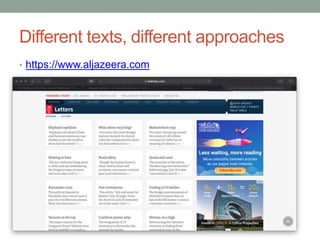
Different texts, different approaches
• https://www.aljazeera.com
Looking at/Learning from content
• “Sixty percent of all prime time television news is about
violent events”
• “Forty percent of news headlines refer to politicians”
• Seventy five percent of news stories have summary
leads.”
• The Times of India carried more editorials on climate
change than any other major newspaper in 2011.”
• Dalit issues are under-represented in mainstream media
content
• The four major newspapers take a soft line on
environmental issues
So what is content analysis?
• “systematic procedure …to examine the content of
recorded information” (Walizer & Wiener, 1978)
• “research technique for making replicable and valid
references from data to their context” (Krippendorf, 1980)
• “a method of studying and analyzing communication in a
systematic, objective and quantitative manner for the
purposes of measuring variables” (Kerlinger, 1986)
• “a class of methods at the intersection of quantitative and
qualitative traditions” (Duriau, Reger and Pfarrer 2007)
Types of Content Analysis
• Conceptual Analysis :
A concept is chosen for examination, and the analysis
involves quantifying and tallying its presence. The focus
here is on looking at the occurrence of selected terms
within a text. (Coverage of environmental issues in the
Times of India)
• Relational Analysis :
It begins with the act of identifying concepts present in
a given text or set to texts and seeks to go beyond
presence by exploring the relations between the
concepts identified. (editorial statements about Modi in
the ToI versus The Hindu)
Varieties of content analysis
• Quantitative
• Qualitative
• Textual analysis
• Semiotic analysis
• Discourse analysis
What is measured with CA?
• Content volume (length, duration)
• Content tone
• Medium variables
• Typography
• Layout
• Design
• Shot duration
• Camera angle
• Location
• Etc
• Both form and content are important (Neuendorf, 2002)
• Manifest and latent content
Uses of content analysis
• Describing communication content
• Testing hypotheses of message characteristics
• Comparing media content to the “real world”
• Assessing the image of particular groups in society
• Establishing a starting point (baseline) for studies of
media effects
The process
• Formulate the research question or hypothesis
• Define the population
• Select and define the unit of analysis
• Construct the categories of content for analysis
• Establish a system of quantification
• Test the coding method—pilot study
• Code the data and analyse it
• Draw conclusions based on the analysis
Defining the population for CA
• Question: What are the most common metaphors used for
love in popular film songs?
• What would be the population?
• How would you define it?
• This study looks at a sample from the top 20 Hindi songs
of each year from the decade 2000-2010.
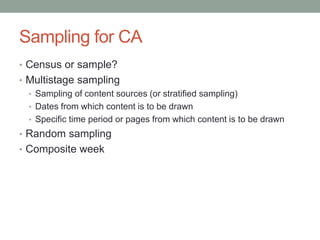
Sampling for CA
• Census or sample?
• Multistage sampling
• Sampling of content sources (or stratified sampling)
• Dates from which content is to be drawn
• Specific time period or pages from which content is to be drawn
• Random sampling
• Composite week
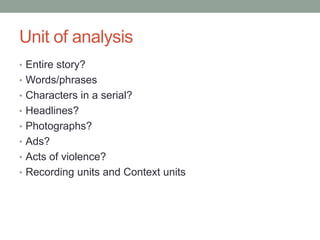
Unit of analysis
• Entire story?
• Words/phrases
• Characters in a serial?
• Headlines?
• Photographs?
• Ads?
• Acts of violence?
• Recording units and Context units
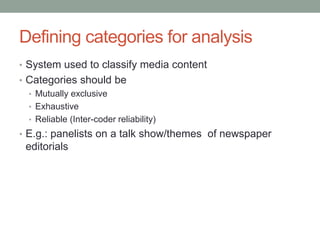
Defining categories for analysis
• System used to classify media content
• Categories should be
• Mutually exclusive
• Exhaustive
• Reliable (Inter-coder reliability)
• E.g.: panelists on a talk show/themes of newspaper
editorials
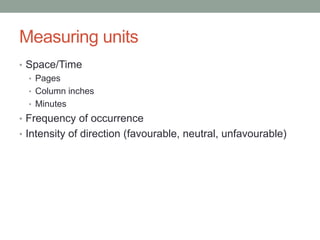
Measuring units
• Space/Time
• Pages
• Column inches
• Minutes
• Frequency of occurrence
• Intensity of direction (favourable, neutral, unfavourable)
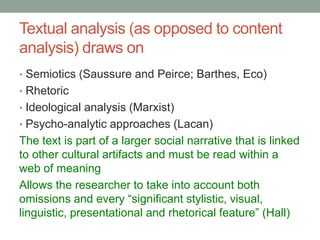
Textual analysis (as opposed to content
analysis) draws on
• Semiotics (Saussure and Peirce; Barthes, Eco)
• Rhetoric
• Ideological analysis (Marxist)
• Psycho-analytic approaches (Lacan)
The text is part of a larger social narrative that is linked
to other cultural artifacts and must be read within a
web of meaning
Allows the researcher to take into account both
omissions and every “significant stylistic, visual,
linguistic, presentational and rhetorical feature” (Hall)
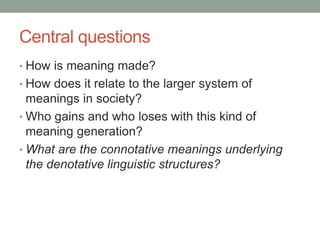
Central questions
• How is meaning made?
• How does it relate to the larger system of
meanings in society?
• Who gains and who loses with this kind of
meaning generation?
• What are the connotative meanings underlying
the denotative linguistic structures?
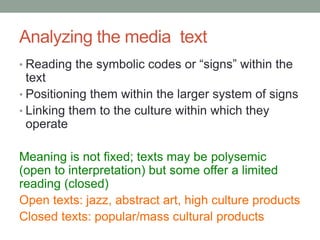
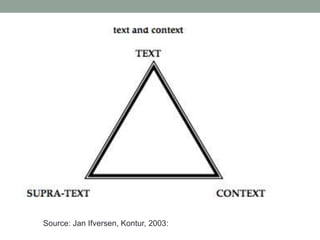
Analyzing the media text
• Reading the symbolic codes or “signs” within the
text
• Positioning them within the larger system of signs
• Linking them to the culture within which they
operate
Meaning is not fixed; texts may be polysemic
(open to interpretation) but some offer a limited
reading (closed)
Open texts: jazz, abstract art, high culture products
Closed texts: popular/mass cultural products
Source: Jan Ifversen, Kontur, 2003:
The purpose of textual analysis
• Meaning is subject to the same power relations
and struggles as other areas of social production
• Meanings within texts can be read as dominant
(preferred), negotiated, or oppositional (Stuart
Hall)
• Focuses on uncovering the “preferred” reading
The process—”close reading”
• Considers the textual features, rhetorical features
and the relationship of this text with other texts
• What modes of address are implied/used?—who
is the audience that is “written into” the text? Who
is the “ideal” reader for whom the text is written?
• Textual content—genre, syntagmatic forms (conceptual,
spatial and sequential relationships among elements)
• Social context—presence or absence of producer,
economic factors, etc
• Technological features—constraints of the medium
Ways of positioning the subject
• Interpellation—positioning receivers so that they
accept their place in discourse
• Point of view/Gaze—leading the receiver through
the writer’s eyes
• Intertextuality—reading the text in relation to/in
the knowledge of other texts in the culture
• By omission and commission, constructing the
“other” (Hall, others)
Deconstructing texts
• How is the subject created? (who is the consumer
for an ad, the reader for a news story?)
• What norms are reinforced by the text through
assumptions that render the intended message
“transparent”?
• What is the ideological positioning of the subject
in a realist text?
Let’s take a stab at it
• Hypothesis: The digital news organization Scroll.in has an
anti-government bias in its reporting
• Reportage is based on left-leaning and anti-establishment sources
• Language exhibits subtle bias
• Content analysis (qualitative or quantitative?) or textual
analysis?
• Operationalising variables
• Deciding on the population for study
• Sampling
Acknowledgement and Feedback
• The MOOC on Academic Writing which is a SWAYAM
initiative sponsored by UGC (MHRD) is a much needed
course to not only introduce people to the art of academic
writing to native and non native speakers, but also hone
their skills as researchers.
• It is a step by step guide for researches, teachers and
even younger students.
• It touches every corner of not only academic writing, but
also the field of academics.
• As per my knowledge, this is the first ever initiative of its
kind.
• The job done by Dr. Ajay Semalty and his team is
conmendable.
References and Further Readings
• References:
• Alan., Bryman (2011). Business research methods. Bell, Emma, 1968- (3rd ed.).
Cambridge: Oxford University Press. ISBN 9780199583409. OCLC 746155102.
• Hodder, I. (1994). The interpretation of documents and material culture. Thousand
Oaks etc.: Sage. p. 155. ISBN 978-0761926870.
• Further Readings:
• Budge, Ian (ed.) (2001). Mapping Policy Preferences. Estimates for Parties,
Electors and Governments 1945-1998. Oxford, UK: Oxford University Press.
ISBN 978-0199244003.
• Krippendorff, Klaus, and Bock, Mary Angela (eds) (2008). The Content Analysis
Reader. Thousand Oaks, CA: Sage. ISBN 978-1412949668.
• Roberts, Carl W. (ed.) (1997). Text Analysis for the Social Sciences: Methods for
Drawing Inferences from Texts and Transcripts. Mahwah, NJ: Lawrence Erlbaum.
ISBN 978-0805817348.

Content analysis

  • 1.
    SUBJECTIVE ASSIGNMENT 2on Content Analysis (Academic Writing) (UGC) • Course Code: ugc19_ge03 • Course Title/Name: Academic Writing (AW) • Name: Deepak S Mewada • Affiliation: Research Scholar at H.N.B. Garhwal University • Application Number: 3bd48982e4eb11e989c0371ff469a0ec
  • 2.
    ANALYZING CONTENT GETTING TOUNDERLYING MEANINGS
  • 3.
    WHAT (AND WHERE)IS “CONTENT”? • Words • Text (printed, digital, spoken) • Images • Still • Moving • Sounds • Verbal • Non verbal • Music A question for you--Where do we find “content”?
  • 4.
    Different texts, differentapproaches • https://www.aljazeera.com
  • 5.
    Looking at/Learning fromcontent • “Sixty percent of all prime time television news is about violent events” • “Forty percent of news headlines refer to politicians” • Seventy five percent of news stories have summary leads.” • The Times of India carried more editorials on climate change than any other major newspaper in 2011.” • Dalit issues are under-represented in mainstream media content • The four major newspapers take a soft line on environmental issues
  • 6.
    So what iscontent analysis? • “systematic procedure …to examine the content of recorded information” (Walizer & Wiener, 1978) • “research technique for making replicable and valid references from data to their context” (Krippendorf, 1980) • “a method of studying and analyzing communication in a systematic, objective and quantitative manner for the purposes of measuring variables” (Kerlinger, 1986) • “a class of methods at the intersection of quantitative and qualitative traditions” (Duriau, Reger and Pfarrer 2007)
  • 7.
    Types of ContentAnalysis • Conceptual Analysis : A concept is chosen for examination, and the analysis involves quantifying and tallying its presence. The focus here is on looking at the occurrence of selected terms within a text. (Coverage of environmental issues in the Times of India) • Relational Analysis : It begins with the act of identifying concepts present in a given text or set to texts and seeks to go beyond presence by exploring the relations between the concepts identified. (editorial statements about Modi in the ToI versus The Hindu)
  • 8.
    Varieties of contentanalysis • Quantitative • Qualitative • Textual analysis • Semiotic analysis • Discourse analysis
  • 9.
    What is measuredwith CA? • Content volume (length, duration) • Content tone • Medium variables • Typography • Layout • Design • Shot duration • Camera angle • Location • Etc • Both form and content are important (Neuendorf, 2002) • Manifest and latent content
  • 10.
    Uses of contentanalysis • Describing communication content • Testing hypotheses of message characteristics • Comparing media content to the “real world” • Assessing the image of particular groups in society • Establishing a starting point (baseline) for studies of media effects
  • 11.
    The process • Formulatethe research question or hypothesis • Define the population • Select and define the unit of analysis • Construct the categories of content for analysis • Establish a system of quantification • Test the coding method—pilot study • Code the data and analyse it • Draw conclusions based on the analysis
  • 12.
    Defining the populationfor CA • Question: What are the most common metaphors used for love in popular film songs? • What would be the population? • How would you define it? • This study looks at a sample from the top 20 Hindi songs of each year from the decade 2000-2010.
  • 13.
    Sampling for CA •Census or sample? • Multistage sampling • Sampling of content sources (or stratified sampling) • Dates from which content is to be drawn • Specific time period or pages from which content is to be drawn • Random sampling • Composite week
  • 14.
    Unit of analysis •Entire story? • Words/phrases • Characters in a serial? • Headlines? • Photographs? • Ads? • Acts of violence? • Recording units and Context units
  • 15.
    Defining categories foranalysis • System used to classify media content • Categories should be • Mutually exclusive • Exhaustive • Reliable (Inter-coder reliability) • E.g.: panelists on a talk show/themes of newspaper editorials
  • 16.
    Measuring units • Space/Time •Pages • Column inches • Minutes • Frequency of occurrence • Intensity of direction (favourable, neutral, unfavourable)
  • 17.
    Textual analysis (asopposed to content analysis) draws on • Semiotics (Saussure and Peirce; Barthes, Eco) • Rhetoric • Ideological analysis (Marxist) • Psycho-analytic approaches (Lacan) The text is part of a larger social narrative that is linked to other cultural artifacts and must be read within a web of meaning Allows the researcher to take into account both omissions and every “significant stylistic, visual, linguistic, presentational and rhetorical feature” (Hall)
  • 18.
    Central questions • Howis meaning made? • How does it relate to the larger system of meanings in society? • Who gains and who loses with this kind of meaning generation? • What are the connotative meanings underlying the denotative linguistic structures?
  • 19.
    Analyzing the mediatext • Reading the symbolic codes or “signs” within the text • Positioning them within the larger system of signs • Linking them to the culture within which they operate Meaning is not fixed; texts may be polysemic (open to interpretation) but some offer a limited reading (closed) Open texts: jazz, abstract art, high culture products Closed texts: popular/mass cultural products
  • 20.
    Source: Jan Ifversen,Kontur, 2003:
  • 21.
    The purpose oftextual analysis • Meaning is subject to the same power relations and struggles as other areas of social production • Meanings within texts can be read as dominant (preferred), negotiated, or oppositional (Stuart Hall) • Focuses on uncovering the “preferred” reading
  • 22.
    The process—”close reading” •Considers the textual features, rhetorical features and the relationship of this text with other texts • What modes of address are implied/used?—who is the audience that is “written into” the text? Who is the “ideal” reader for whom the text is written? • Textual content—genre, syntagmatic forms (conceptual, spatial and sequential relationships among elements) • Social context—presence or absence of producer, economic factors, etc • Technological features—constraints of the medium
  • 23.
    Ways of positioningthe subject • Interpellation—positioning receivers so that they accept their place in discourse • Point of view/Gaze—leading the receiver through the writer’s eyes • Intertextuality—reading the text in relation to/in the knowledge of other texts in the culture • By omission and commission, constructing the “other” (Hall, others)
  • 24.
    Deconstructing texts • Howis the subject created? (who is the consumer for an ad, the reader for a news story?) • What norms are reinforced by the text through assumptions that render the intended message “transparent”? • What is the ideological positioning of the subject in a realist text?
  • 25.
    Let’s take astab at it • Hypothesis: The digital news organization Scroll.in has an anti-government bias in its reporting • Reportage is based on left-leaning and anti-establishment sources • Language exhibits subtle bias • Content analysis (qualitative or quantitative?) or textual analysis? • Operationalising variables • Deciding on the population for study • Sampling
  • 26.
    Acknowledgement and Feedback •The MOOC on Academic Writing which is a SWAYAM initiative sponsored by UGC (MHRD) is a much needed course to not only introduce people to the art of academic writing to native and non native speakers, but also hone their skills as researchers. • It is a step by step guide for researches, teachers and even younger students. • It touches every corner of not only academic writing, but also the field of academics. • As per my knowledge, this is the first ever initiative of its kind. • The job done by Dr. Ajay Semalty and his team is conmendable.
  • 27.
    References and FurtherReadings • References: • Alan., Bryman (2011). Business research methods. Bell, Emma, 1968- (3rd ed.). Cambridge: Oxford University Press. ISBN 9780199583409. OCLC 746155102. • Hodder, I. (1994). The interpretation of documents and material culture. Thousand Oaks etc.: Sage. p. 155. ISBN 978-0761926870. • Further Readings: • Budge, Ian (ed.) (2001). Mapping Policy Preferences. Estimates for Parties, Electors and Governments 1945-1998. Oxford, UK: Oxford University Press. ISBN 978-0199244003. • Krippendorff, Klaus, and Bock, Mary Angela (eds) (2008). The Content Analysis Reader. Thousand Oaks, CA: Sage. ISBN 978-1412949668. • Roberts, Carl W. (ed.) (1997). Text Analysis for the Social Sciences: Methods for Drawing Inferences from Texts and Transcripts. Mahwah, NJ: Lawrence Erlbaum. ISBN 978-0805817348.