31-oct-2022
Contemporary Systems Engineering
Anatoly Levenchuk
Head of Science, EEM Institute
Director for research, INCOSE RUS
https://eem.institute/
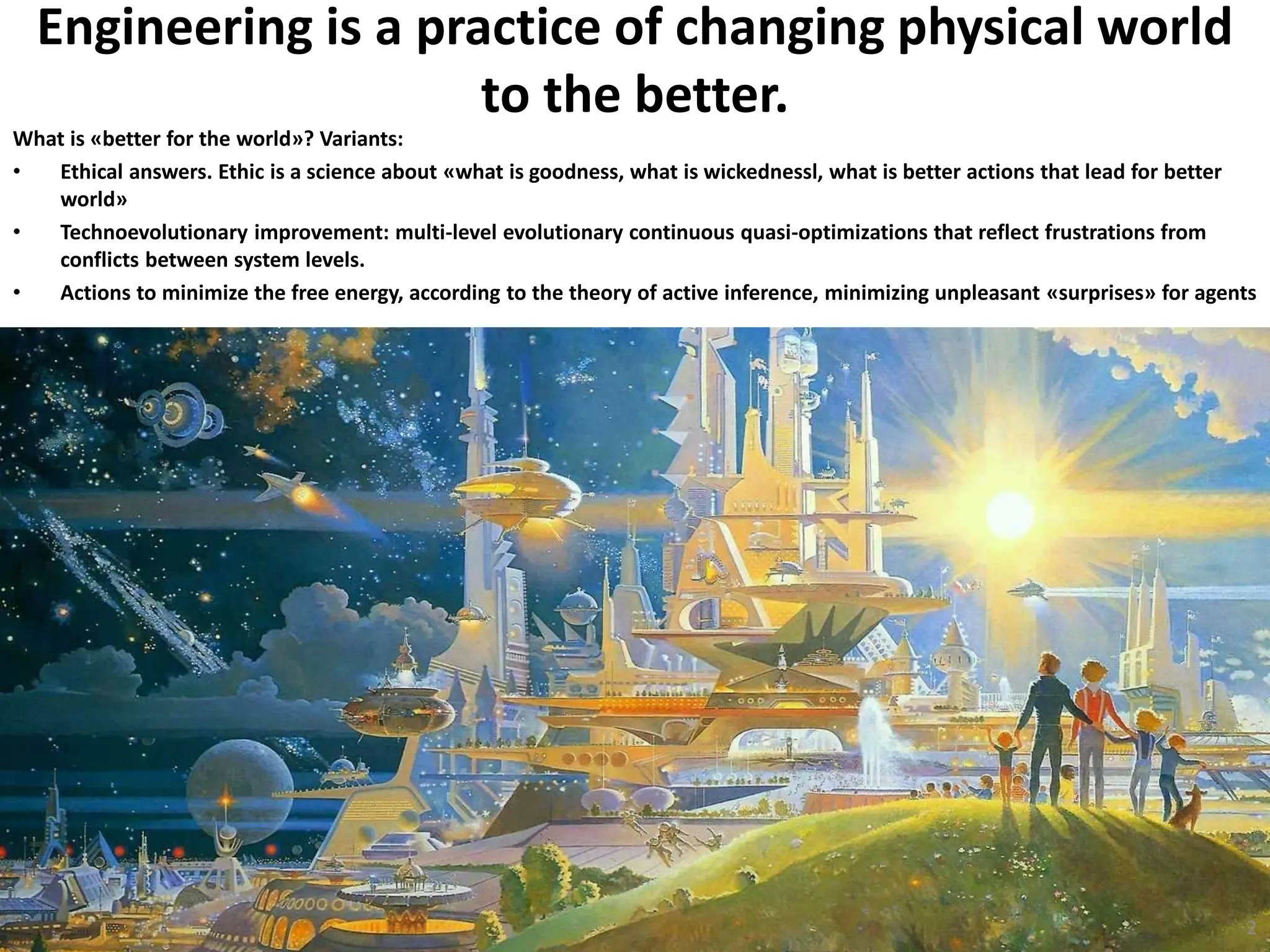
Engineering is a practice of changing physical world
to the better.
What is «better for the world»? Variants:
• Ethical answers. Ethic is a science about «what is goodness, what is wickednessl, what is better actions that lead for better
world»
• Technoevolutionary improvement: multi-level evolutionary continuous quasi-optimizations that reflect frustrations from
conflicts between system levels.
• Actions to minimize the free energy, according to the theory of active inference, minimizing unpleasant «surprises» for agents
2
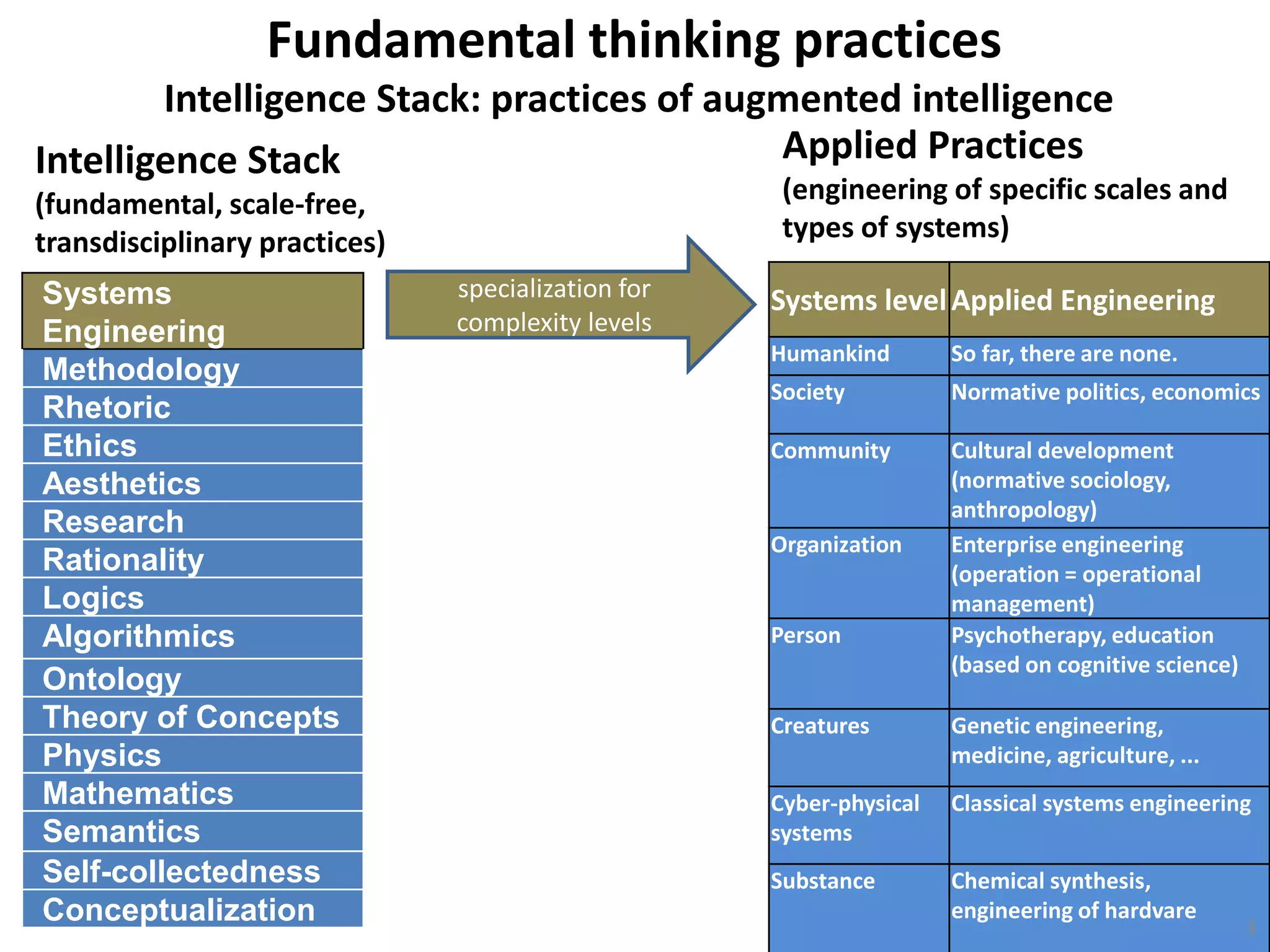
Systems
Engineering
Methodology
Rhetoric
Ethics
Aesthetics
Research
Rationality
Logics
Algorithmics
Ontology
Theory of Concepts
Physics
Mathematics
Semantics
Self-collectedness
Conceptualization
Fundamental thinking practices
Intelligence Stack: practices of augmented intelligence
Systems levelApplied Engineering
Humankind So far, there are none.
Society Normative politics, economics
Community Cultural development
(normative sociology,
anthropology)
Organization Enterprise engineering
(operation = operational
management)
Person Psychotherapy, education
(based on cognitive science)
Creatures Genetic engineering,
medicine, agriculture, ...
Cyber-physical
systems
Classical systems engineering
Substance Chemical synthesis,
engineering of hardvare
specialization for
complexity levels
Intelligence Stack
(fundamental, scale-free,
transdisciplinary practices)
3
Applied Practices
(engineering of specific scales and
types of systems)
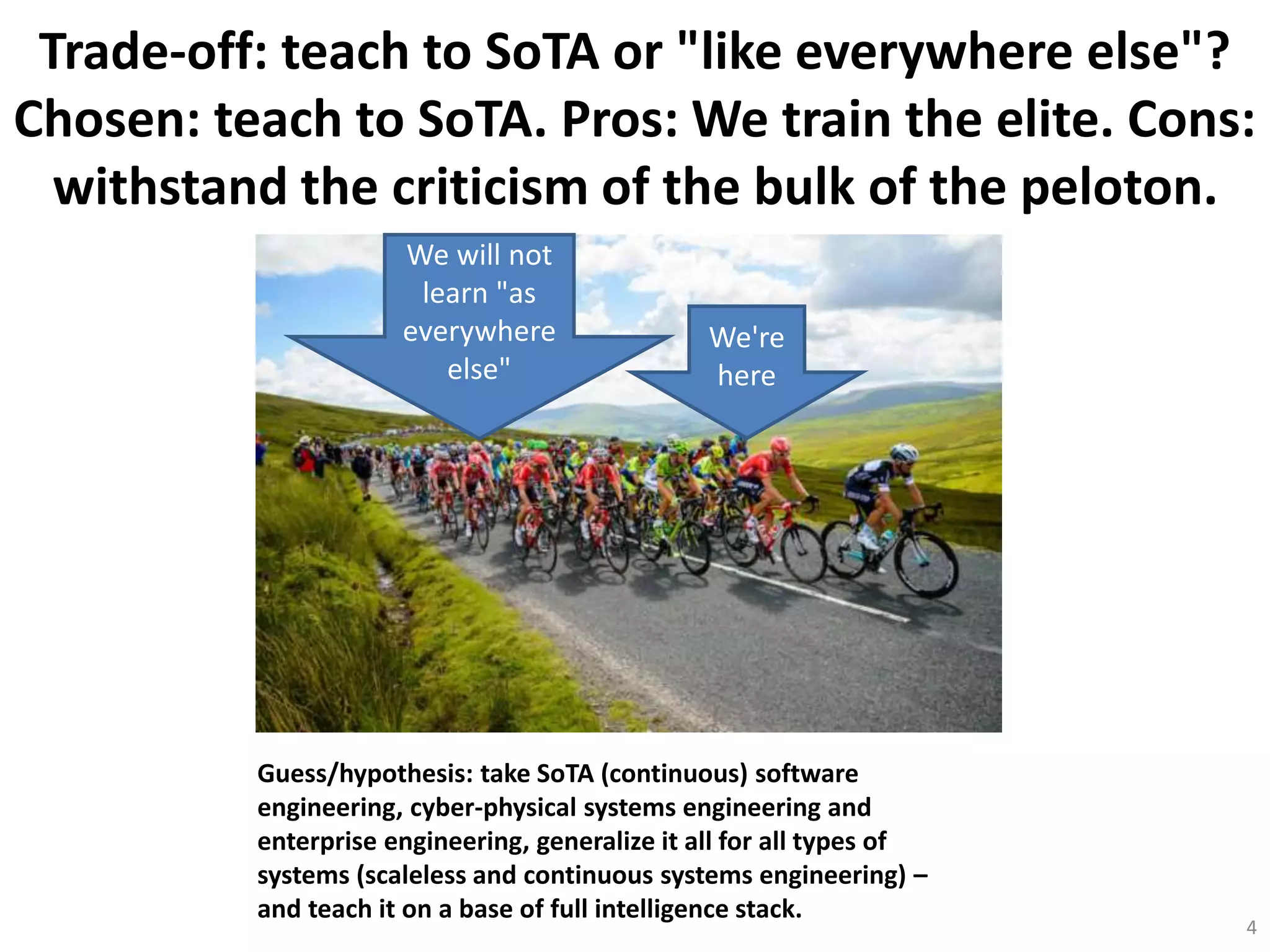
Trade-off: teach to SoTA or "like everywhere else"?
Chosen: teach to SoTA. Pros: We train the elite. Cons:
withstand the criticism of the bulk of the peloton.
4
We're
here
We will not
learn "as
everywhere
else"
Guess/hypothesis: take SoTA (continuous) software
engineering, cyber-physical systems engineering and
enterprise engineering, generalize it all for all types of
systems (scaleless and continuous systems engineering) –
and teach it on a base of full intelligence stack.
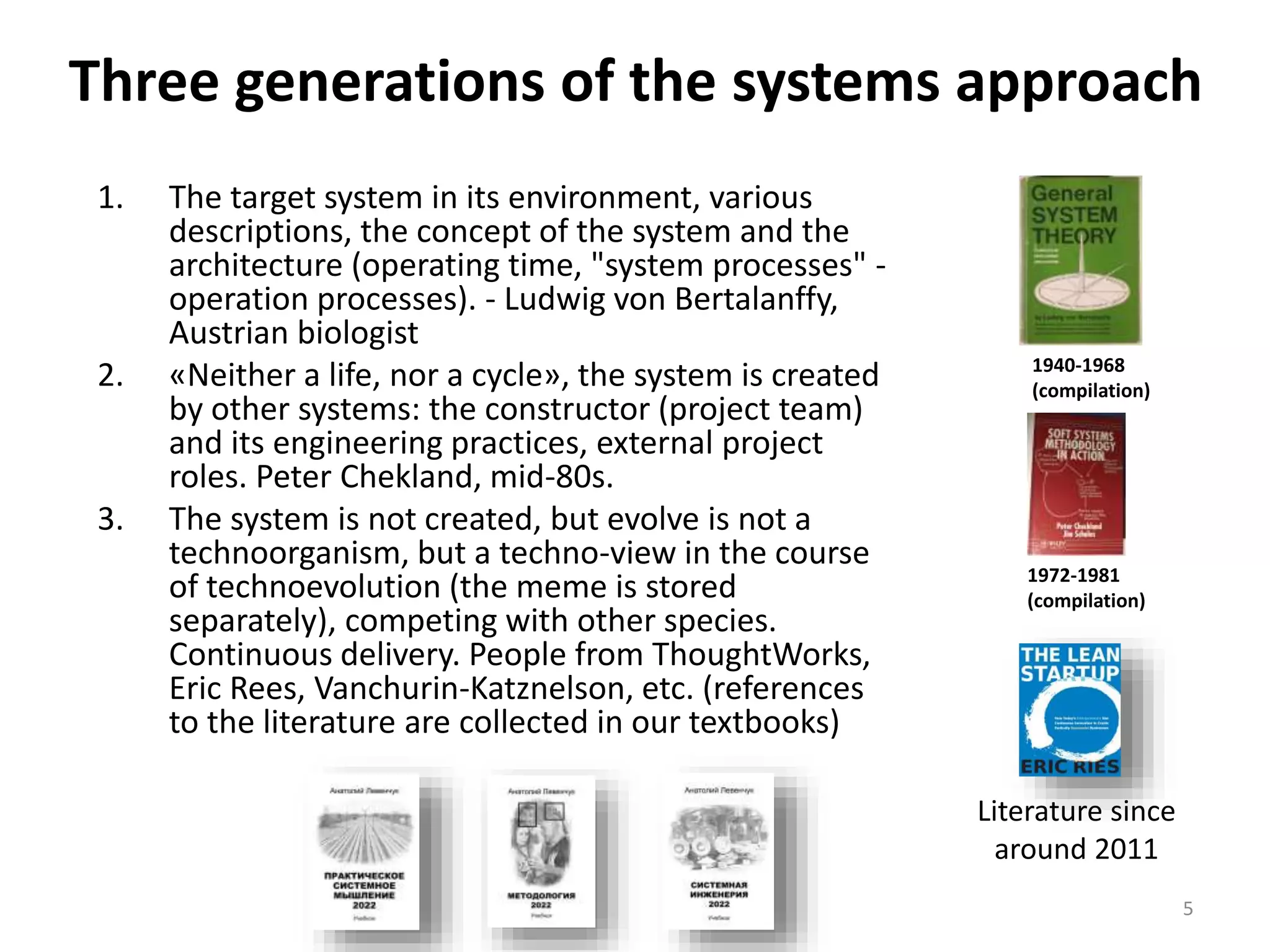
Three generations of the systems approach
1. The target system in its environment, various
descriptions, the concept of the system and the
architecture (operating time, "system processes" -
operation processes). - Ludwig von Bertalanffy,
Austrian biologist
2. «Neither a life, nor a cycle», the system is created
by other systems: the constructor (project team)
and its engineering practices, external project
roles. Peter Chekland, mid-80s.
3. The system is not created, but evolve is not a
technoorganism, but a techno-view in the course
of technoevolution (the meme is stored
separately), competing with other species.
Continuous delivery. People from ThoughtWorks,
Eric Rees, Vanchurin-Katznelson, etc. (references
to the literature are collected in our textbooks)
5
1940-1968
(compilation)
1972-1981
(compilation)
Literature since
around 2011
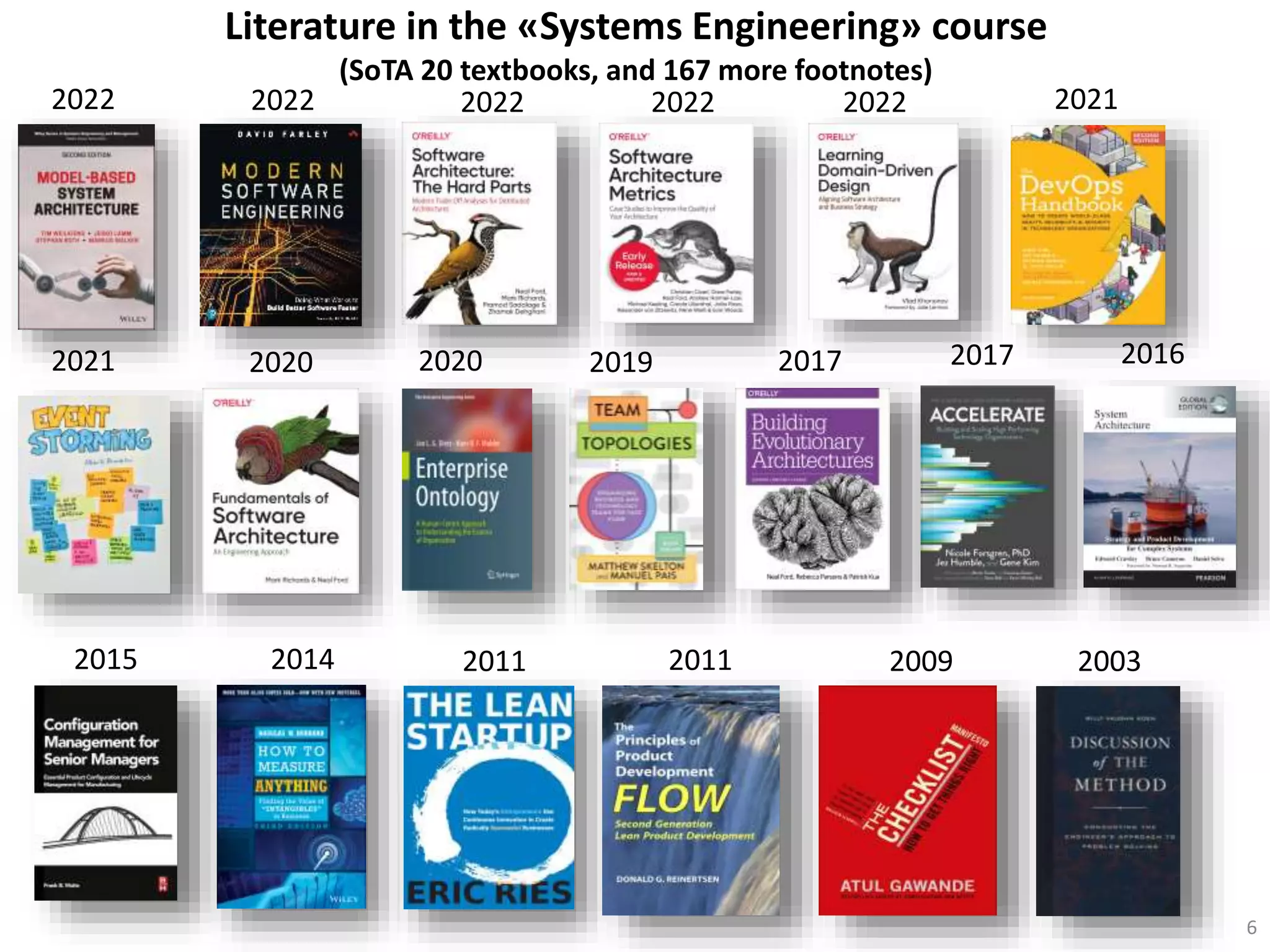
6
2003
2022
2016
2022
2021 2020
2022
2020 2017
2019
2011
2017
2022
2014
2022 2021
2015 2009
2011
Literature in the «Systems Engineering» course
(SoTA 20 textbooks, and 167 more footnotes)
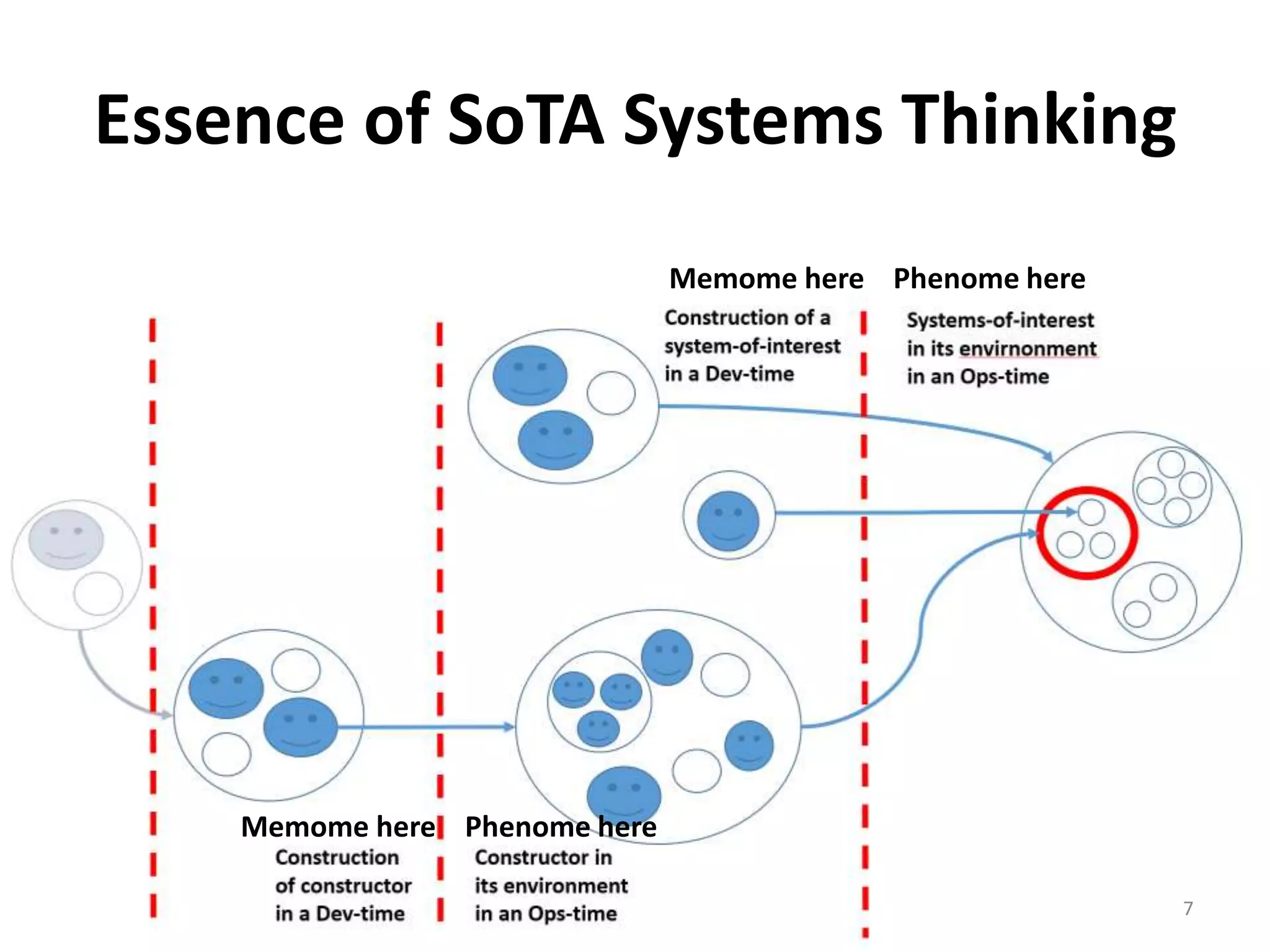
Essence of SoTA Systems Thinking
7
Memome here
Phenome here
Phenome here
Memome here
Test for the presence of systems thinking
• Systematic is not systemic
• System thinking is the use of the concepts of systems
approach for conceptual attention aiming and locking at
important objects in activity / practice / labour /
engineering.
• If there are system levels (suprasystem-system-
subsystem) used in reasoning, then systems thinking at
presence. If not, then it's reductionism or holism:
ignoring emergence or the inevitable conflicts that lead
to frustrations.
• An example where there is no systems thinking: "A
building is made of bricks": truth, but useless truth. The
building is conveniently considered to consist of walls,
not bricks. And the walls are made of bricks, one more
system level.
8
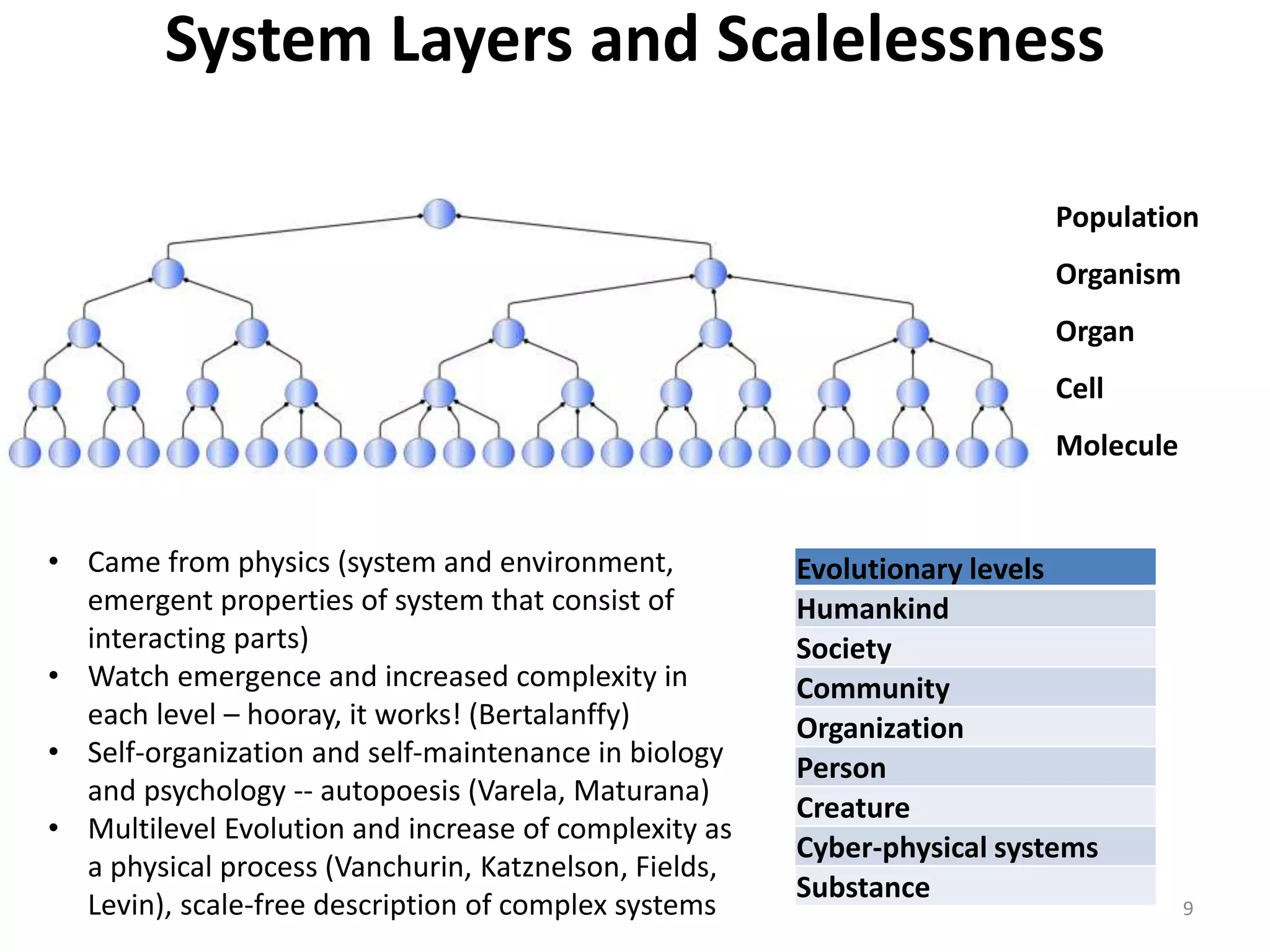
System Layers and Scalelessness
9
Evolutionary levels
Humankind
Society
Community
Organization
Person
Creature
Cyber-physical systems
Substance
• Came from physics (system and environment,
emergent properties of system that consist of
interacting parts)
• Watch emergence and increased complexity in
each level – hooray, it works! (Bertalanffy)
• Self-organization and self-maintenance in biology
and psychology -- autopoesis (Varela, Maturana)
• Multilevel Evolution and increase of complexity as
a physical process (Vanchurin, Katznelson, Fields,
Levin), scale-free description of complex systems
Population
Organism
Organ
Cell
Molecule
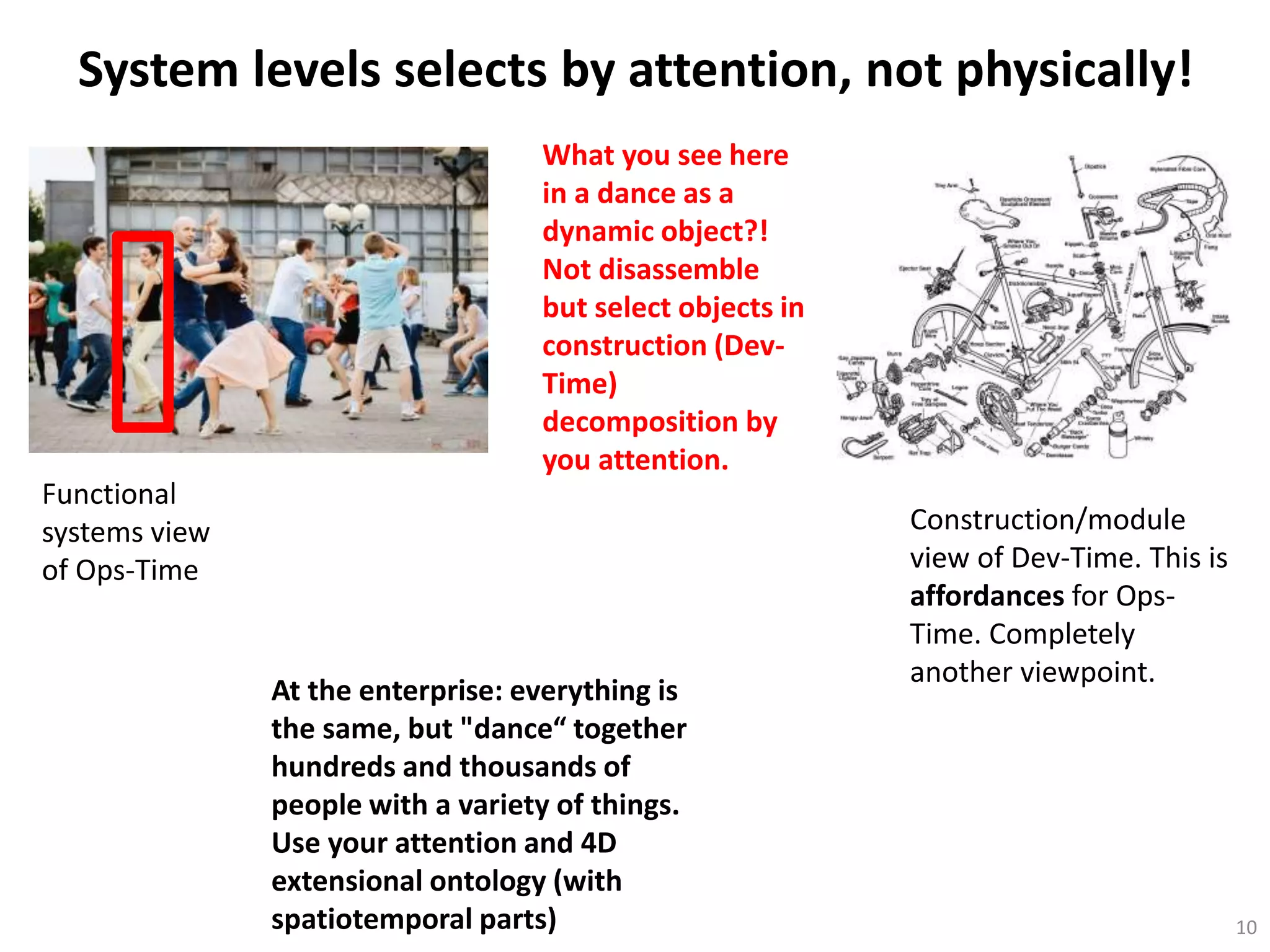
System levels selects by attention, not physically!
10
At the enterprise: everything is
the same, but "dance“ together
hundreds and thousands of
people with a variety of things.
Use your attention and 4D
extensional ontology (with
spatiotemporal parts)
Functional
systems view
of Ops-Time
Construction/module
view of Dev-Time. This is
affordances for Ops-
Time. Completely
another viewpoint.
What you see here
in a dance as a
dynamic object?!
Not disassemble
but select objects in
construction (Dev-
Time)
decomposition by
you attention.
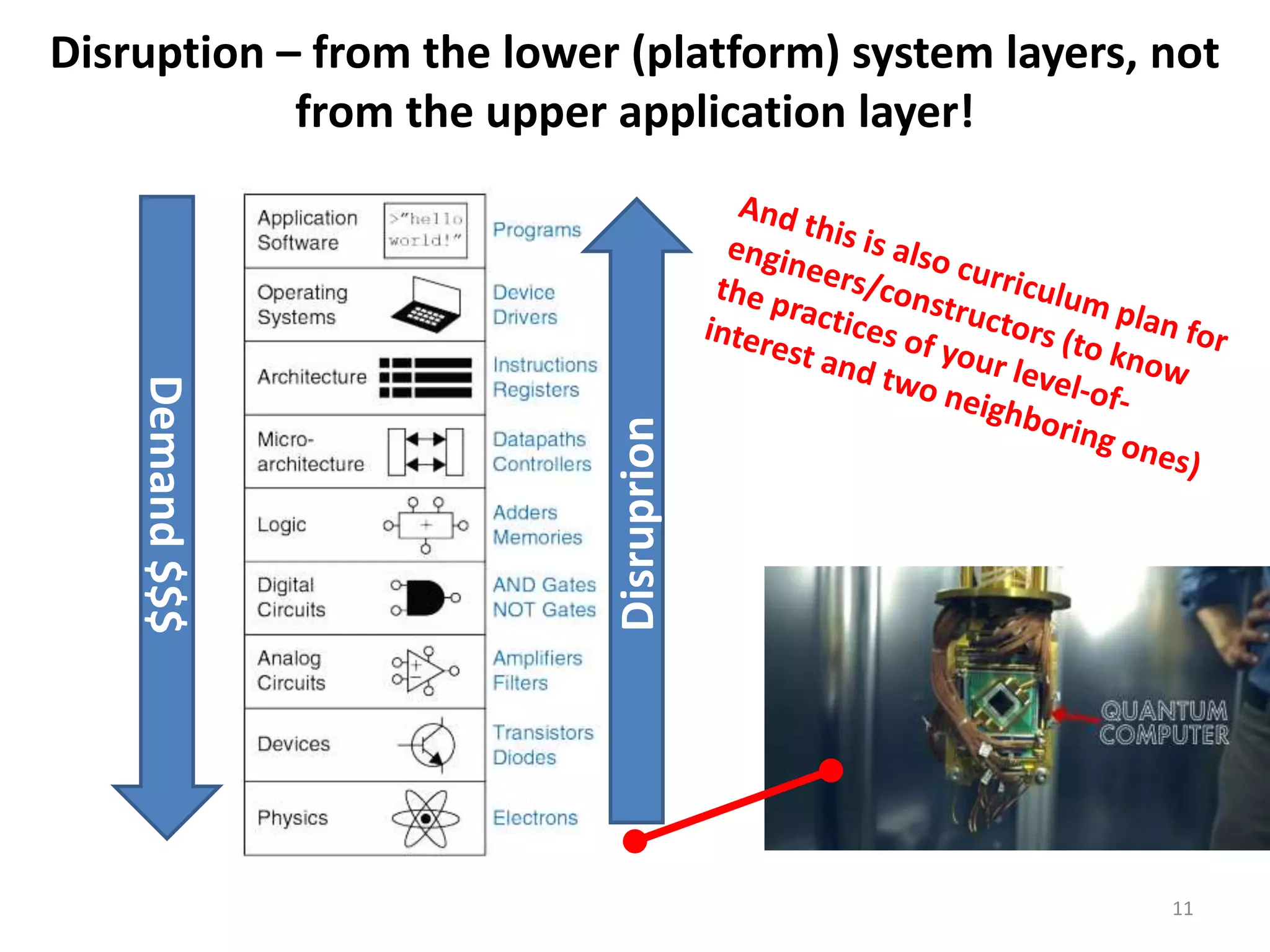
Disruption – from the lower (platform) system layers, not
from the upper application layer!
11
Disruprion
Demand
$$$
MBSE: no need for a term.
Simply «Engineering»
12
2018 Boeing MBE diamond diagram
[now: for MVP than increments, no life cycle]
• Non-systems engineering already not exist
• Non-model-based engineering already not exist (but not with SysML language!)
• Life cycle vanished as viable concept (continuous everything: only MVP and
increments, all guesses, not requirements)
• No retirement phase (continuous everything)
• Digital twins, digital thread, digital engineering – modeling reaches operations
• AI will disrupt all of this
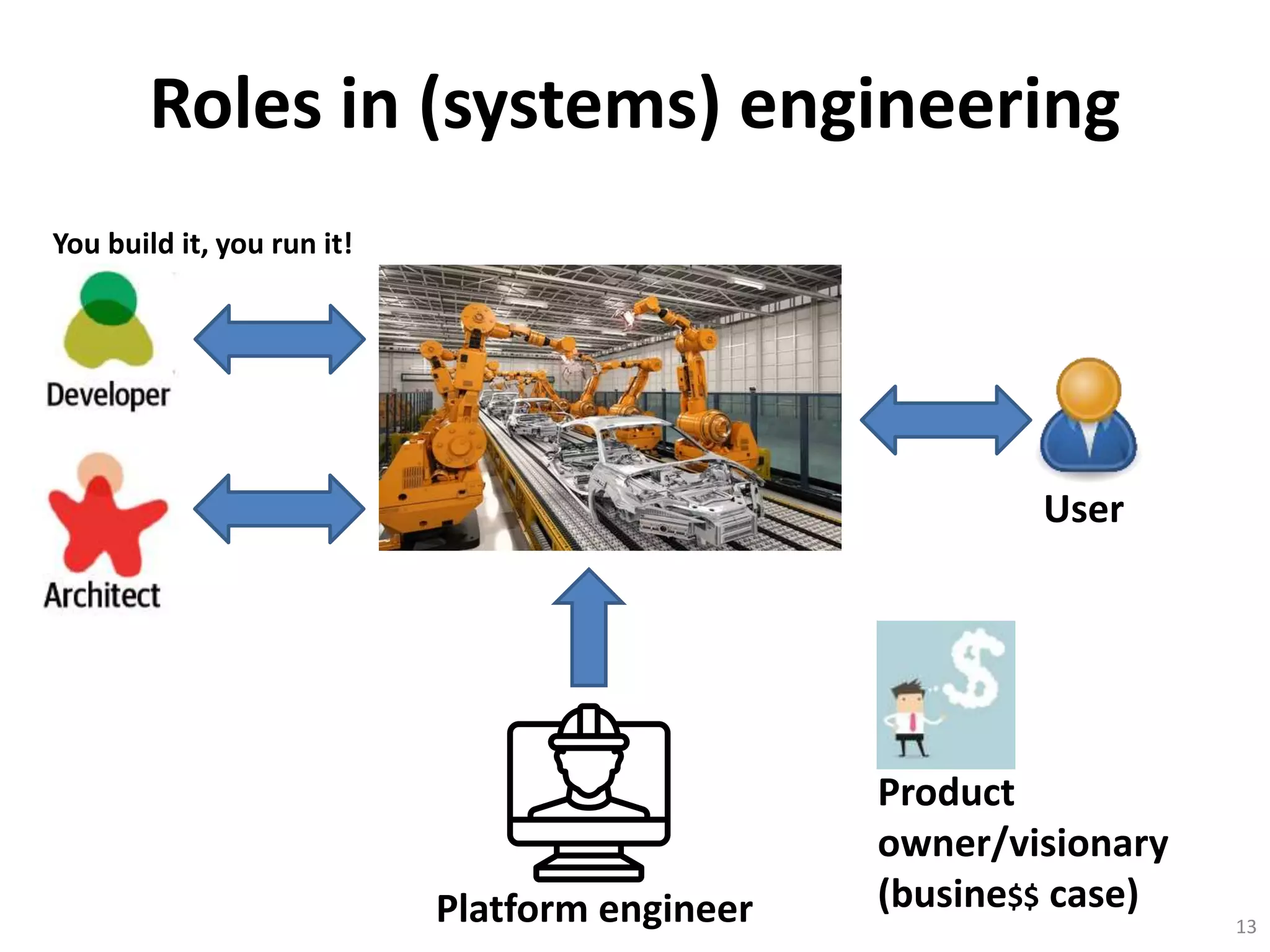
Roles in (systems) engineering
13
User
Platform engineer
You build it, you run it!
Product
owner/visionary
(busine$$ case)
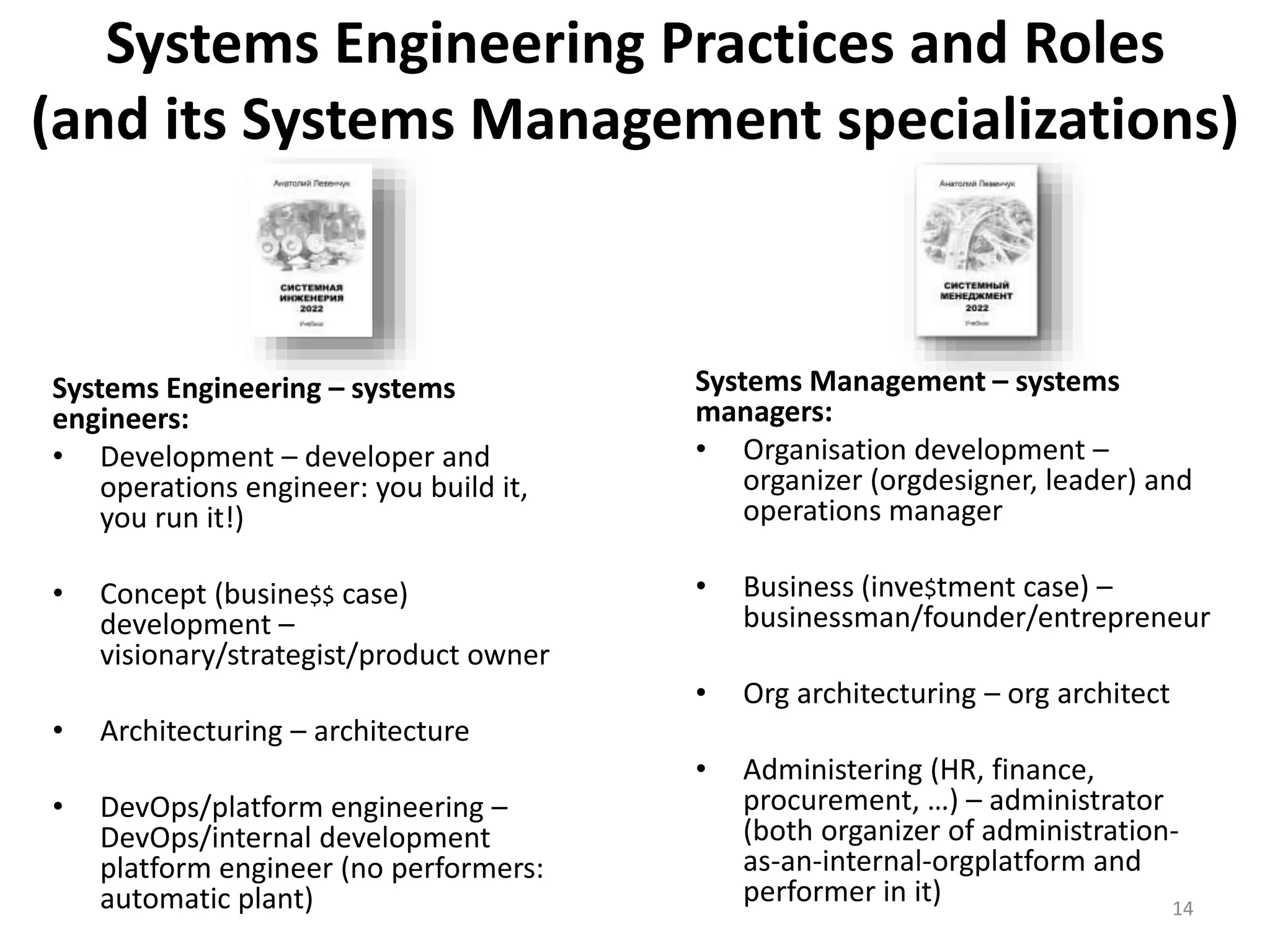
Systems Engineering Practices and Roles
(and its Systems Management specializations)
Systems Engineering – systems
engineers:
• Development – developer and
operations engineer: you build it,
you run it!)
• Concept (busine$$ case)
development –
visionary/strategist/product owner
• Architecturing – architecture
• DevOps/platform engineering –
DevOps/internal development
platform engineer (no performers:
automatic plant)
Systems Management – systems
managers:
• Organisation development –
organizer (orgdesigner, leader) and
operations manager
• Business (inve$tment case) –
businessman/founder/entrepreneur
• Org architecturing – org architect
• Administering (HR, finance,
procurement, …) – administrator
(both organizer of administration-
as-an-internal-orgplatform and
performer in it) 14
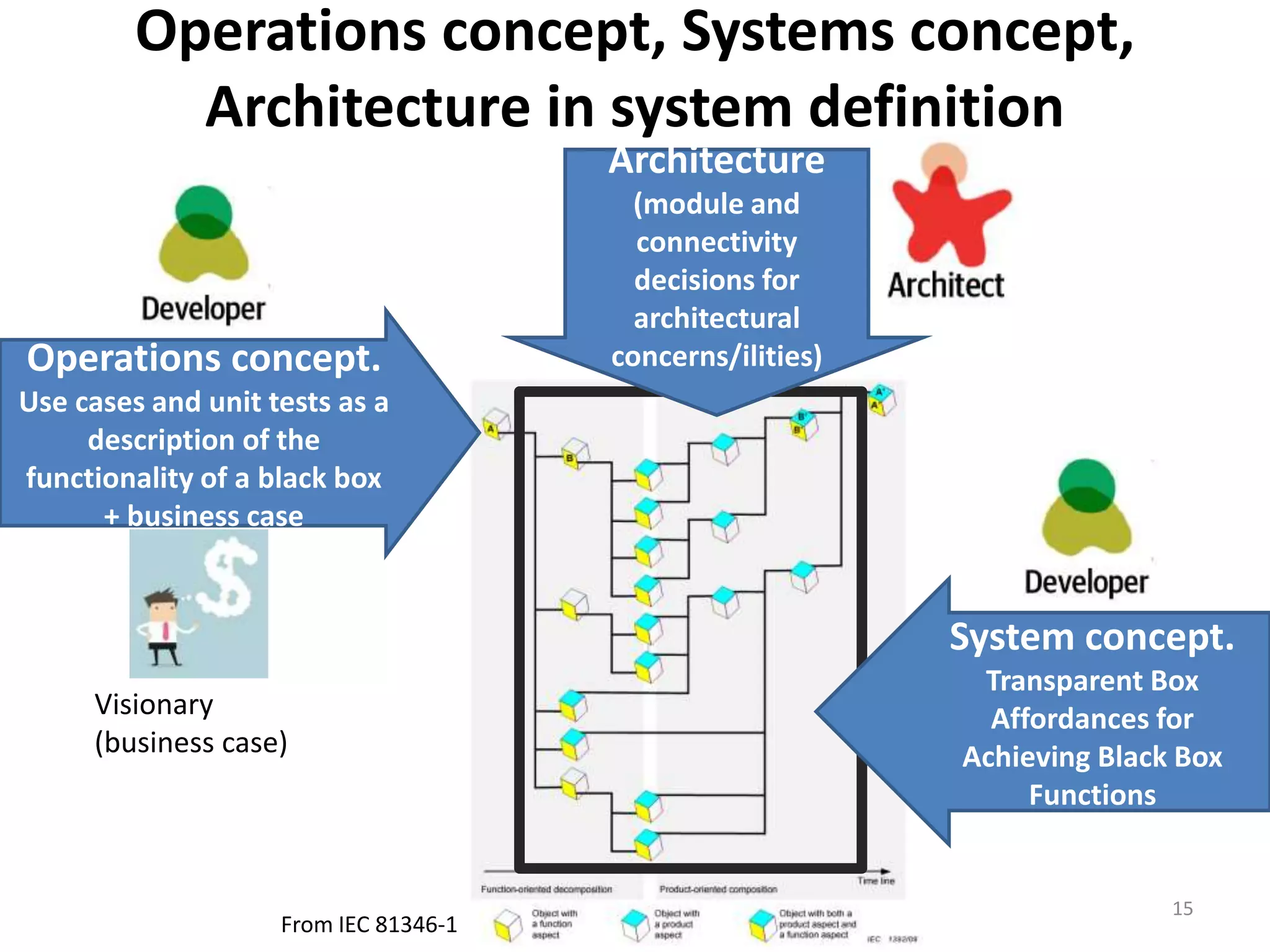
Operations concept, Systems concept,
Architecture in system definition
15
Operations concept.
Use cases and unit tests as a
description of the
functionality of a black box
+ business case
System concept.
Transparent Box
Affordances for
Achieving Black Box
Functions
Architecture
(module and
connectivity
decisions for
architectural
concerns/ilities)
Visionary
(business case)
From IEC 81346-1
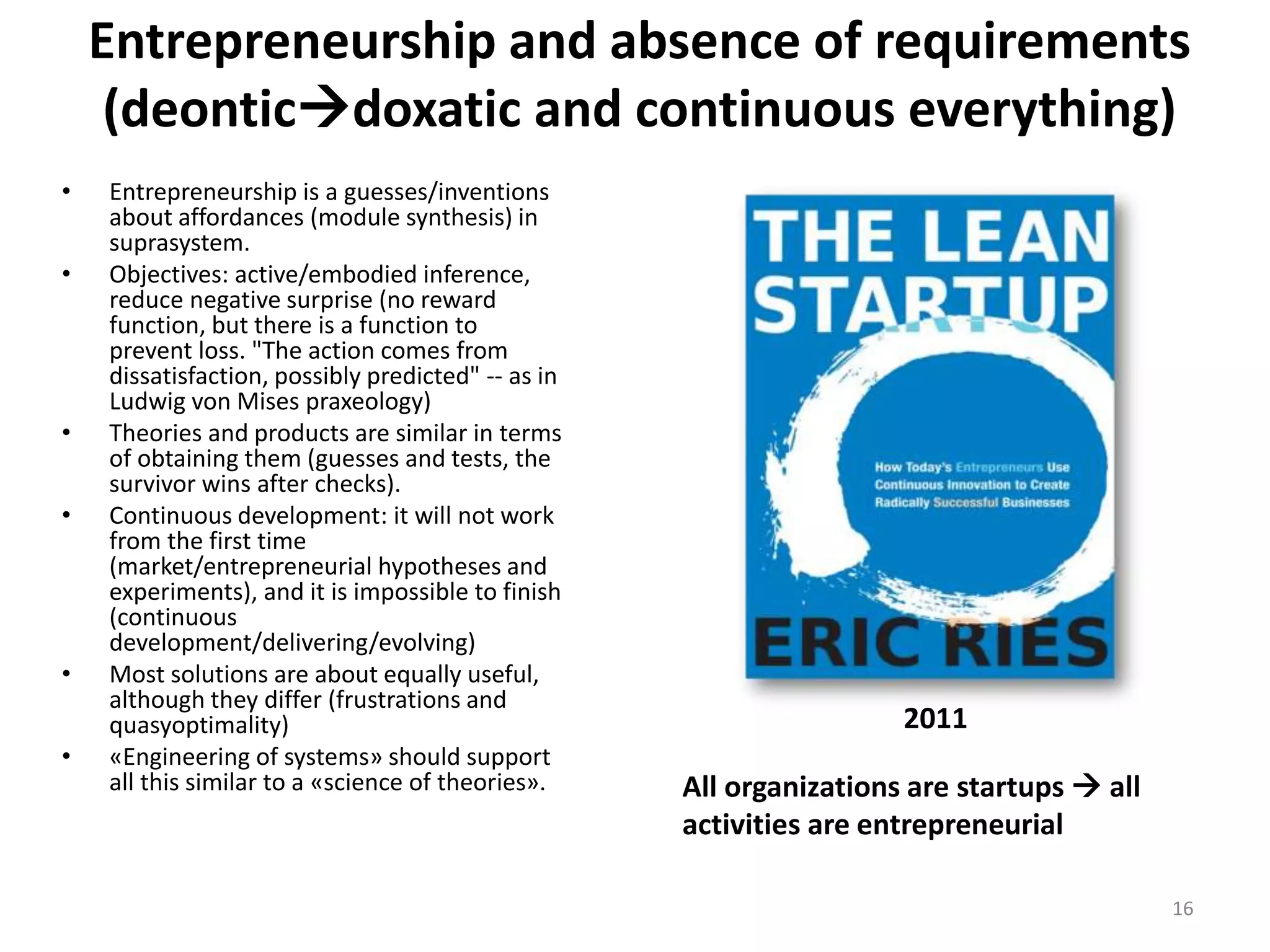
Entrepreneurship and absence of requirements
(deonticdoxatic and continuous everything)
• Entrepreneurship is a guesses/inventions
about affordances (module synthesis) in
suprasystem.
• Objectives: active/embodied inference,
reduce negative surprise (no reward
function, but there is a function to
prevent loss. "The action comes from
dissatisfaction, possibly predicted" -- as in
Ludwig von Mises praxeology)
• Theories and products are similar in terms
of obtaining them (guesses and tests, the
survivor wins after checks).
• Continuous development: it will not work
from the first time
(market/entrepreneurial hypotheses and
experiments), and it is impossible to finish
(continuous
development/delivering/evolving)
• Most solutions are about equally useful,
although they differ (frustrations and
quasyoptimality)
• «Engineering of systems» should support
all this similar to a «science of theories».
16
All organizations are startups  all
activities are entrepreneurial
2011
17
Thank you for your
attention
Anatoly Levenchuk
https://www.linkedin.com/in/ailev/

Contemporary Systems Engineering (oct 2022)

  • 1.
    31-oct-2022 Contemporary Systems Engineering AnatolyLevenchuk Head of Science, EEM Institute Director for research, INCOSE RUS https://eem.institute/
  • 2.
    Engineering is apractice of changing physical world to the better. What is «better for the world»? Variants: • Ethical answers. Ethic is a science about «what is goodness, what is wickednessl, what is better actions that lead for better world» • Technoevolutionary improvement: multi-level evolutionary continuous quasi-optimizations that reflect frustrations from conflicts between system levels. • Actions to minimize the free energy, according to the theory of active inference, minimizing unpleasant «surprises» for agents 2
  • 3.
    Systems Engineering Methodology Rhetoric Ethics Aesthetics Research Rationality Logics Algorithmics Ontology Theory of Concepts Physics Mathematics Semantics Self-collectedness Conceptualization Fundamentalthinking practices Intelligence Stack: practices of augmented intelligence Systems levelApplied Engineering Humankind So far, there are none. Society Normative politics, economics Community Cultural development (normative sociology, anthropology) Organization Enterprise engineering (operation = operational management) Person Psychotherapy, education (based on cognitive science) Creatures Genetic engineering, medicine, agriculture, ... Cyber-physical systems Classical systems engineering Substance Chemical synthesis, engineering of hardvare specialization for complexity levels Intelligence Stack (fundamental, scale-free, transdisciplinary practices) 3 Applied Practices (engineering of specific scales and types of systems)
  • 4.
    Trade-off: teach toSoTA or "like everywhere else"? Chosen: teach to SoTA. Pros: We train the elite. Cons: withstand the criticism of the bulk of the peloton. 4 We're here We will not learn "as everywhere else" Guess/hypothesis: take SoTA (continuous) software engineering, cyber-physical systems engineering and enterprise engineering, generalize it all for all types of systems (scaleless and continuous systems engineering) – and teach it on a base of full intelligence stack.
  • 5.
    Three generations ofthe systems approach 1. The target system in its environment, various descriptions, the concept of the system and the architecture (operating time, "system processes" - operation processes). - Ludwig von Bertalanffy, Austrian biologist 2. «Neither a life, nor a cycle», the system is created by other systems: the constructor (project team) and its engineering practices, external project roles. Peter Chekland, mid-80s. 3. The system is not created, but evolve is not a technoorganism, but a techno-view in the course of technoevolution (the meme is stored separately), competing with other species. Continuous delivery. People from ThoughtWorks, Eric Rees, Vanchurin-Katznelson, etc. (references to the literature are collected in our textbooks) 5 1940-1968 (compilation) 1972-1981 (compilation) Literature since around 2011
  • 6.
    6 2003 2022 2016 2022 2021 2020 2022 2020 2017 2019 2011 2017 2022 2014 20222021 2015 2009 2011 Literature in the «Systems Engineering» course (SoTA 20 textbooks, and 167 more footnotes)
  • 7.
    Essence of SoTASystems Thinking 7 Memome here Phenome here Phenome here Memome here
  • 8.
    Test for thepresence of systems thinking • Systematic is not systemic • System thinking is the use of the concepts of systems approach for conceptual attention aiming and locking at important objects in activity / practice / labour / engineering. • If there are system levels (suprasystem-system- subsystem) used in reasoning, then systems thinking at presence. If not, then it's reductionism or holism: ignoring emergence or the inevitable conflicts that lead to frustrations. • An example where there is no systems thinking: "A building is made of bricks": truth, but useless truth. The building is conveniently considered to consist of walls, not bricks. And the walls are made of bricks, one more system level. 8
  • 9.
    System Layers andScalelessness 9 Evolutionary levels Humankind Society Community Organization Person Creature Cyber-physical systems Substance • Came from physics (system and environment, emergent properties of system that consist of interacting parts) • Watch emergence and increased complexity in each level – hooray, it works! (Bertalanffy) • Self-organization and self-maintenance in biology and psychology -- autopoesis (Varela, Maturana) • Multilevel Evolution and increase of complexity as a physical process (Vanchurin, Katznelson, Fields, Levin), scale-free description of complex systems Population Organism Organ Cell Molecule
  • 10.
    System levels selectsby attention, not physically! 10 At the enterprise: everything is the same, but "dance“ together hundreds and thousands of people with a variety of things. Use your attention and 4D extensional ontology (with spatiotemporal parts) Functional systems view of Ops-Time Construction/module view of Dev-Time. This is affordances for Ops- Time. Completely another viewpoint. What you see here in a dance as a dynamic object?! Not disassemble but select objects in construction (Dev- Time) decomposition by you attention.
  • 11.
    Disruption – fromthe lower (platform) system layers, not from the upper application layer! 11 Disruprion Demand $$$
  • 12.
    MBSE: no needfor a term. Simply «Engineering» 12 2018 Boeing MBE diamond diagram [now: for MVP than increments, no life cycle] • Non-systems engineering already not exist • Non-model-based engineering already not exist (but not with SysML language!) • Life cycle vanished as viable concept (continuous everything: only MVP and increments, all guesses, not requirements) • No retirement phase (continuous everything) • Digital twins, digital thread, digital engineering – modeling reaches operations • AI will disrupt all of this
  • 13.
    Roles in (systems)engineering 13 User Platform engineer You build it, you run it! Product owner/visionary (busine$$ case)
  • 14.
    Systems Engineering Practicesand Roles (and its Systems Management specializations) Systems Engineering – systems engineers: • Development – developer and operations engineer: you build it, you run it!) • Concept (busine$$ case) development – visionary/strategist/product owner • Architecturing – architecture • DevOps/platform engineering – DevOps/internal development platform engineer (no performers: automatic plant) Systems Management – systems managers: • Organisation development – organizer (orgdesigner, leader) and operations manager • Business (inve$tment case) – businessman/founder/entrepreneur • Org architecturing – org architect • Administering (HR, finance, procurement, …) – administrator (both organizer of administration- as-an-internal-orgplatform and performer in it) 14
  • 15.
    Operations concept, Systemsconcept, Architecture in system definition 15 Operations concept. Use cases and unit tests as a description of the functionality of a black box + business case System concept. Transparent Box Affordances for Achieving Black Box Functions Architecture (module and connectivity decisions for architectural concerns/ilities) Visionary (business case) From IEC 81346-1
  • 16.
    Entrepreneurship and absenceof requirements (deonticdoxatic and continuous everything) • Entrepreneurship is a guesses/inventions about affordances (module synthesis) in suprasystem. • Objectives: active/embodied inference, reduce negative surprise (no reward function, but there is a function to prevent loss. "The action comes from dissatisfaction, possibly predicted" -- as in Ludwig von Mises praxeology) • Theories and products are similar in terms of obtaining them (guesses and tests, the survivor wins after checks). • Continuous development: it will not work from the first time (market/entrepreneurial hypotheses and experiments), and it is impossible to finish (continuous development/delivering/evolving) • Most solutions are about equally useful, although they differ (frustrations and quasyoptimality) • «Engineering of systems» should support all this similar to a «science of theories». 16 All organizations are startups  all activities are entrepreneurial 2011
  • 17.
    17 Thank you foryour attention Anatoly Levenchuk https://www.linkedin.com/in/ailev/