A Beginner’s
Guide to
Systems
Engineering
by NTT DATA & PTC’s
Codebeamer Technology
A BEGINNER’S GUIDE TO SYSTEMS ENGINEERING
Introduction
Today’s dynamic market environment is
characterized by fast-changing customer needs,
new technologies disrupting existing markets, and
growing software content in almost all categories of
products. Innovators of technology products today
are finding that their tried and tested development
methods are reaching their limits.
Systems Engineering (SE) is an established solution to
modernizing these outdated development approaches. This white
paper provides fundamental information on the concept and
framework of SE, complete with key considerations and valuable
best practices to help you get started on your journey to
Systems Engineering!
Growing variant diversity and mass customization require
developers to build out capabilities to cover a range of different
needs efficiently. As software is becoming the innovation driver
and industries are merging or converging, new market players
(such as Big Tech) are joining conventional sectors, putting
pressure on traditional players.
Rising intertwining between domains (e.g. hardware, software,
electrical/electronic components, and service) adds interface
complexity within the product, while connectivity enables a whole
new range of services that developers can (and increasingly
have to) offer. Servitization requires them to develop product-
service systems with levels of sophistication never seen before.
Meanwhile, regulators are catching up with technological
development, adding to the number, scope, and complexity of
market & industry regulations.
Therefore, developers of technology products are facing
multiple challenges: accelerating the innovation of increasingly
sophisticated system-of-systems products with multiple
variants while driving down costs and complying with
regulations. Traditional development approaches are no longer
capable of satisfying these needs. To maintain a competitive
edge, developers are looking to move away from their aged
development approaches.
A BEGINNER’S GUIDE TO SYSTEMS ENGINEERING
Drawbacks of rigid development methods
Traditional domain-specific methods of product development are limiting
efficiency, development speed, and profitability in various ways.
The historically evolved ways of product
development result in a multi-speed
R&D environment with innovation silos
and overly long product cycles. A lack of
alignment and the varying iteration speeds
of different methods used for SW, HW,
and E/E development make it difficult to
integrate deliverables. Integration issues are
also present in the infrastructure due to a
disconnected toolchain across the product’s
development lifecycle. In most teams,
limited collaboration and fragmented tooling
make the accurate control of changes and
analyzing their impact a nightmare.
The difficult integration of deliverables,
procedural models, and delivery cycles
requires immense manual effort from
developers. Because their processes and
tools are out of sync, information and
traceability gaps draw focus away from
productive work.
All these issues are prompting manufacturers
to search for new and innovative ways of
product development in order to cope with
changes in the environment and to stay
competitive as the speed and nature of
innovation shift.
Key considerations for a modern
product development approach
Collaborative: Should enable
collaboration and integration to
move away from silo-oriented work
Holistic: Needs to consider all the aspects
from technical to organizational
Agile-ready: Take advantage of Agile
strategies where applicable to
cope with challenges
Future-proof and adaptable: Challenges
will keep on increasing. A rigid solution
will be obsolete in a few years, so
adaptability is crucial.
A BEGINNER’S GUIDE TO SYSTEMS ENGINEERING
Systems Engineering: a holistic approach
Systems Engineering provides a holistic, all-encompassing framework to
tackling these problems.
System Design
• From rough detail
• Thinking variants
• Phases of system development
• Problem solving process as
working logic
Project Management
• Organization and coordination of the
problem-solving process
• Coordination of individuals and
organizations
The International Council on Systems
Engineering (INCOSE) defines Systems
Engineering as:
“A transdisciplinary and integrative
approach to enable the successful
realization, use, and retirement of
engineered systems, using systems
principles and concepts, and scientific,
technological, and management
methods. […] Systems engineering
integrates all the disciplines and
specialty groups into a team effort
forming a structured development
process that proceeds from concept
to production to operation. Systems
engineering considers both the business
and the technical needs of all customers
with the goal of providing a quality
product that meets the user needs.”
Problem Solving Process
System Thinking Process Model
Solution
Problem
Source: INCOSE website on Systems Engineering
A BEGINNER’S GUIDE TO SYSTEMS ENGINEERING
Their definition also includes that SE’s goal is to identify and document
requirements early on, and to consider the entire problem when validating
the system’s proposed design. SE takes into consideration various aspects of
the product including design, costs, delivery, performance, maintenance, and
retirement.
Systems Engineering aspects
To elaborate, INCOSE further adds that Systems Engineering focuses on:
• Understanding the goals, purpose, and success criteria of all
stakeholders early in the lifecycle to form valid product requirements
• The modeling and baselining of requirements and solution architectures
for each lifecycle phase
• Considering the complete problem (including operations, cost
and schedule, performance, training and support, product testing,
manufacturing, and retirement / disposal) as opposed to the
considerations of a single engineering discipline or product component
• Establishing the lifecycle model, adequate processes, and governance
structures that appropriately support the delivery of the product
• Verifying and validating the system and performing design synthesis to
ensure it suits requirements
A BEGINNER’S GUIDE TO SYSTEMS ENGINEERING
Building blocks of Systems Engineering
The two fundamental building blocks of Systems Engineering are
Systems Thinking and its Process Model.
Systems Thinking
Systems Thinking is based on System
Theory, e.g. the interdisciplinary study of
systems. It supports the way we conceive
and think about systems including
the system’s structure, behavior, and
interactions with the environment and its
users.
Systems Thinking considers systems
as a combination of interrelated and
interdependent parts, and it helps us think
about the system throughout its entire
lifecycle. From rough to the detailed level,
it increases focus on problem-solving:
first, understanding and decomposing the
problem, then designing a function and
integrating the solution that responds to
that problem. Systems Thinking also helps
integrate both technical and human-
central disciplines in order to develop
working product systems that are both
effective and efficient in responding to
user needs.
ISO/IEC 15288 Process Groups
Technical Processes: related directly to the
technical aspects of the system (requirements,
architecture, design, verification, validation,
integration, disposal, etc.)
Technical Management Processes: to support
the management of technical processes and
project-related aspects (project planning, risk
management, information management, Quality
Assurance, etc.)
Organizational Project-enabling Processes:
to enable the organization to be Systems
Engineering-ready (Infrastructure management,
portfolio management, HR, etc.)
Agreement Processes: to enable collaboration
with external partners throughout the value
chain
A BEGINNER’S GUIDE TO SYSTEMS ENGINEERING
Systems Engineering Process Model
The Process Model is what helps organize work into processes in
the context of Systems Engineering. The process model defined
by the technical standard ISO/IEC 15288 includes system lifecycle
process groups that cover all lifecycle stages. The standard
applies the following categories to group processes:
Further considerations of the Process Model include Specialty
Engineering (related to the nature of the system e.g. safety,
security, reliability, availability, maintainability, etc) and Tailoring
(guidelines and best practices to adapting generic Systems
Engineering concepts to the context of a specific organization).
A BEGINNER’S GUIDE TO SYSTEMS ENGINEERING
Why Systems Engineering: the benefits
By definition, the goal of SE is to
help deliver effective systems
that satisfy real customer needs
and that are developed efficiently.
Quite naturally, adopting SE has a range
of benefits that all contribute to achieving
these fundamental goals:
Control complexity and manage
variation
Coping with complexity is a basic
objective for Systems Engineering. Using
it can help introduce efficiency in the
management of both complex product
systems, and the product lines (with
multiple product variants) that they are
part of.
Increase reusability, remove
redundancy & optimize
architecture
SE helps drive down project costs
by optimizing the way you build your
products and introducing efficient reuse
patterns to remove redundant work.
Boost product quality
Systems Engineering enables virtual
Verification & Validation early on in the
lifecycle. It helps make sure that all
requirements are available, verified, and
that they respond to existing customer
requirements. It also enhances risk
management, further contributing to
product quality.
Ensure reliability, availability,
maintainability & safety
By considering all aspects of the system’s
lifecycle, SE helps add robustness to your
products.
A BEGINNER’S GUIDE TO SYSTEMS ENGINEERING
Single source of truth & end-to-end traceability
Establishing a central source of information is a key SE principle. By providing a
single source of product development truth to all stakeholders, adopting Systems
Engineering helps ensure the flow of information across the organization. This
also simplifies internal and external collaboration (across teams, stakeholders, and
external contributors such as suppliers).
Scaled, stable, and managed framework
Systems Engineering enables the efficient and effective development of complex
solutions in large projects.
Regarding the success of a Systems Engineering approach, INCOSE reports that
research shows effective use cases of Systems Engineering can contribute to a 10-
20% reduction of project budgets.
Systems Engineering frameworks and
approaches
Some of the most popular frameworks to support the
practical approach to Systems Engineering are:
Function-oriented Systems Engineering: This
iterative approach focuses on function as a central
element, essentially, the purpose of the system. Once
it is understood what the system needs to perform to
fulfill requirements, engineers start planning how the
system will deliver the expected result.
Agile Systems Engineering: Similar to Agile applied in
the context of software, Agile SE enables adaptability
and sustainability under unpredictable and fast-
changing conditions.
Lean Systems Engineering: For increase efficiency,
lean SE applies lean thinking principles to Systems
Engineering in order to deliver maximum value to the
customer with minimum effort.
Model-Based Systems Engineering: Detailed in
a separate section, MBSE refers to the formalized
application of modeling to support systems
engineering.
A BEGINNER’S GUIDE TO SYSTEMS ENGINEERING
Model-Based Systems Engineering
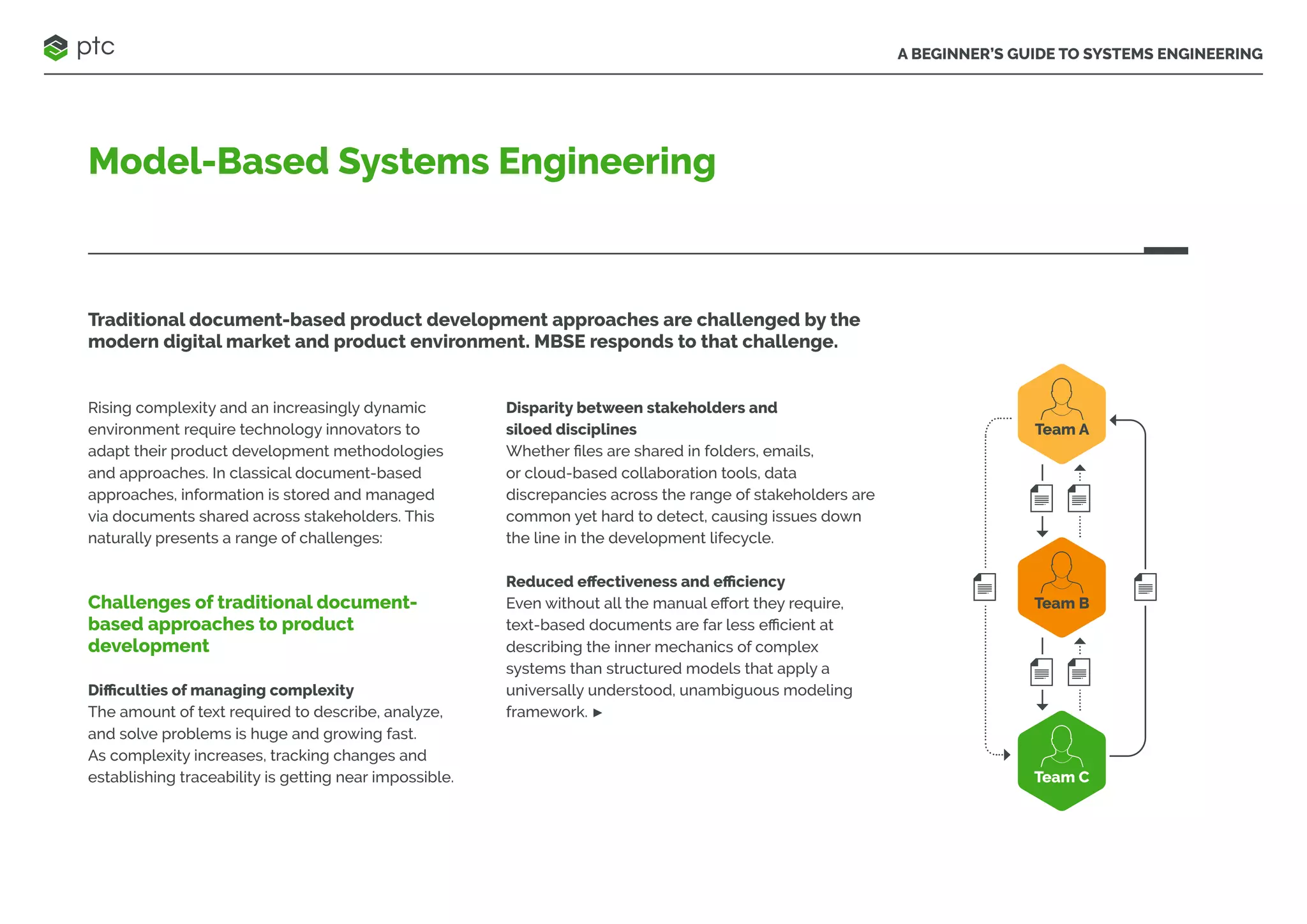
Traditional document-based product development approaches are challenged by the
modern digital market and product environment. MBSE responds to that challenge.
Rising complexity and an increasingly dynamic
environment require technology innovators to
adapt their product development methodologies
and approaches. In classical document-based
approaches, information is stored and managed
via documents shared across stakeholders. This
naturally presents a range of challenges:
Challenges of traditional document-
based approaches to product
development
Difficulties of managing complexity
The amount of text required to describe, analyze,
and solve problems is huge and growing fast.
As complexity increases, tracking changes and
establishing traceability is getting near impossible.
Disparity between stakeholders and
siloed disciplines
Whether files are shared in folders, emails,
or cloud-based collaboration tools, data
discrepancies across the range of stakeholders are
common yet hard to detect, causing issues down
the line in the development lifecycle.
Reduced effectiveness and efficiency
Even without all the manual effort they require,
text-based documents are far less efficient at
describing the inner mechanics of complex
systems than structured models that apply a
universally understood, unambiguous modeling
framework. ►
Team B
Team A
Team C
A BEGINNER’S GUIDE TO SYSTEMS ENGINEERING
Model-Based Systems Engineering (MBSE) is a framework
that emerged to help overcome these challenges.
The INCOSE Systems Engineering Vision 2020 (released
in 2007) defines MBSE as “the formalized application
of modeling to support system requirements, design,
analysis, verification, and validation activities beginning in
the conceptual design phase and continuing throughout
development and later life cycle phases.”
A transition towards model-centric approaches has long
been experienced in other engineering disciplines like
mechanical, electrical, and software. MBSE extends that
trend to Systems Engineering by applying SE and modeling
activities for systems development.
Model-Based Systems Engineering provides:
• A central repository for managing and sharing
information across stakeholders
• Focused perspective without the loss of global context
• Consistent, dynamic & extendable data
• Reusability for maximum efficiency in managing
product variants
• Optimized impact analysis & change management
• Efficient interface management and better integration
between system components
• Models & intelligent work products to carry information
A BEGINNER’S GUIDE TO SYSTEMS ENGINEERING
Building blocks of an MBSE approach
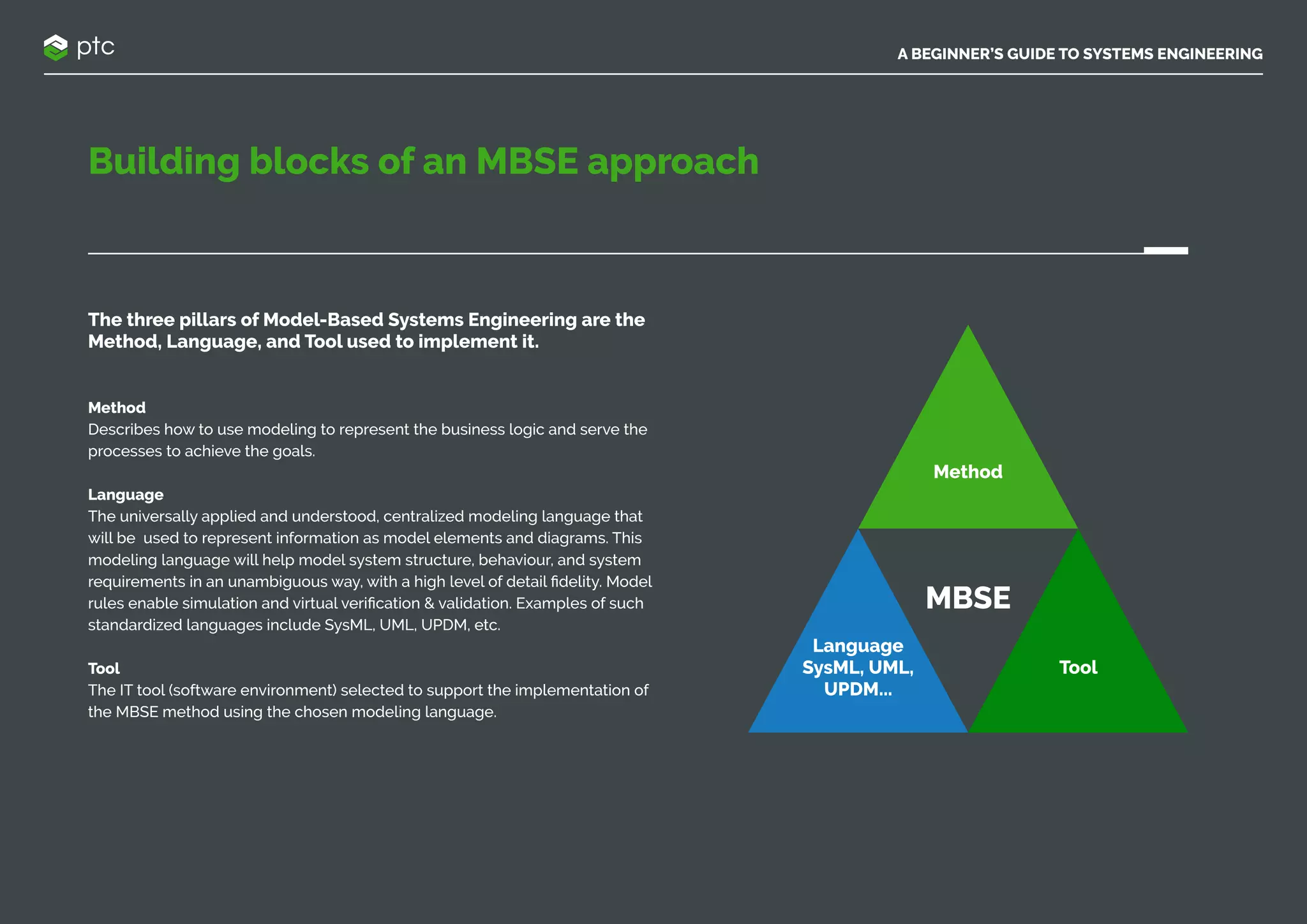
The three pillars of Model-Based Systems Engineering are the
Method, Language, and Tool used to implement it.
Method
Describes how to use modeling to represent the business logic and serve the
processes to achieve the goals.
Language
The universally applied and understood, centralized modeling language that
will be used to represent information as model elements and diagrams. This
modeling language will help model system structure, behaviour, and system
requirements in an unambiguous way, with a high level of detail fidelity. Model
rules enable simulation and virtual verification & validation. Examples of such
standardized languages include SysML, UML, UPDM, etc.
Tool
The IT tool (software environment) selected to support the implementation of
the MBSE method using the chosen modeling language.
Method
Language
SysML, UML,
UPDM...
Tool
MBSE
A BEGINNER’S GUIDE TO SYSTEMS ENGINEERING
Model-Based Systems Engineering:
Key strategies & best practices
Rely on established methods
and best practices to guide your
implementation of an MBSE
approach.
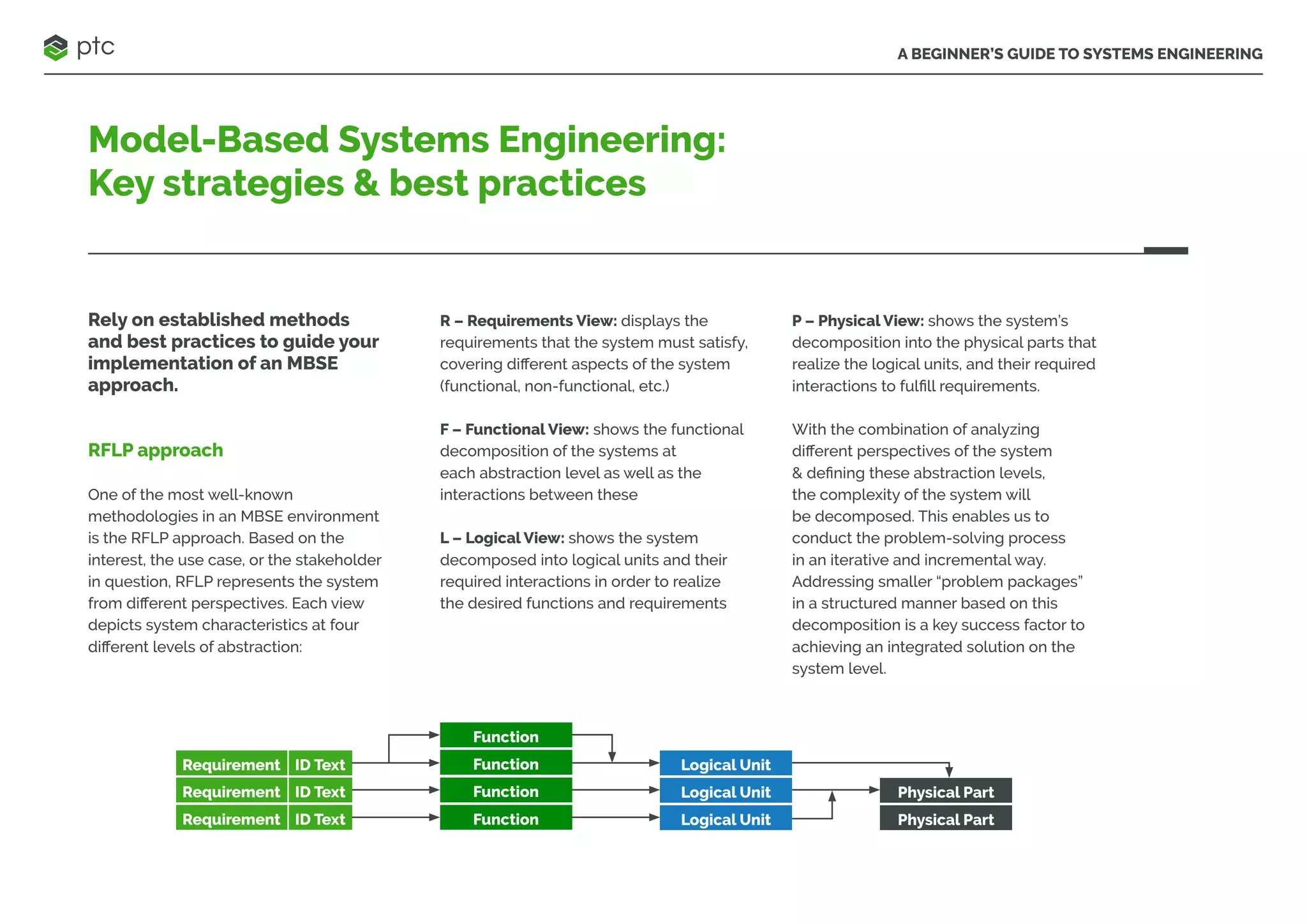
RFLP approach
One of the most well-known
methodologies in an MBSE environment
is the RFLP approach. Based on the
interest, the use case, or the stakeholder
in question, RFLP represents the system
from different perspectives. Each view
depicts system characteristics at four
different levels of abstraction:
R – Requirements View: displays the
requirements that the system must satisfy,
covering different aspects of the system
(functional, non-functional, etc.)
F – Functional View: shows the functional
decomposition of the systems at
each abstraction level as well as the
interactions between these
L – Logical View: shows the system
decomposed into logical units and their
required interactions in order to realize
the desired functions and requirements
P – Physical View: shows the system’s
decomposition into the physical parts that
realize the logical units, and their required
interactions to fulfill requirements.
With the combination of analyzing
different perspectives of the system
& defining these abstraction levels,
the complexity of the system will
be decomposed. This enables us to
conduct the problem-solving process
in an iterative and incremental way.
Addressing smaller “problem packages”
in a structured manner based on this
decomposition is a key success factor to
achieving an integrated solution on the
system level.
Requirement ID Text
Function
Logical Unit
Physical Part
Requirement ID Text
Function
Logical Unit
Physical Part
Requirement ID Text
Function
Logical Unit
Function
A BEGINNER’S GUIDE TO SYSTEMS ENGINEERING
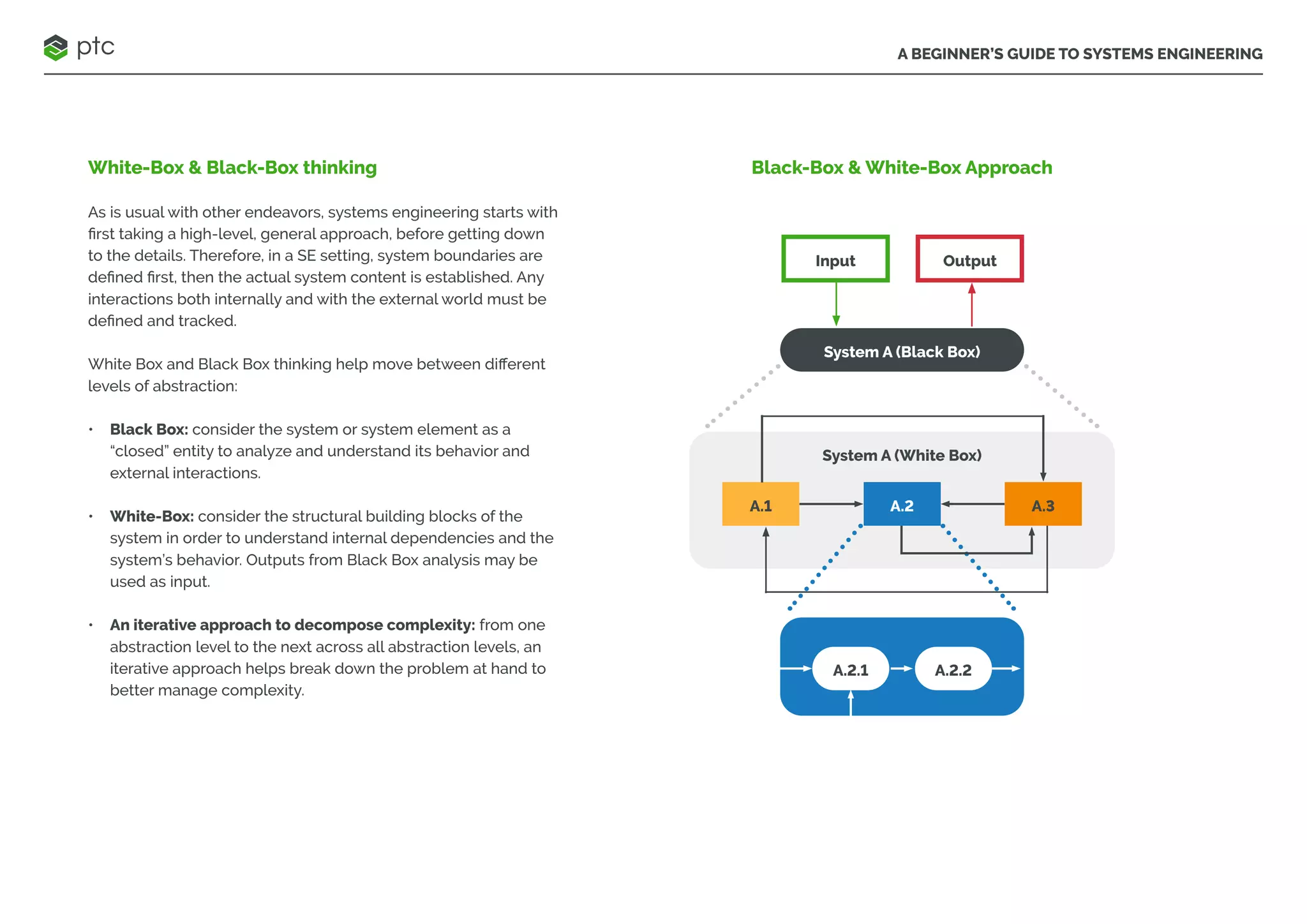
White-Box & Black-Box thinking
As is usual with other endeavors, systems engineering starts with
first taking a high-level, general approach, before getting down
to the details. Therefore, in a SE setting, system boundaries are
defined first, then the actual system content is established. Any
interactions both internally and with the external world must be
defined and tracked.
White Box and Black Box thinking help move between different
levels of abstraction:
• Black Box: consider the system or system element as a
“closed” entity to analyze and understand its behavior and
external interactions.
• White-Box: consider the structural building blocks of the
system in order to understand internal dependencies and the
system’s behavior. Outputs from Black Box analysis may be
used as input.
• An iterative approach to decompose complexity: from one
abstraction level to the next across all abstraction levels, an
iterative approach helps break down the problem at hand to
better manage complexity.
Black-Box & White-Box Approach
System A (Black Box)
A.2
A.1
A.2.1 A.2.2
A.3
Input Output
System A (White Box)
A BEGINNER’S GUIDE TO SYSTEMS ENGINEERING
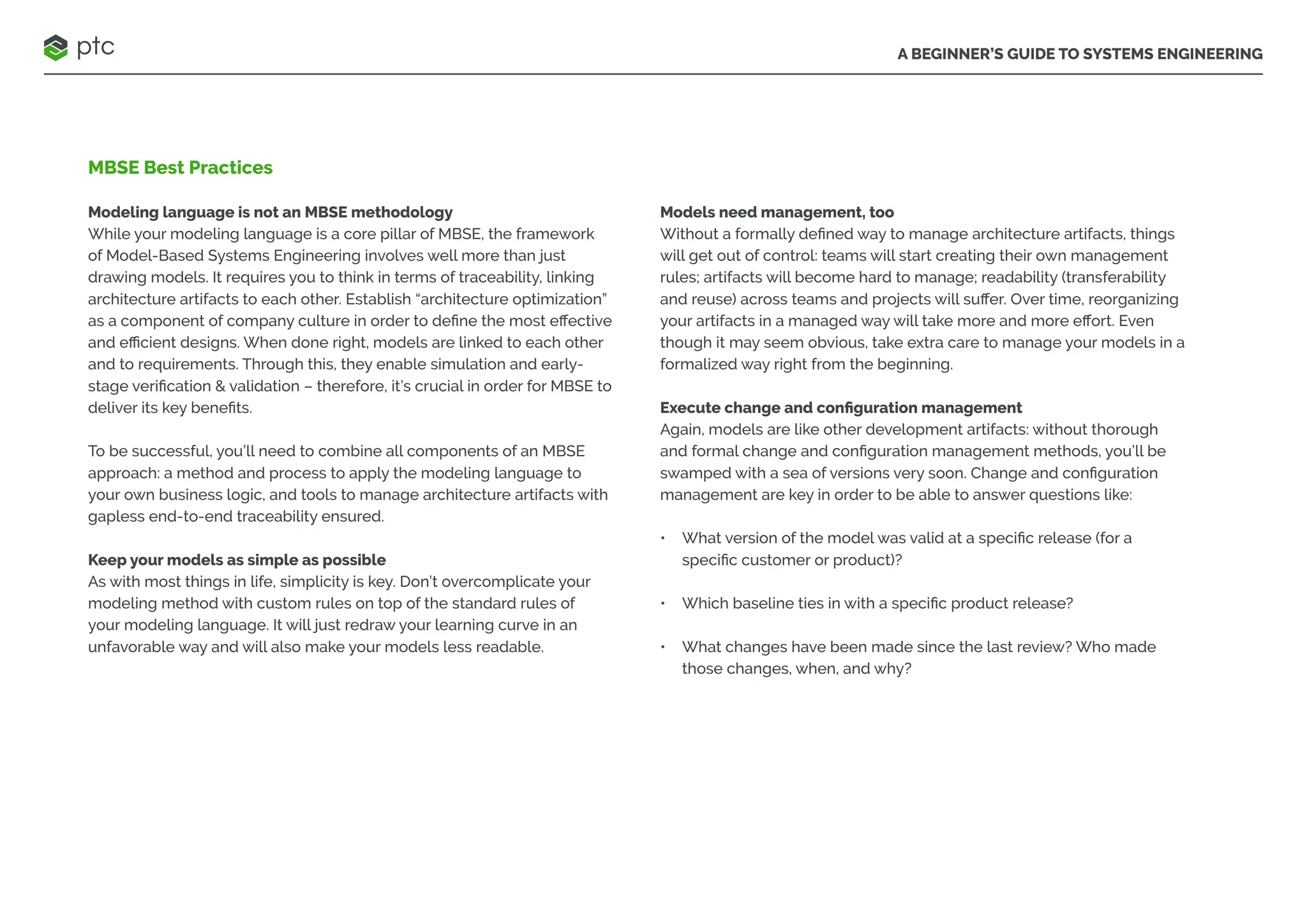
MBSE Best Practices
Modeling language is not an MBSE methodology
While your modeling language is a core pillar of MBSE, the framework
of Model-Based Systems Engineering involves well more than just
drawing models. It requires you to think in terms of traceability, linking
architecture artifacts to each other. Establish “architecture optimization”
as a component of company culture in order to define the most effective
and efficient designs. When done right, models are linked to each other
and to requirements. Through this, they enable simulation and early-
stage verification & validation – therefore, it’s crucial in order for MBSE to
deliver its key benefits.
To be successful, you’ll need to combine all components of an MBSE
approach: a method and process to apply the modeling language to
your own business logic, and tools to manage architecture artifacts with
gapless end-to-end traceability ensured.
Keep your models as simple as possible
As with most things in life, simplicity is key. Don’t overcomplicate your
modeling method with custom rules on top of the standard rules of
your modeling language. It will just redraw your learning curve in an
unfavorable way and will also make your models less readable.
Models need management, too
Without a formally defined way to manage architecture artifacts, things
will get out of control: teams will start creating their own management
rules; artifacts will become hard to manage; readability (transferability
and reuse) across teams and projects will suffer. Over time, reorganizing
your artifacts in a managed way will take more and more effort. Even
though it may seem obvious, take extra care to manage your models in a
formalized way right from the beginning.
Execute change and configuration management
Again, models are like other development artifacts: without thorough
and formal change and configuration management methods, you’ll be
swamped with a sea of versions very soon. Change and configuration
management are key in order to be able to answer questions like:
• What version of the model was valid at a specific release (for a
specific customer or product)?
• Which baseline ties in with a specific product release?
• What changes have been made since the last review? Who made
those changes, when, and why?
A BEGINNER’S GUIDE TO SYSTEMS ENGINEERING
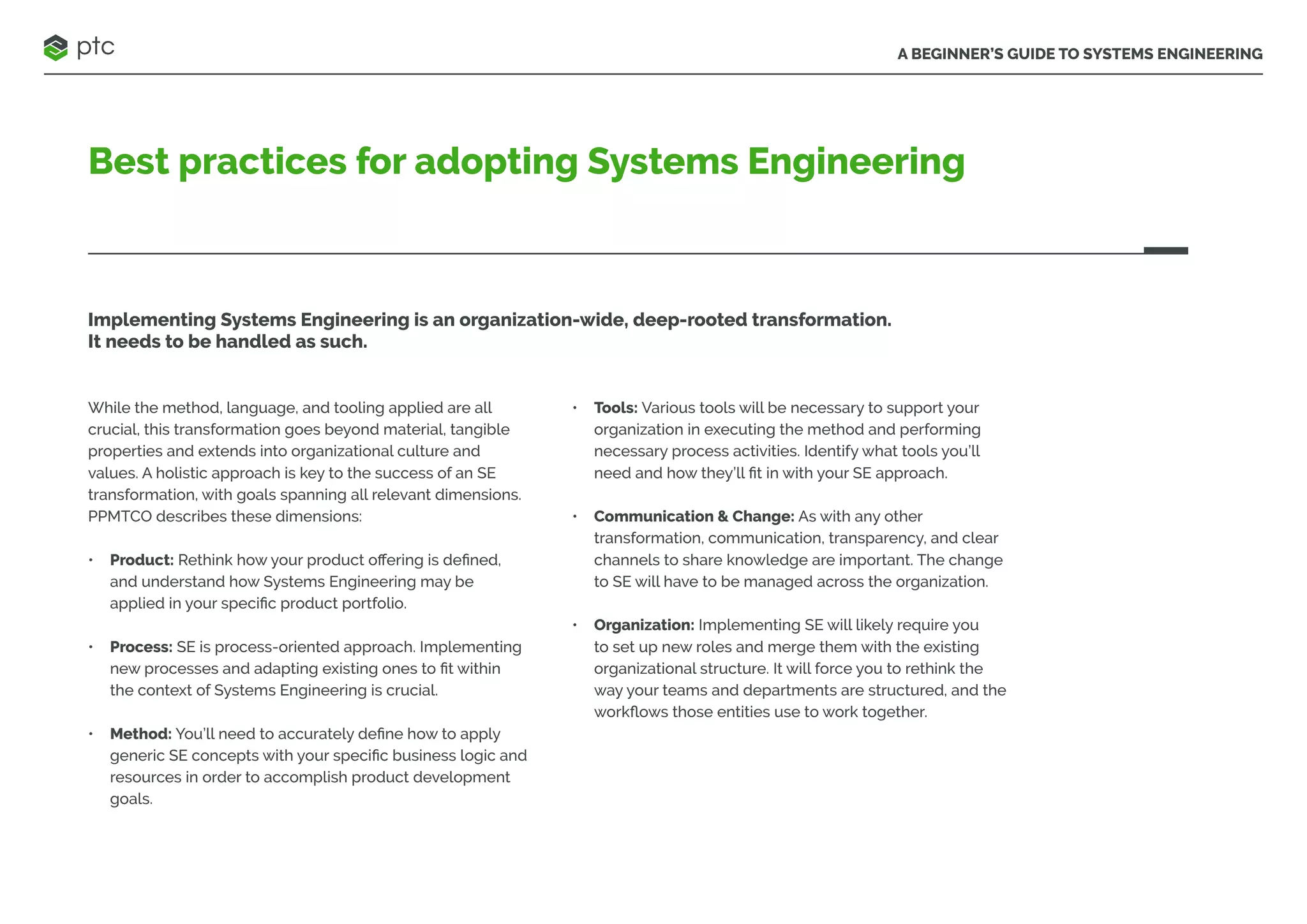
Best practices for adopting Systems Engineering
Implementing Systems Engineering is an organization-wide, deep-rooted transformation.
It needs to be handled as such.
While the method, language, and tooling applied are all
crucial, this transformation goes beyond material, tangible
properties and extends into organizational culture and
values. A holistic approach is key to the success of an SE
transformation, with goals spanning all relevant dimensions.
PPMTCO describes these dimensions:
• Product: Rethink how your product offering is defined,
and understand how Systems Engineering may be
applied in your specific product portfolio.
• Process: SE is process-oriented approach. Implementing
new processes and adapting existing ones to fit within
the context of Systems Engineering is crucial.
• Method: You’ll need to accurately define how to apply
generic SE concepts with your specific business logic and
resources in order to accomplish product development
goals.
• Tools: Various tools will be necessary to support your
organization in executing the method and performing
necessary process activities. Identify what tools you’ll
need and how they’ll fit in with your SE approach.
• Communication & Change: As with any other
transformation, communication, transparency, and clear
channels to share knowledge are important. The change
to SE will have to be managed across the organization.
• Organization: Implementing SE will likely require you
to set up new roles and merge them with the existing
organizational structure. It will force you to rethink the
way your teams and departments are structured, and the
workflows those entities use to work together.
A BEGINNER’S GUIDE TO SYSTEMS ENGINEERING
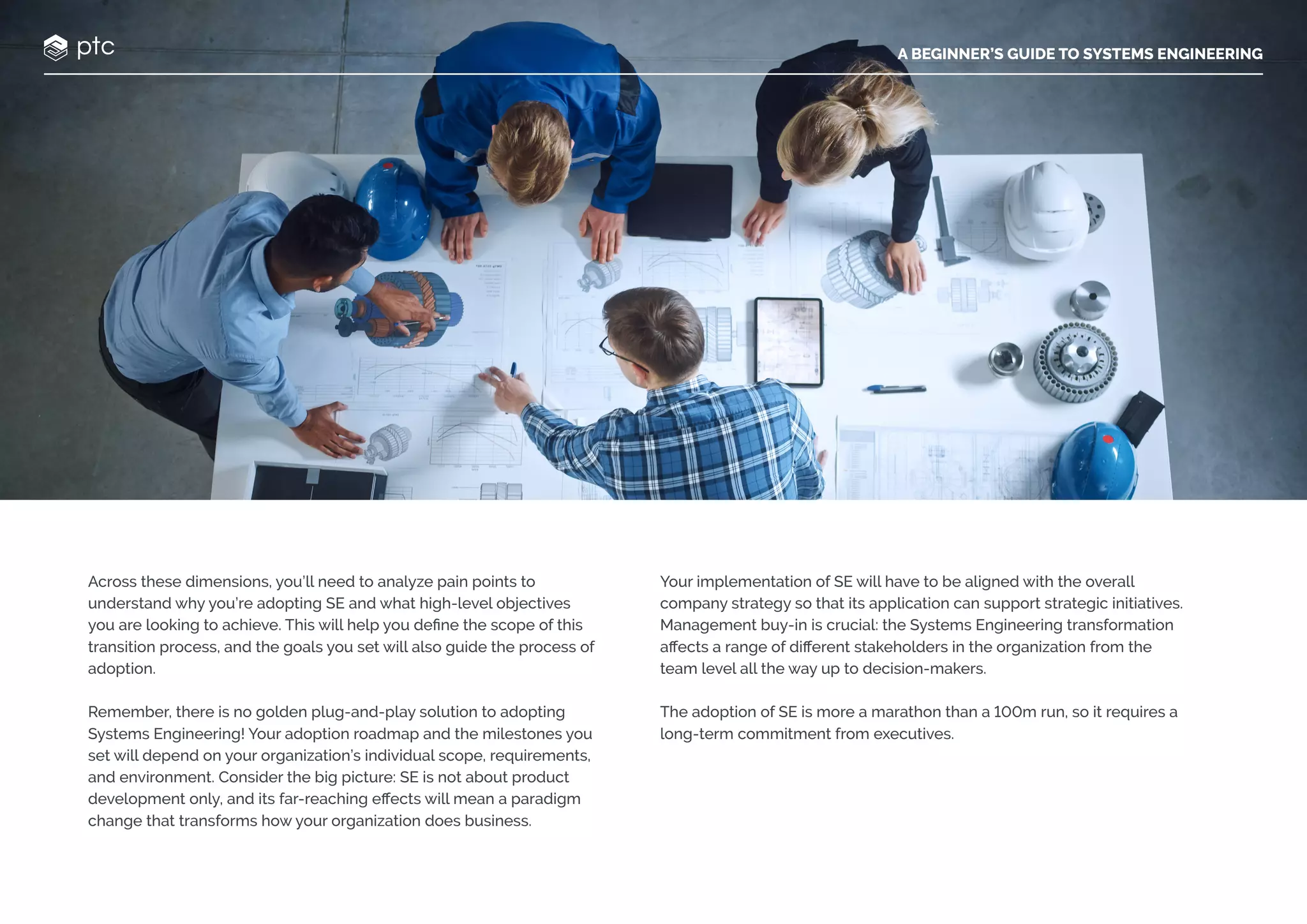
Across these dimensions, you’ll need to analyze pain points to
understand why you’re adopting SE and what high-level objectives
you are looking to achieve. This will help you define the scope of this
transition process, and the goals you set will also guide the process of
adoption.
Remember, there is no golden plug-and-play solution to adopting
Systems Engineering! Your adoption roadmap and the milestones you
set will depend on your organization’s individual scope, requirements,
and environment. Consider the big picture: SE is not about product
development only, and its far-reaching effects will mean a paradigm
change that transforms how your organization does business.
Your implementation of SE will have to be aligned with the overall
company strategy so that its application can support strategic initiatives.
Management buy-in is crucial: the Systems Engineering transformation
affects a range of different stakeholders in the organization from the
team level all the way up to decision-makers.
The adoption of SE is more a marathon than a 100m run, so it requires a
long-term commitment from executives.
A BEGINNER’S GUIDE TO SYSTEMS ENGINEERING
Codebeamer offers industry-leading software
tools to simplify complex product and software
engineering at scale.
Our enterprise-grade platforms help accelerate the
development of technology products and simplify regulatory
compliance. PTC’s solutions are used by leading companies
including top automotive, medical, pharma, and life sciences
developers worldwide to manage their innovative, compliant
product engineering processes.
NTT DATA is a top 10 global IT services provider with
130,000+ employees in more than 50 countries.
NTT DATA offers an advanced portfolio of consulting,
application, business process, cloud, and infrastructure services
to businesses and governments worldwide. The company has
extensive experience in the field of Systems Engineering and
MBSE (Model-Based Systems Engineering).
Learn more
121 Seaport Blvd, Boston, MA 02210 : ptc.com
© 2023, PTC Inc. All rights reserved. Information described herein is furnished for informational use only, is subject to change without notice, and should not
be taken as a guarantee, commitment, condition or offer by PTC. PTC, the PTC logo, and all other PTC product names and logos are trademarks or registered
trademarks of PTC and/or its subsidiaries in the United States and other countries. All other product or company names are property of their respective owners.
002-a-beginners-guide-to-systems-engineering-02-03

a-beginners-guide-to-systems-engineering.pdf

  • 1.
    A Beginner’s Guide to Systems Engineering byNTT DATA & PTC’s Codebeamer Technology
  • 2.
    A BEGINNER’S GUIDETO SYSTEMS ENGINEERING Introduction Today’s dynamic market environment is characterized by fast-changing customer needs, new technologies disrupting existing markets, and growing software content in almost all categories of products. Innovators of technology products today are finding that their tried and tested development methods are reaching their limits. Systems Engineering (SE) is an established solution to modernizing these outdated development approaches. This white paper provides fundamental information on the concept and framework of SE, complete with key considerations and valuable best practices to help you get started on your journey to Systems Engineering! Growing variant diversity and mass customization require developers to build out capabilities to cover a range of different needs efficiently. As software is becoming the innovation driver and industries are merging or converging, new market players (such as Big Tech) are joining conventional sectors, putting pressure on traditional players. Rising intertwining between domains (e.g. hardware, software, electrical/electronic components, and service) adds interface complexity within the product, while connectivity enables a whole new range of services that developers can (and increasingly have to) offer. Servitization requires them to develop product- service systems with levels of sophistication never seen before. Meanwhile, regulators are catching up with technological development, adding to the number, scope, and complexity of market & industry regulations. Therefore, developers of technology products are facing multiple challenges: accelerating the innovation of increasingly sophisticated system-of-systems products with multiple variants while driving down costs and complying with regulations. Traditional development approaches are no longer capable of satisfying these needs. To maintain a competitive edge, developers are looking to move away from their aged development approaches.
  • 3.
    A BEGINNER’S GUIDETO SYSTEMS ENGINEERING Drawbacks of rigid development methods Traditional domain-specific methods of product development are limiting efficiency, development speed, and profitability in various ways. The historically evolved ways of product development result in a multi-speed R&D environment with innovation silos and overly long product cycles. A lack of alignment and the varying iteration speeds of different methods used for SW, HW, and E/E development make it difficult to integrate deliverables. Integration issues are also present in the infrastructure due to a disconnected toolchain across the product’s development lifecycle. In most teams, limited collaboration and fragmented tooling make the accurate control of changes and analyzing their impact a nightmare. The difficult integration of deliverables, procedural models, and delivery cycles requires immense manual effort from developers. Because their processes and tools are out of sync, information and traceability gaps draw focus away from productive work. All these issues are prompting manufacturers to search for new and innovative ways of product development in order to cope with changes in the environment and to stay competitive as the speed and nature of innovation shift. Key considerations for a modern product development approach Collaborative: Should enable collaboration and integration to move away from silo-oriented work Holistic: Needs to consider all the aspects from technical to organizational Agile-ready: Take advantage of Agile strategies where applicable to cope with challenges Future-proof and adaptable: Challenges will keep on increasing. A rigid solution will be obsolete in a few years, so adaptability is crucial.
  • 4.
    A BEGINNER’S GUIDETO SYSTEMS ENGINEERING Systems Engineering: a holistic approach Systems Engineering provides a holistic, all-encompassing framework to tackling these problems. System Design • From rough detail • Thinking variants • Phases of system development • Problem solving process as working logic Project Management • Organization and coordination of the problem-solving process • Coordination of individuals and organizations The International Council on Systems Engineering (INCOSE) defines Systems Engineering as: “A transdisciplinary and integrative approach to enable the successful realization, use, and retirement of engineered systems, using systems principles and concepts, and scientific, technological, and management methods. […] Systems engineering integrates all the disciplines and specialty groups into a team effort forming a structured development process that proceeds from concept to production to operation. Systems engineering considers both the business and the technical needs of all customers with the goal of providing a quality product that meets the user needs.” Problem Solving Process System Thinking Process Model Solution Problem Source: INCOSE website on Systems Engineering
  • 5.
    A BEGINNER’S GUIDETO SYSTEMS ENGINEERING Their definition also includes that SE’s goal is to identify and document requirements early on, and to consider the entire problem when validating the system’s proposed design. SE takes into consideration various aspects of the product including design, costs, delivery, performance, maintenance, and retirement. Systems Engineering aspects To elaborate, INCOSE further adds that Systems Engineering focuses on: • Understanding the goals, purpose, and success criteria of all stakeholders early in the lifecycle to form valid product requirements • The modeling and baselining of requirements and solution architectures for each lifecycle phase • Considering the complete problem (including operations, cost and schedule, performance, training and support, product testing, manufacturing, and retirement / disposal) as opposed to the considerations of a single engineering discipline or product component • Establishing the lifecycle model, adequate processes, and governance structures that appropriately support the delivery of the product • Verifying and validating the system and performing design synthesis to ensure it suits requirements
  • 6.
    A BEGINNER’S GUIDETO SYSTEMS ENGINEERING Building blocks of Systems Engineering The two fundamental building blocks of Systems Engineering are Systems Thinking and its Process Model. Systems Thinking Systems Thinking is based on System Theory, e.g. the interdisciplinary study of systems. It supports the way we conceive and think about systems including the system’s structure, behavior, and interactions with the environment and its users. Systems Thinking considers systems as a combination of interrelated and interdependent parts, and it helps us think about the system throughout its entire lifecycle. From rough to the detailed level, it increases focus on problem-solving: first, understanding and decomposing the problem, then designing a function and integrating the solution that responds to that problem. Systems Thinking also helps integrate both technical and human- central disciplines in order to develop working product systems that are both effective and efficient in responding to user needs. ISO/IEC 15288 Process Groups Technical Processes: related directly to the technical aspects of the system (requirements, architecture, design, verification, validation, integration, disposal, etc.) Technical Management Processes: to support the management of technical processes and project-related aspects (project planning, risk management, information management, Quality Assurance, etc.) Organizational Project-enabling Processes: to enable the organization to be Systems Engineering-ready (Infrastructure management, portfolio management, HR, etc.) Agreement Processes: to enable collaboration with external partners throughout the value chain
  • 7.
    A BEGINNER’S GUIDETO SYSTEMS ENGINEERING Systems Engineering Process Model The Process Model is what helps organize work into processes in the context of Systems Engineering. The process model defined by the technical standard ISO/IEC 15288 includes system lifecycle process groups that cover all lifecycle stages. The standard applies the following categories to group processes: Further considerations of the Process Model include Specialty Engineering (related to the nature of the system e.g. safety, security, reliability, availability, maintainability, etc) and Tailoring (guidelines and best practices to adapting generic Systems Engineering concepts to the context of a specific organization).
  • 8.
    A BEGINNER’S GUIDETO SYSTEMS ENGINEERING Why Systems Engineering: the benefits By definition, the goal of SE is to help deliver effective systems that satisfy real customer needs and that are developed efficiently. Quite naturally, adopting SE has a range of benefits that all contribute to achieving these fundamental goals: Control complexity and manage variation Coping with complexity is a basic objective for Systems Engineering. Using it can help introduce efficiency in the management of both complex product systems, and the product lines (with multiple product variants) that they are part of. Increase reusability, remove redundancy & optimize architecture SE helps drive down project costs by optimizing the way you build your products and introducing efficient reuse patterns to remove redundant work. Boost product quality Systems Engineering enables virtual Verification & Validation early on in the lifecycle. It helps make sure that all requirements are available, verified, and that they respond to existing customer requirements. It also enhances risk management, further contributing to product quality. Ensure reliability, availability, maintainability & safety By considering all aspects of the system’s lifecycle, SE helps add robustness to your products.
  • 9.
    A BEGINNER’S GUIDETO SYSTEMS ENGINEERING Single source of truth & end-to-end traceability Establishing a central source of information is a key SE principle. By providing a single source of product development truth to all stakeholders, adopting Systems Engineering helps ensure the flow of information across the organization. This also simplifies internal and external collaboration (across teams, stakeholders, and external contributors such as suppliers). Scaled, stable, and managed framework Systems Engineering enables the efficient and effective development of complex solutions in large projects. Regarding the success of a Systems Engineering approach, INCOSE reports that research shows effective use cases of Systems Engineering can contribute to a 10- 20% reduction of project budgets. Systems Engineering frameworks and approaches Some of the most popular frameworks to support the practical approach to Systems Engineering are: Function-oriented Systems Engineering: This iterative approach focuses on function as a central element, essentially, the purpose of the system. Once it is understood what the system needs to perform to fulfill requirements, engineers start planning how the system will deliver the expected result. Agile Systems Engineering: Similar to Agile applied in the context of software, Agile SE enables adaptability and sustainability under unpredictable and fast- changing conditions. Lean Systems Engineering: For increase efficiency, lean SE applies lean thinking principles to Systems Engineering in order to deliver maximum value to the customer with minimum effort. Model-Based Systems Engineering: Detailed in a separate section, MBSE refers to the formalized application of modeling to support systems engineering.
  • 10.
    A BEGINNER’S GUIDETO SYSTEMS ENGINEERING Model-Based Systems Engineering Traditional document-based product development approaches are challenged by the modern digital market and product environment. MBSE responds to that challenge. Rising complexity and an increasingly dynamic environment require technology innovators to adapt their product development methodologies and approaches. In classical document-based approaches, information is stored and managed via documents shared across stakeholders. This naturally presents a range of challenges: Challenges of traditional document- based approaches to product development Difficulties of managing complexity The amount of text required to describe, analyze, and solve problems is huge and growing fast. As complexity increases, tracking changes and establishing traceability is getting near impossible. Disparity between stakeholders and siloed disciplines Whether files are shared in folders, emails, or cloud-based collaboration tools, data discrepancies across the range of stakeholders are common yet hard to detect, causing issues down the line in the development lifecycle. Reduced effectiveness and efficiency Even without all the manual effort they require, text-based documents are far less efficient at describing the inner mechanics of complex systems than structured models that apply a universally understood, unambiguous modeling framework. ► Team B Team A Team C
  • 11.
    A BEGINNER’S GUIDETO SYSTEMS ENGINEERING Model-Based Systems Engineering (MBSE) is a framework that emerged to help overcome these challenges. The INCOSE Systems Engineering Vision 2020 (released in 2007) defines MBSE as “the formalized application of modeling to support system requirements, design, analysis, verification, and validation activities beginning in the conceptual design phase and continuing throughout development and later life cycle phases.” A transition towards model-centric approaches has long been experienced in other engineering disciplines like mechanical, electrical, and software. MBSE extends that trend to Systems Engineering by applying SE and modeling activities for systems development. Model-Based Systems Engineering provides: • A central repository for managing and sharing information across stakeholders • Focused perspective without the loss of global context • Consistent, dynamic & extendable data • Reusability for maximum efficiency in managing product variants • Optimized impact analysis & change management • Efficient interface management and better integration between system components • Models & intelligent work products to carry information
  • 12.
    A BEGINNER’S GUIDETO SYSTEMS ENGINEERING Building blocks of an MBSE approach The three pillars of Model-Based Systems Engineering are the Method, Language, and Tool used to implement it. Method Describes how to use modeling to represent the business logic and serve the processes to achieve the goals. Language The universally applied and understood, centralized modeling language that will be used to represent information as model elements and diagrams. This modeling language will help model system structure, behaviour, and system requirements in an unambiguous way, with a high level of detail fidelity. Model rules enable simulation and virtual verification & validation. Examples of such standardized languages include SysML, UML, UPDM, etc. Tool The IT tool (software environment) selected to support the implementation of the MBSE method using the chosen modeling language. Method Language SysML, UML, UPDM... Tool MBSE
  • 13.
    A BEGINNER’S GUIDETO SYSTEMS ENGINEERING Model-Based Systems Engineering: Key strategies & best practices Rely on established methods and best practices to guide your implementation of an MBSE approach. RFLP approach One of the most well-known methodologies in an MBSE environment is the RFLP approach. Based on the interest, the use case, or the stakeholder in question, RFLP represents the system from different perspectives. Each view depicts system characteristics at four different levels of abstraction: R – Requirements View: displays the requirements that the system must satisfy, covering different aspects of the system (functional, non-functional, etc.) F – Functional View: shows the functional decomposition of the systems at each abstraction level as well as the interactions between these L – Logical View: shows the system decomposed into logical units and their required interactions in order to realize the desired functions and requirements P – Physical View: shows the system’s decomposition into the physical parts that realize the logical units, and their required interactions to fulfill requirements. With the combination of analyzing different perspectives of the system & defining these abstraction levels, the complexity of the system will be decomposed. This enables us to conduct the problem-solving process in an iterative and incremental way. Addressing smaller “problem packages” in a structured manner based on this decomposition is a key success factor to achieving an integrated solution on the system level. Requirement ID Text Function Logical Unit Physical Part Requirement ID Text Function Logical Unit Physical Part Requirement ID Text Function Logical Unit Function
  • 14.
    A BEGINNER’S GUIDETO SYSTEMS ENGINEERING White-Box & Black-Box thinking As is usual with other endeavors, systems engineering starts with first taking a high-level, general approach, before getting down to the details. Therefore, in a SE setting, system boundaries are defined first, then the actual system content is established. Any interactions both internally and with the external world must be defined and tracked. White Box and Black Box thinking help move between different levels of abstraction: • Black Box: consider the system or system element as a “closed” entity to analyze and understand its behavior and external interactions. • White-Box: consider the structural building blocks of the system in order to understand internal dependencies and the system’s behavior. Outputs from Black Box analysis may be used as input. • An iterative approach to decompose complexity: from one abstraction level to the next across all abstraction levels, an iterative approach helps break down the problem at hand to better manage complexity. Black-Box & White-Box Approach System A (Black Box) A.2 A.1 A.2.1 A.2.2 A.3 Input Output System A (White Box)
  • 15.
    A BEGINNER’S GUIDETO SYSTEMS ENGINEERING MBSE Best Practices Modeling language is not an MBSE methodology While your modeling language is a core pillar of MBSE, the framework of Model-Based Systems Engineering involves well more than just drawing models. It requires you to think in terms of traceability, linking architecture artifacts to each other. Establish “architecture optimization” as a component of company culture in order to define the most effective and efficient designs. When done right, models are linked to each other and to requirements. Through this, they enable simulation and early- stage verification & validation – therefore, it’s crucial in order for MBSE to deliver its key benefits. To be successful, you’ll need to combine all components of an MBSE approach: a method and process to apply the modeling language to your own business logic, and tools to manage architecture artifacts with gapless end-to-end traceability ensured. Keep your models as simple as possible As with most things in life, simplicity is key. Don’t overcomplicate your modeling method with custom rules on top of the standard rules of your modeling language. It will just redraw your learning curve in an unfavorable way and will also make your models less readable. Models need management, too Without a formally defined way to manage architecture artifacts, things will get out of control: teams will start creating their own management rules; artifacts will become hard to manage; readability (transferability and reuse) across teams and projects will suffer. Over time, reorganizing your artifacts in a managed way will take more and more effort. Even though it may seem obvious, take extra care to manage your models in a formalized way right from the beginning. Execute change and configuration management Again, models are like other development artifacts: without thorough and formal change and configuration management methods, you’ll be swamped with a sea of versions very soon. Change and configuration management are key in order to be able to answer questions like: • What version of the model was valid at a specific release (for a specific customer or product)? • Which baseline ties in with a specific product release? • What changes have been made since the last review? Who made those changes, when, and why?
  • 16.
    A BEGINNER’S GUIDETO SYSTEMS ENGINEERING Best practices for adopting Systems Engineering Implementing Systems Engineering is an organization-wide, deep-rooted transformation. It needs to be handled as such. While the method, language, and tooling applied are all crucial, this transformation goes beyond material, tangible properties and extends into organizational culture and values. A holistic approach is key to the success of an SE transformation, with goals spanning all relevant dimensions. PPMTCO describes these dimensions: • Product: Rethink how your product offering is defined, and understand how Systems Engineering may be applied in your specific product portfolio. • Process: SE is process-oriented approach. Implementing new processes and adapting existing ones to fit within the context of Systems Engineering is crucial. • Method: You’ll need to accurately define how to apply generic SE concepts with your specific business logic and resources in order to accomplish product development goals. • Tools: Various tools will be necessary to support your organization in executing the method and performing necessary process activities. Identify what tools you’ll need and how they’ll fit in with your SE approach. • Communication & Change: As with any other transformation, communication, transparency, and clear channels to share knowledge are important. The change to SE will have to be managed across the organization. • Organization: Implementing SE will likely require you to set up new roles and merge them with the existing organizational structure. It will force you to rethink the way your teams and departments are structured, and the workflows those entities use to work together.
  • 17.
    A BEGINNER’S GUIDETO SYSTEMS ENGINEERING Across these dimensions, you’ll need to analyze pain points to understand why you’re adopting SE and what high-level objectives you are looking to achieve. This will help you define the scope of this transition process, and the goals you set will also guide the process of adoption. Remember, there is no golden plug-and-play solution to adopting Systems Engineering! Your adoption roadmap and the milestones you set will depend on your organization’s individual scope, requirements, and environment. Consider the big picture: SE is not about product development only, and its far-reaching effects will mean a paradigm change that transforms how your organization does business. Your implementation of SE will have to be aligned with the overall company strategy so that its application can support strategic initiatives. Management buy-in is crucial: the Systems Engineering transformation affects a range of different stakeholders in the organization from the team level all the way up to decision-makers. The adoption of SE is more a marathon than a 100m run, so it requires a long-term commitment from executives. A BEGINNER’S GUIDE TO SYSTEMS ENGINEERING
  • 18.
    A BEGINNER’S GUIDETO SYSTEMS ENGINEERING Codebeamer offers industry-leading software tools to simplify complex product and software engineering at scale. Our enterprise-grade platforms help accelerate the development of technology products and simplify regulatory compliance. PTC’s solutions are used by leading companies including top automotive, medical, pharma, and life sciences developers worldwide to manage their innovative, compliant product engineering processes. NTT DATA is a top 10 global IT services provider with 130,000+ employees in more than 50 countries. NTT DATA offers an advanced portfolio of consulting, application, business process, cloud, and infrastructure services to businesses and governments worldwide. The company has extensive experience in the field of Systems Engineering and MBSE (Model-Based Systems Engineering). Learn more
  • 19.
    121 Seaport Blvd,Boston, MA 02210 : ptc.com © 2023, PTC Inc. All rights reserved. Information described herein is furnished for informational use only, is subject to change without notice, and should not be taken as a guarantee, commitment, condition or offer by PTC. PTC, the PTC logo, and all other PTC product names and logos are trademarks or registered trademarks of PTC and/or its subsidiaries in the United States and other countries. All other product or company names are property of their respective owners. 002-a-beginners-guide-to-systems-engineering-02-03