Everything You Need to
Know About Container
Orchestration
Agenda
What is container orchestration?
Why do we need container orchestration?
How does container orchestration work?
Best practices for optimizing container orchestration
Container orchestration platforms: Who are the
market leaders?
Real-world success stories of container
orchestration
What is container orchestration?
Container orchestration is a process of automating the operational effort, including the provisioning, scaling,
availability, deployment, networking, and lifecycle management of containers, to run containerized workloads.
Container orchestration can also enable the operation of containers across multi-cloud
infrastructure environments.
Therefore, we can say that container orchestration perfectly complements a multi-cloud
environment and accelerates digital transformation initiatives.
Multi-cloud container orchestration
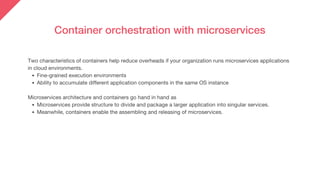
Container orchestration with microservices
Fine-grained execution environments
Ability to accumulate different application components in the same OS instance
Microservices provide structure to divide and package a larger application into singular services.
Meanwhile, containers enable the assembling and releasing of microservices.
Two characteristics of containers help reduce overheads if your organization runs microservices applications
in cloud environments.
Microservices architecture and containers go hand in hand as
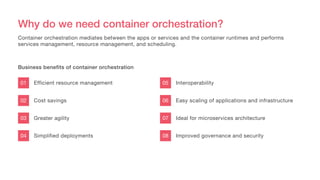
Why do we need container orchestration?
Efficient resource management
Cost savings
Greater agility
Simplified deployments
01
02
03
04
Container orchestration mediates between the apps or services and the container runtimes and performs
services management, resource management, and scheduling.
Business benefits of container orchestration
Interoperability
Easy scaling of applications and infrastructure
Ideal for microservices architecture
Improved governance and security
05
06
07
08
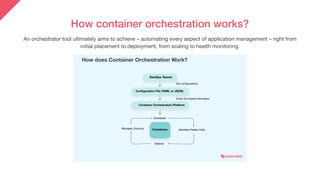
How container orchestration works?
An orchestrator tool ultimately aims to achieve – automating every aspect of application management – right from
initial placement to deployment, from scaling to health monitoring.
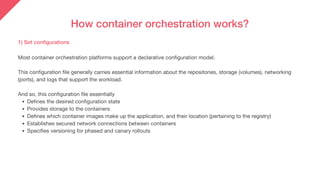
How container orchestration works?
1) Set configurations
Defines the desired configuration state
Provides storage to the containers
Defines which container images make up the application, and their location (pertaining to the registry)
Establishes secured network connections between containers
Specifies versioning for phased and canary rollouts
Most container orchestration platforms support a declarative configuration model.
This configuration file generally carries essential information about the repositories, storage (volumes), networking
(ports), and logs that support the workload.
And so, this configuration file essentially
How container orchestration works?
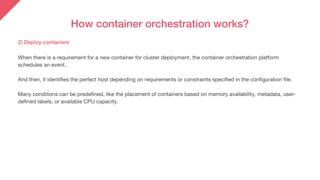
2) Deploy containers
When there is a requirement for a new container for cluster deployment, the container orchestration platform
schedules an event.
And then, it identifies the perfect host depending on requirements or constraints specified in the configuration file.
Many conditions can be predefined, like the placement of containers based on memory availability, metadata, user-
defined labels, or available CPU capacity.
How container orchestration works?
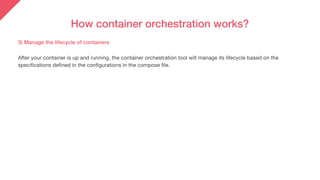
After your container is up and running, the container orchestration tool will manage its lifecycle based on the
specifications defined in the configurations in the compose file.
3) Manage the lifecycle of containers
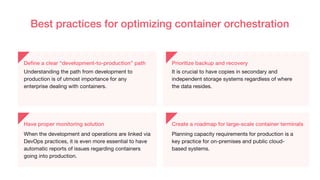
Best practices for optimizing container orchestration
Define a clear “development-to-production” path Prioritize backup and recovery
Have proper monitoring solution Create a roadmap for large-scale container terminals
Understanding the path from development to
production is of utmost importance for any
enterprise dealing with containers.
It is crucial to have copies in secondary and
independent storage systems regardless of where
the data resides.
Planning capacity requirements for production is a
key practice for on-premises and public cloud-
based systems.
When the development and operations are linked via
DevOps practices, it is even more essential to have
automatic reports of issues regarding containers
going into production.
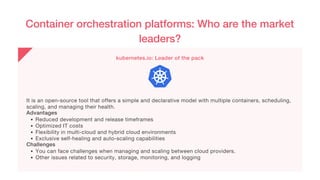
Container orchestration platforms: Who are the market
leaders?
kubernetes.io: Leader of the pack
Reduced development and release timeframes
Optimized IT costs
Flexibility in multi-cloud and hybrid cloud environments
Exclusive self-healing and auto-scaling capabilities
You can face challenges when managing and scaling between cloud providers.
Other issues related to security, storage, monitoring, and logging
It is an open-source tool that offers a simple and declarative model with multiple containers, scheduling,
scaling, and managing their health.
Advantages
Challenges
Container orchestration platforms: Who are the market
leaders?
docker.com: Easy cluster creation with powerful container scheduling
A low learning curve
You can use Docker images and configurations with no changes and deploy them at scale
Ideal for smaller deployments
Automated load balancing within the Docker containers
No option to connect containers to storage
Less robust automation capabilities
Docker Swarm is an easy-to-use orchestration tool native to the Docker platform and made by the
Docker team and community.
Advantages
Challenges
Container orchestration platforms: Who are the market
leaders?
apache.org: Complex yet inherently flexible
Lightweight interface
Inherent flexibility and scalability
Simplified resource allocation by combining abstract data resources into a single pool
Marathon is designed for long-running apps and can handle persistent containers.
It is a distributed systems kernel upon which you can create custom orchestrators.
Mesos having a high learning curve entails organizations acquiring technical expertise.
Apache Mesos, slightly older than Kubernetes, is an open-source cluster manager.
Advantages
Challenges
Real-world success stories of container orchestration
Adidas was able to reduce the site loading time by half while
running the site on Kubernetes.
They also started releasing 3-4 times a day, which earlier was once
in 4-6 weeks. With 200 nodes, 4,000 pods, and 80,000 builds per
month, Adidas started running 40% of its critical, impactful systems
on its cloud-native platform.
1) Adidas
Real-world success stories of container orchestration
2) Apple (Siri)
Apple's team completely rebuilt its infrastructure to run on Mesos to
get it running on Apple’s in-house architecture.
The use of Mesos made Siri scalable and available from an
infrastructure perspective and also improved latency on the iOS
application itself.
Real-world success stories of container orchestration
3) BMW
BMW ConnectedDrive is a digital product of BMW groups which
connects the driver and vehicle to various services apps.
In 2016, BMW started migrating its full application suite to
OpenShift to support over 1,000 web-based apps for its customers,
vehicles, dealerships, factories, and the complete production and
sales process.
Contact Us
Email Address
contactus@simform.com
Website
www.simform.com
Social Presence
twitter.com/simform
facebook.com/simform
linkedin.com/company/simform/

Container Orchestration.pdf

  • 1.
    Everything You Needto Know About Container Orchestration
  • 2.
    Agenda What is containerorchestration? Why do we need container orchestration? How does container orchestration work? Best practices for optimizing container orchestration Container orchestration platforms: Who are the market leaders? Real-world success stories of container orchestration
  • 3.
    What is containerorchestration? Container orchestration is a process of automating the operational effort, including the provisioning, scaling, availability, deployment, networking, and lifecycle management of containers, to run containerized workloads.
  • 4.
    Container orchestration canalso enable the operation of containers across multi-cloud infrastructure environments. Therefore, we can say that container orchestration perfectly complements a multi-cloud environment and accelerates digital transformation initiatives. Multi-cloud container orchestration
  • 5.
    Container orchestration withmicroservices Fine-grained execution environments Ability to accumulate different application components in the same OS instance Microservices provide structure to divide and package a larger application into singular services. Meanwhile, containers enable the assembling and releasing of microservices. Two characteristics of containers help reduce overheads if your organization runs microservices applications in cloud environments. Microservices architecture and containers go hand in hand as
  • 6.
    Why do weneed container orchestration? Efficient resource management Cost savings Greater agility Simplified deployments 01 02 03 04 Container orchestration mediates between the apps or services and the container runtimes and performs services management, resource management, and scheduling. Business benefits of container orchestration Interoperability Easy scaling of applications and infrastructure Ideal for microservices architecture Improved governance and security 05 06 07 08
  • 7.
    How container orchestrationworks? An orchestrator tool ultimately aims to achieve – automating every aspect of application management – right from initial placement to deployment, from scaling to health monitoring.
  • 8.
    How container orchestrationworks? 1) Set configurations Defines the desired configuration state Provides storage to the containers Defines which container images make up the application, and their location (pertaining to the registry) Establishes secured network connections between containers Specifies versioning for phased and canary rollouts Most container orchestration platforms support a declarative configuration model. This configuration file generally carries essential information about the repositories, storage (volumes), networking (ports), and logs that support the workload. And so, this configuration file essentially
  • 9.
    How container orchestrationworks? 2) Deploy containers When there is a requirement for a new container for cluster deployment, the container orchestration platform schedules an event. And then, it identifies the perfect host depending on requirements or constraints specified in the configuration file. Many conditions can be predefined, like the placement of containers based on memory availability, metadata, user- defined labels, or available CPU capacity.
  • 10.
    How container orchestrationworks? After your container is up and running, the container orchestration tool will manage its lifecycle based on the specifications defined in the configurations in the compose file. 3) Manage the lifecycle of containers
  • 11.
    Best practices foroptimizing container orchestration Define a clear “development-to-production” path Prioritize backup and recovery Have proper monitoring solution Create a roadmap for large-scale container terminals Understanding the path from development to production is of utmost importance for any enterprise dealing with containers. It is crucial to have copies in secondary and independent storage systems regardless of where the data resides. Planning capacity requirements for production is a key practice for on-premises and public cloud- based systems. When the development and operations are linked via DevOps practices, it is even more essential to have automatic reports of issues regarding containers going into production.
  • 12.
    Container orchestration platforms:Who are the market leaders? kubernetes.io: Leader of the pack Reduced development and release timeframes Optimized IT costs Flexibility in multi-cloud and hybrid cloud environments Exclusive self-healing and auto-scaling capabilities You can face challenges when managing and scaling between cloud providers. Other issues related to security, storage, monitoring, and logging It is an open-source tool that offers a simple and declarative model with multiple containers, scheduling, scaling, and managing their health. Advantages Challenges
  • 13.
    Container orchestration platforms:Who are the market leaders? docker.com: Easy cluster creation with powerful container scheduling A low learning curve You can use Docker images and configurations with no changes and deploy them at scale Ideal for smaller deployments Automated load balancing within the Docker containers No option to connect containers to storage Less robust automation capabilities Docker Swarm is an easy-to-use orchestration tool native to the Docker platform and made by the Docker team and community. Advantages Challenges
  • 14.
    Container orchestration platforms:Who are the market leaders? apache.org: Complex yet inherently flexible Lightweight interface Inherent flexibility and scalability Simplified resource allocation by combining abstract data resources into a single pool Marathon is designed for long-running apps and can handle persistent containers. It is a distributed systems kernel upon which you can create custom orchestrators. Mesos having a high learning curve entails organizations acquiring technical expertise. Apache Mesos, slightly older than Kubernetes, is an open-source cluster manager. Advantages Challenges
  • 15.
    Real-world success storiesof container orchestration Adidas was able to reduce the site loading time by half while running the site on Kubernetes. They also started releasing 3-4 times a day, which earlier was once in 4-6 weeks. With 200 nodes, 4,000 pods, and 80,000 builds per month, Adidas started running 40% of its critical, impactful systems on its cloud-native platform. 1) Adidas
  • 16.
    Real-world success storiesof container orchestration 2) Apple (Siri) Apple's team completely rebuilt its infrastructure to run on Mesos to get it running on Apple’s in-house architecture. The use of Mesos made Siri scalable and available from an infrastructure perspective and also improved latency on the iOS application itself.
  • 17.
    Real-world success storiesof container orchestration 3) BMW BMW ConnectedDrive is a digital product of BMW groups which connects the driver and vehicle to various services apps. In 2016, BMW started migrating its full application suite to OpenShift to support over 1,000 web-based apps for its customers, vehicles, dealerships, factories, and the complete production and sales process.
  • 18.
    Contact Us Email Address contactus@simform.com Website www.simform.com SocialPresence twitter.com/simform facebook.com/simform linkedin.com/company/simform/