Top Microservice Design
Patterns to Use For Your
Business
Table of Contents
2
What are microservices design patterns?
Strangler pattern
Saga pattern
Aggregator pattern
Event Sourcing
I
II
III
IV
V
Command Query Responsibility Segregation (CQRS)
Sidecar pattern
Database per microservice
VI
VII
VIII
2
A microservice consists of independent app components that perform
specific functions for a system.
It may have a single instance or multiple instances based on the
functional requirements.
Together with the client-side (web interface and mobile UI) and other
integrated services in the intermediate layers, each of these
microservices forms a complete architecture.
What are microservices design
patterns?
2
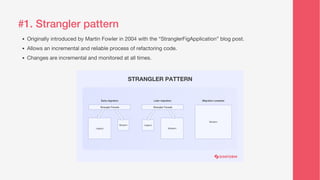
Originally introduced by Martin Fowler in 2004 with the “StranglerFigApplication” blog post.
Allows an incremental and reliable process of refactoring code.
Changes are incremental and monitored at all times.
#1. Strangler pattern
2
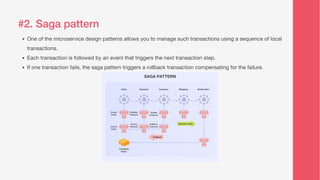
One of the microservice design patterns allows you to manage such transactions using a sequence of local
transactions.
Each transaction is followed by an event that triggers the next transaction step.
If one transaction fails, the saga pattern triggers a rollback transaction compensating for the failure.
#2. Saga pattern
2
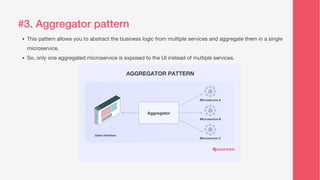
This pattern allows you to abstract the business logic from multiple services and aggregate them in a single
microservice.
So, only one aggregated microservice is exposed to the UI instead of multiple services.
#3. Aggregator pattern
2
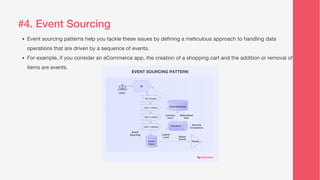
Event sourcing patterns help you tackle these issues by defining a meticulous approach to handling data
operations that are driven by a sequence of events.
For example, if you consider an eCommerce app, the creation of a shopping cart and the addition or removal of
items are events.
#4. Event Sourcing
2
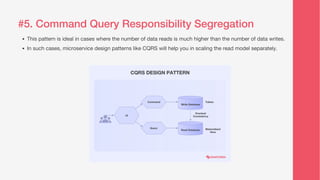
This pattern is ideal in cases where the number of data reads is much higher than the number of data writes.
In such cases, microservice design patterns like CQRS will help you in scaling the read model separately.
#5. Command Query Responsibility Segregation
2
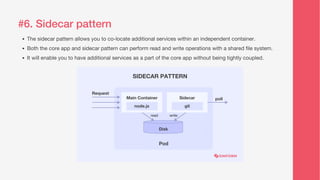
The sidecar pattern allows you to co-locate additional services within an independent container.
Both the core app and sidecar pattern can perform read and write operations with a shared file system.
It will enable you to have additional services as a part of the core app without being tightly coupled.
#6. Sidecar pattern
2
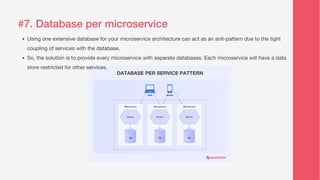
Using one extensive database for your microservice architecture can act as an anti-pattern due to the tight
coupling of services with the database.
So, the solution is to provide every microservice with separate databases. Each microservice will have a data
store restricted for other services.
#7. Database per microservice
Contact Us
Email Address
contactus@simform.com
Website
www.simform.com
Social Presence
twitter.com/simform
facebook.com/simform
linkedin.com/company/simform/

Microservice Design Patterns.pdf

  • 1.
    Top Microservice Design Patternsto Use For Your Business
  • 2.
    Table of Contents 2 Whatare microservices design patterns? Strangler pattern Saga pattern Aggregator pattern Event Sourcing I II III IV V Command Query Responsibility Segregation (CQRS) Sidecar pattern Database per microservice VI VII VIII
  • 3.
    2 A microservice consistsof independent app components that perform specific functions for a system. It may have a single instance or multiple instances based on the functional requirements. Together with the client-side (web interface and mobile UI) and other integrated services in the intermediate layers, each of these microservices forms a complete architecture. What are microservices design patterns?
  • 4.
    2 Originally introduced byMartin Fowler in 2004 with the “StranglerFigApplication” blog post. Allows an incremental and reliable process of refactoring code. Changes are incremental and monitored at all times. #1. Strangler pattern
  • 5.
    2 One of themicroservice design patterns allows you to manage such transactions using a sequence of local transactions. Each transaction is followed by an event that triggers the next transaction step. If one transaction fails, the saga pattern triggers a rollback transaction compensating for the failure. #2. Saga pattern
  • 6.
    2 This pattern allowsyou to abstract the business logic from multiple services and aggregate them in a single microservice. So, only one aggregated microservice is exposed to the UI instead of multiple services. #3. Aggregator pattern
  • 7.
    2 Event sourcing patternshelp you tackle these issues by defining a meticulous approach to handling data operations that are driven by a sequence of events. For example, if you consider an eCommerce app, the creation of a shopping cart and the addition or removal of items are events. #4. Event Sourcing
  • 8.
    2 This pattern isideal in cases where the number of data reads is much higher than the number of data writes. In such cases, microservice design patterns like CQRS will help you in scaling the read model separately. #5. Command Query Responsibility Segregation
  • 9.
    2 The sidecar patternallows you to co-locate additional services within an independent container. Both the core app and sidecar pattern can perform read and write operations with a shared file system. It will enable you to have additional services as a part of the core app without being tightly coupled. #6. Sidecar pattern
  • 10.
    2 Using one extensivedatabase for your microservice architecture can act as an anti-pattern due to the tight coupling of services with the database. So, the solution is to provide every microservice with separate databases. Each microservice will have a data store restricted for other services. #7. Database per microservice
  • 11.
    Contact Us Email Address contactus@simform.com Website www.simform.com SocialPresence twitter.com/simform facebook.com/simform linkedin.com/company/simform/