
How Container Orchestration
works?
What is container orchestration?
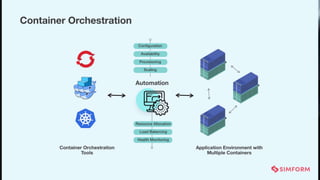
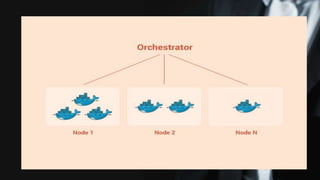
Container orchestration is the automation of much of the operational effort required
to run containerized workloads and services. This includes a wide range of things
software teams need to manage a container’s lifecycle, including provisioning,
deployment, scaling (up and down), networking, load balancing and more.
Section Break
Insert the Subtitle of Your Presentation
What are the benefits of container orchestration?
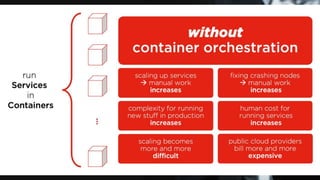
Container orchestration is key to working with containers, and it allows
organizations to unlock their full benefits. It also offers its own benefits for
a containerized environment, including:
‱Simplified operations: This is the most important benefit of container
orchestration and the main reason for its adoption. Containers introduce a
large amount of complexity that can quickly get out of control without
container orchestration to manage it.
‱Resilience: Container orchestration tools can automatically restart or
scale a container or cluster, boosting resilience.
‱Added security: Container orchestration’s automated approach helps
keep containerized applications secure by reducing or eliminating the
chance of human error.
Container orchestration versus Docker
Docker is a specific platform for building containers, including the Docker Engine
container runtime, whereas container orchestration is a broader term referring to
automation of any container’s lifecycle. Docker also includes Docker Swarm, which
is the platform’s own container orchestration tool that can automatically start
Docker containers.
Container orchestration encourages the use of the microservices architecture
pattern, in which an application is composed of smaller, atomic, independent
services — each one designed for a single task. Each microservice is packaged as
a container, and multiple microservices logically belonging to the same application
are orchestrated by Kubernetes at runtime.
Container orchestration versus Docker
Docker is a specific platform for building containers, including the Docker Engine container runtime,
whereas container orchestration is a broader term referring to automation of any container’s
lifecycle. Docker also includes Docker Swarm, which is the platform’s own container orchestration
tool that can automatically start Docker containers.
Container orchestration encourages the use of the microservices architecture pattern, in which an
application is composed of smaller, atomic, independent services — each one designed for a single
task. Each microservice is packaged as a container, and multiple microservices logically belonging
to the same application are orchestrated by Kubernetes at runtime.
Docker Container Orchestration vs. Kubernetes Container Orchestration
The Docker container orchestration tool, also known as Docker Swarm, can
package and run applications as containers, find existing container images
from others, and deploy a container on a laptop, server or cloud (public cloud
or private). Docker container orchestration requires one of the simplest
configurations.
Orchestration in container services for Kubernetes allows container clustering
via a container orchestration engine. Kubernetes has declarative
management that hides complexity, and is open source so you can run it
Section Break
Insert the Subtitle of Your Presentation
Section Break
Insert the Subtitle of Your Presentation
Why container orchestration is needed?
Container orchestration automates the deployment, management, scaling,
and networking of containers. Enterprises that need to deploy and manage
hundreds or thousands of LinuxÂź containers and hosts can benefit from
container orchestration. Container orchestration can be used in any
environment where you use containers
What is the difference between Kubernetes and Docker Swarm?
The major difference between the platforms is based on
complexity. Kubernetes is well suited for complex applications. On the
other hand, Docker Swarm is designed for ease of use, making it a
preferable choice for simple applications.
Features of a Container Orchestration Platform
Putting this notion into practice, containers at scale extended and refined
the concepts of scaling and resource availability.
The baseline features of a typical container orchestration platform include:
‱Resource management.
‱Service discovery.
‱Health checks.
‱Updates and upgrades.
The container orchestration market is currently dominated by Kubernetes.
It has gained the acceptance of enterprises, platform vendors, cloud
providers and infrastructure companies.
Section Break
Insert the Subtitle of Your Presentation
Why Do We Need Container Orchestration?
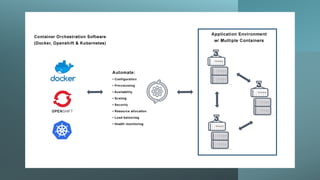
Container orchestration is used to automate the following tasks at scale:
‱ Configuring and scheduling of containers
‱ Provisioning and deployments of containers
‱ Availability of containers
‱ The configuration of applications in terms of the containers that they run in
‱ Scaling of containers to equally balance application workloads across
infrastructure
‱ Allocation of resources between containers
‱ Load balancing, traffic routing and service discovery of containers
‱ Health monitoring of containers
‱ Securing the interactions between containers.
Section Break
Insert the Subtitle of Your Presentation
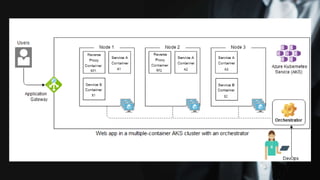
What is Kubernetes container orchestration?
Kubernetes is a popular open source platform for container orchestration. It
enables developers to easily build containerized applications and services, as
well as scale, schedule and monitor those containers. While there are other
options for container orchestration, such as Apache Mesos or Docker Swarm,
Kubernetes has become the industry standard. Kubernetes provides extensive
container capabilities, a dynamic contributor community, the growth of cloud-
native application development and the widespread availability of commercial
and hosted Kubernetes tools. Kubernetes is also highly extensible and
portable, meaning it can run in a wide range of environments and be used in
conjunction with other technologies, such as service meshes.
THANK YOU
Like the Video and Subscribe the Channel

Container Orchestration

  • 1.
  • 2.
    What is containerorchestration? Container orchestration is the automation of much of the operational effort required to run containerized workloads and services. This includes a wide range of things software teams need to manage a container’s lifecycle, including provisioning, deployment, scaling (up and down), networking, load balancing and more.
  • 3.
    Section Break Insert theSubtitle of Your Presentation
  • 4.
    What are thebenefits of container orchestration? Container orchestration is key to working with containers, and it allows organizations to unlock their full benefits. It also offers its own benefits for a containerized environment, including: ‱Simplified operations: This is the most important benefit of container orchestration and the main reason for its adoption. Containers introduce a large amount of complexity that can quickly get out of control without container orchestration to manage it. ‱Resilience: Container orchestration tools can automatically restart or scale a container or cluster, boosting resilience. ‱Added security: Container orchestration’s automated approach helps keep containerized applications secure by reducing or eliminating the chance of human error.
  • 6.
    Container orchestration versusDocker Docker is a specific platform for building containers, including the Docker Engine container runtime, whereas container orchestration is a broader term referring to automation of any container’s lifecycle. Docker also includes Docker Swarm, which is the platform’s own container orchestration tool that can automatically start Docker containers. Container orchestration encourages the use of the microservices architecture pattern, in which an application is composed of smaller, atomic, independent services — each one designed for a single task. Each microservice is packaged as a container, and multiple microservices logically belonging to the same application are orchestrated by Kubernetes at runtime.
  • 7.
    Container orchestration versusDocker Docker is a specific platform for building containers, including the Docker Engine container runtime, whereas container orchestration is a broader term referring to automation of any container’s lifecycle. Docker also includes Docker Swarm, which is the platform’s own container orchestration tool that can automatically start Docker containers. Container orchestration encourages the use of the microservices architecture pattern, in which an application is composed of smaller, atomic, independent services — each one designed for a single task. Each microservice is packaged as a container, and multiple microservices logically belonging to the same application are orchestrated by Kubernetes at runtime. Docker Container Orchestration vs. Kubernetes Container Orchestration The Docker container orchestration tool, also known as Docker Swarm, can package and run applications as containers, find existing container images from others, and deploy a container on a laptop, server or cloud (public cloud or private). Docker container orchestration requires one of the simplest configurations. Orchestration in container services for Kubernetes allows container clustering via a container orchestration engine. Kubernetes has declarative management that hides complexity, and is open source so you can run it
  • 8.
    Section Break Insert theSubtitle of Your Presentation
  • 9.
    Section Break Insert theSubtitle of Your Presentation
  • 10.
    Why container orchestrationis needed? Container orchestration automates the deployment, management, scaling, and networking of containers. Enterprises that need to deploy and manage hundreds or thousands of LinuxÂź containers and hosts can benefit from container orchestration. Container orchestration can be used in any environment where you use containers What is the difference between Kubernetes and Docker Swarm? The major difference between the platforms is based on complexity. Kubernetes is well suited for complex applications. On the other hand, Docker Swarm is designed for ease of use, making it a preferable choice for simple applications.
  • 11.
    Features of aContainer Orchestration Platform Putting this notion into practice, containers at scale extended and refined the concepts of scaling and resource availability. The baseline features of a typical container orchestration platform include: ‱Resource management. ‱Service discovery. ‱Health checks. ‱Updates and upgrades. The container orchestration market is currently dominated by Kubernetes. It has gained the acceptance of enterprises, platform vendors, cloud providers and infrastructure companies.
  • 12.
    Section Break Insert theSubtitle of Your Presentation
  • 13.
    Why Do WeNeed Container Orchestration? Container orchestration is used to automate the following tasks at scale: ‱ Configuring and scheduling of containers ‱ Provisioning and deployments of containers ‱ Availability of containers ‱ The configuration of applications in terms of the containers that they run in ‱ Scaling of containers to equally balance application workloads across infrastructure ‱ Allocation of resources between containers ‱ Load balancing, traffic routing and service discovery of containers ‱ Health monitoring of containers ‱ Securing the interactions between containers.
  • 14.
    Section Break Insert theSubtitle of Your Presentation
  • 15.
    What is Kubernetescontainer orchestration? Kubernetes is a popular open source platform for container orchestration. It enables developers to easily build containerized applications and services, as well as scale, schedule and monitor those containers. While there are other options for container orchestration, such as Apache Mesos or Docker Swarm, Kubernetes has become the industry standard. Kubernetes provides extensive container capabilities, a dynamic contributor community, the growth of cloud- native application development and the widespread availability of commercial and hosted Kubernetes tools. Kubernetes is also highly extensible and portable, meaning it can run in a wide range of environments and be used in conjunction with other technologies, such as service meshes.
  • 16.
    THANK YOU Like theVideo and Subscribe the Channel