CHAPTER TWO
CONSUMPTION SPENDING
Prepared by Dagim F.
DEPARTMENT OF ECONOMICS, MIZAN-TEPI UNIVERSITY
08/08/2024
www.dagimfetene7@gmail.com
2
2.1. Keynesian Consumption Function
 The Keynesian Consumption function states the relationship between
income and consumption.
 The hypothesis is also known as absolute income hypothesis.
 It stated that the current real consumer spending is a function of
current real disposable income.
 This simple linear relationship is typically based on causal observation of
the consumption decision of households, and assumes three conjectures.
08/08/2024
www.dagimfetene7@gmail.com
3
Cont…
 First, he holds that marginal propensity to consume (MPC)-which is the
additional spending on consumption for a rise in income by one birr, is
between 0 and 1.
 This is, because, when an individual earns 1 birr additional will be spend
some of it and save some of it.
MPC= dC/dY
where; C is consumption and
Y is income.
08/08/2024
www.dagimfetene7@gmail.com
4
Cont…
 Second, Keynes conjectured that average propensity to consume
(APC), which is the ratio of consumption to total income, falls as
income of households rises.
 He holds that as income increases the fraction saved out of it rises.
 This is so because he considers saving as luxury, resulting in the rich
saving higher proportion of their income than the poor.
APC= C⁄Y
08/08/2024
www.dagimfetene7@gmail.com
5
Cont…
 Third, Keynes conjectured that consumption was a function of income.
 This view was in a stark contrast to classical thought that held
consumption was a function of interest rate, and therefore they are
inversely related.
 On the basis of the three conjectures, Keynes’s consumption function
could be defined as:
08/08/2024
www.dagimfetene7@gmail.com
6
Cont…
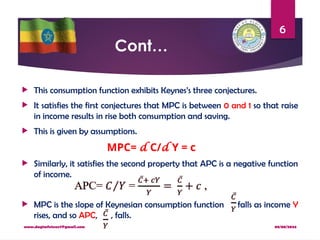
 This consumption function exhibits Keynes’s three conjectures.
 It satisfies the first conjectures that MPC is between 0 and 1 so that raise
in income results in rise both consumption and saving.
 This is given by assumptions.
MPC= d C/d Y = c
 Similarly, it satisfies the second property that APC is a negative function
of income.
 MPC is the slope of Keynesian consumption function falls as income Y
rises, and so APC, , falls.
08/08/2024
www.dagimfetene7@gmail.com
7
Cont…
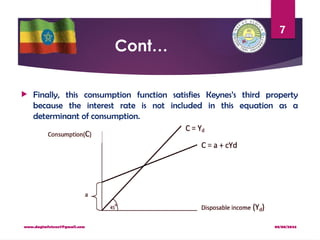
 Finally, this consumption function satisfies Keynes’s third property
because the interest rate is not included in this equation as a
determinant of consumption.
08/08/2024
www.dagimfetene7@gmail.com
8
The Early Empirical Success:
 Soon after Keynes proposed the consumption function, economists
began collecting and examining data to test his conjectures.
 The earliest studies indicated that the Keynesian consumption function
is a good approximation of how consumers behave.
 In some of these studies, researchers surveyed households and collected
data on consumption and income.
 They found that households with higher income consumed more, which
confirms that the marginal propensity to consume is greater than zero.
08/08/2024
www.dagimfetene7@gmail.com
9
Cont…
 They also found that households with higher income saved more, which
confirms that the marginal propensity to consume is less than one.
 In addition, these researchers found that higher-income households
saved a larger fraction of their income, which confirms that the average
propensity to consume falls as income rises.
 Thus, these data verified Keynes’s conjectures about the marginal and
average propensities to consume.
 In other studies, researchers examined aggregate data on consumption
and income for the period between the two world wars.
 These data also supported the Keynesian consumption function.
08/08/2024
www.dagimfetene7@gmail.com
10
Cont…
 In years when income was unusually low, such as during the depths of
the Great Depression, both consumption and saving were low,
indicating that the marginal propensity to consume is between zero
and one.
 In addition, during those years of low income, the ratio of consumption
to income was high, confirming Keynes’s second conjecture.
 Finally, because the correlation between income and consumption was
so strong, no other variable appeared to be important for explaining
consumption.
 Thus, the data also confirmed Keynes’s third conjecture that income is
the primary determinant of how much people choose to consume.
08/08/2024
www.dagimfetene7@gmail.com
11
Secular Stagnation, Simon Kuznets, and
the Consumption Puzzle
 On the basis of the Keynesian consumption function, these economists
reasoned that as incomes in the economy grew over time, households
would consume a smaller and smaller fraction of their incomes.
 They feared that there might not be enough profitable investment
projects to absorb all this saving.
 If so, the low consumption would lead to an inadequate demand for goods
and services, resulting in a depression once the wartime demand from the
government ceased.
 In other words, on the basis of the Keynesian consumption function, these
economists predicted that the economy would experience what they called
secular stagnation a long depression of indefinite duration unless fiscal
policy was used to expand aggregate demand.
08/08/2024
www.dagimfetene7@gmail.com
12
Cont…
 Fortunately for the economy, but unfortunately for the Keynesian
consumption function, the end of World War II did not throw the
country into another depression.
 Although incomes were much higher after the war than before, these
higher incomes did not lead to large increases in the rate of saving.
 Keynes’s conjecture that the average propensity to consume would fall
as income rose appeared not to hold.
 The second anomaly arose when economist Simon Kuznets constructed
new aggregate data on consumption and income dating back to 1869.
 Kuznets assembled these data in the 1940s and would later receive the
Nobel Prize for this work.
08/08/2024
www.dagimfetene7@gmail.com
13
Cont…
 He discovered that the ratio of consumption to income was remarkably
stable from decade to decade, despite large increases in income over
the period he studied.
 Again, Keynes’s conjecture that the average propensity to consume
would fall as income rose appeared not to hold.
 The failure of the secular-stagnation hypothesis and the findings of
Kuznets both indicated that the average propensity to consume is fairly
constant over long periods of time.
 This fact presented a puzzle that motivated much of the subsequent
work on consumption.
08/08/2024
www.dagimfetene7@gmail.com
14
Cont…
 Economists wanted to know why some studies confirmed Keynes’s
conjectures and others refuted them.
 That is, why did Keynes’s conjectures hold up well in the studies of
household data and in the studies of short time-series, but fail when
long time-series were examined?
 This evidence suggested that there were two consumption functions.
 Namely, the short-run and long-run consumption function.
08/08/2024
www.dagimfetene7@gmail.com
15
2.2. Short-run and Long-run Consumption
Function
 As shown above, the failure of the secular-stagnation hypothesis and the
findings of Kuznets both suggested that there were two consumption functions.
 For the household data or for the short time-series, the Keynesian consumption
function appeared to work well.
 Yet for the long time series, the consumption function appeared to have a
constant average propensity to consume.
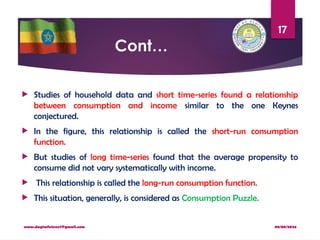
 In Figure 6.2, these two relationships between consumption and income are
called the short-run and long-run consumption functions.
 Economists needed to explain how these two consumption functions could be
consistent with each other.
08/08/2024
www.dagimfetene7@gmail.com
16
Cont…
Figure-2.2: Short-run and Long-run Consumption Function
08/08/2024
www.dagimfetene7@gmail.com
17
Cont…
 Studies of household data and short time-series found a relationship
between consumption and income similar to the one Keynes
conjectured.
 In the figure, this relationship is called the short-run consumption
function.
 But studies of long time-series found that the average propensity to
consume did not vary systematically with income.
 This relationship is called the long-run consumption function.
 This situation, generally, is considered as Consumption Puzzle.
08/08/2024
www.dagimfetene7@gmail.com
18
Cont…
 The final reconciling conclusion of the opposing results of Kuznets and
Keynes-consumption puzzle- is:
1. In the short run, the average propensity to consume (APC) falls as
income rises. This is because; in the short run consumption does not
immediately rise with income.
2. In the long run, the average propensity to consume (APC) is stable or
remains constant because people tend to spend their money on
durables as income increases. Thus, Keynes’ theory is valid in the short
run, but not in the long run.
08/08/2024
www.dagimfetene7@gmail.com
19
2.3. Theories of Consumption
 A number of hypotheses have been developed to explain the
consumers’ behaviors and at the same time to explain the short-run
and long-run consumption functions.
 Some of these theories or hypotheses are:
a) Keynesian absolute income hypothesis,
b) Relative Income hypothesis,
c) Fisher’s Intertemporal Model of Consumption,
d) Modegliani’s Life-Cycle Hypothesis and
e) Friedman’s Permanent Income hypothesis.
08/08/2024
www.dagimfetene7@gmail.com
20
2.3.1. Keynesian absolute income hypothesis
 Keynes proposed that consumption is a function of absolute level of
income [C= f(Y)].
 In other words, the consumption function can be stated as; C = a + cY.
 Where c is the marginal propensity to consume (which is the percentage
change in consumption due to change in income).
 Income is the most important explanatory variable of consumption; but
interest rate is irrelevant in explaining consumption.
 Some economists argued that interest rate determines consumption level.
 When interest rate in the banks increases, people save more money in
banks to receive the higher interest income and consume less.
08/08/2024
www.dagimfetene7@gmail.com
21
Cont…
 However, Keynes had not considered this effect.
 The ratio of consumer expenditure to income (C/Y) = APC (average
propensity to consume) varies inversely with the level of income both
cyclically (from time to time for a given family) and cross sectionally or
across families (from one family to another during the same period).
 For Keynesians the long-run consumption function is stated by the view
that short-run consumption function shifts upward over time and long
run consumption function is estimated from shifting points of the short-
run consumption functions.
08/08/2024
www.dagimfetene7@gmail.com
22
Cont…
 This upward shift in short-run consumption function could be due to
many reasons. Some of these reasons are:
a) Migration from rural to urban areas. This forces the people to spend
more even if income has not increased as urban people spend more
than the rural people.
b) Consumption function can also shift up ward due to the introduction of
new products as it stimulates the consumption.
08/08/2024
www.dagimfetene7@gmail.com
23
Cont…
C. An increase in population of a country also adds to consumption and
shifts its function upward.
D. Economic progress increases individuals’ income which in turn increases
consumption level.
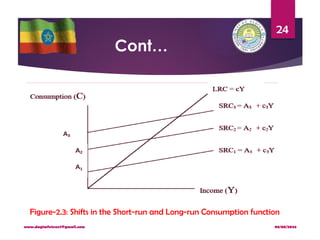
 Thus, basic proponents of absolute income hypothesis argue that the
short-run consumption function shifts upwards and produces the long
run consumption function, as shown in Figure below.
08/08/2024
www.dagimfetene7@gmail.com
24
Cont…
Figure-2.3: Shifts in the Short-run and Long-run Consumption function
08/08/2024
www.dagimfetene7@gmail.com
25
Cont…
 Where; SRC1, SRC2, and SRC3, are shifting short run consumption
functions (from SRC1 to SRC2 and then to SRC3);
 LRC is long run consumption function; and
 A1, A2 and A3 are the levels of autonomous consumption levels
corresponding to SRC1, SRC2, and SRC3 respectively
08/08/2024
www.dagimfetene7@gmail.com
26
2.3.2. Relative Income
hypothesis
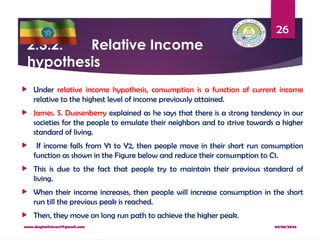
 Under relative income hypothesis, consumption is a function of current income
relative to the highest level of income previously attained.
 James. S. Duesenberry explained as he says that there is a strong tendency in our
societies for the people to emulate their neighbors and to strive towards a higher
standard of living.
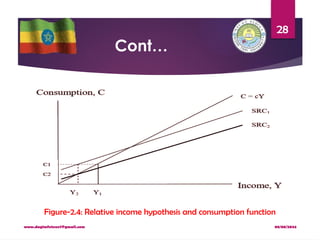
 If income falls from Y1 to Y2, then people move in their short run consumption
function as shown in the Figure below and reduce their consumption to C1.
 This is due to the fact that people try to maintain their previous standard of
living.
 When their income increases, then people will increase consumption in the short
run till the previous peak is reached.
 Then, they move on long run path to achieve the higher peak.
08/08/2024
www.dagimfetene7@gmail.com
27
Cont…
 Based on this, James S. Duesenberry explained an interesting concept
called demonstration effect.
 A family with any given level of income will typically spend more on
consumption if it lives in a community in which that income is relatively
high than if it lives in a community in which that income is relatively low.
 For instance, if a person with monthly income of 500 living in a
community with monthly incomes of 450, 560, 600, 900 and 980 spends
300 per month, he/she would spend more than 300 if she/he lives in
community with monthly income of 870, 950, 1500, 1800 and 2300.
 In short, this theory holds that there is psychological and family member
pressure on a person or household living in high income community to
spend more on consumption.
08/08/2024
www.dagimfetene7@gmail.com
28
Cont…
Figure-2.4: Relative income hypothesis and consumption function
08/08/2024
www.dagimfetene7@gmail.com
29
Cont…
 According to this theory (as it can be seen from the above figure), when
income of a person declines from Y1 to Y2, the person will not consume
C2 level; rather, he/she will consume a higher level C1 by moving to on
the short run consumption function.
 This is because the decline in income makes him/her a person with a
relatively low income in the community and so spends relatively more
on consumption.
 Normally, when a family lives in a locality with higher income groups
then the family with lower income spends more by seeing the spending
pattern of other families in the same locality.
08/08/2024
www.dagimfetene7@gmail.com
30
Cont…
 This tendency arises in part from pressure on the family to ‘keep up with
the joneses’ and
 in part from the fact that the family observes the goods and services
used by the neighbors and try to purchase those goods which are superior
goods due to demonstration effect.
 For example, in a locality if somebody buys a color television then
immediately one can see other families also buying the same irrespective
of their income.
 This is called demonstration effect where they try to demonstrate by
purchasing superior goods and services.
08/08/2024
www.dagimfetene7@gmail.com
31
2.3.3. Irving Fisher’s Inter temporal Model
 The consumption function introduced by Keynes relates current
consumption to current income.
 This relationship, however, is incomplete at best.
 When people decide how much to consume and how much to save, they
consider both the present and the future.
 The more consumption they enjoy today, the less they will be able to
enjoy tomorrow.
 In making this tradeoff, households must look ahead to the income they
expect to receive in the future and to the consumption of goods and
services they hope to be able to afford.
08/08/2024
www.dagimfetene7@gmail.com
32
Cont…
 Irving Fisher developed the model with which economists analyze how
rational, forward-looking consumers make inter-temporal choices-that is,
choices involving different periods of time.
 Fisher‘s model illuminates the constraints consumers face, the preferences
they have, and how these constraints and preferences together determine
their choices about consumption and saving.
08/08/2024
www.dagimfetene7@gmail.com
33
The Inter-temporal Budget Constraint
 Most people would prefer to increase the quantity or quality
of the goods and services they Consume to wear nicer clothes,
eat at better restaurants, or see more movies.
 The reason people consume less than they desire is that their
consumption is constrained by their income.
 In other words, consumers face a limit on how much they can
spend, called a budget constraint.
08/08/2024
www.dagimfetene7@gmail.com
34
Cont…
 When they are deciding how much to consume today versus
how much to save for the future, they face an inter-temporal
budget constraint, which measures the total resources
available for consumption today and in the future.
 Our first step in developing Fisher‘s model is to examine this
constraint in some detail.
08/08/2024
www.dagimfetene7@gmail.com
35
Cont…
 To keep things simple, we examine the decision facing a consumer
who lives for two periods.
 Period one represents the consumer’s youth and period two
represents the consumer’s old age.
 The consumer earns income Y1 and consumes C1 in period one, and
earns income Y2 and consumes C2 in period two.
 (All variables are real that is, adjusted for inflation.) Because the
consumer has the opportunity to borrow and save, consumption in
any single period can be either greater or less than income in that
period.
08/08/2024
www.dagimfetene7@gmail.com
36
Cont…
 Consider how the consumer’s income in the two periods constrains consumption in
the two periods.
 In the first period, saving equals income minus consumption. That is,
S = Y1 − C1,
 Where; S is saving. In the second period, consumption equals the accumulated
saving, including the interest earned on that saving, plus second-period income.
 That is, C2 = (1 + r)S + Y2, where r is the real interest rate.
 For example, if the interest rate is 5 percent, then for every $1 of saving in period
one, the consumer enjoys an extra $1.05 of consumption in period two.
 Because there is no third period, the consumer does not save in the second period.
08/08/2024
www.dagimfetene7@gmail.com
37
Cont…
 Note that the variable S can represent either saving or borrowing and that
these equations hold in both cases.
 If first-period consumption is less than first period income, the consumer is
saving, and S is greater than zero.
 If first-period consumption exceeds first-period income, the consumer is
borrowing, and S is less than zero.
 For simplicity, we assume that the interest rate for borrowing is the same as
the interest rate for saving.
 To derive the consumer’s budget constraint, combine the two preceding
equations. Substitute the first equation for S into the second equation to
obtain C2 = (1 + r)(Y1 − C1) + Y2.
08/08/2024
www.dagimfetene7@gmail.com
38
Cont…
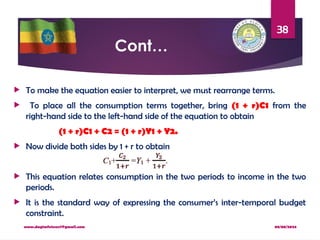
 To make the equation easier to interpret, we must rearrange terms.
 To place all the consumption terms together, bring (1 + r)C1 from the
right-hand side to the left-hand side of the equation to obtain
(1 + r)C1 + C2 = (1 + r)Y1 + Y2.
 Now divide both sides by 1 + r to obtain
 This equation relates consumption in the two periods to income in the two
periods.
 It is the standard way of expressing the consumer’s inter-temporal budget
constraint.
08/08/2024
www.dagimfetene7@gmail.com
39
Cont…
 The consumer’s budget constraint is easily interpreted.
 If the interest rate is zero, the budget constraint shows that total consumption
in the two periods equals total income in the two periods.
 In the usual case in which the interest rate is greater than zero, future
consumption and future income are discounted by a factor 1 + r.
 This discounting arises from the interest earned on savings.
 In essence, because the consumer earns interest on current income that is
saved, future income is worth less than current income.
 Similarly, because future consumption is paid for out of savings that have
earned interest, future consumption costs less than current consumption.
08/08/2024
www.dagimfetene7@gmail.com
40
Cont…
 The factor 1/(1 + r) is the price of second period consumption measured in
terms of first-period consumption:
 it is the amount of first-period consumption that the consumer must forgo to
obtain 1 unit of second-period consumption.
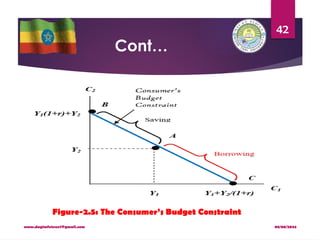
 Figure-2.5 below graphs the consumer’s budget constraint with three points
marked on it.
 At point A, the consumer consumes exactly his income in each period
(C1 = Y1 and C2 = Y2), so there is neither saving nor borrowing between
the two periods.
08/08/2024
www.dagimfetene7@gmail.com
41
Cont…
 At point B, the consumer consumes nothing in the first period (C1 = 0) and
saves all income, so second-period consumption C2 is (1 + r)Y1 + Y2.
 At point C, the consumer plans to consume nothing in the second period
(C2 = 0) and borrows as much as possible against second-period income,
so first-period consumption C1 is Y1 + Y2/(1 + r).
 Of course, these are only three of the many combinations of first- and
second-period consumption that the consumer can afford: all the points on
the line from B to C are available to the consumer.
08/08/2024
www.dagimfetene7@gmail.com
42
Cont…
Figure-2.5: The Consumer’s Budget Constraint
08/08/2024
www.dagimfetene7@gmail.com
43
Consumer Preferences
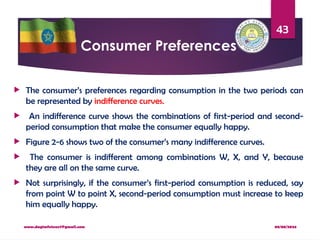
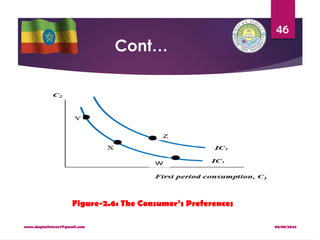
 The consumer’s preferences regarding consumption in the two periods can
be represented by indifference curves.
 An indifference curve shows the combinations of first-period and second-
period consumption that make the consumer equally happy.
 Figure 2-6 shows two of the consumer’s many indifference curves.
 The consumer is indifferent among combinations W, X, and Y, because
they are all on the same curve.
 Not surprisingly, if the consumer’s first-period consumption is reduced, say
from point W to point X, second-period consumption must increase to keep
him equally happy.
08/08/2024
www.dagimfetene7@gmail.com
44
Cont…
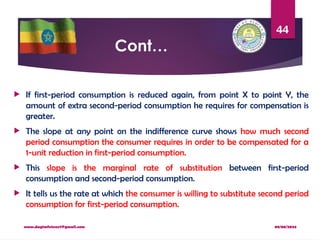
 If first-period consumption is reduced again, from point X to point Y, the
amount of extra second-period consumption he requires for compensation is
greater.
 The slope at any point on the indifference curve shows how much second
period consumption the consumer requires in order to be compensated for a
1-unit reduction in first-period consumption.
 This slope is the marginal rate of substitution between first-period
consumption and second-period consumption.
 It tells us the rate at which the consumer is willing to substitute second period
consumption for first-period consumption.
08/08/2024
www.dagimfetene7@gmail.com
45
Cont…
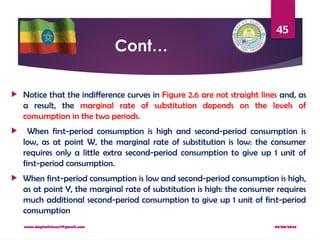
 Notice that the indifference curves in Figure 2.6 are not straight lines and, as
a result, the marginal rate of substitution depends on the levels of
consumption in the two periods.
 When first-period consumption is high and second-period consumption is
low, as at point W, the marginal rate of substitution is low: the consumer
requires only a little extra second-period consumption to give up 1 unit of
first-period consumption.
 When first-period consumption is low and second-period consumption is high,
as at point Y, the marginal rate of substitution is high: the consumer requires
much additional second-period consumption to give up 1 unit of first-period
consumption
08/08/2024
www.dagimfetene7@gmail.com
46
Cont…
Figure-2.6: The Consumer’s Preferences
08/08/2024
www.dagimfetene7@gmail.com
47
Cont…
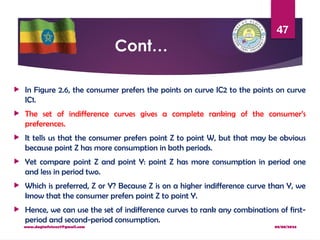
 In Figure 2.6, the consumer prefers the points on curve IC2 to the points on curve
IC1.
 The set of indifference curves gives a complete ranking of the consumer’s
preferences.
 It tells us that the consumer prefers point Z to point W, but that may be obvious
because point Z has more consumption in both periods.
 Yet compare point Z and point Y: point Z has more consumption in period one
and less in period two.
 Which is preferred, Z or Y? Because Z is on a higher indifference curve than Y, we
know that the consumer prefers point Z to point Y.
 Hence, we can use the set of indifference curves to rank any combinations of first-
period and second-period consumption.
08/08/2024
www.dagimfetene7@gmail.com
48
Optimization
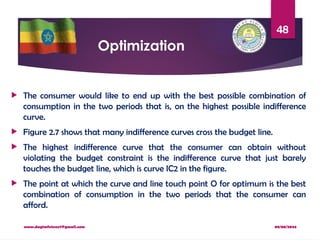
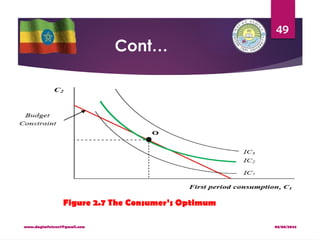
 The consumer would like to end up with the best possible combination of
consumption in the two periods that is, on the highest possible indifference
curve.
 Figure 2.7 shows that many indifference curves cross the budget line.
 The highest indifference curve that the consumer can obtain without
violating the budget constraint is the indifference curve that just barely
touches the budget line, which is curve IC2 in the figure.
 The point at which the curve and line touch point O for optimum is the best
combination of consumption in the two periods that the consumer can
afford.
08/08/2024
www.dagimfetene7@gmail.com
49
Cont…
Figure 2.7 The Consumer’s Optimum
08/08/2024
www.dagimfetene7@gmail.com
50
How Changes in Income Affect Consumption
 At the optimum, the slope of the indifference curve (MRS) equals the slope of the
budget line (1 + r). i.e., the indifference curve is tangent to the budget line.
 We conclude that at point O, MRS = The consumer chooses consumption in the two
periods so that the marginal rate of substitution equals 1 plus the real interest rate.
 Now that we have seen how the consumer makes the consumption decision, let’s
examine how consumption responds to an increase in income.
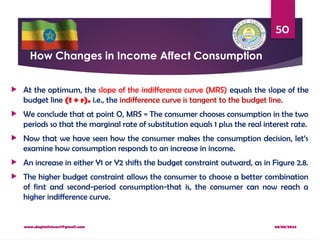
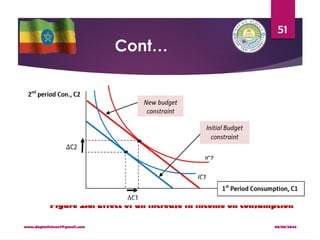
 An increase in either Y1 or Y2 shifts the budget constraint outward, as in Figure 2.8.
 The higher budget constraint allows the consumer to choose a better combination
of first and second-period consumption-that is, the consumer can now reach a
higher indifference curve.
08/08/2024
www.dagimfetene7@gmail.com
51
Cont…
Figure 2.8: Effect of an increase in income on consumption
08/08/2024
www.dagimfetene7@gmail.com
52
Cont…
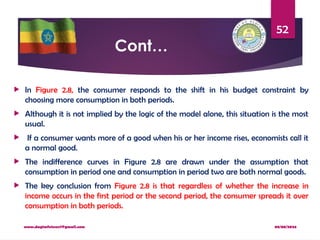
 In Figure 2.8, the consumer responds to the shift in his budget constraint by
choosing more consumption in both periods.
 Although it is not implied by the logic of the model alone, this situation is the most
usual.
 If a consumer wants more of a good when his or her income rises, economists call it
a normal good.
 The indifference curves in Figure 2.8 are drawn under the assumption that
consumption in period one and consumption in period two are both normal goods.
 The key conclusion from Figure 2.8 is that regardless of whether the increase in
income occurs in the first period or the second period, the consumer spreads it over
consumption in both periods.
08/08/2024
www.dagimfetene7@gmail.com
53
Cont…
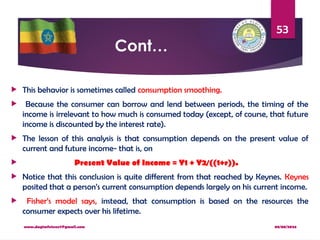
 This behavior is sometimes called consumption smoothing.
 Because the consumer can borrow and lend between periods, the timing of the
income is irrelevant to how much is consumed today (except, of course, that future
income is discounted by the interest rate).
 The lesson of this analysis is that consumption depends on the present value of
current and future income- that is, on
 Present Value of Income = Y1 + Y2⁄((1+r)).
 Notice that this conclusion is quite different from that reached by Keynes. Keynes
posited that a person’s current consumption depends largely on his current income.
 Fisher’s model says, instead, that consumption is based on the resources the
consumer expects over his lifetime.
08/08/2024
www.dagimfetene7@gmail.com
54
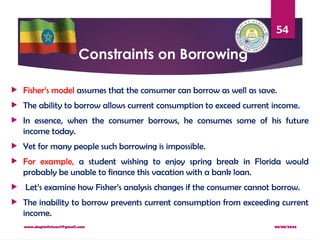
Constraints on Borrowing
 Fisher’s model assumes that the consumer can borrow as well as save.
 The ability to borrow allows current consumption to exceed current income.
 In essence, when the consumer borrows, he consumes some of his future
income today.
 Yet for many people such borrowing is impossible.
 For example, a student wishing to enjoy spring break in Florida would
probably be unable to finance this vacation with a bank loan.
 Let’s examine how Fisher’s analysis changes if the consumer cannot borrow.
 The inability to borrow prevents current consumption from exceeding current
income.
08/08/2024
www.dagimfetene7@gmail.com
55
Cont…
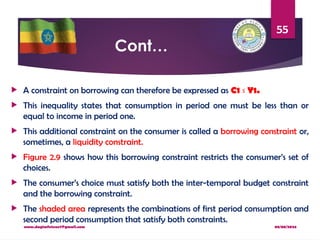
 A constraint on borrowing can therefore be expressed as C1 ≤ Y1.
 This inequality states that consumption in period one must be less than or
equal to income in period one.
 This additional constraint on the consumer is called a borrowing constraint or,
sometimes, a liquidity constraint.
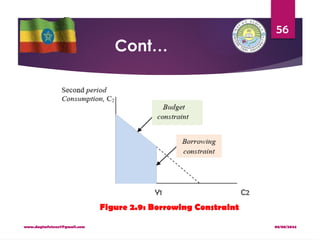
 Figure 2.9 shows how this borrowing constraint restricts the consumer’s set of
choices.
 The consumer’s choice must satisfy both the inter-temporal budget constraint
and the borrowing constraint.
 The shaded area represents the combinations of first period consumption and
second period consumption that satisfy both constraints.
08/08/2024
www.dagimfetene7@gmail.com
56
Cont…
Y1 C2
Figure 2.9: Borrowing Constraint
08/08/2024
www.dagimfetene7@gmail.com
57
Cont…
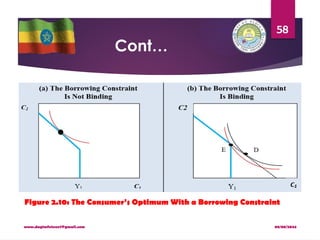
 Figure 2.10 shows how this borrowing constraint affects the consumption
decision. There are two possibilities.
 In panel (a), the consumer wishes to consume less in period one than he earns.
 The borrowing constraint is not binding and, therefore, does not affect
consumption.
 In panel (b), the consumer would like to choose point D, where he consumes
more in period one than he earns, but the borrowing constraint prevents this
outcome.
 The best the consumer can do is to consume his first-period income,
represented by point E.
08/08/2024
www.dagimfetene7@gmail.com
58
Cont…
Figure 2.10: The Consumer’s Optimum With a Borrowing Constraint
08/08/2024
www.dagimfetene7@gmail.com
59
Cont…
 The analysis of borrowing constraints leads us to conclude that there are
two consumption functions.
 For some consumers, the borrowing constraint is not binding, and
consumption in both periods depends on the present value of lifetime
income, Y1 + [Y2/(1 + r)].
 For other consumers, the borrowing constraint binds, and the
consumption function is C1 = Y1 and C2 = Y2.
 Hence, for those consumers who would like to borrow but cannot,
consumption depends only on current income.
08/08/2024
www.dagimfetene7@gmail.com
60
2.3.4. Franco Modigliani and the Life-Cycle
Hypothesis
 Franco Modigliani and his collaborators Albert Ando and Richard Brumberg
used Fisher’s model of consumer behavior to study the consumption function.
 One of their goals was to solve the consumption puzzle that is, to explain the
apparently conflicting pieces of evidence that came to light when Keynes’s
consumption function was brought to the data.
 According to Fisher’s model, consumption depends on a person’s lifetime income.
 Modigliani emphasized that income varies systematically over people’s lives and
that saving allows consumers to move income from those times in life when
income is high to those times when it is low.
 This interpretation of consumer behavior formed the basis for his life-cycle
hypothesis.
08/08/2024
www.dagimfetene7@gmail.com
61
The Hypothesis
 One important reason that income varies over a person’s life is retirement.
 Most people plan to stop working at about age 65, and they expect their incomes to fall
when they retire.
 Yet they do not want a large drop in their standard of living, as measured by their
consumption.
 To maintain consumption after retirement, people must save during their working
years.
 Let’s see what this motive for saving implies for the consumption function. Consider a
consumer who expects to live another T years, has wealth of W, and expects to earn
income Y until she retires R years from now.
 What level of consumption will the consumer choose if she wishes to maintain a smooth
level of consumption over her life?
08/08/2024
www.dagimfetene7@gmail.com
62
Cont…
 The consumer’s lifetime resources are composed of initial wealth W and lifetime
earnings of R × Y.
 (For simplicity, we are assuming an interest rate of zero; if the interest rate were
greater than zero, we would need to take account of interest earned on savings as
well.)
 The consumer can divide up her lifetime resources among her T remaining years of
life.
 We assume that she wishes to achieve the smoothest possible path of consumption
over her lifetime.
 Therefore, she divides this total of W + RY equally among the T years and each
year consumes C = (W + RY )/T.
 We can write this person’s consumption function as C = (1/T )W + (R/T )Y.
08/08/2024
www.dagimfetene7@gmail.com
63
Cont…
 For example, if the consumer expects to live for 50 more years
and work for 30 of them, then T = 50 and R = 30, so her
consumption function is
C = 0.02W + 0.6Y
 This equation says that consumption depends on both income
and wealth.
 An extra $1 of income per year raises consumption by $0.60 per
year, and an extra $1 of wealth raises consumption by $0.02 per
year.
08/08/2024
www.dagimfetene7@gmail.com
64
Cont…
 If every individual in the economy plans consumption like this,
then the aggregate consumption function is much the same
as the individual one.
 In particular, aggregate consumption depends on both
wealth and income.
 That is, the economy’s consumption function is C = aW + bY,
where the parameter “a” is the marginal propensity to
consume out of wealth, and the parameter “b” is the
marginal propensity to consume out of income.
08/08/2024
www.dagimfetene7@gmail.com
65
Implications
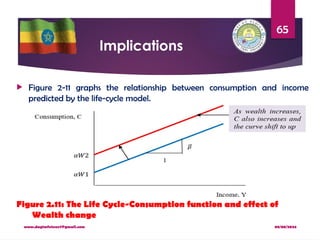
 Figure 2-11 graphs the relationship between consumption and income
predicted by the life-cycle model.
Figure 2.11: The Life Cycle-Consumption function and effect of
Wealth change
08/08/2024
www.dagimfetene7@gmail.com
66
Cont…
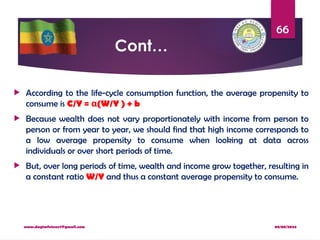
 According to the life-cycle consumption function, the average propensity to
consume is C/Y = (W/Y ) + b
α
 Because wealth does not vary proportionately with income from person to
person or from year to year, we should find that high income corresponds to
a low average propensity to consume when looking at data across
individuals or over short periods of time.
 But, over long periods of time, wealth and income grow together, resulting in
a constant ratio W/Y and thus a constant average propensity to consume.
08/08/2024
www.dagimfetene7@gmail.com
67
Cont…
 To make the same point somewhat differently, consider how the consumption
function changes over time.
 As Figure 2.10 shows, for any given level of wealth, the life-cycle consumption
function looks like the one Keynes suggested.
 But this function holds only in the short run when wealth is constant.
 In the long run, as wealth increases, the consumption function shifts upward, as
shown in Figure 2.10 too.
 This upward shift prevents the average propensity to consume from falling as
income increases.
 In this way, Modigliani resolved the consumption puzzle posed by Simon
Kuznets’s data.
08/08/2024
www.dagimfetene7@gmail.com
68
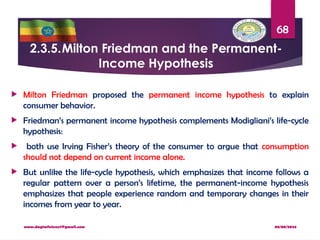
2.3.5.Milton Friedman and the Permanent-
Income Hypothesis
 Milton Friedman proposed the permanent income hypothesis to explain
consumer behavior.
 Friedman’s permanent income hypothesis complements Modigliani’s life-cycle
hypothesis:
 both use Irving Fisher’s theory of the consumer to argue that consumption
should not depend on current income alone.
 But unlike the life-cycle hypothesis, which emphasizes that income follows a
regular pattern over a person’s lifetime, the permanent-income hypothesis
emphasizes that people experience random and temporary changes in their
incomes from year to year.
08/08/2024
www.dagimfetene7@gmail.com
69
Cont…
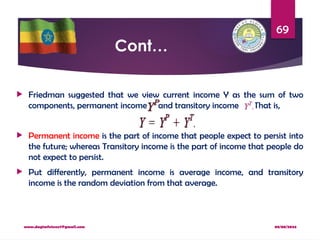
 Friedman suggested that we view current income Y as the sum of two
components, permanent income and transitory income . That is,
 Permanent income is the part of income that people expect to persist into
the future; whereas Transitory income is the part of income that people do
not expect to persist.
 Put differently, permanent income is average income, and transitory
income is the random deviation from that average.
08/08/2024
www.dagimfetene7@gmail.com
70
Cont…
 Friedman reasoned that consumption should depend primarily on
permanent income, because consumers use saving and borrowing to
smooth consumption in response to transitory changes in income.
 For example, if a person received a permanent raise of $10,000 per
year, his consumption would rise by about as much. Yet if a person won
$10,000 in a lottery, he would not consume it all in one year. Instead, he
would spread the extra consumption over the rest of his life. Assuming an
interest rate of zero and a remaining life span of 50 years, consumption
would rise by only $200 per year in response to the $10,000 prize.
 Thus, consumers spend their permanent income, but they save rather than
spend most of their transitory income.
08/08/2024
www.dagimfetene7@gmail.com
71
Cont…
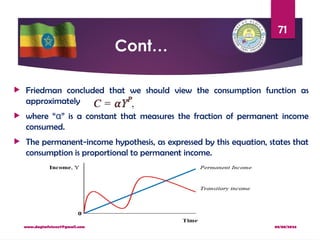
 Friedman concluded that we should view the consumption function as
approximately
 where “ ” is a constant that measures the fraction of permanent income
α
consumed.
 The permanent-income hypothesis, as expressed by this equation, states that
consumption is proportional to permanent income.
08/08/2024
www.dagimfetene7@gmail.com
72
Cont…
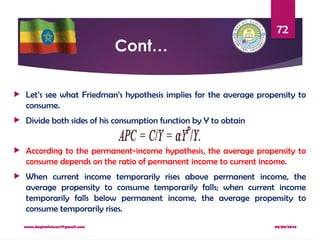
 Let’s see what Friedman’s hypothesis implies for the average propensity to
consume.
 Divide both sides of his consumption function by Y to obtain
 According to the permanent-income hypothesis, the average propensity to
consume depends on the ratio of permanent income to current income.
 When current income temporarily rises above permanent income, the
average propensity to consume temporarily falls; when current income
temporarily falls below permanent income, the average propensity to
consume temporarily rises.
Macro II Chapter 2.pptx For economics stude.

Macro II Chapter 2.pptx For economics stude.

  • 1.
    CHAPTER TWO CONSUMPTION SPENDING Preparedby Dagim F. DEPARTMENT OF ECONOMICS, MIZAN-TEPI UNIVERSITY
  • 2.
    08/08/2024 www.dagimfetene7@gmail.com 2 2.1. Keynesian ConsumptionFunction  The Keynesian Consumption function states the relationship between income and consumption.  The hypothesis is also known as absolute income hypothesis.  It stated that the current real consumer spending is a function of current real disposable income.  This simple linear relationship is typically based on causal observation of the consumption decision of households, and assumes three conjectures.
  • 3.
    08/08/2024 www.dagimfetene7@gmail.com 3 Cont…  First, heholds that marginal propensity to consume (MPC)-which is the additional spending on consumption for a rise in income by one birr, is between 0 and 1.  This is, because, when an individual earns 1 birr additional will be spend some of it and save some of it. MPC= dC/dY where; C is consumption and Y is income.
  • 4.
    08/08/2024 www.dagimfetene7@gmail.com 4 Cont…  Second, Keynesconjectured that average propensity to consume (APC), which is the ratio of consumption to total income, falls as income of households rises.  He holds that as income increases the fraction saved out of it rises.  This is so because he considers saving as luxury, resulting in the rich saving higher proportion of their income than the poor. APC= C⁄Y
  • 5.
    08/08/2024 www.dagimfetene7@gmail.com 5 Cont…  Third, Keynesconjectured that consumption was a function of income.  This view was in a stark contrast to classical thought that held consumption was a function of interest rate, and therefore they are inversely related.  On the basis of the three conjectures, Keynes’s consumption function could be defined as:
  • 6.
    08/08/2024 www.dagimfetene7@gmail.com 6 Cont…  This consumptionfunction exhibits Keynes’s three conjectures.  It satisfies the first conjectures that MPC is between 0 and 1 so that raise in income results in rise both consumption and saving.  This is given by assumptions. MPC= d C/d Y = c  Similarly, it satisfies the second property that APC is a negative function of income.  MPC is the slope of Keynesian consumption function falls as income Y rises, and so APC, , falls.
  • 7.
    08/08/2024 www.dagimfetene7@gmail.com 7 Cont…  Finally, thisconsumption function satisfies Keynes’s third property because the interest rate is not included in this equation as a determinant of consumption.
  • 8.
    08/08/2024 www.dagimfetene7@gmail.com 8 The Early EmpiricalSuccess:  Soon after Keynes proposed the consumption function, economists began collecting and examining data to test his conjectures.  The earliest studies indicated that the Keynesian consumption function is a good approximation of how consumers behave.  In some of these studies, researchers surveyed households and collected data on consumption and income.  They found that households with higher income consumed more, which confirms that the marginal propensity to consume is greater than zero.
  • 9.
    08/08/2024 www.dagimfetene7@gmail.com 9 Cont…  They alsofound that households with higher income saved more, which confirms that the marginal propensity to consume is less than one.  In addition, these researchers found that higher-income households saved a larger fraction of their income, which confirms that the average propensity to consume falls as income rises.  Thus, these data verified Keynes’s conjectures about the marginal and average propensities to consume.  In other studies, researchers examined aggregate data on consumption and income for the period between the two world wars.  These data also supported the Keynesian consumption function.
  • 10.
    08/08/2024 www.dagimfetene7@gmail.com 10 Cont…  In yearswhen income was unusually low, such as during the depths of the Great Depression, both consumption and saving were low, indicating that the marginal propensity to consume is between zero and one.  In addition, during those years of low income, the ratio of consumption to income was high, confirming Keynes’s second conjecture.  Finally, because the correlation between income and consumption was so strong, no other variable appeared to be important for explaining consumption.  Thus, the data also confirmed Keynes’s third conjecture that income is the primary determinant of how much people choose to consume.
  • 11.
    08/08/2024 www.dagimfetene7@gmail.com 11 Secular Stagnation, SimonKuznets, and the Consumption Puzzle  On the basis of the Keynesian consumption function, these economists reasoned that as incomes in the economy grew over time, households would consume a smaller and smaller fraction of their incomes.  They feared that there might not be enough profitable investment projects to absorb all this saving.  If so, the low consumption would lead to an inadequate demand for goods and services, resulting in a depression once the wartime demand from the government ceased.  In other words, on the basis of the Keynesian consumption function, these economists predicted that the economy would experience what they called secular stagnation a long depression of indefinite duration unless fiscal policy was used to expand aggregate demand.
  • 12.
    08/08/2024 www.dagimfetene7@gmail.com 12 Cont…  Fortunately forthe economy, but unfortunately for the Keynesian consumption function, the end of World War II did not throw the country into another depression.  Although incomes were much higher after the war than before, these higher incomes did not lead to large increases in the rate of saving.  Keynes’s conjecture that the average propensity to consume would fall as income rose appeared not to hold.  The second anomaly arose when economist Simon Kuznets constructed new aggregate data on consumption and income dating back to 1869.  Kuznets assembled these data in the 1940s and would later receive the Nobel Prize for this work.
  • 13.
    08/08/2024 www.dagimfetene7@gmail.com 13 Cont…  He discoveredthat the ratio of consumption to income was remarkably stable from decade to decade, despite large increases in income over the period he studied.  Again, Keynes’s conjecture that the average propensity to consume would fall as income rose appeared not to hold.  The failure of the secular-stagnation hypothesis and the findings of Kuznets both indicated that the average propensity to consume is fairly constant over long periods of time.  This fact presented a puzzle that motivated much of the subsequent work on consumption.
  • 14.
    08/08/2024 www.dagimfetene7@gmail.com 14 Cont…  Economists wantedto know why some studies confirmed Keynes’s conjectures and others refuted them.  That is, why did Keynes’s conjectures hold up well in the studies of household data and in the studies of short time-series, but fail when long time-series were examined?  This evidence suggested that there were two consumption functions.  Namely, the short-run and long-run consumption function.
  • 15.
    08/08/2024 www.dagimfetene7@gmail.com 15 2.2. Short-run andLong-run Consumption Function  As shown above, the failure of the secular-stagnation hypothesis and the findings of Kuznets both suggested that there were two consumption functions.  For the household data or for the short time-series, the Keynesian consumption function appeared to work well.  Yet for the long time series, the consumption function appeared to have a constant average propensity to consume.  In Figure 6.2, these two relationships between consumption and income are called the short-run and long-run consumption functions.  Economists needed to explain how these two consumption functions could be consistent with each other.
  • 16.
  • 17.
    08/08/2024 www.dagimfetene7@gmail.com 17 Cont…  Studies ofhousehold data and short time-series found a relationship between consumption and income similar to the one Keynes conjectured.  In the figure, this relationship is called the short-run consumption function.  But studies of long time-series found that the average propensity to consume did not vary systematically with income.  This relationship is called the long-run consumption function.  This situation, generally, is considered as Consumption Puzzle.
  • 18.
    08/08/2024 www.dagimfetene7@gmail.com 18 Cont…  The finalreconciling conclusion of the opposing results of Kuznets and Keynes-consumption puzzle- is: 1. In the short run, the average propensity to consume (APC) falls as income rises. This is because; in the short run consumption does not immediately rise with income. 2. In the long run, the average propensity to consume (APC) is stable or remains constant because people tend to spend their money on durables as income increases. Thus, Keynes’ theory is valid in the short run, but not in the long run.
  • 19.
    08/08/2024 www.dagimfetene7@gmail.com 19 2.3. Theories ofConsumption  A number of hypotheses have been developed to explain the consumers’ behaviors and at the same time to explain the short-run and long-run consumption functions.  Some of these theories or hypotheses are: a) Keynesian absolute income hypothesis, b) Relative Income hypothesis, c) Fisher’s Intertemporal Model of Consumption, d) Modegliani’s Life-Cycle Hypothesis and e) Friedman’s Permanent Income hypothesis.
  • 20.
    08/08/2024 www.dagimfetene7@gmail.com 20 2.3.1. Keynesian absoluteincome hypothesis  Keynes proposed that consumption is a function of absolute level of income [C= f(Y)].  In other words, the consumption function can be stated as; C = a + cY.  Where c is the marginal propensity to consume (which is the percentage change in consumption due to change in income).  Income is the most important explanatory variable of consumption; but interest rate is irrelevant in explaining consumption.  Some economists argued that interest rate determines consumption level.  When interest rate in the banks increases, people save more money in banks to receive the higher interest income and consume less.
  • 21.
    08/08/2024 www.dagimfetene7@gmail.com 21 Cont…  However, Keyneshad not considered this effect.  The ratio of consumer expenditure to income (C/Y) = APC (average propensity to consume) varies inversely with the level of income both cyclically (from time to time for a given family) and cross sectionally or across families (from one family to another during the same period).  For Keynesians the long-run consumption function is stated by the view that short-run consumption function shifts upward over time and long run consumption function is estimated from shifting points of the short- run consumption functions.
  • 22.
    08/08/2024 www.dagimfetene7@gmail.com 22 Cont…  This upwardshift in short-run consumption function could be due to many reasons. Some of these reasons are: a) Migration from rural to urban areas. This forces the people to spend more even if income has not increased as urban people spend more than the rural people. b) Consumption function can also shift up ward due to the introduction of new products as it stimulates the consumption.
  • 23.
    08/08/2024 www.dagimfetene7@gmail.com 23 Cont… C. An increasein population of a country also adds to consumption and shifts its function upward. D. Economic progress increases individuals’ income which in turn increases consumption level.  Thus, basic proponents of absolute income hypothesis argue that the short-run consumption function shifts upwards and produces the long run consumption function, as shown in Figure below.
  • 24.
    08/08/2024 www.dagimfetene7@gmail.com 24 Cont… Figure-2.3: Shifts inthe Short-run and Long-run Consumption function
  • 25.
    08/08/2024 www.dagimfetene7@gmail.com 25 Cont…  Where; SRC1,SRC2, and SRC3, are shifting short run consumption functions (from SRC1 to SRC2 and then to SRC3);  LRC is long run consumption function; and  A1, A2 and A3 are the levels of autonomous consumption levels corresponding to SRC1, SRC2, and SRC3 respectively
  • 26.
    08/08/2024 www.dagimfetene7@gmail.com 26 2.3.2. Relative Income hypothesis Under relative income hypothesis, consumption is a function of current income relative to the highest level of income previously attained.  James. S. Duesenberry explained as he says that there is a strong tendency in our societies for the people to emulate their neighbors and to strive towards a higher standard of living.  If income falls from Y1 to Y2, then people move in their short run consumption function as shown in the Figure below and reduce their consumption to C1.  This is due to the fact that people try to maintain their previous standard of living.  When their income increases, then people will increase consumption in the short run till the previous peak is reached.  Then, they move on long run path to achieve the higher peak.
  • 27.
    08/08/2024 www.dagimfetene7@gmail.com 27 Cont…  Based onthis, James S. Duesenberry explained an interesting concept called demonstration effect.  A family with any given level of income will typically spend more on consumption if it lives in a community in which that income is relatively high than if it lives in a community in which that income is relatively low.  For instance, if a person with monthly income of 500 living in a community with monthly incomes of 450, 560, 600, 900 and 980 spends 300 per month, he/she would spend more than 300 if she/he lives in community with monthly income of 870, 950, 1500, 1800 and 2300.  In short, this theory holds that there is psychological and family member pressure on a person or household living in high income community to spend more on consumption.
  • 28.
  • 29.
    08/08/2024 www.dagimfetene7@gmail.com 29 Cont…  According tothis theory (as it can be seen from the above figure), when income of a person declines from Y1 to Y2, the person will not consume C2 level; rather, he/she will consume a higher level C1 by moving to on the short run consumption function.  This is because the decline in income makes him/her a person with a relatively low income in the community and so spends relatively more on consumption.  Normally, when a family lives in a locality with higher income groups then the family with lower income spends more by seeing the spending pattern of other families in the same locality.
  • 30.
    08/08/2024 www.dagimfetene7@gmail.com 30 Cont…  This tendencyarises in part from pressure on the family to ‘keep up with the joneses’ and  in part from the fact that the family observes the goods and services used by the neighbors and try to purchase those goods which are superior goods due to demonstration effect.  For example, in a locality if somebody buys a color television then immediately one can see other families also buying the same irrespective of their income.  This is called demonstration effect where they try to demonstrate by purchasing superior goods and services.
  • 31.
    08/08/2024 www.dagimfetene7@gmail.com 31 2.3.3. Irving Fisher’sInter temporal Model  The consumption function introduced by Keynes relates current consumption to current income.  This relationship, however, is incomplete at best.  When people decide how much to consume and how much to save, they consider both the present and the future.  The more consumption they enjoy today, the less they will be able to enjoy tomorrow.  In making this tradeoff, households must look ahead to the income they expect to receive in the future and to the consumption of goods and services they hope to be able to afford.
  • 32.
    08/08/2024 www.dagimfetene7@gmail.com 32 Cont…  Irving Fisherdeveloped the model with which economists analyze how rational, forward-looking consumers make inter-temporal choices-that is, choices involving different periods of time.  Fisher‘s model illuminates the constraints consumers face, the preferences they have, and how these constraints and preferences together determine their choices about consumption and saving.
  • 33.
    08/08/2024 www.dagimfetene7@gmail.com 33 The Inter-temporal BudgetConstraint  Most people would prefer to increase the quantity or quality of the goods and services they Consume to wear nicer clothes, eat at better restaurants, or see more movies.  The reason people consume less than they desire is that their consumption is constrained by their income.  In other words, consumers face a limit on how much they can spend, called a budget constraint.
  • 34.
    08/08/2024 www.dagimfetene7@gmail.com 34 Cont…  When theyare deciding how much to consume today versus how much to save for the future, they face an inter-temporal budget constraint, which measures the total resources available for consumption today and in the future.  Our first step in developing Fisher‘s model is to examine this constraint in some detail.
  • 35.
    08/08/2024 www.dagimfetene7@gmail.com 35 Cont…  To keepthings simple, we examine the decision facing a consumer who lives for two periods.  Period one represents the consumer’s youth and period two represents the consumer’s old age.  The consumer earns income Y1 and consumes C1 in period one, and earns income Y2 and consumes C2 in period two.  (All variables are real that is, adjusted for inflation.) Because the consumer has the opportunity to borrow and save, consumption in any single period can be either greater or less than income in that period.
  • 36.
    08/08/2024 www.dagimfetene7@gmail.com 36 Cont…  Consider howthe consumer’s income in the two periods constrains consumption in the two periods.  In the first period, saving equals income minus consumption. That is, S = Y1 − C1,  Where; S is saving. In the second period, consumption equals the accumulated saving, including the interest earned on that saving, plus second-period income.  That is, C2 = (1 + r)S + Y2, where r is the real interest rate.  For example, if the interest rate is 5 percent, then for every $1 of saving in period one, the consumer enjoys an extra $1.05 of consumption in period two.  Because there is no third period, the consumer does not save in the second period.
  • 37.
    08/08/2024 www.dagimfetene7@gmail.com 37 Cont…  Note thatthe variable S can represent either saving or borrowing and that these equations hold in both cases.  If first-period consumption is less than first period income, the consumer is saving, and S is greater than zero.  If first-period consumption exceeds first-period income, the consumer is borrowing, and S is less than zero.  For simplicity, we assume that the interest rate for borrowing is the same as the interest rate for saving.  To derive the consumer’s budget constraint, combine the two preceding equations. Substitute the first equation for S into the second equation to obtain C2 = (1 + r)(Y1 − C1) + Y2.
  • 38.
    08/08/2024 www.dagimfetene7@gmail.com 38 Cont…  To makethe equation easier to interpret, we must rearrange terms.  To place all the consumption terms together, bring (1 + r)C1 from the right-hand side to the left-hand side of the equation to obtain (1 + r)C1 + C2 = (1 + r)Y1 + Y2.  Now divide both sides by 1 + r to obtain  This equation relates consumption in the two periods to income in the two periods.  It is the standard way of expressing the consumer’s inter-temporal budget constraint.
  • 39.
    08/08/2024 www.dagimfetene7@gmail.com 39 Cont…  The consumer’sbudget constraint is easily interpreted.  If the interest rate is zero, the budget constraint shows that total consumption in the two periods equals total income in the two periods.  In the usual case in which the interest rate is greater than zero, future consumption and future income are discounted by a factor 1 + r.  This discounting arises from the interest earned on savings.  In essence, because the consumer earns interest on current income that is saved, future income is worth less than current income.  Similarly, because future consumption is paid for out of savings that have earned interest, future consumption costs less than current consumption.
  • 40.
    08/08/2024 www.dagimfetene7@gmail.com 40 Cont…  The factor1/(1 + r) is the price of second period consumption measured in terms of first-period consumption:  it is the amount of first-period consumption that the consumer must forgo to obtain 1 unit of second-period consumption.  Figure-2.5 below graphs the consumer’s budget constraint with three points marked on it.  At point A, the consumer consumes exactly his income in each period (C1 = Y1 and C2 = Y2), so there is neither saving nor borrowing between the two periods.
  • 41.
    08/08/2024 www.dagimfetene7@gmail.com 41 Cont…  At pointB, the consumer consumes nothing in the first period (C1 = 0) and saves all income, so second-period consumption C2 is (1 + r)Y1 + Y2.  At point C, the consumer plans to consume nothing in the second period (C2 = 0) and borrows as much as possible against second-period income, so first-period consumption C1 is Y1 + Y2/(1 + r).  Of course, these are only three of the many combinations of first- and second-period consumption that the consumer can afford: all the points on the line from B to C are available to the consumer.
  • 42.
  • 43.
    08/08/2024 www.dagimfetene7@gmail.com 43 Consumer Preferences  Theconsumer’s preferences regarding consumption in the two periods can be represented by indifference curves.  An indifference curve shows the combinations of first-period and second- period consumption that make the consumer equally happy.  Figure 2-6 shows two of the consumer’s many indifference curves.  The consumer is indifferent among combinations W, X, and Y, because they are all on the same curve.  Not surprisingly, if the consumer’s first-period consumption is reduced, say from point W to point X, second-period consumption must increase to keep him equally happy.
  • 44.
    08/08/2024 www.dagimfetene7@gmail.com 44 Cont…  If first-periodconsumption is reduced again, from point X to point Y, the amount of extra second-period consumption he requires for compensation is greater.  The slope at any point on the indifference curve shows how much second period consumption the consumer requires in order to be compensated for a 1-unit reduction in first-period consumption.  This slope is the marginal rate of substitution between first-period consumption and second-period consumption.  It tells us the rate at which the consumer is willing to substitute second period consumption for first-period consumption.
  • 45.
    08/08/2024 www.dagimfetene7@gmail.com 45 Cont…  Notice thatthe indifference curves in Figure 2.6 are not straight lines and, as a result, the marginal rate of substitution depends on the levels of consumption in the two periods.  When first-period consumption is high and second-period consumption is low, as at point W, the marginal rate of substitution is low: the consumer requires only a little extra second-period consumption to give up 1 unit of first-period consumption.  When first-period consumption is low and second-period consumption is high, as at point Y, the marginal rate of substitution is high: the consumer requires much additional second-period consumption to give up 1 unit of first-period consumption
  • 46.
  • 47.
    08/08/2024 www.dagimfetene7@gmail.com 47 Cont…  In Figure2.6, the consumer prefers the points on curve IC2 to the points on curve IC1.  The set of indifference curves gives a complete ranking of the consumer’s preferences.  It tells us that the consumer prefers point Z to point W, but that may be obvious because point Z has more consumption in both periods.  Yet compare point Z and point Y: point Z has more consumption in period one and less in period two.  Which is preferred, Z or Y? Because Z is on a higher indifference curve than Y, we know that the consumer prefers point Z to point Y.  Hence, we can use the set of indifference curves to rank any combinations of first- period and second-period consumption.
  • 48.
    08/08/2024 www.dagimfetene7@gmail.com 48 Optimization  The consumerwould like to end up with the best possible combination of consumption in the two periods that is, on the highest possible indifference curve.  Figure 2.7 shows that many indifference curves cross the budget line.  The highest indifference curve that the consumer can obtain without violating the budget constraint is the indifference curve that just barely touches the budget line, which is curve IC2 in the figure.  The point at which the curve and line touch point O for optimum is the best combination of consumption in the two periods that the consumer can afford.
  • 49.
  • 50.
    08/08/2024 www.dagimfetene7@gmail.com 50 How Changes inIncome Affect Consumption  At the optimum, the slope of the indifference curve (MRS) equals the slope of the budget line (1 + r). i.e., the indifference curve is tangent to the budget line.  We conclude that at point O, MRS = The consumer chooses consumption in the two periods so that the marginal rate of substitution equals 1 plus the real interest rate.  Now that we have seen how the consumer makes the consumption decision, let’s examine how consumption responds to an increase in income.  An increase in either Y1 or Y2 shifts the budget constraint outward, as in Figure 2.8.  The higher budget constraint allows the consumer to choose a better combination of first and second-period consumption-that is, the consumer can now reach a higher indifference curve.
  • 51.
  • 52.
    08/08/2024 www.dagimfetene7@gmail.com 52 Cont…  In Figure2.8, the consumer responds to the shift in his budget constraint by choosing more consumption in both periods.  Although it is not implied by the logic of the model alone, this situation is the most usual.  If a consumer wants more of a good when his or her income rises, economists call it a normal good.  The indifference curves in Figure 2.8 are drawn under the assumption that consumption in period one and consumption in period two are both normal goods.  The key conclusion from Figure 2.8 is that regardless of whether the increase in income occurs in the first period or the second period, the consumer spreads it over consumption in both periods.
  • 53.
    08/08/2024 www.dagimfetene7@gmail.com 53 Cont…  This behavioris sometimes called consumption smoothing.  Because the consumer can borrow and lend between periods, the timing of the income is irrelevant to how much is consumed today (except, of course, that future income is discounted by the interest rate).  The lesson of this analysis is that consumption depends on the present value of current and future income- that is, on  Present Value of Income = Y1 + Y2⁄((1+r)).  Notice that this conclusion is quite different from that reached by Keynes. Keynes posited that a person’s current consumption depends largely on his current income.  Fisher’s model says, instead, that consumption is based on the resources the consumer expects over his lifetime.
  • 54.
    08/08/2024 www.dagimfetene7@gmail.com 54 Constraints on Borrowing Fisher’s model assumes that the consumer can borrow as well as save.  The ability to borrow allows current consumption to exceed current income.  In essence, when the consumer borrows, he consumes some of his future income today.  Yet for many people such borrowing is impossible.  For example, a student wishing to enjoy spring break in Florida would probably be unable to finance this vacation with a bank loan.  Let’s examine how Fisher’s analysis changes if the consumer cannot borrow.  The inability to borrow prevents current consumption from exceeding current income.
  • 55.
    08/08/2024 www.dagimfetene7@gmail.com 55 Cont…  A constrainton borrowing can therefore be expressed as C1 ≤ Y1.  This inequality states that consumption in period one must be less than or equal to income in period one.  This additional constraint on the consumer is called a borrowing constraint or, sometimes, a liquidity constraint.  Figure 2.9 shows how this borrowing constraint restricts the consumer’s set of choices.  The consumer’s choice must satisfy both the inter-temporal budget constraint and the borrowing constraint.  The shaded area represents the combinations of first period consumption and second period consumption that satisfy both constraints.
  • 56.
  • 57.
    08/08/2024 www.dagimfetene7@gmail.com 57 Cont…  Figure 2.10shows how this borrowing constraint affects the consumption decision. There are two possibilities.  In panel (a), the consumer wishes to consume less in period one than he earns.  The borrowing constraint is not binding and, therefore, does not affect consumption.  In panel (b), the consumer would like to choose point D, where he consumes more in period one than he earns, but the borrowing constraint prevents this outcome.  The best the consumer can do is to consume his first-period income, represented by point E.
  • 58.
    08/08/2024 www.dagimfetene7@gmail.com 58 Cont… Figure 2.10: TheConsumer’s Optimum With a Borrowing Constraint
  • 59.
    08/08/2024 www.dagimfetene7@gmail.com 59 Cont…  The analysisof borrowing constraints leads us to conclude that there are two consumption functions.  For some consumers, the borrowing constraint is not binding, and consumption in both periods depends on the present value of lifetime income, Y1 + [Y2/(1 + r)].  For other consumers, the borrowing constraint binds, and the consumption function is C1 = Y1 and C2 = Y2.  Hence, for those consumers who would like to borrow but cannot, consumption depends only on current income.
  • 60.
    08/08/2024 www.dagimfetene7@gmail.com 60 2.3.4. Franco Modiglianiand the Life-Cycle Hypothesis  Franco Modigliani and his collaborators Albert Ando and Richard Brumberg used Fisher’s model of consumer behavior to study the consumption function.  One of their goals was to solve the consumption puzzle that is, to explain the apparently conflicting pieces of evidence that came to light when Keynes’s consumption function was brought to the data.  According to Fisher’s model, consumption depends on a person’s lifetime income.  Modigliani emphasized that income varies systematically over people’s lives and that saving allows consumers to move income from those times in life when income is high to those times when it is low.  This interpretation of consumer behavior formed the basis for his life-cycle hypothesis.
  • 61.
    08/08/2024 www.dagimfetene7@gmail.com 61 The Hypothesis  Oneimportant reason that income varies over a person’s life is retirement.  Most people plan to stop working at about age 65, and they expect their incomes to fall when they retire.  Yet they do not want a large drop in their standard of living, as measured by their consumption.  To maintain consumption after retirement, people must save during their working years.  Let’s see what this motive for saving implies for the consumption function. Consider a consumer who expects to live another T years, has wealth of W, and expects to earn income Y until she retires R years from now.  What level of consumption will the consumer choose if she wishes to maintain a smooth level of consumption over her life?
  • 62.
    08/08/2024 www.dagimfetene7@gmail.com 62 Cont…  The consumer’slifetime resources are composed of initial wealth W and lifetime earnings of R × Y.  (For simplicity, we are assuming an interest rate of zero; if the interest rate were greater than zero, we would need to take account of interest earned on savings as well.)  The consumer can divide up her lifetime resources among her T remaining years of life.  We assume that she wishes to achieve the smoothest possible path of consumption over her lifetime.  Therefore, she divides this total of W + RY equally among the T years and each year consumes C = (W + RY )/T.  We can write this person’s consumption function as C = (1/T )W + (R/T )Y.
  • 63.
    08/08/2024 www.dagimfetene7@gmail.com 63 Cont…  For example,if the consumer expects to live for 50 more years and work for 30 of them, then T = 50 and R = 30, so her consumption function is C = 0.02W + 0.6Y  This equation says that consumption depends on both income and wealth.  An extra $1 of income per year raises consumption by $0.60 per year, and an extra $1 of wealth raises consumption by $0.02 per year.
  • 64.
    08/08/2024 www.dagimfetene7@gmail.com 64 Cont…  If everyindividual in the economy plans consumption like this, then the aggregate consumption function is much the same as the individual one.  In particular, aggregate consumption depends on both wealth and income.  That is, the economy’s consumption function is C = aW + bY, where the parameter “a” is the marginal propensity to consume out of wealth, and the parameter “b” is the marginal propensity to consume out of income.
  • 65.
    08/08/2024 www.dagimfetene7@gmail.com 65 Implications  Figure 2-11graphs the relationship between consumption and income predicted by the life-cycle model. Figure 2.11: The Life Cycle-Consumption function and effect of Wealth change
  • 66.
    08/08/2024 www.dagimfetene7@gmail.com 66 Cont…  According tothe life-cycle consumption function, the average propensity to consume is C/Y = (W/Y ) + b α  Because wealth does not vary proportionately with income from person to person or from year to year, we should find that high income corresponds to a low average propensity to consume when looking at data across individuals or over short periods of time.  But, over long periods of time, wealth and income grow together, resulting in a constant ratio W/Y and thus a constant average propensity to consume.
  • 67.
    08/08/2024 www.dagimfetene7@gmail.com 67 Cont…  To makethe same point somewhat differently, consider how the consumption function changes over time.  As Figure 2.10 shows, for any given level of wealth, the life-cycle consumption function looks like the one Keynes suggested.  But this function holds only in the short run when wealth is constant.  In the long run, as wealth increases, the consumption function shifts upward, as shown in Figure 2.10 too.  This upward shift prevents the average propensity to consume from falling as income increases.  In this way, Modigliani resolved the consumption puzzle posed by Simon Kuznets’s data.
  • 68.
    08/08/2024 www.dagimfetene7@gmail.com 68 2.3.5.Milton Friedman andthe Permanent- Income Hypothesis  Milton Friedman proposed the permanent income hypothesis to explain consumer behavior.  Friedman’s permanent income hypothesis complements Modigliani’s life-cycle hypothesis:  both use Irving Fisher’s theory of the consumer to argue that consumption should not depend on current income alone.  But unlike the life-cycle hypothesis, which emphasizes that income follows a regular pattern over a person’s lifetime, the permanent-income hypothesis emphasizes that people experience random and temporary changes in their incomes from year to year.
  • 69.
    08/08/2024 www.dagimfetene7@gmail.com 69 Cont…  Friedman suggestedthat we view current income Y as the sum of two components, permanent income and transitory income . That is,  Permanent income is the part of income that people expect to persist into the future; whereas Transitory income is the part of income that people do not expect to persist.  Put differently, permanent income is average income, and transitory income is the random deviation from that average.
  • 70.
    08/08/2024 www.dagimfetene7@gmail.com 70 Cont…  Friedman reasonedthat consumption should depend primarily on permanent income, because consumers use saving and borrowing to smooth consumption in response to transitory changes in income.  For example, if a person received a permanent raise of $10,000 per year, his consumption would rise by about as much. Yet if a person won $10,000 in a lottery, he would not consume it all in one year. Instead, he would spread the extra consumption over the rest of his life. Assuming an interest rate of zero and a remaining life span of 50 years, consumption would rise by only $200 per year in response to the $10,000 prize.  Thus, consumers spend their permanent income, but they save rather than spend most of their transitory income.
  • 71.
    08/08/2024 www.dagimfetene7@gmail.com 71 Cont…  Friedman concludedthat we should view the consumption function as approximately  where “ ” is a constant that measures the fraction of permanent income α consumed.  The permanent-income hypothesis, as expressed by this equation, states that consumption is proportional to permanent income.
  • 72.
    08/08/2024 www.dagimfetene7@gmail.com 72 Cont…  Let’s seewhat Friedman’s hypothesis implies for the average propensity to consume.  Divide both sides of his consumption function by Y to obtain  According to the permanent-income hypothesis, the average propensity to consume depends on the ratio of permanent income to current income.  When current income temporarily rises above permanent income, the average propensity to consume temporarily falls; when current income temporarily falls below permanent income, the average propensity to consume temporarily rises.