BY
Sakthivel.R

Consumption is defined as the final
purchase of goods and services by
individuals.
And this is also called as consumer
spending.
CONSUMPTION

The consumption function is a
function that expresses consumer
spending in terms of its determinants,
such as income and accumulated
wealth.
CONSUMPTION FUNCTION

GOODS:
Any tangible commodity that
satisfies human want is said to be a good.
Example: air
SERVICES:
Any intangible thing that satisfies
human want is called a service.
Example: service of a doctor.
GOODS AND SERVICES

FREE GOODS:
A free good is a good that is not scarce, and
therefore available without limits.
Example: air
ECONOMIC GOODS:
A consumable item that is useful to people but
scarce in relation to its demand, so that human
effort is required to obtain it.
Example: rice
FREE GOODS AND ECONOMIC GOODS

PRODUCER GOODS:
The goods that satisfy the wants of the
consumer directly are called producer
goods.
 CONSUMER GOODS:
They are tangible goods that are
purchased for direct consumption to satisfy
a human need or want
PRODUCER GOODS AND CONSUMER
GOODS

PERISHABLE GOODS:
The goods that has a short life and decay
quickly are called perishable goods.
Example: vegetables
DURABLE GOODS:A durable good is a
consumer good with an extended life
expectancy.
Example: car
PERISHABLE GOODS AND DURABLE GOODS

SUBSTITUTE GOODS:
Two goods are said to be substitutes if
one among them can be used instead of the
other.
Example: tea and coffee
COMPLEMENTARY GOODS:
Two goods are said to be complementary
if both are needed to satisfy the same want.
SUBSTITUTE GOODS AND
COMPLEMENTARY GOODS

WEALTH:
 It is an economic good which is easily
transferable.
It must be a material good.
A non material good cannot form a wealth.
INCOME:
Remuneration paid to the different factors
of production.
WEALTH AND INCOME

REAL INCOME:
If the income is expressed in terms of
commodity then it is said to be real income.
MONEY INCOME:
If the income is expressed in terms of
money then it is called money income.
REAL INCOME AND MONEY INCOME

Economic value is the measure of
benefit provided by a good or service
to an economic agent.
It is generally measured relative to
units of currency.
VALUE

When value is expressed as money in
exchange is called price.
`the payments like rent, wages,
interest are also a kind of price that we
may pay to land, labour, capital
respectively.
PRICE

Market is a place where the sellers of a
particular good or service can meet with the
buyers of that goods and service where
there is potential for a transaction to take
place.
MARKET

This theory explains that how consumers
buy different goods and services.
Theories included in consumer behaviour :
1.utility theory
2.indifference preference theory
THEORY OF CONSUMER
BEHAVIOUR

As successive quantity of good is
consumed, the utility we derive diminishes.
According to Alfred Marshall “the
additional benefit which a person derives
from a given increase of his stock.”
LAW OF DIMINISHING MARGINAL
UTILITY

This was brought forth by an economist
vilfredo pareto.
In this analysis the consumer analysis is
described in terms of consumer preferences
of various combination of goods.
INDIFFERENCE PREFERENCE
THEORY

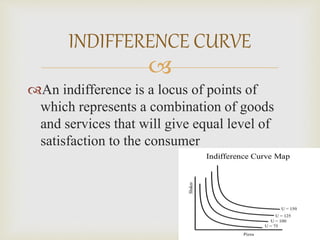
An indifference is a locus of points of
which represents a combination of goods
and services that will give equal level of
satisfaction to the consumer
INDIFFERENCE CURVE

A budget line shows the combination
of goods that can be purchased at a
given level of income.
BUDGET LINE

Consumer equilibrium refers to the
combination of goods that gives the highest
level of satisfaction to a consumer that is
within his purchasing power.
CONSUMER EQUILIBRIUM

Consumption

  • 1.
  • 2.
     Consumption is definedas the final purchase of goods and services by individuals. And this is also called as consumer spending. CONSUMPTION
  • 3.
     The consumption functionis a function that expresses consumer spending in terms of its determinants, such as income and accumulated wealth. CONSUMPTION FUNCTION
  • 4.
     GOODS: Any tangible commoditythat satisfies human want is said to be a good. Example: air SERVICES: Any intangible thing that satisfies human want is called a service. Example: service of a doctor. GOODS AND SERVICES
  • 5.
     FREE GOODS: A freegood is a good that is not scarce, and therefore available without limits. Example: air ECONOMIC GOODS: A consumable item that is useful to people but scarce in relation to its demand, so that human effort is required to obtain it. Example: rice FREE GOODS AND ECONOMIC GOODS
  • 6.
     PRODUCER GOODS: The goodsthat satisfy the wants of the consumer directly are called producer goods.  CONSUMER GOODS: They are tangible goods that are purchased for direct consumption to satisfy a human need or want PRODUCER GOODS AND CONSUMER GOODS
  • 7.
     PERISHABLE GOODS: The goodsthat has a short life and decay quickly are called perishable goods. Example: vegetables DURABLE GOODS:A durable good is a consumer good with an extended life expectancy. Example: car PERISHABLE GOODS AND DURABLE GOODS
  • 8.
     SUBSTITUTE GOODS: Two goodsare said to be substitutes if one among them can be used instead of the other. Example: tea and coffee COMPLEMENTARY GOODS: Two goods are said to be complementary if both are needed to satisfy the same want. SUBSTITUTE GOODS AND COMPLEMENTARY GOODS
  • 9.
     WEALTH:  It isan economic good which is easily transferable. It must be a material good. A non material good cannot form a wealth. INCOME: Remuneration paid to the different factors of production. WEALTH AND INCOME
  • 10.
     REAL INCOME: If theincome is expressed in terms of commodity then it is said to be real income. MONEY INCOME: If the income is expressed in terms of money then it is called money income. REAL INCOME AND MONEY INCOME
  • 11.
     Economic value isthe measure of benefit provided by a good or service to an economic agent. It is generally measured relative to units of currency. VALUE
  • 12.
     When value isexpressed as money in exchange is called price. `the payments like rent, wages, interest are also a kind of price that we may pay to land, labour, capital respectively. PRICE
  • 13.
     Market is aplace where the sellers of a particular good or service can meet with the buyers of that goods and service where there is potential for a transaction to take place. MARKET
  • 14.
     This theory explainsthat how consumers buy different goods and services. Theories included in consumer behaviour : 1.utility theory 2.indifference preference theory THEORY OF CONSUMER BEHAVIOUR
  • 15.
     As successive quantityof good is consumed, the utility we derive diminishes. According to Alfred Marshall “the additional benefit which a person derives from a given increase of his stock.” LAW OF DIMINISHING MARGINAL UTILITY
  • 16.
     This was broughtforth by an economist vilfredo pareto. In this analysis the consumer analysis is described in terms of consumer preferences of various combination of goods. INDIFFERENCE PREFERENCE THEORY
  • 17.
     An indifference isa locus of points of which represents a combination of goods and services that will give equal level of satisfaction to the consumer INDIFFERENCE CURVE
  • 18.
     A budget lineshows the combination of goods that can be purchased at a given level of income. BUDGET LINE
  • 19.
     Consumer equilibrium refersto the combination of goods that gives the highest level of satisfaction to a consumer that is within his purchasing power. CONSUMER EQUILIBRIUM