ABOUT COMPANY
• In 1824, John Cadbury began selling tea, coffee, and drinking chocolate
which he produced himself at Bull Street in Birmingham, England.
• He later moved into the production of a variety of cocoa and drinking
chocolates, made in a factory in Bridge Street .
• John Cadbury became a partner with his brother Benjamin and the
company they formed was called ‘Cadbury Brothers of Birmingham’.
Company Analysis
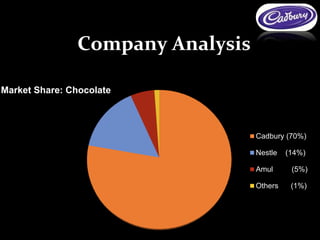
Market Share: Chocolate
Cadbury (70%)
Nestle (14%)
Amul (5%)
Others (1%)
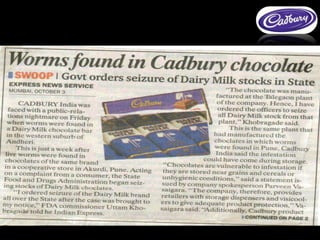
• In eight outlets across Maharashtra, worms were found in some bars of
Cadbury Dairy Milk.
• Inquiry was instituted by the Food and Drug Administration and negative
media publicity spread like wildfire.
• Consequently, sales volume plummeted, retailer cooperation lessened
and employee morale dwindled. All in all, the company's credibility
suffered extensive damage
Crisis
• Reputation and credibility was under intense scrutiny.
• Sales volumes came down drastically in the first 10 weeks.
• Employee morale – especially that of the sales team – was shaken.
• Due to which media coverage touched close to 1000 clips in print
and 120 on TV news channels.
• People even assumed that every chocolate could be contaminated.
Impact
• Cadbury India Ltd. has begun investigations into reports that live
worms were found in its Dairy Milk chocolate bars.
• Cadbury’s statement : We are concerned about these reports and are
investigating it," a company spokesperson said.
• The Maharashtra Food and Drugs Administration (FDA) had
announced that it would prosecute Cadbury India Ltd. after tests
indicated "insect infestations" in the chocolate samples tested.
Problems faced by Cadbury
• To Restore confidence in the key stakeholders.
• Build back credibility.
• Make customer believe about safety.
• To increase the sales.
Challenges
In response to the crisis, Cadbury therefore developed three key messages:-
• Infestation was a storage problem;
• It was safe to eat Cadbury chocolates; and
• Consumers must exercise the same care in purchasing a chocolate as
they would when buying any food item.
Objectives
• They did not deny the fact of worms being present in the chocolates
• Project Vishwas
• Advertisement featuring Amitabh Bachchan.
• Revamping of packaging of Dairy Milk having metallic poly flow.
Steps taken by Cadbury to
achieve the objectives -
• Identification of four stakeholders the consumers, its employees, the
media, and the government authorities (i.e. the FDA)
• Situation with FDA would improve as the company was strictly adhering to
food safety laws
• Attention from media would fade as media would lose interest and find
other stories to cover
What & How to be Done?
Internal Actions
Implementation of Actions
▪ Letters from MD to the employees
▪ Employees were asked to go to the
markets and check for themselves
▪ Series of town hall meetings were
held
▪ Regular email updates
External Actions
▪ Packaging
▪ Project “Vishwas”
▪ Two advertisements featuring Amitabh
Bachchan
▪ Media conferences platform of BQC
▪ Retail monitoring and education program
▪ Toll free numbers and emails to the
retailers
• A plan involving distribution and retail channels to ensure the quality of
products.
• Quality control managers and 300 sales staff checked over 50,000 retail
outlets in Maharashtra and replaced all questionable stocks.
• Built awareness among retailers on storage requirements for chocolates.
• Provided assistance in improving and strengthening packaging of
company’s range of products.
Project VISHWAS
• Appointed as brand ambassador for a period of two years.
• The company believed that the reputation he has built up over the last
three decades complements their own, which was built over a period of
50 years.
• AB played a pivotal role in all communication relating to Cadbury's
products and brands.
• Aimed at rational and emotional appeal.
Why Big B?
• Infestation was Storage-linked problem, not manufacturing related.
• Sales volumes climbed back.
• Responsiveness of company.
• Significant upward movement in ratings
• Within eight weeks of the introduction of its new packaging and
advertising campaign, sales had almost reached pre-crisis levels.
• Cadbury has maintained its position at the top of the Indian chocolate
industry ever since.
As A Result:-
• Through timely and consistent marketing communications Cadbury
succeeded in solving a daunting business crisis.
• With a 360-degree communications approach that targeted various
audiences, Cadbury could quickly control and off-set the negative word of
mouth it had received.
• By integrating a variety of tools like press release and conferences,
consumer advertising, trade advertising, point-of-purchase
communications, packaging initiatives, email communications and the like,
all focusing on the same problem, Cadbury could communicate a unified
message and get audiences to appreciate the efforts it had taken to
minimize instances of future occurrences.
Conclusion
THANK YOU

Cadbury

  • 2.
    ABOUT COMPANY • In1824, John Cadbury began selling tea, coffee, and drinking chocolate which he produced himself at Bull Street in Birmingham, England. • He later moved into the production of a variety of cocoa and drinking chocolates, made in a factory in Bridge Street . • John Cadbury became a partner with his brother Benjamin and the company they formed was called ‘Cadbury Brothers of Birmingham’.
  • 3.
    Company Analysis Market Share:Chocolate Cadbury (70%) Nestle (14%) Amul (5%) Others (1%)
  • 5.
    • In eightoutlets across Maharashtra, worms were found in some bars of Cadbury Dairy Milk. • Inquiry was instituted by the Food and Drug Administration and negative media publicity spread like wildfire. • Consequently, sales volume plummeted, retailer cooperation lessened and employee morale dwindled. All in all, the company's credibility suffered extensive damage Crisis
  • 6.
    • Reputation andcredibility was under intense scrutiny. • Sales volumes came down drastically in the first 10 weeks. • Employee morale – especially that of the sales team – was shaken. • Due to which media coverage touched close to 1000 clips in print and 120 on TV news channels. • People even assumed that every chocolate could be contaminated. Impact
  • 7.
    • Cadbury IndiaLtd. has begun investigations into reports that live worms were found in its Dairy Milk chocolate bars. • Cadbury’s statement : We are concerned about these reports and are investigating it," a company spokesperson said. • The Maharashtra Food and Drugs Administration (FDA) had announced that it would prosecute Cadbury India Ltd. after tests indicated "insect infestations" in the chocolate samples tested. Problems faced by Cadbury
  • 8.
    • To Restoreconfidence in the key stakeholders. • Build back credibility. • Make customer believe about safety. • To increase the sales. Challenges
  • 9.
    In response tothe crisis, Cadbury therefore developed three key messages:- • Infestation was a storage problem; • It was safe to eat Cadbury chocolates; and • Consumers must exercise the same care in purchasing a chocolate as they would when buying any food item. Objectives
  • 10.
    • They didnot deny the fact of worms being present in the chocolates • Project Vishwas • Advertisement featuring Amitabh Bachchan. • Revamping of packaging of Dairy Milk having metallic poly flow. Steps taken by Cadbury to achieve the objectives -
  • 11.
    • Identification offour stakeholders the consumers, its employees, the media, and the government authorities (i.e. the FDA) • Situation with FDA would improve as the company was strictly adhering to food safety laws • Attention from media would fade as media would lose interest and find other stories to cover What & How to be Done?
  • 12.
    Internal Actions Implementation ofActions ▪ Letters from MD to the employees ▪ Employees were asked to go to the markets and check for themselves ▪ Series of town hall meetings were held ▪ Regular email updates External Actions ▪ Packaging ▪ Project “Vishwas” ▪ Two advertisements featuring Amitabh Bachchan ▪ Media conferences platform of BQC ▪ Retail monitoring and education program ▪ Toll free numbers and emails to the retailers
  • 13.
    • A planinvolving distribution and retail channels to ensure the quality of products. • Quality control managers and 300 sales staff checked over 50,000 retail outlets in Maharashtra and replaced all questionable stocks. • Built awareness among retailers on storage requirements for chocolates. • Provided assistance in improving and strengthening packaging of company’s range of products. Project VISHWAS
  • 14.
    • Appointed asbrand ambassador for a period of two years. • The company believed that the reputation he has built up over the last three decades complements their own, which was built over a period of 50 years. • AB played a pivotal role in all communication relating to Cadbury's products and brands. • Aimed at rational and emotional appeal. Why Big B?
  • 15.
    • Infestation wasStorage-linked problem, not manufacturing related. • Sales volumes climbed back. • Responsiveness of company. • Significant upward movement in ratings • Within eight weeks of the introduction of its new packaging and advertising campaign, sales had almost reached pre-crisis levels. • Cadbury has maintained its position at the top of the Indian chocolate industry ever since. As A Result:-
  • 16.
    • Through timelyand consistent marketing communications Cadbury succeeded in solving a daunting business crisis. • With a 360-degree communications approach that targeted various audiences, Cadbury could quickly control and off-set the negative word of mouth it had received. • By integrating a variety of tools like press release and conferences, consumer advertising, trade advertising, point-of-purchase communications, packaging initiatives, email communications and the like, all focusing on the same problem, Cadbury could communicate a unified message and get audiences to appreciate the efforts it had taken to minimize instances of future occurrences. Conclusion
  • 17.