Content
 Milestones of Sony
 Nowadays Sony
 Strategic Analyses
 Problems
 Recommandations
Milestones of Sony
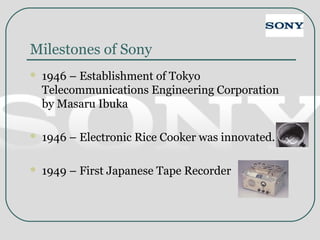
 1946 – Establishment of Tokyo
Telecommunications Engineering Corporation
by Masaru Ibuka
 1946 – Electronic Rice Cooker was innovated.
 1949 – First Japanese Tape Recorder
Milestones of Sony
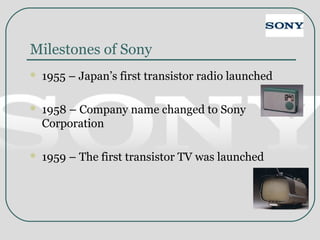
 1955 – Japan’s first transistor radio launched
 1958 – Company name changed to Sony
Corporation
 1959 – The first transistor TV was launched
Milestones of Sony
 1960 – Sony Corporation of America was
established.
 1967 – The first factory in abroad was opened in
Taiwan.
 1968 – Sony Ltd. Established in the United
Kingdom.
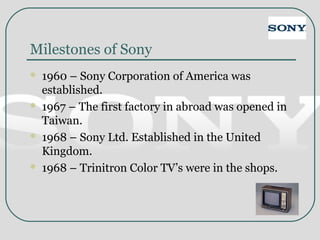
 1968 – Trinitron Color TV’s were in the shops.
Milestones of Sony
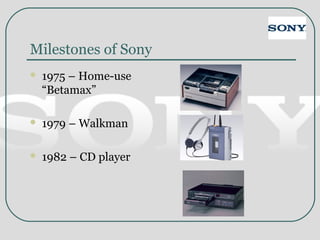
 1975 – Home-use
“Betamax”
 1979 – Walkman
 1982 – CD player
Milestones of Sony
 1989 – The first miniaturized camcorder
 1989 – Sony purchased Columbia Pictures.
 1993 – Sony computer entertainment was
established.
 1994 – Sony Playstation one was started to be
sold.
Milestones of Sony
 1996 – Sony Home PCs (VAIO) were launched.
 2001 – Sony Ericcson Mobile Communications
established.
 2004 – Sony BMG Music Entertainment
established.
Nowadays Sony
With its ;
158.500 employees
64 billion dollars annual sales
wide product range
strong brand image
Sony is one of the most important companies in
world business.
Product Range
 TV
 Computer
 Game Consoles
 Audio Equipment
 Video Equipment
 Mobile Phones
 Movies
 Music
 Financial Services
(only in Japan)
General Characteristics of Sony
 Working Practices
 Not a typical Japanese company
 Integration with differant cultures
 Continuous innovation
 High R&D expenditures
Strategic Analyses
 Generic Business Level Strategies
 SWOT
 Porter’s Five Forces
 BCG
 Competitors Analyses
Generic Business Level Strategies
 Alliances
- Philips (to develop and launch CD players & CDs
- 1980)
 Acqusitions
- Colombia Pictures was acquired.
Generic Business Level Strategies
 Differentiation
- Prestige
- Superior Quality
- Competitively High Prices
- Rapid Innovation
- High Customer Service
SWOT - Strenghts
 Strong Brand Image
 Worldwide Reputation
 High Market Share
 High Quality Products
 High Technology
 Pioneer in the Industry as Being Creative and
Innovative
 Supports R&D Activites
SWOT - Strenghts
 Diversification in Manufacturing Locations
Around the World
 Ability to Provide High Motivation to Its
Employees
 Loyal Customers
SWOT - Weaknesses
 Over self-confidence which’s level sometimes
reaches not paying attention to their rivals.
 Diversifications in unsuitable businesses for
itself.
 They insist on their own formats.
 Competitively high prices.
SWOT - Opportunities
 Continuous growth in their sectors.
 Increasing demand in technological products
around the world.
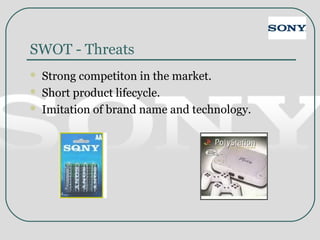
SWOT - Threats
 Strong competiton in the market.
 Short product lifecycle.
 Imitation of brand name and technology.
Industry Analysis (Porter’s Five Forces)
 Threat of new entrants - Low
 Barganing power of buyers – High
 Barganing power of suppliers – Low
 Rivalry among existing firms – High
 Threat of subsitute products - Low
Competitors Analyses
 Audio Visual
Equipments
-VHS vs Betamax
-HD-DVD vs BluRay
 Game Consoles
-Nintendo,Microsoft
 Mp3 Players
-Apple
Betamax versus VHS
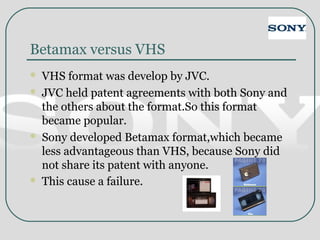
 VHS format was develop by JVC.
 JVC held patent agreements with both Sony and
the others about the format.So this format
became popular.
 Sony developed Betamax format,which became
less advantageous than VHS, because Sony did
not share its patent with anyone.
 This cause a failure.
Blu-ray versus HD-DVD
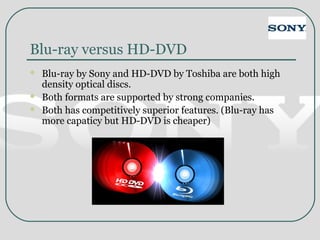
 Blu-ray by Sony and HD-DVD by Toshiba are both high
density optical discs.
 Both formats are supported by strong companies.
 Both has competitively superior features. (Blu-ray has
more capaticy but HD-DVD is cheaper)
Game Consol Competition
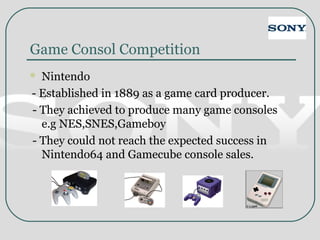
 Nintendo
- Established in 1889 as a game card producer.
- They achieved to produce many game consoles
e.g NES,SNES,Gameboy
- They could not reach the expected success in
Nintendo64 and Gamecube console sales.
Game Consol Competition
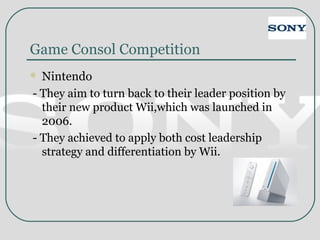
 Nintendo
- They aim to turn back to their leader position by
their new product Wii,which was launched in
2006.
- They achieved to apply both cost leadership
strategy and differentiation by Wii.
Game Consol Competition
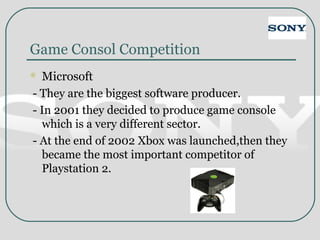
 Microsoft
- They are the biggest software producer.
- In 2001 they decided to produce game console
which is a very different sector.
- At the end of 2002 Xbox was launched,then they
became the most important competitor of
Playstation 2.
Game Consol Competition
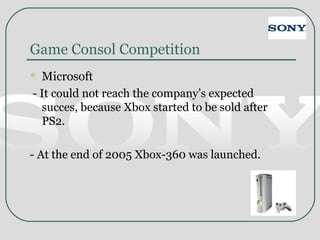
 Microsoft
- It could not reach the company’s expected
succes, because Xbox started to be sold after
PS2.
- At the end of 2005 Xbox-360 was launched.
Game Consol Competition
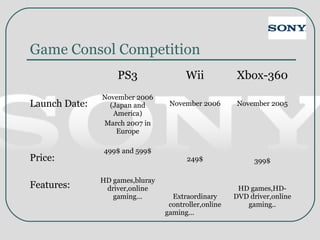
Launch Date:
Price:
Features:
PS3
November 2006
(Japan and
America)
March 2007 in
Europe
499$ and 599$
HD games,bluray
driver,online
gaming...
Wii
November 2006
249$
Extraordinary
controller,online
gaming...
Xbox-360
November 2005
399$
HD games,HD-
DVD driver,online
gaming..
Game Consol Competition
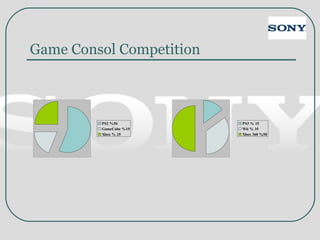
PS2 %56
GameCube %19
Xbox % 25
PS3 % 15
Wii % 35
Xbox 360 %50
Mp3 Player Competition
 Apple Ipod
- iPod is a brand of portable media player
designed and marketed by Apple and launched
in October 2001 .
- It became a very important product in mp3
player market by its extraordinary design and
easy usage.
Mp3 Player Competition
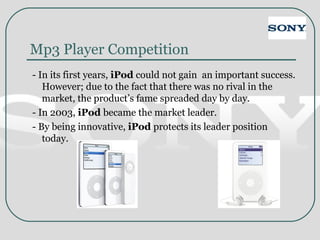
- In its first years, iPod could not gain an important success.
However; due to the fact that there was no rival in the
market, the product’s fame spreaded day by day.
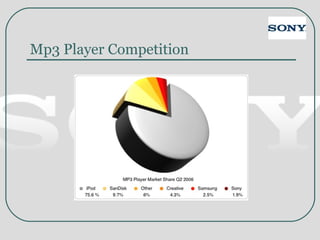
- In 2003, iPod became the market leader.
- By being innovative, iPod protects its leader position
today.
Mp3 Player Competition
What are the Problems?
 By not giving the patent of Betamax it could not
be as popular as VHS.
 They could not produce a superior strategy as
compare to its rivals.
 Their entrance time to mp3 player sector was not
suitable (late). They continued to insist on their
own format.
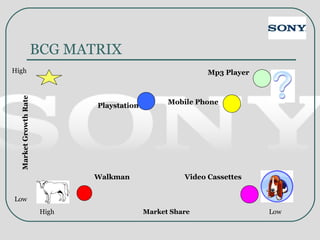
BCG MATRIX
Playstation
Mp3 Player
Mobile Phone
Walkman Video Cassettes
High
Low
High LowMarket Share
MarketGrowthRate
Recommendation
 Should continue to be creative.
 Should pay more attention to their rivals.
 Sub brand which can be cost leader.
 They should accept the technologies preffered by
customers.
Thank You
Presented By-
Divyanshi Dangayach

Sony

  • 2.
    Content  Milestones ofSony  Nowadays Sony  Strategic Analyses  Problems  Recommandations
  • 3.
    Milestones of Sony 1946 – Establishment of Tokyo Telecommunications Engineering Corporation by Masaru Ibuka  1946 – Electronic Rice Cooker was innovated.  1949 – First Japanese Tape Recorder
  • 4.
    Milestones of Sony 1955 – Japan’s first transistor radio launched  1958 – Company name changed to Sony Corporation  1959 – The first transistor TV was launched
  • 5.
    Milestones of Sony 1960 – Sony Corporation of America was established.  1967 – The first factory in abroad was opened in Taiwan.  1968 – Sony Ltd. Established in the United Kingdom.  1968 – Trinitron Color TV’s were in the shops.
  • 6.
    Milestones of Sony 1975 – Home-use “Betamax”  1979 – Walkman  1982 – CD player
  • 7.
    Milestones of Sony 1989 – The first miniaturized camcorder  1989 – Sony purchased Columbia Pictures.  1993 – Sony computer entertainment was established.  1994 – Sony Playstation one was started to be sold.
  • 8.
    Milestones of Sony 1996 – Sony Home PCs (VAIO) were launched.  2001 – Sony Ericcson Mobile Communications established.  2004 – Sony BMG Music Entertainment established.
  • 9.
    Nowadays Sony With its; 158.500 employees 64 billion dollars annual sales wide product range strong brand image Sony is one of the most important companies in world business.
  • 10.
    Product Range  TV Computer  Game Consoles  Audio Equipment  Video Equipment  Mobile Phones  Movies  Music  Financial Services (only in Japan)
  • 11.
    General Characteristics ofSony  Working Practices  Not a typical Japanese company  Integration with differant cultures  Continuous innovation  High R&D expenditures
  • 12.
    Strategic Analyses  GenericBusiness Level Strategies  SWOT  Porter’s Five Forces  BCG  Competitors Analyses
  • 13.
    Generic Business LevelStrategies  Alliances - Philips (to develop and launch CD players & CDs - 1980)  Acqusitions - Colombia Pictures was acquired.
  • 14.
    Generic Business LevelStrategies  Differentiation - Prestige - Superior Quality - Competitively High Prices - Rapid Innovation - High Customer Service
  • 15.
    SWOT - Strenghts Strong Brand Image  Worldwide Reputation  High Market Share  High Quality Products  High Technology  Pioneer in the Industry as Being Creative and Innovative  Supports R&D Activites
  • 16.
    SWOT - Strenghts Diversification in Manufacturing Locations Around the World  Ability to Provide High Motivation to Its Employees  Loyal Customers
  • 17.
    SWOT - Weaknesses Over self-confidence which’s level sometimes reaches not paying attention to their rivals.  Diversifications in unsuitable businesses for itself.  They insist on their own formats.  Competitively high prices.
  • 18.
    SWOT - Opportunities Continuous growth in their sectors.  Increasing demand in technological products around the world.
  • 19.
    SWOT - Threats Strong competiton in the market.  Short product lifecycle.  Imitation of brand name and technology.
  • 20.
    Industry Analysis (Porter’sFive Forces)  Threat of new entrants - Low  Barganing power of buyers – High  Barganing power of suppliers – Low  Rivalry among existing firms – High  Threat of subsitute products - Low
  • 21.
    Competitors Analyses  AudioVisual Equipments -VHS vs Betamax -HD-DVD vs BluRay  Game Consoles -Nintendo,Microsoft  Mp3 Players -Apple
  • 22.
    Betamax versus VHS VHS format was develop by JVC.  JVC held patent agreements with both Sony and the others about the format.So this format became popular.  Sony developed Betamax format,which became less advantageous than VHS, because Sony did not share its patent with anyone.  This cause a failure.
  • 23.
    Blu-ray versus HD-DVD Blu-ray by Sony and HD-DVD by Toshiba are both high density optical discs.  Both formats are supported by strong companies.  Both has competitively superior features. (Blu-ray has more capaticy but HD-DVD is cheaper)
  • 24.
    Game Consol Competition Nintendo - Established in 1889 as a game card producer. - They achieved to produce many game consoles e.g NES,SNES,Gameboy - They could not reach the expected success in Nintendo64 and Gamecube console sales.
  • 25.
    Game Consol Competition Nintendo - They aim to turn back to their leader position by their new product Wii,which was launched in 2006. - They achieved to apply both cost leadership strategy and differentiation by Wii.
  • 26.
    Game Consol Competition Microsoft - They are the biggest software producer. - In 2001 they decided to produce game console which is a very different sector. - At the end of 2002 Xbox was launched,then they became the most important competitor of Playstation 2.
  • 27.
    Game Consol Competition Microsoft - It could not reach the company’s expected succes, because Xbox started to be sold after PS2. - At the end of 2005 Xbox-360 was launched.
  • 28.
    Game Consol Competition LaunchDate: Price: Features: PS3 November 2006 (Japan and America) March 2007 in Europe 499$ and 599$ HD games,bluray driver,online gaming... Wii November 2006 249$ Extraordinary controller,online gaming... Xbox-360 November 2005 399$ HD games,HD- DVD driver,online gaming..
  • 29.
    Game Consol Competition PS2%56 GameCube %19 Xbox % 25 PS3 % 15 Wii % 35 Xbox 360 %50
  • 30.
    Mp3 Player Competition Apple Ipod - iPod is a brand of portable media player designed and marketed by Apple and launched in October 2001 . - It became a very important product in mp3 player market by its extraordinary design and easy usage.
  • 31.
    Mp3 Player Competition -In its first years, iPod could not gain an important success. However; due to the fact that there was no rival in the market, the product’s fame spreaded day by day. - In 2003, iPod became the market leader. - By being innovative, iPod protects its leader position today.
  • 32.
  • 33.
    What are theProblems?  By not giving the patent of Betamax it could not be as popular as VHS.  They could not produce a superior strategy as compare to its rivals.  Their entrance time to mp3 player sector was not suitable (late). They continued to insist on their own format.
  • 34.
    BCG MATRIX Playstation Mp3 Player MobilePhone Walkman Video Cassettes High Low High LowMarket Share MarketGrowthRate
  • 35.
    Recommendation  Should continueto be creative.  Should pay more attention to their rivals.  Sub brand which can be cost leader.  They should accept the technologies preffered by customers.
  • 36.