THE CONSUMER
DECISION PROCESS
BY: RACHIT GUPTA
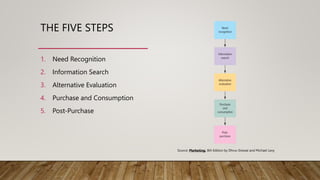
THE FIVE STEPS
1. Need Recognition
2. Information Search
3. Alternative Evaluation
4. Purchase and Consumption
5. Post-Purchase
Source: Marketing, 8th Edition by Dhruv Grewal and Michael Levy
NEED RECOGNITION
• The consumer decision process begins when consumers recognize
when they realize they have an unsatiated need and would like to go
from their needy state to a different, desired state.
• Two Types of Needs:
• Functional Needs – The needs that pertain to the performance
of a product or service
• Ex.: Many consumers purchase BMW's K1600 motorcycle
model because it is functionally superior to other
motorcycles.
• Psychological Needs – The needs pertaining to the personal
gratification consumers link with a product or service
• Ex.: Many people purchase expensive shoe brands, such
as Jimmy Choos, for their visual appeal even though
they can easily purchase $50 shoes.
Credits: Studio Pilot Photography, Pexels
SEARCH FOR INFORMATION
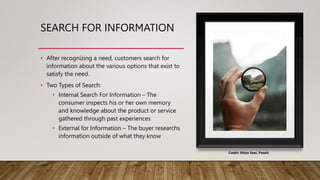
• After recognizing a need, customers search for
information about the various options that exist to
satisfy the need.
• Two Types of Search:
• Internal Search For Information – The
consumer inspects his or her own memory
and knowledge about the product or service
gathered through past experiences
• External for Information – The buyer researchs
information outside of what they know
Credit: Ethan Sees, Pexels
SEARCH FOR INFORMATION
• There are several factors that affect consumers' search processes:
• Perceived Benefits vs. Perceived Costs of Search – Is it worth the time and effort to search
for information about a product or service?
• The Locus Of Control:
• Internal Locus of Control – Refers to when purchaser believes they have some control
over the outcomes of their actions; the consumer will engage more in the search
process
• External Locus of Control – Refers to when the purchaser thinks that fate or other
external factors control all end results; the consumer will engage less in the search
process
• Actual vs Perceived Risk – There are 5 risks that can delay or discourage a purchase
(discussed next); the higher the risk, the more likely the consumer will spend more time in
the search process.
SEARCH FOR
INFORMATION –
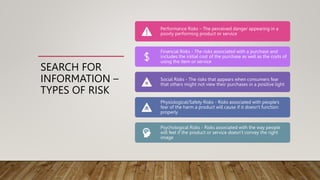
TYPES OF RISK
Performance Risks – The perceived danger appearing in a
poorly performing product or service
Financial Risks - The risks associated with a purchase and
includes the initial cost of the purchase as well as the costs of
using the item or service
Social Risks - The risks that appears when consumers fear
that others might not view their purchases in a positive light
Physiological/Safety Risks - Risks associated with people's
fear of the harm a product will cause if it doesn't function
properly
Psychological Risks - Risks associated with the way people
will feel if the product or service doesn’t convey the right
image
EVALUATION OF ALTERNATIVES
• Once a consumer has recognized a problem and explored the potential options,
they must sift through the choices available and evaluate alternatives.
• Many individuals organize and categorize alternatives to aid their decision process
:
• Universal Sets – Include all the possible choices for where to purchase a
product
• Retrieval Sets – Brands or stores that can be easily brought forth to memory
• Evoked Set – The attribute set which consists of alternative brands or stores
that the consumer believes they would consider when making a purchase
decision
• Evaluative Criteria - The significant attributes of a particular product; consumers
base their evaluation on these features
• Determinant Attributes – Product or service characteristics that are
important to the buyer and on which competing brands or stores are
disimillar
• Because many important and desirable criteria are equal among the
consumer's choices, they look for something unique to differentiate
each choice.
Credits: Anna Poan, Pexelen
EVALUATION OF ALTERNATIVES –
DECISION RULES
• Consumer Decision Rules – Sets of standards that
consumers use to quickly and efficiently select among
several choices
• Compensatory Decision Rule – Refers to when the
consumer is assessing alternatives and trades off
one characteristic against another such that the
good characteristics compensate for the bad ones;
one example of a compensatory model is the multi-
attribute model
• Noncompensatory Decision Rule – Refers to when
buyers select a product or service based on a
certain set of characteristics, regardless of the values
of its other features
Credits: Cottonbro Studios, Pexels
EVALUATION OF ALTERNATIVES – CHOICE
ARCHITECUTRE
• Choice Architecture – An effort marketers undertake to infleunce consumers through
the design of the surroundings in which they make purchase decisions
• Impulse Products – Products purchased without planning, such as fragrances and cosmetics
in department stores
• Nudge – An element of the choice architecture that adjusts a consumer's thought process
in a predictable way, without restricting other options or significanlty changing any
economic incentives
• Default – An element of choice architecture that deals with a "no-action" condition by
imposing a choice on a person who fails to decide or does not actively opt in for something
different
• In many countries, personal information is in the public domain, and people need to opt
out if they don't want their personal information shared. However, in other
countries, personal information is the property of the user, and they need to opt in if they
want to share it.
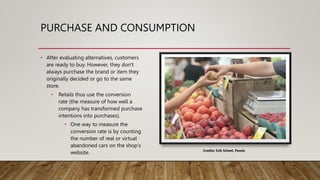
PURCHASE AND CONSUMPTION
• After evaluating alternatives, customers
are ready to buy. However, they don't
always purchase the brand or item they
originally decided or go to the same
store.
• Retails thus use the conversion
rate (the measure of how well a
company has transformed purchase
intentions into purchases).
• One way to measure the
conversion rate is by counting
the number of real or virtual
abandoned cars on the shop's
website. Credits: Erik Scheel, Pexels
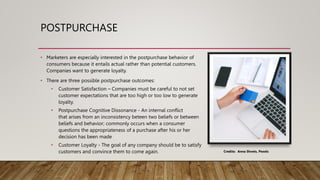
POSTPURCHASE
• Marketers are especially interested in the postpurchase behavior of
consumers because it entails actual rather than potential customers.
Companies want to generate loyalty.
• There are three possible postpurchase outcomes:
• Customer Satisfaction – Companies must be careful to not set
customer expectations that are too high or too low to generate
loyalty.
• Postpurchase Cognitive Dissonance - An internal conflict
that arises from an inconsistency beteen two beliefs or between
beliefs and behavior; commonly occurs when a consumer
questions the appropriateness of a purchase after his or her
decision has been made
• Customer Loyalty - The goal of any company should be to satisfy
customers and convince them to come again. Credits: Anna Shvets, Pexels
CITATIONS
Grewal, Dhruv, and Michael Levy. Marketing. MCGRAW, 2022, mheducation,
https://www.mheducation.com/highered/product/marketing-grewal-
levy/M9781260717433.html, Accessed 19 Feb. 2023.
• All information is from the textbook.

The Consumer Decision Process

  • 1.
  • 2.
    THE FIVE STEPS 1.Need Recognition 2. Information Search 3. Alternative Evaluation 4. Purchase and Consumption 5. Post-Purchase Source: Marketing, 8th Edition by Dhruv Grewal and Michael Levy
  • 3.
    NEED RECOGNITION • Theconsumer decision process begins when consumers recognize when they realize they have an unsatiated need and would like to go from their needy state to a different, desired state. • Two Types of Needs: • Functional Needs – The needs that pertain to the performance of a product or service • Ex.: Many consumers purchase BMW's K1600 motorcycle model because it is functionally superior to other motorcycles. • Psychological Needs – The needs pertaining to the personal gratification consumers link with a product or service • Ex.: Many people purchase expensive shoe brands, such as Jimmy Choos, for their visual appeal even though they can easily purchase $50 shoes. Credits: Studio Pilot Photography, Pexels
  • 4.
    SEARCH FOR INFORMATION •After recognizing a need, customers search for information about the various options that exist to satisfy the need. • Two Types of Search: • Internal Search For Information – The consumer inspects his or her own memory and knowledge about the product or service gathered through past experiences • External for Information – The buyer researchs information outside of what they know Credit: Ethan Sees, Pexels
  • 5.
    SEARCH FOR INFORMATION •There are several factors that affect consumers' search processes: • Perceived Benefits vs. Perceived Costs of Search – Is it worth the time and effort to search for information about a product or service? • The Locus Of Control: • Internal Locus of Control – Refers to when purchaser believes they have some control over the outcomes of their actions; the consumer will engage more in the search process • External Locus of Control – Refers to when the purchaser thinks that fate or other external factors control all end results; the consumer will engage less in the search process • Actual vs Perceived Risk – There are 5 risks that can delay or discourage a purchase (discussed next); the higher the risk, the more likely the consumer will spend more time in the search process.
  • 6.
    SEARCH FOR INFORMATION – TYPESOF RISK Performance Risks – The perceived danger appearing in a poorly performing product or service Financial Risks - The risks associated with a purchase and includes the initial cost of the purchase as well as the costs of using the item or service Social Risks - The risks that appears when consumers fear that others might not view their purchases in a positive light Physiological/Safety Risks - Risks associated with people's fear of the harm a product will cause if it doesn't function properly Psychological Risks - Risks associated with the way people will feel if the product or service doesn’t convey the right image
  • 7.
    EVALUATION OF ALTERNATIVES •Once a consumer has recognized a problem and explored the potential options, they must sift through the choices available and evaluate alternatives. • Many individuals organize and categorize alternatives to aid their decision process : • Universal Sets – Include all the possible choices for where to purchase a product • Retrieval Sets – Brands or stores that can be easily brought forth to memory • Evoked Set – The attribute set which consists of alternative brands or stores that the consumer believes they would consider when making a purchase decision • Evaluative Criteria - The significant attributes of a particular product; consumers base their evaluation on these features • Determinant Attributes – Product or service characteristics that are important to the buyer and on which competing brands or stores are disimillar • Because many important and desirable criteria are equal among the consumer's choices, they look for something unique to differentiate each choice. Credits: Anna Poan, Pexelen
  • 8.
    EVALUATION OF ALTERNATIVES– DECISION RULES • Consumer Decision Rules – Sets of standards that consumers use to quickly and efficiently select among several choices • Compensatory Decision Rule – Refers to when the consumer is assessing alternatives and trades off one characteristic against another such that the good characteristics compensate for the bad ones; one example of a compensatory model is the multi- attribute model • Noncompensatory Decision Rule – Refers to when buyers select a product or service based on a certain set of characteristics, regardless of the values of its other features Credits: Cottonbro Studios, Pexels
  • 9.
    EVALUATION OF ALTERNATIVES– CHOICE ARCHITECUTRE • Choice Architecture – An effort marketers undertake to infleunce consumers through the design of the surroundings in which they make purchase decisions • Impulse Products – Products purchased without planning, such as fragrances and cosmetics in department stores • Nudge – An element of the choice architecture that adjusts a consumer's thought process in a predictable way, without restricting other options or significanlty changing any economic incentives • Default – An element of choice architecture that deals with a "no-action" condition by imposing a choice on a person who fails to decide or does not actively opt in for something different • In many countries, personal information is in the public domain, and people need to opt out if they don't want their personal information shared. However, in other countries, personal information is the property of the user, and they need to opt in if they want to share it.
  • 10.
    PURCHASE AND CONSUMPTION •After evaluating alternatives, customers are ready to buy. However, they don't always purchase the brand or item they originally decided or go to the same store. • Retails thus use the conversion rate (the measure of how well a company has transformed purchase intentions into purchases). • One way to measure the conversion rate is by counting the number of real or virtual abandoned cars on the shop's website. Credits: Erik Scheel, Pexels
  • 11.
    POSTPURCHASE • Marketers areespecially interested in the postpurchase behavior of consumers because it entails actual rather than potential customers. Companies want to generate loyalty. • There are three possible postpurchase outcomes: • Customer Satisfaction – Companies must be careful to not set customer expectations that are too high or too low to generate loyalty. • Postpurchase Cognitive Dissonance - An internal conflict that arises from an inconsistency beteen two beliefs or between beliefs and behavior; commonly occurs when a consumer questions the appropriateness of a purchase after his or her decision has been made • Customer Loyalty - The goal of any company should be to satisfy customers and convince them to come again. Credits: Anna Shvets, Pexels
  • 12.
    CITATIONS Grewal, Dhruv, andMichael Levy. Marketing. MCGRAW, 2022, mheducation, https://www.mheducation.com/highered/product/marketing-grewal- levy/M9781260717433.html, Accessed 19 Feb. 2023. • All information is from the textbook.