Consumer
behavior
By: Rose Thomas
What is consumer
behavior?
• Consumer behavior studies a consumers
buying process when trying to satisfy
their needs and wants. This consists of
examaning psychological, functional,
physical, and economic aspects and
seeing its role on their purchase and
post-purchase outcomes.
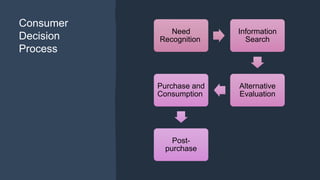
Consumer
Decision
Process
Need
Recognition
Information
Search
Alternative
Evaluation
Purchase and
Consumption
Post-
purchase
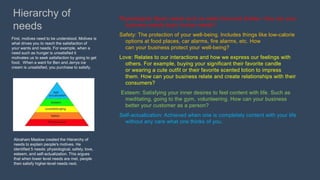
Hierarchy of
needs
Physiological: Basic needs such as water food and shelter. How can your
business satisfy basic human needs?
Safety: The protection of your well-being. Includes things like low-calorie
options at food places, car alarms, fire alarms, etc. How
can your business protect your well-being?
Love: Relates to our interactions and how we express our feelings with
others. For example, buying your significant their favorite candle
or wearing a cute outfit or their favorite scented lotion to impress
them. How can your business relate and create relationships with their
consumers?
Esteem: Satisfying your inner desires to feel content with life. Such as
meditating, going to the gym, volunteering. How can your business
better your customer as a person?
Self-actualization: Achieved when one is completely content with your life
without any care what one thinks of you.
First, motives need to be understood. Motives is
what drives you to reach the satisfaction of
your wants and needs. For example, when a
need such as hunger is unsatisfied it
motivates us to seek satisfaction by going to get
food. When a want for Ben and Jerrys ice
cream is unsatisfied, you purchase to satisfy.
Abraham Maslow created the Hierarchy of
needs to explain people's motives. He
identified 5 needs: physiological, safety, love,
esteem, and self-actualization. This argues
that when lower level needs are met, people
then satisfy higher-level needs next.
Factors that
affect the
consumer
decision process
Psychological: Motives, attitudes, perception, learning,
memory, and lifestyle.
Social: External social environmen: Family, culture,
friends, reference groups.
Situational: Needs specific to a situatioln usually
pertaiining to sensory (visual, auditory,
olfactory, tactile, and touch) or temporal (mood
swings, state of mind, etc.)
Marketing Mix: The 4 P's
Functional Needs
"Functional needs include the performance of a
product or service that the consumer needs."
Glasses would be a functional need to a
person who had bad vision.
What needs can your product meet for the
consumers that the competitors cannot?
Psychological needs
"Personal gratification consumers
associate with a prooduct or service."
Glasses are a functional need to
someone who cannoot see. A
coonsumer may next look at what
brand of eyeware frames like Ray-
Bands or Micheal Kors rather than the
generic pairs they sell at the eye
doctors to fill a psychological need of
high-status when purchasing.
How the consumer will feel better
about themselves purchasing your
product over the competitors?
External searches
• "Occurs when the buyer seeks information outside
his or her personal knowledge base to help make
the buying decision."
• When I moved back to Centerville I was looking for
a nail tech I googled places and read some reviews
but also, everytime I saw someone whos nails I
liked I would ask where they went.
•
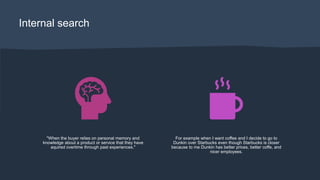
Internal search
"When the buyer relies on personal memory and
knowledge about a product or service that they have
aquired overtime through past experiences."
For example when I want coffee and I decide to go to
Dunkin over Starbucks even though Starbucks is closer
because to me Dunkin has better prices, better coffe, and
nicer employees.
Post purchase outcomes
• Customer Satisfaction: Goal of every sale, happy customer (:
• Ways to ensure postpurchase satisfaction:
• Build realistic expectations
• Demonstrate correct product use
• Money-back guarantees and warranties
• Postpurchase cognitive dissonance: "The psychologically uncomfortable state produced by
an inconsistency between beliefs and behaviors that in turn evokes a motivation to reduce
the dissonance; buyers’ remorse." What sellers attempt to avoid so customers do not
spread bad reviews and harm the repuation of a business or return the product.
• Customer loyalty: When consumers consider you their go to brand or restaurant or store
and spread positive feedback.
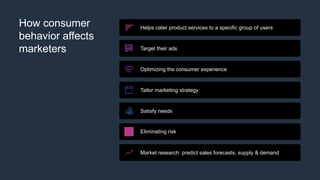
How consumer
behavior affects
marketers
Helps cater product services to a specific group of users
Target their ads
Optimizing the consumer experience
Tailor marketing strategy
Satisfy needs
Eliminating risk
Market research: predict sales forecasts, supply & demand

Consumer Behavior

  • 1.
  • 2.
    What is consumer behavior? •Consumer behavior studies a consumers buying process when trying to satisfy their needs and wants. This consists of examaning psychological, functional, physical, and economic aspects and seeing its role on their purchase and post-purchase outcomes.
  • 3.
  • 4.
    Hierarchy of needs Physiological: Basicneeds such as water food and shelter. How can your business satisfy basic human needs? Safety: The protection of your well-being. Includes things like low-calorie options at food places, car alarms, fire alarms, etc. How can your business protect your well-being? Love: Relates to our interactions and how we express our feelings with others. For example, buying your significant their favorite candle or wearing a cute outfit or their favorite scented lotion to impress them. How can your business relate and create relationships with their consumers? Esteem: Satisfying your inner desires to feel content with life. Such as meditating, going to the gym, volunteering. How can your business better your customer as a person? Self-actualization: Achieved when one is completely content with your life without any care what one thinks of you. First, motives need to be understood. Motives is what drives you to reach the satisfaction of your wants and needs. For example, when a need such as hunger is unsatisfied it motivates us to seek satisfaction by going to get food. When a want for Ben and Jerrys ice cream is unsatisfied, you purchase to satisfy. Abraham Maslow created the Hierarchy of needs to explain people's motives. He identified 5 needs: physiological, safety, love, esteem, and self-actualization. This argues that when lower level needs are met, people then satisfy higher-level needs next.
  • 5.
    Factors that affect the consumer decisionprocess Psychological: Motives, attitudes, perception, learning, memory, and lifestyle. Social: External social environmen: Family, culture, friends, reference groups. Situational: Needs specific to a situatioln usually pertaiining to sensory (visual, auditory, olfactory, tactile, and touch) or temporal (mood swings, state of mind, etc.) Marketing Mix: The 4 P's
  • 6.
    Functional Needs "Functional needsinclude the performance of a product or service that the consumer needs." Glasses would be a functional need to a person who had bad vision. What needs can your product meet for the consumers that the competitors cannot?
  • 7.
    Psychological needs "Personal gratificationconsumers associate with a prooduct or service." Glasses are a functional need to someone who cannoot see. A coonsumer may next look at what brand of eyeware frames like Ray- Bands or Micheal Kors rather than the generic pairs they sell at the eye doctors to fill a psychological need of high-status when purchasing. How the consumer will feel better about themselves purchasing your product over the competitors?
  • 8.
    External searches • "Occurswhen the buyer seeks information outside his or her personal knowledge base to help make the buying decision." • When I moved back to Centerville I was looking for a nail tech I googled places and read some reviews but also, everytime I saw someone whos nails I liked I would ask where they went. •
  • 9.
    Internal search "When thebuyer relies on personal memory and knowledge about a product or service that they have aquired overtime through past experiences." For example when I want coffee and I decide to go to Dunkin over Starbucks even though Starbucks is closer because to me Dunkin has better prices, better coffe, and nicer employees.
  • 10.
    Post purchase outcomes •Customer Satisfaction: Goal of every sale, happy customer (: • Ways to ensure postpurchase satisfaction: • Build realistic expectations • Demonstrate correct product use • Money-back guarantees and warranties • Postpurchase cognitive dissonance: "The psychologically uncomfortable state produced by an inconsistency between beliefs and behaviors that in turn evokes a motivation to reduce the dissonance; buyers’ remorse." What sellers attempt to avoid so customers do not spread bad reviews and harm the repuation of a business or return the product. • Customer loyalty: When consumers consider you their go to brand or restaurant or store and spread positive feedback.
  • 11.
    How consumer behavior affects marketers Helpscater product services to a specific group of users Target their ads Optimizing the consumer experience Tailor marketing strategy Satisfy needs Eliminating risk Market research: predict sales forecasts, supply & demand